Sharif University of Technology
Scientia IranicaTransactions B: Mechanical Engineering www.scientiairanica.com
Sensitivity analysis of vibration modes of rectangular
cantilever beams immersed in uid to surface stiness
variations
A.F. Payam
School of Electrical & Computer Engineering, University of Tehran, Tehran, Iran Received 13 March 2012; received in revised form 27 November 2012; accepted 6 May 2013
KEYWORDS Atomic force microscope; Cantilever; Sensitivity; Surface stiness; Inviscid uid.
Abstract. In this paper, the sensitivity of exural and torsional vibration modes of a rectangular cantilever immersed in a uid to surface stiness variations has been analyzed and a closed-form expression is derived. To represent this sensitivity, we use analytical formulas for the vibrational resonant frequencies of a rectangular cantilever beam immersed in an inviscid uid. The eect of the surface contact stiness on both exural and torsional sensitivities in a uid is investigated and compared with cases in which the cantilever operates in air. The results show that in low surface stiness, the rst mode is the most sensitive. As sample surface stiness is increased, higher resonant frequencies show a larger shift, compared with lower resonant frequencies. In addition, comparison between modal sensitivities in air and uid shows that the resonance frequency shifts in air are greater than resonant frequency shifts in uid.
c
2013 Sharif University of Technology. All rights reserved.
1. Introduction
Dynamic analysis of cantilever beams immersed in uids is necessary for numerous applications, including environmental sensing [1], micro/nano electromechan-ical system designing [2], and high resolution imag-ing [3]. In comparison with air or vacuum environ-ments, cantilever dynamics in uid remain much less understood and, thus, require more investigation [4].
By increasing cantilever size, the eect of viscosity on the dynamic response of the cantilever immersed in a uid is decreased, and the uid can be considered inviscid [5]. This assumption signicantly simplies analysis of cantilever dynamics in uid. Based on this assumption, Chu [6] presented a simple expression for the exural resonant frequency of a cantilever in uid. The presented expression shows an acceptable agree-*. Corresponding author. Tel: +9821 88020403
E-mail address: [email protected] (A.F. Payam)
ment with experiments for macroscopic cantilevers, especially for fundamental and the next few modes [7]. Based on Chu's work [6], Elmer and Dreier [8] proposed an expression for exural modes of arbitrary mode numbers. Based on the work carried out in [8] and [9], Eysden et al. [5] proposed an explicit analyt-ical formula for both exural and torsional resonant frequencies of a rectangular cantilever beam immersed in an inviscid uid.
Jensen and Hegner recently undertook work to calculate the exural resonance frequency in a uid environment [10], and used the compressible uid model of Van Eysden and Sader in [5] to calculate the exural resonance frequencies of the micro cantilever.
The motion of the cantilever beam can be aected by the interactive stiness of a cantilever with the sample surface [11].
Much research work has been carried out to study the vibration response of a cantilever beam to the interaction between the cantilever and the sample surface [12-19].
As a pioneer work in this eld, Turner and Wihen, in [12], have proposed analytical expressions to calculate the sensitivity of exural and torsional micro cantilevers to surface stiness variations for both rectangular and V-shaped cantilevers. However, all these studies are carried out in an air environment. In this paper, following the method presented in [12] for an air environment, we study the sensitivity of exural and torsional vibration modes of a cantilever beam immersed in a uid. We consider the inviscid uid environment and use the analytical expression for the exural and torsional resonance frequencies of the cantilever derived in [5]. Based on this assumption, we derive expressions for the vibration mode sensitivity of a cantilever beam immersed in uid.
In Sections 2 and 3, analytical formulas for ex-ural and torsional vibrations are derived. Numerical results are presented in Section 4 and, nally, a conclusion is provided in Section 5.
2. Flexural Vibration
For the exural modes of vibration, the governing equation for elastic deformation is:
EI@4y(x; t)@x4 + cA@ 2y(x; t)
@t2 = F (x; t); (1)
where y(x; t) is the deection function of the beam, E is the modulus of elasticity, I is the area moment of inertia, c is the volume density, and A is the uniform
cross section area of the cantilever. F (x; t) is the external applied force per unit length of the beam. The schematic of the cantilever beam is depicted in Figure 1.
The corresponding boundary conditions are given by:
y(0; t) = 0; @y(0; t) @x = 0; @2y(L; t)
@x2 = 0; EI
@3y(L; t)
@x3 = Kny(L; t); (2)
Figure 1. Schematic of a rectangular cantilever.
where Kn is normal contact stiness. Following the
analysis given in [5], the resonant frequencies in the uid of a rectangular cantilever beam are given by:
!uid(n) = !(n) vac
1 +fa 4cb f(kn)
1=2
; (3)
where: !(n)
vac= 2 n
L2
s EI
cA; (4)
where n is the mode order and n is the nth positive
root of the following characteristics equation: C(n; f) =n3(cos ncosh n+ 1) f
(sinh ncos n sin ncosh n) = 0; (5)
where f = EI=LKn3, fis the density of the uid, a is the
cantilever width and b is the cantilever height. Also, the hydrodynamic function, f(kn), is given by [5]:
f(kn)= 1 + 0:74273kn+ 0:14862k 2 n
1+0:74273kn+0:35004k2n+0:058364kn3; (6)
where kn= naL.
The exural sensitivity of the cantilever can be calculated from the derivative of the exural frequency with respect to the exural surface stiness, f.
For the exural mode, the frequency is given by: fuid;n= fvac;n
1 +fa 4cb f(kn)
1=2
; (7)
where: fvac;n=
2 n
2L2
s EI
cA: (8)
So, based on Eqs. (7) and (8), we have: @fuid;n
@f =
@fuid;n
@n
@n
@f: (9)
From Eq. (7), we have: @fuid;n
@n =
@fvac;n
@n
1 + 4fa
cb f(kn)
1=2
fa
8cb
1 +4fa
cb f(kn)
3=2
@ f(kn) @kn
@kn
@n; (10)
@fvac;n @n = Ln2
q
EI
cA; (11)
@ f(kn)
@kn = (0:74273+0:29724kn)(1+0:74273kn+0:35004k 2
n+0:058364k3
n) (1+0:74273kn+0:14862k2n)(0:74273+0:70008kn+0:175092k2n) (1+0:74273kn+0:35004k2
n+0:058364kn3)2 ;
(12)
@kn
@n =La: (13)
Box (I). On the other hand, @n=@f can be calculated
from: @n
@f =
@C=@f
@C=@n: (14)
So, based on the characteristics Eq. (5), we have: @n
@f = (cos nsinh n sin ncosh n)
32
n(1+cos ncosh n)+2fsin nsinh n
+3
n(cos nsinh n sin ncosh n) 1:
(15) Therefore, by substituting Eqs. (11)-(13) into Eq. (10),
@ffluid;n
@n is obtained, and by substituting Eq. (15) and
the obtained @ffluid;n
@n into Eq. (9),
@ffluid;n
@f is calculated.
Finally, the dimensionless form of exural sensi-tivity can be calculated by:
f;n =@fuid;n=@f 1
2L2
q
EI cA
: (16)
3. Torsional Vibration
The governing equation for the torsional oscillations is: G@2(x; t)@x2 cJ@
2(x; t)
@t2 = M(x; t); (17)
where (x; t) is the angle of torsion of the cross-sectional area, shown in Figure 1, M(x; t) is the applied torque per unit length of the beam, G is the shear modulus, J is the polar moment of inertia, and is the torsional parameter for a rectangular beam, which is given in [20]:
= 13h3a1 0:63h
a
: (18)
The corresponding boundary conditions are: (0; t) = 0;
G@(L; t)@x = Kth2(L; t); (19)
where Ktis lateral surface stiness and h is tip height.
Following the analysis given in [5], the torsional reso-nant frequencies in the uid of a rectangular cantilever beam are given by:
!uid(n) = !(n) vac
1 +32fa
cb t(kn)
1=2
; (20)
where: !(n)
vac= Ln
s G
cJm; (21)
where n is the mode order and n is the nth positive
root of the following characteristics equation:
C(n; t) = ncos n+ tsin n = 0; (22)
where t = Kth2L=G. Also, the hydrodynamic
function, t(kn), is given by [5]:
t(kn) = 161
1 + 0:37922kn+ 0:072912kn2
1 + 0:37922kn+ 0:088056k2n+ 0:010737k3n
; (23) where kn= nLa.
The exural sensitivity of cantilever can be calcu-lated from the derivative of frequency, with respect to surface lateral stiness, t.
For the exural mode, the frequency is given by: fuid;n= fvac;n
1 +3fa 2cb t(kn)
1=2
; (24)
where:
fvac;n= 2Ln
s G
So, based on Eqs. (24) and (25), we have: @fuid;n
@t =
@fuid;n
@n
@n
@t: (26)
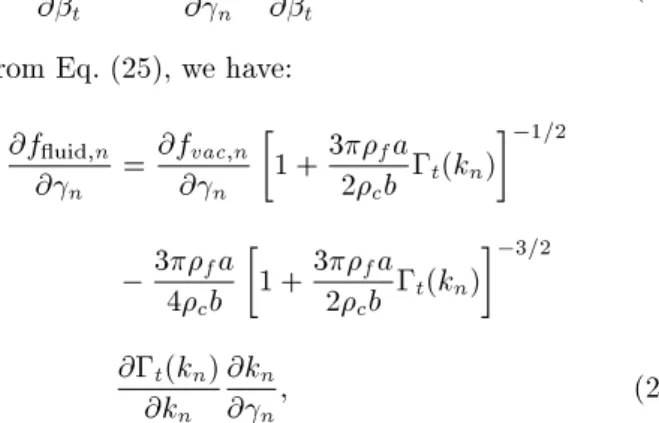
From Eq. (25), we have: @fuid;n
@n =
@fvac;n
@n
1 + 32fa
cb t(kn)
1=2
3fa
4cb
1 + 32fa
cb t(kn)
3=2
@ t(kn)
@kn
@kn
@n; (27)
where: Eqs. (28)-(30) are shown in Box (II). On the other hand, @n
@t can be calculated from:
@n
@t =
@C=@t
@C=@n: (31)
So, based on the characteristics of Eq. (22), we have: @n
@t =
sin n
nsin n (1 + t) cos n: (32)
Therefore by substituting Eqs. (28)-(30) into Eq. (27),
@ffluid;n
@n is obtained, and by substituting Eq. (32)
and the obtained @ffluid;n
@n into Eq. (27),
@ffluid;n
@t is
calculated.
Also, the dimensionless form of torsional sensitiv-ity can be obtained as:
t;n =@fuid;n=@t 1
2L
q
G cJ
: (33)
4. Results
In this section, the sensitivity of the vibrational modes of a rectangular cantilever immersed in uid has been analyzed. The cantilever parameters are listed in Table 1.
Table 1. Parameters for a cantilever. Elastic modulus E (GPa) 170
Shear modulus G (GPa) 66.4 Density of the cantilever c(kg/m3) 2330
Density of the Fluid f (kg/m3) 1000
Length L (m) 445
Width a (m) 44
Thickness b (m) 2.18 Tip length h (m) 10
Figure 2. Comparison between the cantilever exural modal sensitivity in air and uid.
The exural sensitivity of the rst ve modes for the rectangular cantilever in uid is plotted in Figure 2. Also, for the purpose of comparison with an air environment, the numerical results of the air environment are added to this gure.
When the cantilever is more compliant than the sample surface, the rst mode is most sensitive to surface stiness. By increasing sample stiness, the sensitivity of the rst mode is decreased, and when f
is about 25, the second mode is the most sensitive. Also, when f is in the range of 200, the third mode
is the most sensitive. By increasing f, higher modes
become more sensitive than lower ones. In other words, when f is small, the rst resonance frequency has the
largest shift among all resonance frequencies.
By increasing sample stiness, higher resonance
@fvac;n @n =2L1
q
G
cJ; (28)
@ t(kn)
@kn =
(0:37922+0:145824kn)(1+0:37922kn+0:088056k2
n+0:010737k3n) (1+0:37922kn+0:072912k2n)(0:37922+0:176112kn+0:032211k2n)
(1+0:37922kn+0:088056kn+0:010737k2 n)3 2 ;
(29)
@kn
@n = La: (30)
frequencies show more frequency shift in comparison with lower resonance frequencies. As shown in Fig-ure 2, cantilever sensitivity in air is greater than cantilever sensitivity in uid. In other words, the frequency shifts (changes) due to the variation of surface stiness in uid are less than those in the air. Also, comparing the sensitivity of mode 2 of uid with mode 3 of air shows that for low values of surface stiness, they are very close to each other, but when surface stiness is increased, the sensitivity of mode 3 of air is greater than the sensitivity of the second mode of uid. Also, for the any value of surface stiness, the sensitivity of mode 4 in air is greater than the sensitivities of modes 3 and 4 in uid. In other words, the frequency shift of the fourth resonance frequency in air is greater than the frequency shifts of the third and fourth resonance frequencies in uid.
The torsional sensitivity of the rst ve modes for the rectangular cantilever in uid is plotted in Figure 3.
As seen from Figure 3, torsional modal sensitivity shows similar behavior with the exural modal sensi-tivity. For smaller lateral surface stiness, the rst mode is the most sensitive. For the stier sample, the sensitivity starts to decrease as tis increased; the shift
in the resonance frequencies of higher torsional modes becomes larger than that of the lower modes.
Comparison shows that the torsional sensitivity in air is greater than in uid. Also, the sensitivities of the third mode of the cantilever in air, is greater than the second mode sensitivity in uid. We can conclude that, generally, the frequency shifts of the torsional resonance frequencies of a cantilever in air are signicantly greater than those in uid.
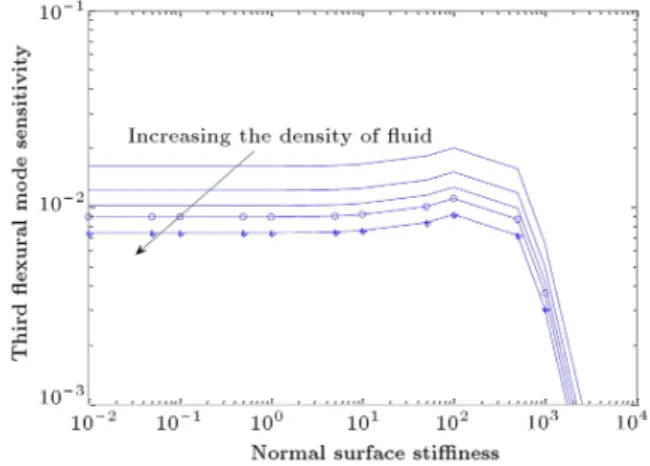
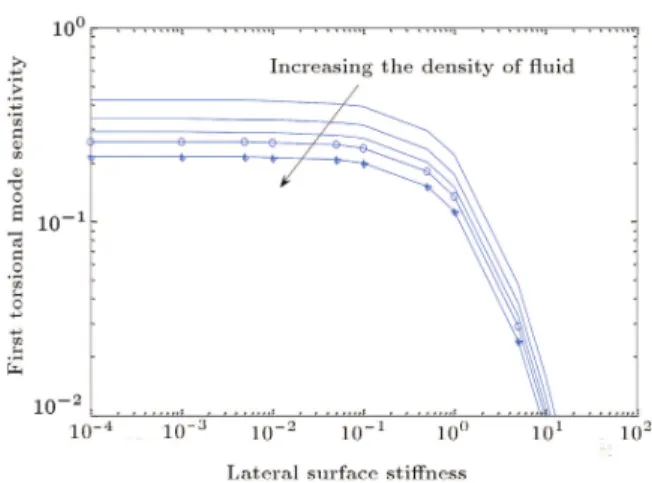
Moreover, for the purpose of investigating the eect of a uid environment on the sensitivity of a cantilever, other numerical analyses are carried out. As shown in Figures 4-6, for the rst three modes of exural vibration, and in Figures 7-9 for the rst three modes of torsional vibration, if the density of the uid is increased, the sensitivity of the cantilever
Figure 3. Comparison between the cantilever torsional modal sensitivity in air and uid.
Figure 4. First exural modal sensitivity, f, as a
function of normal contact stiness for dierent uids.
Figure 5. Second exural modal sensitivity, f, as a
function of normal contact stiness for dierent uids.
Figure 6. Third exural modal sensitivity, f, as a
function of normal contact stiness for dierent uids.
is reduced, which means that for AFM imaging in a uid environment, imaging in an environment with higher density leads to a decrease in image contrast, and, based on the stiness of the sample, excitation of higher eigenmodes as the driving frequency is recom-mended.
Figure 7. First torsional modal sensitivity, tas a
function of lateral contact stiness for dierent uids.
Figure 8. Second torsional modal sensitivity, t, as a
function of lateral contact stiness for dierent uids.
Figure 9. Third torsional modal sensitivity, t;as a
function of lateral contact stiness for dierent uids.
5. Conclusion
In this paper, we have employed an analytical expres-sion for the exural and torexpres-sional resonance frequency of a rectangular cantilever beam immersed in uid. We derived analytical formulas for the exural and tor-sional sensitivity of a cantilever immersed in an inviscid
uid to surface stiness variations. It was concluded that for the lower value of normal and lateral stiness, the sensitivity of the rst mode is dominant, but, as stiness is increased, the sensitivity of the rst mode is decreased and the higher vibration modes become more sensitive. Comparison between the vibrational mode sensitivity of air and uid shows that the modal sensitivity in air is greater than that in uid, i.e the frequency shifts in the resonance frequencies of the cantilever to the variation of surface stiness in the air are greater than those in uid. Thus, if we use the cantilever for imaging, the image contrast in air is better than that in uid for a similar mode and similar cantilever.
Nomenclature
y(x; t) Deection function of the beam E Modulus of elasticity
I Area moment of inertia
c Volume density
A Uniform cross section area of the cantilever
F (x; t) External applied force per unit length of the beam
Kn Normal contact stiness
f Density of uid
a Cantilever width
b Cantilever height f Flexural surface stiness
(x; t) Angle of torsion of the cross-sectional area
M(x; t) Applied torque per unit length of the beam
G Shear modulus
J Polar moment of inertia
Torsional parameter for a rectangular beam
Kt Lateral surface stiness
h Tip height
t Surface lateral stiness
(kn) Hydrodynamic function
References
1. Berger, R., Gerber, C.H., Land, H.P. and Gimzewski, J.K. \Micromechanics: A toolbox for femtoscale sci-ence: Towards a laboratory on a tip", Microelectron. Eng., 35, pp. 373-379 (1997).
2. Ho, C.H. and Tai, Y.C. \Micro electro mechanical systems (MEMS) and uid ows", Annu. Rev. Fluid Mech., 30, pp. 579-612 (1998).
3. Binning, G., Quate, C.F. and Gerber, C.H. \Force microscope", Phys. Rev. Lett., 56, pp. 930-933 (1986).
4. Raman, A., Melcher, J. and Tung, R. \Cantilever dynamics in atomic force microscopy", Nanotoday, 3, pp. 20-27 (2008).
5. Eysden, C.A.V. and Sader, J.E. \Resonant frequencies of a rectangular cantilever beam immersed in a uid", J. Appl. Phys., 100, pp. 1-8 (2006).
6. Chu, W.H. \Vibration of fully submerged cantilever plates in water", Southwest Research Inst. Tech. Rep., 2 (1963).
7. Lindholm, U.S., Kana, D.D., Chu, W.H. and Abram-son, H.N. \Elastic vibration characteristics of can-tilever plates in water", J. Ship. Res., 9, pp. 11-22 (1965).
8. Elmer, F.J. and Dreier, M. \The eigen frequencies of a rectangular AFM cantilever in a medium", J. Appl. Phys., 81, pp. 7709-77015 (1997).
9. Sader, J.E. \Frequency response of cantilever beams immersed in viscous uids with application to the atomic force microscop", J. Appl. Phys., 84, pp. 64-76 (1998).
10. Jensen, J. and Hegner, M. \Predictions of the com-pressible uid model and its comparison to experimen-tal measurements of Q factors and exural resonance frequencies for microcantilevers", Hindawi Pub. Corp. J. Sensors (2012).
11. Turner, J.A., Hirsekorn, S., Rabe, U. and Arnold, W. \High frequency response of atomic force cantilevers", J. Appl. Phys., 82, pp. 966-979 (1997).
12. Turner, J.A. and Wiehn, J.S. \Sensitivity of ex-ural and torsional vibration modes of atomic force microscope cantilevers to surface stiness variations", Nanotech., 12, pp. 322-330 (2001).
13. Chang, W.J. \Sensitivity of vibration modes of atomic force microscope cantilevers in continuous surface con-tact", Nanotech., 13, pp. 510-514 (2002).
14. Shen, K., Hurley, D.C. and Turner J.A. \A dynamic behavior of dagger-shaped cantilevers for atomic force microscopy", Nanotech., 15, pp. 1582-1589 (2004).
15. Wu, T.S., Chang, W.J. and Hsu, J.C. \Eect of
tiplength and normal and lateral contact stiness on the exural vibration response of atomic force microscope cantilevers", Microelectron. Eng., 71, pp. 15-20 (2004).
16. Lee, H.L., Chang, W.J. and Yang, Y.C. \Flexural sensitivity of a V-shaped cantilever of an atomic force microscope", Mater. Chemist. & Phys., 92, pp. 438-442 (2005).
17. Chang, W.J., Fang, T.H. and Chou, H.M. \Eect
of interactive damping on the sensitivity of vibration modes of rectangular AFM cantilevers", Phys. Lett. A, 312, pp. 158-165 (2003).
18. Lee, H.L. and Chang, W.J. \Coupled lateral bending-torsional vibration sensitivity of atomic force micro-scope cantilever", Ultramicroscopy, 108, pp. 707-711 (2008).
19. Kahrobiyan, M.H., Ahmadian, M.T., Haghighi, P. and Haghighi, A. \Sensitivity and resonant frequency of an AFM with sidewall and top-surface probes for both exural and torsional modes", Int. J. Mech. Sci., 52, pp. 1357-1365 (2010).
20. Timoshenko, S.P. and Goodier, J.N., Theory of Elas-ticity, McGraw-Hill, New York (1987).
Biographies
Amir Farrokh Payam was born in Tehran, Iran. He received a BS degree in Electrical Engineering from K.N. Toosi University of Technology, Tehran, Iran, in 2002, an MS degree in Electrical Engineering from Isfahan University of Technology, Iran, in 2006, and a PhD degree in Nanotechnology-Electronics Engineer-ing from Tehran University, Iran, in 2011. Also, he was a visiting student in the Institute of Microelec-tronics of Madrid, in Spain from September 2010 to March 2011. He is currently working as Postdoctoral Researcher in the Instituto de Ciencia de Materiales de Madrid (ICMM), Spain. His research interests include modeling, dynamic analysis and control of atomic force microscopes, NEMS & MEMS, surface science, electrical drives and applied nonlinear control.