EJEL Editorial
e-Learning has survived a number of phases: the initial tentative fully on-line
courses: the dot.com hype that e-Learning was going to result in a ‘shake out’
of learning providers, and result in a small number of global giants, making
huge profits; and the inevitable disillusionment that followed. And where are
we now? We are now in a typical new technology consolidation phase, in
which the financial hype is discarded, and the serious players in the business
- of teaching and learning – are focusing on the value of e-Learning, and
consolidating its basic building blocks The key value that the “e” adds to
learning is networked, interactive, collaborative learning. And the key building
block is the Learning Object.
Learning Objects, like the rest of “Internet” education, have gone through a
similar new technology growth cycle. First it was thought that Learning
Objects would provide the financial holy grail for university administrators –
the first fully commoditised learning packages, that could not only be
exchanged across courses, institutions and countries, but could be
rearranged in any way you liked: a global currency of global ‘intellectual
capital’.
That too has passed. Learning Objects are very useful, but they are generally
not that exchangeable, and they have to be re-versioned, if not re-designed
even for similar courses. They also can’t just be added together, and
expected to make up a ‘course’ – a lot more thought needs to go into how
courses are designed, and what kinds of learning objects are best suited to
what kinds of teaching and learning tasks. We might usefully differentiate
between Discussion, Information, Skills, Research, and Assessment Learning
Objects. And above all, as Stephen Downes says, doing e-Learning is much
more like conducting an orchestra than managing a linear process – good
e-Learning should take advantage of the flexibility of e-Learning Objects and
networked interaction; it should expect the unexpected, and welcome it; it
should be far more like a participatory workshop of peers than a formal
induction into predetermined ways of thinking and applying ideas by ‘experts’.
So the challenge is to make Learning Objects work – primarily for teaching
and learning. Adams et al provide an interesting application of the principles
of collaborative (paired) learning to the design and development of
Assessment Learning Objects, applying peer-review, and just-in-time learning,
with rapid, interactive feedback. Schneider discusses ways in which
assessment in a virtual university environment can be achieved at scale,
using sophisticated testing techniques. Stav et al discuss the detailed design
and application issues in what is the heart of Learning Object systems design
and management – the management of Learning Objects using metadata
formats, which provide powerful ways to categorise Learning Objects not by
their content, but by their use, within a learning context. This still has a way to
go, and various formats are discussed. But it heralds a possible revolution in
the way in which learning and teaching repositories are structured.
Tavangarian et al explore one of the consequences of ‘commoditised’ learning
tendencies, namely that the learner becomes homogenised. They also pick up
on the metadata issues, and emphasise that “XML based document
description languages have been proven tools for a time to achieve reusability
and media independence of learning materials” They operationalise these
ideas in their Multidimensional Learning Objects and Modular Lectures
Markup Language or “ML
3”, (“em-el-three”), which enables them to the create
learner specific documents. Tsalapatas et al discuss a e-content management
platform, for the publication and management of educational content, which
provides services for all user groups, specifically for asynchronous e-Learning
process. Vossen and Westerkamp report on their experience in providing
e-Learning facilities via the growing platform of web services. They
too, like
Adams et al, apply the principles of modular Learning Objects to break down
the “central functionalities of an e-Learning system”into several stand-alone
applications, which can then be accessed as Web services. This allows
learners to access, compile, and navigate through a variety of resources, to
construct their own learning path.
These papers explore some of the key issues in both the potential benefits
and pitfalls of an object-oriented approach to learning design and
development. As I said above, we are now in the painstaking consolidation
phase – there are clearly solid, useful, tools and frameworks here, which will
contribute to the consolidation and further development of e-Learning.
Roy Williams
Editor.
ECMS.-.Educational Contest Management System for
Selecting Elite Students
Thorsten Schneider
University of Bielefeld, Germany
Abstract: Selecting elite students out of a huge collective is a difficult task. The main problem is to provide automated processes to reduce human work. ECMS (Educational Contest Management System) is an online tool approach to help - fully or partly automated - with the task of selecting such elite students out of a mass of candidates. International tests like the PISA study revealed the need for such new methods in extracting better students out of collectives and to offer new online based tools for knowledge gaining processes.
Keywords: ECMS; Educational Contest Management System; Elite Students; PISA Study; LMS (Learning Management System); e-Learning; Test & Assessment Tools
1. Introduction
The problem of selecting elite students out of a collective is the need of massive human resources to organize and operate such a process. Automating these processes is an essential task to reduce time and human efforts. The need for such tool applications increased after several statistical studies and publications like the PISA Study (Stanat 2000; OECD 2004a). Since the national results of the PISA Study (OECD 2004b) have been a shocking event, a wide spread discussion broke out about how to solve such educational problems and what tools would be necessary to teach and test scholars and students more efficient.
Unlike many existing test and assessment tools (TA) or LMS (Learning Management Systems) - like the Blackboard Learning System (Blackboard 2004), ILIAS (ILIAS 2004), Moodle (Moodle 2004), Claroline (Claroline 2004), .LRN (Bartle 2002; MIT Sloan 2002) or the Whiteboard Courseware System (Whiteboard 2004) - the introduced ECMS (Educational Contest Management System) provides not only an e-Learning platform. It also gives opportunities to offer simple multi-choice tests and homework problems(Schneider 2004a). An essential part of ECMS is the semester-based structure of exams to be sat by the students. This allows for the scenario that not all students will pass
each semester (exam) and join the next semester (exam). ECMS is now developed as version 2.0 and is integrated into the Universitas Virtualis (Virtual University Environment) project (Schneider 2004b). A previous version of ECMS 1.0 (”The Reverse-Engineering-Academy (REA)”) (REA 2002; Schneider 2004b) - with focus on software-protection (SP) and Reverse Code Engineering (RCE) - shows the success of the ECMS sieving process in the time range of a long time survey of 2 1/2 years using very hard problems increasing in difficulty (see section (III)). The ECMS has it’s own connection to the Universitas Virtualis Bibliotheca Server (Schneider 2004c) which uses GDL 4.0 (Ganesha Digital Library Project) (Fahmi 2004) as its core platform and provides additional access to learning material and ECMS related publications.
2. System
description
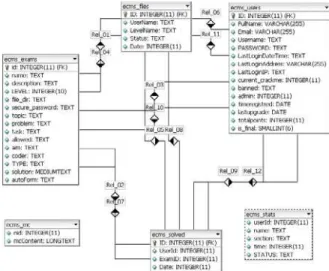
ECMS is based on MySQL 4.0 and PHP 4.3.0. It is not dependent on third-party packages and can be installed easily on local machines or any servers using the Apache Webserver System (Behlendorf 2004). The ECMS can be accessed via standard web-browsers (See figure (2)). Figure (1) shows the UML layout of the database scheme.
Figure 1: UML Diagram of the ECMS database scheme As a basic principle ECMS is capable of
offering an unlimited mixture of multiple choice tests and homework. It is therefore open for any type of exam content. ECMS 2.0 currently offers a free and anonymous registration process for students, which is capable of extension and cross-link to third-party authorisation systems. Students have access to multiple provided course material which can be attached as original file (e.g. .doc or .pdf) or as a package file (e.g. .zip or .tar.gz) by the exam moderator. To prevent students from being non-active after the registration process, ECMS automatically bans all students not finishing the first exam after 30 days and deactivates the account to prevent
re-registration with the same userdata. The current grading and ranking table can be viewed by every registered student. The ECMS can only be used by registered students using an self-set password. Extending ECMS to accept additional user registration data or using a different password system is made easy and there is an option to adapt the system for individual needs.
To give granted access to the administration and moderation area, ECMS uses a simple but effective security concept using .htaccess and .htpasswd files. Adapting the administration authentification process to database driven variants can be done quickly and easily.
Figure 2: The ECMS Web-Frontend offering a multiple choice test.
2.1 Multiple choice exam layout
The core of each Multiple Choice Exam is the XML based template which definition can be seen in figure (3). The template defines the
name and a description for each given exam to add additional information about the topic or similar. <MINCORRECT> defines the minimum number of correct answers to pass the exam. Failing the exam will result in an overview page
Thorsten Schneider
showing which answers had been wrong but without any information about what was wrong. ECMS protects itself against cheating via history- back-button brute force attacks. <TRIALS> defines the maximum tries which are allowed for the student. Exceeding the maximum number will lead into automated failure and results in automated banning from ECMS. After the general exam information each multiple-choice question is defined by <TESTITEM and a unique identifying id. Using these id’s ECMS can build dynamic forms for the web front-end. Each test item consists of several node informations. <QUESTION> contains the question the student will be
asked. <ITEM defines over unique id’s the possible pre-set answers of the student. To identify the correct answer the <CORRECT> tag connects to the corresponding <ITEM id. The XML structure gives the possibility to add unlimited questions to each exam. The XML is stored in the database and will be loaded dynamically with each form called by the student. <ATTACHEDFILE defines using id an unlimited number of attached files of non-restricted formats (.pdf, .zip, .doc,) which can for example contain files with courseware or lectures. To offer additional information the <ATTACHEDIMAGE tag contains a link to attached images related to the exam.
<TEST>
<NAME>File Knowledge Exam</NAME>
<DESCRIPTION>
This exam contains questions about...
</DESCRIPTION>
<MINCORRECT>8</MINCORRECT>
<TRIALS>6</TRIALS>
<TESTITEM id="1">
<Q>
<QUESTION>
How many sections can...
</QUESTION>
<ATTACHEDFILE id="1">
courseware1.zip
</ATTACHEDFILE>
<ATTACHEDIMAGE id="1">
question1.gif
</ATTACHEDIMAGE>
<CORRECT>2</CORRECT>
<ITEM id="1">4.294.967.295</ITEM>
<ITEM id="2">65.535</ITEM>
...
</Q>
</TESTITEM>
...
</TEST>
Figure 3: XML template for multiple choice exams.
2.2 Homework system
The homework feature consists of giving the student the problem and needed material which may be needed to solve the problem. The solution will be uploaded by the student and can be accessed by the administrators and moderators in the administration area of ECMS. Homework will be checked manually by any moderator registered. Since each homework is correlated to one exam constructor (moderator) an automated mail information will be send to the moderator about the new incoming homework. If the homework fails, the moderator marks the homework as failed and uses the ECMS mail functionality to tell the student why the solution had been
denied. To accept the solution the moderator klicks the hyperlink ”upgrade” and the student will be automatically set one exam higher including an automated mail about the accepted status of the solution. Denying a homework will activate the same process with difference that the moderator can enter the reason of the negative answer. Since students can not be banned automated within the homework process, the moderator has the option to ban and unban the student from ECMS directly. The number of failures is stored in the database and is shown to the moderator.
2.3 Gathering of elite students via statistical functions
ECMS 2.0 offers an extendable possibility for evaluating the running sieving progress. Since all data is collected in the main ECMS database, statistics can be easily extracted from it. Possible evaluation modules can contain histograms, scatter-plots or other statistical related methods. From such statistical methods the contest manager can gain an overview on how the progress of the contest and the exams is and may react on the problems occurring with the exam contents.
3. Evaluation and results of ECMS
1.0
ECMS 1.0 was first introduced in 2002. It’s exams were focused on software-protection, cryptography and Reverse Code Engineering (RCE) topics. ECMS 1.0 included 19 main exams which had been all declared as homeworks. Additionally there had been 10 correlated homeworks to improve the student
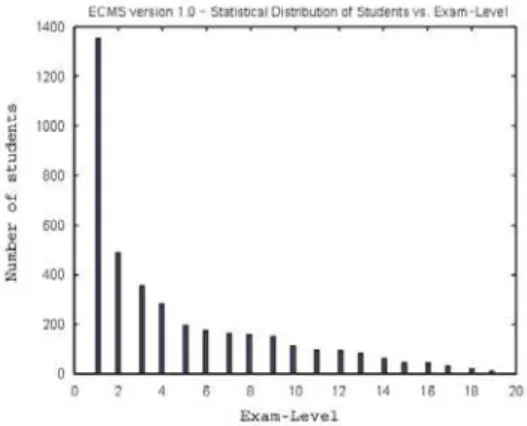
knowledge. Another 39 exams with topics mathematics and crptography had been added as fun part to give students more tasks to solve. Solving these 39+10 exams had no influence on the sieving process. ECMS 1.0 gave the possibility to register anonymous via an existing e-mail account and an username. After 2 years of running the system counted 6361 registered students in the ECMS system. The automated sieving process lead via auto-ban functionality in auto-banning 4998 students who had not been able to solve the first main exam within 30 days. Therefore 78.57% of the students failed the first main exam. The rest of 1352 (21.25%) students were capable of solving the first main exam within the 30 days limit. From the remaining 1352 students only 9 students had been able to solve all 19 main exams. This is 0.14% of the registered 6361 students and 0.67% of the 1352 active students. The average solving time of all exams was a 3/4 year. The set of increasing difficulties was well chosen for the contest focus (See figure (4) and table (1)).
Figure 4: Statistics of the sieving process during 19 exams. Table1 shows the statistics of the sieving
process during 19 exams including percentage of total registered students and of students passing exam number 1.
Table 1: Sieving process statistics
Exam-Level
No. of Students
% of total % of after exam 1
19 9 0.14 0.67
18 21 0.33 1.55
17 32 0.50 2.37
16 44 0.69 3.25
15 45 0.71 3.33
14 60 0.94 4.44
13 83 1.30 6.14
12 93 1.46 6.88
11 96 1.51 7.10
10 113 1.78 8.36
9 150 2.36 11.09
8 155 2.44 11.46
7 162 2.55 11.98
Exam-Level
No. of Students
% of total % of after exam 1
6 174 2.74 12.87
5 193 3.03 14.28
4 282 4.43 20.86
3 355 5.58 26.26
2 488 7.67 36.10
1 1352 21.25 100.00
4. Possible
Scenarios
There are many scenarios possible for using an ECMS. One field is the company aspect where companies try to evaluate the knowledge of their employees or to offer pre-selection tests for new employees. Another aspect is the university aspect, which offers capabilities to pre-select new tutors or employees. Additional the ECMS can be used for special educational tasks, like supporting
Thorsten Schneider
students in self-testing their knowledge in bioinformatics, medicine, law or economy. ECMS can be used for scholars as well. One example are school-contests containing math-contests or similar.
5. Conclusions and future work
ECMS differs from existing e-Learning, test & assessment tools. As difference to common e-Learning solution ECMS is not thought only for educational purposes. It is correlated to a sieving process for the gathering of elite students out of a huge collective. Future Improvements of ECMS will include time limits for each exam. Next there will be support for automated exclusion of students after failing n homework. Additional the support for displaying LATEX2 documents including LATEX- and LATEX2 -style formulas should be included within future work. Enhanced statistical functionalities for better automated processes is a necessity. Counting wrong given answers will be included. A library containing multiple choice tests and homework with sorted difficulty have to be build. The average solving time for all 19 main exams described in section (III) was fast for the given software-protection, cryptography and Reverse Code Engineering (RCE) topics. For other topics like algorithms in bioinformatics, exams in medicine or math exams there should be a careful preselection of the used exams to prevent long sieving times. To protect the multiple choice tests from brute forcing attacks a randomisation of questions should be implemented.6. Acknowledgments
This work, including access to the data and technical assistance, has been supported by the Universitas- Virtualis (Virtual University Environment) project. Our special thanks for longtime support goes to ”Pegasus” who administrated the ECMS 1.0 for over 1 year. Last we want to thank the software- protectionists and Reverse Code Engineering (RCE) community who joined ECMS 1.0 so numerous.
References
Bartle, E. (2002). “.LRN: An exiting e-Learning platform”. University of Bergen (Division of Information). Available:
http://www.uib.no/info/english/news/php/ ?xmlfil=111002140742.xml [24 Feb 2004]
Behlendorf, B. et al (2004). “Apache - http server project”.Available
http://www.apache.org [20 Dec 2003] Blackboard, Inc. (2004). “Blackboard learning
system”. Available
http://www.blackboard.com [20 Dec 2003]
Claroline (2004). “Claroline - open source course management system”. Université catholique de Louvain. Institute de Pédagogie universitaire et des multimédias. Available
http://www.claroline.net [16 Jan 2004] Fahmi, I. (2004). “Ganesha digital library”.
Available http://gdl.itb.ac.id [12 Jan 2004]
ILIAS Open Source (2004). ”ILIAS - Learning Management System (LCMS)”.
Available http://ilias.uni-koeln.de [12 Jan 2004]
MIT Sloan (2002). “.LRN - Open Source Enterprise-Class Suite of Web
Applications and a Portal Framework for Supporting Course Management, Online Communities and Collaboration”. University of Heidelberg. Available http://www.dotlrn.org [27 Jan 2004] Moodle, D. G. (2004). “Moodle - A Free, Open
Source Course Management System for Online Learning”. Available
http://moodle.org/ [27 Jan 2004] OECD (2004a). “The OECD Programme For
International Student Assessment (PISA)”. Organisation for Economic Co-operation and Development. Available http://www.pisa.oecd.org/ [05 Dec 2003] OECD (2004b). “PISA - National Reports”.
Organisation for Economic Co-operation and Development. Available
http://www.pisa.oecd.org/NatReports/cnt ry.htm [05 Dec 2003]
Schneider, T. (2004a). “ECMS (Universitas Virtualis Educational Contest
Management System)”. Available http://ecms.universitas-virtualis.org [12 Nov 2003]
Schneider, T. (2004b). “Universitas Virtualis - Virtual University Environment”. Universitas Virtualis Research Project. Available http://www.universitas-virtualis.org [10 Mar 2004]
Schneider, T. (2004c), “UVBS (Universitas Virtualis Bibliotheca Server)”.
Universitas Virtualis Research Project. Available
http://bib.universitas-virtualis.org [10 Mar 2004]
Stanat, et al (2000). „PISA 2000 - Die Studie im Überblick: Grundlagen, Methoden, Ergebnisse“. Informationsbroschüre - Max-Planck-Institut für
Bildungsforschung. Available
http://www.mpib-berlin.mpg.de/pisa/PISA im Ueberblick.pdf [10 Feb 2004] REA (2002), “The
Reverse-Engineering-Academy”. Universitas Virtualis Research Project. Department for Software-Protection and
Reverse-Code-Engineering.Available
http://www.reverser-course.de [10 Mar 2004]
Whiteboard, a. S. (2004). “Whiteboard Courseware System”. Available http://whiteboard.sourceforge.net/ [18 Feb 2004]
Open, Dynamic Content and e-Learning Management
Infrastructure for Engineering and Natural Sciences
John B. Stav1 and Hariklia Tsalapatas21Sor-Trondelag University College, Trondheim, Norway 2University of Thessaly, Volos, Greece
Abstract: NS-eCMS is developing an open web-based content management, communication, and collaboration eLearning platform that addresses the specialized requirements for distance education in natural sciences. The federated architecture enables straightforward development, exchange, and publication of material through open standards like XML/MathML. The system will provide an open communication platform for dynamical information exchange and management in a pedagogical framework. Time effective communication during the educational process for undergraduate learners and under-graduate academic institutions, is obtained by exploring new interfaces as light pens and electronic blackboards.
Keywords: distance education, e-Learning, content management, learning management, mathematics, physics, natural sciences, engineering, XML, MathML,
1. Introduction
Distance education programs on natural sciences combining asynchronous e-Learning with synchronous AV-learning have been used with success in recent years. Universities use new developments such as live-sized multi-point videoconferencing over IP with integrated AV and data environments, such as shared applications and Smartboard technology, with great success to incorporate distance learning into their ordinary on-campus programs (sebra 2003). However, although both asynchronous e-Learning overcomes geographical and temporal constraints transforming learning into a process that can occur at the independently determined convenience of instructor and learner (Harris D., DiPabolo A., Goodmann J., 1994), asynchronous e-Learning is recently being used as a complementary educational tool in traditional classroom education (e-Learning 2001), demand has been developing for asynchronous and synchronous authoring, presentation, and collaboration tools that promote use of standard mathematical and scientific notation. The Xmath project (Xmath 2001) was one of the first projects addressing such topics in mathematical education. Such tools must overcome the increased requirements for time-effective and interactive communication during the educational process enabling efficient interaction among administrators, educators, learners, and researchers through the exchange of media rich documents containing information in a standard format. The typical content of such documents are text based material supported with formulas, graphs, sketches, animations, (interactive) simulations and support for online
calculation through Computer Algebra Systems (CAS) in sophisticated combinations. Vendors of Commercial e-Learning Distance Learning Platforms have not supported dynamic representation of standard mathematical and scientific notation because distance learning on most generic subjects have not required it. On the other hand, lack of standard mathematical and scientific notation and simple integration of, for instance sketches and drawings that are imperative, have limited the utility of distance learning whenever there is a strong technical component in the educational material.
Engineering educational programs at graduate level use a wealth of new, advanced, and standalone scientific calculation and construction tools, while typically many students at the undergraduate level hesitate to use advanced software tools due to time limitations related to heavy academic schedules and a limited number of available computers at the universities. During the last couple of years have several advanced commercial CAS introduced web-based learning alternatives. The last version of the scientific calculation tool Maple (Maple 2003) offers for instance mechanisms for direct publication of scientific content on Web. Such advanced calculation tools have traditionally been tailored to a large extent to research oriented development at a graduate or higher level, and they use as a rule their own information representation. The existing solutions are characterized by lack of integration with a learning and/or content management infrastructure, whereby these systems work best as standalone courseware
management tools for scientific computations. As a result, CAS constitute useful tools but not complete solutions for undergraduate distance learning programs in natural sciences.
Commercial Courseware Management Systems (CCMS) have during the last year evolved significantly through the emerging open XML standard. CCMS such as Blackboard® (Blackboard 2003) and WebCT (WebCT 2003) will soon integrate MapleNET (MapleNET 2003, sebra 2003) content ranging from links to fully integrated features through dedicated windows applications like Maplets. Open courseware and MapleTA (Maple 2003), a web-based assessment system, are expected to work similarly. WebMathematica (Wolfram 2003) supports the addition of interactive calculations and visualization to a website by integrating Mathematica, the world leading competitor to Maple, with the latest web server technology and server based computation. These CCMS claim at the “shipping level” to address a range of explorative working methods by providing web extensions for the use of standard mathematical and scientific notation, the inclusion of scientific calculation tools, and Open courseware delivery.
However, there are several unsolved questions for their appropriateness to natural science education in general and to the usefulness and importance of such tools in distance teaching at undergraduate level in particular. It is for instance not quite clear how numerous standalone scientific calculation and construction tools, which indeed uses their own information representation, are going to interfere with the open XML standard for information representation, including delivery, exchange, up- and downloading of documents. Of particular interest are the new frameworks for separation of concerns and component-based web development.
It becomes apparent that institutions in Europe have been often forced to use unsuited tools and web solutions in an effort to upgrade content that contains natural sciences and engineering components. This practice highlights the need for an educational service for natural sciences that addresses all aspects of the educational process from entering media rich data in a time efficient way for both learners, teachers and tutors, including mathematical formulas, graphs and sketches/drawings into the system, educational content management, exchange and retrieval of learning material through
international standard formats, inclusion of scientific computations, and learner knowledge assessment. Standardization and system interoperability with present and forthcoming e-Learning portal initiatives, and existing Learning Management infrastructures, are desired.
The NS-eCMS project, which is partly founded by the Socrates–Minerva programme in the period 2003-2005, is designing and implementing an open web-based content management, communication, and collaboration e-Learning service that addresses the specialized requirements for distributed distance education in natural sciences. The system will be an extension of the existing web based eCMS federated content managements system for support of distributed teaching, founded by the European Commission’s Minerva-Socrates program in the period 2001-2003. Media rich content management will be achieved through a federated architecture enabling straightforward development, exchange and publication using international standards, specifically XML and MathML. The proposed infrastructure will support the integration and interaction with mathematical tools for the execution of computations. Additional user interfaces, e.g. light pens and electronic blackboards that facilitate time efficient interaction with the system for various user groups, will be explored.
The proposed system will mainly benefit undergraduate learners and undergraduate academic institutions involved in natural science teaching/instruction by providing services that addresses the entire educational process in natural sciences, from information exchange to information management.
2. The basic features of the
NS-eCMS infrastructure
The 5 partner institutions in the project (NS-eCMS 2003) have complementary experiences from net based learning activities at university level, as well as from national and international collaboration. From previous projects the partners knew that joint ventures between traditional universities and net-based collaboration, are possible at national and at limited international levels. The current project aims at extending these activities to a Pan-European level, establishing it with a true European dimension. Concentration of the content to natural science related services implies an implicit contribution to the ICT
John B Stav and Hariklia Tsalapatas
literacy and exploitation of technology and services adopted to technical education and amongst the general public. The dissemination is going to focus on joint efforts and collaboration to create a European network for higher technical and scientific education, applying experiences and findings from this and previous work.
Figure 2 displays how MathML standardized web output can be transferred from the web page into a MathML supporting editor. For instance might a web-page provide an advanced calculator (CAS systems) giving the results in standardized MathML format. Mathematical interactive tests can through MapleTA be provided online with automatic grading of results. The teacher submits and exchange content with the eCMS system through a standardized format. The student will interact with course modules which might interact with various services like MapleNET, MapleTA, eCMS etc.
NS-eCMS aims at supporting distance learning of undergraduate learners by providing an open communication platform for dynamical information exchange and management in a pedagogical framework. The communication system (Stav J. B. and Tsalapatas H 2004) handles rich multimedia content and offers interfaces containing tools for online execution of computations, plotting, online examinations, and tests. The system supports time efficient interaction through light pens, electronic blackboards, tablet PCs, etc. Mathematical objects are exchangeable from the web interface to MathML standardized supporting tools and editors.
Component based web development involve four concern areas for a successful web-presentation, i.e. production of content using open standards like XML, inclusion of external calculation tools through application logic, design of various presentation styles which easily could be adapted for various web-environments, and presentation of the complete learning material on web. Such a selection will remove the historical troublesome contract between application logic and presentation (Apache Cocon 2003).
Figure 2: Basic overview of the NS-eCMS functionality, and the location of the previous eCMS system. Use of XML based technology ensures that the course material, i.e. learning objects, might be adapted to future needs, as XML is well adapted for database transformations to new standards. This includes for instance simple adjustment to new ICT solutions that will emerge and new design of web pages and course management systems. A knowledge base containing XML documents might be recycled into new presentations by using XSL transformations (XSLT).
The main outcome is going to be services offering time efficient mechanisms for communication in distributed distance teaching of natural sciences. The services and system will be evaluated through user trials and courses. Feedback from internal and external groups of students will evaluate the quality and relevance of the services.
Figure 1: Separation of the four concern areas As shown in figure 1, the NS-eCMS services will separate XML based content from application logic and design of the web presentation. These challenging areas involve various topics like MathML, standard mathematical scientific notation, Chemical Markup Language (CML), Scalable Vector Graphics (SVG), educational content metadata descriptions, and for instance the Maple 9.0 XML tools package which is updated with significant new functionality including namespace support, XSL transforms (XSLT) and a validating XML parser.
3. Objectives for the NS-eCMS
services
The project vision is the design and development of an adapted open web-based content management, communication, and collaboration infrastructure for the support of eLearning of natural sciences, which will make these fields more attractive to a broader
undergraduate student population. The infrastructure to be developed is going to address all aspects of the learning process on natural sciences from introducing information into the system, including dynamical representation of mathematical formulas and easy implementation of hand made sketches/drawings, which are imperative in natural sciences. Moreover, the dedicated infrastructure will contain features for managing the educational content, facilitating the educational process through effective communication and collaboration, executing computations on-line, and assessing learner knowledge through exercises, tests and examinations.
The specific objectives of the system are
Single point of access to possibly distributed content and services including compatibility with present or forthcoming eLearning initiatives, for administrators, learners and content providers.
Efficient educational content management, emphasizing use of standard mathematical formalism in natural sciences and internal information representation using open standards like XML and MathML.
Flexible internal representation of content (XML and MathML) that can be transformed to several existing and forthcoming formats. User interfaces enabling easy introduction of elements related to the teaching of natural sciences, including mathematical formulas, graphs and sketches/drawings, into the system. Multiple interaction methods will be explored, including web technology, light pens, electronic blackboards and digital document cameras.
Integration of mathematical software tools (CAS servers) for on-line execution of computations and visualization of results, and integration of legacy code developed at the participating institutions will be explored as proof of concept.
Minimal requirements for installation of client tools. Services for the support of cheap online web-solutions for large groups of learners based on the above-mentioned infrastructure. Services to be implemented include on-line learner assessment through examinations and exercises.
Efficient collaboration and communication that facilitates the learning process through asynchronous tools (chat-rooms, forums, collaborative space sharing) and
synchronous applications as video-conferencing through desktop units. Online structured course development and editing. Organized state of the art educational content for natural sciences that takes advantage of the proposed infrastructure and MathML for effective information presentation.
Autonomy of providers through distribution of material and metadata descriptions.
4. Envisaged results and outputs
The project aims at a federated, distributed organization of content provided by educational institutions across Europe. The challenge is going to be to cover all aspects of the eLearning process in those fields, from the introduction of information into the system, to the management of the information (publication, dissemination, discovery, retrieval, presentation, indexing, etc), to the execution of computations required by the educational process. This infrastructure will ensure autonomy to content contributors and it will be transparent to learners, who will have access to the system, services, and content through a single point.
Specifically, the following outputs are envisaged
The adaptation of an existing eCMS content management infrastructure
Development of a limited amount of educational content material for natural sciences by using international standards, specifically XML and MathML, and implementation of MapleNet. MathML will be used for the internal representation of mathematical formulas to ensure compatibility with other (forthcoming) initiatives and tools.
A straightforward user interface enabling easy introduction of elements related to the teaching of natural sciences, including mathematical formulas, graphs, and sketches/drawings, into the system.
Integration of external mathematical tools for the execution of computations.
Assessment tools and services
Reports on system design, implementation and evaluation.
The above will result into a repository of services and content for eLearning on natural sciences. Access to the repository will be provided through a single-point of access portal. New developments will be achieved through open-source tools to
John B Stav and Hariklia Tsalapatas
To train students in logical and abstract thinking
ensure cost effectiveness in the mass deployment of the services.
To build up physical comprehension by applying mathematical knowledge to all types of natural sciences and engineering fields.
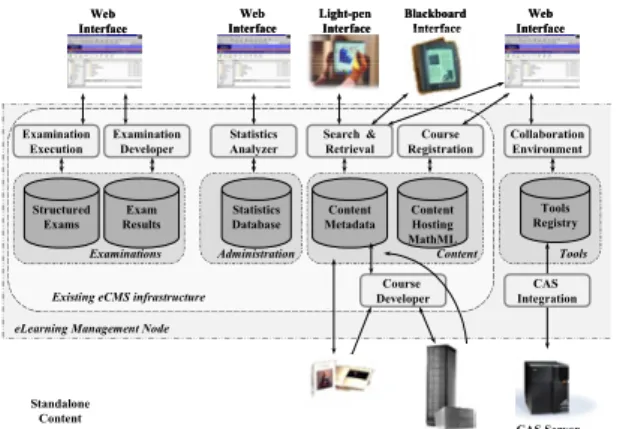
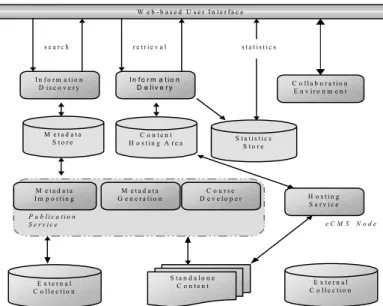
Figure 3 outlines a high level overview of the NS-eCMS system and services to be developed. The existing eCMS infrastructure (Tsalapata H., Stav J., Brna P., Kalantzis C., 2003 ), which will be adapted and extended with new services for the needs of this project, is displayed on figure 1. Additional information can be found which provide more details and key features of eCMS services can be found in the eCMS Design and Implementation Reports (Tsalapata H., Brna P., Stav J.; Tsalapata H., Kalantzis C., Brna P., Stav J., 2003). The existing eCMS metadata and content repositories will be redesigned to take advantage of XML and MathML technology. Furthermore, the examinations databases and services will be upgraded to support MathML as well as random question generation. The statistics database will be updated to hold and analyse additional information as necessary. Additional services and interfaces will be implemented as displayed.
However, advanced scientific calculation and constructions tools have been developed over the last few years. They easily do tedious work calculations in a second and extend continuously the physical limits and barriers of complex problem solving in research. They have in a sense have achieved status as “generic public property” in engineering and natural science education at higher university level.
Nevertheless, from a historical point of view have students usually obtained a significant part of such qualifications and experience by doing a tremendous amount of (tedious) work, exercises, and projects by hand in order to drill use of exact notation and unambiguous communication which are generic for natural sciences. In the academic communities, lessons on traditional blackboards and various amounts of deep and/or formal exercise solving on paper, partly through the help of calculators and computers, are still going to be important basic components in the daily life for an undergraduate student in the forthcoming years. Both these old European traditions, which call attention to a wider context of the educational process than the final examination, and the natural requirements for exact and unambiguous communication are going to be the premise provider for the pedagogical goals of successful distance eLearning programs of natural sciences. The communication and collaboration environment proposed in this project would address these challenges more effectively than existing solutions.
Statistics Database Administration Structured Exams Exam Results Examinations Examination Developer Examination Execution Statistics Analyzer
eLearning Management Node
Standalone Content Web Interface Web Interface Web Interface Web Interface Blackboard Interface Blackboard Interface Content Metadata Content Hosting MathML Content Course Developer Course Registration Search & Retrieval Tools Registry Tools Collaboration Environment CAS Server Light-pen Interface Light-pen Interface Web Interface Web Interface CAS Integration
Existing eCMS infrastructure
Figure 3: The NS-eCMS system architecture Users are going to interact with the NS-eCMS Content Learning Management services through a web-based interface providing customized library views targeting the needs of learners, content providers, course managers,
and repository administrators. The project is not primarily aimed at development of new pedagogical and didactical models. It will instead use existing models for learning environment tools used in ODL which usually provide four main areas, presentation-/lecture area, working area, knowledge-area and private area (Haugen H., Ask B. and Hjeltnes T. , 2002), and direct its actions more towards the organisation dynamics that apply for previously obtained results in natural sciences, i.e. by establishing bridges between the old teaching traditions and the new flexible interactive features. The project intends to turn the student into a “player” with dynamical natural science expressions, rather that he should act as passive viewer. It should as well at the same The integrated metadata scheme take into
account earlier work in this area (The Dublin Core), (ETB), (Learning Technology Standards Committee 2000), (Nikolaou C., Georgakopoulos G., Tsalapatas H., 2000) and (eCMS 2001).
5. Pedagogical and didactical
approaches in natural sciences
Teaching of natural sciences have - more or less independently of ICT developments - always called attention to a wider context of the educational process by maintaining two crucial topics:
time stimulate the teacher to act more as an instructor that has the ability to monitor students working though the distance learning services in a host of new ways, i.e. through various mechanisms connected with student-student, student-teacher, and teacher-teacher communication. Services that support learners, teachers, and course organizers to retrieve previous course material, structure new educational material, and deliver high quality communication support (assessment, feedback, discussions, and course management) are going to be of particular interest of those pursuing eLearning of natural sciences. State of the art methods and systems will be applied, in line with the experiences at the partner institutions.Special attention must be given to stable and scalable uploading and downloading of content, which should be represented in a standard format, selection of time efficient formula editors and online distribution through high quality videoconferencing in distance teaching.
In the present situation the main tools for large number of undergraduate students still consist of writing their solutions on ordinary paper, partly by some help from calculators. One of the main outcomes of the proposed system is going to be the design and implementation of a sensible adapted communication and collaboration distance learning environment, which will greatly enhance undergraduate students possibilities for writing digital solutions of for instance their exercises or project work using standard mathematical and scientific notation in an easy and time-effective way at any time and at any place. Although the system should tolerate a range of explorative ways of working, only a limited number of digital sources adapted to the special needs of the targeted group, are going to be available in order to lower the user threshold to an absolute minimum. This includes interfaces for light-pens, electronic blackboards, digital document cameras, exchange of multimedia rich content, accessing of a limited amount of functionalities from advanced Computer Algebra Systems, online assessments, etc. Furthermore, an effective distance learning educational program at the undergraduate level, which contains a “very smooth and adapted” introduction to Computer Algebra Systems, definitely promotes and simplifies the use of the standalone Computer Algebra Systems at the graduate or higher level. Content management is an essential ingredient to the delivery of these user-oriented services in a pedagogical framework, which supports learners, teachers, and course
organizers to retrieve previous course material, structure new educational material and deliver high quality communication support (assessment, feedback, discussion, and course management) for the benefit of those pursuing eLearning. The work program is designed to provide state of the art management services which have been developed with the end users in mind. Thus, the focus of the work emphasizes delivery via easily available current technologies for the delivery of various mechanisms connected with student-student, student-teacher, and teacher-teacher communication.
6. Proposed design of natural
science course modules
Each course is supposed to consist of several modules where the content actually are produced by using a range of different digital sources, including the possibility of using high quality videoconferencing and application sharing in distance educational courses. It is expected that each module might contain a wealth of different types of course material as lecture notes (from digital blackboards), resumes, examples, calculations, training exercises, compulsory exercises, interactive animations and simulations, video, etc. The system is designed in such a way that previous developed material is stored in a similar manner as the online production of material during the course lectures. It is expected that the natural science learning material at least is grouped together into 5 classes consisting of
Different types of online material from the lectures
Pre developed course material in form of learning objects
Different types of exercises
Different types of self tests and evaluations Portfolio assessment
It is also desirable to use the natural science learning modules in combination with new real time collaboration technologies and audio-video-data learning environments. This includes both asynchronous and synchronous communication services such as streaming video, use of technology transparent studios with integrated AV and shared data environments (documents, whiteboards, high quality multi point fluid video and crisp audio solutions on H264 etc.), and remotely managed virtual conferencing services over reliable networks.
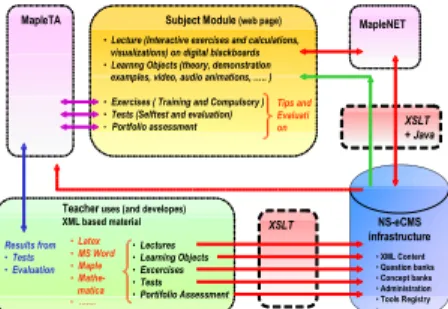
Figure 4 displays the dependence of the different technologies in an interactive natural
John B Stav and Hariklia Tsalapatas
science course module solution. Demonstrations in one course module might run mathematical calculations and make up plots and graphs through external software tools like MapleNET, while MapleTA offer students self tests and evaluations. MapleNET/TA offer low user thresholds for the end user and operate through flexible interfaces where the end user might operate either in calculator mode (enter expressions as on an advanced calculator) or in standard mathematical and scientific mode (enter mathematical expressions as in their text book). It should however be noted that the universities must have quite high competence and infrastructure in order to operate and exploit the potential of these new solutions. This includes both system administrators and teaching and instructional personnel.
NS-eCMS infrastructure MapleTA MapleNET XSLT XSLT + Java
Teacher uses (and developes) XML based material
Subject Module (web page) •Lecture (Interactive exercises and calculations,
visualizations) on digital blackboards •Learnng Objects (theory, demonstration
examples, video, audio animations, ….. ) •Exercises ( Training and Compulsory ) •Tests (Selftest and evaluation)
•Portfolio assessment
Tips and Evaluati on
•Lectures •Learning Objects •Excercises •Tests •Portifolio Assessment •Latex
•MS Word •Maple • Mathe-matica •……. Results from •Tests •Evaluation
•XML Content
•Question banks
•Concept banks
•Administration
•Tools Registry
•…..
Figure 4: The NS-eCMS proposed interactive Natural Science course modules
7. Pedagogical characteristics of
the services
A wealth of distance education infrastructures, including tools for content development and delivery, have been developed over the last few years aiming to overcome geographical and temporal constraints in the learning process. Such tools include content publication mechanisms, course development tools and course delivery systems including virtual classroom functionality and collaboration. However, existing commercial as well as open source tools for eLearning management focus on the delivery of course on generic topics while at the same time they lack key functionality and infrastructure for supporting time efficient communication in the eLearning process in natural sciences.
Faculty time is a limited resource and online teaching increases the workload and take time from research. Many universities and professors demand interactive facilities, not complex distance teaching services that are “killing the instructor.” This community, which includes students, educators, and information managers, will benefit from services that address the needs
of obtaining time efficient distance teaching processes. Topics included are organization, publication, delivery, internal information representation through emerging open standards such as XML/MathML, course development, user-friendly and dynamic interfaces for submitting and reviewing technical multimedia rich content such as server based interactive simulations, integration of scientific calculation tools, on-line self-assessment / examinations etc. Currently, no comprehensive services that address the above issues in a user-friendly manner tailored to undergraduate- and graduate higher education students exist. The NS-eCMS project proposes an infrastructure and services for the mass deployment of eLearning initiatives in natural sciences. While the project does not aim to change the traditional educational processes of academic institutions in those fields, it is expected to have a positive impact in the eLearning processes by facilitating close collaboration and more time-efficient communication between learners and instructors and by enabling the efficient exchange of media rich content, which currently is addressed inadequately by available tools. Rather than altering educational processes, the above two aspects of the proposed solution are expected to make on-line initiatives more effective and promote the launch of new eLearning programs where none exist due to the lack of effective and cost efficient solutions.
A comprehensive platform service does not yet exist with a number of desirable pedagogical characteristics adapted to the needs of natural sciences. Such characteristics include: (i) user-friendly interfaces for the organization, submission and retrieval of documents containing scientific and mathematical formulas (ii) dynamic presentation of such formulas through MathML (iii) flexible internal information representation through standards that ensure portability of content between commercial and open source tools (iv) effective synchronous and asynchronous collaboration tools (v) inclusion of scientific computations (vi) effective presentation of problem solutions (vii) minimum requirements for installation of client tools on behalf of the user (ideally no requirements except of the use of an Internet browser) (viii) real-time information presentation through high quality multipoint videoconferencing (ix) inclusion of virtual laboratories (x) cost and time effectiveness for the deployment to a large number of learners (xi) easy administration.
8. Implementation
considerations
The system will be implemented as a 3-tier web-based application. The back end (or server side) of the architecture will be a commercial relational database (Oracle 8i) that will serve as metadata and statistics storage. Metadata information will be published on the web through a commercial Application Server (Oracle Application Server 9i). The middle tier will be developed as servlets and JAVA classes. The front end (or client side) will be developed as JSP applications.
The use of JAVA ensures that the infrastructure is portable to any operating system. The web access ensures that the requirements from the user for accessing the system will be minimal, and specifically a simple web browser with MathML plug-ins. Figure 5 displays the 3-tier implementation. As shown in the figure, independent services will be developed for each of the 4 identified user groups: Public Services aimed at learners, Provider Services aimed at content providers, Management Services aimed at course managers, and Administrator Services aimed at repository administrators.
Figure 5: The 3-tier implementation
Performance and scalability are of key importance for the adoption of the system in a wide range of applications. The NS-eCMS architecture ensures that the system is scalable in terms of the amount of information managed and that performance does not deteriorate as the managed information grows in volume. Scalability and performance are ensured through distribution of metadata and content, and multi-threading of connections. The NS-eCMS system supports a network of independent information management nodes ensuring the installations can grow while maintaining autonomy for participating parties. For example, large institutions may opt for a number of NS-eCMS nodes, each managing the needs of particular departments. The nodes communicate with distributed search protocols to ensure that the underlying complexity is transparent to the users, who access information uniformly from a single point on the web. Users do not need to know
where the information they access is managed.
Database connections are established through shared servers. While shared servers connect to the database, users connect to the shared servers. This indirect database connectivity ensures that the system resources are preserved and well managed as the number of users connecting to NS-eCMS increases. Given the fact that NS-eCMS is a web-based application that could potentially be accessed by hundreds or possibly thousands of users, system resource management is critical for scaling and performance purposes. Multi-threading ensures that resources are well managed even under stress. The shared servers automatically perform connection load balancing.
M eta d a ta D a ta b ase
S h a red serv er S h a red serv er
S h a red serv er
…
U se r C o n n e ctio n
U se r C o n n e ctio n
U se r C o n n e ctio n
U se r C o n n e ctio n
U se r C o n n e ctio n
Figure 6: Multi-threaded connections
Applications that make use of databases often need to frequently obtain connections to the database. For example, a popular website that is serving out information from back-end database may need to obtain a database connection for each client who is requesting a page with their browser. To ensure that application is capable of responding to each client fast enough the time spent performing each of it’s task is profiled. One of the most time expensive tasks involving accessing databases is the initial creation of the connection. Once the connection has been made the transaction often takes place very quickly. This is where the connection pool comes in, by retaining a pool of already opened connections so the application can simply grab one when it needs to, use it and then hand it back, without the long wait for the initial creation of the connection.
9. Target
groups
The project focuses on the academic community in the areas of distance teaching of natural sciences. This community has varying needs due to the pedagogical methods used in different circumstances. For example, use of highly specialized notation is essential for the transfer of knowledge at undergraduate- and graduate level in higher education. Specifically,
John B Stav and Hariklia Tsalapatas
the following target user groups in those academic areas are identified:
Higher education undergraduate students In-service training of engineering professionals
Undergraduate academic institutions Educational content providers Tutors of natural sciences
Educational repository administrators
Engineering and science institutions throughout Europe would benefit from the proposed services for the support of eLearning by deploying the platform to enhance existing programs and launch new ones. Professionals and higher education students will benefit from the single point of access to a wealth of content and the easy interaction services. Given the size of the academic community in engineering and natural sciences, the project results will have a large dissemination audience. Furthermore, given the challenges in eLearning of such subjects, the potential impact of the proposed easy access and low cost infrastructure is large and European wide.
10. Conclusions and future work
This paper presented the NS-eCMS educational content management, collaboration and communication system for the support of distance teaching and learning of natural sciences. The proposed system will benefit undergraduate learners and undergraduate academic institutions involved in natural science teaching/instruction by providing services that addresses the entire educational process, from information exchange to information management, computation execution and examinations. The purpose of the system is to provide more time efficient communication services and an open scalable platform for the homogenous publication, management, and dissemination of possibly distributed, heterogeneous educational material developed by educational content providers across Europe while maintaining the autonomy of participating organizations. In addition to providing services for the publication and management of educational content, the system provides services for all user groups participating in the asynchronous eLearning process, namely learners, content providers, course managers, and repository administrators.
The presented architecture are currently implemented in the context of MINERVA-SOCRATES action project 110159-CP-1-2003-1-NO-MINERVA-M “Content Management and
collaboration System for eLearning of Natural Sciences” (NS-eCMS 2003).
Forthcoming work will focus on how the developed services could be extended to support distance teaching in more general engineering disciplines like for instance electrical and mechanical engineering. It is expected that these subjects will give additional challenges for the development of dynamic and interactive web-presentations containing large amounts of media rich educational content, which could be distributed synchronously in real time on broadband networks through integrated AV and data environments.
References
Apache Cocon (2003): The Apache CoCon Project, [on-line],
http://cocoon.apache.org/ Blackboard (2003): [on-line],
http://www.blackboard.com eCMS (2001): “Content Management
Middleware for the support of eLearning across Europe”, MINERVA-SOCRATES funded project 90613-CP-1-2001-1-GR-MINERVA-M, [on-line],
http://elearning.noc.uth.gr e-Learning (2001): [on-line]
ftp://ftp.cordis.lu/pub/documents_r5/natd ir0000001/s_1530009_20010125_14330 6_GPRC001349en.pdfHarris D.,
DiPaolo A., Goodman J. (1994): ADEPT proposal, [on line], http://stanford-online.stanford.edu/history/fulldesc.html ETB: European Treasury Browser:[on-line]
http://www.eun.eun.org
Haugen H., Ask B. and Hjeltnes T. (2002): “Model for an European, Networked University”,
http://www.hsh.no/ln/inf/menu Learning Technology Standards Committee
(2000): Approved Working Draft of the IEEE Learning Technology Standards Committee (LTSC) Learning Object Metadata Working Group. IEEE P1484.12
http://ltsc.ieee.org/doc/wg1/ltsa/ltsa_05. pdfMaple (2003): [on-line],
http://www.maplesoft.com MapleNET (2003): [on-line], look at the
(hidden) interactive demo site http://maplenet.maplesoft.com
Nikolau C., Georgakopoulos G., Tsalapatas H. (2000): “A Federated Digital Library for Universities' Grey-Literature: Practical Issues and a "Transient" Analysis”. University of Crete Technical Report
NS-eCMS (2003): “Content Management and collaboration System for eLearning of Natural Sciences”,
MINERVA-SOCRATES founded project 110159-CP-1-2003-1-NO-MINERVA-M, http://ns-ecms.noc.uth.gr/index.html sebra (2003): Centre for broadband
applications, [on-line],
http://www.hist.no/aft/sebra/english/inde x.php
Stav J. B. and Tsalapatas H (2004): “A Content and Learning Management Infrastructure for Distance Education of Natural Sciences”, proce. of The 2nd European Conference on eLearning, Glasgow, 2003. J.B. Stav and H. Tsalapatas: “Open Learning
Management Services for Distrubuted Teaching in Natural Sciences”, proce. from the Second International
Conference on Multimedia and ICTs in Education, Badajoz, 2003. J. B. Stav, H. Tsalapatas, T. M. Thorseth, C.
Kalantzis, “System Design of Scientific Elearning Management Services”, to be published in the proceedings of the Ed-Media Conference, Lugano, 2004. The Dublin Core: [on-line]
http://purl.org/metadata/dublin-core Tsalapata H., Stav J. B. , Brna P., Kalantzis C.,
(2003): “eCMS: eLearning Content
Management Middelware”, published in the proceedings of the 2nd Euopean Conference on e-Learning, Glascow, November 2003. H. Tsalapatas, J. B. Stav, P. Brna, C. Kalantiz and S.
Tsalapatas: Towards a Federated Digital Library of European Educational
Content, published in the proceedings of the Second International Conference on Multimedia and ICTs in Education, Badajoz, 2003. Hariklia Tsalapatas, John. B. Stav, Christos Kalantiz, “Content Management middleware for the Support of Distributed Teaching”, Electronic Journal of eLearning (EJEL), http://www.ejel.org, June 2004.
Tsalapata H., Brna P., Stav J. (2002): “eCMS System Design Report”, [online],
University of Thessaly Technical Report, http://elearning.noc.uth.gr/docs/DRV01. doc
Tsalapata H., Kalantzis C., Brna P., Stav J. B. (2003): “eCMS System Implementation Report”, [online], University of Thessaly Technical Report,
http://elearning.noc.uth.gr/docs/IRV01.d ocWebCT (2003): [on-line],
http://www.webct.com Wolfram (2003), [On-line],
http://www.wolfram.com/
Is e-Learning the Solution for Individual Learning?
Djamshid Tavangarian, Markus E. Leypold, Kristin Nölting, Marc Röser, Denny Voigt University of Rostock, Germany
[email protected] [email protected] [email protected] [email protected] [email protected] http://wwwra.informatik.uni-rostock.de
Abstract: Despite the fact that Learning exists for a relatively long time, it is still in its infancy. Current e-Learning systems on the market are limited to technical gadgets and organizational aspects of teaching, instead of supporting the learning. As a result the learner has become deindividualized and demoted to a noncritical homogenous user. One way out of this drawback is the creation of individual e-Learning materials. For this purpose a flexible multidimensional data model and the generation of individual content are the solution. It is necessary to enable the interaction between the learners and the content in e-Learning systems in the same manner.
Keywords: constructivist learning model, learning objects, e-Learning system, document generation
1. Motivation
“Learning through 'discovery' is best supported through the 'interactive' media of the field trip [...]. This is the richest mode of learning and, of course, the most expensive, requiring both the intimate involvement of the teacher, and the 'teacher-constructed world'“ (Laurillard 1995).
Already in the nineties a change in learning methodologies began to emerge in the US. Constructivist approaches started to replace instructional methods; the focus went away from the teacher and moved to the individual learner. A large number of trend reports and Delphi studies accompanied these discussions about Learning. In this golden age of e-Learning a lot of consulting companies presented a never-ending series of rather optimistic studies to the public. During this hype the primary motivation is a profitable motive. The acceleration of the ROI (“Return on Investment”) of e-Learning projects was moved into the centre instead to optimise the learning process. Mostly the e-efforts are reduced to the equation “Learning = e-business”. The usually quoted cost reductions should be the proper raison d’être of e-Learning. Also, the focus of activity has been mostly on mapping traditional educational processes one to one into a digital environment. Considerations of the learning process requirements and the needs of the individual learners have been mostly absent in practice. But, learning can only take place when heeding the specific context out of which
learning activity is going to happen as well as making allowances for individual skills, interests, mental attitudes and abilities. Therefore we will suggest a learner centric point of view for all e-Learning investigations. Learning in this sense is an active, self-regulated, constructive and situated process (Duffy et al. 1992, Bransford et al. 2000) as well as a social one. That means learning has a procedural and active character, which must lead to construction of knowledge by the learner on the background of the learners individual experience and knowledge (Mandl et al. 2002, Sun et al. 2003). We will henceforth refer to this model as the constructivistlearning model (Piaget 1977, Maturana et al. 1987, Clement 1989, Papert 1992). Furthermore, we will develop a new definition of e-Learning which takes this approach particularly into account.
A multitude of definitions of e-Learning already exists in literature. For many authors the adoption of electronic media in a learning
scenario is already sufficient to constitute
e-Learning (see e-Learning Consultant 2003). This definition is clearly too broad. For example the use of a microphone during a lecture should be excluded by a proper definition from being e-Learning. So, the simple use of electronic media is not enough. A proper definition should demand that the electronic media give specific support to the learning process itself, which probably could not be achieved by other media (else we would have a case of electronic media just emulating traditional media).