Making Smart IT Choices
Understanding Value and Risk in
Government IT Investments
Sharon S. Dawes Theresa A. Pardo Stephanie Simon Anthony M. Cresswell Mark F. LaVigne David F. Andersen Peter A. Bloniarz
Center for Technology in Government University at Albany, SUNY 187 Wolf Road Albany, NY 12205 Phone: (518) 442-3892 Fax: (518) 442-3886 E-mail: [email protected] www.ctg.albany.edu
Table of Contents
Part One
Introduction 1
Chapter 1. 7 The risks of IT innovation in government
8 Risks of IT innovation 10 Public sector risks 12 How this guide can help
Chapter 2. 13 The analysis and evaluation process
15 Analysis is a group process
15 Techniques for acquiring needed information 17 Phase 1. Understand the problem and its context 21 Phase 2. Identify and test solutions
26 Phase 3. Evaluate and make smart choices
Chapter 3. 33 Preparing a business case
34 Essential elements of a business case 36 Problem statement
37 A mission or vision statement 38 Specific objectives
39 Preferred approach 40 Expected benefits
41 Performance and group process 42 Risks and ways to address them
43 A basic plan of work, timeline, and key milestones 44 Project management and staffing
Part Two
Skills for working with groups
62 Group facilitation
65 Consensus building, collaboration, and decision making 67 Audience and presentation skills
Information gathering techniques
69 Library and document research 71 Internet research
75 Surveys 77 Interviews 79 Experiments 82 Simulations
Tools for Phase 1: Understanding the problem and its context 85 Visioning 87 Hopes and fears 89 Service objective 91 Strategic framework 95 Stakeholder analysis 97 Positioning charts 99 Partisan analysis 101 Process analysis 105 Self-assessment tools 107 Models of problems
Tools for Phase 2: Indentifying and testing solutions
110 Best and current practice research 112 Technology awareness reviews 114 Benchmarking
116 Environmental scanning 118 Models of solutions
120 Modest, moderate, elaborate alternatives 123 Prototyping
Tools for Phase 3: Evaluating and making smart choices 125 Risk analysis
128 Scenario building and forecasting 130 Cost estimation
133 Cost-benefit and cost-performance analysis 135 MAU models
137 Prioritizing methods 139 SWOT analysis
Introduction
T
his guide is designed to help you and your organization make good decisions about when and how to invest in information technology (IT). Put another way, it will help you avoid becoming one of the statistics that dominate reports on information technology investments.Reports on failure rates range from 50 to 80 percent and sometimes more. Failures don’t happen because people aren’t smart or trying hard. But failures do happen every day—mostly because people fail to realize and appreciate the complexity of these decisions and the way they affect nearly every other aspect of an organization’s work.
Failure is almost inevitable if decisions about IT are hasty, unrealistic, or uninformed. To help you avoid this fate, we lead you
needed to improve or change the way they gather and use information. Here at the Center for Technology in Government, we have worked on projects in human services, criminal justice, financial management, and environmental protection, among others.
The agencies we’ve worked with range in size from enormous federal departments to tiny towns, and everything in between. Their goals focused on a wide variety of functions including case management, direct citizen contacts, research and analysis, general administration, and regulatory affairs. Some had many years of experience in using IT; others were novices.
Regardless of their differences, every project encountered similar basic challenges. Early conceptualizations of their problems were
CENTER FOR TECHNOLOGY IN GOVERNMENT:MAKING SMART IT CHOICES
2
process that accounts for program goals, stakeholders, processes, costs, and technology alternatives. In chapters three and four, we guide you through the process of turning your analysis into a business case and presenting it to various audiences.
Part Two presents a wide variety of skills, techniques, and tools that can help you through the exercises introduced here. We will also publish a series of case studies that provide practical examples of how these concepts, tools, and techniques were used in some of our projects.
We know that no single formula can guarantee success in developing and implementing a new IT resource. But this guide does offer a well-tested approach to reducing the risk of failure. The first principle is to apply the familiar principle of modern architecture—that form follows function. Accordingly, the initial focus of any IT effort needs to be on the service objectives and underlying business processes of the organization(s) involved, rather than on the technology itself. The best technology will not correct outdated policies, inadequate management practices, or poorly designed workflows.
The second principle is to identify all of the internal and external stakeholders and to understand clearly their different needs, resources, and expectations. Each stakeholder group needs to be taken into account in
identifying and considering the costs and benefits of various options.
We also describe some ways to evaluate and choose among an ever-expanding array of technologies, including how to recognize when the best solution is no new technology at all. Finally, we offer some advice about how to use performance measures to evaluate your results.
These challenges that confront every organization do not mean that the people working on them are not focused, skilled, or well versed in their fields. They emerge from highly complex work environments and from unexpected interdependencies among
organizations and processes. They require an appreciation for the critical importance of “up front” business and risk analysis.
Too often, the quest for action–purchasing, hiring, designing, and programming—pushes critical knowledge-building activities aside. “Don’t you know enough to move forward with an RFP yet?” is a question many of our agency partners have heard after just a few weeks—along with, “We don’t have time to study the business problem any more, we need a system in place in six months.” In our experience, when the pressure to act exceeds the ability to understand the consequences of action, the risks of failure soar.
The Center for Technology in Government is an applied research program at the University at Albany/SUNY. Established in 1993, the Center works with government to develop information strategies that foster innovation and enhance the quality and coordination of public services. We carry out this mission through applied research and partnership projects that address the policy, management, and technology dimensions of information use in the public sector.
This guide offers our best thinking about how to define an information technology project and make a solid case for needed financial and organizational investments. It will be completed in two parts.
Part One has four chapters and begins by considering the special characteristics of the public sector as an environment for making management decisions and IT choices. In the second chapter, we describe an analytical
I The Internet Services Testbed which involved seven state and local government agencies in a process of defining,
designing, and building their very first information services on the World Wide Web.
I The Bureau of Shelter Services and a score of nonprofit service providers and local governments who need to share information in order to evaluate services to homeless people.
I The Municipal Affairs Division and its effort to create a consistent statewide information repository to support regional staff working on the financial affairs of local governments. I The Council on Children and Families and
its 13 member agencies who wanted to offer a wide variety of statistical information about children over the World Wide Web. I The Office of the State Comptroller and its
effort to ground a redesign of the Central Accounting System in a rigorous analysis of stakeholder needs.
We acknowledge, with thanks, the energy and collaboration of the federal, state, local, and nonprofit agency managers and technical staff who have participated in projects at CTG. We also thank the corporate partners and university faculty who contributed their exper tise. Without their willingness to experiment with new approaches and their strong commitment to improving government services, the work we describe here could not have been accomplished.
How the material is organized
This guide is organized to lead you through a careful analytical process that results in a sound business case for investing in a significant IT project. Along the way, we refer you to specific tools and techniques that can assist you. We also offer case illustrations that show the tools in action in the context of specific, real projects.
The analytical process, Par t One, has four chapters. The first discusses the risks of IT innovation. The second describes the kinds of problems that are worth the time and effort of careful analysis we present a three-stage analytical process that helps you understand the problem and its context, identify and test solutions, and evaluate alternatives and make smart choices.
Chapter three addresses the process of turning your analysis into a business case. Chapter four suggests ways a business case can be presented to various stakeholders, including top management, budget officers, and elected officials, as well as to users and customers.
Part Two describes dozens of skills, techniques, and tools that are useful at various stages of analysis and case building. Many of them are well within the skills of any competent manager. Others require the help of an expert. You may already be familiar with many of them. For each, we describe its purpose, strengths, and limitations. We also cite books and articles that go into more detail. In some cases, we also
Part One
Introduction 1
Chapter 1. 7 The risks of IT innovation in government
8 Risks of IT innovation 10 Public sector risks 12 How this guide can help
Chapter 2. 13 The analysis and evaluation process
15 Analysis is a group process
15 Techniques for acquiring needed information 17 Phase 1. Understand the problem and its context 21 Phase 2. Identify and test solutions
26 Phase 3. Evaluate and make smart choices
Chapter 3. 33 Preparing a business case
34 Essential elements of a business case 36 Problem statement
37 A mission or vision statement 38 Specific objectives
39 Preferred approach 40 Expected benefits
41 Performance and group process 42 Risks and ways to address them
43 A basic plan of work, timeline, and key milestones 44 Project management and staffing
Chapter 1. The risks of IT innovation in
government
In 1995, the Standish Group began to publish reports of the IT failure rates of both public and private organizations in the United States. They suggested that more than 80 percent of systems development projects fail in whole or in part. Most projects cost more, take longer than planned, and fail to achieve all of their goals. One-third are canceled before they are completed.
One system development project cancellation took place at the State of California Department of Motor Vehicles (DMV) in the mid-1990s. The project to move nearly 70 million vehicle, license, and identification records from an antiquated system to a new relational database was both behind schedule and over budget. When California’s lawmakers finally decided to end the agency’s IT project, over $44 million had already been spent and no end was in sight. One of the reasons the DMV project failed, says California Assemblyman Phillip Isenberg, is “because the agency staff were over their heads with a technology they did not understand.”
The project also lacked a clear link between agency operational goals and the capabilities of the selected technology. Due to procurement restrictions, the agency was committed to a specific hardware platform before all the available options could be explored. As a result of the failure, California’s technology procurement process faces even greater
using advanced information technologies. However, as the California DMV failure amply demonstrates, the risks of IT innovation in government are daunting.
Years of research on information system success and failure have been unable to conclusively identify the factors that cause good or bad results. Information technology success and failure seem to be in the eye of the beholder.
We’ve spoken to public managers who consider a project a success if it comes in on time and on budget. Others, who evaluate functionality and usability, might call the same project a failure. Many see failure when, regardless of time and budget, a new system makes it more difficult to do routine and familiar tasks. They have the latest technology but can’t get their work done as well as they did before. We’ve heard about systems that perform beautifully, but can’t be supported by in-house staff and therefore continue to generate high costs for consultants to maintain them.
Failure may be a desirable statewide system that local governments can’t use because they lack their own expertise and technical infrastructure to connect to it. Failure has also been described as an on-time, on-budget system with great user interfaces and function-ality, but users will not work with it because they don’t trust the underlying data sources.
CENTER FOR TECHNOLOGY IN GOVERNMENT:MAKING SMART IT CHOICES
8
The technology is only a part, and often a small part, of the story. We’ve seen projects delayed or even halted due to unrealistic expectations about how quickly a project can be completed, about the human resource requirements, about how much collaboration was necessary and how costly it can be, and about how much and how many kinds of new learning and training would be required to build and use a new system.
Lack of organizational support and acceptance
Adoption of a new way of doing business or of a new technology is unlikely to succeed if it does not have widespread organizational support and acceptance. Much has been written about the critical importance of top management suppor t and this is surely necessary. But, we’ve learned that success depends on many other organizational factors as well. It also takes skilled and committed team members and support and acceptance throughout the organization, especially among the people who will use the new processes and the new technology. Often this is the most important level of suppor t, and often the most difficult to achieve.
Failure to evaluate and redesign business processes
IT management expert Michael Hammer says systems may not meet performance expectations because organizations “tend to use technology to mechanize old ways of doing business. They leave the existing processes intact and use computers simply to speed them up.”
Meeting the needs of customers, employees, and decision makers means carefully studying and evaluating business processes. In most organizations, new processes are added as needed, but old processes are rarely evaluated to determine if they still make sense.
identify risks, consider contingencies, and result in more successful innovation.
Risks of IT innovation
Expert observers of IT trends say organiza-tions waste time, money, and credibility on IT because of a few fatal mistakes. They either buy the wrong technology for the job, or they buy the right technology but do not implement it effectively. They allow technical experts to design systems without the substantive, ongoing involvement of system users. They build systems that ignore the way people and processes really work. They don’t take into account the other systems that are already in place. They start investing resources in an IT solution before they really understand their needs and options. They are overconfident that they will get it right and don’t plan or budget for the inevitable post-implementation refinements that any system needs. They don’t attend to environmental realities such as workforce limitations, election or business cycles, rapidly changing technologies, political processes, and competing priorities.
Clearly, IT innovation is risky business in every organization. Repeatedly, organizations abandon IT projects because these initiatives fail to accomplish the objectives they were intended to meet. In both the public and private sectors, a well-documented set of risks attends IT innovation.
Unrealistic expectations
Organizational perceptions of new technology are critical to achieving success. Positive expectations help lead to success, but too often overly optimistic expectations cause serious trouble. All the people involved in an IT initiative, from sponsors to users, need to have realistic goals and must share a common understanding of potential benefits, required policy and process changes, and the financial and organizational costs.
manual record keeping, speed up transactions, increase revenue, prevent errors, or support good and timely decisions. All of these kinds of improvements should be represented by baseline measures and target levels of performance. Without them, the technology tends to take on its own independent course, and fails to have its intended impact on how real people use information to accomplish real work.
Failure to understand the strengths and limitations of new technology
Information technology is constantly changing and improving. No one is able to keep up with the details of all new developments or to understand comprehensively how each new technical tool works. Add to this the fact that most new technologies must work in tandem with others, or must be incorporated into existing older systems, and the possibility for trouble mounts rapidly. Since most organizations are not in the IT evaluation business, they may rely on word of mouth, vendor claims, and trade publications for the bulk of their knowledge about which tools may be right for which jobs. There is little opportunity to learn first-hand before making expensive, irrevocable decisions.
Projects that are too specialized or ambitious to manage successfully
For years, oversight organizations like the US General Accounting Office (GAO) have warned against information technology initiatives that some characterize as “grand designs.” These are the projects whose scope is so large, time horizon so long, or design so unique that they When new technology is brought into the
picture, a cumbersome and inefficient process may be automated “as is.” The results are systems that do not serve business needs, systems that are too expensive for the small productivity gains they provide, and systems that are not flexible enough to meet changing demands. This leads to poor performance in individual organizations and even worse problems when the system is expected to connect multiple programs or agencies, as is often the case in government.
In order to make system design work more manageable, we often ignore the ways in which one system affects related work processes. For example, an accounting system needs to factor in the ways in which accounting is related to budgeting, revenue collection, and financial management. The accounting function does not stand alone, and a system that suppor ts accounting cannot behave as if it does. Often organizations are not willing to invest the time and money necessary to do compre-hensive process mapping and analysis. Many organizations see this as an unnecessary effor t; in place of it they share procedures manuals (typically outdated and not reflective of what is going on) with system designers. Unfortunately, this sets up a “pay me now or pay me later” proposition. Ineffective or incorrect processes become embedded in the new system causing need for costly revisions or manual “work-arounds” that defeat the purpose of applying technology in the first place.
CENTER FOR TECHNOLOGY IN GOVERNMENT:MAKING SMART IT CHOICES
Layers of complexity surrounding
government IT initiatives
Organizational
setting
Technology
solution
Business processes
Program, policy &
political context
10
into trouble. Others recognize that the structure of government decision making, public finance, and public accountability complicate the government managers’ jobs and limit the choices available to them. In addition, some government programs are so large and pervasive, that they simply push the limits of the best technical and managerial know-how.
This environment brings a layer of risks unique to the public sector. When added to the organizational, operational, and technical risks described above, they present a daunting challenge to public managers responsible for choosing, funding, and building IT innovations. price tag of $15,000, in an overall budget of
$400,000, with an IT staff of one is just as ambitious as a multi-million dollar project in a large state or federal agency.
Public sector risks
Government seems to have even more trouble than the private sector in successfully applying new technology. The public policy choices and public management processes that are par t of government make it an especially difficult environment for IT managers. Some contend that bid protests, relatively low government wages, and legislative interference lead large government information technology projects
Limited authority to make decisions
By design, governmental authority is divided across multiple decision makers. Executive managers do not have a clear line of
authority over operations. Their decisions are circumscribed by law, limited appropriations, civil service rules, and a variety of legally mandated procedures or court decisions. These restrictions do not blend well with the complexities of managing an expensive and complex IT project in a rapidly changing technical environment. Worse, as can be seen in the California DMV experience, when IT projects fail the common legislative response is to place more restrictions and more controls over the IT management process.
Multiple stakeholders and competing goals
Government programs are characterized by a multiplicity of stakeholders who often have competing goals. Customers, constituents, taxpayers, service providers, elected officials, professional staff, and others all have some stake in most programs. Some want more or different services, others want lower taxes or fewer rules. Understanding how different choices may affect each stakeholder group helps to identify likely conflicts and prevent unexpected problems.
One year budgets
Uncertainty about the size and availability of future resources weakens the ability of government agencies to successfully adopt new IT innovations. Most government budgets are handled on an annual cycle. While many agencies have developed planning mechanisms to cover a three to five year
procurement are goals of integrity and fairness, the processes are often a source of problems and delays. Agencies write Requests for Proposals (RFPs) using the information they have been able to gain from limited research. Vendors spend large sums of money trying to develop the winning response. Time consuming, arms-length reviews and negotiations ensue. Losers often take advantage of bid protest procedures that can further delay contract awards for months—or even years. Due to insufficient project support or understanding by top management, IT procurement requests may receive low priority. The resulting delays can mean time and cost overruns which in turn yield negative publicity, decreased support from top management, and negative perceptions of the overall value of the effort. Commodity-based procurement, on the other hand, is easy for agencies to use, but assumes that they have all the information and exper tise they need to design and assemble a high-performance system out of a catalog of par ts.
Little capability to design or operate integrated or government-wide programs
Critics (including many public officials themselves) complain that different
government agencies operate more or less without regard to the fact that they often serve the same people. The difficult fact of life is that government is organized mostly into separate programs that receive specific authorization and funding from Congress or a state
legislature. Accountability rules and traditions demand that these programs be operated separately, and one result is the famous “stovepipe” systems of government.
CENTER FOR TECHNOLOGY IN GOVERNMENT:MAKING SMART IT CHOICES
12
save using IT, or even if you will save any money at all. This book is about how to think about an IT investment. It offers a set of analytical techniques to understand the issues and opportunities and to build a business case for investing in a particular path. It shows how to use that business case to get the support you need to move forward with your project. We think of this phase of the IT investment process as the one that comes “before the beginning.” It is necessary before the first design meeting, before an RFP is written, before the budget is developed. We believe this kind of up front analysis is essential to doing all of those things well because it uncovers both risks and resources that lead to smarter IT decisions.
In shor t, three kinds of analysis mitigate the risks of these investments:
I thoroughly understand both the problem to be solved and its context
I identify and test possible solutions to the problem
I evaluate the results of those tests against clear service and performance goals The following chapters present a well-tested methodology that can help you to understand and carry out these three critical tasks.
References
Hammer, Michael. (1990.) “Reengineering Work: Don’t Automate, Obliterate,” Harvard Business Review, July-August.
Isenberg, Phillip. (1994.) “Point of View: When BIG IT Projects Falter,” Government Technology, July, 7(7).
Miller, Brian. (1994.) “DMV Project Hits Dead End,” Government Technology, July, 7 (7) pp. 1, 53-54.The Standish Group. (1995).
The CHAOS Report. On line at
www.standishgroup.com/sample_research/ chaos_1994_1.php
Extreme risk aversion
Government’s business is public business. This means that most new ideas have to be implemented in full public view. An innovation “gone wrong” risks not only dollars, but also the credibility of an agency and its leadership with legislators, executive officials, and the public. It’s not surprising, then, that government tends to rely on the “tried and true.”
How this guide can help
Government managers need to analyze and evaluate IT choices because these choices are among the most complex and expensive decisions they are expected to make. Whether you are a local official considering a new system to suppor t building permits or an administrator at a large federal agency considering a new network infrastructure, you are faced with a complex and relatively expensive decision-making process. The consequences of your IT decisions often have a significant and direct impact on the public. For example, the safety of the flying public rests on the ability of the Federal Aviation Administration to implement systems that control air traffic. A state child welfare agency gathers and responds to information that protects the health and well being of children in that state. A local government emergency response application ensures that emergency vehicles are routed to incidents in the fastest and safest way possible. Systems that support law enforcement make a big difference in the ability of federal, state, and local criminal justice agencies to provide public safety. These systems cost thousands, millions, even billions of dollars. They are impor tant because the goals they serve are crucial to our quality of life. The risks of system failure are linked to the risks of service failure for hundreds, thousands, or even millions of people. This guide can’t tell you what technology to buy, or even what problem is most important to solve. It can’t tell you how much money you will
Chapter 2. The analysis and evaluation
process
Choose a "good"
problem
How to Make
Smart IT Choices
Phase 1Understand the problem and its context
Specify your program or business objective Identify and assess stakeholders
Analyze the problem or process to be tackled
Find relevant practices, tools & techniques Develop and test alternative solutions
Phase 2
Identify and test solutions
Figure 1. Overview of the analytical and evaluation process
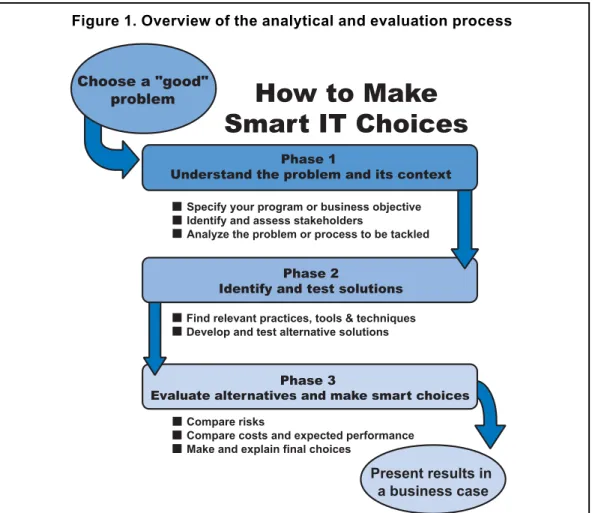
In this chapter, we present an analytical process that can be used in any project that applies IT to a service delivery or administrative goal. The process begins by defining a problem or purpose within its environmental context. It then goes on to identify and test possible solutions. The third phase focuses on the evaluation of alternatives and the selection of a preferred approach. For simplicity, we present these phases as sequential steps, but in action they are often iterative. What you learn in one phase may prompt you to return to an earlier one to refine your thinking before moving forward again.
Although this process of feedback and learning takes extra time, it is critical to comprehensive understanding, and it allows you to build a business case that reflects all the essential risks and options. The final steps described in the chapters three and four are the preparation and presentation of that business case. Each phase builds on the perspective gained from earlier ones. The result is a multi-faceted analysis of a proposed project that has a high likelihood of accurately predicting real costs and outcomes. Figure 1 illustrates the entire process.
CENTER FOR TECHNOLOGY IN GOVERNMENT:MAKING SMART IT CHOICES
14
Each regional office is responsible for
monitoring and advising local governments in its geographic area on their financial affairs. Each region collects information and does things in its own way. There is no statewide repository of information that can provide context, history, best practices, or overall performance information about this important aspect of municipal government.
The third example does not focus on operational concerns, but on the availability and usability of statistical information about children. In this case, the information comes from 13 state agencies, is compiled once a year into a printed book by a central
coordinating agency, and is used by hundreds of municipalities, nonprofit service agencies, and research organizations. The data is collected according to different time periods, using different definitions, and covering different geographic distributions.
Despite their differences, these problems have some similarities. First, they are mission critical to the agencies that sponsor them. The homeless services project is deeply embedded in the core services and values of all involved organizations. The financial health of municipalities is one of a handful of overriding mission goals for the administrative agency. And a visible public focus on the needs of children is the entire reason for the existence of the coordinating agency.
Second, these problems are information-intensive situations. The solution to each problem depends, in large part, on the quality, timeliness, and accessibility of information. In most cases, some information systems are already in place and need to be taken into account in any new approach.
Third, they all exist in an environment of high complexity. Both the homelessness and children’s data projects involve many
independent organizations, each with its own
First things first: Choose a “good” problem
The research, testing, and evaluation that go into this analysis are labor intensive processes. They can be applied to any problem, but not every problem deserves this level of attention. This is a process that is worthwhile for
complex, mission-critical, information-intensive problems. We call these “good” problems because their solution has high positive impact. For these problems, you need to pay close attention to the political, economic, legal, and organizational environments as well as the technologies involved. Not every IT decision has these characteristics or warrants the investment of resources that this process entails. Here are some administrative problems and service delivery questions that have successfully used this process:
I How effective are current service packages in helping homeless families achieve independence?
I How can the complete history of relation-ships between a state agency and local governments be captured for ongoing use in current and future technical assistance? I How can information about the health and
well being of children be made readily available to professionals and individuals concerned with the design of children’s service programs?
The first question represents an information sharing and program evaluation problem. The homeless services system involves not only state agencies, but local governments, and scores of nonprofit shelter and service
providers, all with different kinds of information maintained in different systems and formats. These organizations also respond to different funding streams and to a variety of legal requirements.
The second problem involves the central office of a major administrative agency and its regional offices distributed around the state.
and implement a project. But their individual differences, and group dynamics, can make it difficult for the group to reach its goals. Consensus-building tools and skilled group facilitation can be very helpful in guiding a group through the steps necessary to make effective decisions.
Consensus-finding and -building tools are often needed to help a group resolve different views and conflicting objectives or interests. Groups also frequently need to be introduced to models for collaboration, especially if they’ve never worked together before. Effective teamwork may also involve difficult trade-offs and other choices, so some decision-making tools and techniques can be useful. Group processes take skill and time to work
effectively, but they result in well-documented and well-understood decisions that can then guide the work group to a successful outcome. Tools and techniques for all of these topics are described in Part Two.
Techniques for acquiring needed
information
Your analysis will rely on many kinds of information that can be gathered in a variety of ways. While most of the tools and
techniques we identify later are associated with a particular phase of the analytical process, data gathering techniques can be used whenever they fit the situation. You can use survey research methods such as self-administered or telephone questionnaires to capture data about some characteristic, practices, values, and rules. Similarly, the
municipal affairs project covers the whole state and must deal with local diversity ranging from huge sophisticated cities to tiny rural towns and villages. All three projects must deal with public opinion, public budgeting and legislative cycles, and legal requirements. Civil service rules circumscribe staffing assignments and
compensation. Organizational rules, traditions, and structures set boundaries. Many different business processes already in place will need to be understood, and may need to be
changed.
In projects with these characteristics,
opportunities abound for wrong assumptions, premature decisions, and dangerous
oversimplification. This kind of complexity seems overwhelming, and a common reaction is to try to cut through to the part of the project that is more concrete and manageable—the technology. This is almost always a mistake. Projects like these demand a careful analysis that works through and manages the complexity at every level, from the larger environment, to the organizational considerations, to the work processes and data needs, to the technology choices.
Analysis is a group process
For projects like those described above, the analytical process is not a solitary process. These projects involve many people in different organizations or organizational units. One person may lead an effor t, or might collect, organize, and present information, but groups of people will inevitably become involved and
CENTER FOR TECHNOLOGY IN GOVERNMENT:MAKING SMART IT CHOICES
16
I Experiments – Use an experiment to learn what influences the way some process or activity actually works. The data is typically a result of direct observation of behavior in a controlled situation. The natural setting involves a combination of many interacting influences that make it very difficult to sort out the independent effects of one factor or another. By contrast, an experiment is designed to control some factors so the impacts of specific ones can be assessed. Experimenting with new process models or user interfaces, for example, might provide a team with insights into their proposed changes.
I Simulations – System simulations provide a structured approach to visualizing and understanding how complex social and managerial systems give rise to problem behaviors, as well as what types of solutions might be applied.
I Process Analysis – Business process maps (sometimes referred to as process models) are a graphical representation of the steps followed to achieve specific purpose, like hiring a new staff member or approving a permit application. Process models help you understand and communicate about a business process. They can be used to improve a process by evaluating,
reorganizing, changing, or eliminating steps. They can also be used to track the flow of resources, such as information, through a process.
Some of these data gathering techniques, like Web searching and basic interviewing, are easily learned. Others, like experimental design or simulation, require considerable exper tise. For these, you may want to consult with or hire an exper t.
understand current processes, and to design or evaluate new ones. All of the following data-gathering techniques will be described more fully in the tools installment.
I Library and document research – The purpose of these systematic searches of print and electronic sources is to identify, review, analyze, and evaluate the recorded experience and assessments of others who have dealt with a similar information problem, or who have used a technology similar to the one you are considering. I Internet research – Web searching is a
specialized kind of literature review that involves using Internet search engines to locate pertinent information about a given topic. By entering various key words and phrases, you can search the Internet for Web sites, publications, listservs, and other resources about your topic. An important point to remember about the Web: contrary to much popular opinion, the Web doesn’t provide you access to every worthwhile thing ever written—it only directs you to those things people have made available. I Self-administered questionnaires – When you need information from a large number of people or organizations, self-adminis-tered questionnaires are the right method. They allow you to collect structured data fairly quickly from many people in different locations. They usually employ short, simple questions and follow a careful sampling plan.
I Interviews – When you want to gather detailed information about people’s impressions, experiences, ideas, and attitudes, interviews are often the best method. Face-to-face or telephone inter-views yield rich information, and are good way to understand complex topics.
Choose a "good"
problem
How to Make
Smart IT Choices
Phase 1
Understand the problem and its context Specify your program or business objective Identify and assess stakeholders
Analyze the problem or process to be tackled
Find relevant practices, tools & techniques Develop and test alternative solutions
Phase 2
Identify and test solutions
Phase 3
Evaluate alternatives and make smart choices
Tools for Phase 1
Specify objectives: I visioning
I hopes and fears exercise I strategic framework
Identify and assess stakeholders: I positioning charts
I partisan analysis I stakeholder analysis Analyze problem or process: I self-assessment
Phase 1. Understand the problem and its context
objective you want to achieve. This sounds simple, but in practice is often very difficult. Many projects go wrong at this very first step because those responsible assume everyone sees the situation and its resolution in the same way. This is almost never the case. Even simple programs or processes can be approached from different points of view. One participant may see a service that could be more accessible to its customers, another can look at the same service and want to reduce the cost and effort to deliver it, and still another may take an evaluator’s perspective and ask what value it delivers to society.
Having identified a significant need or problem, the first phase of the analysis is to understand it as fully as possible in the context in which it occurs. Three kinds of work help you reach this depth of understanding: specifying objectives, identifying and assessing the influence of all stakeholders, and then analyzing the need or problem in detail. A more detailed description of the tools that can help gain a greater under-standing of the problem and its context can be found beginning in Part Two.
The first kind of work leads you and the others involved to a clear, unambiguous, shared understanding of the business or program
CENTER FOR TECHNOLOGY IN GOVERNMENT:MAKING SMART IT CHOICES
18
Sharpen your goals
In the Internet Testbed project, agencies generally started out with enthusiasm for the big possibilities of the Web for reaching more people with more
information. By using the strategic framework tool, especially its service objective component, they soon came to see that these goals were too vague to be the basis for design or implementation. This tool pushed them to say
what exactly they would do for whom with what result. For example, the Office of Real Property Services developed an objective to use the Web to support professional training and provide reference services to local government assessors in order to develop, improve, and maintain their assessment skills without costly classroom training and cumbersome paper binders. By specifying in concrete terms how they would use the Web to provide value to a well-defined audience, they were able to sharpen their focus and move more smoothly to understand their stakeholders, find suitable practices and tools, and consider alternative approaches.
way, the group can work toward the specification of a shared statement of objectives. The public statement of fears works in a similar way. It represents early indications of problems that are likely to be encountered along the way.
Other tools such as service objective and a
strategic framework are different approaches to the same goal—a clearly specified, unambiguous, agreed-upon objective.
Specify objectives
Several tools can be used to work through this essential first step of setting objectives. One simple tool is called a hopes and fears exercise
in which the members of a work group individually state what they hope the project will accomplish—and what they are afraid might happen instead or as a consequence. These individual statements can be grouped into themes that often reveal multiple, competing, and sometimes conflicting objectives. Once specified in this public
Know your stakeholders
When the State Comptroller’s Office decided to plan for a successor to its 18 year-old statewide accounting system, the staff recognized how crucial this system is to the financial operations of every state agency. They embarked on an extensive stakeholder analysis that divided agencies into groups with similar characteristics and invited them to take part in 13 day-long workshops to specify their needs and ideas for a revised system. This process engaged the key users of the system in a dialog that generated strong recommendations for meeting user needs, and initiated an atmosphere of collaboration and user suppor t for the project. One group of stakeholders was especially important to the project. These “strategic par tners” represented the agencies that would eventually have to approve the design and funding of the project. They were
A positioning chart is a good first stakeholder analysis tool. The chart places stakeholders on a two-dimensional grid that shows both the degree to which they suppor t or oppose the project and their impor tance to its success. Those stakeholders who are impor tant to success, whether they are supporters or opponents, deserve careful scrutiny and a clear-cut plan of action for how to get them involved or how to deal with their concerns. A partisan analysis can be used to uncover potential conflicts and completing interests among stakeholders.
Identify and assess stakeholders
The next step in this phase is careful identification of all stakeholders and the ways they can influence or be affected by the project. This can be done with a stakeholder analysis exercise. Many projects limit stake-holder considerations to those who are directly involved in the development of a system. Generally, this is not enough. Those who are indirectly affected count, too. Often, this kind of analysis does a good job of identifying positive effects such as who saves time or money, but they often ignore the negative effects such as who gets lower priority or picks up the cost of making things cheaper for someone else. Stakeholder influences are also critical. Some stakeholders are essential because of their legitimacy or power regardless of how active they are in a project.
CENTER FOR TECHNOLOGY IN GOVERNMENT:MAKING SMART IT CHOICES
20
Get some baseline data
The Adirondack Park Agency faced both process and workload problems that generated low customer satisfaction. Most staff time was devoted to the processing of permit applications by landowners or developers for permission to build or otherwise develop privately owned property in the six-million acre park. Workload statistics, however, revealed that the vast majority of customer contacts (and therefore the best opportunity to give good service) were telephone inquiries about relatively simple questions. By collecting these workload statistics, the Agency was better able to focus its effor ts. Staff learned that answers to telephone inquires could be shortened by 99 percent by changing the way information was organized and accessed. On the other hand, process analysis revealed that permits were subject to so many legally mandated time frames that theire processing time could be shortened by only one to two percent.
Other problems are not process oriented so they demand different tools. Self-assessment tools can help gather information about the current situation. Models of the problems can help to make your situation more explicit. Sometimes you need customer satisfaction information and may want to conduct interviews or a survey. Statistical data about some aspect of performance or cost may be needed. The important point is to analyze the problem fully, using the tools at your disposal. You will often be surprised by unexpected findings and new ways to understand cause and effect.
Analyze the problem and the process
The last work in this phase is where you begin to tackle the problem itself. Often the problem or objective is embedded in at least one work process. Process analysis is therefore a good way to delve into the details, understand the bottlenecks, see the handoffs, and identify where information is added or recorded. A process map that shows this in sufficient detail is then ready for preliminary process improvement ideas where the work team identifies ways to streamline or get more value from it.
Choose a "good"
problem
How to Make
Smart IT Choices
Phase 1
Understand the problem and its context Specify your program or business objective Identify and assess stakeholders
Analyze the problem or process to be tackled
Find relevant practices, tools & techniques Develop and test alternative solutions
Phase 2
Identify and test solutions
Phase 3
Evaluate alternatives and make smart choices
Tools for Phase 2
Find relevant practices, tools, and techniques:
I best and current practice research
I technology awareness reviews
I benchmarking
I environmental scanning Develop and test alternatives: I models of solutions Phase 1 arms you with a very detailed
under-standing of your objective and the context in which you must try to achieve it. In Phase 2, the work turns to a search for reasonable solutions that you can investigate and test. This phase makes substantial use of the experiences of others who have tackled similar goals. It also leads you to develop alternative solutions and offers some ways to try them out in low-cost, low-risk ways. You are not building a system yet—but you are building a great deal of knowledge about the system that you will eventually construct. A more detailed descrip-tion of the tools that can help identify and test possible solutions are available in Part Two.
Phase 2. Identify and test solutions
No matter how unique your problem may seem, some other organization has probably faced it. That organization may be another agency in your own state; it could be a government somewhere else in the US or the world; it could be a commercial or nonprofit organization. It might be much bigger or much smaller than your organization, or engaged in a very different kind of work. Regardless of their settings, you can learn from them. The first part of the work in Phase 2 is the search for relevant practices, tools, and techniques whose use in other places can teach you something that you don’t have to learn on your own.
CENTER FOR TECHNOLOGY IN GOVERNMENT:MAKING SMART IT CHOICES
22
Find relevant practices, tools, and techniques
You can learn from the experiences of others by using a variety of research tools. Best and current practice research is a good general-purpose tool that any professional can use effectively. You can conduct this kind of research in the library, on the Internet, at professional meetings, in face-to-face interviews, and on the phone. The key is to specify, as clearly and narrowly as you can, the questions you want to answer, and then to evaluate critically what you read and hear.
Learn from the experiences of others
When the Division of Military and Naval Affairs (DMNA) was considering how to design its first Web site, best and current practices research helped staff make basic decisions about what to focus on and what to avoid. By searching the Web sites of similar state and federal agencies, DMNA staff identified good business uses of the Web (such as recruiting, location of facilities, and employment opportunities), good design principles (such as consistency from page to page, clear contact information, and an informative home page), and features to avoid (big graphics, no feedback mechanism, agency-centric presentation). Today many of these are considered gospel, but in the early days of the Web this research was invaluable to making a good start.
One benefit of working in the public sector is the general willingness of public managers to share their good and bad experiences with one another. You can often learn more by picking up the phone and calling a contact person than by just reading a story in a newsletter or Web site. Probe for the complete story of how a project unfolded or a technique was used. Ask about critical success factors and ask also what should have been done differently.
Understand the implementation environment
The Bureau of Shelter Services is responsible for programs that serve homeless people around the state. It carries out this mission in concert with local governments and many nonprofit organizations that actually provide shelter and services. When these agencies began to discuss ways to share information to better assess service performance, they needed to consider how information is collected and processed in these many different organizations. Some of these organizations already had sophisticated information systems; others had just the basics or none at all. As a result, part of the project to define a shared Homeless Information Management System (HIMS) included a series of technology awareness meetings in which different kinds of case management systems were introduced and discussed, and the current and future technology capabilities of the par ticipants became much better understood. Consequently, the system design took these variations into account. By focusing on shared service values and data quality, as well as technology, the design offered benefits even to those with little technical
Know your environment
An environment scan can help determine what is happening in the overall environment that may have an impact on the project. The results of this kind of review may lead you to reconsider some aspects of your own service or business objective. You may want to return to and refine your focus before moving forward to other parts of the analysis. You might also discover other stakeholders need to be considered or that some part of your problem analysis needs more attention. Take advantage of these early opportunities to improve your fundamental analysis—they are more valuable and less costly now than they will be later in the project.
Benchmarking, and building technology awareness through trade shows, demos, and vendor presentations are other good ways to collect current information that you then evaluate for comparability, completeness, and relevance to your own situation. These investigations may help you understand the features and applications of technologies you are considering for your project. They may also help you understand the broader infrastructure needs you will have to take into account.
CENTER FOR TECHNOLOGY IN GOVERNMENT:MAKING SMART IT CHOICES
Associate benefits with cost and complexity
The idea behind the Kids Well-being Indicator Clearinghouse (KWIC) is to make statistical information about the condition of children readily available to government agencies, researchers, service organizations, and advocates over the Web. The statistics already existed in the form of an annual printed book. The challenge was to create a Web-based repository that would be easy to use and easy to update. During the project, the potential clearinghouse was specified in modest, moderate, and elaborate terms. The modest version would simply to post the tables from the book on the Web. It would be more accessible because it would not be tied to the number of copies that could be printed. The moderate version would use a database format, a query capability, meta data, and links to help users understand the data better. The elaborate version would add data manipulation tools and mapping capability. Each level obviously offered different benefits and different operational and management considerations.
24
and degree of integration with other processes or systems. The next step involves describing how a minimally useful solution would address each of these elements. This is the “modest” solution or the one that accomplishes the least worth doing. Then specify how a “moderate” solution would address each element. This one offers greater functionality, more convenience, or other improvements over the modest level. Third, list how an “elaborate” solution would address each element. This is the most advanced solution that an organization might attempt. Finally, for all three alternative solutions, state the benefits and who reaps them. Benefits may be quantifiable as dollar or time savings. We think of these as the “cheaper” or “faster” benefits. Another category of benefits might be categorized as “better.” These benefits come from qualitative changes such as improvements in service quality or availability.
Identify modest, moderate, and elaborate solutions
Phase 2 is completed by specifying several alternative approaches or solutions that seem to fit well with the context, problem, and stakeholder analyses from Phase 1 as well as the information you gathered and evaluated from other places at the start of Phase 2. At this point, your work group may have several ideas to pursue. You should specify them all in similar ways so that you can compare them.
Models of solutions can be built to help minimize risks and get all the potential development costs on paper.
A description of features and functionality at
modest, moderate, and elaborate levels of investment is one way to do this. First, list the key elements of a solution. These will vary according to your objective, but some common elements are the means of customer access, response time, degree of customization, level of security, extent of manual data handling,
Test and evaluate alternatives
The operating environment of homeless services is both complex and highly variable. For this reason, it was important to build and test a prototype of the Homeless Information Management System (HIMS) to determine its feasibility and value to different types of users. To prototype the system, the project participants had to focus first on the kinds of questions they would want the system to answer and then on the nature and quality of the data that would be needed. These discussions were very lengthy and detailed, much more so than the technical system design step. Once built, the prototype was deployed in a testing environment in which shelter providers, local officials, and other users evaluated its usability and its ability to help them answer questions and perform functions relevant to their particular situations. While some organizations did not even have computers, better service and data definitions benefited everyone, even those with little or no technology.
Prototype when possible
Testing your alternatives may start by gathering and comparing performance data from existing projects that are operating elsewhere. If all the alternatives are
operationally feasible, then testing the concept with appropriate stakeholders may be sufficient. If the proposals involve some real unknowns, then try to create test conditions that are as close to real life as possible, such as building one or more prototype systems tested under field conditions in a controlled experiment. Also remember that the more costly the solution (in dollars, effort, and change to the status quo) the more reason you have to conduct a life-like field test.
One surprising result of these tests may be the extent to which non-technology solutions fill your needs. Often significant improvements in business processes or information flow go a long way toward meeting your objectives, even without the application of new technologies. In one agency we worked with, $3 million had been set aside for an imaging system to improve customer service transactions. After successfully building and testing a prototype that reflected completely revamped business processes, the agency decided not to spend the money on new technology. Why? The prototype effort showed that most of the benefits could be obtained by process improvements alone.
CENTER FOR TECHNOLOGY IN GOVERNMENT:MAKING SMART IT CHOICES
Choose a "good"
problem
How to Make
Smart IT Choices
Phase 1
Understand the problem and its context
Present results in a business case
Specify your program or business objective Identify and assess stakeholders
Analyze the problem or process to be tackled
Compare risks
Compare costs and expected performance Make and explain final choices
Find relevant practices, tools & techniques Develop and test alternative solutions
Phase 2
Identify and test solutions
Phase 3
Evaluate alternatives and make smart choices
Phase 3. Evaluate alternatives and make smart choices
Tools for Phase 3
Compare risks: I risk analysis I scenario building I forecasting
Compare costs and expected performance:
I cost estimation I cost benefit and cost
performance
Make and explain final choices: I MAU models
I Prioritizing methods I SWOT analysis
26
The final analysis of alternatives is mainly an opportunity to integrate and compare information. Your work group has looked at the problem and potential solutions from many points of view using several tools. Now is the time to step back and ask what the entire body of data has to say. What are the main findings and conclusions that emerge? This final
analysis helps you see what can and cannot be done to achieve your goals. Often, at this point you have several reasonable approaches to consider. This is the stage where you compare and contrast them along important dimensions such as risk, cost, and acceptability to key stakeholders. A more detailed description of the tools that can help you evaluate alternatives are available in Part Two beginning here.
Usually one or two of the possible solutions seem better to you than the others. The analysis you conduct at this stage needs to use the full range of data to test these preferences and justify why a particular course of action is preferable.
The most important limitation of any analysis is the quality and completeness of the data on which it is based. Weak data can’t be improved by powerful analytical tools or fancy presentations. Be sure to pay attention to assumptions, estimates, and just plain guesses, and be honest with yourself and others in revealing what part they play in your analysis. Remember, too, that everyone has biases. Try to identify yours and counter balance them with solid analysis and
reasonable alternative interpretations of the data.
Scenarios can help identify risks
The Homeless Information Management System (HIMS) project was not the first attempt by a government agency to gather information from service providers. In fact, a project to do just that had failed completely a few years earlier. That first effort did not take provider needs and capabilities into
account, but was simply selected by a government agency and imposed on the nonprofit organizations. The nonprofit providers resisted strongly and formed a coalition to prevent future efforts of this kind. Through a process of scenario building the Bureau of Shelter Services could see that their idea was at great risk of rejection. To move forward, they had to build trust among the providers and engage them fully in the planning and design effor t. This process took considerable time but it removed perhaps the greatest risk of failure—the likelihood that the users would reject the system.
consequences of decisions and actions. It helps you see what could go wrong in different situations. You could also model these situations on paper or in simulations to understand how different actions or decisions might lead to unexpected results. This kind of analysis improves the confidence level of decision makers. These realistic projections of risk will help them understand the possible consequences of different choices.
Compare risks
In this phase you will make an explicit analysis of the risks associated with various tested alternatives. Notice that you have been identifying and dealing with risks from the outset. Opposing stakeholders represent risks, new technologies bring risk, and so on. Risk analysis can be very formal and quantitative or more qualitative. Scenario building (one of the strategic planning tools in Part 2) is a technique in which you describe a hypothetical situation in a way that helps you predict the
CENTER FOR TECHNOLOGY IN GOVERNMENT:MAKING SMART IT CHOICES
Estimate the costs of reasonable options
The Kids Well-being Indicator Clearinghouse Project (KWIC) moved from the specification of modest, moderate, and elaborate program designs to a similar cost-performance evaluation. The staff identified the benefits that could be expected from each level of system specification and who would receive those benefits. They then estimated the cost of developing and operating each version. Cost categories included project management, organizational readiness activities, user technology, technical and suppor t staff, information content development and maintenance, and the costs of hosting the KWIC Web site. They developed cost estimates for the first year and for annual recurring costs. It turned out that the moderate version was both feasible and cost-effective. It would deliver more benefits than the modest version, as well as most of the benefits of the elaborate version, at a more affordable price to the agency.
Compare costs and expected performance improvements
Costs, of course, are critical to the final analysis of alternatives. You begin to identify and specify them much earlier in the process, just as you did with risks. This is the time to examine them in more detail to be certain that all cost factors are accounted for and that future costs are considered along with the costs of design and implementation. In projects that involve more than one organization or level of government, be sure to assess the costs to all players. Avoid the common mistake of costing out only the direct investments that your own organization must make.
28
Cost estimates can be obtained from historical data such as budgets or spending records, feasibility studies, or from outside consultants or agencies that have attempted similar projects. A cost-benefit analysis can be a simple comparison of costs and projected savings, or it can be a more detailed financial model. You can also conduct a robust
cost-benefit or cost-performance analysis by considering all the players and effects of the system over time. Whatever you choose, the results have to be a convincing aspect of the business case you will develop.
Make and explain final choices
At this point you may have a clear best choice and need go no further to consider other options. If you still have at least two feasible alternatives, though, some selection tools will be useful. These are designed to compare alternative courses of action in a structured and explicit way.
The multi-attribute utility model or MAU model is a versatile tool for comparing alternatives. Its academic-sounding name makes it seem forbidding, but if you have been involved in any major procurements, you have probably
already used it. The MAU model rests on the specification of weighted evaluation criteria. These might be such items as total cost, convenience to users, time to completion, reliance on contractors, or a host of others. Each criterion is weighted relative to the others, often by distributing 100 points among them. Then each alternative solution is scored on all criteria. Simple math gives each alterna-tive a total score. Sometimes the scores demonstrate a clear best choice, sometimes they narrow the field, and other decision-making processes are needed. Occasionally the numerical scores do not “fit” the intuitive assessments of the evaluation group or decision maker. Often this means that an
important criterion is not being made explicit and should be added to the model.
SWOT(for “strengths, weakness, opportunities, and threats”) analysis presents another way to compare alternatives. This and other prioritizing and choice-making tools to consider will be described in the tools installment.
If you have done a thorough job of working through the three phases of analysis and evaluation, you will now be in a good position to make “smart” choices. You will have a clear understanding of the project objective(s) and will know what your stakeholders think about it. Relevant business processes will have been identified and improved. You will have information about alternative ways of approaching your goal, including the
experiences of others who have done similar work. These alternatives will have been tested in some way with stakeholders and users, and the costs and risks of each one will have been identified. If more than one approach makes sense, you’ve conducted a comparison process that reveals their relative strengths and weaknesses. Now you are ready to make your recommendation for action in the form of a business case.