COMPETITIVENESS AND INNOVATION FRAMEWORK PROGRAMME
ICT Policy Support Programme (ICT PSP)
Towards pan-European recognition of electronic IDs (eIDs)
ICT PSP call identifier: ICT-PSP/2007/1ICT PSP Theme/objective identifier: 1.2
Project acronym: STORK
Project full title: Secure Identity Across Borders Linked Grant agreement no.: 224993
D2.3 - Quality authenticator scheme
Deliverable Id : D2.3
Deliverable Name : Quality Authenticator Scheme
Status : Final
Dissemination Level : Public
Due date of deliverable : M9
Actual submission date : 03 March 2009
Work Package : 2
Organisation name of lead contractor for
this deliverable : Dutch Ministry of the Interior and Kingdom Relations Author(s): B. Hulsebosch, G. Lenzini, and H. Eertink Partner(s) contributing : AT,BE,EE,ES,FR,IC,NL,SW,UK
Abstract: This deliverable combines the work described in deliverable D2.1 and D2.2 and defines the common STORK Quality Authentication Assurance framework. It describes how national authentication levels can be mapped onto STORK QAA levels to ensure eID interoperability. Mapping of these levels onto each other is not always straightforward. Recommendations are given to ensure proper mapping. Furthermore, legal implications regarding the use of qualified certificates are taken into account in the STORK QAA framework. Solution directions are offered to ensure legally allowed use of identifiers in STORK.
Project funded by the European Community under the ICT Policy Support Programme Copyright by the STORK-eID Consortium
STORK-eID Consortium Page 2 of 44
History
Version Date Modification reason Modified by
0.0 11/11/08 Creation of the Deliverable G. Lenzini
0.1 01/12/08 added part of the background G. Lenzini
0.2 01/12/08 added part of the legal implications B. Hulsebosch
0.3 12/01/09 Draft version for internal review G. Lenzini, B. Hulsebosch 0.4 17/01/09 Extended table of content, and revised sections G. Lenzini, B. Hulsebosch,
H. Eertink
0.5 19/01/09 All sections have been revised and extended. G. Lenzini, B. Hulsebosch, H. Eertink
0.8 09/02/09 Processed comments of member states G. Lenzini, B. Hulsebosch 1.0 10/02/09 Second processing of comments B. Hulsebosch, G. Lenzini 1.1 17/02/09 Template compliance, risks list section. and minor
adjustments
B. Hulsebosch
1.2 18/02/09 Integrated with feedback given during the WP2 meeting at The Hague (18 February)
B. Hulsebosch, G. Lenzini
1.3 19/02/09 Processed comments of WP2 manager B. Hulsebosch
1.4 23/02/09 Processed comments of various member states B. Hulsebosch, G. Lenzini 1.5 24/02/09 Added Risk and Quality management S. Kenswil, G. Lenzini 1.6 27/02/09 Final check by WP2 manager and authors J. Timmermans, B.
STORK-eID Consortium Page 3 of 44
Table of contents
HISTORY... 2
TABLE OF CONTENTS ... 3
LIST OF FIGURES... 5
LIST OF TABLES... 6
EXECUTIVE SUMMARY ... 7
ACRONYMS ... 9
1 OVERVIEW AND INTRODUCTION ... 10
1.1 INTRODUCTION... 10
1.2 SCOPE AND OBJECTIVES... 10
1.3 OVERALL METHODOLOGY... 10
1.4 APPROACH... 11
1.5 RISK MANAGEMENT... 12
1.5.1 IDENTIFIED RISKS... 14
1.5.2 MATERIALIZED RISKS... 15
1.6 QUALITY MANAGEMENT... 15
1.6.1 ACCEPTANCE CRITERIA... 15
1.6.2 THE PROCESS... 15
2 STORK QUALITY OF AUTHENTICATION ASSURANCE MODEL... 17
2.1 DESCRIPTION OF STORKQAA LEVELS... 17
2.2 REQUIREMENTS FOR STORKQAA LEVELS... 18
2.3 STORK REQUIREMENTS FOR THE REGISTRATION PHASE... 19
2.3.1 QUALITY OF THE IDENTIFICATION PROCEDURE... 20
2.3.2 QUALITY OF THE IDENTITY ISSUING PROCESS... 21
2.3.3 QUALITY OF THE ENTITY ISSUING THE IDENTITY CREDENTIALS... 23
2.3.4 ASSURANCE LEVELS FOR THE REGISTRATION PHASE... 24
2.4 STORK REQUIREMENTS FOR THE ELECTRONIC AUTHENTICATION PHASE... 25
2.4.1 TYPES AND ROBUSTNESS OF THE IDENTITY CREDENTIAL... 25
2.4.2 SECURITY OF THE AUTHENTICATION MECHANISM... 26
2.4.3 ASSURANCE LEVELS FOR THE ELECTRONIC AUTHENTICATION PHASE... 28
2.5 STORKQAA LEVELS... 29
3 MAPPING EXISTING MECHANISMS ON THE STORK QAA LEVELS ... 30
3.1 MAPPING THE NATIONAL EID LEVELS TO STORKQAA LEVELS... 30
3.2 MAPPING TO THE PEPS AND MIDDLEWARE APPROACH... 33
STORK-eID Consortium Page 4 of 44
3.4 COMPLIANCE AND SUPERVISION... 34
4 LEGAL IMPLICATIONS AND SOLUTIONS ... 35
4.1 ANALYSIS OF THE LEGAL IMPLICATIONS... 35
4.1.1 USE OF CERTIFICATES FOR AUTHENTICATION PURPOSES... 35
4.1.2 IDENTIFIERS... 36
4.2 SOLUTION DIRECTIONS... 36
4.2.1 OPAQUE AND TRANSIENT IDENTIFIERS... 36
4.2.2 PRIVACY ENHANCING TECHNOLOGIES... 38
4.2.3 USER CONSENT... 38
4.2.4 USER-CENTRIC IDENTITY MANAGEMENT... 39
5 SERVICE PROVIDER PERSPECTIVE ... 41
6 SUMMARY AND CONCLUSIONS ... 42
STORK-eID Consortium Page 5 of 44
List of figures
Figure 1: Mapping authentication assurance levels... 12
Figure 2: Factors that influence the STORK QAA Levels... 19
Figure 3: Applying the mapping... 30
Figure 4: Legal implications in the framework. ... 35
STORK-eID Consortium Page 6 of 44
List of Tables
Table 1 Risk analysis template. ... 13
Table 2: General Risk List... 15
Table 3: Acceptance criteria list and results... 16
Table 4: STORK QAA levels... 17
Table 5: Quality levels of the identification procedure. ... 21
Table 6: Quality levels of the issuing process. ... 22
Table 7: Requirements regarding the quality of the entity issuing identity credentials. ... 24
Table 8: Aggregated quality levels of the registration phase. ... 24
Table 9: Quality levels of the identity tokens... 26
Table 10: Quality levels of the authentication mechanism... 28
Table 11: Aggregated quality levels for the electronic authentication process. ... 28
Table 12: STORK Quality of Authentication Assurance levels... 29
STORK-eID Consortium Page 7 of 44
Executive summary
The STORK project aims to make it easier for European citizens and businesses to access online public services across borders. Authentication is an important element to realize this ambition. However, most individual member states have their own eID solutions for citizen authentication thereby hampering successful provisioning of pan European services. Therefore, a common framework for mutual recognition of national electronic identities between participating countries must be developed and tested. Such a framework provides interoperability of national eID solutions and also ensures that the member states are aware of each other’s solutions and of the quality of eID assurance associated to each authentication solution.
In this deliverable we have defined a common framework for eID interoperability. This so-called STORK QAA framework includes four levels of authentication assurance and facilitates mapping of national levels and eID solutions onto each other. The four levels are related to the requirements regarding the needed assurance of the user’s identity. The stronger the requirements, the higher the level of assurance will be. The STORK QAA levels contain an organizational and a technical component. Organizational aspects that must be taken into account are the quality of the identification procedure, the process of issuing identity tokens, and the quality of the certification authority. Technical aspects are related to the overall authentication procedure and include the type and robustness of the identity tokens provided and the quality of the mechanisms used for user authentication. Each of these five aspects is individually rated and the weakest component determines the over STORK QAA level for a certain eID. The presented STORK QAA framework allows for mapping of national eID solutions to STORK QAA levels and provides a means for mapping of national levels of different member states onto each other.
This mapping however is not always straightforward. The following situations need attention:
• There are member states that have multiple authentication solutions with different assurance on the national level but with equal assurance in the STORK framework (e.g. Luxembourg and France). To prevent undesired mappings we recommend in this case that the STORK QAA level must always be mapped onto the highest national level corresponding to the STORK level.
• There are member states that have several authentication solutions with equal assurance on the national level but with different assurance in the STORK framework (e.g. Italy and Estonia). In this case a more fine-grained national level specification is required to prevent unsought mapping of levels. We recommend them to adopt the STORK QAA levels. Alternatively, a more detailed specification on the protocol level could be used. However, it is unlikely that SAML, as the default standard for identity information exchange, can facilitate this.
• There are member states that do not have authentication solutions that map onto the highest STORK level (e.g. the Netherlands and the UK). In principle this is not a problem. Many member states are in the process implementing national identity cards (STORK level 4) or are at least thinking about it. This problem will be solved over time when all member states realize their roadmaps.
• There are member states that have only a single authentication assurance level that corresponds to STORKS’s highest level (e.g. Austria). Service providers of those member states may be inclined to authenticate citizens with the highest level of assurance: Level 4 in STORK terminology. This inclination, however, implies that many citizens of other member states can never access their services. For these citizens, other more expensive solutions need to be provided. Service providers should therefore make a risk assessment regarding their services and decide for themselves if the highest level is the best choice. Less critical services
STORK-eID Consortium Page 8 of 44
may be rated with a lower assurance level thereby allowing more citizens access. This implies that service providers of such member states should have knowledge about other levels, and preferably STORK levels, as well. If service providers are given the option to conform to the STORK QAA framework instead of a national assurance framework, then they must express what type of assurance levels they adhere to (STORK and/or national). Otherwise mapping may go wrong.
Mapping of levels onto each other will be done in a distributed manner and, depending on the solution used, executed at the PEPS or by the middleware.
Legal matters limit the use of eID solutions across Europe and can therefore be a major show-stopper for eID interoperability. They do not have a direct impact on the STORK QAA framework however but they may for instance forbid the communication of persistent identifiers between member states or require the use of qualified certificates. The latter matter is taken into account in the STORK QAA framework. The use of qualified or non-qualified certificates is an important element for the determination of the assurance level. Regarding the prohibition of using persistent identifiers several solution directions are available. These solutions directions include the use of opaque and transient identifiers, privacy enhancing technologies, and explicit user consent via user-centric identity management solutions.
Finally, some form of supervision is required to enforce compliance to the STORK QAA framework and to take care of the contractual aspects regarding trusted eID interoperability. These aspects fall outside the scope of WP2 but should be discussed and solved in STORK.
The following table lists the acronyms and abbreviations used along the document.
AP Attribute Provider
CSP Credentials Service Provider
eGov Electronic Government
eID, eID Electronic Identity
IDABC Interoperable Delivery of European eGovernment
Services to public Administrations, Businesses and Citizens
IDP Identity Provider
MAGERIT Metodología de Análisis y Gestión de Riesgos de los
Sistemas de Información (in English: Methodology for Information Systems Risk Analysis and Management)
MS Member State
OCSP Online Certificate Status Protocol
PEPS Pan European Proxy Services
PKI Public Key Infrastructure
RA Registration Authority
RP Relying Party
SAML Security Assertion Markup Language
SP Service Provider
STORK QAA STORK Quality Authentication Assurance
STORK-eID Consortium Page 10 of 44
1
Overview and introduction
1.1
Introduction
STORK is about ensuring access to services supplied by any European service provider using authentication tokens that are provided by or on behalf of any European government. Accepting electronic credentials issued by a foreign country requires being aware of the assurance level associated to that foreign electronic authentication solution. Thus, in order to be able to determine the assurance levels in authentication, we must be able to measure the quality of different authentication procedures. That allows us to claim that a certain solution has the same (a better, a worse) quality assurance level as another solution. The definition of assurance levels in authentication allows one to abstract from concrete authentication tokens and processes, to adapt to new technologies easily, and to compare different authentication solutions in order to ensure interoperability between the different eID solutions that exist nowadays in Europe.
1.2
Scope and objectives
The aim of WP2 is to define a common framework for the definition of authentication assurance levels for cross-border authentication interoperability among the EU member states. The work accomplished in WP2 should serve as input for several other work packages, in particular WP4, WP5, and WP6.
According to the STORK DoW, WP2 is split up into three successive tasks. The first activity consisted of the definition of a preliminary STORK Quality Authentication Assurance (in short STORK QAA) framework, an inventory of all eID solutions use in Europe, their national ratings and a preliminary mapping of these national ratings onto STORK QAA levels. The results are described in deliverable D2.1 [1]. In the second activity, we analysed the legal implications for eID interoperability in Europe. This analysis included an overview of national legislation regarding the use of identity information and resulted in several STORK QAA framework dependencies with current legislation. The results are described in deliverable D2.2 [2]. This deliverable D2.3 refers to the third task, the final definition of a common framework for quality assessment of eID authentication solutions in Europe. It summarizes and refines the contents of deliverable D2.1 [1] and takes into account the legal implications as described in deliverable D2.2 [2] of the STORK project.
1.3
Overall methodology
The first step to complete deliverable D2.3 was the analysis op the work done in deliverable D2.1 and D2.2. The second step was to map the analysis from deliverable D2.1 and D2.2 to each other and to define a STORK QAA Level. Based on a list of high priority questions for deliverable D2.3 a preliminary draft was sent out to all WPs. This preliminary draft described the planned objectives, tasks and results for each country report. The partners were asked for comments on the conclusion. The comments have been taken into account and the final draft has been created and sent to all WP-partners with request for comments. The received comments have been processed and the document has been adapted (comments from UK, Spain, France, Iceland, Belgium, Sweden, Austria, Netherlands and Estonia). On the 18th of February, the Dutch ministry of the Interior and Kingdom Relations organised a final meeting in The Hague and some fundamental issues for D2.3 were discussed. After this meeting all partners were given a week for final modifications. On the 27th of February, D2.3 has been finalised.
STORK-eID Consortium Page 11 of 44
1.4
Approach
The starting point for WP2 was an analysis of the IDABC report on authentication interoperability [3]. IDABC uses a multilevel approach for authentication assurance.
Authentication assurance levels are defined in terms of organizational and technical factors that characterize the authentication process. Those factors address both the registration phase and the (on-line) electronic authentication phase, which are two phases composing the authentication process.
Organizational factors, which concern the registration phase, are:
• The quality of the identification process;
• The quality of the issue of the credential;
• The quality of the entity issuing the credential
Technical factors, which concern the electronic authentication phase, include:
• The type and the robustness of a credential (e.g., an ID token);
• The security features of the authentication mechanism in the remote authentication; Each assurance level describes the degree to which a relying party in an electronic transaction can be confident that the identity information presented actually represents the entity referred to in the identity information. Service providers will have to manage the risk of providing a service to the wrong citizen or user (due to man-in-the-middle attacks, not secure processes of handing out credentials, stolen passwords and so forth). They will have to analyze these risks and map them to an authentication assurance level.
The eID interoperability solution of the STORK project supports four quality assurance levels. In general, levels of eID authentication are classified by the means that are used and the processes via which they are handed out: Smart cards with PKI tend to mean high-end solutions, software certificates are seen as middle-end, and username/password based identification solutions are often considered as low-end. For example, from a process perspective, a software certificate obtained via the Internet without any physical presentation of the owner and without the use of qualified signatures provides less assurance than a username/password combination obtained via a face-to-face verification by the government.
The STORK QAA model focuses on the quality of user identification and authentication. It does not take into account the quality of the STORK infrastructure for communicating eID-credentials and related information. For instance, mapping errors of local to STORK levels and the robustness of the STORK infrastructure against denial of service attacks are outside the scope of this work.
The STORK QAA model updates the IDABC proposal. STORK considers the current need of interoperability of the member states and, as such, discusses and recommends solution that may foster interoperability. It also considers in the model important legal aspects and discusses how they may influence the applicability of the model
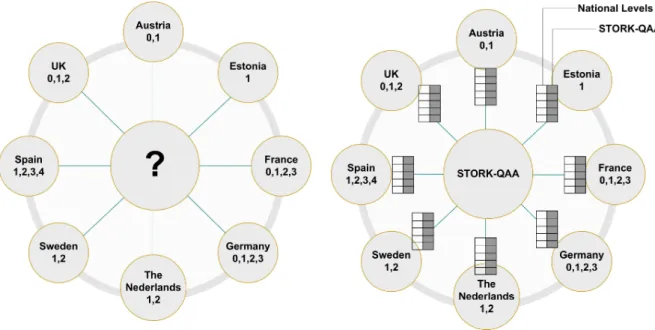
In STORK, we have to map the country-specific levels of authentication to the STORK QAA levels as well. It is an explicit objective to have as less impact as possible on existing services. In Figure 1.a the problem is illustrated: there are incompatible definitions of national levels. The STORK QAA levels are defined as a common European understanding for quality of authentication assurance. This solution requires a mapping of local authentication levels (and authentication tokens, Figure 1.b) to the STORK QAA level. Based on the input of the STORK
STORK-eID Consortium Page 12 of 44
member states, a mapping of national levels to the STORK QAA levels is described in more detail in Section 3.
a. STORK Problem b. Solution: define QAA levels and related mappings
Figure 1: Mapping authentication assurance levels.
Most European countries have legislation in place that governs the use of their electronic identities and, sometimes, also the authentication levels. These legal aspects influence the use of electronic identities in cross-border scenarios. Deliverable D2.2 (cf. [2]) of the STORK project contains an extensive analysis of the legal issues of each of the countries present in the STORK project. These are summarised in Section 4 of this report.
Section 5 focuses on the perspective of the service provider, and finally Section 6 summarises the main findings of this report.
Having finished the work the over-all document has been created and sent by the WP2 manager to all WP2 partners and the WP4, WP5 and WP6 work package managers with request for comments. The received comments from UK, Spain, France, Iceland, Belgium, Sweden, Austria, Netherlands and Estonia have been processed and the document has been adapted.
1.5
Risk management
According to the STORK Quality Management plan, each deliverable/task has to follow the agreed quality management process and has to be accompanied by a risk analysis. The following tables comprise the identified risks for this deliverable. According the structure of this deliverable the risks are divided into general risks affecting the whole task 3 of WP2 and risks affecting the individual work items only.
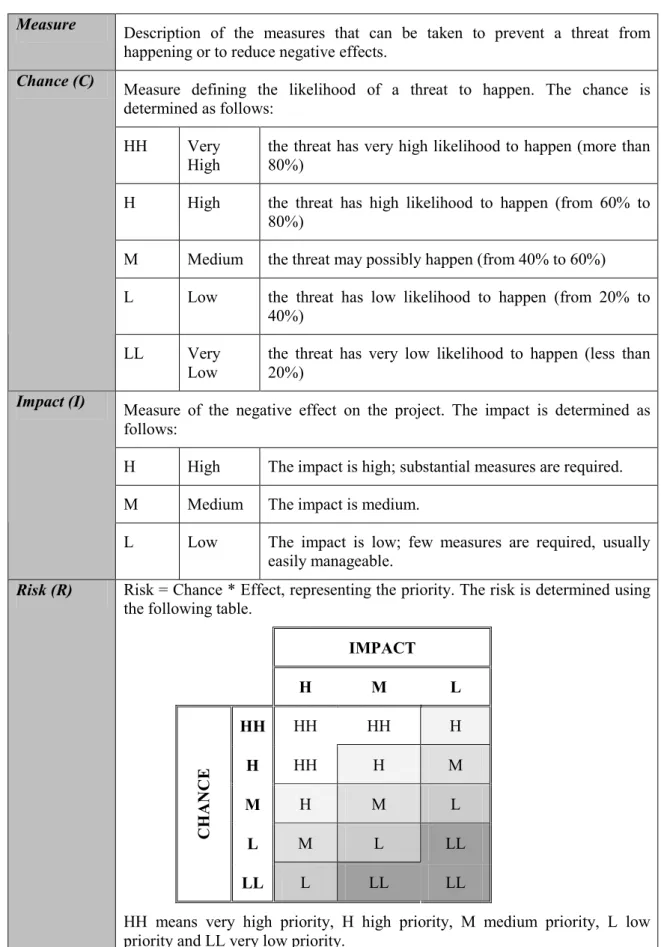
The following table illustrates the template that was used for the risk analysis: Threat Description of a potential danger towards the project.
Consequence
STORK-eID Consortium Page 13 of 44
Measure
Description of the measures that can be taken to prevent a threat from happening or to reduce negative effects.
Measure defining the likelihood of a threat to happen. The chance is determined as follows:
HH Very High
the threat has very high likelihood to happen (more than 80%)
H High the threat has high likelihood to happen (from 60% to 80%)
M Medium the threat may possibly happen (from 40% to 60%)
L Low the threat has low likelihood to happen (from 20% to 40%)
Chance (C)
LL Very Low
the threat has very low likelihood to happen (less than 20%)
Measure of the negative effect on the project. The impact is determined as follows:
H High The impact is high; substantial measures are required.
M Medium The impact is medium. Impact (I)
L Low The impact is low; few measures are required, usually easily manageable.
Risk (R) Risk = Chance * Effect, representing the priority. The risk is determined using the following table.
IMPACT
H M L
HH HH HH H
H HH H M
M H M L
L M L LL
C
H
A
N
C
E
LL L LL LL
HH means very high priority, H high priority, M medium priority, L low priority and LL very low priority.
STORK-eID Consortium Page 14 of 44
1.5.1
Identified risks
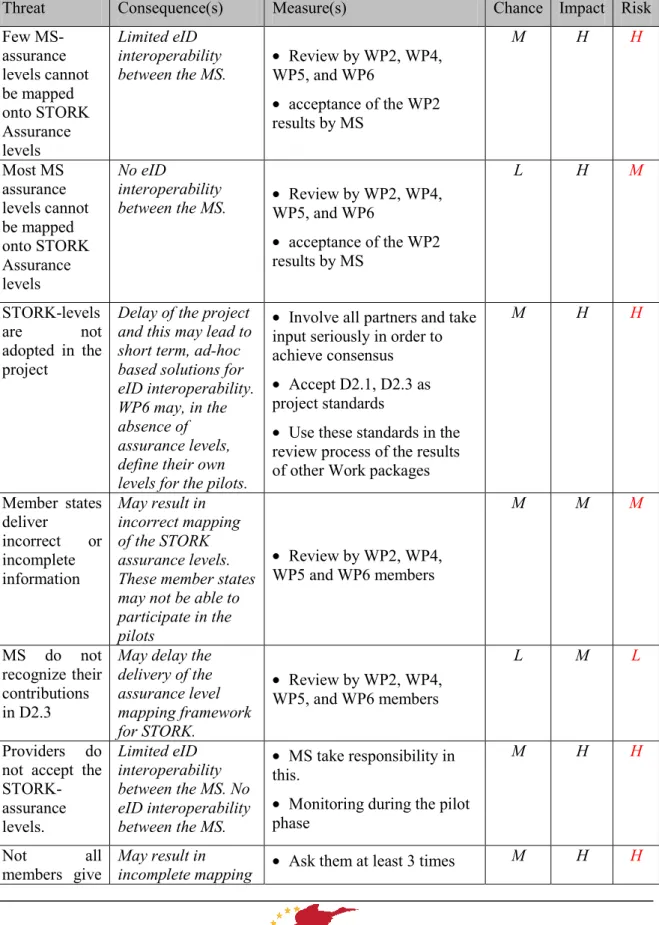
Table 2 defines general risks that apply for this deliverable.
Threat Consequence(s) Measure(s) Chance Impact Risk Few MS-assurance levels cannot be mapped onto STORK Assurance levels Limited eID interoperability between the MS.
• Review by WP2, WP4, WP5, and WP6
• acceptance of the WP2 results by MS
M H H
Most MS assurance levels cannot be mapped onto STORK Assurance levels No eID interoperability
between the MS. •WP5, and WP6 Review by WP2, WP4,
• acceptance of the WP2 results by MS
L H M
STORK-levels are not adopted in the project
Delay of the project and this may lead to short term, ad-hoc based solutions for eID interoperability. WP6 may, in the absence of assurance levels, define their own levels for the pilots.
• Involve all partners and take input seriously in order to achieve consensus
• Accept D2.1, D2.3 as project standards
• Use these standards in the review process of the results of other Work packages
M H H
Member states deliver
incorrect or incomplete information
May result in incorrect mapping of the STORK assurance levels. These member states may not be able to participate in the pilots
• Review by WP2, WP4, WP5 and WP6 members
M M M
MS do not recognize their contributions in D2.3
May delay the delivery of the assurance level mapping framework for STORK.
• Review by WP2, WP4, WP5, and WP6 members
L M L
Providers do not accept the STORK-assurance levels.
Limited eID interoperability between the MS. No eID interoperability between the MS.
• MS take responsibility in this.
• Monitoring during the pilot phase
M H H
Not all members give
May result in
incomplete mapping • Ask them at least 3 times
STORK-eID Consortium Page 15 of 44
information. of the STORK levels. These member states may not be able to participate in the pilots.
• Escalate to executive-board
Table 2: General Risk List.
1.5.2
Materialized risks
The risk that actually materialized was a slight delay in returning feedback on the first draft of the deliverable. The work package leader managed this situation by sending a reminder and by extending the actual deadline for feedback. In December, at the STORK General meeting the first results were presented and another WP2 meeting was held in which the first final draft was discussed. It was then opened for comment for all MS-partners. On the basis of their input, a new final draft was prepared. On the 18th of February the Dutch ministry of the Interior and Kingdom Relations organised a final meeting in The Hague and the last fundamental issues for deliverable D2.3 were discussed. After this meeting all MS-partners were once more given a week for giving their final comments on deliverable D2.3.
1.6
Quality Management
1.6.1
Acceptance criteria
The acceptance criteria used to evaluate the quality of the deliverable are defined considering the following parameters:
• Deliverable - a description of the deliverable.
• Acceptance criterion – a description acceptance criterion.
• Norm – a description of the norm that is applied to measure conformance.
• Process – a description of the process that is used to test conformance.
• Priority – the priority to meet a acceptance criterion (Low = nice to conform to, Medium = important to conform to, High = necessary to conform to).
1.6.2
The process
The following table reports the criteria adopted for deliverable D2.3 and the ensuing results.
Deliverable Acceptance criteria Norm Process Priority Checked
• Conform to STORK template
• Template issued by QM on 25-11-2008
Checked against template.
high Yes
• Language & Spelling
• English (UK) Reviewed by native speaker.
high Yes Deliverable
D2.3, as mentioned in the DoW
• Each member state in WP2 and WP6 (pilots) are represented
• Use appropriate communication procedures
Check against sending an
STORK-eID Consortium Page 16 of 44
in deliverable D2.3 e-mail.
• Consistency with description in DoW
• DoW version 1.5 aligned with DoW.
high Yes
• Contents is fit for purpose
• DoW version 1.5 Reviewed by WP2 and MS-partners
high Yes
• Contents is fit for use
• DoW version 1.5 Reviewed by WP2 and MS-partners
high Yes
• Commitment within WP
• DoW version 1.5 Reviewed by WP2 and MS-partners
high Yes
• Delivered on time • Planning for the Work Package
Discussion of the final draft by WP2, The Hague the 18th of February.
High, deadline
is 20/02
Yes
• Content of D2.3 satisfies to the edge conditions for starting WP2.3
• DoW version 1.5 Reviewed by WP2 and MS-partners
high Yes
STORK-eID Consortium Page 17 of 44
2
STORK Quality of Authentication Assurance model
This section describes the STORK Quality of Authentication Assurance model. That means to define the STORK QAA levels and to describe a set of requirements used to determine to which level an authentication solution belongs. STORK QAA levels are described in Section 2.1. The requirements, based on an analysis of the process of giving out credentials and the strength of the authentication token and protocols, are given Section 2.3
2.1
Description of STORK QAA levels
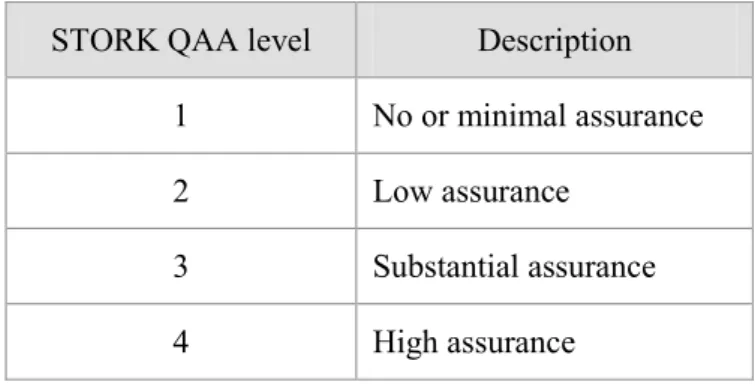
STORK recognizes four QAA levels, numbered from one to four. They are described in the following table:
STORK QAA level Description
1 No or minimal assurance
2 Low assurance
3 Substantial assurance
4 High assurance
Table 4: STORK QAA levels.
The four levels are similar to the “IDABC authentication levels report” [3]; they are also quite compatible with the “Liberty Identity Assurance Framework” [4]. A four-level scale is used to keep the complexity and the costs to maintain both the authentication information to operate the corresponding processes and the underlying infrastructure manageable. Conversely, it offers sufficient granularity to match the different business requirements with the potential protection mechanisms resulting in a complete coverage of the risks. A larger number of levels is not desirable, as it may lead to a fuzzy distinction between the levels and it may compromise the trustworthiness in the interoperability framework. Similarly, too many QAA levels might confuse the user and consequently might decrease his confidence and trust in the authentication framework and the applications using the framework.
STORK QAA levels are layered according to the severity of the impact of damages that might arise from misappropriation of a person identity. The more severe the likely consequences are the more confidence in an asserted identity will be required from a service provider’s perspective to engage in a transaction.
STORK QAA level 1 is the lowest assurance level; it either assures a minimal confidence in the asserted identity or no confidence at all. Identity credentials are accepted without any form of verification. If the subscriber provides an e-mail address, the only check that is performed is the verification of the correctness of the e-mail address. This level is appropriate when negative consequences that result from an erroneous authentication have a very low or a negligible impact. This level suits recognized on-line services implementing either a minimal set of security protection mechanisms or no set at all.
STORK QAA level 2 defines the level used by those services where damage from a misappropriation of a real-word identity has a low impact. Even if the claimants are not required to appear physically during the registration, their real-word identities must be validated and a token issued by a body subjected to specific governmental agreement. Identity tokens must be
STORK-eID Consortium Page 18 of 44
delivered with accuracy and security guarantees. Sufficiently robust authentication protocols must be used during the electronic authentication phase.
STORK QAA Level 3 defines the level used by services that may suffer substantial damages in case of an identity misuse. The registration of an identity is processed with methods that unambiguously and with a high level of certainty identify the claimant. The identity providers are supervised or accredited by the government. The credentials delivered are at least soft certificates or hard certificates. The authentication mechanisms used in the remote authentication phase are robust.
STORK QAA Level 4is the highest assurance level and addresses those services where damage caused by an identity misuse might have a heavy impact. The registration requires at least once (i.e., the very first time of the request but not for a later renewal) either the physical presence of the claimant or a physical meeting with the claimant (e.g., a certificate is requested on-line, delivered at home, and deployed in the hands of the claimant after a physical check of his/her identity). Alternatively, in case of on-line registration, a claimant identity is validated using trusted e-signatures. Annex II of the e-signature Directive 1999/93/EC leaves the details of identity verification to national law. Therefore, level 4 is fulfilled if the national legal requirements for issuing a qualified certificate have been met. Furthermore, the identity provider must be a qualified entity according to the Annex II of the e-signature Directive. The certificates are hard certificates qualified according to the Annex I of the e-signature Directive. The most robust authentication mechanisms are used during the authentication phase.
2.2
Requirements for STORK QAA levels
Each STORK QAA level is defined in terms of a series of requirements on relevant authentication
factors. So we have a set of requirements for STORK QAA level 1, STORK QAA level 2, and so forth. Each requirement defines the functional and technical properties that must be satisfied by a factor to belong to the specified level. The number and the kind of factors, reported in Figure 2, slightly deviates from those defined in the IDABC report [3]. WP2’s analysis resulted into a merge of several IDABC factors; new factors were not needed. Organisational factors, which concern the registration phase, are on the left side of Figure 2; Technical factors, which concern the electronic authentication phase, are on the right side of Figure 2.
The requirements on the factors of eID are organized hierarchically. The requirements for a STORK QAA level are constituted by the requirements for the (offline or online) registration
phase and requirements for the on-line electronic authentication phase. The requirements of each of the two phases are a combination of requirements over sub-factors relevant for each of the phases.
STORK-eID Consortium Page 19 of 44 Figure 2: Factors that influence the STORK QAA Levels.
Each STORK QAA level thus is represented by a set of organisational (ID, IC, and IE) and technical (RC and AM) factors and their individual quality level. The lowest value of the individual quality levels will ultimately determine the overall STORK QAA level.
In the remainder of this section we look first at the registration aspects (Section 2.3), then to the authentication aspects (Section 2.4), and finally come up with the resulting STORK QAA level. The model and approach here can be applied for all registration processes and authentication processes deployed in a member state. It will result in the STORK QAA level for that particular means of authentication.
As the number of national assurance levels can be higher or lower than the STORK QAA, the mapping between the national levels and the STORK QAA levels can mean that more national levels map into one STORK QAA level. It may also occur that the mapping is not exhaustive for certain member states (e.g., some STORK QAA levels cannot be reached by any national level). As consequence of this, some STORK levels may not be achievable by some national authentication solutions and citizens of such member states might not be able to access a service that requires that particular STORK QAA level. A discussion about how to apply the mapping, and an analysis of the specific mapping cases is the topic of Section 3.
2.3
STORK requirements for the registration phase
The STORK QAA levels of the registration phase are defined as a function of the assurance levels of the following quality factors: the identification procedure, the process of issuing identity credentials, the entity issuing the certificate. The requirements extend those in the IDABC proposal for a multi-level authentication mechanism [3] that, in turn, were inspired by the authentication policies of the UK and Germany, the IDABC Authentication Policy, and the NIST Guidelines for registration. The current requirements also look at the e-signature Directive 1999/93/EC [5], in regard of the definition of qualified identity providers and qualified certificates.
STORK-eID Consortium Page 20 of 44
2.3.1
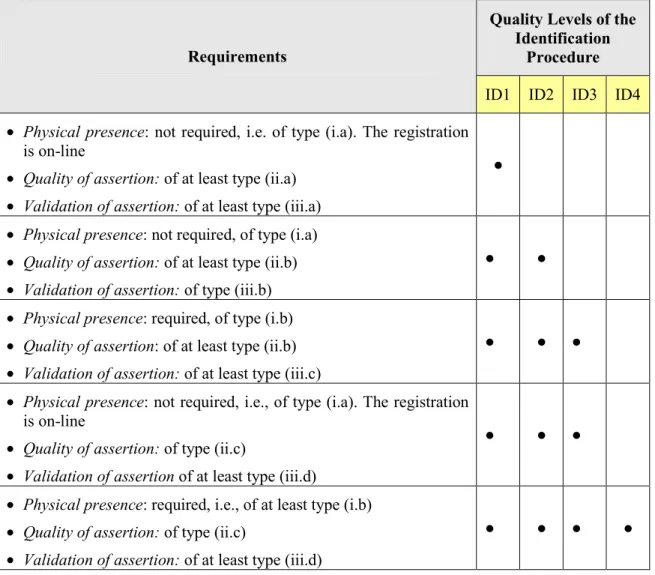
Quality of the identification procedure
This is the mechanism through which the citizen/user is identified before an authentication token is given out. The level assigned to the identification procedure depends upon a number of factors: (i) The physical presence of the claimant in some moment of the identification process:
a. The identification of the claimant does not require his/her physical presence at all. In other words there is no physical meeting with the claimant ever.
b. The identification of the claimant requires a physical meeting with the claimant during the registration. This must happen at least once (e.g., it may be not required for a renewal).
c. The identification of the claimant requires a physical presence when the certificates is delivered to him/her (e.g., the claimant may register on line, but must be present when the certificate is delivered to him/her). This must happen at least once (e.g., it may be not required for a renewal)
(ii) The quality of assertions about the identity of the claimant:
a. Single assertion of data related to the claimant that is not necessarily known by the claimant only (e.g., her/his name, the date of birth). This does not necessarily result in a unique identification.
b. Multiple assertions of data related to the claimant that are not necessarily known by the claimant only (e.g., her/his name, the date of birth, residential address). These must result into a unique identification.
c. Assertions that at least refer to some unique piece of information that only the claimant is assumed to know (e.g., his/her social security number, his/her passport number) and that can be checked against some official register. These do result in a unique identification.
(iii) The validation of the assertions given by the claimant about his/her identity, according to the following cases:
a. The validation is limited to a verification of an email address, if an e-mail is provided. Otherwise no verification is performed.
b. The validation of an assertion is performed by cross-referencing the provided assertions with an official identity source or identity database from a neutral and trustworthy source such as a bank, an insurance agency or a government department. c. The validation requires the assertion to be signed with a non-qualified digital
signature.
d. The validation requires the exhibition of a physical and official government identity document such as an identity card, a passport or a driving license which, at least, contains a photo and/or signature.
e. The validation requires the assertion to be signed with a digital signature which is verified by a Certificate Service Provider (CSP) before issuing the token/credential. The following table shows the Levels for the Quality of the Identification Process (ID1 - ID4). They correspond to the amount of requirements that they satisfy.
STORK-eID Consortium Page 21 of 44 Quality Levels of the
Identification Procedure Requirements
ID1 ID2 ID3 ID4
• Physical presence: not required, i.e. of type (i.a). The registration is on-line
• Quality of assertion: of at least type (ii.a)
• Validation of assertion: of at least type (iii.a)
• Physicalpresence: not required, of type (i.a)
• Quality of assertion: of at least type (ii.b)
• Validation of assertion: of type (iii.b)
• Physicalpresence: required, of type (i.b)
• Quality of assertion: of at least type (ii.b)
• Validation of assertion: of at least type (iii.c)
• Physicalpresence: not required, i.e., of type (i.a). The registration is on-line
• Quality of assertion: of type (ii.c)
• Validation of assertion of at least type (iii.d)
• Physicalpresence: required, i.e., of at least type (i.b)
• Quality of assertion: of type (ii.c)
• Validation of assertion: of at least type (iii.d)
Table 5: Quality levels of the identification procedure.
2.3.2
Quality of the identity issuing process
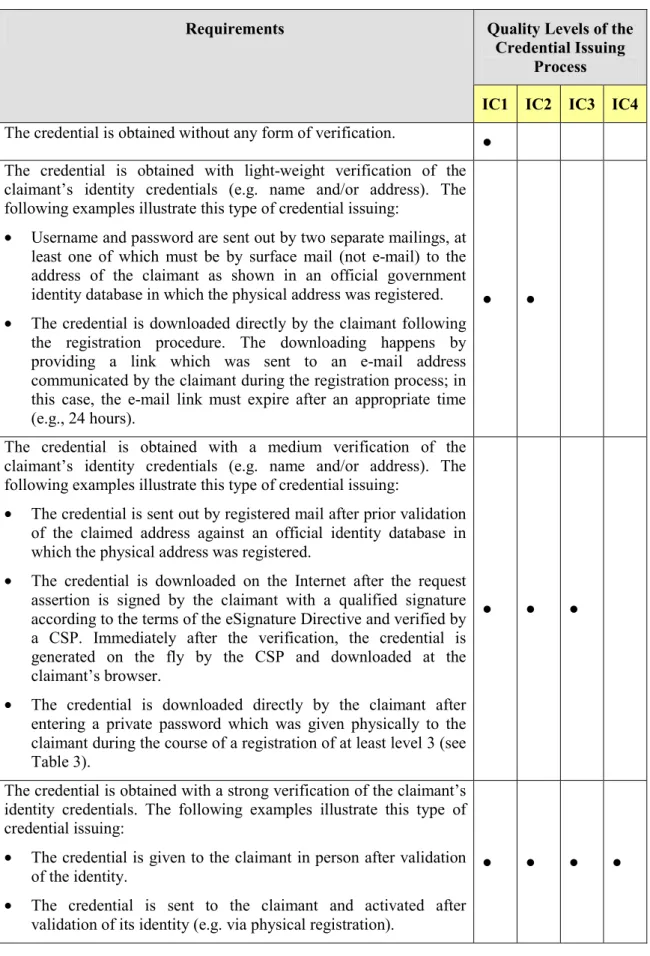
The second registration factor concerns the process via which an identity token or credential is issued. The quality of an issuing process depends upon whether the delivery happens via e-mail or via surface mail, and upon whether the token is delivered as one piece of information or as separated pieces that must be combined later.
The higher the quality of the issuing procedure, the stronger the binding between the claimant’s claimed identity and his real-life identity in the successive electronic authentication phase. The highest level (limited to the issuing process) is reached when the delivery is conducted in the physical presence of the claimant. Note that in order to obtain an highest level in the overall registration phase the delivery in person must be associated with the highest identification process; this requires that the identity of the receiver is validated using an official government identity document (either at the location of the issuing party, or by authenticated delivery at a selected address).
STORK-eID Consortium Page 22 of 44 Quality Levels of the
Credential Issuing Process Requirements
IC1 IC2 IC3 IC4
The credential is obtained without any form of verification.
The credential is obtained with light-weight verification of the claimant’s identity credentials (e.g. name and/or address). The following examples illustrate this type of credential issuing:
• Username and password are sent out by two separate mailings, at least one of which must be by surface mail (not e-mail) to the address of the claimant as shown in an official government identity database in which the physical address was registered.
• The credential is downloaded directly by the claimant following the registration procedure. The downloading happens by providing a link which was sent to an e-mail address communicated by the claimant during the registration process; in this case, the e-mail link must expire after an appropriate time (e.g., 24 hours).
The credential is obtained with a medium verification of the claimant’s identity credentials (e.g. name and/or address). The following examples illustrate this type of credential issuing:
• The credential is sent out by registered mail after prior validation of the claimed address against an official identity database in which the physical address was registered.
• The credential is downloaded on the Internet after the request assertion is signed by the claimant with a qualified signature according to the terms of the eSignature Directive and verified by a CSP. Immediately after the verification, the credential is generated on the fly by the CSP and downloaded at the claimant’s browser.
• The credential is downloaded directly by the claimant after entering a private password which was given physically to the claimant during the course of a registration of at least level 3 (see Table 3).
The credential is obtained with a strong verification of the claimant’s identity credentials. The following examples illustrate this type of credential issuing:
• The credential is given to the claimant in person after validation of the identity.
• The credential is sent to the claimant and activated after validation of its identity (e.g. via physical registration).
STORK-eID Consortium Page 23 of 44
2.3.3
Quality of the entity issuing the identity credentials
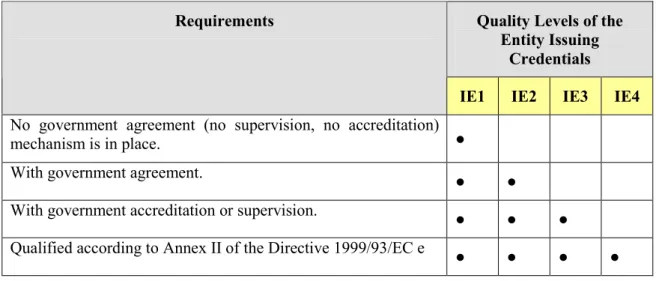
The third aspect that influences the quality assurance of the registration phase is the quality of the entity that issues the identity credentials (certificates, passwords, tokens). Such an issuing entity could for instance be a traditional or electronic identity provider or a Certificate Authority (CA). Whilst the issuers of traditional identification documents (e.g., passports and identity cards) are usually public governmental bodies, the issuers of digital identity tokens can be either entities of the public sector or third parties. The role of the certification authority and the identity provider is usually played by the same physical entity, which we call the certification service provider. We make a distinction between entities that are qualified according to what is stated in the Annex II of the Directive 1999/93/EC and those that are not; only the qualified entities can offer the highest level of assurance.
Among the non-qualified entities, we distinguish between entities that apply mechanisms that are approved, supervised, or accredited by the government and entities that run mechanisms which do not benefit from a governmental supervision, approval, or accreditation (e.g. banks).
Qualified entities are those that meet the requirements of Annex II of the EU Directive 1999/93/EC [5]. A qualified entity is allowed to deliver qualified certificates (compliant with the constraints expressed in Annex I of the same directive; see also part II of deliverable D2.2 [2]1).
Another document of interest here is the Policy requirements for certification authorities issuing public key certificates” (ETSI TS 102 042) [6]. This latter document is relevant for all PKI installations in Europe and concerns all aspects of the registration process in STORK QAA definition.
Note that some of the requirements mentioned in the directive describe the obligations that must be fulfilled when, for example, the certification service provider verifies the identity of the subscriber or when it generates the identity token. Therefore there is overlap between the requirements requested for a certification service provider to be certified (according to the directive) and the requirements that are contained in the STORK model. This overlapping is perfectly licit. For example, the obligation (d) in Annex II of the Directive 1999/93/EC states that “the certification authority must verify, by appropriate means in accordance with national law, the identity and, if applicable, any specific attributes of the person to whom a qualified certificate is issued.” This obligation overlaps with the requirement for the registering process (Section 2.3.1). Because both requirements are associated with the highest level it is still possible to have an overall STORK level four at the end of the evaluation. Differently, if a registering process of level four is performed by a non-qualified entity it is not possible to reach an overall STORK-level four, because the assurance STORK-level of non-qualified entities is less than four. This situation matches perfectly the intention of STORK where technical and legal aspects contribute to the specification of a quality of assurance level.
Another factor that should be taken into account is the absence or presence of a strategy to retain the facts occurring during the registration procedure. A log of the registration data makes it possible, for example, to perform an investigation in case of fraud. The existence of a retention mechanism is one of the requirements contained in the EU Directive 1999/93/EC [5]. Item (i) of Annex II of the directive says that “record all relevant information concerning a qualified certificate for an appropriate period of time, in particular for the purpose of providing evidence of certification for the purposes of legal proceedings. Such recording may be done
1 We are aware that this Directive is meant for digital signatures only and not for authentication purposes. Nevertheless the Directive offers a definition of qualified certificates that can be used for qualifying user authentication as well.
STORK-eID Consortium Page 24 of 44
electronically”. Issuing entities that operate in accordance with the Directive thus also meet the retention requirement and enjoy the highest level of assurance. There must, however, be agreement about the meaning of “an appropriate period of time”. This may be application or member state specific. Entities that do not operate in accordance with the Directive may still have retention mechanisms in place but will never obtain a level of assurance higher than 3.
Quality Levels of the Entity Issuing
Credentials Requirements
IE1 IE2 IE3 IE4
No government agreement (no supervision, no accreditation)
mechanism is in place.
With government agreement.
With government accreditation or supervision.
Qualified according to Annex II of the Directive 1999/93/EC e
Table 7: Requirements regarding the quality of the entity issuing identity credentials.
2.3.4
Assurance levels for the registration phase
The table below aggregates each of the registration process aspects into a single quality level for the overall registration phase.
Quality assurance levels for the registration phase
R1 R2 R3 R4
Quality of the Identification Process
(Table 5)
ID1 ID2 ID3 ID4
Quality of the Credential Issuing Process
(Table 6)
IC1 IC2 IC3 IC4
Quality of the Entity Issuing the Credential
(Table 7)
IE1 IE2 IE3 IE4
Table 8: Aggregated quality levels of the registration phase.
The overall level for the registration phase consists of a set of levels corresponding to the different registration process aspects. The general rule is that the overall registration process level can never exceed the required levels of individual aspects.
STORK-eID Consortium Page 25 of 44
2.4
STORK requirements for the electronic authentication phase
In the electronic authentication phase, the proof of identity supplied by a claimant (i.e., an identity token, a credential) is verified for its authenticity. The quality of this phase depends on factors like the type of the identity token that is used, the remote authentication protocol adopted in the authentication check, and the mechanism used to communicate the result of the remote authentication to the claimant.
2.4.1
Types and robustness of the identity credential
The first factor that influences the quality of assurance of the electronic authentication phase is the type of the electronic identification token that is provided as proof of possession. The token types that we consider in STORK are as follows:
Username/Password or PIN: is a character string, expected to be memorized and kept secret by the claimant. This kind of token is used in many member states, especially for low-risk services. Often, a particular username/password combination, or the PIN code, is associated with and allows use of a set of services. For example, some member states have dedicated portals that generate and issue this kind of tokens to citizens and that handle the authentication of citizens for a number of services. The username part of the combination can either be self-chosen by the claimant or generated by the identity provider. Since it is public, it does not have an impact on the authentication level. For the password or PIN part this is different; there is a different level associated to claimant chosen or automatically generated passwords or PINs.
Password list: Is a personal soft token (paper list) that the claimant possesses. A list contains PIN codes often in combination with a static password or PIN within the authentication system.
One-time password device: Is a personal hardware device that generates a “one-time” password that is valid for only one authentication session. In certain cases the one-time password is generated as a timestamp, by using a cipher algorithm that combines the current time and a secret seed stored in the device. In other cases, a dedicated reader device combines a symmetric key stored on a personal hardware device (e.g., a card) with a nonce. The nonce can be current time, a counter generated on the reader device or, if the device has input capabilities, a challenge sent from the verifier. The generated one-time password that is typically displayed on the reader device, is communicated (e.g., manually digitized on the portal of the service, automatically uploaded on the portal, or sent via SMS) to the remote service.
Soft certificate: is a cryptographic key that is typically stored on a disk, USB stick or some other media. Authentication is accomplished by proving possession and control of the key. Usually the soft certificate is encrypted under a key derived from a password known only to the user; therefore the password is required to activate the certificate.
Qualified Soft certificate or equivalent: is a soft certificate whose technical features are compliant to the requirements laid down in Annex I of the EU Directive 1999/93/EC [5]. Even though there are differences in the transpositions of the Directive into national legislation there is also much common ground in how the certificates are created and in their legal effects. In this definition we also include those soft certificates that are issued by the national government (e.g. Belgium and Estonia) with exactly the same processes as the qualified ones, i.e. normalized certificates.
Hard certificate: is a smartcard or similar media that contains a protected cryptographic key. Authentication is accomplished by proving the possession of the device and control of the key.
Qualified hard certificate or equivalent: is a hard certificate whose technical features are compliant to the requirements laid down in Annex I of the Directive 1999/93/EC [5]. Even though there are differences in the transpositions of the Directive into national legislation there is also
STORK-eID Consortium Page 26 of 44
much common ground in how the certificates are created and in their legal effects. In this definition we also include those hard certificates that are managed by the local government with exactly the same processes as the qualified ones.
A specific quality aspect that is of relevance for identity tokens is their freshness: how often does the issuing entity updates its revocation lists. Issuing entities should express the revocation list update frequency in their certification statement. The quality of the freshness of the identity tokens is part of the quality of the issuing entity and therefore addressed in Annex II of the Directive and therefore tackled in Section 2.3.3.
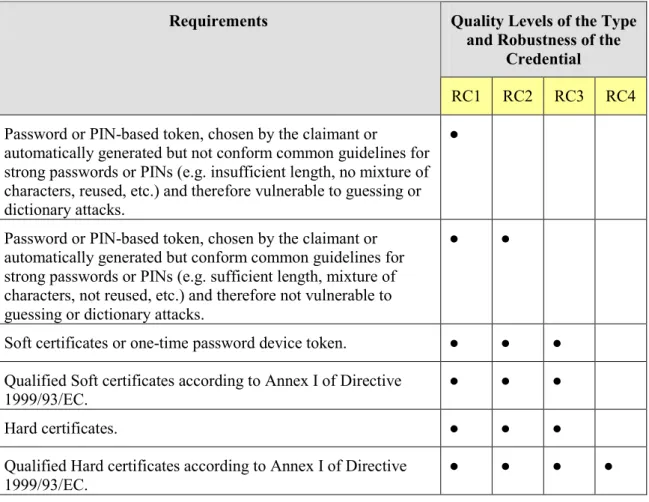
The following table shows the mapping of token types to quality levels. Criteria for rating the tokens are their robustness against copying, the use of multiple independent channels and those mentioned in the Directive.
Quality Levels of the Type and Robustness of the
Credential Requirements
RC1 RC2 RC3 RC4
Password or PIN-based token, chosen by the claimant or
automatically generated but not conform common guidelines for strong passwords or PINs (e.g. insufficient length, no mixture of characters, reused, etc.) and therefore vulnerable to guessing or dictionary attacks.
Password or PIN-based token, chosen by the claimant or automatically generated but conform common guidelines for strong passwords or PINs (e.g. sufficient length, mixture of characters, not reused, etc.) and therefore not vulnerable to guessing or dictionary attacks.
Soft certificates or one-time password device token.
Qualified Soft certificates according to Annex I of Directive 1999/93/EC.
Hard certificates.
Qualified Hard certificates according to Annex I of Directive 1999/93/EC.
Table 9: Quality levels of the identity tokens.
Note that if a certificate is a qualified certificate, then the proof is stronger (assurance level is higher) than for other advanced certificates because qualified certificates are verified in a more tightly controlled process. Furthermore, the used encryption algorithms should provide sufficient protection against forgery using currently available technology (see also Annex III of the e-signature Directive 1999/93/EC).
2.4.2
Security of the authentication mechanism
The level of trust that can be posed on a remote authentication mechanism depends upon its security robustness. The robustness of the authentication mechanisms is here judged with respect
STORK-eID Consortium Page 27 of 44
to the most serious threats that concern authentication: the identity theft. In most cases, a criminal needs to obtain personally identifiable information or documents about an individual in order to impersonate him/her. This can be done in different ways among which, for example retrieving information from redundant equipment, like computer servers that have been disposed of carelessly, e.g. at public dump sites, given away without proper sanitizing etc, or doing research on the victim in government registers, internet search engines, or public records search services., or eventually browsing social network (e.g., MySpace and Facebook) sites, online for personal details that have been posted by users.
These kinds of attacks are basically social engineering, a serious discipline who watches at the user as the weakest point in a security system. Our analysis of the assurance levels of the remote authentication will focus to the threats that come from attacks directed only to the authentication protocol itself. In this case identities can be stolen via a list of attacks against the remote authentication procedure. This can happen via the following types of attacks:
(1) Guessing is a simple attack where a malicious entity tries to guess a secret used in a communication (e.g., an encryption key, a PIN). This attack works in cases where the secret is weak. For instance a simple password can be easily guessed using dictionaries.
(2) Eavesdropping is an attack that consists in observing the messages passing through a communication channel, where for example an authentication protocol runs. The messages are stored usually for performing some off-line analysis of the information, used for launch successive attacks; for example eavesdroppers generally attempt to obtain tokens to pretend to be the claimants.
(3) Hijacking is an attack that consists in taking over an already authenticated session by an attacker and to learn sensitive information.
(4) Replay is a form of attack where a malicious entity repeats or delays previously intercepted messages in order to gain access to sensitive information.
(5) Man-in-the-middle is a form of active eavesdropping in which the attacker makes independent connections with the victims and relays messages between them, making them believe that they are talking directly to each other over a private connection when in fact the entire conversation is controlled by the attacker. The attacker must be able to intercept all messages going between the two victims and inject new ones.
There is direct relationship between the assurance level of the authentication protocol and the robustness against these kinds of attacks. Anyhow being robust is a property that can be checked only with respect to the current status of the technology. Attacks and defenses evolve mutually in time. Thus in the following table we classify an authentication remote procedure according their provable (in the current technology and knowledge) security or proved insecurity against the previously mentioned attacks. Proved insecure means that it is known that the protocol to be vulnerable to the attack. Provable security is a delicate terms. It may refer to the robustness de facto as in the case, for example, of mechanisms that have been in use since quite a time without that an attack was reported. Alternatively, provable secure means formally secure, when studies and tests on the security of the mechanism have been conducted all with positive outcomes. In this context, it must be noticed that certain kind of attacks, like the hijacking and the man-in-the-middle attacks, are very difficult to detect. Moreover, when we say that a mechanism offers protection (or strong protection) against an attack, we mean that with respect to the current technology, the mechanism implements defenses that are recognized to be robust against to that specific attack. So for example a randomly generated password longer than 8 characters and with alpha and numerical characters is known to be robust to guessing and dictionary attack. This implies that only the 4th level can be described in formal terms. For the other levels a self
STORK-eID Consortium Page 28 of 44
assessment will have to take place. We refer to the evaluation assurance levels (EAL) of the Common Criteria for guidance on assigning the appropriate levels [7].
The following table summarizes the requirements for the authentication mechanism assurance level.
Quality Levels of the Security of the Authentication Mechanism Requirements
AM1 AM2 AM3 AM4
Authentication mechanisms that offer little or no protection against the above-mentioned attacks.
Secure authentication mechanisms that offer some protection against the above-mentioned attacks.
Secure authentication mechanisms that offer protection against most of the above-mentioned attacks.
Recognized secure authentication mechanisms that offer protection against all of the above-mentioned attacks. Comparable with EAL4+ or higher of the Common Criteria.
Table 10: Quality levels of the authentication mechanism.
2.4.3
Assurance levels for the electronic authentication phase
The table below aggregates the various factors that determine the quality levels of the electronic authentication process. The general rule is that the overall authentication process level can never exceed the level of an individual aspect. Again, this implies that the overall STORK QAA level can never by higher than the lowest value of one of the individual electronic authentication aspects.
Quality assurance levels for electronic authentication phase
Aspects relevant for electronic authentication
EA1 EA2 EA3 EA4
Type and Robustness of Identity Token
(Table 9)
RC1 RC2 RC3 RC4
Security of Authentication Mechanism
(Table 10)
AM1 - 3 AM1 - 3 AM1 - 3 AM4
STORK-eID Consortium Page 29 of 44
2.5
STORK QAA levels
Using the same techniques as used for the electronic authentication process (Section 2.4.3) and the registration process (Section 2.3.4), we can now compute the overall STORK QAA level. This computation is based on the common paradigm that security is as strong as the weakest link. Therefore the overall STORK QAA level is determined by the lowest assurance level for registration and for electronic authentication. Table 12 below summarizes the results.
Assurance Levels for Electronic Authentication phase
EA1 EA2 EA3 EA4
RP1 STORK QAA Level 1
STORK QAA Level 1
STORK QAA Level 1
STORK QAA Level 1
RP2 STORK QAA Level 1
STORK QAA Level 2
STORK QAA Level 2
STORK QAA Level 2
RP3 STORK QAA Level 1
STORK QAA Level 2
STORK QAA Level 3
STORK QAA Level 3
Assurance Levels for Registration phase
RP4 STORK QAA Level 1
STORK QAA Level 2
STORK QAA Level 3
STORK QAA Level 4
Table 12: STORK Quality of Authentication Assurance levels.
Now that we have defined the framework for assessing STORK QAA levels, the next step is mapping them onto authentication quality assurance levels that are recognized by the member states. This mapping will be explained in the next chapter.
STORK-eID Consortium Page 30 of 44
3
Mapping existing mechanisms on the STORK QAA levels
The STORK approach is that service providers should be allowed to use the nationally recognized assurance levels for authentication. To ensure interoperability with other member states, these national levels must be (automatically) translated into corresponding STORK QAA levels. This is depicted in Figure 3, below.
Figure 3: Applying the mapping.
This corresponds to the following scenario:
1. A foreign user requests access to a local service offered by a service provider. The service provider expresses its authentication requirements in terms of a locally, i.e. nationally, recognized assurance level.
2. This local QAA level is mapped onto a STORK QAA level and subsequently from the STORK QAA level onto a level that is recognized by the foreign user’s member state. An appropriate authentication request in that member state is created.
3. The foreign user is authenticated and an assertion is created corresponding to the foreign local assurance level which, on its turn, corresponds back to a STORK QAA level.
4. This STORK QAA level links also back to the compatible assurance level of the service provider’s member state, which eventually received the assertion of authentication with the desired quality of assurance level.
The STORK QAA level framework thus allows for mapping locally accepted levels to the levels of the user’s member state. For example, if we assume that a citizen of a member state asks for a foreign service that requires authentication at a certain local level then the mapping is used to understand which authentication solutions of the country of origin of the citizen can be used to authenticate that citizen. The STORK QAA level of this authentication solution must be compliant with the STORK QAA level requested by the service provider. Here, “be compliant” means possessing the same or a higher STORK QAA level.
This section discusses how to apply such a mapping (in section 3.1); and subsequently, it discusses the implications of mapping of national and STORK levels onto each other for the middleware and the proxy models (from section 3.2 to section 3.4).
3.1
Mapping the national eID levels to STORK QAA levels
The following Table 13 presents a proposed mapping of the national authentication levels of each member state to the four STORK QAA levels as defined in the previous chapter. This table is based on an inventory of all member states’ authentication solutions described in STORK deliverable D2.1 [1]. The authentication solutions adopted by the member states (analyzed in deliverable D2.1) have been associated with STORK QAA levels by applying the scheme described in Section 2; it does not include the legal implications yet; these will be addressed in Section 4. The cells of the table contain the names of the levels (e.g., “Level 1”, “Level 2”, etc.) as defined by the member state.