Performance of networks containing both MaxNet and SumNet
links
Lachlan L. H. Andrew and Bartek P. Wydrowski∗
Abstract
Both MaxNet and SumNet are distributed congestion control architectures suitable for the Internet. MaxNet has recently been shown to have better fairness and scaling properties, but the majority of existing Internet links use the SumNet paradigm. If MaxNet links are to be deployed, they will need to be compatible with the existing SumNet infrastructure. This paper investigates the fairness and utilisation of networks consisting of mixtures of MaxNet and SumNet links, in different proportions.
Keywords: Network Flow Control, Congestion Control, Stability, Scalability.
1
Introduction
The problem of network flow control is to control source rates so that link capacities are utilised. For Internet-like networks, where links and sources can only have local information, the challenge is to control the source rates in a fully distributed manner. There are many different possible source rate allocations that fulfill the requirement of utilising the capacity. It has been shown [1] that the source rate allocation achieved by TCP Reno maximises an arbitrary utility function. Most other flow control schemes also maximise (different) utility functions [1]. In [2], we showed that it is possible to achieve a different, fairer rate allocation by altering the way the network signals congestion information.
Models of Internet-like networks control the source rate by a scalar feedback congestion signal. This signal is generated by aggregating the congestion prices of links on the end-to-end connection path of the source. For networks which achieve maximum utility, including TCP Reno networks, the signal is aggregated by summing all of the link prices on the path. We refer to these networks as SumNets. MaxNet was introduced in [2]. Its aggregation function is Max, and only the maximum link price along the connection path controls the source rate. MaxNet results in a Max-Min fair rate allocation for sources with homogeneous demand functions [2]. With appropriate parameters, it is stable for arbitrary capacities, delays and routing [3].
Since the difference between MaxNet and SumNet is simply the way the routers calculate the aggregate congestion signal, it is straightforward to build networks consisting of both MaxNet and SumNet links. The price signal forwarded over a MaxNet link is the maximum of the price of the link and the price signal in the incoming packet, while the price signal forwarded over a SumNet link is the sum of the two. All links out of a given router would typically be of the same type (MaxNet or SumNet), but that need not be the case.
∗
The authors are with the ARC Special Research Centre for Ultra-Broadband Information Networks. Department of Electrical and Electronic Engineering, The University of Melbourne, Australia. This work has been supported by the Australian Research Council.
A major drawback of these hybrid networks is that the fairness may be seriously compromised by the heterogeneity of the network. This paper investigates both the fairness and the stability of such hybrid networks.
In Section 2 we start by briefly describing the MaxNet architecture presented in [2], and Section 3 recalls the steady state rate allocation properties of both MaxNet and SumNet. Section 4 investigates the degree to which the heterogeneity of the links causes unequal rates to be allocated to different connections, while Section 5 considers the impact on the total utility achieved by the steady state rate allocations. Stability issues are briefly discussed in Section 6.
2
MaxNet Architecture
In a MaxNet network, the congestion signal,qi, communicated to sourceiis the maximum of all link
prices on the end-to-end transmission path, as illustrated in Figure 1. Letplbe the price at linkland
Libe the set of links connectioniuses, then
qi= max{pl:l∈Li}.
To achieve this, the packet format must include sufficient bits to communicate the complete congestion price. Each link replaces the congestion price in the packet with its own congestion price if its own price is larger than the one in the packet. (This was shown in [4] to be more efficient than the single-bit signalling typically used in SumNets.) The congestion signal is relayed back to the source by the destination host in acknowledgement packets.
The behaviour of connection iis governed by an explicit demand function,Di(·), such that its
transmit rate is
xi=Di(qi) (1)
for a congestion signalqi. The link Active Queue Management (AQM) algorithm is the by the well
studied integrator process [5]:
pl(t+ 1) =pl(t) + (yl(t)−cl)ϕl (2)
whereyl(t) =Pi:l∈Lixi(t)is the aggregate arrival rate for linklat timet,ϕlis the control gain and
clis the target capacity of linklwhich is related to its physical capacityCl by the target utilisation
0< µl <1such thatcl=µlCl.
3
Rate allocation of homogeneous networks
In steady state, whenpl(t+ 1) = pl(t), the rate allocation to connection i, xi will depend on the
magnitude of its demand function relative to those of other connections sharing bottleneck links of
connectioni.
Using MaxNet, the only bottleneck link which influences the rate isl, the link of connection i
with the highest price. IfTlis the set of connections traversing linkland linklhas the highest price
on pathi, then the rate allocation toiis
xi =Cl
Di(qi)
P
k∈TlDk(qk)
(3)
MaxNet can achieve a Max-Min fair rate allocation. A vector of rates,x, is defined as Max-Min
fair if, for every feasible rate vectorrwithri > xi for some connectioni, there exists a connectionk
such thatxk ≤xiandxk > rk. Put simply, a rate vector is Max-Min if it is feasible and no flow can
be increased while maintaining feasibility without decreasing a smaller or equal flow. The following proposition is proved in [2].
Proposition 1 LetD(·) be positive, continuous and decreasing. The rate allocation for a MaxNet network of homogeneous connections withxi=D(qi)is Max-Min fair.
Using SumNet, all bottleneck links traversed by connection iaffect the steady state rate. The
steady state rate allocate of SumNet is the allocation which maximises the sum over all sources,i, of
the utility function,Ui(x) =
Rx
0 Di(x).
4
Fairness of hybrid networks
The degree of unfairness of a rate allocation can be measured as its deviation from the max-min fair allocation. However, fairness per se is not the objective; rather it is to ensure that connections get at least their fair share. This motivates the following definition.
Definition 1 The unfairness index of a rate allocation,x, relative to the max-min fair allocation,y, is
u(x) = X
i:xi<yi
yi−xi
yi
. (4)
In essence, this measures the proportion by which connections fall short of achieving their fair share. In order to investigate the impact of heterogeneous links on the fairness of the equilibrium rate allocation, networks with various arrangements of SumNet and MaxNet links were simulated. In order to isolate the impact of the flow control from that of the network topology, a simple ring topology was used. Even from this very specific topology, several general conclusions can be drawn.
4.1 Simulation setup
Two regular topologies were studied, with several different traffic patterns and with randomly allo-cated MaxNet and SumNet links. For each topology, the average over the traffic patterns was recorded.
The first topology studied was a ring with equal capacity on each of itsLlinks. This is a common
topology for metropolitan area networks, and represents networks with very sparse interconnections. Both unidirectional and bidirectional rings were simulated. To investigate densely connected
net-works, a3×3mesh-torus with unidirectional links was also simulated.
In both topologies, random combinations of source and destination nodes were used. A route through a ring is uniquely determined by its source and its destination, and whether it is bidirectional or unidirectional. For the mesh-torus, routes were shortest paths going in the “horizontal” direction
first and then in the “vertical” direction. Let the number of connections beS. Each connection had
the same demand function,D(p) = x0exp(−kp), wherex0was 1.5 times the link capacity, and the
constantk= 0.005controls the sensitivity of the transmission rate to the price.
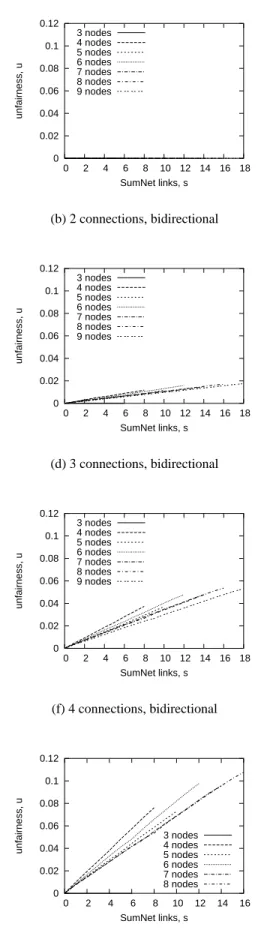
Figure 3 plots the unfairness index, averaged over all traffic patterns, against the number of
Sum-Net links,s, for both bidirectional and unidirectional rings. Figure 4 plots the maximum unfairness
index taken over the same traffic patterns.
Notice that a three node bidirectional ring is always perfectly fair, since all routes are a single hop. Bidirectional rings with two connections are also always perfectly fair, as will be explained below.
4.2 Maximum unfairness
For networks with unidirectional links, the worst case fairness of hybrid MaxNet/SumNet networks is generally worse than pure SumNet. This phenomenon is observable in networks in which two routes use the same pair of links in the same direction but in the reverse order. This is illustrated in Figure 2, with links 12 occurs before link 45 in one path, but after it in the other. If one of these links is costed
Figure 1: MaxNet logical feedback loop.
1 2
3
4 5
6
Figure 2: Routes overlapping on two routes in different orders
by a SumNet link and the other is by a MaxNet link, then the symmetry between the two paths which exists in a pure SumNet network is broken in a heterogeneous network, causing unfair rate allocation. If the two connections shown in Figure 2 are the only ones in the network, then both receive equal bandwidth under both MaxNet and SumNet. However, if link 12 is a SumNet link while link 45 is a MaxNet link, then the price signal conveyed by packets destined for node 2 is the sum of the two link prices, while that of packets destined for node 5 is only the cost of one link. The former cost is twice the latter, causing the transmission rates to differ.
This arrangement can only occur for rings with at least four nodes. It only requires one MaxNet link and one SumNet link in the network, and so occurs in heterogeneous unidirectional rings (of more than three nodes), irrespective of the proportion of MaxNet and SumNet links. However, the proportion of MaxNet and SumNet links influences the proportion of configurations which will be of this form, with the maximum proportion being for equal numbers of MaxNet and SumNet links.
Fortunately, it is impossible to have two shortest paths in bidirectional networks of any topology which both traverse the two links, but in the reverse order. This can be stated formally as follows.
Theorem 1 LetG = (V, E) be a graph with vertices V and undirected edges E ⊂ V2. Weight the edges by the function w : E 7→ (0,∞), with w(u, v) = w(v, u) for all (u, v) ∈ E. Let
R1 and R2 be two shortest paths in G. That is, Ri is the sequence (v1,i, v2,i, . . . , vn(i),i) where
(vj,i, vj+1,i) ∈ E and there is no other sequence (u1,i = v1,i, u2,i, . . . , um(i),i = vn(i),i) with
Pm(i)−1
j=1 w(uj,i, uj+1,i) <
Pn(i)−1
j=1 w(vj,i, vj+1,i). With these definitions, if edge (vk,1, vk+1,1) on
R1is also onR2as(vl,2, vl+1,2)and edge(vk0,1, vk0+1,1)onR1 is also onR2as(vl0,2, vl0+1,2), with
k0> k, thenl0 > l.
Proof: The proof uses the fact that a sub-path of a shortest path is also a shortest path. Assume, with
a view to obtaining a contradiction, thatl0 ≤l. Ifl0 =l, thenvk,1 =vk0,1, whenceR1contains a loop
and is not a shortest path. It remains to show thatl0 < lalso yields a contradiction. LetP(u, v)be the
length of the shortest path betweenuandv. LetA=vk,1,B =vk+1,1,C =vk0,1andD=vk0+1,1,
so thatR1 =. . . AB . . . CD . . .andR2 =. . . CD . . . AB . . .. The cost of the sub-path ofR1which
lies between (and includes) the shared links is then
P(A, D) = P(A, B) +P(B, C) +P(C, D) = P(A, B) +P(C, B) +P(C, D)
> P(C, B).
4.3 Impact of proportions
Although the maximum level of unfairness does not depend greatly on the ratio of MaxNet to SumNet links in the network, the mean level does. For bidirectional rings, the degree of unfairness is directly proportional to the proportion of SumNet links in the network in all cases investigated. That implies that the benefit gained by deploying MaxNet is directly proportional to the scale of the deployment.
This is particularly important from a practical point of view. If MaxNet only provided a benefit when it constituted a large proportion of the network, then it would be unattractive to large infrastruc-ture providers with a large installed base of SumNet equipment, and also to small providers who have to rely on the rest of the Internet for most of their connections. Since partial deployment provides a partial benefit, both of these groups stand to benefit from upgrading to MaxNet equipment.
Unidirectional rings with five connections also show unfairness approximately proportional to the number of SumNet links, although the total level of unfairness is an order of magnitude higher than for bidirectional rings. However, unidirectional rings carrying only three concurrent connections display unfairness which is concave in the number of SumNet links, especially for larger rings. This indicates that there is little benefit from deploying a small number of MaxNet links in such networks, and that widespread deployment is necessary to obtain significant improvement.
4.4 Scaling
The maximum unfairness increases as the number of connections increases. There are two reasons for this. Firstly, the definition of unfairness includes a sum over the connections. Although most connections will contribute zero to the sum, the number of non-zero contributions also increases with the number of connections.
A second and more subtle effect is the increase of the link prices. Because the demand function is exponential, the ratio of transmission rates depends on the absolute difference between the aggregate prices seen by the connections, rather than on their ratio. However, as the number of connections increases, the absolute value of the link prices also increases. Thus, the difference in total price of a connection traversing two SumNet links and one traversing only one such link will increase.
The second effect is particularly important because it causes the unfairness experienced by an individual user to increase, whereas the first effect is simply a reflection of the fact that there are more users in the system.
5
Utility
MaxNet trades increased fairness for decreased total utility. This section investigates how far short heterogeneous networks fall from the maximum utility, which is achieved by homogeneous SumNets. The measure of wasted utility is the waste index.
Definition 2 The waste index of a rate allocation,x, relative to the maximum utility allocation,y, is
w(x) = P
iU(yi)−U(xi)
P
iU(yi)
, (5)
whereU(x) = R0xD(x)is the utility function common to all connections, and the sums are over all connections.
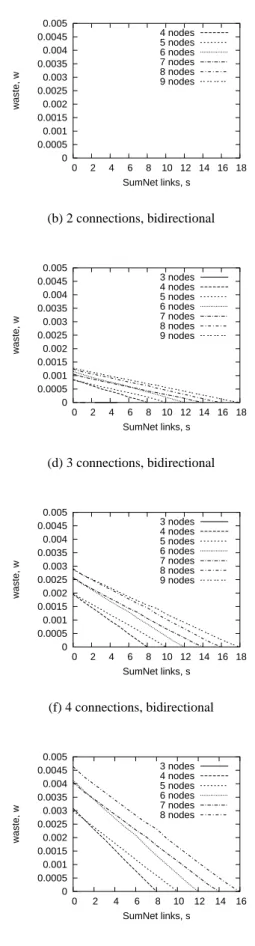
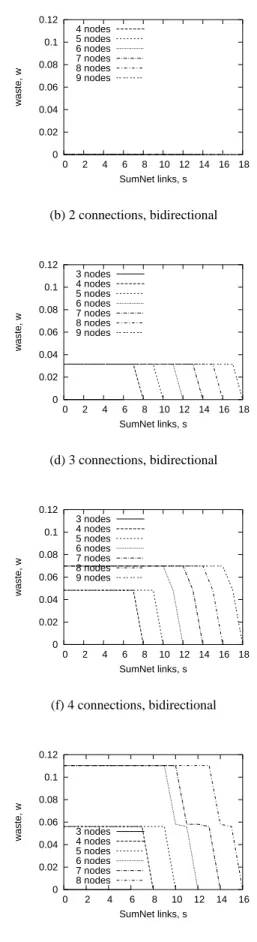
Figures 5 and 6 show the mean and maximum values of waste index of uni- and bi-directional rings, averaged over many traffic patterns.
The maximum waste of unidirectional rings is greater for heterogeneous networks than for either type of homogeneous networks, as was the case for the maximum unfairness. However, this effect decreases as the number of connections increases.
6
Stability of hybrid networks
It is known [3] that MaxNet is locally stable provided that, for each connection,i, the slope of the
demand function around the equilibrium value, x∗i, satisfies D0(x∗i) < x∗i/τi, i, where τi is the
round trip time for connectioni. Similarly, it is known [5] that SumNet is locally stable provided
D(x∗i)< x∗i/Miτi, whereMiis the number of bottleneck links on routei. The proofs rely on specific
properties of the feedback in each case: for MaxNet it relies on the fact that there is no feedback from any link other than the controlling bottleneck, while for SumNet it relies on the symmetry of a connection receiving feedback from all links whose price is influenced by that connection’s rate. Heterogeneous networks have neither of those properties, and there is currently no proof that even the
stricter conditionD(x∗i)< x∗i/Miτiis sufficient for stability.
In particular, for the network in Figure 2, the total delay for the feedback of rate information may be related to the sum of the round trip times for the two connections, rather than either individual round trip time. This is the subject of ongoing investigation.
7
Conclusion
The average behaviour of networks consisting of heterogeneous mixtures of MaxNet and SumNet links is generally between that of homogeneous MaxNets and SumNets. However, in networks with asymmetric links, it is possible for the steady state bandwidth allocation of the heterogeneous network to be significantly less fair than that of either type of homogeneous network. The most common cause, if not the only cause, is routes which overlap in two different parts of the network, and traverse those parts in the same direction, but traverse them in different orders. This cannot occur in bidirectional networks containing only symmetric links.
References
[1] S. H. Low, “A duality model of TCP and queue management algorithms,” in Proc. ITC Specialist
Seminar on IP Traffic Measurement, Modeling and Management, (Monterey, CA), 2002.
[2] B. Wydrowski and M. Zukerman, “MaxNet: A congestion control architecture for maxmin fair-ness,” IEEE Commun. Lett., vol. 6, pp. 512–514, Nov. 2002.
[3] B. Wydrowski, L. L. H. Andrew, and M. Zukerman, “MaxNet: A congestion control architecture for scalable networks,” IEEE Commun. Lett., Accepted for publication.
[4] B. Wydrowski, Techniques in Internet congestion control. PhD thesis, University of Melbourne, 2003.
[5] F. Paganini, J. C. Doyle, and S. H. Low, “Scalable laws for stable network congestion control,” in
0 0.1 0.2 0.3 0.4 0.5 0.6
0 1 2 3 4 5 6 7 8 9
unfairness
SumNet links, s 3 nodes 4 nodes 5 nodes 6 nodes 7 nodes 8 nodes 9 nodes
(a) 2 connections, unidirectional
0 0.02 0.04 0.06 0.08 0.1 0.12
0 2 4 6 8 10 12 14 16 18
unfairness, u
SumNet links, s 3 nodes 4 nodes 5 nodes 6 nodes 7 nodes 8 nodes 9 nodes
(b) 2 connections, bidirectional
0 0.1 0.2 0.3 0.4 0.5 0.6
0 1 2 3 4 5 6 7 8 9
unfairness
SumNet links, s 3 nodes 4 nodes 5 nodes 6 nodes 7 nodes 8 nodes 9 nodes
(c) 3 connections, unidirectional
0 0.02 0.04 0.06 0.08 0.1 0.12
0 2 4 6 8 10 12 14 16 18
unfairness, u
SumNet links, s 3 nodes 4 nodes 5 nodes 6 nodes 7 nodes 8 nodes 9 nodes
(d) 3 connections, bidirectional
0 0.1 0.2 0.3 0.4 0.5 0.6
0 1 2 3 4 5 6 7 8 9
unfairness
SumNet links, s 3 nodes 4 nodes 5 nodes 6 nodes 7 nodes 8 nodes 9 nodes
(e) 4 connections, unidirectional
0 0.02 0.04 0.06 0.08 0.1 0.12
0 2 4 6 8 10 12 14 16 18
unfairness, u
SumNet links, s 3 nodes 4 nodes 5 nodes 6 nodes 7 nodes 8 nodes 9 nodes
(f) 4 connections, bidirectional
0 0.1 0.2 0.3 0.4 0.5 0.6
0 1 2 3 4 5 6 7 8 9
unfairness, u
SumNet links, s 3 nodes 4 nodes 5 nodes 6 nodes 7 nodes 8 nodes 9 nodes
(g) 5 connections, unidirectional
0 0.02 0.04 0.06 0.08 0.1 0.12
0 2 4 6 8 10 12 14 16
unfairness, u
SumNet links, s 3 nodes 4 nodes 5 nodes 6 nodes 7 nodes 8 nodes
(h) 5 connections, bidirectional
0 0.2 0.4 0.6 0.8 1 1.2 1.4 1.6 1.8
0 1 2 3 4 5 6 7 8 9
unfairness, u
SumNet links, s 3 nodes 4 nodes 5 nodes 6 nodes 7 nodes 8 nodes 9 nodes
(a) 2 connections, unidirectional
0 0.2 0.4 0.6 0.8 1 1.2
0 2 4 6 8 10 12 14 16 18
unfairness, u
SumNet links, s 4 nodes 5 nodes 6 nodes 7 nodes 8 nodes 9 nodes
(b) 2 connections, bidirectional
0 0.2 0.4 0.6 0.8 1 1.2 1.4 1.6 1.8
0 1 2 3 4 5 6 7 8 9
unfairness, u
SumNet links, s 3 nodes 4 nodes 5 nodes 6 nodes 7 nodes 8 nodes 9 nodes
(c) 3 connections, unidirectional
0 0.2 0.4 0.6 0.8 1 1.2
0 2 4 6 8 10 12 14 16 18
unfairness
SumNet links, s 4 nodes 5 nodes 6 nodes 7 nodes 8 nodes 9 nodes
(d) 3 connections, bidirectional
0 0.2 0.4 0.6 0.8 1 1.2 1.4 1.6 1.8
0 1 2 3 4 5 6 7 8 9
unfairness, u
SumNet links, s 3 nodes 4 nodes 5 nodes 6 nodes 7 nodes 8 nodes 9 nodes
(e) 4 connections, unidirectional
0 0.2 0.4 0.6 0.8 1 1.2
0 2 4 6 8 10 12 14 16
unfairness
SumNet links, s 4 nodes 5 nodes 6 nodes 7 nodes 8 nodes 9 nodes
(f) 4 connections, bidirectional
0 0.2 0.4 0.6 0.8 1 1.2 1.4 1.6 1.8
0 1 2 3 4 5 6 7 8 9
unfairness, u
SumNet links, s 3 nodes 4 nodes 5 nodes 6 nodes 7 nodes 8 nodes 9 nodes
(g) 5 connections, unidirectional
0 0.2 0.4 0.6 0.8 1 1.2
0 2 4 6 8 10 12 14 16
unfairness, u
SumNet links, s 3 nodes 4 nodes 5 nodes 6 nodes 7 nodes 8 nodes
(h) 5 connections, bidirectional
0 0.005 0.01 0.015 0.02 0.025 0.03
0 1 2 3 4 5 6 7 8 9
waste, w
SumNet links, s 3 nodes 4 nodes 5 nodes 6 nodes 7 nodes 8 nodes 9 nodes
(a) 2 connections, unidirectional
0 0.0005 0.001 0.0015 0.002 0.0025 0.003 0.0035 0.004 0.0045 0.005
0 2 4 6 8 10 12 14 16 18
waste, w
SumNet links, s 4 nodes 5 nodes 6 nodes 7 nodes 8 nodes 9 nodes
(b) 2 connections, bidirectional
0 0.005 0.01 0.015 0.02 0.025 0.03
0 1 2 3 4 5 6 7 8 9
waste, w
SumNet links, s 3 nodes 4 nodes 5 nodes 6 nodes 7 nodes 8 nodes 9 nodes
(c) 3 connections, unidirectional
0 0.0005 0.001 0.0015 0.002 0.0025 0.003 0.0035 0.004 0.0045 0.005
0 2 4 6 8 10 12 14 16 18
waste, w
SumNet links, s 3 nodes 4 nodes 5 nodes 6 nodes 7 nodes 8 nodes 9 nodes
(d) 3 connections, bidirectional
0 0.005 0.01 0.015 0.02 0.025 0.03
0 1 2 3 4 5 6 7 8 9
waste, w
SumNet links, s 3 nodes 4 nodes 5 nodes 6 nodes 7 nodes 8 nodes 9 nodes
(e) 4 connections, unidirectional
0 0.0005 0.001 0.0015 0.002 0.0025 0.003 0.0035 0.004 0.0045 0.005
0 2 4 6 8 10 12 14 16 18
waste, w
SumNet links, s 3 nodes 4 nodes 5 nodes 6 nodes 7 nodes 8 nodes 9 nodes
(f) 4 connections, bidirectional
0 0.005 0.01 0.015 0.02 0.025 0.03
0 1 2 3 4 5 6 7 8 9
waste, w
SumNet links, s 3 nodes 4 nodes 5 nodes 6 nodes 7 nodes 8 nodes 9 nodes
(g) 5 connections, unidirectional
0 0.0005 0.001 0.0015 0.002 0.0025 0.003 0.0035 0.004 0.0045 0.005
0 2 4 6 8 10 12 14 16
waste, w
SumNet links, s 3 nodes 4 nodes 5 nodes 6 nodes 7 nodes 8 nodes
(h) 5 connections, bidirectional
0 0.02 0.04 0.06 0.08 0.1 0.12
0 1 2 3 4 5 6 7 8 9
waste, w
SumNet links, s 3 nodes 4 nodes 5 nodes 6 nodes 7 nodes 8 nodes 9 nodes
(a) 2 connections, unidirectional
0 0.02 0.04 0.06 0.08 0.1 0.12
0 2 4 6 8 10 12 14 16 18
waste, w
SumNet links, s 4 nodes 5 nodes 6 nodes 7 nodes 8 nodes 9 nodes
(b) 2 connections, bidirectional
0 0.02 0.04 0.06 0.08 0.1 0.12
0 1 2 3 4 5 6 7 8 9
waste, w
SumNet links, s 3 nodes 4 nodes 5 nodes 6 nodes 7 nodes 8 nodes 9 nodes
(c) 3 connections, unidirectional
0 0.02 0.04 0.06 0.08 0.1 0.12
0 2 4 6 8 10 12 14 16 18
waste, w
SumNet links, s 3 nodes 4 nodes 5 nodes 6 nodes 7 nodes 8 nodes 9 nodes
(d) 3 connections, bidirectional
0 0.02 0.04 0.06 0.08 0.1 0.12
0 1 2 3 4 5 6 7 8 9
waste, w
SumNet links, s 3 nodes 4 nodes 5 nodes 6 nodes 7 nodes 8 nodes 9 nodes
(e) 4 connections, unidirectional
0 0.02 0.04 0.06 0.08 0.1 0.12
0 2 4 6 8 10 12 14 16 18
waste, w
SumNet links, s 3 nodes 4 nodes 5 nodes 6 nodes 7 nodes 8 nodes 9 nodes
(f) 4 connections, bidirectional
0 0.02 0.04 0.06 0.08 0.1 0.12
0 1 2 3 4 5 6 7 8 9
waste, w
SumNet links, s 3 nodes 4 nodes 5 nodes 6 nodes 7 nodes 8 nodes 9 nodes
(g) 5 connections, unidirectional
0 0.02 0.04 0.06 0.08 0.1 0.12
0 2 4 6 8 10 12 14 16
waste, w
SumNet links, s 3 nodes 4 nodes 5 nodes 6 nodes 7 nodes 8 nodes
(h) 5 connections, bidirectional