A Research Note
d
anielleg
roTonFlorida State University
College of Social Work
This paper briefly reviews studies comparing the effectiveness of various Housing First programs to Continuum of Care pro-grams for outcomes related to housing retention, substance use, and mental health. A literature search was completed entering the search term “Housing First” in electronic databases (PsycINFO, JSTOR, and Web of Science) to find potential studies. Of the 67 items produced by the literature search, after screening for outcome studies of Housing First programs that evaluate housing retention, substance use, and/or mental health in comparison to other pro-grams or treatment as usual, 5 final studies were selected for in-clusion in the review. Of the five studies selected, all had recruited samples of either chronically homeless individuals or homeless in-dividuals with a mental health diagnosis, and all reported results favored Housing First programs over Continuum of Care programs for housing retention. Substance use and mental health outcomes generally stayed constant regardless of program type.While Hous-ing First does appear to show strong promise, the methodological flaws in the studies revewied, including strong research affiliation with the Housing First agencies being evaluated, calls for more rigorous studies to be completed by more objective investigators. Key words: homelessness, Housing First, Continuum of Care, chronic homelessness
In recent years, homelessness has become an important national issue in light of the economic recession. In 2007, just under 700,000 people were estimated to be homeless in a single day (U.S. Department of Housing and Urban Development, 2007), with thousands also suffering from disabling
Journal of Sociology & Social Welfare, March 2013, Volume XL, Number 1
51
concurrent psychiatric conditions. A further barrier, 50-70% of homeless individuals with mental illness also suffer from sub-stance abuse issues. Individuals with mentally or physically disabling conditions and more than 4 episodes of homeless-ness in three years or continuous homelesshomeless-ness for one year or more are known as the chronically homeless (Padgett, Gulcur, & Tsemberis, 2006).
In order to help this vulnerable population obtain per-manent residence and stability, there are two common in-tervention approaches: Continua of Care and Housing First programs. Continuum of Care plans are community-wide interventions that operate under the assumption that home-less individuals need to graduate from a specific sequence of programs before becoming “housing ready” (Kertesz, Crouch, Milby, Cusimano, & Schumacher, 2009). Housing-based pro-grams in these Continua of Care often require sobriety from drugs and alcohol and usage of any necessary medication or treatment for mental health issues (Kertesz et al., 2009).
Because of criticism of the effectiveness of Continua of Care, Housing First programs have been gaining popularity. Housing First programs operate by supplying rapid and direct placement of homeless individuals into permanent housing with supportive services available, but receiving housing is not contingent upon service utilization or treatment (Tsemberis, Gulcur, & Nakae, 2004).
While preliminary studies of Housing First demonstrate that these programs have higher rates of housing reten-tion without increasing rates of substance use and untreated mental illness (Kertesz et al., 2009; Stefanic & Tsemberis, 2007), several studies on this approach have all been completed on the same program, Pathways in New York (Gulcur, Stefanic, Shinn, Tsemberis, & Fischer, 2003; Pagdett et al., 2006; Stefanic & Tsemberis, 2007). In order to fairly assess the utility of these programs, all available outcome studies on various types of Housing First programs need to be reviewed.
Method
Potential studies were identified through searches of elec-tronic databases (PsycINFO, JSTOR, and Web of Science) and manual searches of the reference lists that were eventually
selected for inclusion in the review. Housing First programs are relatively new and are rarely referred to as anything else, so the only search terms used for this review were “housing first” in the title or topics of articles.
Studies were eligible for inclusion in the review if they met the following criteria: (1) were completed in the United States; (2) had more than one treatment condition; (3) only used adult participants who are currently homeless or are at risk of home-lessness; and (4) looked at outcomes related to housing reten-tion, substance use, mental health symptoms, or
treatment-seeking behaviors. For this review, homelessness is defined
as lacking a fixed, regular, and adequate night-time residence. Being at risk of homelessness is defined here as preparing to exit a housing situation or institution (e.g., in-patient treat-ment, prison) without having future housing arrangements. Housing retention is defined only as remaining in permanent housing (including supportive permanent housing provided by programs) at the follow-up of a study. Single-program case studies (e.g., only one program was evaluated with no com-parison programs or control) were excluded, as previous case studies have established that Housing First is promising. The aim of this review is to see if Housing First has better results than treatment as usual or if certain variations are more effec-tive than others. Studies were included regardless of the date of publication. Due to the design of this study, only quantita-tive studies or mixed methods studies were included in this review.
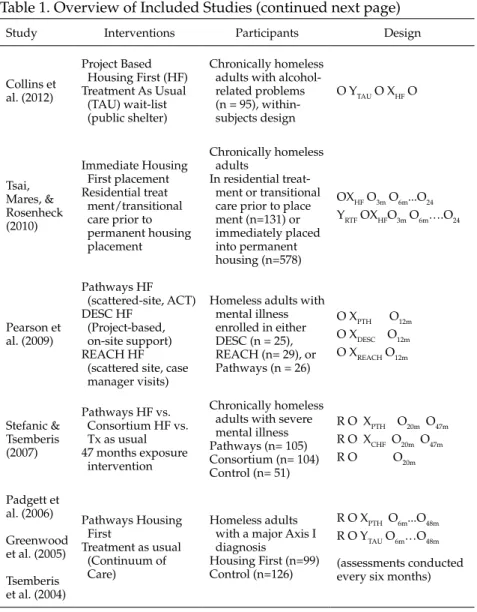
The literature search yielded 67 articles; after review of full titles, 41 articles still appeared relevant to the topic. Each abstract for the remaining articles was carefully screened for inclusion; only 16 articles met the criteria after this screen-ing process. These 16 articles were thoroughly read, resultscreen-ing in the seven studies which were included in this review (see Table 1).
Results
The studies reviewed were Collins et al. (2012), Tsai, Mares, and Rosenheck (2010), Pearson, Montgomery, and Locke (2009), Stefanic and Tsemberis (2007), Padgett et al. (2006), Greenwood, Schaefer-McDaniel, Winkel, & Tsemberis
(2005), and Tsemberis et al. (2004). While seven articles were reviewed, several of the articles were all based on the same parent study, The New York Housing Study—Greenwood et al. (2005), Padgett et al. (2006), and Tsemberis et al. (2004). These citations were grouped together for the purposes of this paper, resulting in five separate studies being reviewed. All five studies had chronically homeless participants, one of the studies also included homeless individuals who did not meet the definition of “chronic homelessness” but had active sub-stance use and/or mental health issues. Studies selected for the review are indicated in the reference section by an asterisk; the articles that utilize data from the New York Housing Study are indicated by double asterisks. Additionally, an overview of the six studies reviewed is provided in Table 1.
Collins et al. (2012)
The study by Collins et al. (2012) looked at alcohol use among chronically homeless consumers in Housing First. The average age of participants was 48.4 (SD = 9.39), and the race most identified in this sample was White (40%), al-though the sample was disproportionately American Indian/
Alaska Native (27%) (n = 95). Measures used for this study
included the Alcohol Use Quantity Form, Addiction Severity Index, 15-item Short Inventory of Problems, and the Alcohol Dependence Checklist.
Multilevel growth modeling was conducted to test the hypothesis that participants in Housing First would decrease their use levels on all the alcohol-use outcomes over the two year follow-up. With a 61% response rate at the two year fol-low-up, researchers found that there was a significant time effect and significant differences between groups. The growth model for typical quantity of alcohol consumed, for example, had a Wald X2 of 25.51 and significance of p < .001. In lay
terms, both control and intervention groups experienced a 7% decrease in typical quantity consumed every 3 months, but the intervention group decreased by 3% per each month of treat-ment as well. Similar results were found for peak quantity con-sumed (Wald X2 = 35.48, p <.001). While both groups decreased
in peak quantity consumed for each 3 months participating in the study by 8%, the intervention group experienced an addi-tional 3% decrease for each month of the study.
A logistic model testing the odds of reporting at least 1
day of not drinking to intoxication was significant (Wald X2
= 14.12; p = .01), and while adjusting for mortality and illness burden, a time effect was observed here as well. For each 3 months in the study, participants’ odds of reporting at least 1 day of not becoming intoxicated increased by ~21%, with in-tervention groups having an additional 6% increase for each month in the intervention. The model for alcohol-related prob-lems was also significant (Wald X2 = 18.93, p = .002),
partici-pants reported lower frequency of alcohol-related problems in both treatment conditions. However, those in the intervention also experienced a monthly decrease for each month in the in-tervention condition. Finally, experience of symptoms related to alcohol dependence was significant (Wald X2 = 25.88, p <
.001), both groups experienced a 4% decrease in dependency-related symptoms. However, those in the intervention had an additional monthly 2% reduction.
Some limitations discussed by the authors included low generalizability of the findings to other populations due to the unusual ethnic and racial diversity of the sample. It was also noted that follow-up consisted solely of self-reports, and this type of data could have inaccuracies from memory loss, social desirability, and cognitive impairment. The authors also note that this means the improvements in alcohol-related outcomes could be linked to regression to the mean or the ceiling effect.
Tsai, Mares, and Rosenheck (2010)
This study compared outcomes between chronically home-less consumers in Housing First programs to consumers as-signed to residential treatment or transitional housing before being placed into permanent housing. Participants (n= 734) were recruited by clinical and research staff at one of eleven sites. Some measures described that are relevant to this review are the 7-item therapeutic alliance scale to assess relationships with participants and their mental health or substance abuse provider (Neale & Rosenheck, 1995), the Addiction Severity Index (McLellan et al., 1980), the Medical Outcomes Study Short Form-12 (Ware et al., 1998), and select subscales from the Brief Symptom Inventory (Derogatis & Spencer, 1982).
the Residential Treatment First (RTF) group, with participants who went into residential treatment or transitional housing before entering the CICH, and Independent Housing First (IHF), who immediately were placed into permanent housing. Any group differences were accounted for in the analyses of the outcome variables. The two groups were similar in age (mean age = 44.8 RTF, 46 IHF) and gender (74 and 76% male) and nearly half of both groups identified as Black (45 and 51%)
Results showed that IHF group stayed in permanent
housing more days than the RTF group (Cohen’s d = 0.4), but
there was no greater rate of improvement for either group. Intuitively, the RTF group spent significantly more days in tran-sitional housing or residential treatment than the IHF group (Cohen’s d = 0.6), but also experienced a steeper decrease over
time in utilizing those services (Cohen’s d = 0.4). There was
no significant difference in substance abuse or mental health during the time of the study for either group. Limitations dis-cussed by the authors include the lack of randomization in the study, which led to baseline differences between the two groups and limited data by the time periods examined, and variations between the eleven sites used in the study.
Pearson, Montgomery, and Locke (2009)
The study by Pearson, Montgomery, and Locke (2009) looked at housing stability among homeless individuals with mental illness in Housing First programs. This study looked at three varying types of Housing First programs: Pathways to Housing, Downtown Emergency Service Center (DESC),and Reaching Out and Engaging to Achieve Consumer Health (REACH). Participants in both DESC and Pathways were similar in age (m = 47.9, m = 47.0, respectively) and gender (16% and 15% female), however Pathways had a higher rep-resentation of Black participants (50% vs. 20% DESC and 17% REACH) than either of the other two programs. REACH had a sample younger in age than the other programs (m = 39.7) and had more female participants (34%).
This study found that 84% of the participants were still housed at the 12-month follow-up. There were differences in housing stability among groups which were statistically insignificant: Pathways had 92% retention, and REACH and
DESC both had 80% retention after 12 months. There was not a significant decrease in either psychiatric symptoms or sub-stance use after 12 months in the programs.
The limitations discussed by the authors include the par-tially retrospective sample, data collection through adminis-trative sources or case managers, and the weakness of using a limited 3-point Likert-type scale to measure substance use and mental health issues (a possible explanation for insig-nificant findings). Another acknowledged limitation was the study’s short follow-up period; it was suggested to them that psychiatric and substance issues would ameliorate in less than 12 months. Finally, REACH did not control its scattered-site apartments, and some of the placements had strict rules, in-cluding curfews and limitations on all substance use; conse-quently, this program was not the best fit for the Housing First model, and results may have been skewed in either direction because of this.
Stefanic and Tsemberis (2007)
Stefanic and Tsemberis’s study (2007) looked at housing access and retention for chronically homeless individuals with severe mental illness. The sample at the start of the interven-tion included 260 adults with an Axis I diagnosis, randomly assigned to the following conditions: 105 to Pathways, 104 to the Consortium, and 51 to the control group. During the course of the study, an additional 132 participants were added to one of the Housing First agencies. Participants in all three conditions were disproportionately male (68-80% male) and African-American (54-60%).
The measures used for this study were administrative reports from the Housing First agencies, the Department of Social Services, and the county’s computerized shelter track-ing system. By the 20-month follow-up, Pathways had placed a total of 62 clients into housing, and 57 clients were still in the program by this time. The Consortium had placed a total of 52 clients into housing, retaining 46 consumers. Of the 51 individ-uals in the control group, only 30 were successfully reached for follow-up. Of these 30, 13 were placed in supportive housing, one was living independently by the 20 month follow-up,
Table 1. Overview of Included Studies (continued next page) Study Interventions Participants Design
Collins et al. (2012)
Project Based Housing First (HF) Treatment As Usual (TAU) wait-list (public shelter)
Chronically homeless adults with related problems (n = 95), subjects design
O YTAU O XHF O
Tsai, Mares, & Rosenheck (2010) Immediate Housing First placement Residential treat ment/transitional care prior to permanent housing placement
Chronically homeless adults
In residential ment or transitional care prior to place ment (n=131) or immediately placed into permanent housing (n=578)
OXHF O3m O6m...O24 YRTF OXHFO3m O6m….O24
Pearson et al. (2009) Pathways HF (scattered-site, ACT) DESC HF (Project-based, on-site support) REACH HF (scattered site, case manager visits)
Homeless adults with mental illness enrolled in either DESC (n = 25), REACH (n= 29), or Pathways (n = 26)
O XPTH O12m O XDESC O12m O XREACH O12m
Stefanic & Tsemberis (2007)
Pathways HF vs. Consortium HF vs. Tx as usual 47 months exposure intervention
Chronically homeless adults with severe mental illness Pathways (n= 105) Consortium (n= 104) Control (n= 51)
R O XPTH O20m O47m R O XCHF O20m O47m R O O20m Padgett et
al. (2006) Greenwood et al. (2005) Tsemberis et al. (2004)
Pathways Housing First
Treatment as usual (Continuum of Care)
Homeless adults with a major Axis I diagnosis
Housing First (n=99) Control (n=126)
R O XPTH O6m...O48m R O YTAU O6m…O48m (assessments conducted every six months)
and the remaining group members were either in emergency shelters or institutions. The average number of times a control group member returned to the shelter during this 20-month period was 3.6 times, for an average of 13.3 nights.
Another follow-up was completed 47 months after the pro-gram’s inception to assess housing retention among groups. Information on control group participants was not avail-able for this time period. The overall rate of retention for the
Table 1. Overview of Included Studies (continued from previous page)
Study Measures Results
Collins et al. (2012)
Alcohol Use Quantity Form Addiction Severity Index Short Inventory of Problems Alcohol Dependence Checklist
Both conditions experienced statistically significant positive outcomes over time, but the HF condition experienced positive outcomes at a statistically significantly higher and faster rate.
Tsai, Mares, & Rosenheck (2010)
7-item Therapeutic Alliance Scale
Addiction Severity Index Medical Outcomes Study Short Form-12
Brief Symptom Inventory
The HF group stayed in permanent housing for statistically significant more days than the RTF group, no statistically significant differences in substance use or mental health for either group.
Pearson et
al. (2009) Case manager interviewsLikert-type scales
84% of participants were still housed in their respective programs at 12 months, no statistically significant differences between conditions. No significant decrease in either psychiatric symptoms or substance use.
Stefanic & Tsemberis (2007)
Administrative reports Shelter tracking system
The HF programs were more successful at both placing
individuals into permanent housing and retaining them in the program than the treatment as usual group.
Padgett et al. (2006) Greenwood et al. (2005) Tsemberis et al. (2004)
6 month Residential Follow-back Calendar
Drug and Alcohol Follow-back Calendar
Treatment Services Inventory Colorado Symptom Index
At 24 months, the Pathways group was consistently significantly more housed than the control group, no differences in substance use; however the control group utilized treatment more.
At 36 months, psychiatric symptoms decreased in both groups, but there were no significant between-groups differences.
Drug use remained constant in both groups through the 48 months.
combined Housing First condition was 68% at the 47-month follow-up. When looking at the Housing First agencies sepa-rately, Pathways consumers maintained housing at 73.8% and the Consortium had consumer retention at 57%.
The authors noted important limitations in their research. The Consortium engaged over 200 participants, but only had 48 enrolled in housing at the final follow-up. Missing data was another large limitation to this study: demographic informa-tion was not available on the addiinforma-tional 132 participants en-rolled after the baseline data were gathered. There was no fol-low-up data available for the control group after the 20-month follow-up, and nearly half the control group was unavailable for the first follow-up. Finally, there did not appear to be any t-tests of significance in the differences between the groups, seriously undermining the results of the study.
New York Housing Study
The articles by Tsemberis et al. (2004), Greenwood et al. (2005), and Padgett et al. (2006) all used data collected by the
New York Housing study. Participants (n = 225) were
random-ly assigned to the Housing First programs (n = 99) or treatment as usual (Continuum of Care, n = 126). Baseline information was gathered after randomization, and then follow-up was completed every 6 months for 48 months. The majority of par-ticipants were between 41-60 years old, male (79%), and Black (41%). Measures used included: a 6-month residential fol-low-back calendar to track housing status; Drug and Alcohol Follow-Back Calendar to measure substance use; Treatment Services Inventory for measuring treatment utilization; and the Colorado Symptom Index for psychiatric symptoms.
The article by Tsemberis et al. (2004) reported on resi-dential status, substance use, treatment utilization, and psy-chiatric symptoms for the first 24 months of the study. They found that at all follow-up intervals for the first 24 months, the experimental group was stably housed significantly more than the control group (p <. 001). There were no significant
differences in substance use between the two groups (p = .35
for alcohol; p = .42 for drug use), however the control group
reported significantly higher rates of utilizing treatment (p < .025 at 6,18, and 24 months; p < .05 at 12 months). The authors caution that these higher rates of utilizing treatment could possibly be explained by the requirements to be in treatment programs to get housing in Continuum of Care programs. There were also no significant differences in psychiatric symp-toms between groups (p = .85).
The article by Greenwood et al. (2005) looked at several outcomes at the 36-month point of the study, but for the pur-poses of this review the only included one is related to psychi-atric symptoms. This article uses data collected from 197 of the original 225 participants. While the mediation analysis found a significant time effect for decreasing psychiatric symptoms in both groups (p < .002), there was no significant relationship involving assignment to either study conditions.
Finally, the article by Padgett et al. (2006) focused on sub-stance use and treatment utilization at the final 48-months follow-up. Regarding drug and alcohol use, there were no significant differences. While there were initially significant differences in substance use treatment utilization at nearly all intervals of data collection (with the control group utilizing more), after the Bonferroni correction, there was only a signifi-cant difference at 36 months (p = .006). For mental health treat-ment, the control group only utilized services significantly
more than the experimental group at 48 months (p = .003).
Implications for Future Research
While the reviewed studies may demonstrate that Housing First shows promise in helping people maintain housing, there is a definite need for studies with more methodological rigor in order for Housing First programs to demonstrate true merit. Low retention rates, failure to collect data consistently across experimental conditions, and vulnerability to recall bias all weaken the current studies’ ability to fairly assess Housing First programs.
Another implication for future study revolves around substance use and psychiatric treatment. While Housing First programs did not increase participants’ use of substances or psychiatric symptoms, the majority of studies reported that neither Housing First nor Continuum of Care programs de-creased substance use or psychiatric symptoms. This strong-ly suggests that regardless of the type of housing strategy implemented in a community, more effective interventions for substance use treatment and mental health need to be investi-gated for this specific population.
References
*Collins, S. E., Malone, D. K., Clifasefi, S. L., Ginzler, J. A., Garner, M. D., Burlingham, B., Lonczak, H. S., Dana, E. A., Kirouac, M., Tanzer, K., Hobson, W. G., Marlatt, A., & Larimer, M. E. (2012). Project-based Housing First for chronically homeless individuals with alcohol problems: Within-subjects analyses of 2-year alcohol trajectories. American Journal of Public Health, 102, 511-519. Derogatis, L. R., & Spencer, N. (1982). The Brief Symptom Inventory:
Administration, scoring, and procedure manual. Baltimore: John Hopkins.
**Greenwood, R. M., Schaefer-McDaniel, N. J., Winkel, G., & Tsemberis, S. J. (2005). Decreasing psychiatric symptoms by increasing choice in services for adults with histories of homelessness. American Journal of Community Psychology, 36, 223-238.
Gulcur, L., Stefanic, A., Shinn, M., Tsemberis, S., & Fischer, S. N. (2003). Housing, hospitalization, and cost outcomes for homeless individuals with psychiatric disabilities participating in Continuum of Care and Housing First programmes. Journal of Community & Applied Social Psychology, 13, 171-186.
Kertesz, S. G., Crouch, K., Milby, J. B., Cusimano, R. E., & Schumacher, J. E. (2009). Housing first for homeless persons with active addiction: Are we overreaching? The Milbank Quarterly, 87, 495-534.
McLellan, A. T., Luborsky, L., Woody, G. E., & O’Brien, C. P. (1980). An improved diagnostic instrument for substance abuse patients: The Addiction Severity Index. Journal of Nervous and Mental Disease, 168, 26-33.
Neale, M. S., & Rosenheck, R. A. (1995). Therapeutic alliance and outcome in a VA intensive case management program. Psychiatric Services, 46, 719-723.
**Pagdett, D. K., Gulcur, L., & Tsemberis, S. (2006). Housing First services for people who are homeless with co-occuring serious mental illness and substance abuse. Research on Social Work Practice, 16, 74-83.
*Pearson, C., Montgomery, A. E., & Locke, G. (2009). Housing stability among homeless individuals with serious mental illness participating in Housing First programs. Journal of Community Psychology, 37, 404-417.
*Stefancic, A., & Tsemberis, S. (2007). Housing first for long-term shelter dwellers with psychiatric disabilities in a suburban county: A four-year study of housing access and retention. Journal of Primary Prevention, 28, 265-279.
*Tsai, J., Mares, A. S., & Rosenheck, R. A. (2010). A multisite comparison of supported housing for chronically homeless adults: “Housing First” versus “residential treatment first.” Psychological Services, 7, 219-232.
**Tsemberis, S., Gulcur, L., & Nakae, M. (2004). Housing first, consumer choice, and harm reduction for homeless individuals with a dual diagnosis. American Journal of Public Health, 94, 651-656.
U.S. Department of Housing and Urban Development. (2007). The third annual homeless assessment report to Congress. Washington, D.C. Retrieved from http://www.huduser.org/ intercept.asp?loc=/Publications/pdf/ahar.pdf
Ware, J. S., Kosinki, M., & Keller, S. E. (1998). How to score the SF-12 physical and mental health summary scales (3rd ed.). Lincoln, RI: Quality Metric, Inc.