Making Geo-Replicated Systems Fast as Possible,
Consistent when Necessary
Cheng Li
†, Daniel Porto
∗†, Allen Clement
†, Johannes Gehrke
‡, Nuno Preguic¸a
∗, Rodrigo Rodrigues
∗†Max Planck Institute for Software Systems (MPI-SWS),∗CITI / DI-FCT-Universidade Nova de Lisboa,‡Cornell University
Abstract: Online services distribute and replicate state across geographically diverse data centers and direct user requests to the closest or least loaded site. While ef-fectively ensuring low latency responses, this approach is at odds with maintaining cross-site consistency. We make three contributions to address this tension. First, we propose RedBlue consistency, which enables blue operations to be fast (and eventually consistent) whi-le the remaining red operations are strongly consistent (and slow). Second, to make use of fast operation when-ever possible and only resort to strong consistency when needed, we identify conditions delineating when opera-tions can be blue and must be red. Third, we introduce a method that increases the space of potential blue op-erations by breaking them into separate generator and shadow phases. We built a coordination infrastructure called Gemini that offers RedBlue consistency, and we report on our experience modifying the TPC-W and RU-BiS benchmarks and an online social network to use Gemini. Our experimental results show that RedBlue consistency provides substantial performance gains with-out sacrificing consistency.
1
Introduction
Scaling services over the Internet to meet the needs of an ever-growing user base is challenging. In order to im-prove user-perceived latency, which directly affects the quality of the user experience [32], services replicate sys-tem state across geographically diverse sites and direct users to the closest or least loaded site.
To avoid paying the performance penalty of synchro-nizing concurrent actions across data centers, some sys-tems, such as Amazon’s Dynamo [9], resort to weaker consistency semantics like eventual consistency where state can temporarily diverge. Others, such as Yahoo!’s PNUTS [8], avoid state divergence by requiring all oper-ations that update the service state to be funneled through a primary site and thus incurring increased latency.
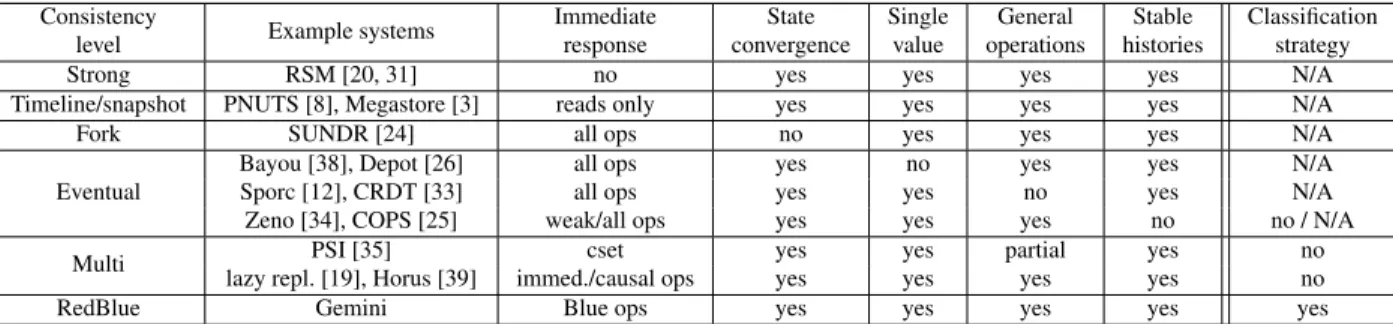
This paper addresses the inherent tension between performance and meaningful consistency. A first step to-wards this goal is to allow multiple levels of consis-tency to coexist [19, 34, 35]: some operations can be exe-cuted optimistically, without synchronizing with concur-rent actions at other sites, while others require a stronger consistency level and thus require cross-site
synchroniza-tion. However, this places a high burden on the developer of the service, who must decide which operations to as-sign which consistency levels. This requires reasoning about the consistency semantics of the overall system to ensure that the behaviors that are allowed by the different consistency levels satisfy the specification of the system. In this paper we make the following three contribu-tions to address this tension.
1. We propose a novel consistency definition called Red-Blue consistency. The intuition behind RedRed-Blue con-sistency is that blue operations execute locally and are lazily replicated in an eventually consistent man-ner [9, 25, 38, 26, 12, 33, 34]. Red operations, in con-trast, are serialized with respect to each other and re-quire immediate cross-site coordination. RedBlue con-sistency preserves causality by ensuring that depen-dencies established when an operation is invoked at its primary site are preserved as the operation is incorpo-rated at other sites.
2. We identify the conditions under which operations must be colored red and may be colored blue in order to ensure that application invariants are never violated and that all replicas converge on the same final state. Intuitively, operations that commute with all other op-erations and do not impact invariants may be blue. 3. We observe that the commutativity requirement
lim-its the space of potentially blue operations. To address this, we decompose operations into two components: (1) a generator operation that identifies the changes the original operation should make, but has no side effects itself, and (2) a shadow operation that performs the identified changes and is replicated to all sites. Only shadow operations are colored red or blue. This al-lows for a fine-grained classification of operations and broadens the space of potentially blue operations.
We built a system called Gemini that coordinates RedBlue replication, and use it to extend three applica-tions to be RedBlue consistent: the TPC-W and RUBiS benchmarks and the Quoddy social network. Our evalu-ation using microbenchmarks and the three applicevalu-ations shows that RedBlue consistency provides substantial la-tency and throughput benefits. Furthermore, our expe-rience with modifying these applications indicates that shadow operations can be created with modest effort.
po-Consistency
level Example systems
Immediate response
State convergence
Single value
General operations
Stable histories
Classification strategy
Strong RSM [20, 31] no yes yes yes yes N/A
Timeline/snapshot PNUTS [8], Megastore [3] reads only yes yes yes yes N/A
Fork SUNDR [24] all ops no yes yes yes N/A
Eventual
Bayou [38], Depot [26] all ops yes no yes yes N/A
Sporc [12], CRDT [33] all ops yes yes no yes N/A
Zeno [34], COPS [25] weak/all ops yes yes yes no no / N/A
Multi PSI [35] cset yes yes partial yes no
lazy repl. [19], Horus [39] immed./causal ops yes yes yes yes no
RedBlue Gemini Blue ops yes yes yes yes yes
Table 1: Tradeoffs in geo-replicated systems and various consistency levels. sition our work in comparison to existing proposals in §2.
We define RedBlue consistency and introduce shadow operations along with a set of principles of how to use them in §4 and §5. We describe our prototype system in §6, and report on the experience transitioning three ap-plication benchmarks to be RedBlue consistent in §7. We analyze experimental results in §8 and conclude in §9.
2
Background and related work
Target end-to-end properties.To frame the discussion of existing systems that may be used for geo-replicat-ion, we start by informally stating some desirable proper-ties that such solutions should support. The first property consists of ensuring a good user experience by provid-inglow latencyaccess to the service [32]. Providing low latency access implies that operations should proceed af-ter contacting a small number of replicas, but this is at odds with other requirements that are often sacrificed by consistency models that privilege low latency. The first such requirement is preservingcausality, both in terms of the monotonicity of user requests within a session and preserving causality across clients, which is key to en-abling natural semantics [28]. Second, it is important that all replicas that have executed the same set of operations are in the same state, i.e., that they exhibitstate conver-gence. Third, we want to avoid marked deviations from the conventional, single server semantics. In particular, operations should return asingle value, precluding solu-tions that return a set of values corresponding to the out-come of multiple concurrent updates; the system should provide a set ofstable histories, meaning that user ac-tions cannot be undone; and it should provide support for
general operations, not restricting the type of operations that can be executed. Fourth, the behavior of the system must obey its specification. This specification may be de-fined as a set ofinvariantsthat must be preserved, e.g., that no two users receive the same user id when regis-tering. Finally, and orthogonally to the tension between low latency and user semantics, it is important for all op-erations executed at one replica to be propagated to all remaining replicas, a property we calleventual propa-gation.
Table 1 summarizes several proposals of consistency definitions, which strike different balances between the
requirements mentioned above. While other consistency definitions exist, we focus on the ones most closely lated to the problem of offering fast and consistent re-sponses in geo-replicated systems.
Strong vs. weak consistency.On the strong consistency side of the spectrum there are definitions like lineariz-ability [17], where the replicated system behaves like a single server that serializes all operations. This, however, requires coordination among replicas to agree on the or-der in which operations are executed, with the corre-sponding overheads that are amplified in geo-replication scenarios. Somewhat more efficient are timeline consis-tency in PNUTS [8] and snapshot consisconsis-tency in Megas-tore [3]. These systems ensure that there is a total order for updates to the service state, but give the option of reading a consistent but dated view of the service. Sim-ilarly, Facebook has a primary site that handles updates and a secondary site that acts as a read-only copy [23]. This allows for fast reads executed at the closest site but writes still pay a penalty for serialization. Fork consis-tency [24, 27] relaxes strong consisconsis-tency by allowing users to observe distinct causal histories. The primary drawback of fork consistency is that once replicas have forked, they can never be reconciled. Such approach is useful when building secure systems but is not appropri-ate in the context of geo-replication.
Eventual consistency [38] is on the other end of the spectrum. Eventual consistency is a catch-all phrase that covers any system where replicas may diverge in the short term as long as the divergence is eventually re-paired and may or may not include causality. (See Saito and Shapiro [30] for a survey.) In practice, as shown in Table 1, systems that embrace eventual consistency have limitations. Some systems waive the stable his-tory property, either by rolling back operations and re-executing them in a different order at some of the repli-cas [34], or by resorting to a last writer wins strategy, which often results in loss of one of the concurrent up-dates [25]. Other systems expose multiple values from divergent branches in operations replies either directly to the client [26, 9] or to an application-specific conflict resolution procedure [38]. Finally, some systems restrict operations by assuming that all operations in the system commute [12, 33], which might require the programmer
to rewrite or avoid using some operations.
Coexistence of multiple consistency levels.The solu-tion we propose for addressing the tension between low latency and strongly consistent responses is to allow dif-ferent operations to run with difdif-ferent consistency lev-els. Existing systems that used a similar approach in-clude Horus [39], lazy replication [19], Zeno [34], and PSI [35]. However, none of these proposals guide the ser-vice developer in choosing between the available consis-tency levels. In particular, developers must reason about whether their choice leads to the desired service behav-ior, namely by ensuring that invariants are preserved and that replica state does not diverge. This can be challeng-ing due to difficulties in identifychalleng-ing behaviors allowed by a specific consistency level and understanding the inter-play between operations running at different levels. Our research addresses this challenge, namely by defining a set of conditions that precisely determine the appropriate consistency level for each operation.
Other related work.Consistency rationing [18] allows consistency guarantees to be associated with data instead of operations, and the consistency level to be automati-cally switched at runtime between weak consistency and serializability based on specified policies. TACT [41] consistency bounds the amount of inconsistency of data items in an application-specific manner, using the follow-ing metrics: numerical error, order error and staleness. In contrast to these models, the focus of our work is not on adapting the consistency levels of particular data items at runtime, but instead on systematically partitioning the space of operations according to their actions and the de-sired system semantics.
One of the central aspects of our work is the notion of shadow operations, which increase operation commuta-tivity by decoupling the decision of the side effects from their application to the state. This enables applications to make more use of fast operations. Some prior work also aims at increasing operation commutativity: Weihl ex-ploited commutativity-based concurrency control for ab-stract data types [40]; operational transformation [10, 12] extends non-commutative operations with a transforma-tion that makes them commute; Conflict-free Replicated Data Types (CRDTs) [33] design operations that com-mute by construction; Gray [15] proposed an open nested transaction model that uses commutative compensating transactions to revert the effects of aborted transactions without rolling back the transactions that have seen their results and already committed; delta transactions [36] di-vide a transaction into smaller pieces that commute with each other to reduce the serializability requirements. Our proposal of shadow operations can be seen as an ex-tension to these concepts, providing a different way of broadening the scope of potentially commutative opera-tions. There exist other proposals that also decouple the
execution into two parts, namely two-tier replication [16] and CRDT downstreams [33]. In contrast to these pro-posals, for each operation, we may generate different shadow operations based on the specifics of the execu-tion. Also, shadow operations can run under different consistency levels, which is important because commuta-tivity is not always sufficient to ensure safe weakly con-sistent operation.
3
System model
We assume a distributed system with state fully rep-licated acrossksites denotedsite0. . .sitek−1. We follow
the traditional deterministic state machine model, where there is a set of possible states
S
and a set of possible op-erationsO
, each replica holds a copy of the current sys-tem state, and upon applying an operation each replica deterministically transitions to the next state and possi-bly outputs a corresponding reply.In our notation, S ∈
S
denotes a system state, and u,v∈O
denote operations. We assume there exists an initial stateS0. If operationuis applied against a systemstateS, it produces another system stateS0; we will also denote this byS0=S+u. We say that a pair of operations uandv commuteif∀S∈
S
,S+u+v=S+v+u. The sys-tem maintains a set of application-specific invariants. We say that stateSisvalidif it satisfies all these invariants. Each operationuis initially submitted at one site which we call u’sprimary site and denotesite(u); the system then later replicatesuto the other sites.4
RedBlue consistency
In this section we introduce RedBlue consistency, which allows replicated systems to be fast as possible and consistent when necessary. “Fast” is an easy concept to understand—it equates to providing low latency re-sponses to user requests. “Consistent” is more nuanced— consistency models technically restrict the state that op-erations can observe, which can be translated to an or-der that operations can be applied to a system. Eventual consistency [25, 38, 26, 12], for example, permits oper-ations to be partially ordered and enables fast systems— sites can process requests locally without coordinating with each other—but sacrifices the intuitive semantics of serializing updates. In contrast, linearizability [17] or se-rializability [5] provide strong consistency and allow for systems with intuitive semantics—in effect, all sites pro-cess operations in the same order—but require signifi-cant coordination between sites, precluding fast opera-tion. RedBlue consistency is based on an explicit divi-sion of operations into blue operations whose order of execution can vary from site to site, and red operations that must be executed in the same order at all sites.
Alice in EU Bob in US
b3 b1
b2
a3 a1
b4 a2
(a) RedBlue orderOof operations
b1 b2
a2 a3
b3
b4 a1
S0
S1
S2
S3
S4
S5
S6
S7
a1 b2
b3 a2
a3
b4 b1
S0
S1'
S2'
S3'
S4'
S5'
S6'
S7'
Alice in EU Bob in US
(b) Causal serializations ofO
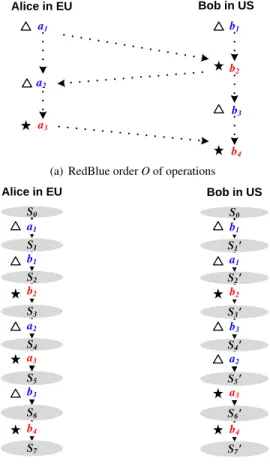
Figure 1: RedBlue order and causal serializations for a system spanning two sites. Operations marked with
?
are red; operations marked with4are blue. Dotted arrows in (a) indicate dependencies between operations.4.1
Defining RedBlue consistency
The definition of RedBlue consistency has two com-ponents: (1) A RedBlue order, which defines a partial order of operations, and (2) a set of local causal serial-izations, which define site-specific total orders in which the operations are locally applied.
Definition 1(RedBlue order). Given a set of operations U=B∪R, where B∩R=0/, aRedBlue orderis a partial order O= (U,≺)with the restriction that∀u,v∈R such that u6=v, u≺v or v≺u (i.e., red operations are totally ordered).
Recall that each site is a deterministic state machine that processes operations in a serial order. The serial or-der executed by site i is a causal serialization if it is compatible with the global RedBlue order and ensures causality for all operations initially executed at sitei. A replicated system with ksites is then RedBlue consis-tent if every site applies a causal serialization of the same global RedBlue orderO.
Definition 2(Causal serialization). Given a site i, Oi= (U, <)is an i-causal serialization(or short, acausal se-rialization) of RedBlue order O= (U,≺)if (a) Oi is a
1 float balance, interest = 0.05;
2 funcdeposit( float money ):
3 balance = balance + money;
4 funcwithdraw ( float money ):
5 if ( balance - money >= 0 )then:
6 balance = balance - money;
7 else print "failure";
8 funcaccrueinterest():
9 float delta = balance ×interest;
10 balance = balance + delta;
Figure 2: Pseudocode for the bank example. linear extension of O (i.e.,<is a total order compatible with the partial order≺), and (b) for any two operations u,v∈U , if site(v) =i and u<v in Oi, then u≺v.
Definition 3(RedBlue consistency). A replicated system is O-RedBlue consistent(or short, RedBlue consistent) if each site i applies operations according to an i-causal serialization of RedBlue order O.
Figure 1 shows a RedBlue order and a pair of causal serializations of that RedBlue order. In systems where every operation is labeled red, RedBlue consistency is equivalent to serializability [5]; in systems where every operation is labeled blue, RedBlue consistency allows the same set of behaviors as eventual consistency [38, 25, 26]. It is important to note that while RedBlue consis-tency constrains possible orderings of operations at each site and thus the states the system can reach, it does not ensure a priorithat the system achieves all the end-to-end properties identified in §2, in particular, state con-vergence and invariant preservation, as discussed next.
4.2
State convergence and a RedBlue bank
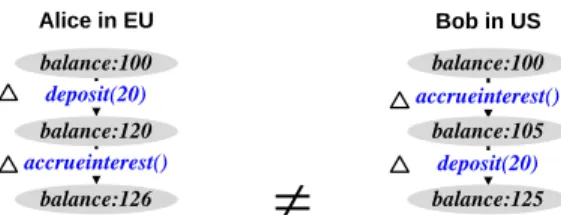
In order to understand RedBlue consistency it is in-structive to look at a concrete example. For this exam-ple, consider a simple bank with two users: Alice in the EU and Bob in the US. Alice and Bob share a single bank account where they can deposit or withdraw funds and where a local bank branch can accrue interest on the account (pseudocode for the operations can be found in Figure 2). Let thedepositandaccrueinterest opera-tions be blue. Figure 3 shows a RedBlue order of deposits and interest accruals made by Alice and Bob and causal serializations applied at both branches of the bank.
State convergence is important for replicated sys-tems. Intuitively a pair of replicas is state convergent if, after processing the same set of operations, they are in the same state. In the context of RedBlue consistency we formalize state convergence as follows:
Definition 4(State convergence). A RedBlue consistent system is state convergent if all causal serializations of the underlying RedBlue order O reach the same state S.
The bank example as described is not state conver-gent. The root cause is not surprising: RedBlue consis-tency allows sites to execute blue operations in differ-ent orders but two blue operations in the example corre-spond to non-commutative operations—addition (
dep-Alice in EU Bob in US
accrueinterest() deposit(20)
(a) RedBlue orderOof operations issued by Alice and Bob
deposit(20) accrueinterest()
¹
deposit(20)balance:100
accrueinterest()
Alice in EU Bob in US
balance:100
balance:120 balance:105
balance:126 balance:125
(b) Causal serializations ofOleading to diverged state
Figure 3: A RedBlue consistent account with initial bal-ance of $100.
osit) and multiplication (accrueinterest). A suffi-cient condition to guarantee state convergence in a Red-Blue consistent system is that every blue operation is globally commutative, i.e., it commutes with all other op-erations, blue or red.
Theorem 1. Given a RedBlue order O, if all blue op-erations are globally commutative, then any O-RedBlue consistent system is state convergent.1
The banking example and Theorem 1 highlight an important tension inherent to RedBlue consistency. On the one hand, low latency requires an abundance of blue operations. On the other hand, state convergence requires that blue operations commute with all other operations, blue or red. In the next section we introduce a method for addressing this tension by increasing commutativity.
5
Replicating side effects
In this section, we observe that while operations themselves may not be commutative,we can often make the changes they induce on the system state commute. Let us illustrate this issue within the context of the Red-Blue bank from §4.2. We can make the deposit and
accrueinterestoperations commute by first
comput-ing the amount of interested accrued and then treatcomput-ing that value as a deposit.
5.1
Defining shadow operations
The key idea is to split each original application op-eration u into two components: agenerator operation gu with no side effects, which is executed only at the
primary site against some system state S and produces a shadow operation hu(S), which is executed at every
site (including the primary site). The generator operation decides which state transitions should be made while the shadow operation applies the transitions in a state-indep-endent manner.
The implementation of generator and shadow oper-ations must obey some basic correctness requirements. Generator operations, as mentioned, must not have any
1All proofs can be found in a separate technical report [22].
side effects. Furthermore, shadow operations must pro-duce the same effects as the corresponding original oper-ation when executed against the original stateSused as an argument in the creation of the shadow operation.
Definition 5 (Correct generator / shadow operations).
The decomposition of operation u into generator and sh-adow operations is correct if for all states S, the genera-tor operation guhas no effect and the generated shadow operation hu(S)has the same effect as u, i.e., for any state S: S+gu=S and S+hu(S) =S+u.
Note that a trivial decomposition of an original oper-ationuinto generator and shadow operations is to letgu
be a no-op and lethu(S) =ufor allS.
In practice, as exemplified in §7, separating the de-cision of which transition to make from the act of ap-plying the transition allows many objects and their as-sociated usage in shadow operations to form an abelian group and thus dramatically increase the number of com-mutative (i.e., blue) operations in the system. Unlike pre-vious approaches [16, 33], for a given original operation, our solution allows its generator operation to generate state-specific shadow operations with different proper-ties, which can then be assigned different colors in the RedBlue consistency model.
5.2
Revisiting RedBlue consistency
Decomposing operations into generator and shadow components requires us to revisit the foundations of Red-Blue consistency. In particular, only shadow operations are included in a RedBlue order while the causal serial-ization for siteiadditionally includes the generator oper-ations initially executed at sitei. The causal serialization must ensure that generator operations see the same state that is associated with the generated shadow operation and that shadow operations appropriately inherit all de-pendencies from their generator operation.
We capture these subtleties in the following revised definition of causal serializations. Let U be the set of shadow operations executed by the system andVibe the
generator operations executed at sitei.
Definition 6(Causal serialization–revised). Given a site i, Oi= (U∪Vi, <)is an i-causal serialization of RedBlue order O= (U,≺)if
• Oiis a total order;
• (U, <)is a linear extension of O;
• For any hv(S)∈U generated by gv∈Vi, S is the state obtained after applying the sequence of shadow oper-ations preceding gvin Oi;
• For any gv∈Vi and hu(S)∈U , hu(S)<gv in Oi iff hu(S)≺hv(S0)in O.
Note that shadow operations appear in every causal serialization, while generator operations appear only in the causal serialization of the initially executing site.
1 funcdeposit’ ( float money ):
2 balance = balance + money;
3 funcwithdrawAck’ ( float money ):
4 balance = balance - money;
5 funcwithdrawFail’ ():
6 /* no-op */
7 funcaccrueinterest’ ( float delta ):
8 balance = balance + delta;
Figure 4: Pseudocode for shadow bank operations.
Alice in EU Bob in US
accrueinterest’(5)
withdrawAck’(60) deposit’(20)
withdrawAck’(70)
(a) RedBlue orderOof banking shadow operations
withdrawAck’(60) withdrawAck’(60)
withdrawAck’(70)
withdrawAck’(70)
balance:125
Alice in EU Bob in US
balance:125
balance:55 balance:65
balance:-5 balance:-5
withdraw(70) withdraw(60)
(b) Invalid but convergent causal serializations ofO
Figure 5: A RedBlue consistent bank with only blue op-erations. The starting balance of $125 is the result of applying shadow operations above the solid line to an initial balance of $100. Loops indicate generator opera-tions.
5.3
Shadow banking and invariants
Figure 4 shows the shadow operations for the bank-ing example. Note that thewithdrawoperation maps to two distinct shadow operations that may be labeled as blue or red independently—withdrawAck’ and
with-drawFail’.
Figure 5 illustrates that shadow operations make it possible for all operations to commute, provided that we can identify the underlying abelian group. This does not mean, however, that it is safe to label all operations blue. In this example, such a labeling would allow Alice and Bob to successfully withdraw $70 and $60 at their local branches, thus ending up with a final balance of $-5. This violates the fundamental invariant that a bank balance should never be negative.
To determine which operations can be safely labeled blue, we begin by defining that a shadow operation is invariant safe if, when applied to a valid state, it always transitions the system into another valid state.
Definition 7(Invariant safe). Shadow operation hu(S)is invariant safe if for all valid states S and S0, the state S0+hu(S)is also valid.
The following theorem states that in a RedBlue con-sistent system with appropriate labeling, each replica transitions only through valid states.
Theorem 2. If all shadow operations are correct and all blue shadow operations are invariant safe and globally
Alice in EU Bob in US
despoit’(10) accrueinterest’(5)
withdrawAck’(60)
withdrawAck’(40) deposit’(20)
withdrawAck’(30) withdrawFail’()
(a) RedBlue orderOof banking shadow operations
withdrawAck’(30) withdrawAck’(40)
deposit’(10) withdrawFail’()
withdrawAck’(60)
accrueinterest’(5) deposit’(20) balance:100
Alice in EU
balance:125
withdrawAck’(30) withdrawAck’(40)
withdrawFail’() deposit’(10)
withdrawAck’(60)
deposit’(20) accrueinterest’(5)
Bob in US
balance:100
balance:125 balance:120 balance:105
balance:65 balance:65
balance:65 balance:75 balance:75 balance:75
balance:35 balance:35
balance:5 balance:5 deposit(20)
withdraw(70)
withdraw(30) deposit(10) accrueinterest()
withdraw(40)
withdraw(60)
(b) Convergent and invariant preserving causal serializations ofO
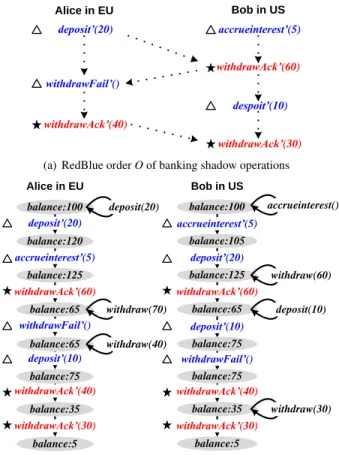
Figure 6: A RedBlue consistent bank with correctly la-beled shadow operations and initial balance of $100. commutative, then for any execution of that system that is RedBlue consistent, no site is ever in an invalid state.
What can be blue? What must be red?The combina-tion of Theorems 1 and 2 leads to the following proce-dure for deciding which shadow operations can be blue or must be red if a RedBlue consistent system is to pro-vide both state convergence and invariant preservation: 1. For any pair of non-commutative shadow operationsu
andv, label bothuandvred.
2. For any shadow operationuthat may result in an in-variant being violated, labelured.
3. Label all non-red shadow operations blue.
Applying this decision process to the bank example leads to a labeling wherewithdrawAck’ is red and the remaining shadow operations are blue. Figure 6 shows a RedBlue order with appropriately labeled shadow opera-tions and causal serializaopera-tions for the two sites.
5.4
Discussion
Shadow operations introduce some surprising anomalies to a user experience. Notably, while the effect of every user action is applied at every site, the final system state is not guaranteed to match the state resulting from a serial ordering of the original operations. The important thing to keep in mind is that the decisions
made always make sense in the context of thelocalview of the system: when Alice accrues interest in the EU, the amount of interest accrued is based on the balance that Alice observes at that moment. If Bob concurrently makes a deposit in the US and subsequently observes that interest has been accrued, the amount of interestwill notmatch the amount that Bob would accrue based on the balance as he currently observes it.
Shadow operations always provide for a coherent se-quence of state transitions that reflects the effects de-manded by user activity; while this sequence of state transitions is coherent (and convergent), the state tran-sitions are chosen based on the locally observable state when/where the user activity initiated and not the system state when they are applied.
6
Gemini design & implementation
We implemented the Gemini storage system to pro-vide RedBlue consistency. The prototype consists of 10K lines of java code and uses MySQL as its storage back-end. Each Gemini site consists of four components: a storage engine, a proxy server, a concurrency coordina-tor, and a data writer. A multi-site deployment is con-structed by replicating the single site components across multiple sites.
The basic flow of user requests through the system is straightforward. A user issues requests to a proxy serverlocated at the closest site. The proxy server pro-cesses a request by executing an appropriate application transaction, which is implemented as a single Gemini operation, comprising multiple data accesses; individ-ual data accesses within a generator operation execute in a temporary private scratchpad, providing a virtual pri-vate copy of the service state. The original data lies in astorage engine, which provides a standard storage in-terface. In our implementation, the storage engine is a relational database, and scratchpad operations are exe-cuted against a temporary table. Upon completion of the generator operation, the proxy server sends the produced shadow operation on to theconcurrency coordinatorto admit or reject this operation according to RedBlue con-sistency. The concurrency coordinator notifies the proxy server if the operation is accepted or rejected. Addition-ally, accepted shadow operations are appended to the end of the local causal serialization and propagated to remote sites and to the local data writerfor execution against the storage engine. When a shadow operation is rejected, the proxy server re-executes the generator operation and restarts the process.
6.1
Optimistic concurrency control
Gemini relies on optimistic concurrency control (OCC) [5] to run generator operations without blocking.
Gemini uses timestamps to determine if opera-tions can complete successfully. Timestamps are logical
clocks [20] of the form hhb0,b1, . . . ,bk−1i,ri, where bi
is the local count of shadow operations initially executed by site iandris the global count of red shadow oper-ations. To ensure that different sites do not choose the same red sequence number (i.e., all red operations are totally-ordered) we use a simple token passing scheme: only the coordinator in possession of a unique red token is allowed to increase the counterrand approve red oper-ations. In the current prototype, a coordinator holds onto the red token for up to 1 second before passing it along.
When a generator operation completes, the coordina-tor must determine if the operation (a) reads a coherent system snapshot and (b) obeys the ordering constraints of a causal serialization, as described in §5. To do this, the coordinator checks the timestamps of the data items readd and written by the completing operation, and com-pares them to the timestamps associated with operations completing concurrently and the remote shadow opera-tions that were being applied simultaneously at that site. Upon successful completion of a generator operation the coordinator assigns the corresponding shadow oper-ation a timestamp that is component-wise equal to the latest operation that was incorporated at its site, and in-crements its blue and, if this shadow operations is red, the red component of the logical timestamp. This times-tamp determines the position of the shadow operation in the RedBlue order, with the normal rules that determine that two operations are partially ordered if one is equal to or dominates the other in all components. It also al-lows sites to know when it is safe to incorporate remote shadow operations: they must wait until all shadow op-erations with smaller timestamps have already been in-corporated in the local state of the site. When a remote shadow operation is applied at a site, it is assigned a new timestamp that is the entry-wise max of the timestamp assigned to the shadow operation in the initial site and the local timestamps of accessed data objects. This cap-tures dependencies that span local and remote operations.
Read-only shadow operations.As a performance op-timization, a subset of blue shadow operations can be marked read-only. Read-only shadow operations receive special treatment from the coordinator: once the genera-tor operation passes the coherence and causality checks, the proxy is notified that the shadow operation has been accepted but the shadow operation is not incorporated into the local serialization or global RedBlue order.
6.2
Failure handling
The current Gemini prototype is designed to demon-strate the performance potential of RedBlue consistency in geo-replicated environments and as such is not imple-mented to tolerate faults of either a local (i.e., within a site) or catastrophic (i.e., of an entire site) nature. Ad-dressing these concerns is orthogonal to the primary
con-tributions of this paper, nonetheless we briefly sketch mechanisms that could be employed to handle faults.
Isolated component failure.The Gemini architecture consists of four main components at each site, each rep-resenting a single point of failure. Standard state machine replication techniques [20, 31] can be employed to make each component robust to failures.
Site failure.Our Gemini prototype relies on a simple to-ken exchange for coordinating red epochs. To avoid halt-ing the system upon a site failure, a fault tolerant con-sensus protocol like Paxos [21] can regulate red tokens.
Operation propagation.Gemini relies on each site to propagate its own local operations to all remote sites. A pair-wise network outage or failure of a site following the replication of a operation to some but not all of the sites could prevent sites from exchanging operations that de-pend on the partially replicated operation. This can be ad-dressed using standard techniques for exchanging causal logs [26, 2, 38, 28] or reliable multicast [13].
Cross-session monotonicity.The proxy that each user connects to enforces the monotonicity of user requests within a session [37]. However, a failure of that proxy, or the user connecting to a different site may result in a subset of that user’s operations not carrying over. This can be addressed by allowing the user to specify a “last-read” version when starting a new session or requiring the user to cache all relevant requests [26] in order to replay them when connecting to a new site.
7
Case studies
In this section we report on our experience in modi-fying three existing applications—the TPC-W shopping cart benchmark [7], the RUBiS auction benchmark [11], and the Quoddy social networking application [14]—to work with RedBlue consistency. The two main tasks to fulfill this goal are (1) decomposing the application into generator and shadow operations and (2) labeling the shadow operations appropriately.
Writing generator and shadow operations.Each of the three case study applications executes MySQL data-base transactions as part of processing user requests, gen-erally one transaction per request. We map these applica-tion level transacapplica-tions to the original operaapplica-tions and they also serve as a starting point for the generator operations. For shadow operations, we turn each execution path in the original operation into a distinct shadow operation; an execution path that does not modify system state is ex-plicitly encoded as a no-op shadow operation.When the shadow operations are in place, the generator operation is augmented to invoke the appropriate shadow operation at each path.
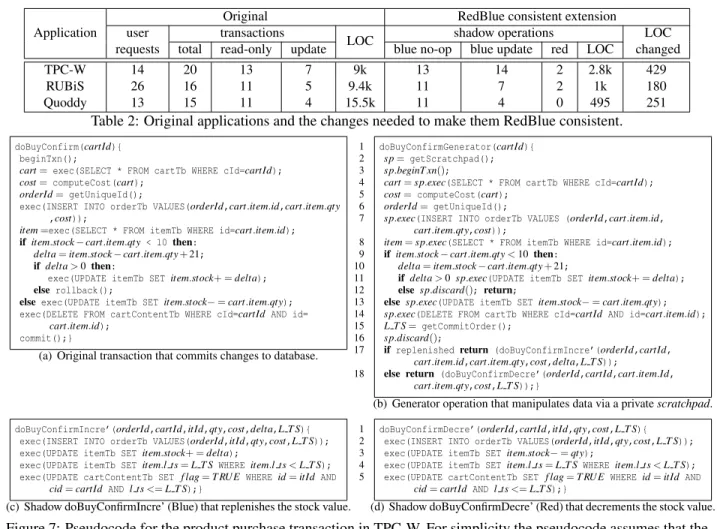
Labeling shadow operations.Table 2 reports the num-ber of transactions in the TPC-W, RUBiS, and Quoddy,
the number of blue and red shadow operations we iden-tified using the labeling rules in §5.3, and the application changes measured in lines of code. Note that read-only transactions always map to blue no-op shadow opera-tions. In the rest of this section we expand on the lessons learned from making applicaations RedBlue consistent.
7.1
TPC-W
TPC-W [7] models an online bookstore. The appli-cation server handles 14 different user requests such as browsing, searching, adding products to a shopping cart, or placing an order. Each user request generates between one and four transactions that access state stored across eight different tables. We extend an open source imple-mentation of the benchmark [29] to allow a shopping cart to be shared by multiple users across multiple sessions.
Writing TPC-W generator and shadow operations.
Of the twenty TPC-W transactions, thirteen are read-only and admit no-op shadow operations. The remain-ing seven update transactions translate to one or more shadow operations according to the number of distinct execution paths in the original operation .
We now give an example transaction, doBuyConf-irm, which completes a user purchase. The pseudocode for the original transaction is shown in Figure 7(a).
The doBuyConfirm transaction removes all items
from a shopping cart, computes the total cost of the purchase, and updates the stock value for the purchased items. If the stock would drop below a minimum thresh-old, then the transaction also replenishes the stock. The key challenge in implementing shadow operations for
doBuyConfirm is that the original transaction does not
commute with itself or any transaction that modifies the contents of a shopping cart. Naively treating the origi-nal transaction as a shadow operation would force every shadow operation to be red.
Figure 7(b) shows the generator operation of
doBuy-Confirm, and Figures 7(c) and 7(d) depict the
corre-sponding pair of shadow operations:
doBuyConfirmI-ncre’ anddoBuyConfirmDecre’. The former shadow
operation is generated when the stock falls below the minimum threshold and must be replenished; the latter is generated when the purchase does not drive the stock below the minimum threshold and consequently does not trigger the replenishment path. In both cases, the gener-ator operation is used to determine the number of items purchased and total cost as well the shadow operation that corresponds to the initial execution. At the end of the execution of the generator operation these param-eters and the chosen shadow operation are then propa-gated to other replicas.
Labeling TPC-W shadow operations.For 29 shadow operations in TPC-W, we find that 27 can be blue and only two must be red. To label shadow operations, we
Application
Original RedBlue consistent extension
user requests
transactions
LOC shadow operations LOC
changed
total read-only update blue no-op blue update red LOC
TPC-W 14 20 13 7 9k 13 14 2 2.8k 429
RUBiS 26 16 11 5 9.4k 11 7 2 1k 180
Quoddy 13 15 11 4 15.5k 11 4 0 495 251
Table 2: Original applications and the changes needed to make them RedBlue consistent. 1 doBuyConfirm(cartId){
2 beginTxn();
3 cart= exec(SELECT * FROM cartTb WHERE cId=cartId);
4 cost= computeCost(cart);
5 orderId=getUniqueId();
6 exec(INSERT INTO orderTb VALUES(orderId,cart.item.id,cart.item.qty
,cost));
7 item=exec(SELECT * FROM itemTb WHERE id=cart.item.id);
8 ifitem.stock−cart.item.qty < 10 then:
9 delta=item.stock−cart.item.qty+21;
10 ifdelta>0then:
11 exec(UPDATE itemTb SETitem.stock+ =delta);
12 elserollback();
13 elseexec(UPDATE itemTb SET item.stock−=cart.item.qty);
14 exec(DELETE FROM cartContentTb WHERE cId=cartId AND id=
cart.item.id);
15 commit();}
(a) Original transaction that commits changes to database.
1 doBuyConfirmGenerator(cartId){
2 sp= getScratchpad();
3 sp.beginT xn();
4 cart=sp.exec(SELECT * FROM cartTb WHERE cId=cartId);
5 cost=computeCost(cart);
6 orderId=getUniqueId();
7 sp.exec(INSERT INTO orderTb VALUES (orderId,cart.item.id,
cart.item.qty,cost));
8 item=sp.exec(SELECT * FROM itemTb WHERE id=cart.item.id);
9 if item.stock−cart.item.qty<10 then:
10 delta=item.stock−cart.item.qty+21;
11 if delta>0 sp.exec(UPDATE itemTb SETitem.stock+ =delta);
12 else sp.discard(); return;
13 else sp.exec(UPDATE itemTb SETitem.stock−=cart.item.qty);
14 sp.exec(DELETE FROM cartTb WHERE cId=cartId AND id=cart.item.id);
15 L T S= getCommitOrder();
16 sp.discard();
17 if replenishedreturn(doBuyConfirmIncre’(orderId,cartId,
cart.item.id,cart.item.qty,cost,delta,L T S));
18 else return (doBuyConfirmDecre’(orderId,cartId,cart.item.Id,
cart.item.qty,cost,L T S));}
(b) Generator operation that manipulates data via a privatescratchpad.
1 doBuyConfirmIncre’(orderId,cartId,itId,qty,cost,delta,L T S){
2 exec(INSERT INTO orderTb VALUES(orderId,itId,qty,cost,L T S));
3 exec(UPDATE itemTb SETitem.stock+ =delta);
4 exec(UPDATE itemTb SETitem.l ts=L T SWHEREitem.l ts<L T S);
5 exec(UPDATE cartContentTb SET f lag=T RU E WHEREid=itId AND
cid=cartIdAND l ts<=L T S);}
(c) Shadow doBuyConfirmIncre’ (Blue) that replenishes the stock value.
1 doBuyConfirmDecre’(orderId,cartId,itId,qty,cost,L T S){
2 exec(INSERT INTO orderTb VALUES(orderId,itId,qty,cost,L T S));
3 exec(UPDATE itemTb SET item.stock−=qty);
4 exec(UPDATE itemTb SET item.l ts=L T S WHEREitem.l ts<L T S);
5 exec(UPDATE cartContentTb SET f lag=T RU EWHEREid=itIdAND
cid=cartId ANDl ts<=L T S);}
(d) Shadow doBuyConfirmDecre’ (Red) that decrements the stock value.
Figure 7: Pseudocode for the product purchase transaction in TPC-W. For simplicity the pseudocode assumes that the corresponding shopping cart only contains a single type of item.
identified two key invariants that the system must main-tain. First, the number of in-stock items can never fall below zero. Second, the identifiers generated by the sys-tem (e.g., for isys-tems or shopping carts) must be unique.
The first invariant is easy to maintain by labeling
doBuyConfirmDecre’(Figure 7(d)) and its close variant
doBuyConfirmAddrDecre’ red. We observe that they
are the only shadow operations in the system that de-crease the stock value, and as such are the only shadow operations that can possibly invalidate the first invariant. Note that the companion shadow operation
doBuyCon-firmIncre’(Figure 7(c))increasesthe stock level, and
can never drive the stock count below zero, so it can be blue.
The second invariant is more subtle. TPC-W gener-ates IDs for objects (e.g., shopping carts, items, etc.) as they are created by the system. These IDs are used as keys for item lookups and consequently must them-selves be unique. To preserve this invariant, we have to label many shadow operations red. This problem is well-known in database replication [6] and was circumvented by modifying the ID generation code, so that IDs become a pair appproxy id, seqnumber, which makes these
operations trivially blue.
7.2
RUBiS
RUBiS [11] emulates an online auction website mod-eled after eBay [1]. RUBiS defines a set of 26 requests that users can issue ranging from selling, browsing for, bidding on, or buying items directly, to consulting a personal profile that lists outstanding auctions and bids. These 26 user requests are backed by a set of 16 transac-tions that access the storage backend.
Of these 16 transactions, 11 are read-only, and there-fore trivially commutative. For the remaining 5 update transactions, we construct shadow operations to make them commute, similarly to TPC-W. Each of these trans-actions leads to between 1 and 3 shadow operations.
Through an analysis of the application logic, we de-termined three invariants. First, that identifiers assigned by the system are unique. Second, that nicknames chosen by users are unique. Third, that item stock cannot fall be-low zero. Again, we preserve the first invariant using the global id generation strategy described in §7.1. The sec-ond and third invariants require both RegisterUser’, checking if a name submitted by a user was already cho-sen, and storeBuyNow’, which decreases stock, to be
labeled as red.
7.3
Quoddy
Quoddy [14] is an open source Facebook-like so-cial networking site. Despite being under development, Quoddy already implements the most important features of a social networking site, such as searching for a user, browsing user profiles, adding friends, posting a mes-sage, etc. These main features define 13 user requests corresponding to 15 different transactions. Of these 15 transactions, 11 are read-only transactions, thus requir-ing trivial no-op shadow operations.
Writing and labeling shadow operations for the 4 remaining transactions in Quoddy was straightforward. Besides reusing the recipe for unique identifiers, we only had to handle an automatic conversion of dates to the lo-cal timezone (performed by default by the database) by storing dates in UTC in all sites. In the social network we did not find system invariants to speak of; we found that all shadow operations could be labeled blue.
7.4
Experience and discussion
Our experience showed that writing shadow opera-tions is easy; it took us about one week to understand the code, and implement and label shadow operations for all applications. We also found that the strategy of generat-ing a different shadow operation for each distinct execu-tion path is beneficial for two reasons. First, it leads to a simple logic for shadow operations that can be based on operations that are intrinsically commutative, e.g., in-crement/decrement, insertion/removal. Second, it leads to a fine-grained classification of operations, with more execution paths leading to blue operations. Finally, we found that it was useful in more than one application to make use of a standard last-writer-wins strategy to make operations that overwrite part of the state commute.
8
Evaluation
We evaluate Gemini and RedBlue consistency using microbenchmarks and our three case study applications. The primary goal of our evaluation is to determine if RedBlue consistency can improve latency and through-put in geo-replicated systems.
8.1
Experimental setup
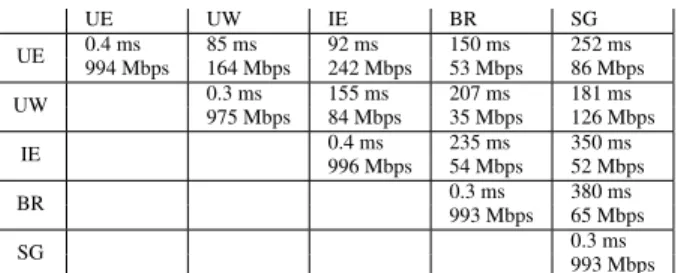
We run experiments on Amazon EC2 using extra large virtual machine instances located in five sites: US east (UE), US west (UW), Ireland (IE), Brazil (BR), and Singapore (SG). Table 3 shows the average round trip latency and observed bandwidth between every pair of sites. For experiments with fewer than 5 sites, new sites are added in the following order: UE, UW, IE, BR, SG. Unless otherwise noted, users are evenly distributed across all sites. Each VM has 8 virtual cores and 15GB of RAM. VMs run Debian 6 (Squeeze) 64 bit, MySQL
UE UW IE BR SG
UE 0.4 ms 85 ms 92 ms 150 ms 252 ms 994 Mbps 164 Mbps 242 Mbps 53 Mbps 86 Mbps UW 0.3 ms 155 ms 207 ms 181 ms
975 Mbps 84 Mbps 35 Mbps 126 Mbps
IE 0.4 ms 235 ms 350 ms
996 Mbps 54 Mbps 52 Mbps
BR 0.3 ms 380 ms
993 Mbps 65 Mbps
SG 0.3 ms
993 Mbps Table 3: Average round trip latency and bandwidth be-tween Amazon sites.
5.5.18, Tomcat 6.0.35, and Sun Java SDK 1.6. Each ex-perimental run lasts for 10 minutes.
8.2
Microbenchmark
We begin the evaluation with a simple microbench-mark designed to stress the costs and benefits of parti-tioning operations into red and blue sets. Each user is-sues requests accessing a random record from a MySQL database. Each request maps to a single shadow opera-tion; we say a request is blue if it maps to a blue shadow operation and red otherwise. The offered workload is var-ied by adjusting the number of outstanding requests per user and the ratio of red and blue requests.
We run the microbenchmark experiments with a dataset consisting of 10 tables, each initialized with 1,000,000 records; each record has 1 text and 4 integer attributes. The total size of the dataset is 1.0 GB.
8.2.1 User observed latency
The primary benefit of using Gemini across multiple sites is the decrease in latency from avoiding the inter-continental round-trips as much as possible. As a result, we first explore the impact of RedBlue consistency on user experienced latency. In the following experiments each user issues a single outstanding request at a time.
Figure 8(a) shows that the average latency for blue re-quests is dominated by the latency between the user and the closest site; as expected, average latency decreases as additional sites appear close to the user. Figure 8(b) shows that this trend also holds for red requests. The av-erage latency and standard deviation, however, are higher for red requests than for blue requests. To understand this effect, we plot in Figures 8(c) and 8(d) the CDFs of ob-served latencies for blue and red requests, respectively, from the perspective of users located in Singapore. The observed latency for blue requests tracks closely with the round-trip latency to the closest site. For red requests, in thek=2 throughk=4 site configurations, four requests from a user in Singapore are processed at the closest site during the one second in which the closest site holds the red token; every fifth request must wait k−1 seconds for the token to return. In the 5 site configuration, the local site also becomes a replica of the service and there-fore a much larger number of requests (more than 300) can be processed while the local site holds the red token. This changes the format of the curve, since there is now
0 100 200 300
2-site 3-site 4-site 5-site
Latency (ms)
US-East US-West Ireland Brazil Singapore
(a) Blue request latency for all users as number of sites increases
0 1000 2000
2-site 3-site 4-site 5-site
Latency (ms)
US-East US-West Ireland Brazil Singapore
(b) Red request latency for all users as number of sites increases
0 0.2 0.4 0.6 0.8 1
1 10 100 1000
Probability
Latency (ms)
2-site 3-site 4-site 5-site
(c) Blue latency CDF for Singapore users as number of sites increases
0 0.2 0.4 0.6 0.8 1
1 10 100 1000 10000
Probability
Latency (ms)
2-site 3-site 4-site 5-site
(d) Red latency CDF for Singapore users as number of sites increases
Figure 8: (a) and (b) show the average latency and standard deviation for blue and red requests issued by users in different locales as the number of sites is increased, respectively. (c) and (d) show the CDF of latencies for blue and red requests issued by users in Singapore as the number of sites is increased, respectively.
a much smaller fraction of requests that need to wait four seconds for the token to return.
8.2.2 Peak throughput
We now shift our attention to the throughput im-plications of RedBlue consistency. Figure 9 shows a throughput-latency graph for a 2 site configuration and three workloads: 100% blue, 100% red, and a 70% blue/30% red mix. The different points in each curve are obtained by increasing the offered workload, which is achieved by increasing the number of outstanding re-quests per user. For the mixed workload, users are par-titioned into blue and red sets responsible for issuing re-quests of the specified color and the ratio is a result of this configuration.
The results in Figure 9 show that increasing the ratio of red requests degrades both latency and throughput. In particular, the two-fold increase in throughput for the all blue workload in comparison to the all red workload is a direct consequence of the coordination (not) required to process red (blue) requests: while red requests can only be executed by the site holding the red token to process, every site may independently process blue requests. The peak throughput of the mixed workload is proportionally situated between the two pure workloads.
8.3
Case studies: TPC-W and RUBiS
Our microbenchmark experiments indicate that Red-Blue consistency instantiated with Gemini offers latency and throughput benefits in geo-replicated systems with sufficient blue shadow operations. Next, we evaluate Gemini using TPC-W and RUBiS.0 20 40 60
0 1000 2000 3000 4000 5000
Latency (ms)
Throughput (request/s)
100Blue/0Red 70Blue/30Red 0Blue/100Red
Figure 9: Throughput versus latency graph for a 2 site configuration with varying red-blue workload mixes.
8.3.1 Configuration and workloads
In all case studies experiments a single site configu-ration corresponds to the original unmodified code with users distributed amongst all five sites. Two through five site configurations correspond to the modified RedBlue consistent systems running on top of Gemini. When nec-essary, we modified the provided user emulators so that each user maintainskoutstanding requests and issues the next request as soon as a response is received.
TPC-W.TPC-W [7] defines three workload mixes dif-ferentiated by the percentage of client requests related to making purchases: browsing (5%), shopping (20%), or-dering (50%). The dataset is generated with the following TPC-W parameters: 50 EBS and 10,000 items.
RUBiS.RUBiS defines two workload mixes: browsing, exclusively comprised of read-only interactions, and bid-ding, where 15% of user interactions are updates. We evaluate only the bidding mix. The RUBiS database con-tains 33,000 items for sale, 1 million users, 500,000 old items and is 2.1 GB in total.
0 2000 4000
1-site 2-site 3-site 4-site 5-site
Latency (ms)
US-East US-West Ireland Brazil Singapore
(a) TPC-W doCart
0 2000 4000
1-site 2-site 3-site 4-site 5-site
Latency (ms)
US-East US-West Ireland Brazil Singapore
(b) TPC-W doBuyConfirm
0 500 1000
1-site 2-site 3-site 4-site 5-site
Latency (ms)
US-East US-West Ireland Brazil Singapore
(c) RUBiS StoreBid
0 2000 4000
1-site 2-site 3-site 4-site 5-site
Latency (ms)
US-East US-West Ireland Brazil Singapore
(d) RUBiS StoreBuyNow
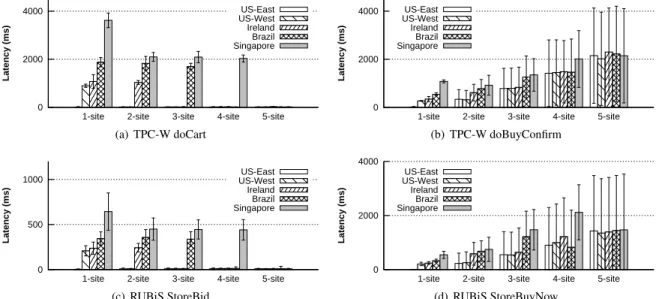
Figure 10: Average latency for selected TPC-W and RUBiS user interactions. Shadow operations for doCart and StoreBid are always blue; for doBuyConfirm and StoreBuyNow they are red 98% and 99% of the time respectively.
Blue Red read-only update
TPC-W shop 99.2 0.8 85 15
TPC-W browse 99.5 0.5 96 4
TPC-W order 93.6 6.4 63 37
RUBiS bid 97.4 2.6 85 15
Table 4: Proportion of blue and red shadow operations and read-only and update requests in TPC-W and RUBiS workloads at runtime.
8.3.2 Prevalence of blue and red shadow operations
Table 4 shows the distribution of blue and red shadow operations during execution of the TPC-W and RUBiS workloads. The results show that TPC-W and RUBiS ex-hibit sufficient blue shadow operations for it to be likely that we can exploit the potential of RedBlue consistency.
8.3.3 User observed latency
We first explore the per request latency for a set of exemplar red and blue requests from TPC-W and RUBiS. For this round of experiments, each site hosts a single user issuing one outstanding request to the closest site.
From TPC-W we select doBuyConfirm (discussed in detail in §7.1) as an exemplar for red requests and doCart (responsible for adding/removing items to/from a shop-ping cart) as an exemplar for blue requests; from RUBiS we identify StoreBuyNow (responsible for purchasing an item at the buyout price) as an exemplar for red requests and StoreBid (responsible for placing a bid on an item) as an exemplar for blue requests. Note that doBuyCon-firm and StoreBid can produce either red or blue shadow operations; in our experience they produce red shadow operations 98% and 99% of the time respectively.
Figures 10(a) and 10(c) show that the latency trends for blue shadow operations are consistent with the results from the microbenchmark—observed latency is directly
proportional to the latency to the closest site. The raw la-tency values are higher than the round-trip time from the user to the nearest site because processing each request involves sending one or more images to the user.
For red requests, Figures 10(b) and 10(d) show that llatency and standard deviation both increase with the number of sites. The increase in standard deviation is an expected side effect of the simple scheme that Gemini uses to exchange the red token and is consistent with the microbenchmark results. Similarly, the increase in aver-age latency is due to the fact that the time for a token ro-tation increases, together with the fact that red requests are not frequent enough that several cannot be slipped in during the same token holding interval. We note that the token passing scheme used by Gemini is simple and additional work is needed to identify an optimal strategy for regulating red shadow operations.
8.3.4 Peak throughput
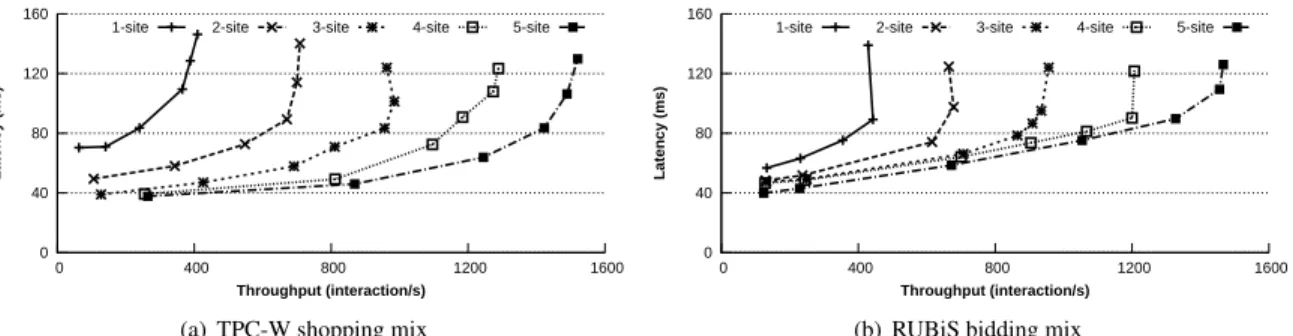
We now shift our attention to the throughput afforded by our RedBlue consistent versions of TPC-W and RU-BiS, and how it scales with the number of sites. For these experiments we vary the workload by increasing the number of outstanding requests maintained by each user. Throughput is measured according to interactions per second, a metric defined by TPC-W to correspond to user requests per second.
Figure 11 shows throughput and latency for the TPC-W shopping mix and RUBiS bidding mix as we vary the number of sites. In both systems, increasing the number of sites increases peak throughput and decreases aver-age latency. The decreased latency results from situating users closer to the site processing their requests. The in-crease in throughput is due to processing blue and read-only operations at multiple sites, given that processing
0 40 80 120 160
0 400 800 1200 1600
Latency (ms)
Throughput (interaction/s)
1-site 2-site 3-site 4-site 5-site
(a) TPC-W shopping mix
0 40 80 120 160
0 400 800 1200 1600
Latency (ms)
Throughput (interaction/s)
1-site 2-site 3-site 4-site 5-site
(b) RUBiS bidding mix
Figure 11: Throughput versus latency for the TPC-W shopping mix and RUBiS bidding mix. The 1-site line corre-sponds to the original code; the 2/3/4/5-site lines correspond to the RedBlue consistent system variants.
0 40 80 120 160 200
0 400 800 1200 1600
Latency (ms)
Throughput (interaction/s)
Browsing mix Shopping mix Ordering mix
Figure 12: TPC-W: Throughput vs. latency graph for TPC-W with Gemini spanning two sites when running the three workload mixes.
their side effects is relatively inexpensive. The speedup for a 5 site Gemini deployment of TPC-W is 3.7x against the original code for the shopping mix; the 5 site Gemini deployment of RUBiS shows a speedup of 2.3x.
Figure 12 shows the throughput and latency graph for a two site configuration running the TPC-W browsing, shopping, and ordering mixes. As expected, the browsing mix, which has the highest percentage of blue and read-only requests, exhibits the highest peak throughput, and the ordering mix, with the lowest percentage of blue and read-only requests, exhibits the lowest peak throughput.
8.4
Case study: Quoddy
Quoddy differs from TPC-W and RUBiS in one cru-cial way: it has no red shadow operations. We use Quod-dy to show the full power of RedBlue geo-replication.
Quoddy does not define a benchmark workload for testing purposes. Thus we design a social networking workload generator based on the measurement study of Benevenuto et al. [4]. In this workload, 85% of the in-teractions are read-only page loads and 15% of the inter-actions include updates, e.g., request friendship, confirm friendship, or update status. Our test database contains 200,000 users and is 2.6 GB in total size.
In a departure from previous experiments, we run only two configurations. The first is the original Quoddy code in a single site. The second is our Gemini based RedBlue consistent version replicated across 5 sites. In both configurations, users are distributed in all 5 regions. Figure 13 shows the CDF of user experienced laten-cies for the addFriend operation. All Gemini users
0 0.2 0.4 0.6 0.8 1
1 10 100 1000 10000
Probability (%)
Latency (ms)
UE (1-site) UW (1-site) IE (1-site) BR (1-site) SG (1-site) Gemini (5-site)
Figure 13: User latencies CDF for the addFriend request in single site Quoddy and 5-site Gemini deployments.
TPC-W shopping RUBiS biding
Original Gemini Original Gemini
Thput. (inter/s) 409 386 450 370
Avg. latency 14 ms 15 ms 6 ms 7 ms
Table 5: Performance comparison between the original code and the Gemini version for both TPC-W and RUBiS within a single site.
rience latency comparable to the local users in the orig-inal Quoddy deployment; a dramatic improvement for users not based in the US East region. The significantly higher latencies for remote regions are associated with the images and javascripts that Quoddy distributes as part of processing the addFriend request.
8.5
Gemini overheads
Gemini is a middleware layer that interposes between the applications that leverage RedBlue consistency and a set of database systems where data is stored. We evaluate the performance overhead imposed by our prototype by comparing the performance of a single site Gemini de-ployment with the unmodified TPC-W and RUBiS sys-tems directly accessing a database. For this experiment we locate all users in the same site as the service.
Table 5 presents the peak throughput and average latency for the TPC-W shopping and RUBiS bidding mixes. The peak throughput of a single site Gemini de-ployment is between 82% and 94% of the original and Gemini increases latency by 1ms per request.
9
Conclusion
In this paper, we presented a principled approach to building geo-replicated systems that are fast as possible
and consistent when needed. Our approach is based on our novel notion of RedBlue consistency allowing both strongly consistent (red) operations and eventually con-sistent (blue) operations to coexist, a concept of shadow operation enabling the maximum usage of blue opera-tions, and a labeling methodology for precisely deter-mining which operations to be assigned which consis-tency level. Experimental results from running bench-marks with our system Gemini show that RedBlue con-sistency significantly improves the performance of geo-replicated systems.
Acknowledgments
We sincerely thank Edmund Wong, Rose Hoberman, Lorenzo Alvisi, our shepherd Jinyang Li, and the anony-mous reviewers for their insightful comments and sug-gestions. The research of R. Rodrigues has received funding from the European Research Council under an ERC starting grant. J. Gehrke was supported by the Na-tional Science Foundation under Grant IIS-1012593, the iAd Project funded by the Research Council of Nor-way, a gift from amazon.com, and a Humboldt Research Award from the Alexander von Humboldt Foundation. N. Preguic¸a is supported by FCT/MCT projects PEst-OE/E-EI/UI0527/2011 and PTDC/EIA-EIA/108963/2008.
References
[1] Ebay website.http://www.ebay.com/, 2012.
[2] M. Ahamad, G. Neiger, J. E. Burns, P. Kohli, and P. Hutto. Causal memory: Definitions, implementation and programming. Tech-nical report, Georgia Institute of Technology, 1994.
[3] J. Baker, C. Bond, J. C. Corbett, J. Furman, A. Khorlin, J. Larson, J.-M. Leon, Y. Li, A. Lloyd, and V. Yushprakh. Megastore: Pro-viding scalable, highly available storage for interactive services. InCIDR, 2011.
[4] F. Benevenuto, T. Rodrigues, M. Cha, and V. Almeida. Charac-terizing user behavior in online social networks. InIMC, 2009. [5] P. A. Bernstein, V. Hadzilacos, and N. Goodman. Concurrency
control and recovery in database systems. 1987.
[6] E. Cecchet, G. Candea, and A. Ailamaki. Middleware-based database replication: the gaps between theory and practice. In SIGMOD, 2008.
[7] T. consortium. Tpc benchmark-w specification v. 1.8. http: //www.tpc.org/tpcw/spec/tpcw_v1.8.pdf, 2002.
[8] B. F. Cooper, R. Ramakrishnan, U. Srivastava, A. Silberstein, P. Bohannon, H.-A. Jacobsen, N. Puz, D. Weaver, and R. Yer-neni. Pnuts: Yahoo!’s hosted data serving platform. InVLDB, 2008.
[9] G. DeCandia, D. Hastorun, M. Jampani, G. Kakulapati, A. Lak-shman, A. Pilchin, S. Sivasubramanian, P. Vosshall, and W. Vo-gels. Dynamo: amazon’s highly available key-value store. In SOSP, 2007.
[10] C. A. Ellis and S. J. Gibbs. Concurrency control in groupware systems. InSIGMOD, 1989.
[11] C. Emmanuel and M. Julie. Rubis: Rice university bidding sys-tem.http://rubis.ow2.org/, 2009.
[12] A. J. Feldman, W. P. Zeller, M. J. Freedman, and E. W. Felten. Sporc: group collaboration using untrusted cloud resources. In OSDI, 2010.
[13] S. Floyd, V. Jacobson, C.-G. Liu, S. McCanne, and L. Zhang. A reliable multicast framework for light-weight sessions and appli-cation level framing.IEEE/ACM Trans. Netw., 1997.
[14] Fogbeam Labs. Quoddy code repository, 2012. http://code. google.com/p/quoddy/.
[15] J. Gray. The transaction concept: Virtues and limitations. In VLDB, 1981.
[16] J. Gray, P. Helland, P. O’Neil, and D. Shasha. The dangers of replication and a solution. InSIGMOD, 1996.
[17] M. P. Herlihy and J. M. Wing. Linearizability: a correctness con-dition for concurrent objects.ACM Trans. Program. Lang. Syst., 1990.
[18] T. Kraska, M. Hentschel, G. Alonso, and D. Kossmann. Consis-tency rationing in the cloud: pay only when it matters. InVLDB, 2009.
[19] R. Ladin, B. Liskov, L. Shrira, and S. Ghemawat. Providing high availability using lazy replication. ACM Trans. Comput. Syst., 1992.
[20] L. Lamport. Time, clocks, and the ordering of events in a dis-tributed system.Commun. ACM, 1978.
[21] L. Lamport. The part-time parliament. ACM Trans. Comput. Syst., 1998.
[22] C. Li, D. Porto, A. Clement, J. Gehrke, N. Preguic¸a, and R. Ro-drigues. Making geo-replicated systems fast as possible, con-sistent when necessary. Technical report, MPI-SWS. http: //www.mpi-sws.org/chengli/rbTR.pdf, 2012.
[23] H. Li. Practical consistency tradeoffs. InPODC, 2012. [24] J. Li, M. Krohn, D. Mazi`eres, and D. Shasha. Secure untrusted
data repository (sundr). InOSDI, 2004.
[25] W. Lloyd, M. J. Freedman, M. Kaminsky, and D. G. Andersen. Don’t settle for eventual: scalable causal consistency for wide-area storage with cops. InSOSP, 2011.
[26] P. Mahajan, S. Setty, S. Lee, A. Clement, L. Alvisi, M. Dahlin, and M. Walfish. Depot: cloud storage with minimal trust. In OSDI, 2010.
[27] D. Mazi`eres and D. Shasha. Building secure file systems out of byzantine storage. InPODC, 2002.
[28] K. Petersen, M. J. Spreitzer, D. B. Terry, M. M. Theimer, and A. J. Demers. Flexible update propagation for weakly consistent replication. InSOSP, 1997.
[29] A. Rito da Silva et al. Project fenix applications and information systems of instituto superior tcnico.https://fenix-cvs.ist. utl.pt, 2012.
[30] Y. Saito and M. Shapiro. Optimistic replication. ACM Comput. Surv., 2005.
[31] F. B. Schneider. Implementing fault-tolerant services using the state machine approach: a tutorial.ACM Comput. Surv., 1990. [32] E. Schurman and J. Brutlag. Performance relatedchanges and
their user impact. Presented at velocity web performance and op-erations conference, 2009.
[33] M. Shapiro, N. Preguic¸a, C. Baquero, and M. Zawirski. Conflict-free replicated data types. InSSS, 2011.
[34] A. Singh, P. Fonseca, P. Kuznetsov, R. Rodrigues, and P. Mani-atis. Zeno: eventually consistent byzantine-fault tolerance. In NSDI, 2009.
[35] Y. Sovran, R. Power, M. K. Aguilera, and J. Li. Transactional storage for geo-replicated systems. InSOSP, 2011.
[36] D. Stocker. Delta transactions. http://collectiveweb. wordpress.com/2010/03/01/delta-transactions/, 2010. [37] D. B. Terry, A. J. Demers, K. Petersen, M. Spreitzer, M. Theimer,
and B. W. Welch. Session guarantees for weakly consistent repli-cated data. InPDIS, 1994.
[38] D. B. Terry, M. M. Theimer, K. Petersen, A. J. Demers, M. J. Spreitzer, and C. H. Hauser. Managing update conflicts in Bayou, a weakly connected replicated storage system. InSOSP, 1995. [39] R. van Renesse, K. P. Birman, and S. Maffeis. Horus: A flexible
group communication system.Commun. ACM, 1996.
[40] W. E. Weihl. Commutativity-based concurrency control for ab-stract data types.IEEE Trans. Comput., 1988.
[41] H. Yu and A. Vahdat. Design and evaluation of a continuous consistency model for replicated services. InOSDI, 2000.