COLLEGE
READINESS
Reading
Between
the Lines
What the ACT Reveals
About College Readiness
in Reading
Founded in 1959, ACT is an independent, not-for-profit organization that provides more than a hundred assessment, research, information, and program management services in the broad areas of education planning, career planning, and workforce development. Each year, we serve millions of people in high schools, colleges, professional associations, businesses, and government agencies—nationally and internationally. Though designed to meet a wide array of needs, all ACT programs and services have one guiding purpose—helping people achieve education and workplace success.
Reading Between the Lines
What the ACT Reveals About
College Readiness in Reading
Contents
A Message from ACT’s CEO and Chairman ... i
1 Our Students Are Not Ready for College
and Workplace Reading ... 1
2 Ready or Not: What Matters in Reading? ... 11
3 Taking Action: How to Help All Students
Become Ready for College-Level Reading ... 23
Appendix ... 29
A Message from ACT’s CEO and Chairman
This report, which is anchored in ACT data, focuses on steps for improving the reading skills of students attending our nation’s high schools. The conclusions reported are based both on what ACT test scores tell us about the reading skills of ACT-tested high school students who graduated in 2005 and trends derived from students who have taken the tests during the past ten years.
What appears, according to our data, to make the biggest difference in students’ being ready to read at the college level is something that, for the most part, is neither addressed in state standards nor reflected in the high school curriculum. Our report offers insights into how state standards in reading can be strengthened and how reading instruction at the high school level can be changed to positively impact students’ reading achievement.
It is our hope that the insights gained from our data will stimulate discussion and action by educators and policymakers who share our interest in
ensuring that all students leave high school with the reading skills needed for successful study in college or a workforce training program.
We share a common interest with teachers, school administrators, parents, school boards, and those making policies affecting school curricula— we all want the very best for our children. We also recognize the challenges inherent in achieving improvements in the reading skills of students from diverse, and sometimes nonsupportive, backgrounds. Daunting and enduring as those challenges are, we believe that, working together, we can overcome them and prevail in our goal of ensuring that all of our nation’s children leave high school armed with the reading skills needed both in college and in the workplace.
Sincerely,
Richard L. Ferguson
1
Our Students Are Not Ready for
College and Workplace Reading
Only 51 percent of 2005 ACT-tested high school
graduates are ready for college-level reading—and,
what’s worse, more students are on track to being
ready for college-level reading in eighth and tenth
grade than are actually ready by the time they
reach twelfth grade.
Just over half of our students are able to meet the demands of college-level reading, based on ACT’s national readiness indicator.Only 51 percent of ACT-tested high school graduates met ACT’s College Readiness Benchmark for Reading, demonstrating their readiness to handle the reading requirements for typical credit-bearing first-year college coursework, based on the 2004–2005 results of the ACT.
ACT’s College Readiness Benchmark for Reading
ACT’s College Readiness Benchmark for Reading represents the level of achievement required for students to have a high probability of success (a 75 percent chance of earning a course grade of C or better, a 50 percent chance of earning a B or better) in such credit-bearing college courses as Psychology and U.S. History— first-year courses generally considered to be typically reading dependent. The benchmark corresponds to a score of 21 on the ACT Reading Test.
100
90
80
70
60
50
40
30
20
10
0
Per
cent
Male African
AmericanAmericanAsian AmericanHispanic ⬍Income$30,000 studentsAll Female
53 49
21 54
33 36 59
33 54
70
White Income
$30,000 to $100,000
Income
⬎$100,000 Native
American
51
Figure 1: 2005 ACT-tested High School Graduates Meeting ACT College Readiness Benchmark for Reading1
1 Based on approximately 1.2 million high school students who took the ACT and indicated that they
would graduate from high school in 2005. Approximately 27 percent of these students were from the East, 40 percent from the Midwest, 14 percent from the Southwest, and 19 percent from the West.
52
60
56
52
48
44
40 42 46 50 54 58
1994 1995 1996 1997 1998 1999 2000 2001 2002 2003 2004 2005
53 53 54 54
55 54
53 53
52 52
51
Figure 2: ACT-tested High School Graduates Meeting Reading Benchmark, 1994–20052
2 Based on more than 12.5 million students who took the ACT from 1993–1994 to 2004–2005 and
indicated that they would graduate from high school during the relevant year.
Unfortunately, the percentage of students who are ready for college-level reading is substantially smaller in some groups.As shown in Figure 1 (on page 1), female students, Asian American students, white students, and students from families whose yearly income exceeds $30,000 are more likely than the ACT-tested population as a whole to be ready for college-level reading. However, male students, African American students, Hispanic American students, Native American students, and students from families whose yearly income is below $30,000 are less likely than the ACT-tested
population as a whole to be ready for college-level reading—in some instances, as much as one and a half to two and a half times less.
Student readiness for college-level reading is at its lowest point in more than a decade.Figure 2 shows the percentages of ACT-tested students who have met the Reading Benchmark each year since 1994. During the first five years, readiness for college-level reading steadily increased, peaking at 55 percent in 1999. Since then, readiness has declined—the current figure of 51 percent is the lowest of the past twelve years.
With a few variations, the same general pattern over time of increase followed by decline holds for both genders and nearly all racial/ethnic groups. Only the readiness of Asian American students, Native American students, and white students has experienced some net increase since 1994, while the readiness of female students returned to its 1994 level after peaking in 1999.
The High Costs of Not Being Ready
for College-Level Reading
Troubling though these data are, they are not surprising given the general condition of college and workplace readiness in the United States today.
As discussed in Crisis at the Core: Preparing All Students for College and Work (ACT, Inc., 2004), college readiness—the level of preparation students need in order to be ready to enroll and succeed without remediation in credit-bearing entry-level coursework at a two- or four-year institution, trade school, or technical
school—is currently inadequate and should be an expectation for all high school students.
It is also recognized today that the knowledge and skills needed for college are equivalent to those needed in the workplace (American Diploma Project, 2004; Barth, 2003). Improving college and workforce readiness is critical to developing a diverse and talented labor force that will help ensure our nation’s economic competitiveness in a growing global economy (Callan & Finney, 2003; Cohen, 2002; Somerville & Yi, 2002).
Reading is an essential component of college and
workplace readiness. Low literacy levels often prevent high school students from mastering other subjects (Alliance for Excellent Education, 2002). Poor readers struggle to learn in text-heavy courses and are frequently blocked from taking academically more challenging courses (Au, 2000).
Much has been written about the literacy problem in U.S. high schools. Recent trend results of the National Assessment of Educational Progress for the period 1971–2004 show that, while average reading scores for 9-year-old students in 2004 were the highest they have ever been in the assessment’s history, scores for 13-year-old students have risen only 3 points since 1975 and scores for 17-year-old students have dropped 5 points since 1992 (Perie, Moran, & Lutkus, 2005).
According to the Alliance for Excellent Education (2002, 2003), approximately six million of the nation’s secondary school students are reading well below grade level. More than 3,000 students drop out of high school every day (Alliance for Excellent Education, 2003), and one of the most commonly cited reasons for the dropout rate is that students do not have the literacy skills to keep up with the curriculum (Kamil, 2003; Snow & Biancarosa, 2003).
International comparisons, such as the Programme for International Student Assessment (PISA), which in 2003 tested more than 275,000 15-year-old students from 41 countries in reading as well as
mathematics, science, and problem solving, indicate that only about one-third of U.S. 15-year-olds are performing at satisfactory reading levels, with nine countries ranking statistically significantly higher than the U.S. in average performance (Organisation for Economic Co-Operation and Development, 2004).
Students at the college level are not faring much better. Eleven percent of entering postsecondary school students are enrolled in remedial reading coursework (National Center for Education Statistics, 2003). Seventy percent of students who took one or more remedial reading courses do not attain a college degree or certificate within eight years of enrollment (Adelman, 2004).
0 500
320
300
280
260
240
220
200 210 230 250 270 290 310
Scale Score
Age 13 Age 17
Age 9
290+ 290+ 290+
289+ 288 288 288
285 286
285 285
255+ 256+ 258 257 257 257 260 258 258 259 259
208+ 210+
215+
211+ 212+209+ 211+211+212+ 212+
219
1971 1975 1980 1984 1988 19901992 1994 1996 1999 2004
+ Significantly different from 2004.
SOURCE: U.S. Department of Education, Institute of Education Sciences, National Center for Education Statistics, National Assessment of Educational Progress (NAEP), selected years, 1971–2004 Long-Term Trend Reading Assessments.
Note. The data in this chart are from NAEP 2004 Trends in Academic Progress: Three Decades of Student Performance in Reading and Mathematics, by M. Perie, R. Moran, & A. D. Lutkus, 2005, Washington, DC: U.S. Department of Education, Institute of Education Sciences, National Center for Education Statistics.
NAEP Trends in Average Reading Scale Scores for Students Ages 9, 13, and 17: 1971–2004
Unfortunately, poor reading skills continue to limit opportunities throughout our lifetimes. When students finish high school or college to enter the workplace, these deficiencies in reading achievement follow them. A survey by the National Association of Manufacturers, Andersen, and the Center for Workforce Success (2001) found that 80 percent of businesses had a moderate to serious shortage of qualified job candidates, citing poor reading as a key reason.
Another survey, published in 2000, found that 38 percent of job applicants taking employer-administered tests lacked the reading skills needed in the jobs for which they applied; this percentage had doubled in four years, not just because applicants lacked basic skills but also because the reading requirements for these jobs had
increased so rapidly (Center for Workforce Preparation, 2002).
According to one estimate, the shortage of basic literacy skills costs U.S. businesses, universities, and underprepared high school graduates as much as $16 billion per year in decreased productivity and remedial costs (Greene, 2000). The Business–Higher Education Forum (2002) states the problem as follows: “Without immediate action to correct [deficiencies] in elementary and secondary education resources nationwide, . . . tomorrow’s workforce will be neither ready to meet the challenges of a knowledge-intensive workplace, nor be able to take advantage of the vast opportunities that our economy will offer” (p. 27). The Business Roundtable (2001) puts it even more strongly: “Unless
school systems adopt higher standards, rigorously assess programs, and hold schools responsible for results, too many students will be unable to get and keep the kinds of jobs they want. And too few companies will be able to sustain the growth they need to compete” (p. 5).
All of this, then, provides the background against which ACT’s findings about low levels of college readiness in reading among U.S. high school graduates come as no surprise. What is surprising about ACT’s data is that, in terms of readiness for college-level reading, students are actually losing momentum during high school.
More Than Two-Thirds of New Jobs Require Some Postsecondary Education
No high school diploma High school diploma Bachelor’s
degree
Some
postsecondary
10%
22% 31%
36%
Note. The data in this chart are from Standards for What?: The Economic Roots of K–16 Reform, by A.P. Carnevale and D.M. Desrochers, 2003, Princeton, NJ: Educational Testing Service. Copyright 2003 by Educational Testing Service.
100
90
80
70
60
50
40
30
20
10
0
Per
cent
1998/2000/2002
57
EXPLORE PLAN ACT
62 63
1999/2001/2003
56
63 65
2000/2002/2004
56
61 63
2001/2003/2005
54
61 61
Combined
56
62 63
Cohort
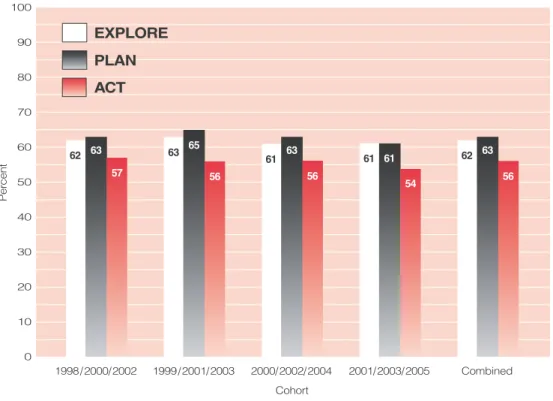
Figure 3: EXPLORE-, PLAN-, and ACT-tested Students Meeting Reading Benchmarks, 1998–2002 to 2001–20053
3 The data in this figure are based on approximately 352,000 students.
Students Are Losing Momentum
in High School
More eighth- and tenth-graders are on track to being ready for college-level reading than are actually ready when they graduate from high school.ACT has developed College Readiness
Benchmarks for the eighth- and tenth-grade components of its early college readiness preparation system, EPASTM(which includes
EXPLORE®, PLAN®, and the ACT). These Benchmarks are based on
the College Readiness Benchmarks for the ACT, adjusted to reflect expected growth between eighth and tenth grades and between tenth and twelfth grades. Figure 3 shows that, in a combined testing population of four recent cohorts of students who participated in all three EPAS programs (EXPLORE in grade 8, PLAN in grade 10, and the ACT in grade 12), 62 percent of eighth-grade students are on track to being ready for college-level reading by the time they graduate from high school. The percentage of these same students who are on track to being ready increases slightly when they reach the tenth grade. However, by the time they take the ACT, a smaller percentage of these same students are actually college ready in reading. Similar patterns were seen in the four individual cohorts (Figure 3) and by gender, race/ethnicity, and annual family income level (Figure 4). Consistently, fewer students are ready for college-level reading by the time they graduate from high school than is expected based on their performance in eighth and tenth grade.
State Reading Standards: We’re Getting
What We’ve Asked For
State standards in high school reading are insufficient—or nonexistent.Why are students losing momentum in high school? One reason may be that they are not being asked to meet specific, rigorous reading standards during their high school years—a time when it is crucial for them to continue refining their reading skills.
After the publication of A Nation at Risk (National Commission on Excellence in Education, 1983), states began to focus on setting explicit
educational standards and expectations for their
students. State educational progress began to be tracked publicly as the states refined their standards, experimented with different ways of communicating these standards to school administrators and teachers so that they could be translated into classroom instruction, and created tests designed to measure student progress. In just six years, 47 states had either initiated statewide assessment programs or substantially expanded programs already in existence.
100 90 80 70 60 50 40 30 20 10 0 Per cent 57 EXPLORE PLAN ACT 6566 Male African American Asian American Hispanic American Income ⬍$30,000
Female White Income
$30,000 to $100,000 Income ⬎$100,000 Native American 54 5859 25 32 35 62 64 69 42 4850 46 5354 60 6667 40 4850 58 6465 71 7575
Figure 4: EXPLORE-, PLAN-, and ACT-tested Students Meeting Reading Benchmarks by Gender, Race/Ethnicity, and Selected Family Income Level,
1998–2002 to 2001–2005 (combined)4
4 The data in this figure are based on approximately 352,000 students (gender), 331,000 students
With the passage of the No Child Left Behind Act in 2001, all elementary school students are now expected to meet educational standards, and schools are now held accountable for their
effectiveness at helping students meet this goal. Forty-nine states have educational standards in place. One effect of this legislation has been an unprecedented demand for rigorous standards that spell out clearly what students need to know and be able
to do in order to move on to the next stage of their education.
However, a careful analysis of state standards in reading at the high school level leads to a very different conclusion about the importance of reading to student success in college and work. Research shows that students must continue to develop their reading ability long after they are typically considered literate (Lyon, 2002; Moore, Bean, Birdyshaw, & Rycik, 1999). But according to our analysis of state standards, 28 of the 49 states with standards —more than half—fully define grade-level standards in reading only through the eighth grade.
▼ At the high school level, 20 of these 28 states specify only a single group of reading standards intended to cover grades 9 through 12—standards that do not recognize expectations for increasing proficiency in reading during those years.
▼ Six additional states specify standards for only one, two, or three high school grades, ignoring the other grades altogether.
▼ Two additional states specify just one set of standards for a subset of grades.
Overall (including Iowa, which has not
identified state standards), nearly 60 percent— 29 states—do not have grade-specific
standards that define the expectations for reading achievement in high school. If such standards don’t exist, teachers can’t teach to them and students can’t learn them. You can’t get what you don’t ask for.
Deficits in Acquiring Reading Comprehension Strategies
Some children encounter obstacles in learning to read because they do not derive meaning from the material that they read. In the later grades, higher order comprehension skills become paramount for learning. Reading comprehension places significant demands on language comprehension and general verbal abilities. Constraints in these areas will
typically limit comprehension. In a more specific vein, deficits in reading comprehension are related to:
(1) inadequate understanding of the words used in the text;
(2) inadequate background knowledge about the domains represented in the text;
(3) a lack of familiarity with the semantic and syntactic structures that can help to predict the relationships between words;
(4) a lack of knowledge about different writing conventions that are used to achieve different purposes via text (humor, explanation, dialogue, etc.);
(5) verbal reasoning ability which enables the reader to “read between the lines”; and
(6) the ability to remember verbal information.
If children are not provided early and consistent experiences that are explicitly designed to foster vocabulary development, background knowledge, the ability to detect and comprehend relationships among verbal concepts, and the ability to actively employ strategies to ensure understanding and retention of material, reading failure will occur no matter how robust word recognition skills are.
High School Reading Instruction
Is Not Sufficient
Not enough high school teachers are teaching reading skills or strategies and many students are victims of teachers’ low expectations.Another likely reason that high school students are losing momentum in readiness for college-level reading is that reading is simply not taught much, if at all, during the high school years, not even in English courses. As one educator explains:
High school English teachers . . . are traditionally viewed—and view themselves— as outside the teaching of reading, because the assumption has been that students come to them knowing how to read. . . . High school English teachers rarely have the backgrounds to
assist the least able readers in their classes, and additionally are often uncertain about what reading instruction actually involves. (Ericson, 2001, pp. 1, 2)
If this is true of English teachers, how much truer must it be of teachers in other courses? Meltzer (2002) reports:
Overwhelmed by higher content standards, many . . . high school teachers feel under pressure to “cover” more content than ever before and are resistant to “adding” literacy responsibilities to their crowded course calendars. . . . Since literacy is not “visible” as a content area, it is not “owned” by any specific department. The English department, it is wrongly assumed, “takes care of that.” (pp. 9, 10)
But even where reading is an element of the high school curriculum— usually as part of English or social studies courses—ACT research suggests that low teacher expectations can prevent some students from being taught the reading skills they need for college and work. According to data gathered as part of the 2002–2003 ACT National Curriculum Survey®(ACT, Inc., 2003), if teachers perceived students to be primarily
college bound, they were more likely to focus their instruction on higher-level critical reading skills. If they perceived students not to be college bound, they were less likely to teach these critical reading skills (Patterson, Happel, & Lyons, 2004; Patterson & Duer, in press). These practices are simply not acceptable.
[A]s a group, the teachers reporting on a class of primarily college-bound students teach and place greater importance on a broader range of reading process skills than do the teachers reporting on a class of primarily non–college-bound students. . . .
The difference in process skills taught is not merely quantitative, but qualitative as well. . . . [T]he process skills most heavily favoring college-bound classes in terms of percent taught . . . were elements of sophisticated, high-level critical reading.
Beyond-Core Coursework in
Social Studies Only Slightly Improves
ACT Reading Test Score
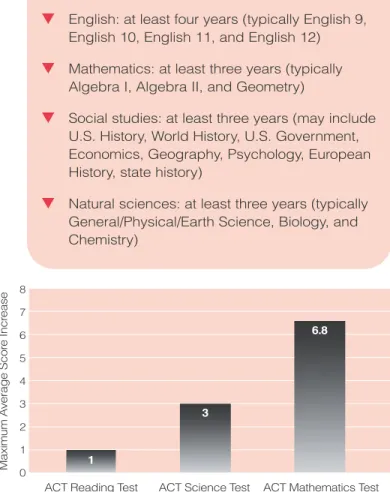
ACT research has well documented the strong positive impact of taking rigorous courses in high school, particularly in English, mathematics, and science (ACT, Inc., 2004). According to 2005 data (shown in Figure 5), students who take additional, beyond-core science courses (i.e., Physics) earn ACT Science Test scores that are up to 3 points higher, on average, than the scores of students who take only the core science curriculum. In mathematics, students who take additional courses (i.e., advanced math beyond Algebra II) have ACT Mathematics Test scores that are up to 6.8 points higher, on average, than the scores of students who take only the core
mathematics curriculum. These increases are on a score scale ranging from 1 to 36 and represent statistically significant gains.
However, Figure 5 also shows that additional coursework in social studies—the high school subject area that overlaps most closely with the kinds of college social sciences courses used to establish the ACT College Readiness Benchmark for Reading—results in an average ACT Reading Test score no more than 1 point higher than that associated with the
recommended three years of social studies. And this includes even those students who took the equivalent of five years of social studies in high school. This suggests that taking additional years of social studies coursework alone does not have a large differential impact on the readiness of ACT-tested students to handle the level of reading required in college social sciences courses. However, as will be discussed in the next chapter, what appears to matter in readiness for college-level reading is not the number of courses students take, but what is being asked of students in these courses. We examined student performance on the ACT Reading Test from a number of perspectives in an attempt to answer the question of what really matters in reading.
ACT Reading Test ACT Science Test
1 3 Maximum A verage Scor e Incr ease
ACT Mathematics Test
6.8 6 5 4 3 2 1 0 7 8
Figure 5: Maximum Average Test Score Increases Associated with Beyond-core Subject-specific Coursework for 2005 ACT-tested High School Graduates ACT’s Recommended Core Curriculum
▼ English: at least four years (typically English 9, English 10, English 11, and English 12)
▼ Mathematics: at least three years (typically Algebra I, Algebra II, and Geometry)
▼ Social studies: at least three years (may include U.S. History, World History, U.S. Government, Economics, Geography, Psychology, European History, state history)
▼ Natural sciences: at least three years (typically General/Physical/Earth Science, Biology, and Chemistry)
2
Ready or Not: What Matters
in Reading?
Those ACT-tested students who can read
complex
texts
are more likely to be ready for college. Those who cannot read
complex texts are less likely to be ready for college.
Students who meet the ACT Benchmark for Reading are more likely to enroll and do better in college than students who do not meet the Benchmark.ACT research demonstrates the clear benefits experienced by students who attain the College
Readiness Benchmark for Reading: increased college enrollment in the fall
immediately following high school graduation, higher grades in selected first-year college social-sciences courses, higher first-year college grade-point average (GPA), and increased retention (defined as those who return for a second year of college at the same institution). These benefits are illustrated in Figures 6 through 9.
The figures show that students who meet the Reading Benchmark are more likely than students who do not meet the Benchmark to:
▼ enroll in college (74 percent vs. 59 percent);
▼ earn a grade of B or higher (63 percent vs. 36 percent) or C or higher (85 percent vs. 64 percent) in first-year college U.S. History courses;
▼ earn a grade of B or higher (64 percent vs. 39 percent) or C or higher (85 percent vs. 68 percent) in first-year college Psychology courses;
▼ earn a first-year college GPA of 3.0 or higher (54 percent vs. 33 percent) or 2.0 or higher (87 percent vs. 76 percent); and
▼ return for a second year of college at the same institution (78 percent vs. 67 percent).
Met Reading Benchmark Did Not Meet Reading Benchmark
Per
cent Enr
olled
100
90
80
70
60
50
40
30
20
10
0
74
59
5 Based on approximately 1.2 million students.
Figure 6: Fall 2003 College Enrollment for 2003 ACT-tested High School Graduates Meeting and Not Meeting ACT’s College Readiness Benchmark
Met Reading Benchmark Did Not Meet Reading Benchmark Per cent Re-enr olled 100 90 80 70 60 50 40 30 20 10 0 78 67
Figure 8: ACT-tested High School Graduates Meeting and Not Meeting ACT’s College Readiness Benchmark
for Reading Who Achieved Specific First-year College Grade-point Averages (GPA)7
3.0 or Higher 2.0 or Higher
Per
cent Acheiving GP
A 100 90 80 70 60 50 40 30 20 10 0 54 87 Met Benchmark
Did Not Meet Benchmark
College GPA
33
76
U.S. History (B or Higher)
U.S. History (C or Higher)
Per
cent Acheiving Grade
100 90 80 70 60 50 40 30 20 10 0 63 Met Benchmark Did Not Meet Benchmark
36
Psychology (C or Higher) Psychology
(B or Higher)
85
64 64
39
85
68
6 Based on data across multiple years from institutions participating in ACT’s Course Placement Service. Approximately 6,000 students were
included in the analysis for U.S. History, and approximately 7,000 were included in the analysis for Psychology.
7 Based on data across multiple years from institutions participating in ACT’s High School Feedback Service. Approximately 302,000 students
were included in the analysis.
Figure 9: Fall 2004 Second-year College Retention Rate at Same Institution for 2003 ACT-tested High School Graduates Meeting and Not Meeting ACT’s College Readiness Benchmark for Reading8 Figure 7: ACT-tested High School Graduates Meeting and Not Meeting ACT’s College Readiness Benchmark for Reading Who Achieved Specific Grades in Selected First-year
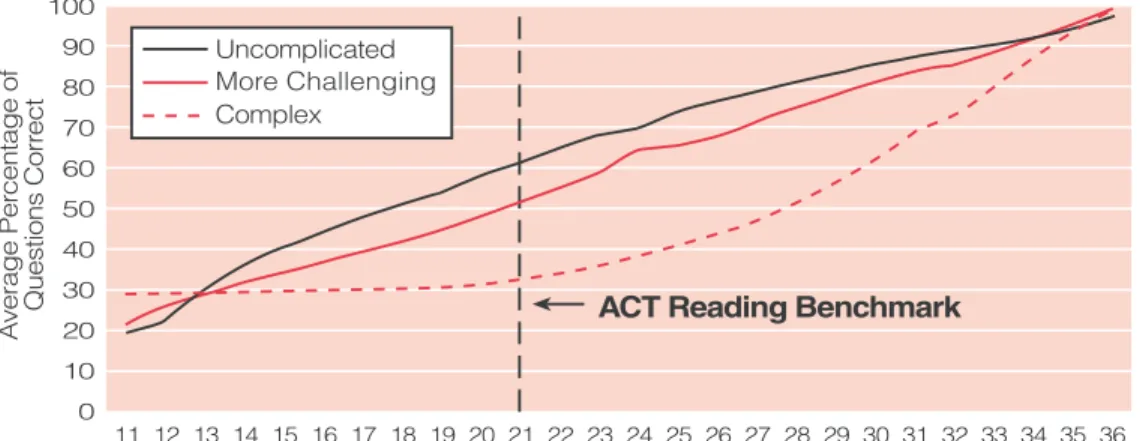
But what differentiates students who meet the Reading Benchmark from students who do not? We looked at student performance on three aspects of ACT Reading Test content: comprehension level, textual elements, and text complexity.
Comprehension Level
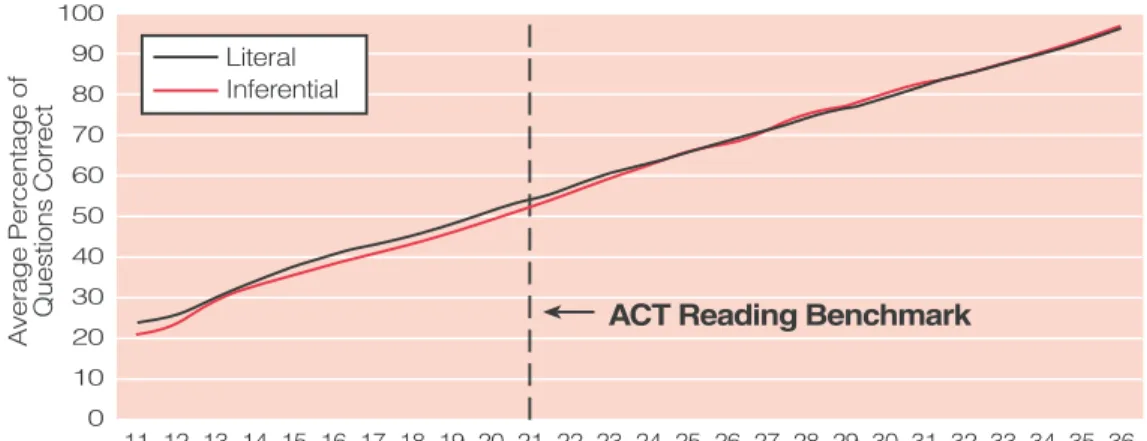
Questions on the Reading Test assess two levels of comprehension: literal and inferential. Literal comprehension requires test-takers to identify information stated explicitly in the text, often within a defined section. Inferential comprehension requires test-takers to process and interpret information not stated explicitly in the text—i.e., to make inferences, often by drawing on material from different sections. Figure 10 presents the results of the analysis by comprehension level.
Figure 10 shows essentially no difference in student performance on the two comprehension levels across the score range, either above or below the ACT College Readiness Benchmark for Reading. At each score point, the percentages of literal and inferential comprehension questions answered correctly are virtually identical. What’s more, both above and below the Benchmark, improvement in performance on each of the two levels is uniform and gradual—that is, as performance on one level increases, so does performance on the other, and to almost exactly the same degree. Given this steadily increasing linear relationship between ACT Reading Test score and reading proficiency, there is no clear differentiator here between those students who are ready for college-level reading and those who are not.
ACT Reading Benchmark
A
verage Per
centage of
Questions Corr
ect
100
80
60
40
20
0 10 30 50 70 90
11 12 13 14 15 16 17 18 19 20 21 22 23 24 25 26 27 28 29 30 31 32 33 34 35 36
ACT Reading Test Score Literal
Inferential
Figure 10: Performance on the ACT Reading Test by Comprehension Level (Averaged across Seven Forms)9
9 Analyses presented in this and the succeeding two figures were based on approximately 563,000
students who took any of seven test forms administered between Fall 2003 and Spring 2005. It was not possible to analyze performance below a score of 11 due to the small number of students scoring in this range.
Textual Elements
Questions on the Reading Test focus on five kinds of textual
elements: 1) main idea or author’s approach, 2) supporting details, 3) relationships (sequential, comparative, or cause and effect), 4) meaning of words, and 5) generalizations and conclusions. Figure 11 presents the results of the analysis by textual element.
As was the case in Figure 10, Figure 11 also shows almost no differences in student performance among the five textual elements across the score range, either above or below the Reading
Benchmark. Again the percentages of questions answered correctly on the five kinds of textual elements are nearly identical, and again improvement on each of the five kinds is uniform and gradual. Thus, with similar relationships seen among these textual elements, there is no clear point of differentiation that can be used to distinguish those who are ready for college-level reading from those who are not.
Text Complexity
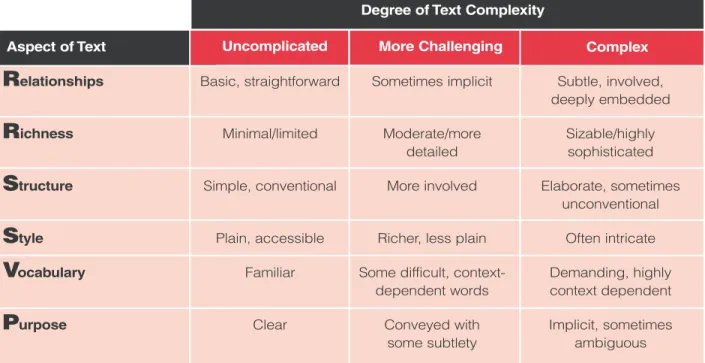
Texts used in the ACT Reading Test reflect three degrees of complexity: uncomplicated, more challenging, and complex. Table 1 summarizes the chief distinctions among the three degrees of text complexity.
Group 2000
R
elationships Basic, straightforward Sometimes implicit Subtle, involved, deeply embeddedR
ichness Minimal/limited Moderate/more Sizable/highlydetailed sophisticated
S
tructure Simple, conventional More involved Elaborate, sometimes unconventionalS
tyle Plain, accessible Richer, less plain Often intricateV
ocabulary Familiar Some difficult, context- Demanding, highly dependent words context dependentP
urpose Clear Conveyed with Implicit, sometimessome subtlety ambiguous
Table 1
Characteristics of Uncomplicated, More Challenging,
and Complex Texts on the ACT Reading Test
Aspect of Text Uncomplicated More Challenging Complex
62
60
A
verage Per
centage of
Questions Corr
ect
100
80
60
40
20
0 10 30 50 70 90
11 12 13 14 15 16 17 18 19 20 21 22 23 24 25 26 27 28 29 30 31 32 33 34 35 36
ACT Reading Test Score Supporting Details
Meaning of Words
Generalizations and Conclusions Relationships
Main Idea/Author’s Approach
ACT Reading Benchmark
Figure 11: Performance on the ACT Reading Test by Textual Element (Averaged across Seven Forms)
A
verage Per
centage of
Questions Corr
ect
100
80
60
40
20
0 10 30 50 70 90
11 12 13 14 15 16 17 18 19 20 21 22 23 24 25 26 27 28 29 30 31 32 33 34 35 36
ACT Reading Test Score
ACT Reading Benchmark Uncomplicated
More Challenging Complex
Figure 12: Performance on the ACT Reading Test by Degree of Text Complexity (Averaged across Seven Forms)
As shown in Table 1, the three types of texts represent a continuum of increasing complexity with respect to the following six aspects (which can be abbreviated to “RSVP”):
▼ Relationships(interactions among ideas or characters)
▼ Richness(amount and sophistication of information conveyed through data or literary devices)
▼ Structure(how the text is organized and how it progresses)
▼ Style(author’s tone and use of language)
▼ Vocabulary(author’s word choice)
What appears to differentiate those who are more likely to be ready from those who are less likely is their proficiency in understanding complex texts.The results of the analysis by degree of text complexity are presented in Figure 12.
In this figure, performance on questions associated with uncomplicated and more challenging texts both above and below the ACT College Readiness Benchmark for Reading follows a pattern similar to those in Figures 10 and 11, in that improvement on each of the two kinds
of questions is gradual and fairly uniform. There is, however, a difference in the percentages of questions answered correctly for the two kinds of texts: for the most part, students correctly answer a higher percentage of questions associated with uncomplicated texts than of questions associated with more challenging texts.
But when we look at performance on questions associated with complex texts, we see a substantially different pattern. Below the
Reading Benchmark, the percentage of questions answered correctly remains virtually constant— and not much higher than the level suggested by chance (25 percent, given that each question contains four answer choices).
Most importantly, above the Reading Benchmark performance improves more steeply than it does with either of the other two levels of text complexity, indicating that students who can master the skills necessary to read and understand complex texts are more likely to be college ready than those who cannot. It is not until the uppermost end of the score scale that student performance on questions associated with all three degrees of text complexity is roughly the same. Furthermore, the three
performance patterns shown in Figure 12 hold for both genders, all racial/ethnic groups, and all annual family income levels.
What does this mean? For one thing, it shows that degree of text complexity differentiates student performance better than either the comprehension level or the kind of textual element tested. (See the sidebar for information about how degrees of text complexity are associated with specific average score increases on the ACT Reading Test.) But another, more important, conclusion is that, because of its distinct pattern of performance increases relative to the ACT College Readiness Benchmark, performance on complex texts is the clearest differentiator in reading between students who Degree of Text Complexity and
ACT Reading Test Score
Performance on ACT Reading Test questions by degree of text complexity is associated with substantial score differences on the test.
Correctly answering questions based on texts classified as more challenging is associated with Reading Test scores that are 3 points higher on average than scores associated with correctly answering questions based on uncomplicated texts. Correctly answering questions based on complex passages is associated with Reading Test scores that are between 6 and 7 points higher on average than scores associated with correctly answering questions based on more challenging texts, and between 9 and 10 points higher on average than scores
associated with correctly answering questions based on uncomplicated texts.
In other words, students who correctly answer questions based on complex texts can score potentially as many as 10 points higher on the Reading Test than students who can correctly answer only questions based on
are likely to be ready for college and those who are not. And this is true for both genders, all racial/ethnic groups, and all family income levels.
Complex Texts: A Closer Look
As Table 1 showed, a complex text is typically complex in the following ways:
▼ Relationships:Interactions among ideas or characters in the text are subtle, involved, or deeply embedded.
▼ Richness:The text possesses a sizable amount of highly sophisticated information conveyed through data or literary devices.
▼ Structure:The text is organized in ways that are elaborate and sometimes unconventional.
▼ Style:The author’s tone and use of language are often intricate.
▼ Vocabulary:The author’s choice of words is demanding and highly context dependent.
▼ Purpose:The author’s intent in writing the text is implicit and sometimes ambiguous.
But it makes sense to examine complex texts in more depth now that we know the significant role these texts play in students’ college
readiness. It is one thing to state, for example, that complex texts contain demanding, highly context-dependent vocabulary, but quite another to see how such vocabulary functions within a text.
Figures 13 and 14 (pages 18–21) present annotated samples of complex texts, in the content areas of prose fiction and natural science, that have been used on the ACT Reading Test. (See the Appendix for annotated examples of additional complex texts in the humanities and social science areas.)
It seems likely that while much of the reading material that students encounter in high school may reflect progressively greater content challenges, it may not actually require a commensurate level of text complexity. This observation appears to be consistent with a recent study by ACT and the Education Trust, On Course for Success
[T]here has been little improvement in areas indicating the substantive content of the English curriculum or the level of difficulty in reading expected by graduation. A few states have content-rich and content-specific literature standards at the high school level. But there has been a decline in the number that seemingly want their English teachers to know how high their academic expectations in reading for students should be by the end of high school.
. . . [W]hile a state’s formal content may sometimes seem demanding (e.g., when it expects study of such literary devices as irony or flashbacks), without standards outlining its substantive content, its formal content can be addressed as easily in simple texts as in complex texts with literary qualities. One can study onomatopoeia in “The Three Little Pigs” as well as in “The Raven.”
—Stotsky, 2005
VOCABULARY: Beginning with the opening sentence—“There had been no words for naming when she was born”—the text uses fairly
sophisticated syntax.
RICHNESS: Imagery abounds in the text, as in the third paragraph, when Sunday is said to have “felt herself entering the greens and reds and browns of her own paintings.”
STRUCTURE: Here, the text shifts to mainly relating Delta’s perspective after presenting Sunday’s perspective.
Figure 13: Annotated Complex Text from the ACT Reading Test (Prose Fiction)
PROSE FICTION: This passage is adapted from the novel
Night Water by Helen Elaine Lee (©1996 by Helen Elaine Lee).
There had been no words for naming when she was born. She was “Girl Owens” on the stamped paper that certified her birth, and at home, she had just been “Sister,” that was all. When asked to decide, at six, what she would be called, she had chosen “Sunday,” the time of voices, lifted in praise.
That was one piece of the story, but other parts had gone unspoken, and some had been buried, but were not at rest. She was headed back to claim them, as she had taken her name.
She could smell the burnt, sweet odor of the paper mill that sprawled across the edge of town, and as the train got closer, she remembered all that she saw. She felt herself entering the greens and reds and browns of her own paintings, pulling aside her brushstrokes as if they were curtains and stepping through. There were autumn trees on fire everywhere, and she moved beyond the surface of color and texture into the hidden layers of the past, from which she had learned to speak her life with paint.
The train passed through the part of town where she grew up. She watched as they left behind the neat, compact frame houses and hollow storage buildings. She was going back to piece together their family story of departure and return. She saw it all from the inside out, as native and exile, woman and child. From all that she remembered and all that she was. She was Girl Owens and Sister. She was Sunday, and she was headed home.
Waiting for Sunday’s arrival, Delta Owens stepped out onto the front porch. She hoped she would be able to find the right way to approach Sunday, with whom she had only been in touch by mail for five years. She had tried to demonstrate a persistent bond with the help of words put together by experts, choosing for each birthday and holiday an oversized greeting card, depending on its ornate script and polished rhyme to express what she had never been able to say. Each one she had signed “Always, Delta” before addressing the envelope carefully and mailing it off to Chicago. She had heard back irregularly, receiving wood block prints or splashes of paint on wefts of heavy paper with ragged edges or on see-through skins. Each one she had turned round and round, looking for right-side up with the help of the signature. Each one she had saved. Though she hadn’t known what, specifically, to make of any of them, she knew their appearance said something about the habit of love.
This text describes two complex, well-developed characters, Sunday and Delta, and their strained yet loving relationship. One factor that contributes to the complexity of the text is its structure: the third-person narrator presents the two sisters both as they see themselves and how each sees the other.
They had kept up contact despite the differences that had accumulated over the years and finally erupted in accusations and insults after Nana’s death. In the wide, post-funeral quiet, after the visitors had gone home, they had both uttered things huge and unerasable.
She had always known how Sunday felt about home. “I’m in a little box,” she had often complained while growing up, trying to express to Delta how dif-ferent she felt, how she was of it, but would never be able to stay. And Delta, who had fought anyone who criticized her sister, had listened and comforted her, but hadn’t really understood. Sunday was the one she was different from.
“This place pulls you down and holds you,” Sunday had said. “Delta, don’t you see, it pulls you down and holds you, silent and safe.”
What Sunday said that night was condemnation of a place, but Delta absorbed it all. She was of Wake County and caught in that understanding of herself. Intoxicated with saying what had long been felt, they both spoke freely and all barriers fell. Most of the things Sunday said had not surprised Delta, but one indictment had left her open-mouthed: “You don’t even see my painting,” Sunday had accused, “you don’t even see me at all.”
Delta had laughed callously at the accusation, for she knew, though she couldn’t have said it, that for most of her life she had seen little else. She had answered by calling her a misfit who thought she was better than the folks she had left behind. And it was Delta’s recognition of her own rancor, as much as the substance of what they said, that staggered and dis-graced her. She hadn’t even realized all the things for which she couldn’t forgive Sunday, hadn’t known her own smallness until she found herself measuring her sister out loud.
Finally, the rush of words had ended, and they had silently straightened up and gone upstairs without repairing their trespasses. Sunday had gathered and packed her things in a wild, tearful stupor of regret and relief, while Delta cried herself to sleep with bitter remorse.
Delta pushed that night from her mind, hoping that this visit might help them leave behind their troubled history.
VOCABULARY; RELATIONSHIPS: The concepts the author presents are often complicated, subtle, and abstract, such as the idea that being safe is a bad thing, or when the narrator notes that Delta “was of Wake County and caught in that understanding of herself.”
RELATIONSHIPS: As the last two paragraphs reveal, the current state of Sunday’s and Delta’s relationship is a mixture of hurt, betrayal, hope, and love.
STYLE; RELATIONSHIPS: As the narrator relates the argument, readers get not only the words used but also the motives and reactions.
NATURAL SCIENCE: This passage is adapted from Lewis Thomas’s The Medusa and the Snail: More Notes of a Biology Watcher (©1979 by Lewis Thomas).
We tend to think of our selves as the only wholly unique creations in nature, but it is not so. Uniqueness is so commonplace a property of living things that there is really nothing at all unique about it. Even individual, free-swimming bacteria can be viewed as unique enti-ties, distinguishable from each other even when they are the progeny of a single clone. Spudich and Koshland have recently reported that motile microorganisms of the same species are like solitary eccentrics in their swimming behavior. When they are searching for food, some tumble in one direction for precisely so many sec-onds before quitting, while others tumble differently and for different, but characteristic, periods of time. If you watch them closely, tethered by their flagellae to the surface of an antibody-coated slide, you can tell them from each other by the way they twirl, as accurately as though they had different names.
Fish can tell each other apart as individuals, by the smell of self. So can mice, and here the olfactory dis-crimination is governed by the same H2 locus which contains the genes for immunologic self-marking.
The markers of self, and the sensing mechanisms responsible for detecting such markers, are convention-ally regarded as mechanisms for maintaining individu-ality for its own sake, enabling one kind of creature to defend and protect itself against all the rest. Selfness, seen thus, is for self-preservation.
In real life, though, it doesn’t seem to work this way. The self-marking of invertebrate animals in the sea, who must have perfected the business long before evolution got around to us, was set up in order to permit creatures of one kind to locate others, not for predation but to set up symbiotic households. The anemones who live on the shells of crabs are precisely finicky; so are the crabs. Only a single species of anemone will find its way to only a single species of crab. They sense each other exquisitely, and live together as though made for each other.
Sometimes there is such a mix-up about selfness that two creatures, each attracted by the molecular con-figuration of the other, incorporate the two selves to make a single organism. The best story I’ve ever heard about this is the tale told of the nudibranch and medusa living in the Bay of Naples. When first observed, the nudibranch, a common sea slug, was found to have a tiny vestigial parasite, in the form of a jellyfish, perma-nently affixed to the ventral surface near the mouth. In curiosity to learn how the medusa got there, some
PURPOSE: The text begins with a general discussion of the phenomenon of biological uniqueness, arguing, paradoxically, that “uniqueness is so commonplace a property of living things that there is nothing at all unique about it.”
RELATIONSHIPS: In the third and fourth paragraphs, the author presents and then challenges the way “the markers of the self, and the sensing mechanisms responsible for detecting such markers, are conventionally regarded.” Figure 14: Annotated Complex Text from the ACT Reading Test (Natural Science)
This text contains a great deal of information related to the idea of biological uniqueness, focusing on the “collaboration” between a particular species of medusa and a particular kind of nudibranch. The vocabulary in the text is often demanding and the concepts are subtly presented.
marine biologists began searching the local waters for earlier developmental forms, and discovered something amazing. The attached parasite, although apparently so specialized as to have given up living for itself, can still produce offspring, for they are found in abundance at certain seasons of the year. They drift through the upper waters, grow up nicely and astonishingly, and finally become full-grown, handsome, normal jellyfish. Meanwhile, the snail produces snail larvae, and these too begin to grow normally, but not for long. While still extremely small, they become entrapped in the tentacles of the medusa and then engulfed within the umbrella-shaped body. At first glance, you’d believe the medusae are now the predators, paying back for earlier humilia-tions, and the snails the prey. But no. Soon the snails, undigested and insatiable, begin to eat, browsing away first at the radial canals, then the borders of the rim, finally the tentacles, until the jellyfish becomes reduced in substance by being eaten while the snail grows corre-spondingly in size. At the end, the arrangement is back to the first scene, with the full-grown nudibranch basking, and nothing left of the jellyfish except the round, successfully edited parasite, safely affixed to the skin near the mouth.
It is a confusing tale to sort out, and even more confusing to think about. Both creatures are designed for this encounter, marked as selves so that they can find each other in the waters of the Bay of Naples. The col-laboration, if you want to call it that, is entirely specific; it is only this species of medusa and only this kind of nudibranch that can come together and live this way. And, more surprising, they cannot live in any other way; they depend for their survival on each other. They are not really selves, they are specific others.
I’ve never heard of such a cycle before. [These creatures] are bizarre, that’s it, unique. And at the same time, like a vaguely remembered dream, they remind me of the whole earth at once.
STRUCTURE: The text ends, somewhat jarringly and cryptically, with a personal observation about how the medusa and the nudibranch remind the author of “the whole earth at once.”
RICHNESS: The heart of the text, the fifth and sixth paragraphs, is a discussion of the
complicated medusa-nudibranch interaction, which serves mainly to help make the author’s broader point about the commonness of uniqueness in biology.
(2004), which examined the curricula of ten high schools that have been especially successful at graduating students who are ready for college and work. This study reported that many of the courses offered at these schools were characterized by reading loads greater than those required by similar courses at other schools. As one teacher who participated in the study observed, the reading material in the rigorous high school courses aimed at preparing students for college “is certainly more abundant, and at times a little more challenging” (p. 18) than in typical high school courses.
State Standards Do Not Address
Text Complexity
In the previous chapter we saw that nearly 60 percent of states do not have grade-specific standards that define the expectations for reading achievement in high school. Our discussion of text complexity leads us to make another, more sobering observation about state standards. Although 10 of the 49 states with standards provide names of works or authors that could be used as indices of the complexity of recommended high school reading material, none of the state standards attempts to define explicitly the degree of complexity a specific grade-level text should have. Relationships, Richness, Structure, Style, Vocabulary, Purpose—none of these “RSVP” aspects is described in detail anywhere in any state’s reading standards.
So, just as with grade-specific state reading standards, when it comes to defining and requiring certain specific levels of complexity in students’ high school reading materials, we’re getting what we’re asking for. And students’ college and workplace readiness is the worse for it.
3
Taking Action: How to Help
All Students Become Ready
for College-Level Reading
We can no longer afford to ignore reading instruction in high school.
Something must be done to improve the reading proficiency of
all students.
As we have seen, students who can’t read and understand complex texts aren’t likely to be ready for college or the workforce. And as we have also seen, students who aren’t ready for college or work are less able to participate in, and contribute to, an increasingly global economy.
What can be done to improve the readiness of our high school students for college-level reading?
1. Strengthen reading instruction in all high school courses by incorporating complex reading materials into course content. The type of text to which students are exposed in high school has a significant impact on their readiness for college-level reading. Specifically, students need to be able to read complex texts if they are to be ready for college. All courses in high school, not just English and social studies but mathematics and science as well, must
challenge students to read and understand complex texts. As we saw in the previous chapter, a complex text is typically complex with respect to:
▼ Relationships(interactions among ideas or characters are subtle, involved, or deeply embedded);
▼ Richness(a sizable amount of highly sophisticated information conveyed through data or literary devices);
▼ Structure(elaborate, sometimes unconventional);
▼ Style(often intricate);
▼ Vocabulary(demanding and highly context dependent); and
▼ Purpose(implicit and sometimes ambiguous).
In most cases, a complex text will contain multiple layers of meaning, not all of which will be immediately apparent to students upon a
At ages 13 and 17, the percentage saying they read for fun almost every day was lower in 2004 than in 1984. This trend was accompanied by an increase over the same 20-year time period in the percentage indicating that they never or hardly ever read for fun.
single superficial reading. Rather, such texts require students to work at unlocking meaning by calling upon sophisticated reading comprehension skills and strategies. (In addition to those
presented in Figures 13 and 14, other distinguishing features of complex texts are described in Figures 20 and 21 of the
Appendix. Annotated examples of more challenging texts used on the ACT Reading Test are also included in the Appendix, as Figures 16 through 19.)
Certainly, students will need to make the effort, both inside and outside of school, to enhance their comprehension of complex texts. But in a nation where 13- and 17-year-olds have
increasingly less exposure to or interaction with books outside of the classroom (Perie, Moran, & Lutkus, 2005), high schools must still play the primary role in providing students with the kinds of complex reading materials and experiences they need in order to be college and work ready and must continue to teach and reinforce reading strategies that deal with increasingly more complex reading tasks.
Students must have the opportunity to improve their reading skills and strategies at a time when they need to build upon the
foundational skills in reading that they developed when they entered high school. They must be given more opportunities to read challenging materials across the curriculum so that they are better positioned to comprehend complex texts in all subjects once they enter college or the workplace.
2. Revise state standards so that they both explicitly define reading expectations across the high school curriculum and incorporate increasingly complex texts into the English, mathematics, science, and social studies courses in grades 9 through 12.Without specific reading standards across the curriculum, teachers cannot be expected to know what level of reading proficiency students should be expected to attain or what degree of text complexity is appropriate in each subject and grade. Reading standards that address text complexity should be embedded in English, mathematics, science, and social studies standards.
3. Make targeted interventions to help students who have fallen behind in their reading skills.As we strengthen high school courses and state standards with respect to text complexity, we must also address the reading skills of those students who begin high school with reading deficiencies. Such deficiencies need to be diagnosed much earlier, in upper elementary and middle school, so that earlier interventions can be made. If a greater number of students can be identified and helped before they
reach high school, they will be more likely to have developed the necessary foundational reading skills upon which college-ready skills can be based.
4. Provide high school teachers with guidance and support to strengthen reading instruction and to incorporate the kinds of complex texts that are most likely to increase students’
readiness for college-level reading.Teachers need the support and professional development opportunities necessary to ensure that they understand the types of reading skills students need to have by the time they graduate from high school.
5. Strengthen high school assessments so that they align with improved state standards and high school instruction across the curriculum.As we strengthen the high school curriculum by incorporating complex reading materials into all courses as defined by improved state standards, so must we also reflect this greater degree of complexity in the high-stakes assessments that high school students take. These assessments need to reflect a wider range of reading materials by including complex texts in all subject areas.
Reading Achievement and Achievement in Other Academic Areas Because reading is likely a
strong intervening factor in academic areas across the high school curriculum, we examined the English, mathematics, and science achievement of students who met and did not meet the ACT College Readiness Benchmark for Reading. The figure at right shows, for students who met and did not meet the Reading Benchmark, the percentage of students meeting the ACT College Readiness Benchmarks for English, Mathematics, and Science.
Of those who metthe Reading Benchmark:
▼ 94 percent also met the ACT English Benchmark;
▼ 63 percent also met the ACT Mathematics Benchmark; and
▼ 47 percent also met the ACT Science Benchmark.
Of those who did not meetthe Reading Benchmark:
▼ only 41 percent met the ACT English Benchmark;
▼ only 16 percent met the ACT Mathematics Benchmark; and
▼ only 5 percent met the ACT Science Benchmark.
100 90 80 70 60 50 40 30 20 10 0 Percent English 94
Met Reading Benchmark Did Not Meet Reading Benchmark
Mathematics Science ACT College Readiness Benchmark 41 63 16 47 5
These are important and far-reaching missions that no one group of concerned individuals can accomplish alone. Teachers, school administrators, and policymakers have crucial roles to play. Following are a number of suggestions for educators and policymakers
representing examples of the kinds of actions necessary to begin improving student readiness for college-level reading.
What Can Policymakers Do?
▼ Consistent with the National Governors Association’s
recommendation that comprehensive literacy plans be developed in each state (NGA Center for Best Practices, 2005), incorporate reading expectations into state standards across the curriculum so that they specify the inclusion, by grade level, of increasingly complex reading materials in English, mathematics, science, and social studies.
▼ Build support for a legislative focus on improving reading achievement in middle school and high school.
▼ Encourage local efforts to improve reading achievement at the school and district levels.
▼ Disseminate best practices found in middle schools and high schools that are achieving results and promote similar efforts on a wider scale.
▼ Increase funding for school or district programs that improve middle school and high school reading achievement.
▼ Provide resources for professional development opportunities for teachers so that they are equipped to provide the necessary reading instruction in their subject areas and grade levels.
▼ Make provisions both for assessing students’ college readiness in reading to evaluate their progress and for making timely interventions when they encounter difficulties.
What Can Educators Do?
▼ Consistent with the National Governors Association’s recommendation that schools and districts develop
comprehensive literacy plans, incorporate reading expectations into state standards across the curriculum so that they specify the inclusion, by grade level, of increasingly complex reading materials in English, mathematics, science, and social studies.
▼ Diagnose reading deficiencies and intervene earlier, before high school.
▼ Incorporate complex reading materials into all high school courses, not just English and social studies, to strengthen students’ reading skills throughout high school.
▼ Require all teachers in all courses to teach reading strategies so that students are able to progress from comprehension of simpler texts to comprehension of more complex texts.
▼ Push students to read texts that are personally challenging, and support their efforts by giving them a variety of critical reading strategies to use.
▼ Systematically assess students’ college readiness in reading to evaluate their progress and make timely interventions when they encounter difficulties.
Conclusion
In Crisis at the Core (ACT, Inc., 2004) we wrote:
Too few of our students are prepared to enter the workforce or postsecondary education without additional training or remediation when they graduate from high school. And far too many have to take remedial courses as part of their postsecondary educations. . . . As a consequence, first-year students are dropping out of school in alarming numbers: one in four freshmen at four-year institutions and one in two freshmen at two-year institutions fails to return for a sophomore year. (p. 22)
One year later, the situation is no less dire.
Reading is an essential part of readiness for college. Today’s economy demands a universally higher level of literacy than at any time in history, and it is reasonable to expect that the demand for a literate workforce will only increase in the future (Snow, 2002). Studies have shown that, regardless of educational attainment, higher levels of literacy translate into higher earnings (Barton, 2000; Kaestle, Campbell, Finn, Johnston, & Mickulecky, 2001), and the fastest-growing jobs also require the highest levels of literacy (Carnevale & Desrochers, 2003; Barton, 2000). Yet too many young people cannot read well enough to get a job with a career path, participate in civic responsibilities, or simply enjoy a good book (U.S. Department of Education, 2003).
ACT data suggest that the readiness of the nation’s high school students for college-level reading is far too low. But ACT data also show that, while it is important for students to be able to comprehend both explicit and implicit material in texts and understand how various textual elements (such as main ideas, relationships, or generalizations) function in a text,
what matters most in reading achievement is the ability to
comprehend complex texts. We must find ways to help all students to read at the level of proficiency necessary to ensure that they are ready to succeed in college without remediation. Students must be able to read and comprehend texts that are complex with respect to “RSVP”: Relationships, Richness, Structure, Style, Vocabulary, and Purpose.
If we help all students to become better readers, they can become ready to succeed in college and work. It’s a difficult goal, but a worthy one. And with greater effort on the part of students, teachers, school administrators, and policymakers, it’s a goal we can achieve.
Appendix
The conclusions in this report are based on large samples of students in the nation’s schools who participated in ACT’s college readiness programs: EXPLORE, PLAN, and the ACT. The students taking the ACT in 2004–2005 represented about 40 percent of all graduating seniors across the country. While this may not constitute a nationally representative sample, we believe that we cannot ignore what the data are telling us.
This appendix provides detailed information on the data sources and methodologies used in this report.
ACT’s EPAS
TMThe data in this report come primarily from administrations of ACT’s Educational Planning and Assessment System (EPASTM),
a system that integrates three aligned programs:
▼ EXPLORE, for students in grades 8 and 9, provides baseline information on the academic preparation of students that can be used to plan high school coursework.
▼ PLAN, for students in grade 10, provides a midpoint review of students’ progress toward their education and career goals while there is still time to make necessary interventions.
▼ The ACT, for students in grades 11 and 12, measures students’ academic readiness to make successful transitions to college and work after high school. The ACT is the most widely accepted and used test by postsecondary institutions across the U.S. for college admission and course placement.
ACT is uniquely qualified to report on the nation’s level of college readiness. We have been measuring the academic achievement of eleventh-grade and twelfth-grade students since the first administration of the ACT in 1959, their career aspirations since 1969, and their academic preparation since 1985. We have tracked each of these three areas for tenth-graders since the debut of PLAN in 1987, and for eighth-graders since 1993, when EXPLORE was added as the newest component of EPAS. Most recently, in 2003 and 2005, we established ACT’s College Readiness Benchmarks, which are defined and discussed in detail in this section.