Whistling
while
they
work
towards
best
practice
whistleblowing
programs
in
public
sector
organisations
Peter
Roberts
Charles
Sturt
University
Jane
Olsen
Crime
and
Misconduct
Commission,
Queensland
and
A.
J.
Brown
Griffith
University
Second
Report
of
the
Australian
Research
Council
Linkage
Project
Whistling While They Work: Enhancing the Theory and Practice of Internal
Witness Management in Public Sector Organisations
Draft
Report
Acknowledgements ... iii
Comments on this report... iii
The authors ... iv
Summary
... 1
This Report ... 1
1. Organisational commitment... 2
2. Encouragement of reporting ... 3
3. Assessment and investigation of reports... 4
4. Internal witness support and protection... 5
5. An integrated organisational approach ... 5
The Checklist: Required elements for a whistleblowing program... 6
Part 1. Introduction
... 11
1. This report
... 12
2. The Whistling While They Work project
... 14
The surveys and interviews ... 15
Major findings from the first report... 16
3. The case study agencies
... 17
Features of the case study agencies ... 17
Comparative analysis... 18
Does type of agency make any difference? ... 18
Program framework... 20
4. Implementation
... 21
Reform of legislative requirements ... 21
Revising the Australian Standard ... 21
Part 2. Towards Best Practice Whistleblowing Programs
... 22
1. Organisational Commitment
... 23
What is meant by organisational commitment?... 23
1.1. Management commitment ... 25
1.2. Whistleblowing policy... 31
1.3. Resources... 37
1.4. Evaluation and engagement... 39
2. Encouragement of reporting
... 42
'If in doubt, report'... 42
2.1. Comprehensive coverage ... 44
2.2. Defining reportable wrongdoing... 44
2.3. Multiple reporting pathways ... 48
2.4. Anonymity ... 54
Sample content for policies & procedures ... 56
3. Assessment and investigation of reports
... 59
Building workplace risk into disclosure assessment... 59
3.1. Identification and tracking of reports... 60
3.2. Assessment procedures ... 63
3.3. Confidentiality ... 73
3.4. Equity and natural justice... 77
Sample content for policies & procedures ... 79
4. Internal witness support and protection
... 82
The unmet challenge ... 82
4.1. Sources of support... 84
4.2. Information and advice ... 94
4.3. Preventing and remedying detrimental action... 98
4.4. Exit and follow-up strategy... 104
Sample content for policies & procedures ... 107
5. An integrated organisational approach
... 109
Why is an integrated approach so important? ... 109
5.1. Clear choice of organisational model for support ... 110
5.2. Separation of investigation and support functions ... 113
5.3. Shared responsibility for whistleblower support... 114
5.4. Embedded policies and procedures... 116
Sample content for policies & procedures ... 116
Part 3. Resources
... 118
Acknowledgements
This draft report was produced as part of the national research project ‘Whistling While They Work: Enhancing the Theory and Practice of Internal Witness Management in the Australian Public Sector’ (see www.griffith.edu.au/whistleblowing). This research was made possible by support from the Australian Research Council (Linkage Project LP0560303) and the partner organisations to the project:
Commonwealth Commonwealth Ombudsman Australian Public Service Commission
New South Wales Independent Commission Against Corruption New South Wales Ombudsman
Queensland Crime & Misconduct Commission Queensland Ombudsman
Office of the Public Service Commissioner Western Australia Corruption & Crime Commission
Ombudsman Western Australia
Office of the Public Sector Standards Commissioner
Victoria Ombudsman Victoria
Northern Territory Commissioner for Public Employment Australian Capital Territory Chief Minister’s Department
Non-government partner Transparency International Australia
The authors thank all project partners and colleagues on the project research team for their support and direct and indirect contributions to these results. Special thanks to the participating case study organisations, and their enthusiastic representatives. The findings and views expressed are those of the authors and do not necessarily represent the views of the Australian Research Council or the partner organisations in the project.
Comments
on
this
report
Comments on the contents of this report are invited by 30 September 2009 and should be directed to:
Peter Roberts
Senior Lecturer, Australian Graduate School of Policing Charles Sturt University
Ph: +61 (0)412 733 757
The
authors
Peter Roberts is Senior Lecturer, Australian Graduate School of Policing, Charles Sturt University, and a former senior executive with the Commonwealth Attorney-General’s Department and National Crime Authority. Email [email protected]. Jane Olsen is a Research and Prevention Officer of the Crime & Misconduct Commission (Queensland), and former Senior Research Assistant, Socio-Legal Research Centre, Griffith University. Email [email protected].
Dr A J Brown is John Kearney Professor of Public Law, Griffith Law School, Griffith University and project leader of the Whistling While They Work project. He is also a former Senior Investigation Officer with the Commonwealth Ombudsman. Email [email protected].
This
Report
This draft report sets out the results of four years of research into how public sector
organisations can help maintain their integrity and value their employees, by developing and implementing new models for better practice in the management of whistleblowing.
It represents the second and final report of the Australian Research Council-funded Linkage Project, Whistling While They Work: Enhancing the Theory and Practice of Internal Witness Management in Public Sector Organisations (2005-2009). It follows the first report,
Whistleblowing in the Australian Public Sector, published by the Australia & New Zealand School of Government and ANU E Press in September 2008 (Brown 2008).
Whistleblowing is the “disclosure by organisation members (former or current) of illegal, immoral or illegitimate practices under the control of their employers, to persons or organisations that may be able to effect action” (Miceli & Near 1984: 689). In this report, whistleblowing is also taken to mean disclosures by organisation members about matters of “public interest” – that is, practices where the suspected or alleged wrongdoing affects more than the personal or private interests of the person making the disclosure.
This report describes, in practical and qualitative terms, the required elements of new, better practice whistleblowing programs in organisations. The research is based on the experience of the 16 case study agencies to the project, seen in the light of the wider research, including:
• the quantitative analyses undertaken in the first report and further analyses
undertaken for the purposes of this report, including extensive comparative analyses;
• qualitative data obtained from the interviews of internal witnesses, managers, investigators and support staff as well as free text responses to the surveys; and
• results of a series of workshops of representatives of case study agencies.
The report provides a new framework of elements and sub-elements, common to the needs of all organisations – large and small – for establishing a successful program for:
• encouraging public officials to report wrongdoing within or by their organisation, to those that can effect action;
• ensuring effective investigation and action in response to those reports; and
• supporting and protecting employees who report.
These recommendations for a new generation of whistleblowing programs are aimed at all organisations who wish to develop or improve their whistleblowing policies and procedures. Two key messages come out of this research. The first is that organisations can and should adopt a policy of ‘when in doubt report’ to encourage the reporting of wrongdoing. This means that organisations should not set artificial administrative thresholds for receiving reports, but rather encourage staff to bring forward any issue that is concerning them. It is the view of the research team that it is better for organisations to receive too much
The corollary of this approach is that organisations will be accepting an active obligation to take each report seriously and to take appropriate action. This action may well be to inform the reporter that their suspicions have not been backed up and explaining to them the reasons for that conclusion.
The second key message to come out of this research project is that organisations need to improve their performance in supporting and protecting persons who come forward with reports of wrongdoing. There was ample evidence that this is one area where organisations are currently falling down. This is the area where our research suggests organisations now have much to gain, through a new approach to whistleblowing programs in which public sector agencies can be more confident that they have the tools to ensure both the
accountability and integrity of our public institutions, and the health, safety and well-being of officials who fulfil their public duty to report wrongdoing.
The program framework has been developed in conjunction with a Standards Australia working group now reviewing the Australian Standard on Whistleblower Protection Programs for Entities (AS 8004-2003), and provides a working basis for the proposed key elements of that revised Standard, for the guidance and assistance of organisations
throughout Australia.
Against each of the five fundamental elements of a whistleblowing program, the report provides a checklist of the key items that are required by any organisation wishing to have successful policies, a guide to key complex issues in the management of whistleblowing, and select sample procedures for operationalising the framework:
1.
Organisational
commitment
It is a major conclusion of the project that legislative provisions and black letter procedures can only go so far in creating an effective whistleblower reporting and protection regime. The research has shown that an essential ingredient in any whistleblowing program is the commitment from each organisation to encourage reporting, act on the reports where they have been verified and to protect reporters from any adverse consequences.
The first required element in a best practice whistleblowing program is a clear statement by senior management of organisations in support of the concept of reporting wrongdoing and the principal of whistleblowing. Senior management also need to commit themselves to undertaking a credible investigation process upon receipt of reports and, where some wrongdoing or failure has been verified, acting upon that. Our research has found that employees who do not believe that their report will be taken seriously are far less likely to report wrongdoing, to the detriment of the organisation involved.
Not only should these commitments be reflected in policies and procedures, they need to be actively pursued on a day-to-day basis. This means that organisational management need to take every opportunity to commit themselves to encouraging reporting and protecting reporters – walking the talk. This needs to be backed up with training and awareness. The research has shown that in many organisations, even where there is commitment from senior management to the principles of whistleblowing, that line managers can sometimes be skeptical and obstructive. Given that line managers are the front line for the receipt of reports of wrongdoing it is essential that they understand the agencies commitment to whistleblowing, its policies and procedures and possess the management skills to be able to
sympathetically deal with reporters. As well, it will be line managers who are best positioned to prevent any reprisal action being taken against reporters.
The qualitative research undertaken in this project indicated that some line managers have negative and prejudicial views about employees who come forward with reports of wrongdoing. This is a challenge for organisations to directly face up to these attitudinal issues and to address them through real leadership and training.
This report has found that, overall; organisations do not generously resource their
whistleblowing functions. One of the key recommendations in this report is that this function be adequately resourced. Following on from that, it is essential that whistleblowing policies and procedures are seamlessly interwoven into every organisation’s governance
arrangements. Audit committees, or the equivalent, should regularly evaluate and monitor the effectiveness of the whistleblowing policies and procedures, just as they evaluate and monitor all other governance issues.
2.
Encouragement
of
reporting
Encouraging the reporting of wrongdoing is the first major objective of any whistleblowing program. Across the agencies studied, the research confirmed that this objective is well reflected and well-embedded in most whistleblowing programs and procedures.
A very large part of the procedures and policies assessed, and the experience of individuals surveyed and interviewed, concerned staff willingness to report, the ease of reporting, and familiarity with the means of doing so.
Although a considerable of reporting of wrongdoing by public employees occurs, the project also gathered considerable evidence of the reticence of employees to report, or to do so in a timely fashion. Some of the reticence may relate to deficiencies in formal systems, including the complexity and lack of comprehensiveness of formal whistleblowing legislation,
providing barriers to the establishment of an 'if in doubt, report' culture within organisations and the general public sector.
More pervasive problems relate to the reporting climate within organisations, where the bulk of evidence of wrongdoing is identified but where employees and organisation members can face natural disincentives to stay silent – ranging from a desire to protect one's career and avoid workplace conflict, to uncertainty over the seriousness of the problem, to fear of reprisal, to unwillingness to 'rock the boat' or challenge friends and colleagues.
The research confirms the importance of a number of key elements if a whistleblowing program is to successfully encourage reporting. Some are basic and practical – clarity as to who is covered, what is covered, and how the organisation should coordinate its handling of different types of reports.
A further key element is the availability of multiple reporting pathways, whereby employees can bring forward reports of wrongdoing either to their line managers – currently the
recipients of the vast majority of whistleblowing disclosures – to alternative reporting points within the organisation, or externally to agencies like Ombudsman’s Offices and
anticorruption bodies. Organisations are encouraged to advise employees that these bodies are an alternative point where reports of wrongdoing can be received. As well, they should maintain close and positive working relations with these organisations.
The research shows that the awareness and accessibility of these alternative pathways may be vital to not only maximizing the chances of employees reporting, but of ensuring that disclosures are properly handled, and the whistleblower effectively supported.
A final key component in encouraging reporting is for the organisation to have credible mechanisms for offering anonymity, backed up by realistic undertakings of confidentiality, for reporters. While this raises the first of many complex issues in the management of disclosures, the research suggests it is a worthy objective that every organisation should aim for. Where employees believe that making a report of wrongdoing will be immediately spread through the informal gossip grapevine within the organisation, it is unlikely that they will come forward with reports of wrongdoing.
3.
Assessment
and
investigation
of
reports
The second major objective of any whistleblowing program is the effective investigation of whistleblowing reports, followed by effective action. However these responses rely on effective assessment of what the disclosure is about, so that it can be handled in the most appropriate way. These elements are crucial to any program.
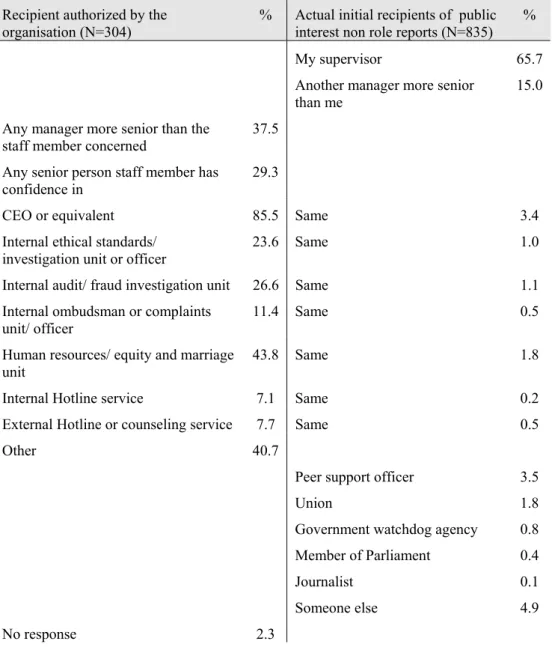
Most key elements discussed in this section, arise from the key finding in the first report that the vast bulk – around 97 per cent – of public interest whistleblowing occurs internally in agencies, with the vast bulk of this occurring to supervisors and line managers, rather than to reporting hotlines or internal specialists in the first instance.
The research identified two further key elements that agencies need to build into the assessment stage of disclosures. The first is the lesson that by virtue of their informal receipt, an overwhelming majority of reports of wrongdoing may not end up being handled within the formal reporting processes of the organisation, due to the common ambiguity about when reports should be handled informally by line managers and where they should be made part of the formal reporting processes. It is accepted that many reports of wrongdoing will be dealt with in the day to day process of management. However, it is essential that organisations develop policies that very clearly set out where managers should handle matters themselves, whether and where they should be recorded and where they should be referred to internal or external organisation mechanisms.
The second key lesson is the importance that efforts to support and protect employees who report wrongdoing should commence at the point of disclosure, rather than when problems begin to arise. Even though it was almost unanimously agreed that risk assessment processes should be applied to whistleblowing, in practice, in most case study agencies, this was hardly ever done, with few organisations having a credible risk management processes in place. Risk management is a key component in protecting reporters from reprisals, but it also can be applied to the broader organisational issues that are faced with reports of wrongdoing. Other components include the need to preserve and manage confidentiality, to begin planning for when confidentiality is not available, and to deal with issues of equity and natural justice that often arise at early stages of investigations. However it is the overarching focus on building risk management into the early stages of the assessment and investigation of disclosures that represents the key finding.
4.
Internal
witness
support
and
protection
The support and protection of whistleblowers is the third, and arguably most important major objective of any whistleblowing program. However the provision of organisational support to whistleblowers is currently the single weakest area of most agencies' responses.
It is clear that the bulk of agencies, in most jurisdictions, need to give active and urgent consideration to strategies for providing whistleblower support. In particular, agencies need to develop programs, commensurate with their own size and needs, for ensuring that support strategies are directed and where necessary, directly delivered, by persons with an
institutional role that conflicts as little as possible with the challenges often implicit in providing that support.
Nevertheless, the results across the case study agencies show that some organisations are considerably more successful than others in tackling this challenge.
All agencies confront the dilemma of the appropriate scale, resourcing and organisational model of internal witness support. Whichever options are chosen, evidence from across the case study agencies points to common elements, all of which must be present in any organisation's approach in some form if the program is to have some prospect of success. Beyond simply the question of compliance with legislative compliance, lies the reality that while positive or successful whistleblowing experiences often go unnoticed by the bulk of other employees in an organisation, negative outcomes can often become well-known, costly and debilitating to organisational moral and performance.
An even more pervasive reason for providing support, was confirmed to be the importance of disclosure experiences for defining whether the agency was able to deliver on commitments to provide its employees with a safe, healthy and productive workplace.
A particular breakthrough from the research, was the lesson for some agencies that internal support for whistleblowers was not necessarily a totally new or different strategy to other programs for maintaining or restoring healthy relationships within the workplace – even if more complex than most other workplace health and safety issues.
No internal witness support strategy can hope to eliminate every case in which a
whistleblower feels aggrieved – whether because in some cases, employee expectations are simply unable to be met; or because the degree of conflict between the employee and management becomes too great or unresolvable; or because despite best efforts, damage to a whistleblower's wellbeing or career is not able to prevented. However the experience in case study agencies confirmed that most agencies have both an opportunity – and a responsibility – to significantly reduce the number of employees falling into these categories, thereby fulfilling their obligations to their employees, lessening the costs of disclosure-related conflicts, and earning greater public confidence in their own integrity.
5.
An
integrated
organisational
approach
As outlined through the previous sections, the three major objectives of a whistleblowing program are to encourage employee reporting of wrongdoing; ensure effective assessment, investigation and action; and support and protect whistle blowers. While this must be underpinned by organisational commitment to the program, the research has also confirmed that clear and sometimes hard decisions are needed to operationalise an effective approach.
Organisational commitment to the program must move beyond procedures setting out the responsibilities and obligations to be fulfilled by staff, to an approach which also emphasises the responsibilities of the organisation as a whole, including the most senior management. The research into the case study agencies confirmed the value, on the whole, of more organised and proactive programs, in terms of measurable results. The following elements are intended to help ensure that the many complex issues involved in embedding a
whistleblowing program in the organisation are addressed in a holistic fashion.
The
Checklist:
Required
elements
for
a
whistleblowing
program
1.
Organisational
commitment
1.1.
Management
commitment
□
Clear statements by senior management of the organisation’s support for the reporting of wrongdoing through appropriate channels ('if in doubt, report')□
Senior management commitment that a credible investigation will follow the receipt of a whistleblowing report, that any confirmed wrongdoing will be remedied, and that whistleblowers will be supported□
Commitment to the principle of whistleblowing among first- and second-level managers□
Understanding of the benefits and importance of having whistleblowing mechanisms among first- and second-level managers□
Knowledge and confidence in policies among first- and second-level managers.1.2.
Whistleblowing
policy
□
Easy to comprehend whistleblowing policy, including guidance on procedures, relation to other procedures, and legal obligations□
Broad staff awareness of the whistleblowing program□
Broad staff confidence in management responsiveness to whistleblowing□
Broad staff awareness and acceptance of responsibility to report1.3.
Resources
□
Staffing and financial resources dedicated to implementation and maintenance of the program, commensurate with organisational size and needs□
Specialised training for key personnel, and inclusion of whistleblowing management issues in general induction and management training1.4.
Evaluation
and
engagement
□
Regular evaluation and continual improvement in the program□
Positive engagement on whistleblowing issues with external integrity agencies, staff associations and client groups2.
Encouragement
of
reporting
2.1.
Comprehensive
coverage
□
Clear identification of all key categories of organisation members (employees, contractors, employees of contractors, volunteers, at-risk clients) needing inclusion in the whistleblowing mechanism2.2.
Defining
reportable
wrongdoing
□
Clear advice on types of wrongdoing that should be reported□
Clear advice on appropriate reporting points for all different types of wrongdoing (including grievances as opposed to public interest disclosures)□
Clear advice on level of information required/desired□
Clear advice that staff are not protected from the consequences of their own wrongdoing by using the whistleblowing mechanism, nor for false or deliberately misleading information□
Clear advice that staff can nevertheless seek and be granted immunity from consequences from their own less serious wrongdoing, when reporting more serious wrongdoing by others or by the organisation2.3.
Multiple
reporting
pathways
□
Clear internal reporting paths and advice on to whom and how whistleblowing reports should be made, including alternatives to 'up the line' reporting□
Clear external reporting paths, including external (contracted) hotlines and advise about relevant regulatory or integrity agencies□
Clear guidance on when reporters should consider reporting outside the normal management chain, or outside the organisation□
Clear advice regarding contact with the media2.4.
Anonymity
□
Clear advice that anonymous reports will be acted upon wherever possible, and as to how anonymous reports/approaches can be made□
Commitment to the confidentiality of whistleblowing reports to the maximum extent possible, with clear advice about possible limits of confidentiality.3.
Assessment
and
investigation
of
reports
3.1.
Identification
and
tracking
of
reports
□
A coordinated system for tracking all significant reports of wrongdoing (including grievances) at all levels of the organisation□
Advice to supervisors on when, how and whom to notify about staff complaints and possible whistleblowing reports□
Organisational procedure for early notification of external regulatory or integrity agencies about significant or higher-risk reports3.2.
Assessment
procedures
□
Skills and procedures for differentiating, as appropriate, between different types of wrongdoing (including grievances), and initiating appropriate investigations□
Flexibility in the type, level and formality of investigation to be conducted, including clear criteria for when no further investigation is required□
Early and continuing assessment of the risks of reprisal, workplace conflict or other adverse outcomes involving whistleblowers or other witnesses3.3.
Confidentiality
□
Procedures for maintaining the confidentiality of whistleblowers and other witnesses to the maximum extent possible□
Procedures for consulting and, where possible, gaining consent ofwhistleblowers prior to action that could identify them, including to external agencies
□
Strategies for supporting employees and managing the workplace when confidentiality is not possible or cannot be maintained3.4.
Equity
and
natural
justice
□
Clear procedures for the protection of the rights of persons against whom allegations have been made□
Appropriate sanctions against false or vexatious allegations□
Clear advice to supervisors about to whom, when and by whom information about allegations need be given, for reasons such as natural justice4.
Internal
witness
support
and
protection
4.1.
Whistleblower
/
internal
witness
support
□
One or more designated officers with responsibility for establishing and coordinating a support strategy appropriate to each whistleblowing case□
Proactive (as well as reactive) operation of the support strategy, i.e. management-initiated rather than simply complaint/concern-driven□
Support arrangements tailored to identified risks of reprisal, workplace conflict or other adverse outcomes□
Involvement of whistleblower in risk assessment and support decisions□
Involvement of identified support person(s) ('confidant', 'mentor', 'interview friend' or similar) and negotiation of their role4.2.
Information
and
advice
□
Provision of information, advice and feedback to internal witnesses on actions being taken in response to disclosure□
Provision of information about how to manage their role in the investigation process, including whom and when to approach regarding issues or concerns□
Access to appropriate professional support services (stress management, counseling, legal, independent career counseling)□
Information and advice regarding external regulatory or integrity agencies that can be accessed for support4.3.
Preventing
and
remedying
detrimental
action
□
Clear commitment that the organisation will not undertake disciplinary or adverse actions, or tolerate reprisals including by managers, as a result of disclosures□
Mechanisms for monitoring the welfare of organisation members who report wrongdoing, from the point of first report□
Positive workplace decisions regarding prevention or containment of the risks of conflict and reprisal□
Direct engagement of supervisors or alternative managers in support strategy and related workplace decisions, to maximum extent possible□
Clear authority for support personnel to involve higher authorities (CEO, audit committee and external agencies) in whistleblower management decisions□
Specialist expertise (internal or external) for investigating alleged detrimental actions or failures in support, with automatic notification to external agencies□
Flexible mechanisms for compensation or restitution where there is failure to provide adequate support, or prevent or contain adverse outcomes4.4.
Exit
and
follow
up
strategy
□
Exit strategies for concluding organised support to whistleblowers□
Follow-up monitoring of whistleblower welfare, as part of regular evaluation of program and to identify ongoing, unreported support needs5.
An
integrated
organisational
approach
5.1.
Clear
choice
of
organisational
model
for
support
□
'Standing', 'devolved', 'case-by-case' support strategies□
Clear understanding of whistleblowing-related roles and responsibilities of key players, internal and external to the organisation5.2.
Separation
of
investigation
and
support
functions
□
Operational separation of functions□
Clear and direct lines of reporting from support personnel to audit/integrity committee and/or CEO, and external agencies5.3.
Shared
responsibility
for
whistleblower
support
□
Clear lines of communication to ensure manager(s) retain responsibility for their workplace and workers to maximum extent possible□
Clear lines of communication with external agencies re: incidence, nature and status of active cases5.4.
Embedded
policies
and
procedures
□
Integrated & coordinated procedures (not 'layered' or 'alternative')□
Integrated complaint/incident recording and management systems□
Whistleblower support integrated into human resources, career development, workplace health & safety (WH&S) policies._________________________________
Part
1.
Introduction
1.
This
report
Organisations are the building blocks of modern society, providing the institutional framework within which economic life, public policy and services, and the livelihoods, careers and social well-being of citizens play out on a daily basis.
Public sector organisations are especially important to the social fabric, as the custodians of shared values and goals, and the vehicles by which millions of Australian federal, state and local public officials serve the interests of the community.
This draft report sets out the results of four years of research into how public sector
organisations can help maintain their integrity and value their employees, by developing and implementing new models for better practice in the management of whistleblowing.
It represents the second and final report of the Australian Research Council-funded Linkage Project, Whistling While They Work: Enhancing the Theory and Practice of Internal Witness Management in Public Sector Organisations (2005-2009). It follows the first report,
Whistleblowing in the Australian Public Sector, published by the Australia & New Zealand School of Government and ANU E Press in September 2008 (Brown 2008).
Whistleblowing is the “disclosure by organisation members (former or current) of illegal, immoral or illegitimate practices under the control of their employers, to persons or organisations that may be able to effect action” (Miceli & Near 1984: 689). In this report, whistleblowing is also taken to mean disclosures by organisation members about matters of “public interest” – that is, practices where the suspected or alleged wrongdoing affects more than the personal or private interests of the person making the disclosure.
The first report set out a new picture of the incidence, significance and management of whistleblowing in government agencies across Australia, from the Commonwealth, NSW, Queensland and Western Australian governments. It drew on information drawn from approximately 300 agencies who provided information about their whistleblowing systems and procedures, 118 agencies whose staff participated in a major randomised survey of public employees, and 16 of those organisations who participated as case study agencies in more in-depth research including further surveys, interviews and workshops.
While the first report provided a comprehensive analysis of the quantitative data that describes whistleblowing in the Australian public sector as a whole, this report fulfils the project objectives of describing, in more practical and qualitative terms, the required elements of new, better practice whistleblowing programs in organisations. The research is based more closely on the experience of the 16 case study agencies to the project, seen in the light of the wider research.
The report provides a new framework of elements and sub-elements, common to the needs of all organisations – large and small – for establishing a successful program for:
• encouraging public officials to report wrongdoing within or by their organisation, to those that can effect action;
• ensuring effective investigation and action in response to those reports; and
• supporting and protecting employees who report.
The recommendations for a new generation of whistleblowing programs contained here, are aimed at all organisations who wish to develop or improve their whistleblowing policies and procedures.
Against each of the five fundamental elements of a whistleblowing program, the report provides a checklist of the key items that are required by any organisation wishing to have successful policies, a guide to key complex issues in the management of whistleblowing, and select sample procedures for operationalising the framework.
The sample procedures are not intended to be adopted word for word by organisations, but taken as a starting point for comparison with existing procedures and updating of policies in line with varying legislative requirements in each jurisdiction and the needs of differing organisational contexts.
The program framework has been developed in conjunction with a Standards Australia working group now reviewing the Australian Standard on Whistleblower Protection Programs for Entities (AS 8004-2003), and provides a working basis for the proposed key elements of that revised Standard, for the guidance and assistance of organisations through Australia.
Two key messages come out of this research. The first is that organisations can and should adopt a policy of ‘when in doubt report’ to encourage the reporting of wrongdoing. This means that organisations should not set artificial administrative thresholds for receiving reports, but rather encourage staff to bring forward any issue that is concerning them. It is the view of the research team that it is better for organisations to receive too much
information about wrongdoing than too little, or too late.
The corollary of this approach is that organisations will be accepting an active obligation to take each report seriously and to take appropriate action. This action may well be to inform the reporter that their suspicions have not been backed up and explaining to them the reasons for that conclusion.
The second key message to come out of this research project is that organisations need to improve their performance in supporting and protecting persons who come forward with reports of wrongdoing. There was ample evidence that this is one area where organisations are currently falling down. This is the area where our research suggests organisations now have much to gain, through a new approach to whistleblowing programs in which public sector agencies can be more confident that they have the tools to ensure both the
accountability and integrity of our public institutions, and the health, safety and well-being of officials who fulfil their public duty to report wrongdoing.
2.
The
Whistling
While
They
Work
project
The Australian Research Council-funded Linkage Project, Whistling While They Work: Enhancing the Theory and Practice of Internal Witness Management in Public Sector Organisations, led by Griffith University (2005-2009), has examined public officers’ experience of and attitudes towards whistleblowing across a wide cross-section of public agencies from the Commonwealth, New South Wales (NSW), Queensland and Western Australian Governments.
The project involved four other Australian universities and 14 partner organisations,
including the public integrity and management agencies listed in the Acknowledgements and on the project website, http://www.griffith.edu.au/whistleblowing. A steering committee representing the partner organisations oversaw the project, while the project team consisted of the lead researchers from each participating university plus three partner investigators, from the NSW, Queensland and Western Australian governments.
The research aim was to identify and expand ‘current best practice’ systems for the management of public interest disclosures in the Australian public sector, including more effective whistleblower protection. By undertaking empirical research into the performance and potential of existing internal witness management approaches, the project sought to develop new standards for internal disclosure procedures (IDPs) in public sector integrity systems, foster improved coordination between integrity bodies in the handling and oversight of disclosures, and support implementation of improved internal witness management strategies in a range of organisational settings.
The four main objectives of the research have been:
• To describe and assess the effects of whistleblower legislative reforms on the Australian public sector over the past decade, including effects on workplace education, willingness to report and reprisal deterrence;
• To study comparatively what is working well and what is not in public sector internal witness management, to inform best practice models for the development of formal internal disclosure procedures (IDPs) and workplace-based strategies for whistleblower management;
• To identify opportunities for better integration of internal witness responsibilities into values-based governance at organisational levels, including improved
coordination between the roles of internal and external agencies, and strategies for embedding internal witness responsibilities in good management; and
• To inform implementation strategies for best practice procedures in case study agencies, including cost-efficient options for institutionalising and servicing such procedures in a range of organisational, cultural and geographic settings, as well as legislative and regulatory reform where needed.
The project is believed to be the largest research project into whistleblowing on a per capita basis conducted anywhere in the world.
The
surveys
and
interviews
As set out in the first report (Brown 2008, pp.15-21), eight surveys were used in the project to collect data on individual experiences and institutional practices.
First, the Agency Survey sought data on the extent, content and operation of whistleblowing
procedures in agencies, as well as participation in further stages of the research. With the support of the partner organisations, this survey was distributed to almost all agencies of the four participating governments (793 agencies in total), resulting in 304 returns. The
participating agencies were a wide cross-section of government organisations in each jurisdiction, from small to large, covering a wide range of functions and portfolios. They include many of the most major departments and statutory authorities in each jurisdiction, government owned corporations, the military, and local governments of varying sizes. Similar data on practices and procedures were sought from specialist integrity agencies in the jurisdiction – including partner organisations to the project – through a corresponding
Integrity Agency Survey.
Of the 304 agencies who answered the Agency Survey, 175 also supplied their written whistleblowing-related procedures, which were analysed in a separate Procedures
Assessment, comparing their comprehensiveness and completeness using a 24-item rating
scale. This scale was developed by the research team on the basis of existing literature and the Australian Standard, as discussed in chapter 10 of the first report (Roberts 2008). The largest single research activity was the Employee Survey, in which 118 agencies
participated. This was a confidential, anonymous survey of a random sample of staff from each agency. From July to October 2006, printed surveys were distributed by agencies to a total of approximately 23,000 public employees, resulting in a total of 7,663 responses. At times these data are analysed in conjunction with the results of the Agency Survey (all 118 Employee Survey agencies had also completed this), as well as the results of the Procedures Assessment (in which 102 of the Employee Survey agencies also participated).
A total of 87 of the agencies volunteered to participate in further research as case study agencies, with 15 agencies being selected by the research team for this role in May 2006.
Since then, an additional agency has also participated in most of the case study analyses, with results varying slightly depending on whether drawn from the group of 15 or 16. In the case study agencies, three more surveys were administered to collected more in-depth information about the whistleblowing arrangements and management practices of these agencies, and the experience of particular target groups of staff. In each case, respondents were also invited to volunteer for a confidential interview.
The Internal Witness Survey elicited more extensive information from 242 whistleblowers
across the case study agencies. The internal witnesses were selected using targeted mechanisms: agencies advertised internally requesting volunteers who had reported wrongdoing, supplemented by approaches to employees known to have reported. The Casehandler and Manager Survey (titled 'Managing the Internal Reporting of
Wrongdoing') elicited more extensive, comparable information from these two groups within the case study agencies. Casehandlers were defined as including: internal investigation, audit and ethics staff; human resource management staff; internal and external (e.g. contracted) employee welfare and assistance staff; and union staff. Surveys were typically distributed to all, or a large proportion of, the identifiable casehandlers in each case study
agency; and to a random selection of managers (typically 5 percent of the total population of managers or 150 individuals, whichever provided the larger figure). Data collection
occurred from April to December 2007. This report includes analysis of the 828 responses received from both groups, being 315 casehandlers (many of whom also identified as managers) and 513 managers (who did not necessarily also identify as casehandlers), again spread across the case study agencies.
In addition, a corresponding Integrity Casehandler Survey was distributed to relevant
casehandling staff from specialist integrity agencies in each jurisdiction (including partner organisations).
From among these survey respondents, 82 individuals were successfully contacted for a further semi-structured interview on their experiences in relation to whistleblowing:
Cth NSW Qld WA Total Internal witnesses 16 21 3 10 50
Casehandlers 1 4 2 4 11
Managers 1 6 9 5 21
Total 18 31 14 19 82
Major
findings
from
the
first
report
The first report of the Whistling While They Work project was published by ANU E-Press and launched by Senator John Faulkner, Commonwealth Special Minister of State in September 2008 (Brown 2008; http://epress.anu.edu.au/whistleblowing_citation.html). The key findings (pp.289-312) also pointed to several areas of improvement needed at the level of organisational whistleblowing programs, now picked up in this report. In summary, the first phases of the research showed particular need for:
1. More comprehensive agency systems for recording and tracking employee reports of wrongdoing;
2. Agency procedures for assessing and monitoring the risk of reprisals or other conflict for those who report;
3. Clearer and better advice for employees on the range of avenues available for reporting wrongdoing;
4. Basic training for public sector managers in how to recognise and respond to possible public interest disclosures;
5. A program of training for internal investigators in basic techniques, with special attention to issues of internal witness management;
6. Adoption and expansion of structured support programs for employees who report wrongdoing;
7. Improved mechanisms for monitoring the welfare of employees who report wrongdoing, from the point of first report;
8. More detailed and flexible agency procedures for the investigation and remediation of reprisals and breaches of duty of care;
9. A dedicated oversight agency or unit for the coordination of responses to employee-reported wrongdoing; and
10. Legislative action to provide more effective organisational systems, realistic compensation mechanisms, and recognise public whistleblowing.
This report provides more detailed guidance on how organisations can address these priority areas (especially findings 1-8), in the context of their overall whistleblowing program. Key lessons from the first phases of the research are also repeated or extended, where useful, throughout this report.
3.
The
case
study
agencies
Features
of
the
case
study
agencies
The purpose of inviting agencies to participate as ‘case study agencies’ was to examine a number of agencies’ internal witness management systems in greater detail, and engage those agencies in the development of new benchmarks for best practice, both for their own use and for the benefit of agencies more generally.
A total of 87 of the agencies volunteered to participate in further research as case study agencies, with 16 agencies being selected by the research team for this role in May 2006. Four agencies were chosen from the Commonwealth and Queensland Governments, five agencies from NSW, and three from Western Australia.
The selection was based on criteria including:
• size;
• type/portfolio area;
• approximate level of integrity risks;
• presence or non-presence of relevant procedures, training & resources;
• internal investigation activity & witness case-load; and
• known or suspected good/bad practice in internal witness management. There is considerable diversity among agencies, and even within particular types of organisations, in terms of their nature, size, and perceived risk of wrongdoing.
The majority of the case study agencies are departments of state (n=9), however there are also three local governments, as well as two statutory bodies, a tertiary education body, and a government-owned corporation. The departments spanned a wide range of portfolio areas, including health (n=3), education (n=3), law enforcement (n=3), and transport (n=1). There is also great variation between in terms of size, with the number of full-time
equivalent employees for each agency ranging from 174 employees in the smallest agency to 110,000 employees in the largest. The most common organisational size for case study agencies was between 1,000 and 5,000 employees, with seven agencies of this size.
The 16 case study agencies were thus a substantial snapshot of the larger group of 118 agencies from which the Employee Survey dataset is drawn. In all, 2,116 responses to the Employee Survey were received from the case study agencies, meaning that while these agencies represent only 13 per cent of the larger group, their respondents account for 28 per cent of the total Employee Survey dataset. Accordingly, the further data collected from the case study agencies – via survey and interview – is likely to be typical of organisational experience more generally.
Comparative
analysis
As part of the research, results from the surveys were compared between the case study agencies on a range of measures. One was the comprehensiveness of their written procedures, as part of the analysis described in Roberts (2008). The agencies were then compared on eight key indicators relevant to whistleblowing. The indicators used were:
1. (Positive) employee attitudes to reporting
2. Level of employee awareness of reporting-related legislation 3. Level of employee awareness of relevant policies
4. Whistleblowing propensity of employees
5. Trust in organisational response to whistleblowing
6. (Low) inaction rate in response to perceived serious wrongdoing 7. Reporters’ knowledge of whether investigation has occurred 8. (Positive) treatment of reporters by management following report.
These indicators were selected as a result of the analysis in the first WWTW report, from which they emerged as key, relatively objective measures of success in relation to the management of whistleblowing.
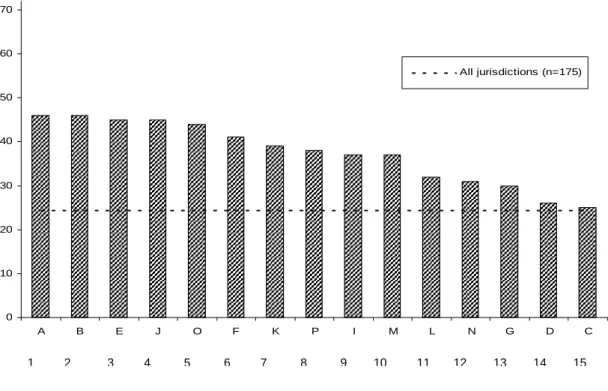
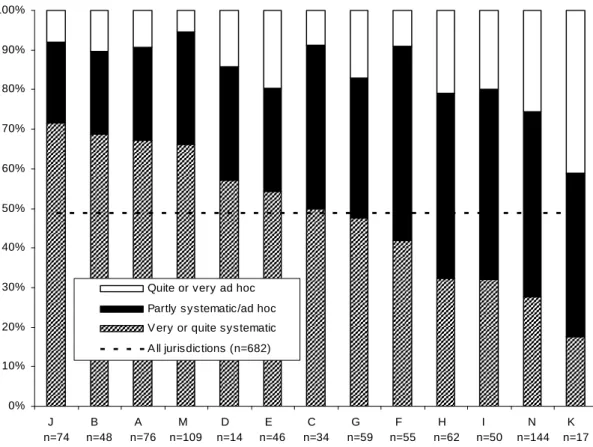
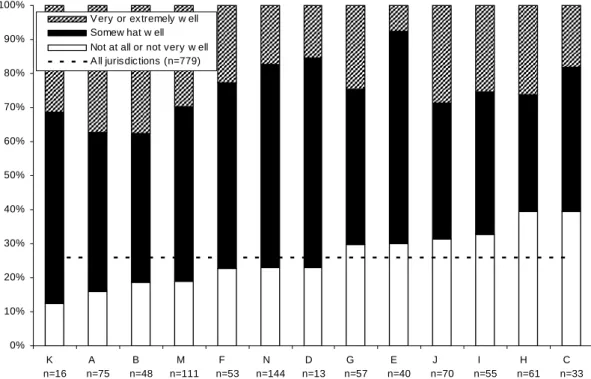
There were significant variations between agencies on many of these measures, just as the first report recorded major variations in results between agencies across the board. Comparisons of the agencies on some of these indicators are shown as column graphs at various places throughout this report.
The agencies were ranked according to their overall level of success against these indicators. The results were shared between representatives of the agencies in a project workshop, for the purposes of provoking discussion about what they each did to encourage reporting, and support whistleblowers. The results of this discussion, along with the quantitative data and results from interviews, was used to inform the content of this report.
Does
type
of
agency
make
any
difference?
The project commenced at a time when a number of Australian police services had
established highly organised whistleblower or 'internal witness support' programs, but it was widely argued that these programs were not necessarily relevant to other public organisations – being different in nature and integrity risks to police services.
To help identify the transferability of lessons between types of agencies, a number of analyses were conducted.
As noted above, one of the criteria for selecting agencies was their approximate level of integrity risk. The Casehandler and Manager Survey (Q12) asked respondents to rate the risk factors for wrongdoing in their organisation (1=very low to 5=very high). While there was variation among individual case study agencies, the generalised view of casehandlers and managers from all agencies were that their risk factors were moderate.
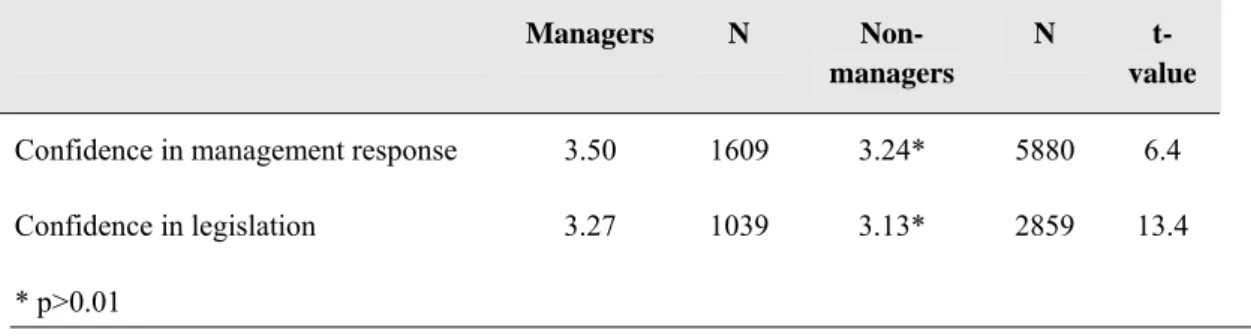
For a more comprehensive comparison, all 118 agencies who participated in the employee survey were also compared by type (Departments of State; Statutory Authorities; Police services; Courts and Tribunals; Local Government Agencies; Educational Institutions; Government owned corporations; and Regulatory bodies, monitoring agencies, enforcement agencies). A one-way between groups multivariate analysis of variance was performed to investigate agency type differences on the six variables relevant to the organisational commitment of employees: trust in management, job satisfaction, organisational citizenship behavior, whistleblowing propensity, confidence in legislation, and commitment to
whistleblowing.
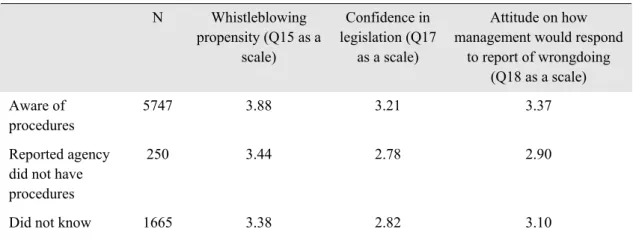
As shown in the table below, the analysis indicated that on these variables, relevant to the salience of whistleblowing and levels of organisational commitment to whistleblowing, there was no significant variation by type of agency. This tends to confirm the indications in the first report that while organisational cultures and levels of commitment do vary significantly between agencies, that these variations are determined principally by the nature of
management in each individual agency rather than by organisation type, purpose, or jurisdiction.
Means of organisational culture variables across types of agencies:
Agency Type N Trust in mgt
Job Satis’n
OCB WB
Prop’y
Conf in leg’n
Com’t to WB
Departments 2751 3.45 3.50 3.79 3.74 3.13 3.30
Statutory Authorities
2161 3.37 3.46 3.75 3.73 3.17 3.27
Police Services 543 3.27 3.49 3.76 4.03 3.31 3.38
Courts/Tribunals 143 3.27 3.39 3.75 3.80 3.16 3.33
Local Government 878 3.39 3.51 3.79 3.75 3.14 3.27
Educational
Institutions 150 3.50 3.54 3.72 3.52 2.97 3.20
Government Owned Corporations
498 3.40 3.61 3.84 3.69 3.01 3.33
Regulators/ Monitoring agencies
251 3.47 3.44 3.66 3.78 3.21 3.40
Overall 7375 3.40 3.48 3.78 3.65 3.16 3.29
Preliminary assumption testing was conducted to check for normality, linearity, univariate and multivariate outliers, homogeneity of variance-covariance matrices and multicollinearity, with no serious violations noted. There was a statistically significant difference between agency types on the combined dependent variables: F (48, 18741) = 6.56, p=000; Wilk’s lambda = .092; partial eta squared = .014. When the results for the dependent variables were considered separately, four of the six reached significance, using a Bonferroni adjusted alpha of .006.
F values of dependant variables from one-way between groups multivariate analysis of
variance
Dependent variables F (8, 3183) p Partial eta squared
Trust in management 5.97 .000 .012
Whistleblowing propensity. 8.27 .000 .017
Confidence in legislation 4.94 .000 .010
Organisational citizenship behavior 5.21 .000 .011
Independent variables were the categories of agency type. The means on each of these variables are set out in the first table above and the F values of dependant variables from one-way between groups multivariate analysis of variance are in the second table.
Program
framework
Early in the project, the research team began the task of assembling a working framework by which to describe and compare the fundamental institutional elements and strategies that made up organisations' different approaches to the management of whistleblowing. As well as being informed by background literature and the experience of members of the research team, the development of this framework commenced at a July 2005 Symposium held by the project and the Australia & New Zealand School of Government in Canberra, at which a number of organisations spoke about their whistleblowing programs.
A first draft framework was then developed based on the 24 items used in the assessment of the comprehensiveness of written agency procedures (Roberts 2008), including the 14 items suggested by the checklist provided in the Australian Standard on Whistleblower Protection Programs for Entities (AS 8004-2003).
The framework was then developed through its use as a basis for discussion among case study agency representatives at three case study workshops, held in July 2007, July 2008, and September 2008. The agency representatives were all responsible for the management of whistleblower issues in their respective organisations. The workshops dealt
systematically with a series of issues raised by the research team. These workshops were recorded, providing a considerable amount of data on the agencies' practices.
The emerging framework was published as an Appendix to the first report.
This framework was then revised in light of further research team discussions and the final case study data, to produce the simplified framework that forms the structure for the body of this report. While it began as a tool for comparative analysis, the framework now provides a comprehensive blueprint of the elements, sub-elements and checklist items validated by the research as needed for an effective whistleblowing program in any organisation.
4.
Implementation
Reform
of
legislative
requirements
In line with the original project objectives, this report is intended to constitute a guide to the required and desired features of the whistleblowing programs of Australian public sector organisations.
This objective was set against a background of uncertainty regarding the adequacy of Australian public sector whistleblowing legislation, and in particular, the take-up of whistleblowing policies at operational levels by agencies. The first report provided considerable evidence confirming widespread failure in that take-up, some of which is repeated or extended in this report.
Since commencement of the project many Australian governments have commenced reviews of their whistleblowing legislation, in part to take advantage of the lessons emerging from this research. As argued in the first report (pp.267-9), legislative action is required to put in place clearer, more comprehensive minimum standards for the obligations and procedures of individual agencies.
The most important review has been undertaken by the Commonwealth Government and Parliament, through the House of Representatives Standing Committee on Legal and Constitutional Affairs (2009). Drawing on the Whistling While They Work research, the Committee recommended the inclusion in proposed Commonwealth legislation of detailed requirements for agency procedures consistent with the program framework recommended by this report.
The project team encourages other governments to continue with the revision of public interest disclosure legislation in a manner that increases the obligations and capacities of agencies to develop procedures on the model now provided from this research.
Revising
the
Australian
Standard
The Australian Standard on Whistleblower Protection Programs for Entities (AS 8004-2003) was used extensively in this research as a benchmark for assessing the content and quality of organisations' approaches to whistleblowing.
The Australian Standard is now under revision, through a Standards Australia working group chaired by Dean Newlan <[email protected]>. Several members of the research team, partner organisations and case study agencies are represented on the working group. In making comments on this report, interest persons are specifically invited to comment on the suitability of the program framework recommended here as a basis for the content of the revised Australian Standard.