International Journal Advances in Social Science and Humanities
Available Online at: www.ijassh.com
RESEARCH ARTICLE
The Impact of Technology on Employee Training and Development
Process
Rajashree K. Gethe
1*,Mahesh S. Hulage
21. Dept. of Human Resource Management, Pune Institute of Business Management, Pune, Maharashtra, India.
2. Dy. Manager-CDMM, Materials Management, Mahindra and Mahindra Ltd., Pune, Maharashtra, India.
*Corresponding Author:Rajashree K. Gethe
Abstract: Training is a systematic and organized learning process by which people learn the skills, concept, and attitude and develop their knowledge so as to improve individual, team and organizational performance. Now a days Indian Government initiative viz., SKILL INDIA, MAKE IN INDIA are propelling development and expansion of manufacturing sector as the sector provides maximum job employment to the people directly and indirectly. Manufacturing sector is facing tremendous challenges from the market and they have to cope with the changing market conditions and requirements. Training and Development helps to improve employee’s Knowledge, Skills and Ability. Thus, organizations are now shifting themselves from imparting traditional training to Modern Technology based Training so that employee will accept the change easily and will become ‘Skilled Employee’ than ‘Know ledged Employee’. The present research study throws light the effectiveness of technology-based Employee Training on Employee’s performance level in selected manufacturing units in various locations like Pune, Mumbai, Delhi etc.
Keywords:Technology, Employee Training, Development Process.
Article Received: 26 Feb. 2020 Revised: 18 March 2020 Accepted: 26 March 2020
Introduction
Importance of the Research Topic
In order to improve Employees Knowledge, Skills and Attitude Organization need to focus on their Training and Development so that employees can meet Desired Performance level as set by their organization in MBO’s i.e. Management by Objectives. Thus in order to improve employee’s skill and performance level organizations are using various technology based training tools and techniques. One of the most important training techniques used by organizations is e-learning.
Table 1: Traditional Methods of Training and Development
Training method Meaning / Definition Example
Case Study method Case study nothing but the description about imaginary or actual/ real life business situations that are already happened in the organization.
In case study method, Trainees are given with the cases where they analyze the facts, identify problems in the case, discuss the facts about the case among participants and find most probable alternative solutions to the solve the same problem.
This method used in training the law students where they learn about past legal cases and their judicial decisions i.e. solutions.
Business/ Management
Games
In business games, Trainees are required to gather the information, analyzing the info. And making decisions about the given business problems.
In this Trainees are divided into groups or teams. A problem related to production, pricing, research expenditure, advertising, labor relations (agreement in contract negotiations), Finance (investments related problems) etc. given to them.
world experience, often during summer vacations as a part of fulfilling requirements of degree programmers. Internship generally offered by Organizations to the college students where students are already known with the Theoretical Knowledge and Concepts but only wants Real Work Experience how the Theory applies Practically.
Engineering, Pharmacy, MBA are undergoing for summer internship programme where students are actually working at workplace and their work has been supervised by the experts in the company.
Job Rotation Job Rotation is the Systematic movement of employees from job to job or project to project within the organization.
It involves rotating the employees & their roles in various functional areas of the company or depts.
It helps to develop knowledge & skills necessary to perform the job
It helps the employees to know the area wherever they need to focus/ improve their knowledge & skills.
transferring person from inventory & store dept. to finance dept. to know how to prepare invoice, GRN [Goods receipt Note] etc.
JOB Shadowing It is one of the On-the-Job Training methods where new employee is allowed to work with experienced employee and follows and observes him
Employees of Choice Hotels International in Silver Spring, Maryland, USA, are provided with an opportunity to job shadow for a day in one of their franchised hotels to experience what it is like to be a hotel operator
Lecture Method Lecture is a best and simplest technique to present and explain various facts, concepts and principles.
It is the verbal presentation for a large group of trainees. Lecturers organize some study materials and give it to the group of trainees and communicate with trainee.
E.g. in colleges and universities, lectures and seminars are the most common methods of training the students.
Mentoring A Mentor is a guide who can help the mentees to find the right direction and who can help them to develop solutions to their career issues.
Mentoring provides guidance and clear understanding of how the organization will achieve their goals and objectives to their junior employees.
Through the mentoring method of training, mentor determines what is required to improve mentee’s performance.
Once mentor identified the problem, weakness and the area of improvement mentor advises relevant training to their mentees.
Mentoring is nothing but one-on-one interaction where weaknesses of mentee are identifying and mentors gives training to him so as to improve his knowledge & skills. Mentoring focus on Attitude Development.
It is conducted of management level employees.
It helps in identifying weaknesses and focusing on areas which needs improvement.
University of Toronto’s dept. of The organizational development and learning center offers 12 month duration Mentoring Programme where their staff is mentored by senior university leaders so as to enhance their job skills and knowledge level .
Apprenticeship Apprenticeship is a work study training method with both on-the-job and classroom training. It is a system of training in which workers entering in skilled trades are given systematic instructions and work experience both on-the-job & off-the-job in the practical and theoretical aspects of the work.
The Organizational Development &
Learning Centre at the University of Toronto offers mentoring programs
of a 12-month duration, which partner staff with more senior university leaders to assist them in
enhancing their job skills and their university experience
Programmed Instruction
Method
In this type of training, supervisor gives instructions to the trainee about how to perform the work.
It involves 4 step instructions training: Preparation, Presentation, Performance and Follow-up.
In pronunciation training using a computer program it has in built automatic speech recognition
component which provides automatic feedback to the trainees at the work and sentence level
Role Plays Requires trainees to assume a character and act out the role in a make-believe scenario or series of scenarios; learning comes by way of reflection on The play.
Reference assistants training at a library, has the trainees play out scenarios which are then followed by
a trainer-led discussion
Simulation Involves the use of a simulator
Where specific skills are developed through repeated practice with a multisensory experience of imitated conditions. A special form of simulation training is Virtual
Reality Training which entails Total sensory immersion.
The Harvey Simulator is a life-sized mannequin that can simulate 27 different cardiac conditions, enables
Brief About the Topic and the Industry
Impact of Technologies towards
Employee’s Training and Development in Manufacturing Sector
Employee training (ET) is a learning experience [1], seeks a change in employee’s skills, knowledge, attitudes, or behavior which is increasingly required to assist the work force in using modern techniques, tools, strategies and materials in their performing jobs. Employee development, on the other hand, generally focuses on future jobs in the organization and it encourages employees to acquire new or advanced skills, knowledge, and viewpoints, by providing learning and training facilities, and workplace where such new ideas can be applied.
Again, employee development (ED) is a joint initiative of the employee as well as the employer goes a long way in training to upgrade the existing skills and knowledge of
an individual
(www.managementstudyguide.com/employee-development.htm) for performing job activities. Additionally, employee training and their development enable human capital to unleash employee’s dexterity and it helps to ensure that organizational members possess the knowledge and skills they need to perform their jobs effectively, take on new responsibilities, and adapt to changing conditions.
For the Employee’s development and productivity, technologies take a great impact on training and development for constant advancement and also prepares the workforce of training, such as artificial intelligence, gamification and virtual reality. As manufacturing sectors emerged as one of the high growth sectors in India and as one of the most crucial economic contributions with the amount of Foreign Direct Investment (FDI) in India’s manufacturing sector reached US$ 73.70 billion during April 2000-December 2017.
The Gross Value Added (GVA) at basic current prices from the manufacturing sector in India grew at a CAGR of 4.34 % during FY12 at basic prices from manufacturing sector grew by 10.92 % in the third quarter of FY18. Under the make India initiative, the government of India aims to increase the share of the manufacturing sector to the GDP
to 25% by 2022, from 16% and to create 100 million new jobs by 2022 So, the development of the working abilities, skills and job relevant knowledge of employees through technology training with other initiatives is too much essential for retaining manufacturing sectors growth and establishment in the country.
Thus, considering the necessity, applicability and retaining of manufacturing sector’s growth and its employee’s development in the country, the researcher decided to study the impact of technology towards employee’s training and development at manufacturing sectors in India.
Research Objective:
Primary objective:
To know the impact of technology towards training and development in manufacturing sector.
Secondary objective:
To learn about training and development practices in manufacturing industry.
To analyze the gap between training and technology in manufacturing industry.
Literature Review Conceptual Review Technology or e-learning
E-learning supports the Organization's Goals. Improved training costs. Producing learning content is time consuming whether it's online or not.
With e-learning, each time the course is accessed the return on investment improves because it will be dividing the fixed production costs by number of uses.
Employee Training (ET)
Training is a program scheduled or design by the organization by offering training to their employees for the permanent change of individual’s attitude, behavior, skills, knowledge. Training referred to the skills deemed necessary by the management of an organization that must be acquired by the member of that organization in order to improve the probability of achievements of its goals.
Employee Development (ED)
On the other hand, development focuses on building the knowledge and skills of the employees so that they will be prepared to take on new responsibilities and challenges. It is more oriented towards individual’s broadening skills for the future needs. The employee development (ED) involves training, education and career development as well. Moreover, it is the “intangible assets” of an organization [2] that leads to mastery as the measure of a person's integrity and self-control and it is characterized by such qualities as competence, effectiveness, and a high degree of personal responsibility which present modern information oriented training that focuses on individual’s current jobs.
Additionally, the concept of employee training and development by Greenberg & Baron adopted as “The set of processes that arouse, direct, and maintain human behavior towards attaining some goal.” Lastly, employee Training and Development strikes a balance between research and real company practices which provide background in the fundamentals of training and development such as needs assessment transfer of training, learning environment design, methods, and evaluation [3].
Theoretical Review
Technology as a Part of Employees Training and Development
Technology-Based Training is the first comprehensive overview and planning guide to the new world of distance learning. Technology has a great impact on the
training and development for employees and organization as well in order to inculcate and improving the advance skills and knowledge which is demanded in the present and future market. To comprehend the important of technologies in training, we need to look upon the continuously demand of the market.
Categories of Employees Training
Employee training programs are conducted following any kind of training methods in an organization. Even within one organization different methods are used for training different people. All the training methods are divided into two classifications by which employee development can be occurred and the categories of training methods are:
On-the-job Training Methods [4], under
these methods new or inexperienced employees learn through observing peers or managers performing the job and trying to imitate their behavior. These methods do not cost much and are less disruptive as employees are always on the job, training is given on the same machines and experience would be on already approved standards, and above all the trainee is learning while earning (http://www.yourarticlelibrary.com). Some of the commonly used methods are: Coaching, Mentoring, Job Rotation, Job Instruction Technology Apprenticeship, Understudy etc.
Off-the-Job Training Methods are
conducted in separate from the job place, study material is supplied, there is full concentration on learning rather than performing, and there is a freedom of expression. The important methods under off-the-job training include: Lectures and Conferences, Vestibule Training, Simulation Exercises, Sensitivity Training, Transactional Training etc. These kinds of training methods have a long-run implication and growth over employees working life, explores the meanings of further improvement [5] and its importance as a supplement for workplace learning [2] that associated with the development of performing activities of employees.
Table 2: The difference between on-the-job training and off the job training
Off-the -Job Training On-the-Job Training Emphasis on learning basic facts and skills Getting the job done
Ultimate Goal Knowing Developing best practices
Knowledge Static, decontextualized, general Dynamic, situated, practice-oriented
Topics/problems Given by curriculum Arise from and embedded in work situation
Backdrop or Linkage of Employees
Training and Development with
Technology
According to David Beach, Technology enabled learning can be an effective tool if the lessons are designed according to instructional design principles. Additionally, employees can complete training materials anytime and anywhere they have an Internet connection. Websites can deliver the primary instructional content or extend and enhance training content. Many online employee training programs require registration and have the capability to monitor employee performance through the use of a learning management system.
Increasingly organizations are leveraging technology enabled instructional methods that utilize technology such as electronic learning via web based training, mobile technology such as I-pads, and simulations in the delivery of instruction. A primary benefit of technology based training is leveraging the scale and scope of employee training programs. If an organization is required to train multiple employees technology offers unlimited options based on relatively low-cost and employee accessibility.
David Beach again said, the most powerful influence on learning from instructional technologies is not the technology itself, but what is delivered with that technology. Poorly designed and implemented employee training programs will not stimulate and support learning outcomes regardless of how interactive or cutting edge the technology used to deliver the training. While technically and theoretically almost anything can be taught on-line, it may not be practical. Technology based employee e-training programs provide self-paced employee directed learning that is delivered with a click of the mouse. Employees review a catalog of online classes and select training
courses that are applicable to the work center. Employers can create a training web site that provides access to databases and links to relevant web sites and search engines. The web site could include descriptions of database link to assist employees in determining links that would be useful for a work center related problem. Employees can search for employment related information and pursue skills or knowledge, when they need it, where they need it, whether it is a video or a web delivered training course.
Although training and development time varies according to individuals, Guhlin [6] states the time required is whatever satisfies a trainer’s need for exploratory learning. That learning includes what the teacher needs to learn to effectively use the computer as both a personal and instructional tool. When designing staff development sessions on technology, individual differences must be addressed and individual strengths supplemented [7, 9].
Even when professional development opportunities for technology are available, personal anxiety associated with such opportunities results because trainers arrive at the learning environment with an immense range of abilities and specific developmental needs. As a result, classroom training should be involved from the beginning in planning the development sessions so they can be certain their specific needs will be addressed [6].
Relationship among Variables
There is a relationship between technology towards training and development in manufacturing industry.
Model/ Conceptual Framework
Theoretical Model
Independent variable: Employee training
and development
Dependent variable: Technology
Demographical variable: Age, gender,
income level, marital status, education qualification, designation
E-learning or Technology Based
Training Needs in Manufacturing Sector
Training has to start with the recognition of training needs through job analysis, performance assessment and organizational analyses. As technology changes, so do the skills workers need. In order to compete successfully in the global market.
Manufacturing organizations must aim at training workers in skills necessary to produce quality goods. The process of manufacturing goods has evolved from craftsmanship to a highly organized factory system. The factory system itself has changed dynamically from mechanized powered systems to the present day trend towards application of Advanced Manufacturing Technology (AMT) (computerized design, planning, and manufacturing tools such as CAD, CAM, MRP, etc.).
Paralleling this evolution have been dramatic changes in the skills required of the human component of the system. Such improved skills are needed in both cognitive and psychomotor areas. Although recent developments in technology have made very significant contributions towards improving productivity in the manufacturing sector, there has been an increase in the skill demands placed on the human as an integral component of the continually evolving work system. Nevins and Whitney state that the drive to automate has led to automating simpler activities, leaving difficult tasks for humans to perform.
According to Adler [10], there is a general trend towards higher skill requirements among manufacturing workers due to speed of the automated equipment. Further, according to Adler, since the role of the human is becoming supervisory in nature, and because of the nature of the computer-controlled technology, there is an increasing demand on maintenance skill requirements (`traditional mechanical, hydraulic, and electrical skills supplemented by electronics expertise).
Manufacturing firms adopting computer-based technologies are upgrading selection criteria for maintenance jobs to reflect the changes in skill requirements with changes in technology. It has been shown that variables such as comprehensive training are essential to human resource management practices, particularly in advanced manufacturing environments.
According to Adler [10], there is a general trend towards higher skill requirements among manufacturing workers due to speed of the automated equipment. Further, according to Adler, since the role of the human is becoming supervisory in nature, and because of the nature of the computer-controlled technology, there is an increasing demand on maintenance skill requirements (`traditional mechanical, hydraulic, and electrical skills supplemented by electronics expertise). The manufacturing firms adopting computer-based technologies are upgrading selection criteria for maintenance jobs to reflect the changes in skill requirements with changes in technology.
Benefits of Technology Based Training
David Beach said, the use of technology driven training delivers benefits to employees and organizations. Leveraging internet enabled training capabilities maximizes available education training resources. Technology offers ease of use, learning retention, dissemination of information, the ability to reinforce learning, employee training convenience and a reduced impact on productivity. While technology provides the building blocks for employee training and development, it is an addition to, not a replacement for, employee training and development processes.
Building a 21st century world class employee training and development program requires the integration of instructor-led training, technology-based training, employee assessments, employee coaching, work center simulations and measurable training outcomes. Overall, training leads to acquiring new skills and/or improvements in existing skills.
It Saves Money: Employees that are properly trained spend less time troubleshooting and more time on productive and revenue-driving tasks.
It Saves Time: When employees are
knowledgeable about the applications they use, they can work quickly and finish projects faster.
It Fosters a Competitive
edge: Companies that can use all their
solutions effectively are likely to outperform those that struggle to understand the basics. And, since you’re saving time and money, you can re-allocate those measures to innovative projects.
It Boosts Confidence: Confident
employees are better employees. When people know how to efficiently do their job, they are much more likely to be happy in their position, resulting in less turnover for your business.
It allows for team building: Training
requires employees from different departments to learn and work together. More experienced users can jump in and help those around them, and employees get a glimpse of how other departments work.
Research Methods
Data Collection Method/technique
For collecting reasonable number of responses, 102 questionnaires were distributed by the help of two representatives (manufacturing employees) from three different manufacturing organization within two weeks in Pune, Mumbai and Meghalaya. The questionnaires were prepared on online mode, that is through the use of google form and the same has been send to the professional employees who currently work in manufacturing industry. So, 102 sample size
with 99% response rate is significantly acceptable for conducting the current study.
Measures
All the items of Employee Training, Employee Development and technology have been measures in questionnaires which has been rate from 1-strongly agree to 5-strongly disagree. So the higher the score the higher the impact of technology towards training and development. All the data received from the survey were entered into the IBM SPSS statistics version 21.0 for summarization and all other related calculation.
Research Type
Descriptive research: This study used
descriptive research for collecting and distributing the questionnaires.
Purposive Random Sampling: Purposive
Random Sampling are used in this study for the questionnaires are judgmental and non-probability sample that is selected based on characteristics and the objective of the study specifically to only the person who work in manufacturing industry.
Source of Data
Primary Data: This study has used primary
data as the questionnaire that has been circulated is confidentially and purely original that has not used by anyone.
Secondary Data: This study has used
secondary data like: Journals, articles, magazine, company website for finding the information about the study.
Analysis & Interpretation of Data Data Analysis Software
IBM SPSS version 21 is used for the data analysis process.
Table 3: Frequency Table
Gender
Frequency Percent Valid Percent Cumulative Percent
Valid
male 84 82.4 82.4 82.4
female 18 17.6 17.6 100.0
Total 102 100.0 100.0
Table 4: The framework of male and female respondents. In this table we can analyze that the total number of respondents is 102, and percentage of male is greater than female with the differences in frequencies, that is, male=84, valid percent is 82.4 and female=18, valid percent is 17.6. The difference of the number between male and female is 66. This is because in the manufacturing, less number of women is available
Location
Frequency Percent Valid Percent Cumulative Percent
Valid
Pune 53 52.0 52.0 52.0
Mumbai 23 22.5 22.5 74.5
others 4 3.9 3.9 100.0
Total 102 100.0 100.0
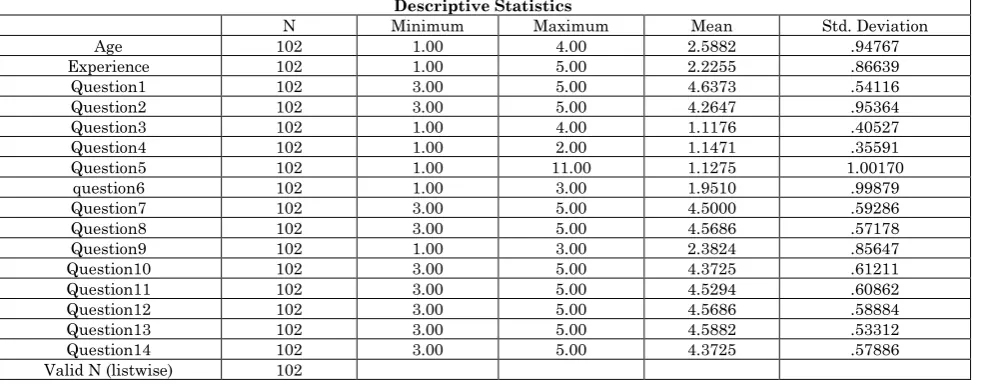
Descriptive Statistics
Table 5: Framework of location/ethnicity In this table, we find that there are 4 or more locations that has been take part in this research questionnaires. From the table, we analyze 3 locations that are Pune with 53 frequencies, Mumbai with 23 frequencies, Meghalaya with 22 frequencies and unknown or others are 4 frequencies. There is a great difference between the numbers of respondents with a specific location. Overall, Pune is the highest in numbers of respondents
Descriptive Statistics
N Minimum Maximum Mean Std. Deviation
Age 102 1.00 4.00 2.5882 .94767
Experience 102 1.00 5.00 2.2255 .86639
Question1 102 3.00 5.00 4.6373 .54116
Question2 102 3.00 5.00 4.2647 .95364
Question3 102 1.00 4.00 1.1176 .40527
Question4 102 1.00 2.00 1.1471 .35591
Question5 102 1.00 11.00 1.1275 1.00170
question6 102 1.00 3.00 1.9510 .99879
Question7 102 3.00 5.00 4.5000 .59286
Question8 102 3.00 5.00 4.5686 .57178
Question9 102 1.00 3.00 2.3824 .85647
Question10 102 3.00 5.00 4.3725 .61211
Question11 102 3.00 5.00 4.5294 .60862
Question12 102 3.00 5.00 4.5686 .58884
Question13 102 3.00 5.00 4.5882 .53312
Question14 102 3.00 5.00 4.3725 .57886
Valid N (listwise) 102
In this table, we analyse the minimum and maximum of age, experience, and the point of view from different person. So the minimum age is 1 that is between 20-25 years and the maximum age is 4 that is between 30-35 years, and the minimum years of experience in industry is 1 that is between 0 to 1 year, maximum years of experience is 5 that is 15 years above of experience. Overall questions from 1 to 14, we find that most of the respondents agreed that technology has an impact towards training and development.
Results & Conclusion
Findings of the Study
From this study, the researcher finds that in manufacturing industry, technologies have a positive impact on training and development as most of the employees have to work with machine. Furthermore, training through technology improves performance, acquire more skills, save time, build confidence.
When technology changes, it creates more difficult to employees to adapt with it, so proper training is required and in the future, training through technology is more relevance than the traditional one. Overall, feedback is also very important for effective training results. After the study on the impact of technology towards training and development in manufacturing industry, we
conclude by saying that technology through technology is compulsory in a manufacturing industry so as to improve both the personal growth of the individual and the organization as well for more productivity in the future.
Limitations & Future Scope of Research
The study suffered some limitation like: short literature review using purposive random sampling technique and small sample size by N= 102 and the short period of time might limit the findings.
The study recommended for further scrutiny on the relationship between Employee Training and Employee Development and Technology including manufacturing sector in India and other country, taking increase of literature with large and more representative sample size.
Additionally, training networking for employee development, an inductive research approach can be applied for conducting this kind of research study for getting the best result in order to make decision in future.
Further, the best advice for future research on the effectiveness of technology towards training and development in manufacturing sector, face to face interview is very important and it will help the confident point of views from different employees.
Managerial Implications
The study has theoretical, empirical, academic and practical implication. From the theoretical point of view, the study provides worth input in the field of literature and a better way to comprehend the study of employee training and development on technology is typically help only by the address on the gap of the current existing in the literature. The study has empirical also because this kind of study may change from time to time in the future as the behaviorists, economists, and practitioners think different about the employee training and development through technology.
Again academicals implication involve in this study for the knowledge that can enhance from the academic perspective as not only in the field of human resources but also in the field of management and organizational behavior. Moreover, practical implications findings of this study may help the researchers, practitioners and business to pinpoint the procedure or method of designing to improve technology- based training in manufacturing sector [11-19] .
References
1. Hughey AW, Mussnug KJ (1997) Designing effective employee training programmes. Training for Quality, 5(2): 52-57.
2. Harris R, Willis P, Simons M (1998) Learning the Job: Juggling the Messages in On-and Off-the-Job Training. National Centre for Vocational Education Research, 252 Kensington Road, Leabrook, South Australia 5068, Australia.
3. Noe RA (2010) Employee training and development. McGraw-Hill/Irwin.
4. Bowman MJ (1987) On-the-job training. Pergamon Books Ltd., Oxford.
5. Smith E (2002) Theory and practice: The contribution of off-the-job training to the development of apprentices and trainees. Journal of vocational education and training, 54(3), 431-45.
6. Guhlin M (1996) Stage a well-designed Saturday session and they will come! Technology Connection, 3(3): 13-14.
7. Boe T (1989) The next step for educators and the technology industry: Investing in teachers. Educational Technology, 29(3): 39-44.
8. Browne DL, Ritchie DC (1991) Cognitive apprenticeship: A model of staff development for implementing technology in schools. Contemporary Education, 63(1): 28-33.
9. Shelton M, Jones M (1996) Staff development that works! A tale of four T’s. NASSP Bulletin, 80(582): 99-105.
10.Adler PS (1991) Capitalizing on new manufacturing technologies: current problems and emergent trends in US Industry. In: National Academy of Engineering (Ed.), People and Technology in the Workplace. National Academy Press, Washington, DC.
11.Baldwin, John R, Gray, Tara Johnson, Joanne (1995) Technology Use, Training and Plant-Specific Knowledge in Manufacturing Establishments Statistics Canada Working Paper 86.
12.Boothroyd G (1990) In: Allen, C.W. (Ed.), Simultaneous Engineering} Integrating Manufacturing and Design Society of Manufacturing Engineers. Dearborn, MI, 90-91.
13.Alebel W (2012) Employee Training and Development Practice in Selected Ethiopian Leather Footwear Factories (Evidence from Selected Shoe Factories) (Doctoral dissertation, aau).
14.Miller JA, Osinski DM (2002) Training needs assessment. London: SHRM. impact+of+technology+in+training+and+d evelopment+in+manufacturing+industry& hl=en&as_sdt=0,5
15.JP Wilson (1999) Human Resource Development, Learning & Training for Individuals & Organizations, Kogan Page, London.
17.RA Swanson (1996) In Praise of the Dependent Variable. Hum. Resour. Dev. Q. 7: 203-207.