165
PRETREATMENT WITH NITRIC OXIDE REDUCES LEAD TOXICITY IN COWPEA
(VIGNA UNGUICULATA [L.] WALP.)
Omid Sadeghipour
Department of Agronomy, Yadegar-e-Imam Khomeini (RAH) Shahre-rey Branch, Islamic Azad University, Tehran, Iran
Author's e-mail: [email protected]
Received: March 25, 2015; Revised: September 29, 2015; Accepted: September 29, 2015; Published online: December 18, 2015
Abstract:Lead (Pb) is one of the most important toxic heavy metals that reduce plant growth and development. Therefore, finding compounds that can alleviate the toxic effects of Pb is necessary. Nitric oxide (NO) is a signaling molecule that plays important roles in different physiological processes in plants, such as the response to biotic and abiotic stresses. A pot experiment was conducted to study the effects of exogenously applied NO on Pb stress tolerance in cowpea. Seeds were soaked at various concentrations of sodium nitroprusside (SNP; NO donor) (0, 0.5 and 1 mM) for 20 h, and then sown in pots containing 0 or 200 mg kg-1 Pb (NO
3)2. The obtained results showed that Pb stress significantly reduced the
chloro-phyll value, relative water content (RWC) and net photosynthetic rate, but increased lipid peroxidation, proline content and superoxide dismutase (SOD), catalase (CAT), ascorbate peroxidase (APX) and glutathione reductase (GR) activities. Nonetheless, different levels of NO significantly lowered Pb toxicity by further increasing SOD, CAT, APX and GR activi-ties as well as proline accumulation. NO pretreatment also raised the chlorophyll value, RWC and net photosynthetic rate but reduced lipid peroxidation. Both NO levels (0.5 and 1 mM) were effective in Pb stress tolerance; however, 0.5 mM was more effective. These results indicate that NO pretreatment plays an important role in protecting cowpea plants against Pb toxicity by enhancing antioxidant enzyme activities and proline accumulation.
Key words: antioxidant enzymes; nitric oxide; Pb stress; photosynthesis; proline
Abbreviations: APX − ascorbate peroxidase; AsA − reduced ascorbate; CAT − catalase; DHAR − dehydroascorbate reduc-tase; Duncan’s multiple range test – DMRT; GR − glutathione reducreduc-tase; GSH − reduced glutathione; GSSG − oxidized glutathione; MDA − malondialdehyde; MDHAR − monodehydroascorbate reductase; NO − nitric oxide; ROS − reactive oxygen species; RWC − relative water content; SNP − sodium nitroprusside; SOD − superoxide dismutase
INTRODUCTION
Lead (Pb) is one of the most important pollutants of air, water and soil. The main sources of lead pollution are mining operations, leaded gasoline, sewage sludge, smelting, metal plating and finishing operations, chem-ical industries, petroleum refining, dyes, pigments, printing, fertilizers and pesticides (Nagajyoti et al., 2010; Pourrut et al., 2011; Sharma and Dubey, 2005). Pb-contaminated agricultural soils cause significant re-duction in crop growth and productivity. Although Pb is not an essential element and has no biological func-tion for plants, it is easily taken up and accumulated in
al., 2014), reduces nutrient uptake (Nareshkumar et al., 2014), prevents seed germination and seedling growth (Hassan and Mansoor, 2014), decreases plant height, leaf area, dry weight and yield (Gautam et al., 2014), reduces root dry weight, root length and the number of lateral roots (Wang et al., 2013).
During the last years, different exogenous chem-icals have been used for the improvement of plant tolerance to abiotic stresses, such as heavy metals. Ni-tric oxide (NO) is an important signaling molecule in plants. This free radical regulates diverse plant pro-cesses such as cell division, mitochondria functional-ity, xylem differentiation, chlorophyll biosynthesis, photosynthesis regulation, induction of seed germina-tion and reducgermina-tion of seed dormancy, root organogen-esis and development, growth of pollen tube, stomatal movement, flowering, nutritional status, plant-rhizo-bacterium interaction, gravitropic bending, matura-tion and senescence, cell-wall lignificamatura-tions and pro-grammed cell death (Planchet and Kaiser, 2006; Sid-diqui et al., 2011; Misra et al., 2011). It has also been suggested that NO protects plants against both biotic and abiotic stress. Exogenous application of the NO donor, sodium nitroprusside (SNP), enhanced plant tolerance to drought (Shallan et al., 2012; Shehab et al., 2010), increased salinity (Guo et al., 2009; Kausar et al., 2013), heavy metals (Kumari et al., 2010; Wang and Yang, 2005), osmotic stress (Tan et al., 2008), high temperatures (Hasanuzzaman et al., 2012), chilling (Liu et al., 2011), waterlogging (Fan et al., 2014) and oxidative stress (Esim and Atici, 2013). Nonetheless, the influence of exogenous NO on Pb stress tolerance in plants is not yet fully understood. The present study was carried out to assess the impact of exogenous NO in reducing lead toxicity in cowpea.
MATERIALS AND METHODS
Plant material and experimental design
The pot experiment was carried out in summer 2014 in a research field of the Yadegar-e-Imam Khomeini Branch, Islamic Azad University, Tehran, Iran. Cow-pea (Vignaunguiculata cv. Kamran) seeds without
vis-ible defect, insect damage or malformation were sur-face sterilized using 5% sodium hypochlorite solution for 5 min and then rinsed 3 times with sterile distilled water. After sterilization, as a pre-sowing treatment, seeds were soaked for 20 h in different concentrations (0, 0.5 and 1 mM) of sodium nitroprusside (SNP) as NO donor. Then the seeds were sown in plastic pots, 50 cm in diameter and depth, filled with 20 kg soil containing an equal mixture of peat, decomposed manure and farm soil. The soil characteristics are presented in Table 1. Before sowing, the soil in the pots was mixed with the appropriate amount of Pb (NO3)2 to provide up to 200 mg kg-1. The sowing date
was 20 June 2014; the pots were then placed in farm conditions. The pots were arranged in a completely randomized design with three replicates. In each pot, 20 seeds were sown at a depth of 3 cm; at the leafy stage after thinning; 6 seedlings remained. Irrigation of the plants was carried out regularly using tap water.
Assay of chlorophyll, net photosynthetic rate and relative water content (RWC)
At the flowering stage, certain physiological and biochemical traits of cowpea were calculated as fol-lows: total chlorophyll value of the 2 youngest fully expanded leaves of 3 plants per pot was measured us-ing a chlorophyll meter (Chlorophyll Content Meter, CL-01, Hansatech Instruments Ltd. England). The device readings were used as relative values for to-tal chlorophyll content. Net photosynthetic rate was measured on sunny days between 11:00 and 12:00 on the 2 youngest fully expanded leaves using a portable photosynthesis system (Handheld Photosynthesis Sys-tem, CID Bio-Science CI-340, USA). To determine the RWC, disks (1 cm in diameter) from the middle portion of the 2 youngest fully expanded leaves of plants per pot were collected, immediately weighed to obtain the fresh weight (FW), then rehydrated in Petri dishes containing distilled water for 24 h under dim
Table 1. Soil characteristics of pots.
EC
light and room temperature to get the turgid weight (TW) and subsequently oven dried at 70°C for 48 h to record the dry weight (DW). RWC was calculated as: RWC (%) = (FW - DW) / (TW - DW) × 100.
Malondialdehyde (MDA) assay
Lipid peroxidation was estimated in terms of MDA content according to the method of Heath and Packer (1968). Leaf samples (1 g) were homogenized in 10 ml of trichloroacetic acid (TCA). The homogenate was centrifuged at 15000 rpm for 5 min. Four ml (0.5%) of thiobarbituric acid in 20% TCA was added to a 1-ml aliquot of the supernatant. The mixture was heated at 95°C for 30 min and then cooled rapidly in an ice bath. After centrifugation at 10000 rpm for 10 min, the absorbance was recorded at 532 nm. The value for non-specific absorption at 600 nm was subtracted. The MDA content was calculated using the absorption coefficient of 155 mM-1 cm-1 and expressed as μmol
g-1 fresh weight.
Antioxidant enzyme activity assay
Superoxide dismutase (SOD) activity was assayed by monitoring the inhibition of photochemical reduc-tion of nitroblue tetrazolium (NBT) according to the methods of Beyer and Fridovich (1987). Five ml of re-action mixture containing 5 mM hydroxyethyl pipera-zine ethane sulfonic acid (HEPES) (pH 7.6), 0.1 mM EDTA, 50 mM Na2CO3 (pH 10.0) 13 mM methionine, 0.025% (v/v) Triton X-100, 63 μmol (NBT) 1.3 μmol riboflavin and an enzyme extract were illuminated for 15 min (360 μmol m-2 s-1) and a control set was not
illuminated to correct for background absorbance. The unit of SOD activity was defined as the amount of enzyme required to cause 50% inhibition of the reaction of NBT at 560 nm. The enzyme activity was expressed in units mg–1 protein.
Catalase (CAT) activity was determined by moni-toring the decomposition of H2O2 at 240 nm using the procedure of Aebi (1984). The reaction mixture con-tained 50 mM phosphate buffer (pH 7.0.), 0.1% (v/v) Triton X-100, 10.5 mM H2O2 and 0.05 ml leaf extract.
The reaction, carried out at 25°C for 3 min, was started with the addition of H2O2. One μmol H2O2 destroyed per min is defined as one unit of CAT activity. The enzyme activity was expressed as unit mg–1 protein.
Ascorbate peroxidase (APX) activity was assayed according to Nakano and Asada (1981) by the de-crease in absorbance of ascorbate at 290 nm. The assay mixture contained phosphate buffer (50 mM, pH 7.0), 0.1 mM EDTA, 0.5 mM ascorbate, 0.1 mM H2O2 and enzyme extract. APX activity was calculated using the extinction coefficient 2.8 mM-1 cm-1. A unit of APX
activity is defined as the μmol of ascorbate oxidized per min at 25°C. The enzyme activity was expressed as unit mg–1 protein.
Glutathione reductase (GR) activity was deter-mined based on the decrease in absorbance at 340 nm due to the oxidation of NADPH to NADP ac-cording to the method of Foyer and Halliwell (1976), with minor modifications. The reaction mixture (3 ml) consisted of 50 mM Tris-HCl (pH 7.6), 5 mM MgCl2, 0.5 mM GSSG, 0.2 mM NADPH and 0.1 ml enzyme extract. The reaction was started by the ad-dition of GSSG and the NADPH oxidation rate was monitored at 340 nm for 3 min. Enzyme activity was determined using the molar extinction coefficient for NADPH (6.2 mM-1 cm-1). One unit of GR activity is
defined as the μmol of GSSG oxidized per min. The enzyme activity was expressed as unit mg–1 protein.
Proline assay
Statistical analysis
Collected data were analyzed by MSTAT-C statistical software and the means were compared by Duncan’s multiple range test (DMRT) at the 5% probability level.
RESULTS
Membrane injury and lipid peroxidation
The content of MDA is an indicator of lipid peroxida-tion and oxidative damage to a membrane. Lead stress adversely affected the cell membranes. Pb treatment resulted in 200% increase in MDA content in com-parison with the control. SNP treatments alleviate the effects of Pb stress on membrane injury and lipid peroxidation. 0.5 and 1 mM concentrations of SNP lowered MDA content by 56 and 41% respectively compared with the Pb treatment alone (Fig. 1). Antioxidant enzyme activities
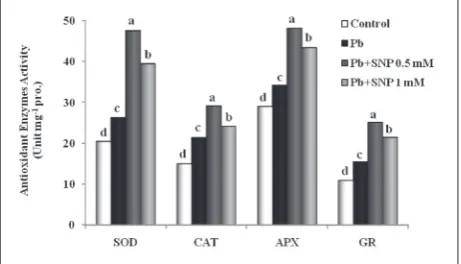
The application of SNP and Pb significantly influ-enced the activities of antioxidant enzymes. Pb treat-ment alone and in combination with SNP significantly increased the activities of SOD, CAT, APX and GR when compared to the control. The activities of SOD, CAT, APX and GR were significantly higher than ob-served after other treatments in combination SNP (0.5 mM) + Pb (Fig. 2).
Pb treatment resulted in a 28% increase in SOD activity as compared to the control. SNP presoaking further increased SOD activity in combination with Pb treatment. 0.5 and 1 mM concentrations of SNP under Pb stress raised SOD activity by 81 and 50% compared with the Pb treatment alone, and by 133 and 93% as compared to the control, respectively (Fig. 2).
The exposure to Pb stress maintained CAT activ-ity at a 43% higher level than the control. SNP treat-ment in combination with Pb resulted in a further increase in CAT activity by 37 and 13% at 0.5 and 1 mM concentrations as compared to Pb treatment alone, and by 95 and 61% as compared to the control, respectively (Fig. 2).
The APX activity was raised by 18% with Pb treat-ment compared to the control. Application of SNP further increased APX activity. 0.5 and 1 mM con-centrations of SNP under Pb stress elevated the APX activity by 41 and 27% as compared to Pb treatment alone, and by 66 and 50% as compared to the control, respectively (Fig. 2).
Pb treatment resulted in an increase in GR activ-ity of 42% as compared to the control. SNP treatment further increased GR activity. 0.5 and 1 mM concen-trations of SNP in combination with Pb raised GR activity by 62 and 39% compared with the Pb treat-ment alone, and by 30 and 97% as compared to the control, respectively (Fig. 2).
Fig. 1. Effect of Pb (200 mg kg-1 soil) and SNP (0.5 and 1 mM as
NO donor) on MDA content of cowpea. Different letters indicate significant differences at P≤0.05 (using DMRT).
Fig. 2. Effect of Pb (200 mg kg-1 soil) and SNP (0.5 and 1 mM as
Proline content
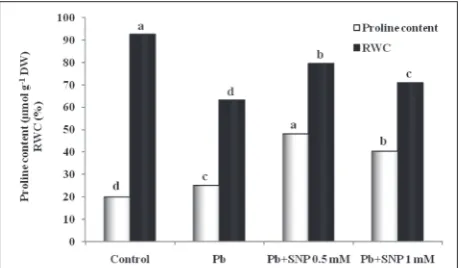
Fig. 3 shows that Pb stress caused a slight increase in proline content of 26% compared with the control. Moreover, the application of SNP caused a marked increase in proline content. 0.5 and 1 mM concentra-tions of SNP under Pb stress elevated proline content by 92 and 61 as compared to Pb treatment alone, and by 142 and 102% as compared to control, respectively.
RWC
The RWC decreased with Pb treatment. A 32% decline was observed compared with the control. SNP treat-ment had a positive effect on RWC. 0.5 and 1 mM concentrations of SNP under Pb stress increased RWC
Fig. 4. Effect of Pb (200 mg kg-1 soil) and SNP (0.5 and 1 mM as
NO donor) on the chlorophyll value and net photosynthetic rate in cowpea. Different letters in each trait indicate significant dif-ferences at P≤0.05 (using DMRT).
Fig. 3. Effect of Pb (200 mg kg-1 soil) and SNP (0.5 and 1 mM as
NO donor) on the proline content and RWC in cowpea. Different letters indicate significant differences at P≤0.05 (using DMRT).
by 26 and 12% as compared to Pb treatment alone, and decreased the RWC by 14 and 24% as compared to the control, respectively (Fig 3).
Chlorophyll value
The chlorophyll value was lowered under Pb stress by 53% as compared to the control. However, SNP treatment increased the chlorophyll value. 0.5 and 1 mM concentrations of SNP in combination with Pb raised the chlorophyll value by 65 and 32% compared with the Pb treatment alone, and decreased it by 23 and 38% as compared to control, respectively (Fig. 4).
Net photosynthetic rate
As shown in Fig. 4, Pb treatment significantly reduced the net photosynthetic rate by 60% compared with the control. However, seed treatment with SNP raised the net photosynthetic rate. 0.5 and 1 mM concentrations of SNP under Pb stress increased the net photosyn-thetic rate by 92 and 56% as compared to Pb treatment alone, and decreased it by 23 and 38% as compared to the control, respectively.
Both nitric oxide levels (0.5 and 1 mM) were ef-fective in improving all measured traits under Pb stress; however, 0.5 mM was more effective.
DISCUSSION
study, we investigated the possible function of exog-enous NO in reducing lead toxicity in cowpea plants.
In our experiment, the MDA level was significantly increased by Pb treatment. The levels of lipid peroxida-tion in the plant cells are measured by the determina-tion of their MDA content, a breakdown product of lipid peroxidation. A high level of MDA is expressive of an enhanced formation of ROS and oxidative dam-age. In fact, ROS removes hydrogen from unsaturated fatty acids and generates lipid radicals and reactive al-dehydes, which distort the lipid bilayer (Mishra et al., 2006). Pb is known to induce oxidative stress in plants due to the elevated production of ROS (Qureshi et al., 2007; Singh et al., 2010; Liu et al., 2008). In this work, increasing MDA levels showed that oxidative stress and lipid peroxidation of membranes were induced by Pb stress in cowpea plants. Similar to our results, Pb toxic-ity caused oxidative damage and elevated MDA content in mung bean (Hassan and Mansoor, 2014), rice (Zhao et al., 2009) and cotton (Bharwana et al., 2014). It was also observed in the present study that seeds soaked in SNP under Pb stress conditions reversed the Pb toxicity effect and decreased the MDA content compared to Pb treatment alone. NO alleviated Pb stress in cowpea plants by preventing oxidative damage via the enhance-ment of antioxidant enzyme activity and proline ac-cumulation. This indicates that NO acts as an efficient ROS scavenger and/or membrane stabilizer in cowpea plants subjected to Pb stress. Metal toxicity by way of oxidative damage can affect plasma membrane integrity and, as reported herein, there is enough evidence to show that the role of NO in alleviating oxidative stress on biological membranes is ascribed to the enhance-ment of ROS-scavenging enzyme activity. This function of NO has been observed in heavy metal stress induced by Cd (Kumari et al., 2010), Al (Wang and Yang, 2005) and Br (Esim and Atici, 2013).
We found that lead treatment enhanced the activi-ties of antioxidant enzymes such as SOD, CAT, APX and GR in cowpea plants. These enzymes have a cru-cial role in the scavenging of ROS to reduce oxidative stress. One of the most important adverse effects of heavy metals such as lead within a plant is an overpro-duction of ROS, which consequently leads to oxidative
stress (Bharwana et al., 2014; Verma and Dubey, 2003; Hassan and Mansoor, 2014; Zhao et al., 2009; Malar et al., 2014). These ROS, such as singlet oxygen (1O
2),
superoxide radicals (O2•–), hydroxyl radicals (•OH), and
hydrogen peroxide (H2O2), are also generated in plant cells during normal metabolic processes. Under normal conditions, ROS are produced at a low concentration and there is equilibrium between the generation and quenching of ROS. This balance may be disturbed by many environmental stresses. ROS at low levels act as signaling molecules for the activation of stress response pathways, but at high levels, ROS can induce oxidative stress and damage to lipids, proteins, nucleic acids and ultimately lead to cell death (Mittler, 2002; Sharma et al., 2012). Therefore, in order to protect themselves against oxidative stress, plants have developed a com-plex antioxidative defense system for scavenging ROS including enzymatic (e.g. SOD, CAT, APX, GR, GPX, MDHAR and DHAR) and non-enzymatic (e.g. ascorbic acid, glutathione, proline, a-tocopherols, carotenoids and flavonoids) components (Gill and Tuteja, 2010; Lee et al., 2007; Sharma et al., 2012; Hossain et al., 2012). SOD, as the first line of cellular defense against oxida-tive stress, dismutates O2•- to O
2 and H2O2. CAT
al., 2010). However, the exogenous application of SNP in combination with Pb raised the antioxidant enzyme activities. Pre-treatment with SNP not only increased the activities of antioxidant enzymes but also decreased the MDA content enhanced by excess Pb. NO is itself a ROS and its dual behavior (protective or toxic) depends on the conditions (Beligni and Lamattina, 1999). The protective role is based on its ability to regulate the level and toxicity of ROS. In many studies, the alleviation of oxidative damage by NO was ascribed to the induction of activity of various ROS-scavenging enzymes (Esim and Atici, 2013; Guo et al., 2009; Kausar et al., 2013). In the present study, seeds soaked in SNP increased the activity of antioxidant enzymes, including SOD, CAT, APX and GR, under Pb stress conditions. In fact, the activities of these enzymes in the presence of SNP under Pb stress were much higher than those under Pb stress alone. One possibility is that NO might activate antioxidant systems to scavenge ROS. Beside the role of NO in the activation of antioxidant enzymes that scavenge ROS, it can also react with O2•– and generate
peroxynitrite (ONOO–). ONOO– is unstable and may
be protonated and decomposed to a nitrate anion and a proton, or it can react with H2O2 to produce a nitrite anion and oxygen (Fan et al., 2014). In this experiment, NO alleviated Pb toxicity in cowpea plants by reducing oxidative damage via increasing activities of antioxidant enzymes. Similar to our findings, increased SOD, CAT, APX and GR activities by exogenously NO have been reported under Cd stress (Kumari et al., 2010), drought stress (Shehab et al., 2010), osmotic stress (Zhang et al., 2003) and salinity stress (Sheokand et al., 2010).
Our experiment demonstrated that cowpea plants accumulated proline in response to lead toxicity. Moreover, the application of SNP enhanced an sig-nificant increase in proline content under Pb stress. Plants respond to the adverse impact of Pb in different ways, such as accumulation of proline. It seems that increased levels of proline have an important role in protecting against the damaging effects of Pb stress. Proline is an amino acid that accumulates in many plant species in response to a wide range of environ-mental stresses, including heavy metals. Proline acts as a ROS scavenger, osmoprotectant, protein and mem-brane stabilizer, heavy metal chelator, participates in
energy transfer, maintains water balance and reduces metal uptake (Sharma and Dubey, 2005; Abd Elga-wad et al., 2015; Mehta and Gaur, 1999). Similar to our results, increasing proline accumulation induced by Pb has also been observed in cassia (Qureshi et al., 2007), sunflower (Noorani Azad et al., 2011) and black gram (Singh et al., 2012). We also found that SNP application increased the proline content under Pb stress conditions. One reason for this occurrence is the activation some key enzymes involved in the synthesis of proline by NO (Zhang et al., 2008). In agreement with our results, the positive effect of SNP application in proline accumulation and the eventual alleviation harmful effects of different abiotic stresses has already been reported in wheat under osmotic stress (Tan et al., 2008), cucumber and wheat under salinity stress (Huaifo et al., 2007; Kausar et al., 2013), cotton under drought stress (Shallan et al. 2012) and wheat under As-induced oxidative stress (Hasanu-zzaman and Fujita, 2013). The present work clearly indicates a positive relationship between NO, Pb stress and proline accumulation that shows a protective role of proline against lead toxicity.
al. (2008) also showed that in wheat seedlings higher water potential and RWC were maintained and leaf water loss in leaves was retarded by exogenous SNP. In chickpea plants, the RWC also decreased under salinity stress, but SNP treatment had a positive effect on the RWC (Sheokand et al., 2010).
In the present study, a significant decrease in chlo-rophyll value was observed in cowpea leaves under Pb stress. Lead may impair the uptake of essential ele-ments, such as Mg and Fe, for chlorophyll biosynthe-sis (Nareshkumar et al., 2014; Chatterjee et al. 2004), substitute divalent cations (Gupta et al., 2009), prevent enzyme activity like aminolevulinic acid dehydratase (Prasad and Prasad, 1987) and increase chlorophyll biodegradation by enhancing chlorophyllase activity (Liu et al. 2008). Similarly, a reduction in the chloro-phyll content after exposure to Pb has been reported in many plant species (Bharwana et al., 2014; Malar et al., 2014; Wang et al., 2013). In this experiment, exogenous NO increased the chlorophyll content under Pb toxicity because NO raised the antioxidant enzyme activity and consequently diminished chlo-rophyll destruction induced by ROS. On the other hand, NO also maintains chlorophyll by increasing the uptake of Fe and Mg under Pb stress (Bai et al., 2015). Thus, NO protects chlorophyll by improving its biosynthesis and reducing its degradation under Pb stress conditions. A high NO-induced accumulation of chlorophyll was also observed in Brassica napus and tomato under Cd stress (Jhanji et al., 2012; Zhang et al., 2010), wheat under heat stress (Hasanuzzaman et al., 2012), cucumber under chilling and waterlog-ging stress (Liu et al., 2011; Fan et al., 2014), turfgrass under drought stress (Hatamzadeh et al., 2015) and wheat under As-induced oxidative stress (Hasanuz-zaman and Fujita, 2013).
The results of our experiment showed that the net photosynthetic rate of cowpea leaves was dramatically reduced by Pb toxicity. Disruption of photosynthesis is a well-known indicator of lead toxicity (Bai et al., 2015; Romanowska et al., 2006; Bharwana et al., 2014). Pb toxicity causes a decline in the photosynthetic rate, which may be due to the reduction of chlorophyll content, stomatal closure (Bharwana et al., 2014; Bai
et al., 2015), distortion of chloroplast ultrastructure, inhibition of Calvin cycle enzyme activity (Sharma and Dubey, 2005) and obstruction of electron trans-port (Pourrut et al., 2011). According to the present study, the decreased net photosynthetic rate by Pb in cowpea plants was related to a reduced chlorophyll value and RWC and also enhanced oxidative damage to the chloroplast membrane. We also observed that seeds soaked in SNP improved the net photosynthetic rate under Pb stress conditions. NO participated in the improvement of photosynthesis by raising chlo-rophyll content and RWC, and also ROS scavenging under Pb stress. In agreement with our findings, the use of SNP promoted the net photosynthetic rate of Artemisia under Br and Al stresses (Aftab et al., 2012), tomato under Cd stress (Zhang et al., 2010), rice and cucumber under salinity stress (Habib et al., 2013; Huaifo et al., 2007) and wheat under osmotic stress (Tan et al., 2008).
In conclusion, the present study demonstrated that Pb stress caused oxidative damage and membrane lipid peroxidation, leading to a significant decrease in chlorophyll value, RWC and net photosynthetic rate in cowpea leaves. On the other hand, the presoaking of cowpea seeds in SNP as NO donor before exposure to Pb had a protective effect against Pb toxicity by increasing antioxidant enzyme (SOD, CAT, APX and GR) activities, as well as promoting proline accumu-lation and leading to an improvement of the chloro-phyll value, RWC and net photosynthetic rate. Thus, exogenous NO can be used to alleviate Pb toxicity in cowpea.
Acknowledgments: The author is grateful to Yadegar-e-Imam Khomeini (RAH) Shahre-rey Branch, Islamic Azad University, Tehran, Iran for financial support.
REFERENCES
Abd Elgawad, H., Vos, D.D., Zinta, G., Domagalska, M.A., Beem-ster, G.T.S. and H. Asard (2015). Grassland species differ-entially regulate proline concentrations under future cli-mate conditions: an integrated biochemical and modelling approach. New Phytol.208, 354-369.
Aftab, T., Khan, M.M.A., Naeem, M., Idrees, M., Moinuddin, Da Silva, J.A.T. and M. Ramd (2012). Exogenous nitric oxide donor protects Artemisia annua from oxidative stress gen-erated by boron and aluminium toxicity. Ecotoxicol. Envi-ron. Saf. 80, 60-68.
Apel, K. and H. Hirt (2004). Reactive oxygen species: metabolism, oxidative stress, and signal transduction. Annu. Rev. Plant Biol.55, 373-399.
Azhar, N., Ashraf, M.Y., Hussain, M., Ashraf, M. and R. Ahmed
(2009). EDTA-induced improvement in growth and water relations of sunflower (Helianthus annuus L.) plants grown in lead contaminated medium. Pak. J. Bot. 41(6), 3065-3074.
Bai, X.Y., Dong, Y.J., Wang, Q.H., Xu, L.L., Kong, J. and S. Liu
(2015). Effects of lead and nitric oxide on photosynthesis, antioxidative ability and mineral element content of peren-nial ryegrass. Biol. Plantarum.59(1), 163-170.
Bates, L.S., Waldren, R.P. and J.D. Teare (1973). Rapid determi-nation of proline for water stress studies. Plant Soil.39,
205-207.
Beligni, M.V. and L. Lamattina (1999). Is nitric oxide toxic or protective? Trends Plant Sci.4 (8), 299-300.
Beyer, W.F. and I. Fridovich (1987). Assaying for superoxide dis-mutase activity: some large consequences of minor changes in conditions. Anal. Biochem.161(2),559-566.
Bharwana, S.A., Ali, S., Farooq, M.A., Iqbal, N., Hameed, A., Abbas, F. and M.S.A. Ahmad (2014). Glycine betaine-induced lead toxicity tolerance related to elevated photo-synthesis, antioxidant enzymes suppressed lead uptake and oxidative stress in cotton. Turk. J. Bot.38, 281-292.
Chatterjee, C., Dube, B.K., Sinha, P. and P. Srivastava (2004). Det-rimental effects of lead phytotoxicity on growth, yield, and metabolism of rice. Commun. Soil Sci. Plant Anal.35(1-2), 255-265.
Esim, N. and O. Atici (2013). Nitric oxide alleviates boron toxic-ity by reducing oxidative damage and growth inhibition in maize seedlings (Zea mays L.). Aus. J. Crop Sci.7(8), 1085-1092.
Fan, H.F., Du, C.X., Ding, L. and Y.L. Xu (2014). Exogenous nitric oxide promotes waterlogging tolerance as related to the activities of antioxidant enzymes in cucumber seedlings.
Russ. J. Plant Physiol.61(3), 366-373.
Foyer, C.H. and B. Halliwell (1976). Presence of glutathione and glutathione reductase in chloroplasts: a proposed role on ascorbic acid metabolism. Planta.133, 21-25.
Gautam, M., Singh, A.K. and R.M. Johri (2014). Influence of Pb toxicity on yield, yield attributing parameters and photo-synthetic pigment of tomato (Solanum lycopersicum) and eggplant (Solanum melongena). Indian J. Agric. Sci.84(7), 808-815.
Gill, S.S. and N. Tuteja (2010). Reactive oxygen species and anti-oxidant machinery in abiotic stress tolerance in crop plants.
Plant Physiol. Biochem.48, 909-930.
Guo, Y., Tian, Z., Yan, D., Zhang, J. and P. Qin (2009). Effects of nitric oxide on salt stress tolerance in Kosteletzkya virginica.
Life Sci. J.6(1),67-75.
Gupta, D., Nicoloso, F., Schetinger, M., Rossato, L., Pereira, L., Cas-tro, G., Srivastava, S. and R. Tripathi (2009). Antioxidant defense mechanism in hydroponically grown Zea mays
seedlings under moderate lead stress. J. Hazard. Mater. 172(1),479-484.
Habib, N., Ashraf, M. and M. Shahbaz (2013). Effect of exog-enously applied nitric oxide on some key physiological attributes of rice (Oryza sativa L.) plants under salt stress.
Pak. J. Bot.45(5),1563-1569.
Hamid, N., Bukhari, N. and F. Jawaid (2010). Physiological responses of Phaseolus vulgaris to different lead concen-trations. Pak. J. Bot. 42(1), 239-246.
Hasanuzzaman, M., Nahar, K., Alam, M.M. and M. Fujita (2012). Exogenous nitric oxide alleviates high temperature induced oxidative stress in wheat (Triticum aestivum L.) seedlings by modulating the antioxidant defense and glyoxalase sys-tem. Aus. J. Crop Sci.6(8),1314-1323.
Hasanuzzaman, M. and M. Fujita (2013). Exogenous sodium nitroprusside alleviates arsenic-induced oxidative stress in wheat (Triticum aestivum L.) seedlings by enhancing antioxidant defense and glyoxalase system. Ecotoxicollogy. 22, 584-596.
Hassan, M. and S. Mansoor (2014). Oxidative stress and antioxi-dant defense mechanism in mung bean seedlings after lead and cadmium treatments. Turk. J. Agric. For.38, 55-61.
Hatamzadeh, A., Nalousi, A.M., Ghasemnezhad, M. and M.H. Biglouei (2015). The potential of nitric oxide for reducing oxidative damage induced by drought stress in two turf-grass species, creeping bentturf-grass and tall fescue. Grass and Forage Sci.70(3), 538-548.
Heath, R.L. and L. Packer (1968). Photoperoxidation in isolated chloroplasts. I. Kinetics and stoichiometry of fatty acid per-oxidation. Arch. Biochem. Biophys.125(1),189-198.
Hossain, M.A., Piyatida, P., Da Silva, J.A.T. and M. Fujita (2012). Molecular mechanism of heavy metal toxicity and toler-ance in plants: central role of glutathione in detoxification of reactive oxygen species and methylglyoxal and in heavy metal chelation. J. Bot.2012, 1-37.
Huaifo, F., Shirong, G., Yansheng, J., Runhua, Z. and L. Juan
(2007). Effects of exogenous nitric oxide on growth, active oxygen species metabolism and photosynthetic character-istics in cucumber seedlings under NaCl stress. Front. Agri. China.1(3),308-314.
Islam, E., Liu, D., Li, T., Yang, X., Jin, X., Mahmood, Q., Tian, S.
and J. Li (2008). Effect of Pb toxicity on leaf growth, physi-ology and ultrastructure in the two ecotypes of Elsholtzia argyi. J. Hazard. Mater.154(1-3),914-926.
Jhanji, S., Setia, R.C., Kaur, N., Kaur, P. and N. Setia (2012). Role of nitric oxide in cadmium-induced stress on growth, pho-tosynthetic components and yield of Brassica napus L. J. Environ. Biol.33, 1027-1032.
Kumari, A., Sheokand, S. and K. Swaraj (2010). Nitric oxide induced alleviation of toxic effects of short term and long term Cd stress on growth, oxidative metabolism and Cd accumulation in chickpea. Braz. J. Plant Physiol.22(4),
271-284.
Lee, Y., Kim, S., Bang, J., Lee, H., Kwak, S. and S. Kwon (2007). Enhanced tolerance to oxidative stress in transgenic tobacco plants expressing three antioxidant enzymes in chloroplasts. Plant Cell Rep.26, 591-598.
Liu, D., Li, T., Jin, X., Yang, X., Islam, E. and Q. Mahmood (2008). Lead induced changes in the growth and antioxidant metabolism of the lead accumulating and non-accumulat-ing ecotypes of Sedum alfredii. J. Integr. Plant Biol.50(2), 129-140.
Liu, X., Wang, L., Liu, L., Guo, Y. and H. Ren (2011). Alleviat-ing effect of exogenous nitric oxide in cucumber seedlAlleviat-ing against chilling stress. Afr. J. Biotech.10(21),4380-4386.
Malar, S., Vikram, S.S., Favas, P.J.C. and V. Perumal (2014). Lead heavy metal toxicity induced changes on growth and anti-oxidative enzymes level in water hyacinths [Eichhornia crassipes (Mart.)]. Bot. Stud.55:54, 1-11.
Mehta, S.K. and J.P. Gaur (1999). Heavy metal induced proline accumulation and its role in ameliorating metal toxicity in
Chlorella vulgaris. New phytol.143, 253-259.
Mishra, S., Srivastava, S., Tripathi, R., Kumar, R., Seth, C. and D. Gupta (2006). Lead detoxification by coontail ( Ceratophyl-lum demersum L.) involves induction of phytochelatins and antioxidant system in response to its accumulation. Che-mosphere. 65(6),1027-1039.
Misra, A.N., Misra, M. and R. Singh (2011). Nitric oxide amelio-rates stress responses in plants. Plant Soil Environ.57(3), 95-100.
Mittler, R. (2002). Oxidative stress, antioxidants and stress toler-ance. Trends Plant Sci. 7 (9), 405-410.
Nagajyoti, P.C., Lee, K.D. and T.V.M. Sreekanth (2010). Heavy metals, occurrence and toxicity for plants: a review. Envi-ron. Chem. Lett. 8, 199-216.
Nakano, Y. and K. Asada (1981). Hydrogen peroxide is scavenged by ascorbate specific peroxidase in spinach chloroplasts.
Plant Cell Physiol.22(5),867-880.
Nareshkumar, A., Krishnappa, B.V., Kirankumar, T.V., Kiranmai, K., Lokesh, U., Sudhakarbabu, O. and C. Sudhakar (2014). Effect of Pb-stress on growth and mineral status of two groundnut (Arachis hypogaea L.) cultivars. J. Plant Sci.2(6), 304-310.
Noorani Azad, H., Shiva, A.H. and R. Malekpour (2011). Toxic effects of lead on growth and some biochemical and ionic parameters of sunflower (Helianthus annuus l.) seedlings.
Curr. Res. J. Biol. Sci.3(4), 398-403.
Planchet, E. and W.M. Kaiser (2006). Nitric oxide production in plants. Plant Signal. Behav.1:2, 46-51.
Pourrut, B., Shahid, M., Dumat, C., Winterton, P. and E. Pinelli
(2011). Lead uptake, toxicity, and detoxification in plants. Rev. Environ. Contam. Toxicol.213, 113-136.
Prasad, D.D.K. and A.R.K. Prasad (1987). Altered aminolevulinic acid metabolism by Pb and Hg in germinating seedling of Bajra (Pennisetum typhoidenum). J. Plant Physiol. 127,
241-249.
Qureshi, M., Abdin, M., Qadir, S. and M. Iqbal (2007). Lead-induced oxidative stress and metabolic alterations in Cassia angustifolia Vahl. Biol. Plantarum.51(1),121-128.
Romanowska, E., Wróblewska, B., Drozak, A. and M. Siedlecka
(2006). High light intensity protects photosynthetic appa-ratus of pea plants against exposure to lead. Plant Physiol. Biochem. 44(5-6), 387-394.
Shallan, M.A., Hassan, H.M.M., Namich, A.A.M. and A.A. Ibra-him (2012). Effect of sodium nitroprusside, putrescine and glycine betaine on alleviation of drought stress in cotton plant. American-Eurasian J. Agric. & Environ. Sci.12(9), 1252-1265.
Sharma, P. and R.S. Dubey (2005). Lead toxicity in plants. Braz. J. Plant Physiol.17(1),35-52.
Sharma, P., Jha, A.B., Dubey, R.S. and M. Pessarakli (2012). Reac-tive oxygen species, oxidaReac-tive damage, and antioxidaReac-tive defense mechanism in plants under stressful conditions.
J. Bot.2012, 217037.
Shehab, G.G., Ahmed, O.K. and H.S. EL-Beltagi (2010). Effects of various chemical agents for alleviation of drought stress in rice plants (Oryza sativa L.). Not. Bot. Hort. Agrobot. Cluj. 38(1),139-148.
Sheokand, S., Bhankar, V. and V. Sawhney (2010). Ameliorative effect of exogenous nitric oxide on oxidative metabolism in NaCl treated chickpea plants. Braz. J. Plant Physiol.22(2), 81-90.
Siddiqui, M.H., Al-Whaibi, M.H. and M.O. Basalah (2011). Role of nitric oxide in tolerance of plants to abiotic stress. Pro-toplasma.248(3),447-455.
Singh, G., Agnihotri, R.K., Reshma, R.S. and M. Ahmad (2012). Effect of lead and nickel toxicity on chlorophyll and pro-line content of urd (Vigna mungo L.) seedlings. Int. J. Plant Physiol. Biochem. 4(6), 136-141.
Singh, R., Tripathi, R.D., Dwivedi, S., Kumar, A., Trivedi, P.K. and
D. Chakrabarty (2010). Lead bioaccumulation potential of an aquatic macrophyte Najas indica are related to antioxi-dant system. Bioresour. Technol. 101, 3025-3032.
Tan, J., Zhao, H., Hong, J., Han, Y., Li, H. and W. Zhao (2008). Effects of exogenous nitric oxide on photosynthesis, anti-oxidant capacity and proline accumulation in wheat seed-lings subjected to osmotic stress. World J. Agric. Sci. 4(3), 307-313.
Verma, S. and R.S. Dubey (2003). Lead toxicity induces lipid per-oxidation and alters the activities of antioxidant enzymes in growing rice plants. Plant Sci.164, 645-655.
Wang, Y.S. and Z.M. Yang (2005). Nitric oxide reduces aluminum toxicity by preventing oxidative stress in the roots of Cassia tora L. Plant Cell Physiol.46, 1915-1923.
Wińska-Krysiak, M., Koropacka, K. and S. Gawroński (2015). Determination of the tolerance of sunflower to lead-induced stress. J. Elem.20(2), 491-502.
Zhang, H., Shen, W.B. and L.L. Xu (2003). Effects of nitric oxide on the germination of wheat seeds and its reactive oxygen species metabolisms under osmotic stress. Acta Bot. Sin. 45, 901-905.
Zhang, L.P., Mehta, S.K., Liu, Z.P. and Z.M. Yang (2008). Copper-induced proline synthesis is associated with nitric oxide
generation in Chlamydomonas reinhardtii. Plant Cell Physiol.49, 411-419.
Zhang, Y., Han, X., Chen, X., Jin, H. and X. Cui (2009). Exogenous nitric oxide on antioxidative system and ATPase activities from tomato seedlings under copper stress. Sci. Hortic. 123, 217-223.
Zhang, Y.K., Cui, X.M., Yang, S.X. and X.L. Chen (2010). Effects of exogenous nitric oxide on active oxygen metabolism and photosynthetic characteristics of tomato seedlings under cadmium stress. Chin. J. Appl. Ecol.21(6),1432-1438.