COMPUTATION OF CHEMICAL POTENTIAL AND FERMI-
DIRAC INTEGRALS APPLIED TO STUDY THE TRANSPORT
PHENOMENA OF SEMICONDUCTORS
R. Kobaidze
[a] [b]
, E. Khutsishvili
[a] [b]
*, Z. Chubinishvili
[a] [c]
, G. Kekelidze
[d]
, N.
Kekelidze †
Keywords:
Chemical potential, Fermi–Dirac integrals, Gauss–Legendre method
In the given paper, two methods of calculating with high precision accuracy the chemical potential and the integrals of the type called the
Fermi–Dirac of different indexes are presented. Our calculations are conclusive with already existing data. These data are essential not only
in the study of the theory of solids but at the explanation of the experimental results of investigated transport phenomena in solids, namely,
in semiconductors.
* Corresponding Author:
E-Mail: [email protected]
[a] Laboratory of Semiconductor Materials Science, Ferdinand
Tavadze Institute of Materials Science and Metallurgy, Tbilisi,
0186, Georgia
[b] Institute of Materials Research, Ivane Javakhishvili Tbilisi
State University, Tbilisi 0179, Georgia
[c]
Department of Engineering Physics, Georgian Technical
University, Tbilisi, 0175, Georgia
[d]
NPO “International Innovative Technologies”, Tbilisi, 0192,
Georgia
Introduction
The physical laws of systems consisting of a huge number
of particles are of a statistical nature. Statistical distribution
determines the probability of having those or other defining
states parameters of the particles of the system.
1One example
of systems of the huge number of particles that requires a
statistical approach is the solid state, in particular,
semiconductors. The distribution of electrons over energies,
namely, the Fermi–Dirac distribution, is the most important.
The Boltzmann distribution, which is valid for particles
obeying classical mechanics, is the limiting case of the
Fermi-Dirac distribution. In the state of statistical equilibrium, the
ideal electrons gas in solid state obeys the Fermi–Dirac
statistics.
2,3Different physical phenomena are differently
sensitive to the type of statistical distribution. When
considering the transport properties in a solid state, we
inevitably collide with integrals of the type called the Fermi–
Dirac integrals.
2,3These are certain integrals often
encountered not only in the study of the theory of
semiconductors but at the explanation of the experimental
results of investigated transport phenomena in
semiconductors.
In this case, we have to use not only the tables of values of
the Fermi integral but also their approximate formulas.
4However, the calculation of integrals according to
approximate formulas and tables gives a sufficiently high
value of error, especially for large and small values of the
reduced Fermi level. The error can reach approximately 25%.
Using approximations is inconvenient and inaccurate.
Therefore, the goal of our paper is to find an appropriate
method for calculation of the Fermi–Dirac integrals for
application in the study of semiconductors properties with
high accuracy <<1%. The presented paper allows also
determining a normalization constant, included in the Fermi–
Dirac statistics, - the chemical potential with high reasonable
accuracy.
Methodology
Gauss–Legendre method integrals solution
Functional integral according to Gauss–Legendre method is
presented as the sum of (
n-1
) coefficients:
.
(1)
Let’s say, at searching of integral we foresee only 2
coefficients, then it follows from (1):
(2)
This expression consists of 4 unknown coefficients (
C
0,
C
1,
x
0,
x
1) and, consequently, we need 4 boundary conditions:
f
=
const
f
=
x
f
=
x
23
f
=
x
(3)
The value of integral may be taken at an arbitrary [
a
,
b
]
boundary. In our case, we take [–1,1] interval and const=1.
From (3), boundary conditions follow:
(4)
The solution of (4) equations gives the following values for
C
and
x
coefficients:
0
( )
0 1( )
1 2( )
2 3( ) ...
3 n 1(
n 1)
I
≈
C f x
+
C f x
+
C f x
+
C f x
+ +
C
−f x
−0
(
0)
1( )
1I
≈
C f x
+
C f x
1
0 0 1 1
1 1
0 0 1 1
1 1
2
0 0 1 1
1 1 3
0 0 1 1
1
1
(
)
( )
2
(
)
( )
0
2
(
)
( )
3
(
)
( )
0
dx C f x
C f x
xdx C f x
C f x
x dx C f x
C f x
x dx C f x
C f x
−
−
−
−
=
+
=
=
+
=
=
+
=
=
+
=
∫
∫
∫
(5)
Taking into account the value of two coefficients, the
magnitude of integral is:
(6)
Taking into account 4 coefficients, we have to add 4
boundary conditions:
f
=
x
4,
f
=
x
5,
f
=
x
6,
f
=
x
7. At these boundary
conditions calculated coefficients are:
(7)
These coefficients are needed to be installed into (1) for
calculation of the digital value of integral. If we take into
account
n
coefficients, we will need 2
n
boundary conditions.
In general, our task is to solve integral
in arbitrary boundaries. For calculation of integral, it is
necessary to transfer the boundary [a,b] into [–1,1]. Let’s say,
the value of the new argument is given by:
(8)
and we search the integral value in the form of
because integrals values are equal to each other:
From this it follows new conditions:
Finally, for integral solved with two coefficients we obtain
formula:
.
(9)
The more terms we take into account in the formula (1), the
more accurate value of integral will be. In general, taking into
n
coefficients:
(10)
where ƒ(
x
) is an arbitrary function, which is continuous in
[a,b] interval and
C
iand
x
iare coefficients found from
boundary conditions.
The second way to calculate
C
iand
x
icoefficients is to solve
Legendre polynomial equitations:
5,6(11)
(12)
To obtain
C
iand
x
icoefficients, first, we have to generate
Legendre polynomials and solve them. We can use
MATLAB-s built-in functions to generate polynomials and
solve them
7(legendrePolynomials_1.m), or we can manually
generate. Program
(legendrePolynomials_2.m) uses
polynomials properties:
5,
(13)
These values are uploaded on the repository (roots_2,
weights_2).
7Method of undefined integrals solution
Let’s say the integral is not given in limited [
a
,
b
] interval,
but in [0,
+∞]
range. We can decompose integral into two
parts:
.
(14)
In the second part of integral, we substitute the variable:
0 0
1 1
1
1
3
1
1
3
C
x
C
x
=
= −
=
=
1
1
(
)
(
)
3
3
I
=
f
−
+
f
0 2
1 3
18
30
18
30
36
36
18
30
18
30
36
36
C
C
C
C
−
+
=
=
+
−
=
=
0 2
1 3
525 70 30
525 70 30
35
35
525 70 30
525 70 30
35
35
x
x
x
x
+
−
= −
=
−
+
= −
=
( )
b
a
I
=
∫
f x dx
1 2 d
x
= +
a
a x
1
1
( )
d dI
f x dx
−
=
∫
1
1
(
)
( )
b
d d
a
I
f x dx
I
f x dx
−
=
∫
=
=
∫
1 2
1 2
a
a
b
a
a
a
+
=
−
=
d2
2
b
a
b
a
x
=
+
+
−
x
d
2
b
a
dx
=
−
dx
b 1
d d
a 1
( )
2
2
2
b a
a b
b a
f x dx
f
x dx
−
−
+
−
=
+
∫
∫
b n
i i
i 1 a
( )
2
2
2
b
a
a
b
b
a
f x dx
C
f
x
=
−
+
−
=
+
∑
∫
n
(
i)
0
P x
=
2 i
i 2
n 1 i
2(1
)
[
( ) ]
x
C
nP
−x
−
=
0 1
( )
1
( )
P x
P x
x
=
=
2 2
3 3
1
( )
(3
1)
2
1
( )
(5
3 )
2
P x
x
P x
x
x
=
−
=
−
( n 1) n n 1
2
1
( )
( )
1
1
n
n
P
xP x
P
x
n
n
+ −
+
=
−
+
+
1
0 0 1
( )
( )
( )
f x dx
f x dx
f x dx
∞ ∞
=
+
∫
∫
∫
1
t
x
=
dx
1
2dt
t
= −
1
1
0
x
t
x
t
=
=
Finally, we obtain formula (15) for approximate calculation
of integral:
(15)
We can apply (10) formula to the two parts of this integral
and solve any integral, which is defined in this range. Taking
into account (14) and (15) formulas, we obtain:
(16)
Calculation of integrals by (16) formulas and their
summation give the final meaning of (14) integral.
Integral Fermi and its derivative
The general view of integrals of Fermi is given by the
formula:
(17)
where
ξ
is the chemical potential. Many authors do not take
into account
Γ( +
k
1)
member and introduce integral Fermi
as:
(18)
The formula for Fermi integrals derivative is given by:
(19)
For gamma function, given in (17) formula, it can be
written:
If
n
is a natural number,
It is also known, that
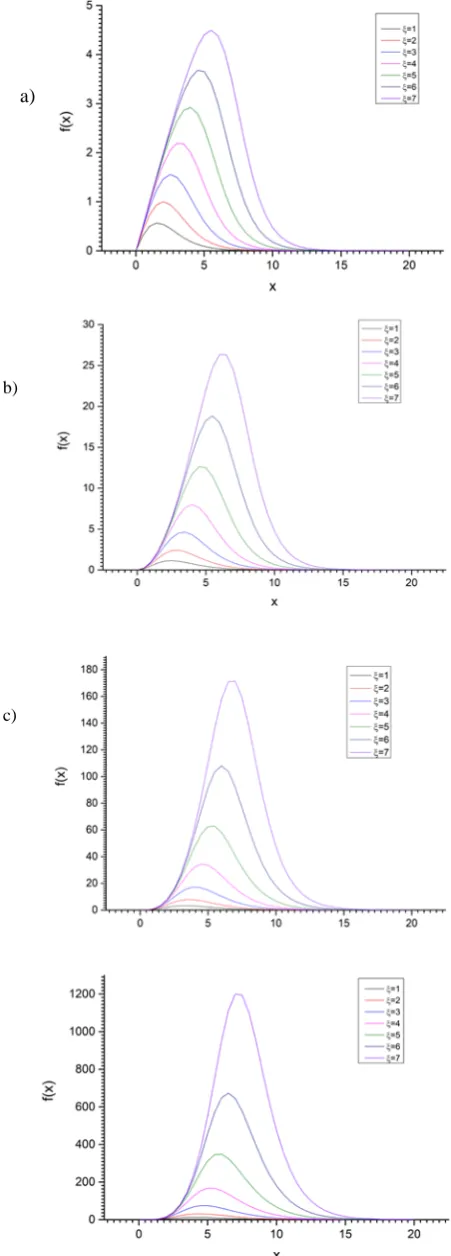
The graphics of integrand function in (18) formula for
different values of
k
and
ξ
are given in Fig.1. It is clear from
Fig.1 that these functions are decomposable and it is possible
to integrate them in certain approximation.
a)
b)
c)
Figure 1
. Dependence of integrand functions of Fermi integrals of
different indexes (
k
) on
x
coefficient (parameter in Gauss–Legendre
decomposition) for different values of chemical potential (
ξ
)
according (18) formula.a)
k
= 1; b)
k
= 2; c)
k
=
3; d)
k
=
4
1 1
2
0 0 0
1
1
( )
( )
(
)
f x dx
f x dx
f
dt
t
t
∞=
+
∫
∫
∫
1 n
i i
i 1 0
( )
0.5 (0.5 0.5 )
f x dx
C
f
x
=
=
∑
+
∫
1 n
i
i 0 i i
0
1
1
1
1
(
)
0.5
(
)
0.5 0.5
0.5 0.5
f
dt
C
f
t
t
=x
x
=
+
+
∑
∫
( )
0
1
(
1)
1
k
k x
x dx
F
k
e
ξξ
) =
∞ −Γ( +
∫
+
( ) 0
(
1
k
k x
x dx
F
e
ξξ
) =
∞ −+
∫
( )
( 1)
(
(
k k
dF
F
d
ξ
ξ
ξ
−)
=
)
( )
n
(
n
1)!
Γ
=
−
(
n
1)
n
( )
n
Γ + = Γ
1
( )
2
π
Γ
=
3
( )
2
2
π
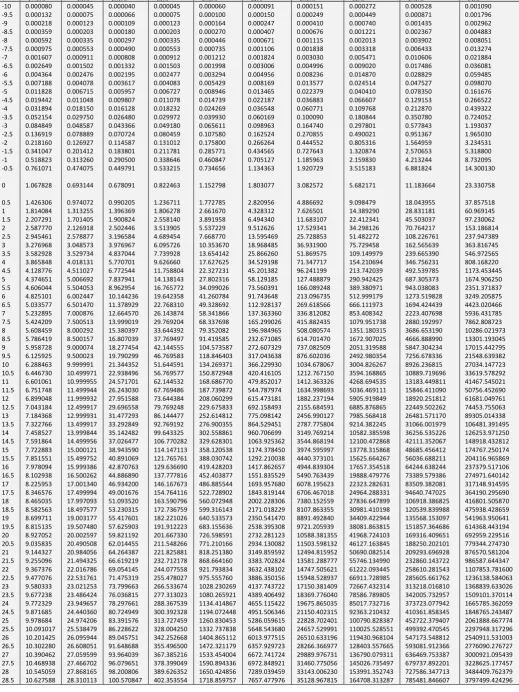
Table 1.
Fermi integrals calculated using Gauss–Legendre numerical method for different
k
and
ξ values.
ξ F(-0.5)(ξ) F(0)(ξ) F(0.5)(ξ) F(1)(ξ) F(1.5)(ξ) F(2)(ξ) F(2.5)(ξ) F(3)(ξ) F(3.5)(ξ) F(4)(ξ)
29 29.5 30
10.723418 10.834220 10.954374
28.828660 29.431761 30.087872
103.379363 106.663945 110.248115
417.578079 435.476104 455.062998
1801.457447 1899.035693 2006.114497
8105.944774 8638.191699 9223.788410
37565.730293 40470.262904 43673.935454
177957.836926 193815.317953 211348.075056
857572.092172 944184.493311 1040169.670945
4189989.132597 4663258.212882 5188924.669727
Finally, the Fermi integrals values have been calculated by
the Gauss–Legendre method, where
C
iand
x
icoefficients
have been found from (11) and (12) formulas. The Program
has been written in Matlab programming language
(Fermi_integral_calculator_1.m) and it uses 100 points of
Gauss–Legendre coefficients.
7The values of calculated Fermi
integrals for different parameters
k
and
ξ
are given in Table 1.
Simson’s integral calculation method
Another way to calculate integrals of function
f
(
x
), which
are defined in [
a
,
b
] range, is Simson’s
integration method, the
general formula of which is given in (20):
7(20)
Results for Simson’s rule are in good agreement with the
Gauss–Legendre method.
Error estimation
Finally, we show the advantages of the method presented in
the article by calculating the error of implemented
calculations.
Gauss–Legendre method error estimation has been done by
using (21) formula:
(21)
where
(22)
and
a
≤ ≤
θ
b
.
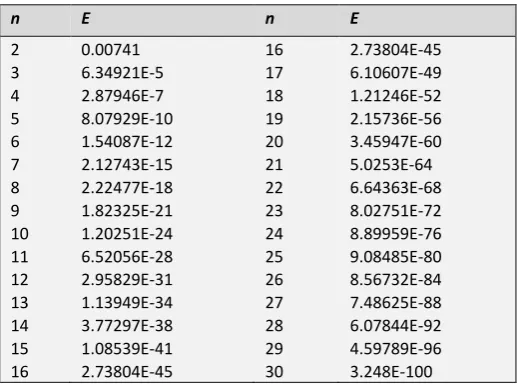
The values of
E
parameter estimated by (22) formula are
given for different
n
in Table 2.
Table 2.
Values of
E
according to (22) formula for different
n
n
E
n
E
2
3
4
5
6
7
8
9
10
11
12
13
14
15
16
0.00741
6.34921E-5
2.87946E-7
8.07929E-10
1.54087E-12
2.12743E-15
2.22477E-18
1.82325E-21
1.20251E-24
6.52056E-28
2.95829E-31
1.13949E-34
3.77297E-38
1.08539E-41
2.73804E-45
16
17
18
19
20
21
22
23
24
25
26
27
28
29
30
2.73804E-45
6.10607E-49
1.21246E-52
2.15736E-56
3.45947E-60
5.0253E-64
6.64363E-68
8.02751E-72
8.89959E-76
9.08485E-80
8.56732E-84
7.48625E-88
6.07844E-92
4.59789E-96
3.248E-100
It is clear that the increase of
n
-value decreases the value of
E
and error goes to nearly zero.
Conclusion
The chemical potential and Fermi–Dirac integrals are
essential for a basic understanding of semiconductors
properties. In this paper, there have been calculated Fermi–
Dirac integrals by two different ways – Gauss–Legendre and
Simson’s methods. Both methods are in good agreement with
each other. Our data let reduce the error of calculation of
Fermi–Dirac integrals up to <<1%.
Acknowledgment
Paper was presented at the 5th International Conference
"Nanotechnologies," November 19–22, 2018, Tbilisi, Georgia
(Nano–2018).
References
1
Lifshitz, E. M., and Pitaevski
ǐ
, L. P.,
Statistical physics
/ Part 2,
Theory of the condensed state
, Oxford; New Yor : Pergamon
Press,
1980
.
2
Blatt, F. J.,
Theory of Mobility of Electrons in Solids
, Academic
Press Inc., New York,
1957
.
3
Anselm, A. I.,
Introduction to the Theory of Semiconductors
, Nauka,
Moscow,
1978
.
4
Fistul, V. I.,
Heavily doped semiconductors
, Phys.-Math. Lit. Press,
Moscow,
1967
.
5
Davis P. and Rabinowitz, P., Abscissas and Weights for Gaussian
Quadratures of High Order,
J. Res. Natl. Bureau Standards
,
1956
,
56(1),
35-37.
https://nvlpubs.nist.gov/nistpubs/jres/56/jresv56n1p35_A1b.pd
f
b
a
x
n
−
∆ =
b
a
( )
(First Last 4(sum of odds) 2(sum of evens))
3
x
f x dx
=
∆
+
+
+
∫
(2n 1) 4
3
2
( !)
(2
1)((2 )!)
n
E
n
n
+
=
+
(2n )
Error
=
Ef
( )
θ
b
1 3
a
5 2n 1 2
4 6 2n
( )
( ( )
( )
4( ( )
( ) ...
3
( )
(
))
2( (
) ...
(
)
(
) ... (
)))
x
f x dx
f a
f b
f x
f x
f x
f x
f x
f x
f x
f x
+
∆
=
+
+
+
+
+
+
+
+
+
6