Investigation into and Analysis of the Current
Situation of Academic English Writing of HLP
Postgraduates: A
Case Study from a Chinese
University
Jing Li
School of Foreign Languages, Sun Yat-sen University, Guangzhou, China
Lei Zeng
School of International Studies, Sun Yat-sen University, Zhuhai, China
Abstract—As many scholars realized the significance and urgency of academic English writing research in English-as-foreign-language countries, numerous studies have been conducted on the topic. To date, however, little focused exclusively on multidisciplinary empirical research on High-level Project (HLP) postgraduates’ academic English writing in China. The present study intends to explore the general tendency of HLP students’ academic English writing. It first investigates the difficulties and writing habits of fifty-one HLP postgraduates in the English training center of a “Project-985”1
university in China through a questionnaire and semi-structured interviews, and then discusses some problems of the present academic English writing classroom and academic English writing skills that need to be improved promptly.
Index Terms—HLP postgraduates, academic English, academic writing
I. INTRODUCTION
For further implementation of the strategy of reinvigorating China through varied human resource development, promoting the development of high-level universities,and enhancing the ability of service for constructing a creative country, the nation carried out “the project of promoting national government-sponsored overseas education for postgraduate students of high-level universities” in the key constructional high-level universities between 2007 and 2011. The program sends about 5,000 first-rate students to top-notch universities or highly-ranked majors in foreign countries each year to study from well-known supervisors. Approved by relevant state departments, the China Scholarship Council added 74 colleges and universities that "featured the key discipline construction project" at the end of 2011. By 2013, the contracted colleges and universities have basically covered the "Project-211" and "Project-985" universities and colleges and also universities that "featured the key discipline construction project".2 In October 2015, the State Council issued the Overall plan for promoting the construction of world-class universities and first-class disciplines, proposing the "double first-class" strategic decision, which sounded the horn to sprint to international top institutions. In the context of international education, English, as a relatively popular lingua franca, plays an important role as a medium in the international exchanges. Especially in the field of international academic communication, academic English writing has gradually become one of the hot spots of scholars around the world.
In the Social Science Citation Index (SSCI) database, we input the subject terms "academic English writing" to search the correlational studies in the past decade (2007-2016). The results show that the distribution of 790 pieces of literature is mainly concentrated in the United States and the United Kingdom, accounting for 28.987% and 11.519% respectively, followed by China, Australia and Spain, each accounting for 9.747%, 8.481% and 7.595%. Although the number of published papers in China ranks only second to America and Britain, and more than Australia, whose official language is English, the h-index (h-index=12) of literature in China is not as high as that in Australia. Swales (2004: 33) points out that Chinese research strength has not yet been fully manifested in various research indices and databases. In the China National Knowledge Infrastructure (CNKI) database, we input the subject terms "academic English writing" and discovered that the number of correlational Chinese papers in the recent decade (2007-2016) had increased dramatically from ten in 2007 to nearly one hundred (83) in 2016. Particularly in 2007, 2011 and 2014, there were three relatively rapid increases (67%, 88% and 58% respectively)(The search was made on March 12, 2017.)This demonstrates that Chinese scholars have realized the significance and urgency of academic English writing research
1 In 1999, the State Council approved the Ministry of Education's Action Plan for Invigorating Education for the 21st century, which means the construction of “Project-985” was officially launched. Construction of the first phase of “Project-985” was first performed at Peking University and Tsinghua University. See "Project-985" on the official website of the Ministry of Education of the People's Republic of China.
2
during that period. Relevant numerous studies have been conducted mainly on the analysis of the requirements of graduate academic English courses or skills (Li, 1983; Cai, 2012; Luo & Chen, 2012; Shen, 2016), current situation of academic English writing teaching (Han & Wang, 2010; Yu, 2014), teaching modes and ability cultivation of academic English writing (Xiong & Yin, 2009; Guo, 2010; Han & Hou, 2012; Li & Zeng, 2015), case studies on the process, teachers’ feedback, and publication of academic English writing (Yang & Wang, 2012; Li, 2011; Tian, 2013). However, little has focused on multidisciplinary empirical research on High-Level Project (hereinafter referred to as HLP) postgraduates’ academic English writing. In the process of language education policy-making, we need the actual investigation of the present academic English teaching situation of HLP postgraduates in a higher education stage. Especially, students’ self-knowledge and self-assessment of current academic English writing instruction cannot be ignored. Thus, the present study intends to fill this void and is designed to find out and discuss some problems of HLP postgraduates in academic English writing, including the difficulties and writing habits of HLP postgraduates in academic English writing, and academic English writing skills that need to be improved promptly.
II. RESEARCH DESIGN AND IMPLEMENTATION
A. Research Questions
This study mainly explores the following questions through a questionnaire survey and analysis. (1)What is the general tendency of HLP postgraduates’ academic English writing?
(2)What difficulties do HLP postgraduates have in academic English writing? And what are their writing habits? (3)What are the problems of academic English writing classroom for HLP postgraduates at present? And what academic English writing skills do the students want to improve?
B. Research Objects
As shown in Table 1, there were fifty-one students from the English Training Center of Sun Yat-sen University involved in the survey. Among them, there were 22 boys and 29 girls, accounting for 43.14% and 56.86% respectively. The respondents were located in a narrow age range, between 24 and 26 years old (64.71%). Their academic level was basically full-time doctoral students (90.20%), mostly beginning with Year 2013 or 2014. Their destination of studying abroad was primarily the United States (70.59%). All hoped that they could study abroad as doctoral students; they basically had reached the English level of CET-6 (88.24%). Among them, the subjects of science and technology and natural medicine were a higher proportion (the total ratio is 78.4%).
TABLE I.
FREQUENCY DISTRIBUTION OF PERSONAL INFORMATION SITUATION
Value label Value Frequency Percent Valid Percent Cum Percent
Sex 1.00(Man) 22 43.14 43.14 43.14
2.00(Woman) 29 56.86 56.86 100.00
Sum 51 100.00 100.00
Age 1.00(below 23) 1 1.96 1.96 1.96
2.00(between 24 and 26) 33 64.71 64.71 66.67
3.00(above 27) 17 33.33 33.33 100.00
Sum 51 100.00 100.00
Training mode 1.00(full-time master) 3 5.88 5.88 5.88
2.00(full-time doctor) 46 90.20 90.20 96.08
3.00(other) 2 3.92 3.92 100.00
Sum 51 100.00 100.00
School year 1.00(in 2014) 25 49.02 49.02 49.02
2.00(in 2013) 14 27.45 27.45 76.47
3.00(in 2012) 5 9.80 9.80 86.27
4.00(in 2011) 2 3.92 3.92 90.19
5.00(in 2015) 5 9.80 9.80 100.00
Sum 51 100.00 100.00
English level 1.00(CET-4) 2 3.92 3.92 3.92
2.00(CET-6) 45 88.24 88.24 92.16
3.00(other) 4 7.84 7.84 100.00
Sum 51 100.00 100.00
Destination
for study
abroad
1.00(Britain) 2 3.92 3.92 3.92
2.00(Australia) 1 1.96 1.96 5.88
3.00(New Zealand) 0 0.00 0.00 5.88
4.00(America) 36 70.59 70.59 76.47
5.00(Canada) 4 7.84 7.84 84.31
6.00(other) 8 15.69 15.69 100.00
Sum 51 100.00 100.00
Valid cases 51 Missing cases 0
In this study, a questionnaire on the status of HLP postgraduates’ academic English writing was utilized to collect relevant data, assisted by semi-structured interview to analyze and demonstrate the related results in the investigation. In order to ensure the content validity of the questionnaire, we employed Delphi Expert consultation method, engaging five experts in foreign language teaching and consulting to discuss whether the content of each item is consistent with the information to be obtained in the research. The Cronbach's α coefficient of this questionnaire is greater than 0.8, which indicates that the reliability is acceptable. The questionnaire was tested in December 2016. The proportion of boys and girls was about 7:9. A total of 51 questionnaires were distributed in this survey. Then the 51 valid ones were recovered and the ratio of valid questionnaires was one hundred percent, which meets the minimum requirement of recovery ratio 70%. In this study, statistical software SPSS17.0 was used for descriptive (frequency, average, standard deviation) data statistical analysis.
The questionnaire has a total of 54 closed questions and two open questions, including four parts: personal information, difficulties and habits of academic English writing, English writing classroom & writing skills and suggestions. In the first part, the respondents need to answer some general questions, including name, age, gender, English level, the destination of studying abroad etc.. In the second part, the respondents need to answer 19 questions about the difficulties and habits of HLP postgraduates in academic English writing. In this part, the Likert scale was used for measuring 15 questions (Questions 23-24, Questions 38-48, Questions 50-51). The respondents were asked to evaluate their writing habits on a 4-point scale (1 = never; 2 = very few; 3 = occasionally; 4 = often), and each answer to the options were assigned 1 to 4 points. Higher scores make clear that they have particular obvious writing habits. The third part includes 20 questions on English writing classroom and writing skills. The fourth part has two open questions, requiring respondents to fill in recommendations for the improvement of academic English writing instruction and teaching materials.
III. RESULTS
A. The General Tendency of HLP Postgraduates’ Academic English Writing
Through the statistics of academic English writing status questionnaires of HLP postgraduates (Questions 1-15), it was found that HLP postgraduates in academic English writing show similar age, close English level, and typical English-speaking destinations of study abroad, which is conducive for teachers to arrange targeted teaching in accordance with their aptitude.
According to the questionnaire (Questions1-15) on the status of academic English writing of HLP postgraduates, it was found that HLP postgraduates were of similar age and close English level and that most of the countries where they would study abroad were native English-speaking countries. This kind of situation is advantageous to the teacher to carry on the teaching arrangement pertinently and teach according to their aptitude. It was found that HLP postgraduates showed similarities in self-cognition of academic English writing.
In terms of self-knowledge and evaluation of academic English writing, as shown in Figure 1, up to seventy percent (70.59%) of the students believed that academic papers were hard to write; some (15.69%) of the students felt that they were extremely difficult; some (13.73%) of the students thought that academic papers were easy to write.
Figure 1. Description statistics of the difficulty of academic English writing
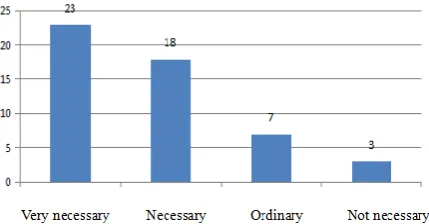
In the aspect of enhancing teaching of the academic paper writing, as shown in Figure 2, nearly half (45.1%) of the respondents believed it was very necessary to do so; quite a lot (35.29%) of the students thought it was necessary to do so; only a few (5.88%) of the students thought it was not necessary to do so.
Most students thought that academic English needed to be strengthened in all aspects, but the demands for English academic communication and speech and listening comprehension were higher than that for academic English reading and writing skills(43.14% >37.25% >25.49% >15.69%). See Figure 3.
Figure 3. Percentage of the demand for English academic skills
B. Difficulties and Writing Habits in Academic English Writing
It is found, in the study, that the difficulties in academic writing mainly lay in vocabulary (52.94%) and writing resources (47.06%) (See Figure 4, multiple topics), and that they mainly employed Internet query (94.12%) when encounter difficulties.
Figure 4. Percentage of difficulties in English writing
TABLE II.
DESCRIPTION STATISTICS OF ACADEMIC ENGLISH WRITING HABITS
Questionnaire entries
N Min Max Mean SD
Look up uncertain words in the dictionary. 51 1.00 4.00 2.5098 .78416
See grammar book when you are not certain about grammar. 51 1.00 4.00 2.3333 .73937
First check whether there are spelling, grammar or other errors after finishing writing by yourself.
51 1.00 4.00 2.9216 .82081
Exchange for checking errors after finish writing. 51 1.00 4.00 3.3922 .85037
Sort out the error after teacher’s correction. 51 1.00 4.00 2.3529 .84436
Ask your teacher or classmates for content questions. 51 1.00 4.00 2.4118 .69790
Mimic the content of model essays and modify slightly. 51 1.00 4.00 2.9608 .74728
Focus on accumulation of some complex sentences in out-of-class learning, such as recitation or taking notes.
51 1.00 4.00 2.9608 .84760
Consciously use the complex sentence patterns that they have just learned or seen. 51 1.00 4.00 2.9216 .84482
Conceive some novel and slightly complicated textual patterns. 51 2.00 4.00 2.9412 .58006
An outline will be listed before writing to ensure that the structure is clear. 51 1.00 4.00 2.4706 .83314 Fully examine the completeness of the content and whether the argument is sufficient and
so on.
51 2.00 4.00 3.0588 .78516
Pay attention to the learning and accumulation of some rhetoric devices in the extracurricular learning.
51 1.00 4.00 2.1176 .71125
Imitate or use the new learned rhetoric devices consciously. 51 1.00 4.00 2.2157 1.04525
Hope teachers still interpret grammar. 51 1.00 4.00 2.6471 .86772
Valid N 51
C. Academic English Writing Classroom and Skills
At present, many Chinese university educators have realized that it is necessary to focus on improving the scientific research writing abilities of HLP postgraduates, especially their academic English writing level, and many key universities have also set up advanced academic English writing course. However, there are still many problems in the current English writing classroom, which is presented as follows.
1. Academic English Writing Classroom
As can be seen in Table 3, the respondents considered that the main problem in the current English writing classroom was that the writing exercises were not enough (51.0%). In addition, some students felt that the writing class was boring (27.5%), as shown in Table 3.
TABLE III.
THE FREQUENCY OF DEFECTS OF ENGLISH WRITING CLASSROOM
Response
N Percentage Case percentage
boring 14 24.6 27.5
not enough class exercise 26 45.6 51.0
too little after-class homework 8 14.0 15.7
other 9 15.8 17.6
Sum 57 100 111
In terms of teaching content, the majority of respondents wanted to learn sentence patterns from the English writing class (82.4%), while 52.9% of the respondents wanted to learn writing norms (See Table 4).
TABLE IV.
THE FREQUENCY OF WHAT YOU WANT TO LEARN IN ENGLISH WRITING CLASS
Response
N Percentage Case percentage
writing norms 27 29.3 52.9
relevant vocabulary 20 21.7 39.2
sentence pattern 42 45.7 82.4
other 3 3.3 5.9
Sum 92 100 180.4
handing in the second draft and the third draft... (70.59%). See Figure 5.
Figure 5. Percentage of teaching methods
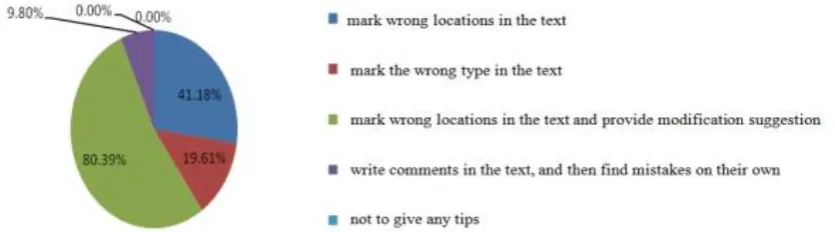
In terms of feedback, it can be seen from Figure 6 that most students wanted the teacher to mark errors in the text, and provide modification and suggestion (80.39%); nearly half (41.18% ) of the students expected the teacher to mark errors in the text; only 19.61 % of the students hoped the teacher to simply mark that what kind of grammatical mistakes were in the text; no students wanted the teacher to write comments in the text, and then find mistakes on their own or wanted the teacher not to give any tips.
Figure 6. Percentage of teacher’s way of pointing out errors in the text (multiple choice)
2. Academic English Writing Skills
The first three writing skills that respondents had the most need to improve were using different sentence patterns (62.7%), writing a powerful introduction (35.3%) and using more attractive vocabulary (29.4%), as shown in Table 5.
TABLE V
THE FREQUENCY OF WRITING SKILLS YOU MOST WANT TO IMPROVE
Response
N Percentage Case percentage
spelling 4 3.2 7.8
paragraph 13 10.5 25.5
punctuation 3 2.4 5.9
a powerful introduction 18 14.5 35.3
Write a strong conclusion 10 8.1 19.6
write in time order 4 3.2 7.8
keep to the point 14 11.3 27.5
use more attractive vocabulary 15 12.1 29.4
use different means of expressions 32 25.8 62.7
how to start 7 5.6 13.7
modify 3 2.4 5.9
other 1 .8 2.0
Sum 124 100.0 243.1
D. Suggestions on Improving the Teaching Methods and Teaching Materials of Academic English Writing
In the fourth part of the questionnaire, the respondents filled out their suggestions on improving the teaching strategies and teaching materials of academic English writing, which can be mainly summarized as follows.
writing ideas.
In terms of teaching materials, the students suggested to add practical and scientific research model essays, especially chart types, and to add comments in the model essays, distinguishing between the pros and cons.
IV. DISCUSSION
Question 1: What is the general tendency of HLP postgraduates’ academic English writing?
The result that demands for English academic communication and speech and listening comprehension were higher than that for academic English reading and academic English writing is consistent with Shen's (2016) survey on the English learning needs of non-English major graduate students in a key university in Jilin Province. One hundred and fifty-nine (72.6%) of the subjects were interested in oral English, and one hundred and eighteen (53.9%) subjects were interested in listening, which reflected that oral English and listening were still the most desired language skills for graduate English learners. The subjects were interested in academic English reading (116 students, 53.0%) and academic English writing (114 students, 52.1%). In addition, from the perspective of language skills, the result of this study contradicted slightly those of Li (1983) and Johns (1981). Li’s (1983) survey on senior researchers in an English workshop shows that the importance placed on practical English skills lies first in reading and listening, then writing and speaking. Similarly, Johns (1981) surveyed 200 teachers from San Diego State University and they thought that students needed receptive skills (both reading and listening) more than productive skills (writing and speaking) for EAP. Through comparative analysis, the reasons for the difference in these results are as follows: (1) The background characteristics of the research subjects were different. Most of the subjects in this study had achieved comparatively high English proficiency of CET-6 or above, so their reading and writing abilities were not poor. And they intended to study abroad but were lack of listening and speaking context training. (2) Academia did not attach importance to academic English writing.
From the perspective of both students and teachers, however, the demand for academic English writing skill was not high compared with other academic English skills. Through interviews with sampling interviewees, the reasons are as follows: (1) Most of the students thought that the experiment was the most important. Since in a team work experiment, one team member was responsible for writing a paper, most students became psychologically dependent and sluggish; (2) Many departments provided writing resources, such as writing templates or writing routine of typical authoritative periodical papers; (3) Some students sought help from foreign tutors to modify their work; (4) Some students directly assigned writing tasks to writing service intermediaries; (5) Many students did not undergo systematic academic writing training during their study and lack confidence in their writing ability; (6) Some students relied entirely on external forces, looking for a third-party agent to write and publish with full help. It was reported that the falsified academic papers by Chinese authors were withdrawn by Springer, publisher of Tumor Biology (107 papers, April 20, 2017). The problem was that there was a black-market industry chain for profit in the third-party intermediary commissioned by the authors. They wore the academic cloak of providing language editing services (language retouching, translation services), but they acted as hypocrites of academic fraud ("ghostreviewing"), even executioners, which made the academia of scientific researchers market-oriented, and seriously affected the international reputation of scientific researchers in China. Although the above incident occurred in the medical field, the peer-reviewed fraud of third-party intermediaries has a long history, which is also a global problem in academia. Though the author, third party organization, and academic journal all had more or less responsibility, the consequences of academic misconduct, damaged reputation, and hindered scientific research career can only be borne by the author himself. It is best to avoid such risks and take a warning from it.
Therefore, it is essential to enhance students' understanding of the importance of academic English writing skills and strengthen the moral education of academic integrity for HLP postgraduates. As scientific researchers, they shouldn’t only have the spirit of researching in scientific experiments, but also abide by academic morality and academic integrity, and have the responsibility and obligation to disseminate scientific research results in the form of languages and words to every corner of the world for academic peer exchange and learning, constantly promoting the common progress and development of human society.
Question 2: What difficulties do HLP postgraduates have in academic English writing? And what are their writing habits?
time, effective learning strategies and approaches should be employed, such as scaffolding peer review / group discussion, self-help correction software, expert lecture and question answering, so as to increase the interaction between students, and between teachers and students and improve the learning efficiency and learning effect of academic English writing skills, thus avoiding relying solely on network resources to solve difficulties.
The results of the above data in Table 2 show that the academic English writing of the HLP postgraduates is still at a relatively low level. Most of the students tended to exchange papers for checking errors (M=3.3922) after finishing writing. Peer review has a positive effect on students’ writing. Storch (2005) indicated that cooperative learning plays an important role in writing: writing tasks can be done better and more efficiently; grammar accuracy and appropriateness are improved; and writing ideas get timely feedback and expansion. However, the students generally lacked an awareness of the language and rhetoric of the written essays (M=2.1176), and they tended to pay more attention to the accuracy of the language syntax (M=2.9216), which were just imitative of the sentence patterns on the surface and ignore their intrinsic functional meanings, hence their writings are mechanical, monotonous and uncreative. In view of this, we suggest that teachers should apply some linguistic theoretical approaches to the analysis of the academic texts, such as three metafunctions (experiential meaning, textual meaning and interpersonal meaning) in Systemic Functional Grammar. According to Fang (2018), “Traditional grammar is essentially a set of normative rules about language, which fails to give students an in-depth understanding of the meaning of language expression and the process of meaning formation”. Language is a semiotic resource used to express meaning. Therefore, what language learners need more is a type of “meaning-oriented grammar, namely Functional Grammar” (Fang, 2018). Especially the concepts of discourse cohesion, Theme-Rheme, nominalization and grammatical metaphor are very helpful for students to correctly understand and recognize the essential features of language, to use language functions flexibly and purposefully, and to achieve an accurate and effective communicative purpose — academic English writing.
Question3: What are the problems of the academic English writing classroom for HLP postgraduates at present? And what academic English writing skills do the students want to improve?
On the one hand, as can be seen in Table 3, more than half (51.0%) of the respondents thought that the writing exercises were not enough. In the actual teaching process, because too few classes are scheduled currently, it is very difficult for teachers to complete the teaching tasks within the prescribed term hours. So the teachers in the classroom mainly focus on teaching theoretical knowledge, while opportunities for students to practice writing are relatively rare. In addition, many subjects (27.5%) felt writing classes boring, and the main reasons found from investigation are as follows: (1) For a long time, the traditional teaching mode of our country is to separate the subject knowledge from the language knowledge ability, which brings students double learning pressure, and the classroom dominated by the traditional grammar teaching method is also relatively boring; (2) The theoretical and scientific nature and rigorous language expression of the academic writing genre make the teaching content itself dull. Therefore, Li & Zeng (2015) pointed out that in the writing class, multimedia technology is used to integrate language mode with other modes such as image sound effectively. The construction of multi-modal English writing Class can increase the channels of interaction and communication between teachers and students, and rich multi-sensory contact can help to reduce the difficulty of students' writing and stimulate students' interest in English writing.
When it comes to the teaching content, most (82.4%) of the respondents expected to learn sentence patterns from the English writing class, while 52.9% of the respondents hoped to learn writing norms (See Table 4). Many HLP postgraduates indicated in the interviews that they had not studied academic English writing systematically. In the initial stage of their writing, the most common method was to imitate the language expressions, text structure and writing norms of published journal papers. This is consistent with Tian (2013)'s long-term investigation of a young scholar (Zhao) in a Western university. Because Zhao received little writing support and limited data, "imitation" became his main method to solve difficulties. The "imitation" here is to express one's main ideas by applying the sentence patterns of other people's utterances. Therefore, sentence pattern expression and writing criteria became the most important writing strategies and writing skills for these novices. The findings are consistent with those of the teaching content analyzed above, and sentence patterns have become the most desirable writing skills for these young researchers. Professor Wang, interviewed by Yu (2014), however, admitted that “this method can only solve the problem of accuracy of English expression, but not the problem of 'elegant' writing with rich language and changeable sentence patterns.” Then, in accordance with the "student-oriented" teaching concept, although the teaching content of academic English writing involves the professional knowledge of various disciplines, it is actually language teaching that matters, focusing on what genres of discourse structure or language expression are used to construct the content of each discipline.Thus it is necessary to cultivate students' language communication skills in a specific field by learning the discourse structure and language expression of each discipline. We propose that it helps to realize the dynamic cycle model of mutual help and mutual benefit between the discipline content and language skills by: (1) taking the academic content of the discipline as a core based on the real and meaningful language materials of a specific discipline; (2) encouraging the equal cooperation between a language teacher and a professional teacher in the subject field; (3) instructing students to master the academic content of the specific subject on the basis of acquiring the language thinking habits of the particular subject; (4) improving language skills in classroom task-activities of learning subject.
change, one of the factors is always the same. That is, both teachers and students think that teachers' feedback on students' writing is the crucial and indisputable teaching content. In terms of feedback, as shown in Figure 6, the result is in line with the survey result of Li (2011), who stated that no student wants the teacher to just point out the existence of mistakes without indicating the specific location. Diversely, in the actual essay writing correction practice, however, teachers found that same mistakes would occur repeatedly in the same student's same paper or in different papers of the same student. And the length of general academic thesis or degree dissertation is relatively long. It is not necessary for the teacher to correct the repeated mistakes of the students one by one, which is not conducive to improve the students' ability of self-analysis and correction. In view of the above two aspects, it is suggested that teachers give corrections to the same types of mistakes that students repeatedly make for the first time, and only point out the location and type if they make mistakes again. In this way, students can be trained to analyze and solve problems, so that they can truly master knowledge and have the ability to independently acquire knowledge.
V. CONCLUSION
Through the statistics of academic English writing questionnaires of HLP postgraduates, it was found that HLP postgraduates in the academic English writing showed common in age, English level, and English-speaking destinations of study abroad, which is conducive for teachers to arrange targeted teaching in accordance with their aptitude. In order to solve the difficulties and bad habits of the students’ academic English writing in the study, in addition to the in-class guidance, we can provide students with other approaches to learning, such as peer review, essay revision software, expert lectures, reading-based writing, etc., which are beneficial to their accumulation of vocabulary and writing materials, and good for the improvement of their learning efficiency and learning effect. Additionally, examining our current problems of academic English writing classroom and writing skills which are urgent to be improved from the perspective of students, can better guide educators to encourage innovation in education ideas, teaching methods and teaching materials. Due tothe limited time and resources, this study has a deficiency in partition degree and less sample size; however, it is hoped that this study can provide reference for future related research.
ACKNOWLEDGMENTS
This study is funded and supported by International Program for Ph.D. Candidates, Sun Yat-sen University. Thanks to Prof. Zhihui Fang of the University of Florida for his careful guidance. Thanks to Fang Huang, a Ph.D candidate of Sun Yat-sen University, for her kind help.
REFERENCES
[1] Cai, J. (2012). Analysis on the Needs of "Academic English" Curriculum and Teaching Methods. Foreign Language Teaching Theory and Practice, (02), 30-35 + 96.
[2] Fang, Z., & Sun, Y. (2018). Prospects for English grammar teaching in Chinese universities. In “Commemorating the 40th anniversary of the Reform and Opening: The Online New Era Forum for Tertiary English Education in China” [EB/OL]. Eapnews. https://mp.weixin.qq.com/s/HK58RTzAQh5ouEpmmKBeTw (Accessed 12/19/2018).
[3] Ferris, D. R., & Hedgcock, J. S. (2005). Teaching ESL Composition: Purpose, Process, and Practice. Mahwah,NJ: Lawrence Erlbaum Associates.
[4] Guo, Q. (2006). On the cultivation of English academic writing ability of non-English-major doctoral students. Academic Degrees & Graduate Education, (02), 52-55.
[5] Grabe, W., & R. Kaplan. (1996). Theory and Practice of Writing: An Applied Linguistic Perspective. London: Longman. [6] Halliday, M. (1985). An Introduction to Functional Grammar. London: Routledge.
[7] Halliday, M. (1994). An Introduction to Functional Grammar (2nd edition). London: Routledge.
[8] Halliday, M., & Matthiessen, C. (2004). An Introduction to Functional Grammar (3rd edition). London: Routledge. [9] Halliday, M., & Matthiessen, C. An Introduction to Functional Grammar (4th edition). London: Routledge.
[10] Han, P., & Hou, L. (2012). Exploring the cultivation of postgraduates' academic English writing ability from the perspective of genre analysis. Foreign Language World, (06), 74-80.
[11] Han, S., & Wang, J. (2010). Multiple reflections on the teaching of academic English writing for non-English majors. Academic Degrees & Graduate Education, (08), 45-49.
[12] Hirvela, A. (2004). Connecting Reading&Writing in Second Language Writing Instruction. Ann Arbor: The University of Michigan Press.
[13] Johns, A. M. (1981). Necessary English: A faculty survey. TESOL Quarterly, 15, 51-57.
[14] Li, J. (2011). A case study on the characteristics of teacher's written feedback and students' reaction in Chinese students' English Writing. Foreign languages, (06), 30-39.
[15] Li, J., & Zeng, L. (2015). Mode selection of English Writing Instruction within the Framework of Multimodal discourse Analysis. Journal of Jiamusi Vocational College, 11, 362-363+365.
[16] Li, X. (1983). The priority of English five skills — EAP student opinion survey. Foreign language teaching and research, (03), 57-60.
[17] Luo, N., & Chen, C. Analysis on the demand for academic English for postgraduates of science and engineering. Contemporary Foreign Language Research, (05), 38-42+77.
[19] Storch, N. (2005). Collaborative writing: Product, process and students' reflections. Journal of Second Language Writing, 14, 153-173.
[20] Swales, J. (2004). Research genres: Exploration and applications. Cambridge: Cambridge University Press.
[21] Tian, M. (2013). A case study of Chinese Young Scholars' experience in Writing and publishing English academic papers.
Education Journal of Renmin University of China, (01), 135-147.
[22] Weissberg, R. (2006). Connecting Speaking & Writing in Second Language Writing Instruction.Ann Arbor: The University of Michigan Press.
[23] Xiong, L., & Yin, M. (2009). On the construction of academic English writing classes for non-English majors based on the research of Chinese and American academic English writing. Foreign Language Teaching, 30, (02), 50-56.
[24] Yang, L., & Wang, X. (2012). A case study of three master degree candidates’ proposal writing and coping strategies. Foreign Language and Foreign Language Teaching, (04), 48-52.
[25] Yu, W. (2014). The main problems and Solutions of English Science and Technology thesis Writing for Ph.D. students in Engineering. Foreign Languages, (03), 55-62.
Jing Li was born in Jilin, China in 1980. She is currently a third-year doctoral candidate majoring in English language and literature at School of Foreign Languages, Sun Yat-sen University, Guangzhou, China. Her research interests include Functional Linguistics, Discourse Analysis, English for Specific/Academic Purposes and Academic Writing. She has published in numerous international and domestic journals.