SYNTHESIS AND CHARACTERIZATION OF POLYIMIDES
BASED ON A FLEXIBLE DIAMINE
M. Saeed Butt
[a]*, Zareen Akhter
[a]and M. Zafar-uz-Zaman
[b]Keywords: Polyimides, ether diamines, 1,4-phenylenedi(oxy-4,4-aniline), solubility, thermal stability
The diamine 1,4-phenylenedi(oxy-4,4-aniline) was prepared via the nucleophilic substitution reaction and polymerized with different dianhydrides either by a one step solution polymerization reaction or a two steps procedure. These polymers had inherent viscosities ranging from 0.64-0.83 dL g-1. Few of the polymers were soluble in most of the organic solvents such as DMSO, DMF, DMAc, NMP and m-cresol even at room temperature and some were soluble on heating. The degradation temperature of the resultant polymers falls in the ranges from 300-450 oC in nitrogen (with only 10% weight loss). The specific heat capacity at 200 oC ranges -4.0322-2.4059 J g1 K1. The maximum degradation temperature ranges from 550-600 oC. T
g values of the polyimides were found from 207 to 228 oC. The activation energy and enthalpy of the polyimides were found in the range of 36.6-94.5 and 34.8-92.5 kJ mole-1 and the moisture absorption from 0.24-0.75%.
Corresponding Authors* Fax: 00925190133154 Tel: 00925190133271
E-Mail: [email protected]
[a] Department of Chemistry, Quaid-i-Azam University, Islamabad-45320, Pakistan
[b] National Engineering and Scientific Commission P.O.Box 2801 Islamabad Pakistan
Introduction
Aromatic polyimides have excellent reputation as high performance materials based on their excellent thermal stability, chemical resistance and mechanical properties. Because of above mentioned properties polyimides can be used in a wide variety of applications such as polymer matrices for high temperature advanced composites, membranes for the low temperature energy separation of industrial gases, interlayer dielectrics, high temperature adhesive and coatings.1-4 Despite their widespread use, most
of them have high melting or softening temperatures and limited solubility in most of the organic solvents because of their rigid backbones and strong intermolecular interactions which may restrict their use in some fields. For such difficulties to be overcome, polymer structure modifications become necessary. Considerable research efforts have been done in designing and synthesizing new dianhydrides5 and
diamines6-11 thus producing a great variety of soluble and
processable polyimides for various purposes. Since 1960, essentially the beginning of the search for high temperature polymers, more attention was focused on the polyimides than any other high performance/high temperature polymers. This is primarily due to the availability of the polyimide monomers (particularly aromatic diamines and dianhydrides), the ease of polymer synthesis, and their unique combination of physical and mechanical properties. However, most fully aromatic polyimides are insoluble in any organic solvent, and they have very high glass transition temperatures, often higher than their decomposition temperatures, which greatly limits their usefulness for many applications. Therefore, much work has been done to
improve the processability of aromatic polyimides while maintaining their excellent level of thermal and mechanical properties.12,13 To meet these aims, by balancing
processability and performance, a number of approaches for structural modifications have been pursued such as incorporation of additional ether, ester, urethane, or amide linkages onto the polymer backbone.14-17 Incorporation of
aryl ether unit is particularly successful method for improving solubility with slight reduction in thermal properties.18,19 In the present study the diamine
1,4-phenylenedi(oxy-4,4-aniline) was synthesized and used to prepare a series of polyimides using various dianhydrides. Due to the presence of flexible moiety in the polyimide backbone, a decrease in the rigidity of the polymer chain would be expected which could improve the solubility of the polymers.
Experimental
Materials
Hydroquinone, p-fluoronitrobenzene, potassium carbonate, 3,3,4,4-benzophenonetetracarboxylic acid dianhydride (BP), 4,4-(hexafluoroisopropylidene)diphthalic anhydride (HF), 3,4,9,10-perylenetetracarboxylic acid dianhydride (PD) and pyromellitic dianhydrides (PMDA) of analytical grade from Aldrich were used as received. All the other reagents and solvents were of analytical grade and used without further purification.
Measurements
1H and 13C NMR spectra were obtained on instrument Jeol
270 spectrophotometer in DMSO using tetramethylsilane as an internal reference. Infrared measurements (KBr pellets) were recorded in the range of 400-4000 cm1 on Bio-Rad
point apparatus. Inherent viscosities were obtained using Gilmount falling ball viscometer at 0.2 g dL-1 in DMSO and
H2SO4. Thermal and DSC analysis were carried out using
Perkin Elmer TGA-7 and DSC 404C Netzsch under nitrogen atmosphere. Elemental analysis was carried out using Perkin Elmer CHNS/O 2400. Wide-angle diffractograms were obtained using 3040/60 X’Pert PRO diffractrometer. Moisture absorption was determined by weighing the changes of the dried pellets before and after immersion in distilled water at 25 oC for 24 hours. Activation energy,
entropy and enthalpy were calculated using Horowitz and Metzger method.20
Monomer Synthesis
1,4-Phenylenedi(oxy-4,4-nitrobenzene) PONB (1)
A mixture of 2.0g (0.018 mol) of hydroquinone, 5.0g (0.036 mol) of anhydrous K2CO3 and 3.81 ml (0.036 mol) of
4-fluoronitrobenzne in a two neck round bottom flask having 70 ml of DMAc was heated at 100 oC for 20 h under
nitrogen atmosphere. The colour of the solution changes from yellow to dark brown as the reaction proceeded. After cooling to room temperature, the reaction mixture was poured in 800 ml of water to form yellow solid which was washed thoroughly with water and then separated by filtration. The crude product was recrystallized from ethanol. Yield 87 %, m.p. 238 oC. Elemental analysis calculated for
C18H12N2O6 (352): C = 61.36%, H = 3.409%, N = 7.95%
and found C = 61.02%, H = 3.69%, N = 7.45%. FTIR (KBr pellet) in cm1: 1589 (aromatic C=C), 1506 and 1340 (NO
2),
1235 (COC). 1H-NMR (DMSO-d
6) in (ppm) and J(Hz):
7.22 (4H, d, Jab=Jab=9.30), 7.3(4H, s), 8.31 (4H, d,
Jba=Jba=9.30). 13C-NMR (DMSO-d6) in (ppm): 116.093
(2C, C5), 125.82 (4C, C3, 3), 127.31 (4C, C6, 6), 145.469 (4C, C2, 2), 149.625 (2C, C4), 163.24 (2C, C1). Yield 87 %, m.p. 238 oC. Crystal data: almost colorless crystal
grown during slow crystallization in ethanol/water (4:1) v/v , 0.38 mm × 0.11 mm × 0.10 mm, triclinic, P1 with a=7.2861(6), b=10.1381(9), c=12.0838(11) Å, α=91.973(7), β=106.497(7), γ=110.152(6)o where D
x = 1.472 Mg m3 for Z = 2 and volume (V) = 794.74 (12) Å3. 22
1,4-Phenylenedi(oxy-4,4-aniline) POA (2)
A 250 ml two neck flask was charged with 1.0g (2.84 mmol) of (1), 10 ml of hydrazine monohydrate, 80 ml of ethanol and 0.06g of 5% palladium on carbon (PdC). The mixture was refluxed for 16 hours and then filtered to remove PdC and the solvent was evaporated and the crude solid was recrystallized from ethanol to yield 85% of the theoretically calculated yield, m.p. 182 oC. Elemental
analysis calculated for C18H16N2O6 (MW=292): C = 73.97%,
H = 5.47%, N = 9.58 and found C = 73.75%, H = 5.12%, N = 9.79%. FTIR (KBr pellet) in cm1: 3400 and 3312 (NH
2),
1639 (NH bending), 1213 (COC), 1495 (NH
deformation). 1H NMR (DMSO-d
6) in (ppm) and J (Hz):
5.08 (4H, s), 6.51 (4H, d, Jab=Jab=8.27), 6.82 (4H, d,
Jba=Jba=8.28), 6.91 (4H, s). 13C NMR (DMSO-d6) in
(ppm): 115.885 (4C, C3, 3), 118.856 (4C, C6, 6), 126.328 (4C, C2, 2), 145.49 (2C, C1) 147.55 (2C, C5), 156.58 (2C, C4). Yield 85%, m.p. 182oC. Crystal data: almost colorless
crystal grown during slow crystallization in ethanol/water (4:1) v/v , 0.42mm × 0.40mm × 0.20 mm, monoclinic, P21/c
with a=6.9579(9), b=22.664(3), c=5.1202(7) Å , β=111.287 (2)o where D
x=1.290 Mg/m3 for Z = 2 and volume (V) =
752.34 (7) Å3. 23
Polymer Synthesis
To a stirred solution of POA (0.36 g, 1.238 mmol) in 8 ml of DMAc was added 3,3,4,4-benzophenonetetracarboxylic acid dianhydride (BP) (0.4 g, 1.238 mmol). The mixture was stirred at room temperature for 2 hours under argon atmosphere to form a polyamic acid (precursor). The film was casted onto a glass plate by heating polyamic acid solution for 18 hours at 80 oC, 2 hours at 150 oC, 2 hours at
200 oC, 2 hours at 250 oC and 2 hours at 280 oC which
converted polyamic acid into polyimide films. The same procedure was adopted for the polymerization of POA with 4,4-hexafluoroisopropylidene diphthalic anhydride (HF) and pyromellitic dianhydride (PMDA) however, the polymerization with perylene dianhydride (PD) was carried out by following procedure. In a 250 ml two neck round bottom flask fitted with nitrogen inlet and outlet the diamine POA [(0.37g, 1.27 mmol), dianhydride (0.5g, 1.27 mmol)], m-cresol (20 ml) and isoquinoline (1 ml) were added. The mixture was heated to 180-200 oC under nitrogen for 6
hours and then cooled to room temperature. The resulting dark red solution was poured into 300 ml of acetone and the resulting solid was washed with (1 N) sodium hydroxide followed by water. After drying at 150 oC overnight,
polyimide was obtained as dark red solid. The inherent viscosities of the polymers were subsequently determined at concentration 0.2 g dL-1 at 25 oC in DMSO and H
2SO4.
Results and Discussion
Monomer Synthesis
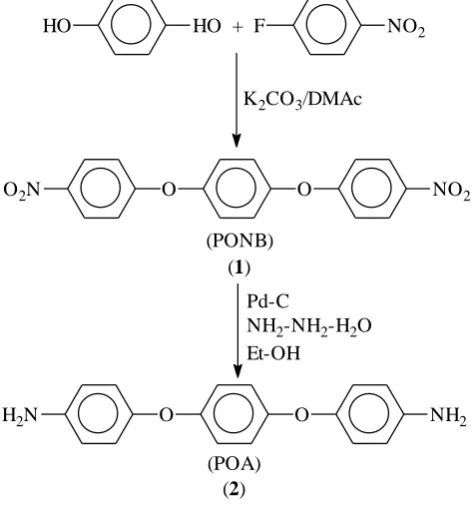
The diamine POA was synthesized according to the well developed method (Scheme-1) The first step is Williamsons etherification21 reaction of 1,4-dihydroxybenzene and
p-fluoronitrobenzene in the presence of potassium carbonate in DMAc, followed by stirring of the mixture at 100 oC for
20 h. The diamine POA was readily obtained in good yield by the catalytic reduction of the intermediate dinitro compound with hydrazine hydrate and PdC catalyst in refluxing ethanol. The schematic diagram of diamine O
O2N 1 O NO2
2
3
4 5
6 a
b 2
3
6
b
a c
O
H2N O NH2
1 2
3
4 5
6 a
b 2
3
6
b
Figure 1. Schematic diagram for the synthesis of 1,4-phenylenedi(oxy-4,4-aniline)
synthesis is shown in the Fig. 1. Elemental, FTIR and NMR analysis were carried out to confirm the structures of intermediate and diamine. The nitro group of intermediate compound gave two absorption band at 1506 and 1340 cm1
(NO2 a symmetric and symmetric stretching). The PONB
crystallizes with two half-molecules in the asymmetric unit. All molecules lie on a centre of inversion. The dihedral angles between the central and terminal benzene rings are 74.75(4) and 85.25(5)o for the two molecules in the
asymmetric unit.22 After reduction the characteristic
absorption of the nitro compound disappeared, and the amino group showed a pair of NH stretching bands in the region of 3300-3500 cm1. The diamine POA is located on a
crystallographic inversion center and the terminal aminophenoxy rings are almost perpendicular to the central benzene ring with a dihedral angle of 85.40(4)o. The
molecular conformation is stabilized by N—H---O and N— H---N intermolecular hydrogen-bonding interactions.23 All
the spectroscopic data obtained was in good agreement with the expected structure.
Polymer Synthesis
The diamine monomers were polymerized with four different aromatic dianhydrides namely 3,3,4,4 -benzophenone tetracarboxylic acid dianhydride (BP), 4,4 -hexafluoroisopropylene)diphthalic anhydride (HF), 3,4,9,10-perylene tetracarboxylic acid dianhydride (PD) and pyromellitic dianhydride (PMDA) as shown in Fig. 2. The polyimides of BP, HF and PMDA were prepared by following a conventional two step procedure which includes the ring-opening polyaddition at room temperature to poly (amic acid), followed by sequential heating to 280 oC. The
polyimide of perylene dianhydride was prepared by a different method. The polyamic acid precursors were prepared by the addition of dianhydride to the diamine solution gradually. The molecular weights were high enough
to cast tough and transparent polyimide films. A rapid temperature elevation resulted in cracked or brittle films. The inherent viscosities determined for some polymer films give values in the range of 0.64-0.83 dL g-1 at concentration
of 0.2 g dL-1 at 25 oC which indicates high molecular
weights of the polymers as shown in Table-2. The polyimides obtained were subjected to solubility and thermal studies. Some of the thermally cured polyimides exhibited excellent solubility in polar solvents such as DMSO, DMF and DMAc. The formation of polyimides was confirmed by IR and elemental analysis (Table-1). All the polyimides exhibited the characteristic imide group absorption around 1780 and 1725 cm1 (typical of imide
carbonyl (symmetric and asymmetric stretching), 1380 cm1
(CN stretch) and 1100 and 730 cm1 (imide ring
deformation). The disappearance of the amide and carboxyl bands indicated a virtually complete conversion of the poly (amic acid) precursor into polyimides. The results of the elemental analysis of all the synthesized polyimides are listed in Table 1. The values found were in good agreement with the calculated one.
BP=3,3,4,4 -Benzophenone-tetracarboxylic acid dianhydride
HF=4,4 -(Hexafluoroiso-propylidene)dipthalic anhydride
PD= 3,4,9,10-Perylenetetra-carboxylic acid dianhydride
PMDA=Pyromellitic dianhydride
Figure 2. Four different acid dianhydrides used for polymerization.
Organo Solubility and Moisture Absorption.
The inherent viscosities determined for polymer films except POA-BP gave values in the range of 0.64-0.83 dLg-1,
reflecting high molecular weight of the polymers. The solubility of the polyimides was determined qualitatively and the results are listed in Table 2. The solvents like DMSO, DMF, DMAc, m-cresol and THF were tested. Some polymers are found soluble on heating while others are slightly soluble and some are insoluble. The organo solubility behaviour of the polymers is generally depended on their chain packing ability and intermolecular interactions that was affected by the rigidity, symmetry and the regularity of the backbone. From the Table 2 it was noticed that the introduction of fluorinated dianhydride component (HF) is especially effective for the high solubility, irrespective of the diamine component. This increase in solubility might be attributed to the molecular asymmetry and the presence of bulky trifluoromethyl groups,
HO HO + F NO2
K2CO3/DMAc
O2N O O NO2
(PONB) (1)
H2N O O NH2
Pd-C
NH2-NH2-H2O Et-OH
(POA) (2)
C O
BP
C CF3 CF3
HF
Table 1. Elemental Analysis of the polymers
Polyimide Formula of the Repeat Unit (Formula Wt.)
C% H% N%
Calc.(Found) Calc. (Found) Calc. (Found) POA-BP C35H18N2O7 (578) 72.66 (71.95) 3.11 (3.20) 4.84 (4.48) POA-HF C37H18N2O6F6 (700) 63.42 (63.14) 2.57 (2.61) 4.00 (3.79) POA-PD C42H20N2O6 (648) 77.77 (77.01) 3.08 (3.29) 4.32 (4.10) POA-PMDA C28H14N2O6 (474) 70.88 (71.83) 2.95 (3.10) 5.90 (6.58)
Table 2. Inherent Viscosity, solubility and moisture absorption of polymers
Polymer DMSO DMF DMAc m-cresol THF H2SO4 inn, dL g-1 Moisture
ab-sorptionc, %
POA-BP + 0.61
POA-HF +++ +++ +++ +++ +++ 0.83a 0.24
POA-PD + + + + ++ 0.64b 0.75
POA-PMDA - - - ++ 0.71 b 0.51
+++ = soluble at room temperature , ++ = soluble on heating; + =slightly soluble on heating , = insoluble; a) measured from 0.2 g dL-1 at 25oC in DMSO; b) measured from 0.2 g dL-1 at 25 oC in H
2SO4; c) moisture absorption was measured at 25±1 oC for 24 hours
which increase the disorder in the chains and hinders the dense chain stacking, thereby reducing the interchain interactions and so enhancing solubility. The poor solubility of the remaining polyimides might be attributed to crosslinking within polymer chain or the tight chain packing and aggregation during imidization at elevated temperature. The moisture absorption of the synthesized polyimides was found in the range of 0.24-0.61 %. The fluorinated polyimide was found to absorb lowest absorption as compared to other polyimides because the trifluoromethyl group possesses the amphiprotic feature, which inhibits the absorption of moisture molecules on the surface of the fluorinated polyimides.24
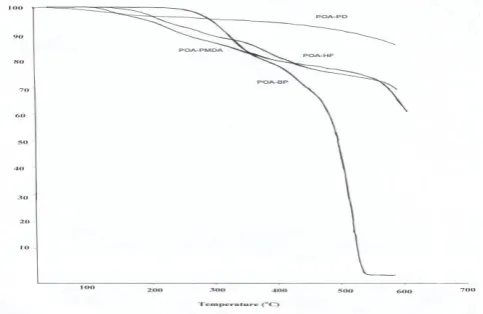
Figure 3. TGA curves of the synthesized polyimides
X-ray Diffraction Data
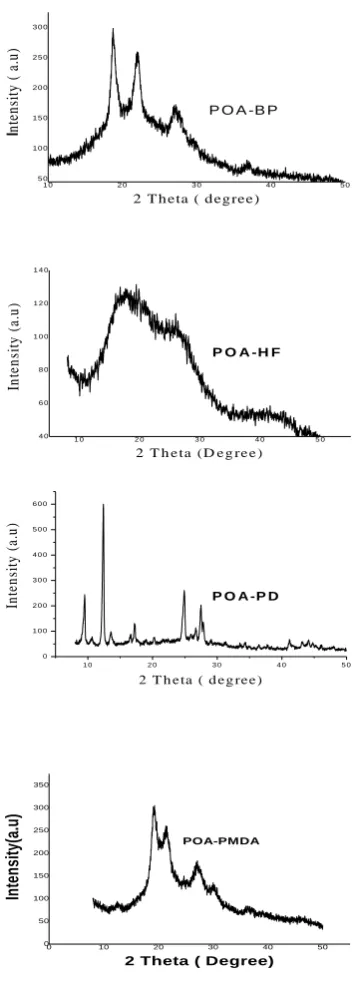
All the polyimides were characterized with WAXD studies. The WAXD pattern is shown in Figure 4. All polyimides except POA-HF, displayed a semicrystalline pattern where as POA-HF displayed nearly completely amorphous pattern because of the bulky CF3 group which
disrupted the symmetry or dense chain packing leading to highly ordered regions. The bulky CF3 also induces looser
chain packing and reveals a large decrease in crystallinity leading to highly ordered regions.24
Thermal Properties
Thermal properties of the polyimides were investigated by the thermogravimetric analysis (TGA) and differential scanning calorimetry (DSC) at heating rate of 10 oC min-1.
Table 3 presents the thermal properties of the polyimides. The results of the TGA analysis showed no significant weight loss below 300 oC in nitrogen. The maximum
degradation temperature (Tmax) for most of the polymers lies
between 550-600 oC.
The thermal stability of the polymers was also evaluated in term of 10 % weight loss (T10), maximum degradation
temperature (Tmax) and residual weight at 600 oC as listed in
Table 3. It has been seen by comparing T10 of the polymers
that the introduction of the diacid PD is especially effective to improve the thermal stability of the polyimides regardless of the diamine component. This increase in thermal stability is attributed to rigid and bulky PD unit which inhibit the rotation of bonds, resulting in an increase in chain stiffness while the polyimides having HF unit are less thermally stable than PD unit which is probably due to the different packing density of the polymer aggregation and the interaction of the polymer chain. The presence of bulky CF3
group reduces the chain interactions and causes the poor packing of the polymer chain and lowers the thermal stability. This thermal behaviour is in agreement with the literature.25
Table 3. Thermal behaviour of pPolymers in nitrogen flow.
Polymer
Specific heat capacitya at
200 oC,
Thermal Stabilityb
R600
(%)e
Tg (oC)f
Activation energy, kJ mol-1
Entropy, kJ mol -1.K
Enthalpy kJ mol-1
T10 Tmax
J g1 K1 (oC)c (oC)d
POA-BP 2.4059 350 550 80.5 228 53.8 0.265 52.0 POA-HF 0.5162 300 580 66.0 225 48.8 0.213 40 POA-PD -4.0322 450 600 85.6 - 94.5 0.672 92.5 POA-PMDA 2.3949 300 600 62.8 207 36.6 0.093 34.8
a ) Measured from DSC under nitrogen at heating rate of 10 oC min-1; b) Measured from TGA under nitrogen at heating rate of 10 oC min-1; c) Temperature at 10% weight loss; d) Maximum degradation temperature obtained from differential curves; e) Residual weight at 600oC; f) Tg (glass transition temperature)
200 oC. T
g values of the polyimides ranged from 207 to 228 oC. The activation energy and enthalpy of the polyimides are
in the range of 36.6-94.5 26 and 34.8-92.5 kJ mol-1,
respectively, and are comparable with the literature.
Conclusions
The diamine POA was successfully prepared in high purity and high yield and was polymerized with four different aromatic dianhydrides to obtain moderate to high molecular weight polyimides. Polyimides with 3,3,4,4 -benzophenone tetracarboxylic acid dianhydride , 4,4 -(hexafluoroisopropylidene) diphthalic anhydride and pyromellitic dianhydrides could be thermally converted into tough and flexible polyimide films. Few polyimides synthesized were soluble in most of the organic solvents such as DMSO, DMF, DMAc and m-cresol. The degradation for 10% weight loss ranges from 300-450oC.
The maximum degradation temperature ranges from 550-600 oC and specific heat capacity -4.0322 to 2.2.4059 J g1
K1 at 200 oC. Tg values of the polyimides ranged from 207
to 257 oC. All polyimides show semicrystalline pattern
except POA-HF which shows completely amorphous pattern. The moisture absorption of the polyimides is in the range of 0.24-0.75%. Activation energy and enthalpy of the polyimides is in the range of 36.6-94.5 kJ mol-1 and
34.8-92.5 kJ mol-1, respectively. These polyimides could be
considered as processable high performance polymeric materials.
Acknowledgments
The authors are grateful to Department of Chemistry Quaid-I-Azam University Islamabad Pakistan and Institut für Anorganische Chemie, J.W.Goethe-Universität Frankfurt, Germany for providing laboratory and analytical facilities.
References
1Kyung, H. C., Kyung, H. L., Jung, J. C., J. Polym. Sci., Part A:
Polym. Chem.,2001, 39, 3818.
2Mittal, K.L., Ed: Polyimides Synthesis, Characterization and
Applications, Plenum: New York, 1985.
3Bessonov, M. I., Koton, M. M., Kudryatsev, V. V., Laius, L. A., Polyimides Thermally Stable Polymers, Consultants Bureau: New York, 1987.
4Abadie, M. J. M., Sillion, B., Eds:, Polyimides and Other High
Temperature Polymers, Elsevier, Amsterdam,1991.
1 0 2 0 3 0 4 0 5 0
5 0 1 0 0 1 5 0 2 0 0 2 5 0 3 0 0
I
n
te
n
si
ty
(
a
.u
)
2 T h eta ( d eg ree)
P O A -B P
1 0 2 0 3 0 4 0 5 0
4 0 6 0 8 0 1 0 0 1 2 0 1 4 0
In
te
n
si
ty
(
a.
u
)
2 T h e ta (D e g re e ) P O A -H F
1 0 2 0 3 0 4 0 5 0
0 1 0 0 2 0 0 3 0 0 4 0 0 5 0 0 6 0 0
In
te
n
si
ty
(
a.
u
)
2 T h e ta ( d e g re e ) P O A -P D
0 10 20 30 40 50
0 50 100 150 200 250 300 350
In
te
n
si
ty
(a
.u
)
2 Theta ( Degree) POA-PMDA
5Li, W. M., Li, S. H., Zhang, S. B., Macromolecules, 2007, 40: 8205-8211.
6Jeong, K. U., Jo, Y. J., Yoon, T. H., J. Polym. Sci. Part A. Polym.
Chem.,2001, 39, 3335-47.
7Liu, J. G., Li, Z. X., Wu, J. T., Zhou, H.W., Wang, F. S., Yang, S.
H., J. Polym. Sci. Part A. Polym. Chem., 2002, 40, 1583-93.
8Reddy, D. S., Choy, C-H., Shu, C-F., Lee, G-H., Polymer, 2003, 44, 557-63.
9Hsiao, S-H., Huang, T-L., J. Polym. Res., 2004, 1, 9.
10Hsiao, H-S., Lin, K-H., J. Polym. Sci. Part A. Polym. Chem.,
2005, 43, 331-41.
11Liaw, D-J., Chang, F-C., Leung, M., Chou, M-H., Mullen, K.,
Macromolecules,2005, 38, 4024-29.
12Jung, J. C., Park, S-B., J. Polym. Sci. Part A. Polym. Chem.,1996, 34, 357-65.
13Sat, M., Polyimides, In Handbook of Thermoplastics; Olabisi O,
Ed; Dekker: New York, 1997.
14Kricheldorf, H. R., Ed. Advances in Polymer Science: Progress in Polyimide Chemistry, Vols. I and II; Springer-Verlag:
Berlin/New York,1998.
15Ayala, A., Lozano, A. E., Abajo, J. D., De La Campa, J. G., J.
Polym. Sci., Part A: Polym. Chem.,1999, 37, 805-14.
16Yang, C. P., Hsiao, S. H., Yang, H. W., Macromol. Chem. Phys.,.
2000, 201, 409-18.
17Ghosh, M. K., Mittal, K. L., Polyimides: Fundamentals and
Applications; Marcel Dekker: New York,1996.
18Harris, F. W., Lanier, L. H., In: Harris, F. W., Seymour, R. B., Editors. Structure–solubility-relationships in polyimides.
New York: Academic Press, 1977, p. 183
19Eastmond, G. G., Paprotny, J., Macromolecules, 1996, 29, 1382-88.
20Horowitz, H. H., Metzger, G., Anal. Chem., 1963, 35, 1464-68.
21Hsiao, H. S., Yang, C. P., Chung, C. L. , J. Polym. Sci. Part A.
Polym. Chem., 2003, 41, 2001-18.
22Butt, M. S., Akhter, Z., Bolte, M., Humaira, M. S. Acta Cryst.
Sect. E., 2006, E62, o3992–o3993.
23Shemsi, M. A., Butt, M. S., Fettouhi, M., Humaira, M. S., Akhter,
Z., Acta Cryst. Sect. E. 2008, E64, o581
24Hsiao, S. H., Yang, C. P., Yang, C. Y., J. Polym. Sci., Part A:
Polym. Chem.,1997, 35, 1487-97.
25Butt, M. S., Akhter, Z., Zaman, M. Z., Munir, A., Eur. Polym. J.,
2005, 41, 1638-46.
26Brekner, M-J., Feger, C., J. Polym. Sci. Part A: Polym. Chem.
1987, 25, 2479-2491.