PREPARATION OF Cu
7S
4NANOSTRUCTURED THIN FILMS
FROM [(Et(Bu)NC(S)NC(O)C
6H
3(NO
2)-3,5]
2Cu(II) BY AEROSOL
ASSISTED CHEMICAL VAPOUR DEPOSITION
Sohail Saeed
[a],*, Naghmana Rashid
[a], Rizwan Hussain
[b]Keywords: Copper complex; copper sulphide (Cu7S4); thin film; aerosol assisted chemical vapour deposition (AA-CVD); SEM; powder XRD; N-[ethyl(butyl)carbamothioyl]-3,5-dinitrobenzamide ligand
The copper(II) complex of N-[ethyl(butyl)carbamothioyl]-3,5-dinitrobenzamide (1) has been synthesized and characterized by elemental analysis, IR spectroscopy and atmospheric pressure chemical ionization-mass spectrometry (MS-APCI). Thermogravimetric analysis shows the complex (2) decomposes in two-step to form copper sulfide. The complex was used as single-source precursor for the deposition of copper sulfide thin film by aerosol assisted chemical vapour deposition (AA-CVD) at 350 oC. Powder X-ray diffraction (p-XRD) pattern of thin film of complex showed the deposition of monoclinic roxbyite Cu7S4 and orthorhombic anilite Cu7S4 phases at 350 oC with spherical crystallites. The degree of film surface roughness was determined by atomic force microscopy (AFM). The scanning electron microscopy (SEM) and energy dispersive X-ray analysis (EDX) results showed the uniform distribution of copper sulfide in the film, which makes it useful semiconducting material on a structured surface.
Corresponding Authors
Tel.: + 0092-51 - 9250081 Fax: + 0092- 51- 9250081
E-Mail: [email protected] (S.Saeed) [a] Department of Chemistry, Research Complex, Allama
Iqbal Open University, Islamabad-44000, Pakistan [b] National Engineering & Scientific Commission, P.O. Box.
2801, Islamabad, Pakistan
Introduction
Recently, nanostructured materials have attracted great attention in the fields of experimental and theoretical chemistry sciences.1-3 Due to extensive dependence of the
properties and application of nanostructured semiconductors on their crystal phase, size, composition and shape, synthesizing of highly tuned nanocrystals have been a challenging issue.4
Copper sulfides thin films and nanoparticles have been investigated for many uses including as: p-type semiconductors in solar cells,5-7 nanoscale switches 8and
cathodic materials for lithium rechargeable batteries.9
Vaughan 10 reported that in 1940 only the end member
(Cu2S) and CuS were known in the Cu-S system. By 1974
nine more copper sulfide phases had been identified 11, 12
and in 2006 a total of fourteen copper sulfide phaseswere recognized.12 Some known forms of copper sulfide
include: chalcocite (Cu2S), djurleite (Cu31S16 or Cu1.94S), digenite (Cu9S5 or Cu1.8S), anilite (Cu7S4 or Cu1.75S), covellite (CuS) and villamaninite (CuS2).7-13Thin films of
copper sulfide have been prepared by various methods including RF-reactive sputtering,14 spray pyrolysis,15
successive ionic layer adsorption and reaction,16 chemical
bathdeposition17and chemical vapor deposition.18
Thiourea and its alkyl derivatives are important precursors for the preparation of metal sulfide nanoparticles. Besides focusing on the applications of these ligands, special attention has been placed on their coordination chemistry to different metal atoms because of the various potential donor sites that these ligands possess.19
Arslan et.al 20 and Benzet et.al 21 reported the
complexation of Cu(II) and Zn(II) with thiourea derivatives and concluded that the coordination was through the sulfur and oxygen atom, using infrared spectroscopy and X-ray diffractions to determine the coordination. In addition, complexes prepared using the alkyl thiourea, such as methylthiourea, showed, using infrared spectroscopy, that the coordination also was through sulfur.21 Thiourea and its derivatives were used
as a source of sulfur because their advantages in this regard are that they are stable for a long time, easy to synthesis, inexpensive and yield good quality crystalline semiconductor particles.
Experimental Section
Materials and Reagents
Analytical grade N-ethylbutyl amine (98 %), sodium thiocyanate (99%), copper(II) nitrate trihydrate (99.5 %), tetrabutylammonium bromide (TBAB) (≥98%) and 3,5-dinitrobenzoyl chloride (≥98.0 %) were purchased from Sigma-Aldrich. Analytical grade solvents such as; tetrahydrofuron (THF), toluene, acetonitrile, n-hexane, dichloromethane, ethanol, methanol, chloroform, ethyl acetate and others were purchased from Sigma-Aldrich and Riedal-deHaen (Germany) whereas ethanol and acetone were dried using standard procedures.22 All the
synthetic manipulations were carried out in air except for the aerosol assisted chemical vapour deposition experiment. The demonstration of AACVD was carried out under argon inert atmosphere.
Physical Measurements
Elemental analysis was carried out using Perkin Elmer CHNS/O 2400. Obtained results were within 0.4 % of the theoretical values. Infrared spectra were recorded on a Specac single reflectance Attenuated Total Reflectance (ATR) instrument (4000-400 cm-1, resolution 4cm-1).
Atmospheric Pressure Chemical Ionization Mass Spectrometry (MS-APCI) of copper complex was recorded on a Micromass Platform II instrument. Metal analysis of the complex was carried out by Thermo iCap 6300 Inductively Coupled Plasma Optical Emission Spectroscopy (ICP-OES). Thermal stability of the copper complex was studied by thermogravimetery in an inert atmosphere, at sample heating rate of 10 oC/ min, with a
DuPont 2000 ATG. Melting points were recorded on Electrothermal IA9000 series digital melting point apparatus. X-ray Powder Diffraction (
p
-
XRD) studies were performed on a Xpert diffractometer using Cu-Kα radiation. The sample was mounted flat and scanned between 20 and 65° with a step size of 0.05 with various count rates. The diffraction pattern was then compared to the documented patterns in the International Center Diffraction Data (ICDD) index.Preparation of the Ligand and Copper(II) Complex
Synthesis of N-[ethyl(butyl)carbamothioyl]-3,5-dinitro benzamide (1)
A solution of 3,5-dinitrobenzoyl chloride (0.01 mol) in anhydrous acetone (80 ml) and 3% tetrabutylammonium bromide (TBAB) in acetone was added drop-wise to a suspension of sodium thiocyanate in acetone (50 ml) and the reaction mixture was refluxed for 45 minutes. After cooling to room temperature, a solution of N-butylethyl amine (0.01 mol) in acetone (25 ml) was added and the resulting mixture refluxed for 2 h. The reaction mixture was poured into five times its volume of cold water, whereupon the thiourea precipitated. The solid product was washed with water and purified by re-crystallization from an ethanol-dichloromethane mixture (1:2). Light Yellow. M.p.: 126-127 oC. Yield: 3.0g (74 %). IR
(νmax/cm-1): 3235 (NH), 2922, 2845 (C-H), 1691(C=O),
1258 (C=S). 1H NMR (400 MHz, CDCl
3) in δ (ppm) and J (Hz): δ 9.10 (t, 1H, J = 1.8), 8.84 (d, 2H, J = 1.8), 8.35(bs, 1H, CONH), 3.91(t, 2H, N-CH2), 3.55(m, 2H,
N-CH2), 1.83(m, 2H, -CH2-), 1.44(m, 2H, -CH2-), 1.20(t, 3H,
CH3), 0.93(t, 3H, CH3). Anal. Calcd. forC14H18N4O5S:
C,47.45; H, 5.12; N,15.81; S,9.05. Found: C, 47.47; H, 5.09; N, 15.82; S, 9.03.
Synthesis of bis[N-[ethyl(butyl)carbamothioyl]-3,5-dinitrobenzamide]copper(II)(2)
To a stirred solution thiourea ligand (3.54 g, 0.01 mol) in ethanol (30 ml) was added drop-wise a solution of copper nitrate (1.20 g, 0.005 mol) in ethanol (30 ml).The reaction mixture was stirred for 3h. The reaction mixture was filtered, washed with ethanol and re-crystallized from THF/acetonitrile mixture (1:1). Dark brown. Yield: 3.6 g (77 %). IR (νmax/cm-1): 2928, 2855(Ar-H), 1507(C-O),
1536(C-N), 1153(C-S); Anal. Calcd. for
C28H34N8O10S2Cu: C, 43.66; H, 4.45; N, 14.55; S, 8.33;
Cu, 8.25. Found: C, 43.11; H, 4.02; N, 14.95; S, 8.32; Cu, 7.94. Mass (MS-APCI) (major fragment, m/z): 770[M+, C28H34N8O10S2Cu].
Deposition of copper sulfide thin film by Aerosol Assisted Chemical Vapor Deposition (AA-CVD)
Experiments were designed according to those reported by us previously. In a typical experiment, 0.25 g of the precursor was dissolved in 15 ml tetrahydrofuran (THF) was loaded in a two-necked 100 ml round-bottom flask with a gas inlet that allowed the carrier gas (argon) to pass into the solution to aid the transport of the aerosol. This round-bottom flask was connected to the reactor tube by a piece of reinforced tubing. The argon flow rate was controlled by a Platon flow gauge. Seven soda glass substrates (approx. 1 × 2 cm) were placed inside the reactor tube, which is placed in a CARBOLITE furnace. The precursor solution in a round-bottom flask was kept in a water bath above the piezoelectric modulator of a PIFCO ultrasonic humidifier (Model No. 1077). The aerosol droplets of the precursor thus generated were transferred into the hot wall zone of the reactor by carrier gas. Both the solvent and the precursor were evaporated and the precursor vapor reached the heated substrate surface where thermally induced reactions and film deposition took place.
Results and Discussion
Most of the materials reported for photovoltaic use are either toxic or use less-abundant elements such as lead, cadmium, Indium or gallium. Less-toxic, abundant, and thus cheaper materials may be more promising even with overall lower efficiencies. Recent estimates of the annual electricity potential as well as material extraction costs and environmental friendliness led to the identification of materials that could be used in photovoltaic applications on a large scale.23 The most promising materials include
Preparation and Spectroscopic Characterization
The bidentate ligand was synthesized from 3,5-dinitrobenzoyl chloride, sodium thiocyanate and N -butylethyl amine in anhydrous acetone. The thiourea derivative (1) and its copper complex (2) were synthesized according to the reported procedure 24-29 with
minor modifications as presented in SynthesisScheme.
The use of phase transfer catalyst as a method of agitating a heterogeneous reaction system is gaining recognition.30,31 In search of improved methods to prepare
the target thiourea by reacting isothiocyanates with nucleophiles, we have found that the use of tetrabutylammonium bromide (TBAB) as phase transfer catalyst (PTC) can produce isothiocyanates in good yield. The reaction proceeds via a nucleophilic addition of the secondary amine to the isothiocyanate. We have conducted our reaction using tetrabutylammonium bromide (TBAB) as phase transfer catalyst to synthesize the thiourea derivative.
Four coordinated copper(II) complex (2) were synthesized by reacting copper nitrate with N -[ethyl(butyl)carbamothioyl]-3,5-dinitrobenzamide (1) in ethanol. The copper(II) complex (2) obtained is green in color, air stable, non-hygroscopic in nature, soluble in tetrahydrofuran(THF), acetonitrile, dichloromethane, chloroform, DMSO, and DMF. The solid state IR spectra of thiourea derivative ligand and the metal complex in the region 4000-400 cm-1 was compared and assigned on
careful comparison. Thiourea ligands behave both as a monodentate and bidentate ligands, depending upon the reaction conditions. The characteristic bands of thiourea ligand are between/ near to; 3235 (NH), 2922, 2845 Ph(CH), 1691 (C=O) and 1258 (C=S), and there is a slight shift of (CN) and (CS) groups stretching frequencies due to coordination of the ligand to the copper atom. As is well known, acythioureas usually act as bidentate ligands to transition-metal ions through the acyl oxygen and sulfur atoms.32-34 The FTIR spectra of
the complex showed significant changes when compared with the FT-IR spectra of the corresponding ligand. The IR spectra of the complex show absorption bands at υmax/cm-1: 2928, 2855 (Ar-H), 1507 O), and 1153
(C-S). The most striking changes is the N-H stretching frequency at 3235 cm-1 in the free ligand, disappears
completely, in agreement with both ligand and complex structure and the complexation reaction. This indicates the loss of the proton originally bonded to nitrogen atom of the (NH-CO) amide group. Another striking change is observed for the carbonyl stretching vibration. The vibrational frequency due to the carbonyl (1691 cm-1)
group in the free ligand is shifted towards lower frequency upon complexation, confirming ligand is coordinated to copper(II) ion through the oxygen and sulfur donor atoms.35-39 A comparative absorption pattern
of the complex with the values of the free ligand demonstrate that the coordination of thiourea ligand to copper atom has a significant effect on υ(NH), υ(CO), and υ(CS) frequencies.
The AA-CVD deposition of copper sulfide thin film from Bis[N-[ethyl(butyl) carbamothioyl]-3,5-dinitrobenzamide]copper(II)(2)
Thermogravimetric Analysis of Copper(II) Complex (2)
The thermogram of the complex 2 shows two stages of weight loss (Supplementary Material). The first step begins at 38 oC and accomplished at 225 oC. The second
one starts at 225 oC and completed at 583 oC, with residue
amounting to 29.82 % at 600 oC of the initial weight. The
O
Cl
NO2 O2N
S C O
N O2N
NO2 O
NH S
N
R R' O2N
NO2
TBAB Dry acetone NaSCN
( 1 )
( 2 )
R = ethyl, R' = butyl and M= Cu (II)
N - butylethyl amine
Copper nitrate
N S
N R
R'
O
O2N
NO2 N
S
N
R R'
O NO2
O2N
M
residual weight (29.82 %) is higher, but considerable close to the expected composition for CuS (cal. 16.58 %), the presence of which was further supported by the XRD analysis of the residue.
Figure 1. X-Ray diffractogram of the copper sulfide thin film obtained from complex (2)
X-ray Diffraction Studies of Deposited Nanostructured Thin Film
Using the above TGA data, the AACVD experiment was run at 350 oC. At 350 oC the XRD pattern from this
film shows two types of phases (Figure 1). The diffraction pattern of the dominated phase is “monoclinic
roxbyite” (Cu7S4) in the space group C2/m (12) with
major diffraction peaks of (1600), (804), (2001) and (0160) planes (ICDD: 023-0958). The second phase is
“orthorhombic anilite” (Cu7S4) in space group Pnma (62)
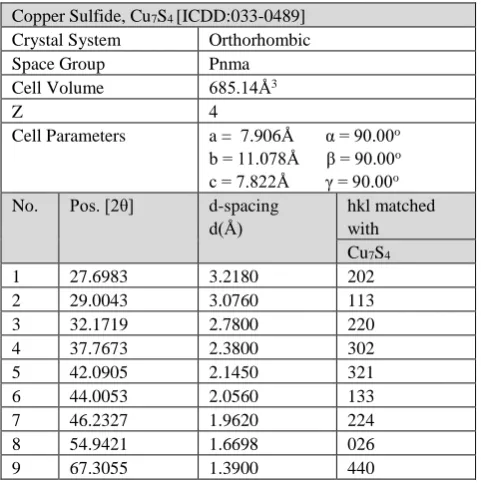
with major diffraction peaks of (202), (220) and (224) planes (ICDD: 022-0250) and cell parameters are listed in Table 1.
Table 1. Powder X-ray crystal data of the decomposed material from copper complex (2)
Copper Sulfide, Cu7S4 [ICDD:033-0489] Crystal System Orthorhombic
Space Group Pnma
Cell Volume 685.14Å3
Z 4
Cell Parameters a = 7.906Å α = 90.00o b = 11.078Å β = 90.00o c = 7.822Å γ = 90.00o No. Pos. [2θ] d-spacing
d(Å)
hkl matched with Cu7S4
1 27.6983 3.2180 202
2 29.0043 3.0760 113
3 32.1719 2.7800 220
4 37.7673 2.3800 302
5 42.0905 2.1450 321
6 44.0053 2.0560 133
7 46.2327 1.9620 224
8 54.9421 1.6698 026
9 67.3055 1.3900 440
Scanning Electron and Atomic Force Microscopic Studies of Nanostructured Thin Film
The SEM image of the film Figure 2a showed that the film morphology with evenly distributed small crystallites without any preferred orientation and diffusion grain boundaries. The particles with spherical appearance have good orientation and clearly well defined grain boundaries. EDX analysis of film shows that the composition as Cu:S ratio: 72.5: 27.5. The AFM image of the film (Figure 2b) shows the growth of closely packed crystallites onto a glass substrate with an average roughness of 11.81 nm (Figure 2c).
Figure 2(a) SEM image of copper sulfide thin film deposited from 2 at 350 oC, (b) AFM image in 3D view of thin film and (c) shows average roughness and Rms roughness of thin film deposited at 350 oC
Conclusions
We have successfully synthesized an unsymmetrical copper(II) complex of Bis[N -[ethyl(butyl)carbamothioyl]-3,5-dinitrobenzamide]copper(II). AA-CVD from copper (II) complex deposited monoclinic roxbyite Cu7S4 and
orthorhombic anilite Cu7S4 phases at 350 oC with
spherical crystallites. The composition of the deposited thin film was confirmed by EDX analysis. AFM studies showed that the average roughness of deposited film was 11.81 n.m.
Acknowledgement
S. Saeed would like to acknowledge the Higher Education Commission (HEC), Government of Pakistan for financial support.
20 30 40 50 60 70 80
25 50 75 100 125 150 175 200 225
x x
x
x x
Re
lative
In
te
nsity (
a.u
)
2-Theta-Scale (deg)
x
y
y
y y
y x = Roxbyite, syn
References
1Monajjemi, M.; Baei, M.T.; Mollaamin, F. Russ. J. Inorg. Chem., 2008, 53, 1430-1437.
2Monajjemi, M.; Mahdavian, L.; Mollaamin, F.; Khaleghian, M. Russ. J. Inorg. Chem., 2009, 54, 1465-1473.
3Zare, K.; Daroule, M.; Mollaamin, F.; Monajjemi, M. Int. J. Phys. Sci. 2011, 6, 2536-2540.
4Sun, Y.G.; Xia, Y.N. Science 2002, 298, 2176-2179.
5Lee, H.; Yoon, S.W.; Kim, E.J.; Park, J. Nano Lett. 2007, 7, 778-7784.
6Wu, Y.; Wadia, C.; Ma, W.; Sadtler, B.; Alivisatos, A.P. Nano Lett. 2008, 8, 2551-2555.
7Wadia, C.; Alivisatos, A.P.; Kammen, D.M. Environ. Sci. Technol. 2009, 43, 2072-2077.
8Sakamoto, T.; Sunamura, H.; Kawaura, H. Appl. Phys. Lett. 2003, 82, 3032-3034.
9Chung, J.S.; Sohn, H.J. J. Power Sources2002, 108, 226-231. 10Vaughan, D.J.; Craig, J.R. Mineral Chemistry of Metal
Sulfides, ed. W. B. Harland, S. O. Agrell, A. H. Cook and N. F. Hughes, Cambridge University Press, Cambridge, 1978, pp. 290-292.
11Fleet, M.E. Rev. Mineral. Geochem. 2006, 61, 365-420. 12Koch, D.F.A.; McIntyre, R. J. Electroanal. Chem. 1976, 71,
285-296.
13He, Y.B.; Polity, A.; Osterreicher, I.; Pfisterer, D.; Gregor, R.; Meyer, B.K.; Hardt, M. Phys. B, 2001, 308-310, 1069-1073.
14Wang, S.Y.; Wang, W.; Lu, Z.H. Mater. Sci. Eng., B2003, 103,184-188.
15Sartale, S.D.; Lokhande, C.D. Mater. Chem. Phys. 2000, 65, 63-67.
16Hu, H.; Nair, P.K. Surf. Coat. Technol. 1996, 81, 183-189. 17Kemmler, K.; Lazell, M.; O’Brien, P.; Otway, D.J.; Park, J.H.;
Walsh, J.R. J. Mater. Sci.: Mater. Electron.2002,13, 531-535.
18Moloto, M.J.; Revaprasadu, N.; O'Brien, P.; Malik, M.A. J. Mater. Sci. Mater. Electron. 2004, 15, 313-316.
19Arslan, H.; Flörke, U.; Kulcu, N.; Emen, M.F. J. Coord. Chem. 2006, 59, 223-228.
20Binzet, G.; Arslan, H.; Flörke, U.; Kulcu, N.; Duran, N. J. Coord. Chem. 2006, 59, 1395-1406.
21Bailey, R.A.; Peterson, T.R. Can. J. Chem. 1967, 45, 1135-1142.
22Perrin, D.D.; Armarego, W.L.F.; Perrin, D.R., Purification of laboratory chemicals, 3rd ed., Pergamon Press Ltd.Oxford, 1988.
23Abdelhady, A.L.; Ramasamy, K.; Malik, M.A.; O’Brien, P.; Haigh, S.J.; Raftery, J. J. Mater. Chem. 2011, 21, 17888-17895.
24Saeed, S.; Rashid, N.; Jones, P.G.; Tahir, A. J. Heterocycl. Chem., 2011, 48, 74-84.
25Saeed, S.; Rashid, N.; Jones, P.G.; Ali, M.; Hussain, R. Eur. J. Med. Chem., 2010, 45, 1323-1331.
26Saeed, S.; Rashid, N.; Jones, P.G.; Hussain, R.; Bhatti, M.H. Cent. Eur. J. Chem., 2010, 8, 550-558.
27Saeed, S.; Rashid, N.; Ali, M.; Hussain, R.; Jones, P.G. Eur. J. Chem., 2010, 1, 221-227.
28Saeed, S.; Wong, W.-T. J. Heterocycl.. Chem., 2012, 49, 580-584.
29Saeed, S.; Rashid, N.; Bhatti, M.H.; Jones, P.G. Turk J. Chem. 2010,34, 761-770.
30Ke, S.-Y.; Xue, S.-J. ARKIVOC 2006, x, 63-68.
31Wei, T.B.; Chen, J.C.; Wang, X.C. Synth. Commun., 1996, 26,1147-1152.
32Fregona, D.; Giovagnini, L.; Ronconi, L.; Marzano, C.; Trevisan, A.; Sitran, S.; Biondi, B.; Bordin, F. J. Inorg. Biochem., 2003, 93, 181-189.
33El-Reash, G.M.A.; Taha, F.I.; Badr, G. Transit. Met. Chem.,1990, 15, 116-119.
34Che, D.J.; Yao, X.L.; Li, G.; Li, Y.H. J. Chem. Soc., Dalton Trans., 1998, 1853-1856.
35Richter, R.; Beyer, L.; Kaiser, J. Z. Anorg. Allg. Chem., 1980, 461, 67-73.
36Beyer, L.; Hoyer, E.; Liebscher, J.; Hartmann, H. Z. Chem.,1980, 21, 81-84.
37Irving, A.; Koch, K.R.; Matoetoe, M. Inorg. Chim. Acta.,1993, 206, 193-198.
38Koch, K.R.; Sacht, C.; Bourne, S. Inorg. Chim.Acta. 1995, 232, 109-115.
39Mikami, M.; Nakagawa, I.; Shimanouch, T. Spectrochim. Acta 1967, 23A, 1037-1053.