THE RELATIONSHIP BETWEEN EMPLOYEE RELATIONS
AND PERFORMANCE OF SUPERMARKETS IN KENYA
Cheptum Florence Jemutai
PhD Candidate, PhD in Business Administration,
Jomo Kenyatta University of Agriculture &
Technology, Kenya.
[email protected]
Dr. Otuya Robert Ingabo
Dean, School of Business and Management Sciences,
University of Eldoret, Kenya.
[email protected]
ABSTRACT
In this paper,the main purpose was to establish the relationship between employee relations and performance of Supermarkets in Kenya. The study adopted the descriptive research design. Both descriptive and inferential techniques were utilized in data analysis. The study made the following recommendation; there is need for supermarkets to promote employees welfare through provision of educational, recreational, housing and credit facilities. The study recommends that further studies should be carried out to explore the relationship between CSR and profitability and to determine whether those relationships hold consistently over time.
Key Words:
Employees, Employee Relations, Performance, Firms, Trade Unions.1.
INTRODUCTION
Performance of a firms comprises of the actual output or results of a firm as measured against its intended outputs. According to Richard (2009), organizational performance encompasses three specific areas of firm outcomes, financial performance consisting of profits, returns on assets and returns on investment; product market performance consisting of sales and market share and shareholder return which comprises total shareholder return and economic value added. In recent years, many organizations have attempted to manage organizational performance using the balanced scorecard method where performance is tracked and measured in multiple dimensions such as: financial performance, customer service, social responsibility and employee stewardshipRichard (2009).
Managers and Chief Executive Officers (CEOs) have embraced the concept of CSR but relationships between CSR and firm performance still has minimal empirical verification in Kenya. Brammer&Milligton (2008), suggested that some forms of socially responsible behaviour are positively associated with firms’ performance while others are not.
2.
LITERATURE REVIEW
stakeholders. (Campbell, 2007). Job quality should be a key objective of any employer. Happy employees create happy customers which produce business results. Employees want fair, respectful, healthy and democratic workplaces that value their participation. The key determinants of job quality include: the pace of work and work stress; opportunities for input; job security; work-life balance; workplace relationships; individual development and physical working condition. Employees also look for excellent employee benefits, competitive salaries, flexible schedules, and a focus on placing employee’s personal well-being front and centre. The following is the profile of different aspects of these employee priorities, including workplace practices; training; safety, health and wellness; work-life balance; diversity; and living wages.
Workplace practices are the procedures and practices affecting how work gets performed in your organization. They include recruitment and promotion, discipline and grievance, termination, compensation, and practices that affect working conditions, such as employee participation. While governments have the primary responsibility for ensuring fair treatment, businesses that seek to be good employers will go further than required by legislation to foster a quality working environment. A starting point could be an employee survey to determine employee job satisfaction and areas of strength and weakness. Or it could be a staff retreat, where the staff is engaged in identifying job-related issues that could improve their work experience. Talking to other employers to find out what works for them can also be worthwhile (Aguinis&Glavas, 2012).
At a minimum a company would want to ensure that it is providing decent wages and hours of work and medical and dental benefits if it can to its human labour. Listening to and involving staff in your business direction can benefit your business both through the goodwill generated and the opportunity to capitalize on their ideas to grow the business. Ten years ago, the number one work priority of Canadians was career advancement; today it is work-life balance: nearly 40% of working women and men reported they would leave a job for work-life balance reasons (Aguinis&Glavas, 2012). With this reality, flexible work practices can be a key source of competitive advantage for recruiting companies. Work-life balance includes combining paid work and family care, but goes beyond it to include support for a variety of non-work roles, including education, culture, recreation and volunteering. Small businesses have an advantage here in that employers can negotiate informal arrangements on an individual basis, by-passing the bureaucracy often associated with large formal programs. Successful work-life programs depend on the example set by top managers and corporate culture. Employers committed to supporting their employees to achieve a healthy balance between work and other pursuits need to demonstrate a personal commitment to this goal and not foster a round-the-clock work culture. Small businesses may have goals to improve the safety, health and wellness of employees for these bottom line reasons, or for social responsibility reasons, or some combination. Some companies even view workplace wellness as a business strategy, because of the connection between health and improved employee satisfaction.
Regardless of the business motivation, healthy workplace efforts typically start with a focus on worksite safety and injury prevention for workers and evolve to include programs that help employees choose healthy behaviours such as quitting smoking, healthy eating or getting physically active. Some of today’s major workplace health issues include stress, smoking, the inability to balance work and family, and feelings of loss of control over workplace schedules and environment. Health and safety concerns can arise over dangerous equipment, processes and substances. To help ensure a safe, productive workplace, businesses can adopt a safety, health and wellness policy, conduct inspections to ensure hazards are eliminated and controlled, train employees on workplace hazards and applicable health and safety regulations, and hold regular meetings to identify unsafe conditions and implement solutions. It is important to ensure employees are interested and involved. A positive health and safety culture can help you to attract and keep your employees, reduce the health care costs associated with disability, drugs and absenteeism, and improve morale. To encourage active lifestyles, modest investments can help employees make active choice (Nassiuma, 2000). Bike racks, showers, health and wellness newsletters, lunchtime walking programs, team sports, healthier alternatives such as fruit and bagels at business meetings, and cafeterias and vending machines that offer healthy options are just some of the simple measures that go a long way to encourage fitness and healthy lifestyles amongst employees. Promoting health in the workplace need not be complicated or expensive (Rodrik, 2011). Success however depends on management commitment, employee engagement, adequate resources and a healthy workplace policy that sets the tone and direction. As a result an organisation will have healthier, more productive employees, and may replicate returns on the organisation’s investment.
come with diverse perspectives, and can better understand the needs and requirements of their changing customer base (Ellemerset al.,
2011). Including people from all communities regardless of gender, ethnicity, disability, age, sexual orientation or belief can be a source of competitive advantage. Diverse staff is the point of contact between the business and the customer; they contribute to product and service design decisions; and participate in business strategy where market and entry strategy decisions are made. Employees from different backgrounds and groups can help you better understand and serve your customers.
There are two stages to developing a diverse workforce: the first step involves adapting hiring practices to achieve greater diversity; the second is to manage the diversity to leverage the benefits to your employees and your firm. If poorly managed, diversity can be a source of frustration, anger and even fear for employees, fostering an unhealthy workplace and limiting the benefits and opportunities that are possible (Kahneman& Deaton, 2010). Effective diversity management requires a commitment from company leaders, along with policies, training, supports, and an action plan, much as any other area of business strategy. Complaints need to be investigated quickly and confidentially and all employees need to be held accountable for their behaviour. This can help to promote a respectful workplace that values differences. Businesses that hold managers accountable and measure results achieve the most from their diversity commitments. Bringing people of diverse backgrounds and interests together in ways that maximize fair and equal treatment and opportunity can bring out everyone’s best for the full benefit of the firm and staff, and ultimately your customers (Rupp, 2011).
Ongoing and on-the-job training can help employees succeed in their current job and position them for future responsibilities within the firm. Investments in employee training and development can help to build the firm’s overall capacity enabling it to achieve its business goals. A higher skilled organization can result in greater employee satisfaction, fostering employee loyalty, and generating business benefits for the firm (Booz, 2012). Training can be used to orient new hires, help employees adapt to new technologies or work processes, address performance challenges, or to support employees in adjusting to new responsibilities within the business (Booz, 2012).Training options include apprenticeships and vocational training, paid educational leave, tuition reimbursement, and broad-based lifelong learning programs. There are many ways to deliver training, including classroom training, e-training via webinars, mentoring, coaching, and support for professional certifications and licensing. Paying decent wages is a prime social responsibility of any business.
Many low-waged employees rely on government subsidies and food banks to ensure their children are properly fed and clothed and able to fully participate in school activities. As argued by (Carmeliet al., 2007) labour shortages are a big barrier to workplace productivity, ahead of tax and regulatory burden and rising costs, according to their study. Thus, wage levels are predicted to have increasingly important productivity implications for small businesses. By offering wages above the minimum, an organization can better attract employees, reduce turnover and absenteeism, and build the firm’s community reputation. A living wage is the wage employees with families need to earn based on the actual costs of living in their community. Businesses able to pay a living wage are helping to reduce child poverty and poor educational attainment and reduce the likelihood of future job insecurity, under-employment and poor health. In addition to supporting healthy child development, living wages can promote gender equality and reduce severe financial stress faced by families.
3.
RESEARCH METHODOLOGY
3.1 Research Design
This study used the descriptive survey design since it is cost effective in enhancing fast collection of information among a large population within a short time (Awoyemi&Quartey, 2002), reported that that the descriptive survey design does more than merely uncover data for its synthesis since it integrates data and points to implications and interrelationships. (Mugenda&Mugenda 1999), also indicate that descriptive survey research seeks to obtain information that describes existing phenomena by asking questions to individuals about how they perceive an something, or a certain behaviour, and that surveys are excellent vehicles for measuring characteristics of large populations.
3.2 Target Population
3.3Types of Data and Data Collection Instruments
The study used both primary and secondary data. Primary data was collected from respondents in the field. While secondary data was obtained from financial statements, bulletins, books among other sources.
3.4 Reliability and Validity of Research Instruments
3.4.1 Reliability
Reliability refers to the consistency with which repeated measures produce the same results across time and across observers. Reliability and validity of data collection instruments was enhanced through conducting a pilot test which was done at Gilanis Supermarket in Nakuru town. Twenty respondents were involved, ten clients and ten staff of the supermarkets.
3.4.2 Validity
Validity is the degree to which results obtained from analysis of data represent the phenomenon under study (Mugenda&Mugenda, 1999).Validity is categorised into content, criterion-related and construct. Content validity addresses the match between test questions and the content or subject area they are intended to assess, a concept of match which is sometimes referred to as alignment, while the content or subject area of the test may be referred to as a performance domain. Criterion-related validity looks at the relationship between a test score and an outcome. Construct validity refers to the degree to which a test or other measure assesses the underlying theoretical construct it is supposed to measure (Kothari, 1985). Reliability and validity of the instruments was undertaken using Cronbach`s alpha coefficient.
Variables
Cronbach’s alpha
Managers questionnaire 0.681
Employees questionnaire 0.735
Clients questionnaire 0.725
Source (Field data, 2015)
3.5 Ethical Considerations
Ethical considerations are the guidelines that a researcher should abide by when conducting a research as every organization has rules governing their policy and practice that may require prior permission before undertaking research (Mugenda&Mugenda, 1999). The researcher took into consideration all the ethical issues that should be strictly followed such as getting a permit while undertaking this research study.Research permit was sought from the relevant authority, respondents were enlightened on the purpose of the study and their consent sought prior to their participation. The researcher protected the identity of respondents by asking the respondents not to write their names on their questionnaires for the purpose of confidentiality.
4.
EMPIRICAL RESULTS
The researcher used both descriptive and inferential data analyses procedures. Data which was obtained from questionnaires was analysed using descriptive statistics. Tables, frequencies and percentages were used to summarize the results. The data was manually coded and entered into the Statistical Package for Social Scientists (SPSS) while descriptive statistics were used to determine frequencies of various variables in the study. Tabulation was used to facilitate data interpretation.
4.1 Demographic Characteristics of the Respondents
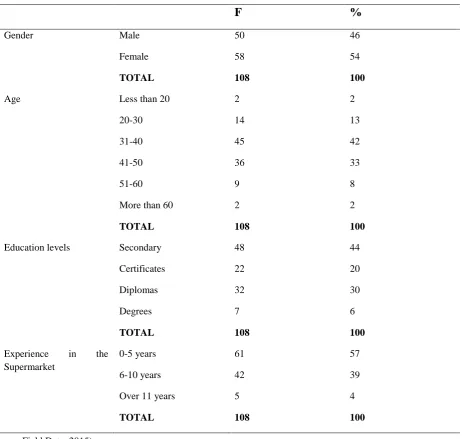
Respondent included 50 (46 %) males and 58(54 %) females (Table 4.1) thus indicating that more females participated in the study than males. Most of the respondents were aged 31 – 40 (42%) thus showing that a large number of those interviewed were in their youthful stages.
Sixty one (57%) of the respondents had experience in the supermarket as employess or customers for a period of between 0 -5 years. However, the percentage dropped to 42 (39%) at 6- 10 years and 5 (4%) above 11 years. This could indicate that most of the respondents were those who had experience of 0 to 5 years in the supermarket.
Table 4.1: Demographic characteristics of the Respondents
F
%
Gender Male
Female TOTAL 50 58 108 46 54 100
Age Less than 20
20-30
31-40
41-50
51-60
More than 60
TOTAL 2 14 45 36 9 2 108 2 13 42 33 8 2 100
Education levels Secondary
Certificates Diplomas Degrees TOTAL 48 22 32 7 108 44 20 30 6 100
Experience in the Supermarket
0-5 years
6-10 years
Over 11 years
TOTAL 61 42 5 108 57 39 4 100
(Source: Field Data, 2015)
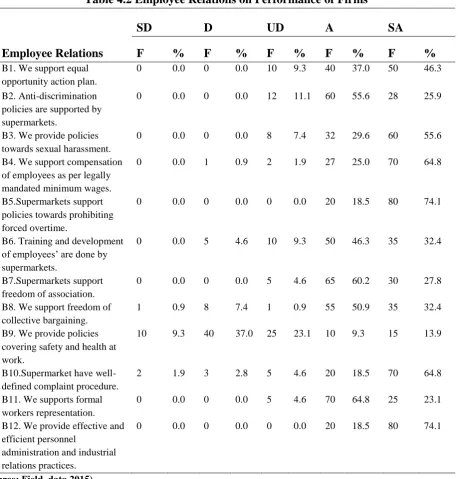
Results showed that supermarkets supported equal opportunity action plan, with responses were as follows: 46.3% of the respondents strongly agreed, 37.0% agreed and 9.3% were undecided. Results on whether anti-discrimination policies towards issues of gender, pregnancy and marital status are supported by supermarkets showed that 55.6% of the respondent agreed, 25.9% strongly agreed and 11.1% were undecided.
of the respondents agreeing, 27.8% strongly agreed and 4.6% were undecided. On whether supermarkets supported freedom of collective bargaining, 50.9% of the respondents agreed, 32.4% strongly agreed, 7.4% disagreed, 0.9% undecided and 0.9% strongly disagreed. On whether there was a well-defined complaint procedure in supermarkets, 64.8% of the respondents strongly agreed, 18.5% agreed, 4.6% were undecided, 2.8% disagreed and only 1.9% strongly disagreed. Results further showed that my supermarkets provide policies covering health and safety at work with responses given as follows 37.0% of the respondents disagreed, 23.1% were undecided, 13.9% strongly agreed, 9.3% strongly disagreed and only 9.3% agreed.
Findings showed that supermarkets support formal workers representation in decision making with responses showing 64.8% of the respondent agreed, 23.1% strongly agreed and 4.6% undecided. The results from Table 4.3 indicated that they provide effective and efficient personnel administration and industrial relations practices with responses showing majority (74.1%) of the respondents strongly agreed and 18.5% agreed.
Table 4.2 Employee Relations on Performance of Firms
Employee Relations
SD
D
UD
A
SA
F
%
F
%
F
%
F
%
F
%
B1. We support equal opportunity action plan.
0 0.0 0 0.0 10 9.3 40 37.0 50 46.3
B2. Anti-discrimination policies are supported by supermarkets.
0 0.0 0 0.0 12 11.1 60 55.6 28 25.9
B3. We provide policies towards sexual harassment.
0 0.0 0 0.0 8 7.4 32 29.6 60 55.6
B4. We support compensation of employees as per legally mandated minimum wages.
0 0.0 1 0.9 2 1.9 27 25.0 70 64.8
B5.Supermarkets support policies towards prohibiting forced overtime.
0 0.0 0 0.0 0 0.0 20 18.5 80 74.1
B6. Training and development of employees’ are done by supermarkets.
0 0.0 5 4.6 10 9.3 50 46.3 35 32.4
B7.Supermarkets support freedom of association.
0 0.0 0 0.0 5 4.6 65 60.2 30 27.8
B8. We support freedom of collective bargaining.
1 0.9 8 7.4 1 0.9 55 50.9 35 32.4
B9. We provide policies covering safety and health at work.
10 9.3 40 37.0 25 23.1 10 9.3 15 13.9
B10.Supermarket have well-defined complaint procedure.
2 1.9 3 2.8 5 4.6 20 18.5 70 64.8
B11. We supports formal workers representation.
0 0.0 0 0.0 5 4.6 70 64.8 25 23.1
B12. We provide effective and efficient personnel
administration and industrial relations practices.
0 0.0 0 0.0 0 0.0 20 18.5 80 74.1
It was found that Supermarkets do not promote employees welfare through provision of recreational, housing and credit facilities and this demonstrated employees being demotivated and hence customer loyalty became a problem due to increased complaints from customers, this leading to high levels of customer dissatisfaction due to poor employee- customer relationships in supermarkets. By the same token, there are situations in which unions can stimulate training. Thus, the expression of a union voice, underwritten by the wage premium, should cut down on labour turnover and increase the incentive of the employer to invest in firm-specific training because of the longer payback period. Application of collective voice might improve contract enforcement and make workers more willing to engage in training, including multiskilling. More importantly, it might tackle a potential ‘hold up’ problem on the part of employers, and firms might ‘hold up’ the sunk investments of workers in training, leading to an under-investment in human capital. Here, unions could act to prevent the holdup problem by making the firm honour its commitments (Menezes-Filho&Van Reenen, 2003,). On this reasoning, stronger unions could well imply improved contract execution. Even if employers in a sense over-train in response to the union premium and turnover is too low – so that society will not benefit – there is no implication that the productivity of training should on this account be lower in union regimes. The principal caveat would presumably be where unions negotiate training (Campbell, 2007).
4.2 Regression Analysis Results
Regression analysis is a statistical tool for the investigation of relationships between variables. Usually, the investigator seeks to ascertain the causal effect of one variable on another.As a result, A 1 unit change on employee relations would lead to a 0.17 change on firm performance in Supermarkets. Also, there was theuse of Employee Relations (t= 2.851)
Table 4.3: Regression Results
Model
Unstandardized
Coefficients
Standardized
Coefficients
T
Sig.
B
Std.
Error
Beta
(Constant) 1.252 0.212 2.470 0.045
Employee Relations 0.061 0.032 0.170 2.550 0.001 (Source: Field Data, 2015)
a. Dependent Variable: Firm performance in Supermarkets
b. Y= α +βx1 + βx2 + βx3 + βx4 +e
4.3 Regression Model Summary
From the results in Table 4.8 R= 0.708, R- square = 0.501, adjusted R- square= 0.459, and the SE= 1.10798. R coefficients indicate the degree of linear relationship of firm performance in supermarkets with all the predictor variables, whereas the coefficient of multiple determinations R-square shows the provision of the total variation in firm performance in supermarkets as explained by the
independent variable employee relations. The adjusted R-square gives us the coefficient of determination between the variables the results from the regression analysis give an adjusted R-square value of 0.459, indicating that the independent variables acting together cause the 45.9% change on dependant variable (firm performance in supermarkets).
Table 4.4: Regression Model summary Results
Model
R
R Square
Adjusted R Square
Std. Error of the
Estimate
1 .708a .501 .459 1.10798
5. CONCLUSIONS AND RECOMMENDATIONS
5.1 Conclusions
It was concluded that, under employee relations, supermarkets do not promote employee welfare through provision of recreational, housing and credit facilities. This led to customers being unsatisfied on how employees serve them especially during rainy the season since their minds are divided on how they will reach where they live. Customer loyalty became a problem due to increased complaints from customers, and this led to high levels of customer dissatisfaction due to employee- customer relationship in supermarkets.
5.2 Recommendations
Under employee relations on firm performance of supermarkets, there is need for supermarkets to promote employees welfare through provision of educational, recreational, housing and credit facilities. This will improve the living standards of the employees hence increased customer service and hence productivity.
5.3 Recommendations for Further Research
1. The researcher found out that the data used in carrying out the research were obtained only from supermarkets in Eldoret town and may be limited to it only. A further study that includes all or the majority of the supermarkets in Kenya is highly recommended.
2. Further research should be conducted on the impact of corporate social responsibility on shareholders in Kenya.
6. REFERENCES
[1] Aguinis, H., &Glavas, A. (2012). What we know and don’t know about corporate social responsibility, A review and research agenda. Journal of Management, 38, 932–968.
[2] Awoyemi,O.&Quartey O.(2002): Research Methods in Education, Accra, KNA B Limited. [3] Booz A.H. (2012). Spirit of Service.
[4] Brammer S., & Millington A. (2008). Does it pay to be different? An analysis of the Relationship between corporate social and financial performance. StrategicManagement Journal, 29(12), 13-25.
[5] Campbell, J. L. (2007). Why Would Corporations Behave in Socially Responsible Ways? An Institutional Theory of Corporate Social Responsibility, Academy of Management Review, 32(3), 946–967.
[6] Carmeli, A., Gilat, G., & Waldman, D. A. (2007). The role of perceived organizational performance in organizational identification, adjustment and job Performance. Journal of Management Studies, 44, 972–992.
[7] Kahneman D., & Deaton, A. (2010).High income improves evaluation of life but note emotional wellbeing. Proceedings of the National Academy of Sciences of the United States of America, 107, 16489–16493.
[8] Kothari, C.R., (1985). Research Methodology- Methods and Techniques, New Delhi, Wiley Eastern Limited.
[9] Menezes, F., Naercio, & John Van R. (2003). Unions and Innovation: A Survey of the Theory and Empirical Evidence,
International Handbook of Trade Unions, Cheltenham and Northampton: Edward Elgar, (2003), 293-334.
[10]Mugenda, M. O. &Mugenda, A. (1999). Research Methods: Qualitative and Quantitative Approaches, Acts Press, Nairobi. [11]Nassiuma,D.K. (2000).Survey sampling: Theory and Methods. Nairobi. Kenya, University of Nairobi Press.
[12]Richard, O. (2009). Measuring Organizational Performance: Towards Methodological Bes Practice, Journal of Management, 32(10), 125-129.
[13]Rodrik, D. (2011). The Future of Economic Convergence. NBER Working Paper, No 17400 Issued in September 2011. [14]Rupp, D. E. (2011). An employee-centred model of organizational justice and social responsibility. Organizational