ISSN: 2347-7474
International Journal Advances in Social Science and Humanities
Available online at: www.ijassh.com
RESEARCH ARTICLE
Work-Life Conflict among University Employees in a Private
Higher Education Institution in Malaysia
Haslinda Abdullah
1*, Cheu Kok Ying
1Faculty of Defence Studies and Management, National Defence University of Malaysia.
2Faculty of Business Management, Open University of Malaysia.
Abstract
Work-life conflict can be described as the situation where conflict arises from incompatibility between fulfilling one’s roles in the work and non-work domains. The available literature has depicted work-life conflict as something negative, as it bring about stress to individuals due to lack of time and energy. From the organisation’s point of view, work-life conflict brings about an apathetic attitude at work and low motivation. The objective of this study is to examine the relationship between work-related, family-related and individual-family-related factors and work-life conflict amongst university employees in a selected private higher education institution in Malaysia. The outcome of the study revealed that work is the main and significant factor contributing to work-life conflict. Respondents in this study did not feel that family demands were contributing to their work-life conflict, but rather that support from their family helped in reducing the tension arising from the conflict. Regarding individual-related factors, the findings revealed that this aspect is significant but weakly related to work-life conflict. Finally, this study also found that the current issue of rising cost of living is contributing to the work-life conflict situation, suggesting that economic factors can also contribute to work-life conflict. The implications of this study for the surveyed institution and the employees in terms of work, pay and resources support are discussed.
Keywords: Work-life conflict, Individual-related factors, Family-related factors, Work-related factors, Private Higher Institution, Malaysia.
Introduction
The Department of Statistics for Malaysia [1] reports that our country’s labour force participation rate is continuously increasing every year. In 2011, it was 64.4%, rising to 65.5% in 2012 and 67% in 2013. With more than half of the nation’s population actively working, managing working commitments together with life commitments requires a careful balancing act on the part of the individual, and this is a major issue in our country, as it affects the well-being of the society. In Asia, it is common to find working individuals working beyond the required 7 to 8 hours in the office. With the advent of the internet, work is no longer confined to the physical office but can be accessible anywhere outside the office, and even at home. This means that the workload will never diminish unless the working individual puts a stop to it at the end of the day.
In trying to balance work commitments and life commitments, it is inevitable that the balancing act will sometimes go out of sync and cause conflict for the affected working individual. Vernon [2] describes such conflict as work-life conflict, which occurs when the demands of work are at odds with non-work demands and fulfilment of either role will make it difficult to fulfil the other. In other literature, work-life conflict is also known as inter-role conflict, which refers to a certain conflict that surfaces when different roles produce sets of pressures that are in some sense incompatible [3,4]. In essence, both of the definitions point to a clear similarity whereby conflict happens when managing work and life are at odds with one another.
is evident in the yearly budget allocation for improving employees’ welfare and benefits and provision of training programmes that aim at improving employees’ skills and knowledge. However, organizations should also not overlook the well-being of the employees, as research has shown that work-life conflict lowers the level of job satisfaction [5] and results in negative work attitudes such as absenteeism, tardiness, leaving work early and turnover intentions [6]. The diminishing job satisfaction and surfacing negative work attitudes affecting job productivity are too costly to be ignored after a substantial investment on employees.
In higher education institutions today, it is observed that emergency leave is requested almost daily. Reasons given are related to either family emergencies or personal emergencies such as cars breaking down or the need to address matters in other agencies such as government offices or banks. Another daily occurrence is medical leave. Both issues are common occurrences in the university and take place at the same time. In the university where the author works, about 70% of the staff are lecturers.
When lecturers require emergency leave and sick leave, classes have to be postponed and replaced, which causes confusion and scheduling conflicts for the affected students and staff managing the classroom timetables. In addition, there are issues with staff leaving work early or arriving late. Again, as most of the staff in the university are lecturers, their unavailability during their free time causes problems for students who are not able to consult them after classes. Academic support administrators such as Head of Programme and their respective officers also face problems in locating them and this poses a disruption and hindrance in trying to manage daily operations. This behaviour brings negativity into the work environment and impacts the morale of other staff who are consistently punctual in their daily work.
Lecturers’ lack of motivation to carry out other tasks other than the assigned task is common today. A common example is lecturers’ reluctance to take on committee roles to look into the teaching and learning
activities to improve the taught subjects and academic programmes, citing that this would be additional to their main teaching role , which takes up much of their time at work. It is also observed that lecturers are not motivated to sign up for training or conferences for their professional development, as attending such events would disrupt their teaching schedules and it is difficult to reschedule the postponed classes. The same reason is also given for their reluctance to pursue higher education or research work, as they are juggling teaching with personal commitments. Apart from lecturers, lack of motivation is also found among non-academic staff, who are contented with their own roles and are not interested in undertaking personal development for higher positions.
In a study on Australian academics, the perceived job stress and job threats affect the well-being and ill-being of the academicians [7]. In the US, Boyar et al. [6] state that empirical findings from numerous studies prove that managing work together with family commitments leads to negative work attitudes. Among them are absenteeism, tardiness, leaving work early, turnover intention, and other negative work behaviour. Buonocore and Russo [8] also cite other scholarly works that listed more negative effects such as stress, burnout, lower job satisfaction and organisational commitment as a result of work-family conflict.
Aizat and Driscoll [12] found that work overload is linked with higher work-to-family interference in a sample of academicians from Malaysia and New Zealand.
Ideally, employees should be motivated to perform the work tasks given because the job incumbents are selected after due consideration to shortlisting candidates for interviews and analysing these candidates during the interview itself. Staff are also given training in order to improve their knowledge and skills at work. However, issues arise when the ideals cannot be met because staff members perceive that their work, family and personal commitments cannot be managed harmoniously. Therefore, the main objective of this study is to examine the relationship between work-related factors, family-work-related factors, individual-related factors and work-life conflict amongst university employees in a selected private higher education institution in Malaysia.
Literature Review
Work-Life Conflict
Greenhaus and Beutell [4] in their landmark proposed model of work-family role pressure incompatibility, state that “inter-role conflict is a form of role conflict in which the sets of opposing pressures arise from participation in different roles”. Subsequent definitions of work-life conflict have continued to build upon Greenhaus and Beutell’s inter-role definition, narrowing it down to work-family conflict. Rotondo, Carlson and Kincaid [13] explain that work-family conflict is “a form of inter-role conflict in which role pressures from the work and family domains are incompatible in some respect.” Samsinar et al. [14] explain that work-family conflict is “the challenges in meeting the (often) incompatible demands of work and family.” In summary, conflict arises from incompatibility between the roles of work and non-work [2].
The concept of work-life conflict began to gain prominence in Western countries in the mid-1980s when the number of woman entering the workforce started increasing [15]. As women change roles from homemaker to career woman, whether due
to financial obligation or personal choice, men’s roles also are affected as they begin assuming more of a homemaker role [15]. This causes role conflicts and brings about physical and psychological distress [15]. In Malaysia, a similar scenario was observed in the 1990s. Aminah [10] conducted a study on work-family conflict among married professional women in Malaysia and found that work-family conflict is negatively related to job satisfaction, family satisfaction and life satisfaction.
After the 1990s, the focus of work-life study shifted from conflict to enrichment where the concept of balancing work and life (work-life balance) was introduced [9,16]. The work-life balance concept, which derives from the spillover theory, posits that “individuals can simultaneously balance the emotional, behavioural and time demands of both paid work, family and personal duties” [7].
The review of literature also found that the concept of work-life conflict can be universally applied across countries. Although there are abundant publications on work-life balance coming from the Western countries, there is also a growing number of studies from the East, such as the Asian region [17], Malaysia, Hong Kong [18], Taiwan [19,20], China [21] and India. Although universally both Western and Eastern researchers agree on the concept of work-life conflict, the concept of work is viewed differently in the East. To Asians, work is a means of improving one’s family’s economic background and is not seen as a source of personal fulfilment, as it is in the West [17,21,22]. Family welfare is still given utmost importance, although Asian business organisations are not proactive in providing work-life support such as flexible working hours as compared to the West. Therefore, work is seen in a less negative light compared to the West, where work is seen as life disruptive [22].
family conflict rather than family-work conflict. The profession-specific issues such as class size, academic management, time invested towards pastoral care and time invested towards maintaining parent relations are stressors at work [2]. Khairunneezam [11] and Bell et al. [7] argue that demands from different stakeholders such as universities, government and society are creating multiple role ambiguity in educationists and thus resulted in stress, affecting well-being and the intention to leave.
Work-life conflict research recognises the interaction between an individual’s personal and working lives. Since there is no absolute definition of work-life conflict, the understanding of work-life conflict draws upon the knowledge from organisational behaviour, industrial psychology and social studies. This multidimensional approach provides a comprehensive understanding of the causal factors, impact and issues surrounding work-life conflict. As the word ‘conflict’ implies negativism in the concept, studies from the 1990s onwards began proposing that managing work-life can also bring about balance between the two domains. As the workforce is now diversified socially (for example, there are increasing numbers of single-parent families), understanding the importance of work-life conflict helps organisations to draw up policies to help their staff in balancing work and life [15,24].
Work-Related Factors
As discussed in the previous section, there are many studies on work-life conflict on all types of profession due to the universality of the concept. In those studies, a number of work-related factors leading to work-life conflict have been identified. They are role autonomy [25], role ambiguity [11,25], role conflict [25], work overload [12,15, 25], long hours [18] and perceived job threat [7].
Role autonomy refers to the freedom, independence and discretion an individual can have pertaining to his or her job [25]. Greater autonomy allows the individual to have greater control over his or her success or failure at work [25]. At the same time, the individual is able to exercise his control over
other non-work domains [25]. When this happens, the degree of conflict between work and life is minimized [25].
Role ambiguity arises when an individual does not have a clear description and understanding of the expectations of his or her work and also how the pay and performance system is linked to it [25]. Khairunneezam [11] describes that lecturers in Malaysian public universities are faced with demands from university management, policy makers, government and society and this has led to confusion among lecturers over the actual expectations of their work.
Role conflict draws its principles from Kahn’s role theory (1964) and Greenhaus and Beutell’s model [4], as it refers to the situation when an individual has to carry out work tasks as required but at the same time the work tasks demanded clash with his non-work demands or personal values [25]. These clashes create pressure on the individual when fulfilling the demands of one role makes it difficult to fulfil other roles [25].
Work overload refers to an individual’s perception that the current workload places great demand on his or her time and energy until it hinders the individual from performing work roles comfortably [12,25]. As individual time and energy are limited, work overload will require the individual to borrow resources from other domains (such as family), causing internal conflict, as less time can be made available for these other domains [25].
Perceived job threat refers to psychological feelings of being overwhelmed or nerve-wrecked [7[. These feelings produces stress, which will lead to organisational problems such as low productivity, increased absenteeism, burnout, reduced job satisfaction, increased intention to leave and lack of organisational commitment [7,11]. They can also bring out adverse effects on employees’ well-being [5,7,21].
Studies on work-related factors propose that support from organisations and supervisors can be the mediating variable in the relationship between work-related factors and work-life conflict [25,26]. One example of organisation support is the availability of child-care benefits, flexible work schedule [18,26] and training programs for supervisors to support work-life issues [26].
Finally, the work-related factors described above can be categorized into three domains. The first is the role characteristics domain, which includes role autonomy, role ambiguity and long hours. The second is the domain of psychological demands, which includes role conflict, role overload and perceived job threat. Finally, the organisational policies and activities domain includes child care benefits and flexible work schedule [6].
Family-Related Factors
A literature review has established that family-related factors can be categorized into two broad domains, namely family structure and spousal support. In the family structure domain, among the attributes used in studies are age, marital status, working spouse, parental demand, hours spent on household work and number of children [6,25]. However, Boyar et al. [6] caution the use of quantitative values of demographic attributes in quantifying the level of demand placed on an individual. An example is using the number of young children in the family. This attribute has been disregarded because the number of young children is insignificant if an individual can find sufficient child care support. Besides that, in a family with more than one child, older children’s demands will decline as they grow up and they will also become able to help their parents, which will in effect lower the demand placed on the parent [6,19].
As for spousal support, studies found that it played an important role in moderating the effects of WLC [14,15]. Studies found that lack of role sharing between spouses or lack of role definition at home has the potential to create tension [15]. This attribute is more important for women because they have been traditionally and socially viewed as the primary homemakers, particularly in Asia’s male-dominant culture [15,18,27]. Another important factor is the increasing number of women entering work force as a result of better education opportunities [22,28] and the trend of the economy, which is shifting towards the service sector [28].
Individual-Related Factors
Turning to individual-related factors, gender [5] , marital status [5,29], life and career stages [30], and personality [5] are among the factors cited in the literature that affect work-life conflict. Under the gender factor, the role of woman in society is still viewed traditionally as a parenting and spousal role. On the other hand, men’s self-esteem is linked with the performance of their work role. Therefore, women feel greater conflict in balancing work and non-work roles, as they are tasked with household chores and child-care responsibilities [2]. However, Zunker [15] argues that men will also experience the same stress as they take on some of the household responsibilities. The perceived role of men and women is somewhat shaped by the culture in which they live. For example, Lo [18] finds that Asian society is still a male-dominant society.
Marital status also affects the level of work-life conflict. Although it is largely assumed that married women with children will experience conflict when managing work and life, a study found that single women without children also experience conflict if they allow work to consume a major part of their life, since they are seen as freer and more independent [29]. The same study also put forward the suggestion that immersing oneself in work is a way to avoid dealing with the social scene for a single woman [29].
career stages will have different levels of conflict. At the early career stage, individuals have high inter-role conflict and low facilitation due to high demands and low resources; in the middle career stage, individuals experience high inter-role conflict and high facilitation due to high demand and high resources; and in the late career stage, the individual has low conflict and high facilitation due to low demand and high resources [30].
The individual’s personality affects how he or she views conflict. According to Nooraini [5], there are two key aspects of personality, namely neuroticism and extraversion. An individual who tends to emphasise the negative side of experience is said to be higher in neuroticism and will tend to display greater stress. On the other hand, individuals who have a positive outlook and feels good about themselves and the world around them tend to display positive mental health [5].
Methods
In order to study the work-life conflict situation in the selected private higher education institution, a descriptive research design has been chosen, as it meets the decision-maker’s objective in understanding the phenomenon in the specified organisational setting. The research design also includes correlational analysis whereby it describes the factors related to work-life conflict. As this research is limited by time and budget, it will only be conducted in a cross-sectional manner.
The research method adopted for this study will be quantitative. The main factors leading to this choice are the large population in this study, which comprises 360 staff in the selected private higher education institution, and the constraint of time. Furthermore, the literature review shows that there are previous studies on work-life conflict in education and non-education sectors which can be use as the basis for this research. Under such circumstances, the researcher is able to use the literature review findings to prepare a structured survey questionnaire to evaluate the work-life conflict situation in the chosen organisation in a parsimonious manner.
This quantitative method is also compatible with the descriptive and correlational research design.
In deciding the sample size, a few factors surrounding this research are considered. First, the objective of this research is to understand the factors related to work-life conflict in the chosen institution. Second, the population of this research is centred on 360 full-time employees in an organisation. Third, this research is constrained by time and budget. Therefore, the stated factors affect how the sample size is chosen. Krejcie and Morgan (1970) developed a table that provides a good sample representation of a given population (Sekaran & Bougie, 2010). Based on the table, a population (N) of 360 requires a sample (S) of 186 responses for statistical evaluation. However, the sampling size will be increased by another 10% in anticipation of non-response and spoilt questionnaires. Therefore, the final sample size decided for this research is 200 responses.
The questionnaire survey method was used in the primary data collection process, as the research scope is confined locally to a selected private higher education institution with 360 full time staff. The questionnaires were printed and distributed to the identified respondents from the clustered sample discussed earlier through face-to-face meetings or via email. The respondents were given a week to complete the survey. During this period, email reminders were sent to the respondents to encourage more responses.
Findings
Work-Life Conflict
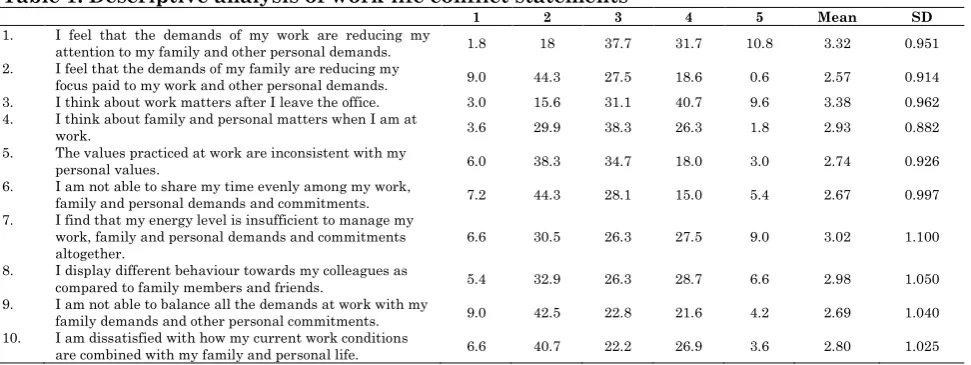
practiced at work are inconsistent with personal values, 38.3% of the respondents disagreed with this statement. The mean score is 2.74, with a standard deviation of 0.926. In terms of displaying different behaviour towards colleagues as compared to family members and friends, 32.9% of the respondents disagreed that they did this. The derived mean is 2.98 with a standard deviation of 1.05.
In relation to family matters, 38.3% of the respondents slightly agreed that they thought about family and personal matters at work, but another 29.9% of the respondents disagreed that they did so. Thus, the mean is 2.93 with a standard deviation of 0.882. Close to half of the respondents (44.3%) did not feel that the demands of the family were reducing their focus on their work and personal matters. This is evident in the mean of 2.57 and standard deviation of 0.914.
With reference to statements related to the self, close to half of the respondents (44.3%) disagreed that they had difficulty dividing their time among work, family and personal demands. This is reflected in the mean of 2.67 and standard deviation of 0.997. In terms of lack of energy to manage work, family and personal matters, 30.5% of the respondents disagreed that they were having difficulty in doing so but 26.3% of the respondents slightly agreed that they were facing this issue. The mean is 3.02 with a standard deviation of 1.10. In response to
the statement on balancing all demands at work with family and personal commitments, 42.5% of the respondents disagreed that they had difficulty in doing so. The mean score was 2.69 with a standard deviation of 1.040. Overall, 40.7% of the respondents disagreed that they were dissatisfied with their current work conditions in combination with their family and personal life. The mean score was 2.80 with a standard deviation of 1.025. Thus, in summary, the employees in this selected private higher institution did not strongly acknowledge the existence of work-life conflict issues in their lives.
Based on the role stress theory explanation, conflict will arise when the demands of different roles at work and at home are not congruent with each another [21]. Social identity theory postulates that conflict will also arise when values linked with multiple roles are distinct [27]. Greenhaus and Beutell’s inter-role model [4] suggested that displaying different behaviour at work and in the family domain will also result in behaviour-based conflict. Evidently in these findings, the respondents seemed to be able to manage their roles in both the work and the non-work domain well. Thus, they did not feel much conflict in their work-life balance. They were also able to practice their values and behaviour similarly at work and at home, which also suggests that there is not much conflict in their social identity or in the way they behave.
Table 1: Descriptive analysis of work-life conflict statements
1 2 3 4 5 Mean SD
1. I feel that the demands of my work are reducing my
attention to my family and other personal demands. 1.8 18 37.7 31.7 10.8 3.32 0.951 2. I feel that the demands of my family are reducing my
focus paid to my work and other personal demands. 9.0 44.3 27.5 18.6 0.6 2.57 0.914 3. I think about work matters after I leave the office. 3.0 15.6 31.1 40.7 9.6 3.38 0.962 4. I think about family and personal matters when I am at
work. 3.6 29.9 38.3 26.3 1.8 2.93 0.882
5. The values practiced at work are inconsistent with my
personal values. 6.0 38.3 34.7 18.0 3.0 2.74 0.926
6. I am not able to share my time evenly among my work,
family and personal demands and commitments. 7.2 44.3 28.1 15.0 5.4 2.67 0.997 7. I find that my energy level is insufficient to manage my
work, family and personal demands and commitments altogether.
6.6 30.5 26.3 27.5 9.0 3.02 1.100
8. I display different behaviour towards my colleagues as
compared to family members and friends. 5.4 32.9 26.3 28.7 6.6 2.98 1.050 9. I am not able to balance all the demands at work with my
family demands and other personal commitments. 9.0 42.5 22.8 21.6 4.2 2.69 1.040 10. I am dissatisfied with how my current work conditions
are combined with my family and personal life. 6.6 40.7 22.2 26.9 3.6 2.80 1.025
Work-Related Factors
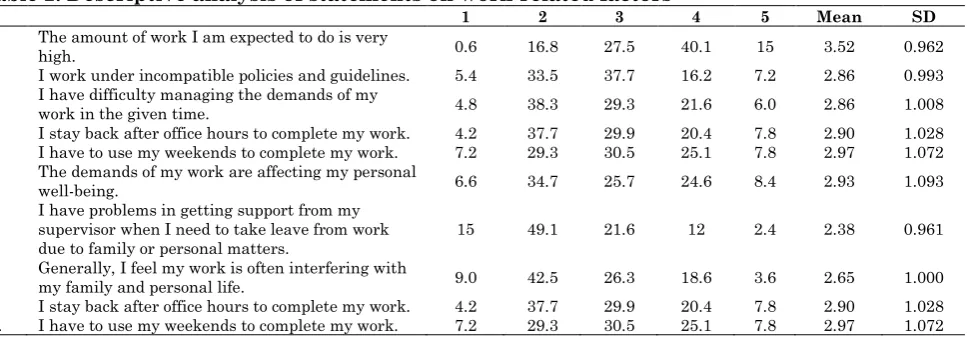
A total of 40.1% of the respondents agreed that the amount of work they were expected to perform was high. The mean score was 3.52 with a standard deviation of 0.962. However, the respondents disagreed that they need to work under incompatible policies and guidelines, based on a mean of 2.86 and a standard deviation of 0.993. Although the respondents agreed that their workload was high, they disagreed that they had difficulty in managing the demands of work in the given time (mean=2.86, standard deviation=1.008); needed to stay back after office hours to complete work (mean=2.90, standard deviation=1.028) and needed to use weekends to complete their work (mean=2.97, standard deviation=1.072).
In terms of work affecting personal wellbeing, 34.7% of the respondents disagreed that this was happening to them (mean=2.93, standard deviation=1.093). When it comes to getting support from supervisor when they need to take leave from work due to family or personal matters, 49.1% of the respondents disagreed that they encountered such problems. The mean score was 2.38 with a standard deviation of 0.961. Generally, 42.5% of the respondents
disagreed that work often interfered with their family and personal life. This is reflected in the mean score of 2.65 and standard deviation of 1.000.
Therefore, employees in this private higher education institution seemed to find their work manageable despite the perceived high workload. This scenario might be due to the work experience of the respondents who participated in this study. Earlier discussion on the respondents’ employment tenure showed that half of the respondents had worked in this selected institution for six years or more. This suggests that half of the respondents were accustomed to their position, work role, colleagues and the culture of the organisation. The fact that the respondents felt that they did not have
difficulty in getting their supervisor’s support to manage their leave also indicates an accommodating work environment. When these two scenarios are considered, the respondents seemed to be able to perform their work roles comfortably without having to resort to borrowing resources such as time and energy from non-work domains, causing internal conflict, as past studies had suggested [25].
Table 2: Descriptive analysis of statements on work-related factors
1 2 3 4 5 Mean SD
1. The amount of work I am expected to do is very
high. 0.6 16.8 27.5 40.1 15 3.52 0.962
2. I work under incompatible policies and guidelines. 5.4 33.5 37.7 16.2 7.2 2.86 0.993
3. I have difficulty managing the demands of my
work in the given time. 4.8 38.3 29.3 21.6 6.0 2.86 1.008
4. I stay back after office hours to complete my work. 4.2 37.7 29.9 20.4 7.8 2.90 1.028
5. I have to use my weekends to complete my work. 7.2 29.3 30.5 25.1 7.8 2.97 1.072
6. The demands of my work are affecting my personal
well-being. 6.6 34.7 25.7 24.6 8.4 2.93 1.093
7. I have problems in getting support from my
supervisor when I need to take leave from work due to family or personal matters.
15 49.1 21.6 12 2.4 2.38 0.961
8. Generally, I feel my work is often interfering with
my family and personal life. 9.0 42.5 26.3 18.6 3.6 2.65 1.000
9. I stay back after office hours to complete my work. 4.2 37.7 29.9 20.4 7.8 2.90 1.028
10. I have to use my weekends to complete my work. 7.2 29.3 30.5 25.1 7.8 2.97 1.072
1=Strongly Disagree; 2=Disagree; 3=Slightly Agree; 4=Agree; 5=Strongly Agree
Family-Related Factors
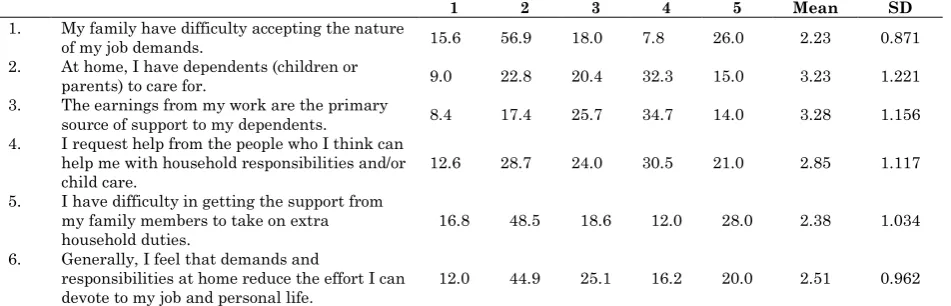
A majority of 56.9% of the respondents disagreed that their family had difficulty accepting the nature of their work. This can be seen in the mean of 2.23 and standard deviation of 0.871. In fact, 32.3% of the respondents agreed that they had
In order to cope with the household responsibilities and childcare, 30.5% of the respondents agreed that they sought help from parties whom they thought could assist them. In addition, a high percentage of 48.5% of the respondents disagreed that they had difficulty in getting support from their family members to take on extra household duties. This is evident in the mean of 2.38 and standard deviation of 1.034. Overall, 44.9% of the respondents disagreed that the demands and responsibilities at home reduced their effort devoted to their work and personal life. This can be observed in mean and standard deviation values of 2.51 and 0.962 respectively.
Similar to the discussion in the previous section, the respondents’ demographics played a role in these findings. As the respondents had been working for many years, they would have made arrangements for family support and other external support. Furthermore, the respondents also indicated that they had the support of family members in terms of accepting their work and rendering help. These situations will evidently reduce the tension and conflict of managing family needs while being at work. These findings complement to past studies which suggested that spousal or family support will play an important role in moderating the effects of work-life conflict [14,15].
Table 3: Descriptive analysis of family-related factors
1 2 3 4 5 Mean SD
1. My family have difficulty accepting the nature
of my job demands. 15.6 56.9 18.0 7.8 26.0 2.23 0.871
2. At home, I have dependents (children or
parents) to care for. 9.0 22.8 20.4 32.3 15.0 3.23 1.221
3. The earnings from my work are the primary
source of support to my dependents. 8.4 17.4 25.7 34.7 14.0 3.28 1.156
4. I request help from the people who I think can help me with household responsibilities and/or
child care. 12.6 28.7 24.0 30.5 21.0 2.85 1.117
5. I have difficulty in getting the support from my family members to take on extra
household duties. 16.8 48.5 18.6 12.0 28.0 2.38 1.034
6. Generally, I feel that demands and
responsibilities at home reduce the effort I can devote to my job and personal life.
12.0 44.9 25.1 16.2 20.0 2.51 0.962
1=Strongly Disagree; 2=Disagree; 3=Slightly Agree; 4=Agree; 5=Strongly Agree
Individual-Related Factors
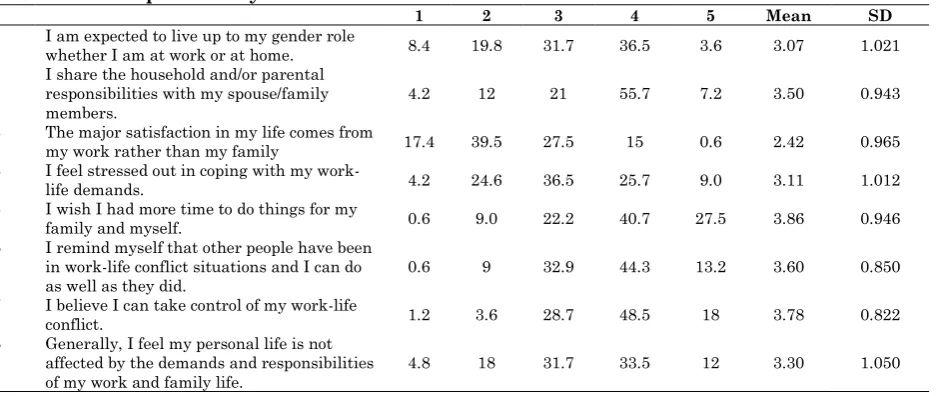
For the statement that asked if respondents had to live up to their gender role, the derived mean is 3.07, with a standard deviation of 1.021, which indicates that they disagreed with the statement. When asked if work rather than family was their major source of satisfaction in life, 39.5% of the respondents disagreed with this statement. This is also reflected in the mean of 2.42 and standard deviation of 0.965. The majority of the respondents agreed that they shared household and/or parental responsibilities with other family members at home. This is reflected by the high percentage of 55.7%, mean of 3.50 and standard deviation of 0.943. The respondents in this survey did not felt stressed in coping with work-life demands, judging from the mean of 3.11 and standard deviation of 1.012. However, 40.7% of them wished they had more time for
themselves and their family (mean=3.86, standard deviation=0.946).
The respondents in this survey were somewhat affected by work-life conflict, but the effect was diluted by three elements: first, the respondents’ outlook on sharing household and parental responsibilities, irrespective of gender role; second, having a positive outlook in managing their personal life around work and family and third, not equating work with their life satisfaction. These findings agree with past studies which propose that support from spouse and family will moderate the effects of work-life conflict [14,15]. The second element supports
Nooraini’s [5] study, which posits that an individual who has a positive outlook on the self and the world around them tends to experience less stress in coping with work-life conflict. The third element reiterates work-life conflict studies from Asian countries, which suggest that Asians view work as a means of improving the family’s financial background and not so much as a way of fulfilling life satisfaction, as is often the case in the Western countries [21,22].
Table 4: Descriptive analysis of individual-related factors statements
1 2 3 4 5 Mean SD
1 I am expected to live up to my gender role
whether I am at work or at home. 8.4 19.8 31.7 36.5 3.6 3.07 1.021
2 I share the household and/or parental responsibilities with my spouse/family
members. 4.2 12 21 55.7 7.2 3.50 0.943
3 The major satisfaction in my life comes from
my work rather than my family 17.4 39.5 27.5 15 0.6 2.42 0.965
4 I feel stressed out in coping with my
work-life demands. 4.2 24.6 36.5 25.7 9.0 3.11 1.012
5 I wish I had more time to do things for my
family and myself. 0.6 9.0 22.2 40.7 27.5 3.86 0.946
6 I remind myself that other people have been in work-life conflict situations and I can do
as well as they did. 0.6 9 32.9 44.3 13.2 3.60 0.850
7 I believe I can take control of my work-life
conflict. 1.2 3.6 28.7 48.5 18 3.78 0.822
8 Generally, I feel my personal life is not affected by the demands and responsibilities
of my work and family life. 4.8 18 31.7 33.5 12 3.30 1.050
1=Strongly Disagree; 2=Disagree; 3=Slightly Agree; 4=Agree; 5=Strongly Agree
Other Factors Leading to Work Life Conflict
As well as ranking their opinions on the abovementioned statements on a five-point Likert scale, the respondents were also asked to provide other factors that would lead to work-life conflict in their own situation through an open-ended question. Based on the responses obtained, the factors can be divided into work-related areas, family-related areas and individual-related areas. This suggests that this study has covered all areas known to cause work-life conflict.
Under work-related areas, the factors given included conflicts in relationships with superiors and colleagues; dissatisfaction with management policies; too much work and the ad-hoc nature of work. These factors are similar to the statements used in this study and support the findings discussed above, which highlight supervisor support,
incompatible policies and guidelines and work demands. As well as repeating the stated factors, some respondents cited other factors related to work, such as low salary, performance management, lack of manpower and cultural differences in the workplace.
Apart from the above, a number of respondents stated that the increasing cost of living due to the current economic situation in the country is a factor contributing to their work-life conflict. Some of the respondents directly pointed out that the implementation of Goods and Services Tax in Malaysia this year had increased their cost of living. This new and repeatedly cited reason suggests that apart from work, family and individual factors, economic factors will play a role in work-life conflict. Indeed, Zunker [15] and Aminah [10] pointed out that the increased prevalence of work-life conflict from the 1980s was due to an unfavourable economic outlook, which led to more women joining the workforce in order to supplement the main breadwinner’s income.
Relationships between Work, Family and Individual Factors and Work-Life Conflict
The findings revealed that work-related
factors had a strong and positive relationship with work-life conflict based on a Pearson’s correlation coefficient (r) of 0.781, which was significant at the 0.000 level. Family related factors had moderate, positive and significant relationship with work-life conflict (r=0.408 and p=0.000. The relationship between individual related factors and work-life conflict was weak, positive and significant (r=0.309 and
p=0.000). Therefore, the Pearson correlation analysis indicates that the employees of this selected private higher education institution felt that work-related factors were positive and strongly significant to work-life conflict, followed by family-related factors, which had a positive but moderately significant relationship with work-life conflict. The relationship between individual related factors and work-life conflict, although positive, was only weakly significant.
Table 5: Relationships between work, family and individual factors and work-life conflict
Work-life Conflict
Work-related factors Pearson Correlation
Sig. (2-tailed) N
0.781** 0.000 167
Family-related factors Pearson Correlation
Sig. (2-tailed) N
0.408** 0.000 167
Individual-related factors Pearson Correlation
Sig. (2-tailed) N
0.309** 0.000 167
Note: **=Correlation is significant at the 0.01 level (2-tailed).
Influence of Work, Family and
Individual Factors on Work-Life
Conflict
Apart from understanding the significant relationships between work-life conflict and the identified work, family and individual factors, the final objective of this research is to find the most significant factors affecting work-life conflict. In order to do this, regression analysis was performed on the collected data. The regression analysis produced a significant outcome with an F-value of 93.738 at p=0.000.
The findings presented in Table 7 indicated that work-related factors are the most significant factors affecting work-life conflict (p=0.000), as opposed to family-related
factors (p=0.011) and individual-related factors (p=0.391). There was a strong and positive relationship between work-related factors and work-life conflict based on the high value of standardized coefficients of 0.720. This direction and strength of the relationship outcome is similar to the correlation findings discussion in section 4.4. Although the significance value for family-related factors (p=0.011) is smaller than the alpha value set (p=0.05), the standardized coefficient value of 0.139 is low, which denotes a rather weak relationship between family-related factors and work-life conflict. As shown in
value for the adjusted R-square of 0.626 also indicates that 62.6% of the variance in work-life conflict can be explained by work-related factors.
Studies on work-life conflict have proposed that such conflict arises out of difficulty in managing work and family due to
constraints of time and energy [4,6,10]. However, the regression outcome from this selected private higher education institution showed that the respondents felt that work-related factors are the most significant in affecting their work-life conflict as opposed to non-work factors such as family and self.
Table 6: ANOVAa of work, family and individual factors with work-life conflict
Model Sum of Squares df Mean Square F Sig.
1 Regression 4179.504 3 1393.168 93.738 0.000b
Residual 2422.555 163 14.862
Total 6602.060 166
Note: a. Dependent Variable: Worklifeconf
b. Predictors: (Constant), Individual, Work, Family
Table 7:Coefficientsaof work, family and individual factors with work-life conflict
Model
Unstandardized Coefficients Standardized Coefficients
T Sig. B Std. Error Beta
1 (Constant) 4.718 2.545 1.854 0.066
Work 0.799 0.057 0.720 14.004 0.000
Family 0.218 0.085 0.139 2.577 0.011
Individual 0.088 0.103 0.045 0.859 0.391
Note: a. Dependent Variable: Worklifeconf
Table 8: Model summaryof work, family and individual factors with work-life conflict
Model R R Square Adjusted R Square Std. Error of the Estimate
Change Statistics R Square Change F Change
1 0.796a 0.633 0.626 3.85517 0.633 93.738
Note: a. Predictors: (Constant), Individual, Work, Family
Conclusion
Generally, the employees in this institution did not agree that they were experiencing a high level of work-life conflict. Although they did agree that they were facing high workloads, they felt that they could still manage the demands of the workload together with the non-work domains such as family and their personal life. Due to their ability to strike a balance among work, family and personal life, the respondents did not think that work-life conflict was a serious issue for them. Since the respondents implied that their income from work was to support the family, support and understanding from their family regarding their work also helped to reduce any work-life conflict that might arise. The respondents’ feedback also reflected that they had a positive outlook in managing their work-life balance, which also helped to alleviate the negative effects of work-life conflict. The correlation analysis revealed that all three factors, namely work-related, family-related and individual-related factors, were significantly and positively
related to work-life conflict. However, the strength of correlation of the three factors with work-life conflict was different. Work-related factors showed a strong correlation with work-life conflict, followed by family-related factors, which showed a moderate correlation, while individual-related factors showed only a weak correlation. The regression analysis revealed that work-related factors are the most significant factors related to work-life conflict. Family related factors are significantly but weakly related to work-life conflict, while individual-related factors did not show much relation to work-life conflict.
Contribution of Study
life conflict issues in the education sector in Malaysia. Since there are many higher institutions in Malaysia, the importance of this sector to the country’s economy cannot be undermined. Therefore, this study could help future researchers to develop better research to produce more comprehensive findings. The second contribution of this study is in helping policy makers and senior management in the education sector in their policy making. The information in this study will undoubtedly draw policy makers and senior managers’ attention to work-life conflict situations faced by the employees in the organisation. Having created awareness of this issue, the policy makers and managers can have better insight through this study and acknowledge the issue in the organisation. This study will ultimately contribute to their insights in helping them to review the organisation’s culture, policies and practices that affect employees’ work-life balance. Further, from reviewing the organisation’s policies and practices, the third contribution of this study is in helping the decision-makers to refine the current practices in the organisation that can impact on work-life conflict. The purpose of refining current practices in the organisation is to improve the working conditions for the employees. As a result of this refinement, the negative effects caused by work-life conflict in the organisation will be reduced.
Implications and Recommendations
Two implications can be drawn from this study. The first implication is related to work and the organisation. This study has confirmed that work-life conflict is present in the surveyed institution. According to past studies, employees who experience work-life conflict will experience stress, burnout, lower job satisfaction and reduced organisational commitment [8]. From the organisation’s point of view, having employees working for them in such a state is a loss to them. The loss comes in the form of low job productivity arising from apathetic staff attitudes and low motivation at work, as described in this study. The respondents who had worked in the organisation for many years had settled into a mode of normality and thus found their work discouraging and their pay inequitable. The second implication is related to the
individual. This study has found that having social support, such as from one’s spouse and family members, in dealing with work-life matters will help individuals to deal positively with work-life conflict. Realising this, another way an organisation can reduce the negative effects of work-life conflict is to be inclusive in its staff social support groups by extending resources to support its employees in dealing with their work-life matters.
Work-life support facilities such as a fitness centre or child care centres are also available options. As well as providing activities and facilities centred on health, the organisation could also look into organising financial planning and parenting seminars for staff in order to help them to be knowledgeable in managing their life issues. These activities and resources will indirectly encourage employees to change their negative attitude towards positive behaviour and enable them to view their management as caring and concerned for their well-being. There is no doubt that work-life conflict will result in poor performance for the organisation. The Malaysia Qualifications Agency (2009) has reported that there are more than 400 private higher education institutions in Malaysia. With such intense competition in the private education sector, the productivity of an institution cannot be sidelined.
Limitations and Recommendations for Future Research
The main focus of this study is to evaluate the work-life conflict situation in a selected private higher education institution by verifying the three chosen factors contributing to it, namely work-related, family-related and individual-related factors. As well as verifying the relationship of the three factors to work-life conflict, this study also attempts to understand the most significant factor contributing to work-life conflict within this selected private higher education institution.
Thus, the unit of measurement in this studied sample is focusing on full-time employees engaged by the institution. Therefore, the first limitation of this study is that the findings are generalized to the selected organisation and were not broken down by subgroups such as academic and non-academic staff, gender, age, marital status or other demographic attributes that may be deemed significant in moderating the relationship. Future research should be expanded to demographic subgroups to examine whether the chosen demographic attributes will affect the relationship differently. Secondly, due to cost and time constraints, this study is carried out in a
cross-sectional manner. Cross-sectional data refers to data that is collected at a single point of time or “taking a snapshot of the current situation” [31]. The limitation of such data collection is the occurrence of recency bias. This refers to a situation where the respondent will provide survey feedback based on his or her most recent or current experience.
Because of this, recent positive or negative experiences that he or she can recall will impair the quality of the data, as they may not be a true reflection of his or her general experience. In order to get a better understanding of this studied area, it is recommended that a follow-up cross-sectional study be conducted for comparison or that longitudinal studies be carried out where the same group of respondents are questioned at different points in time [31]. Only then will the causal relationship be determined correctly.
The findings from this study were gathered from a small sample of 167 respondents in one selected institution in the private higher education industry in Malaysia. The sample was made up mostly of females and staff who had worked in the organisation for a long time. Half of the respondents were from administrative positions and therefore the findings may not be an entirely true indication for academic positions.
References
1.Department of Statistics Malaysia. (2013). Labour force survey report. Kuala Lumpur: Department of Statistics
Malaysia. Retrieved Oct 20, 2014, from
http://www.statistics.gov.my/portal/index.php?option=com_
content&id=1864%3Alabour-force-survey-report-malaysia&lang=en
2.Vernon WA (2013) Factors responsible for work-life conflict: a study comparing the teaching and legal professions.
3.Oates KL, Hall ML, Anderson TL (2005) Calling and conflict: a qualitative exploration of interole conflict and the sanctification of work in christian mothers in academia. Journal of Psychology and Theology, 33(3):210-223.
4.Greenhaus JH, Beutell NJ (1985) Sources of conflict between work and family roles. The Academy of Management Review, 76-88.
5.Nooraini MN (2003) Work-and family-related variables, work-family conflict and women's well-being: some observations. Community, Work & Family, 6(3):297-319.
6.Boyar SL, Mertz Jr, CP, Mosley Jr, DC, Carr JC (2008) The impact of work/family demand on work-family conflict. Journal of Managerial Psychology, 23(3):215-235.
7.Bell AS, Rajendran D, Theiler S (2012) Job stress, wellbeing, work-life balance and work-life conflict among Australian academics. Electronic Journal of Applied Psychology. 8(1):25-37.
8.Buonocore F, Russo M (2013) Reducing the effects of work– family conflict on job satisfaction: the kind of commitment matters. Human Resource Management Journal, 23(1):91-108.
9.Rozanti A, Salmiah MA (2014) Work-family conflict and work-family enrichment and their consequences in Malaysia. Middle-East Journal of Scientific Research, 19(5):729-733.
10.Aminah A (1996) Work-family conflict among married professional woman in Malaysia. TheJournal of Social Psychology, 136(5):663-665.
11.Khairunneezam M (2011) Work-life balance and intention to leave among academics in Malaysian public higher education institutions. International Journal of Business and Social Science, 2(11):240-248.
12.Aizzat MN, O'Driscoll MP (2012) Work overlaod parental demand, perceived organizational support, family support, and work-family conflict among New Zealand and Malaysian academics. New Zealand Journal of Psychology, 41(1):38-48.
13.Rotondo DM, Carlson DS, Kincaid JF (2003) Coping with multiple dimenions of work-family conflict. Personnel Review, 32(3):275-296.
14.Samsinar MS, Murali S, Izhairi I (2010) Relationship between work-family conflict a conflict and quality of life: an investigation into the role of social support. Journal of Managerial Psychology, 25(1):58-81.
15.Zunker VG (2002) Career counseling: applied concepts of life planning (6th ed.). California: Brooks/Cole.
16.Sarika J, Shreekumar KN (2013) Research on work-family balance: a review. Business Perspectives and Research, 43-58.
17.De Cieri H, Bardoel E (2009) What does 'work-life management' mean in China and Southeast Asia for MNCs? Community, Work & Family, 12(2).
18.Lo S (2003) Perceptions of work-family conflict among married female professionals in Hong Kong. Personnel Review, 32(3):376-390.
19.Lu L, Cooper CL, Kao SF, Chang TT, Allen TD, Lapierre LM, Spector PE (2010) Cross-cultural differences on work-to-family conflict and role satisfaction: a Taiwanese-British comparison. Human Resource Management, 49(1):67-85.
20.Hsu YR (2011) Work-family conflict and job satisfacion in stressful working environments. International Journal of Manpower, 32(2):233-248.
21.Zhang M, Griffeth RW, Fried DD (2012) Work-family conflict and individual consequences. Journal of Managerial Psychology, 27(7):696-713.
22.Zaiton H, Dollard MF, Winefield AF (2010) Work-family conflict in East vs Western countries. Cross Cultural Management: An International Journal, 17(1):30-49. 23.Nikandrou I, Panayotopoulau L, Apospori E (2008) The
impact of individual and organizational characteristics on work-family conflict and career outcomes. Journal of Managerial Psychology, 23(5):576-598.
24.Watkins KE (1995) Changing managers defensive
reasoning about work/family conflicts. Journal of Management Development, 14(2):77-88.
25.Fu CK, Shaffer MA (2001) The tug of work and family. Personnel Review, 30(5):502-522.
26.Warner MA, Hausdorf PA (2009) Understanding work-to-family conflict: The role of organisation and supervisor support for work-life issues. Organisation Management Journal, 6:130-145.
27.Aminah A (2008) Job, family and individual factors as predictors of work-family conflict. The Journal of Human Resource and Adult Learning, 4(1):57-65.
28.Irwan NM, Nor Azaian A (2011) The prevalence of work-family conflict among mothers in peninsular Malaysia. International Journal of Humanities and Social Science, 1(17): 154-161.
29.Hamilton EA, Gordon JR, Whelan-Berry KS (2006) Understanding the work‐life conflict of never‐married women without children. Women in Management Review, 21(5):393-415.
30.Demerouti E, Peeters MC, Van der Heijden BI (2012) Work–family interface from a life and career stage perspective: The role of demands and resources. International Journal of Psychology, 47(4):241-258. 31.Zikmund WG, Babin BJ, Carr JC, Griffin M (2013)