ARTIGO ORIGINAL
ABSTRACT
Introduction: Accidental dural puncture is an important complication of regional anesthesia and post-dural puncture headache remains a disable outcome in obstetric population. The aim of our study was to calculate the incidence of accidental puncture and post-puncture headache and evaluate its management among obstetric anesthesiologists.
Material and Methods: We conducted a retrospective audit, between January 2007 and December 2014. We reviewed the record sheets of patients who experienced either accidental puncture or post-puncture headache. We excluded the patients undergoing spinal block. We use the SPSS 22.0 for statistical analyses.
Results: We obtained 18497 neuro-axial blocks and 58 accidental dural punctures (0.3%). After detected puncture, in 71.4% epidural catheter was re-positioned and 21.4% had intra-thecal catheters. Forty-five (77.6%) developed headache and the prophylactic measures were established in 76.1%. Conservative treatment was performed in all patients. The epidural blood patch was performed in 32.8% with a 84.2% of success.
Discussion: The incidence of post-dural puncture headache is unrelated to the type of delivery or insertion of intrathecal catheter. The re-placement of the epidural catheter remains the main approach after puncture. The institution of prophylactic measures is a common practice, despite the low level of evidence. We performed epidural blood patch after failure of conservative treatment.
Conclusion: The incidence of accidental dural puncture and post-dural puncture headache was similar to the literature. Despite being a common complication, there remains lack of consensus on its approach.
Keywords: Analgesia, Epidural; Anesthesia, Obstetrical; Blood Patch, Epidural; Dura Mater; Post-Dural Puncture Headache. RESUMO
Introdução: A punção acidental da dura é uma importante complicação da anestesia regional e a cefaleia pós-punção continua a ser causa de morbilidade na população obstétrica. O objetivo do nosso estudo foi calcular a incidência de punção acidental e cefaleia pós-punção no nosso Centro Hospitalar e avaliar a sua abordagem entre os anestesiologistas obstétricos.
Material e Métodos: Realizámos uma auditoria retrospetiva, entre janeiro de 2007 e dezembro de 2014. Revimos as folhas de registo das doentes em que ocorreu punção inadvertida da dura ou cefaleia pós-punção. Excluímos as doentes submetidas a bloqueio sub-aracnoideu. Utilizámos o SPSS 22.0 no tratamento estatístico dos dados.
Resultados: Obtivémos 18 497 bloqueios neuro-axiais e 58 punções acidentais da dura (0,3%). Após punção detetada, em 71,4% o cateter epidural foi re-posicionado e 21,4% tiveram cateteres intra-tecais. Quarenta e cinco (77,6%) desenvolveram cefaleia e a insti-tuição de medidas profiláticas ocorreu em 76,1%. O tratamento conservador foi efetuado em todas as doentes. O blood patch epidural foi realizado em 32,8% com um sucesso de 84,2%.
Discussão: A incidência de cefaleia pós-punção não está relacionada com o tipo de parto ou a inserção do cateter intra-tecal. A re-colocação do cateter epidural mantém-se a abordagem de eleição após punção. A instituição de medidas profiláticas é uma prática comum, apesar do baixo grau de eficácia. Realizámos blood patch epidural após falência do tratamento conservador.
Conclusão: A incidência de punção inadvertida e cefaleia pós-punção foi semelhante à da literatura. Apesar de ser uma complicação comum, existe falta de consenso na sua abordagem.
Palavras-chave: Analgesia Epidural; Anestesia Obstétrica; Cefaleia Pós-Punção Dural; Dura-Máter; Placa de Sangue Epidural.
Accidental Dural Puncture and Post-dural Puncture
Headache in the Obstetric Population: Eight Years of
Experience
Punção Acidental da Dura e Cefaleia Pós-punção da
Dura na População Obstétrica: Oito Anos de Experiência
1. Serviço de Anestesiologia. Centro Hospitalar de São João. Porto. Portugal.
Autor correspondente: Maria Vaz Antunes. [email protected]
Recebido: 16 de julho de 2015 - Aceite: 02 de novembro de 2015 | Copyright © Ordem dos Médicos 2016
Maria Vaz ANTUNES1, Adriano MOREIRA1, Catarina SAMPAIO1, Aida FARIA1
Acta Med Port 2016 Apr;29(4):268-274 ▪ http://dx.doi.org/10.20344/amp.6815
INTRODUCTION
Accidental dural puncture (ADP) is a major complication of neuroaxial anaesthesia and post-dural puncture headache (PDPH) is an adverse outcome in obstetric population.1
Pregnant mothers are considered at increased risk for PDPH when compared to other populations, due to their younger age and gender.2 PDPH is a relevant cause for morbidity in pregnant mothers, explaining for an increased length of stay as well as additional costs in complementary investigations and therapy. There are also late-onset clinical presentations, explaining for the important role of Family
Medicine physician’s awareness on this complication of neuroaxial anaesthesia.
ARTIGO ORIGINAL epidural blood patch (EBP).
Our study aimed to determine the incidence rate of PDPH in the obstetric population attending our Centro Hospitalar
as well as to assess the approach to this complication by obstetric anaesthetists.
MATERIAL AND METHODS
The study was approved by the Ethics Committee and was a retrospective study carried out in a tertiary care referral hospital where 21,772 deliveries took place between January 2007 and December 2014.
ADP or PDPH associated with epidural anaesthesia or analgesia as well as with epidural space research during neuroaxial combined spinal-epidural (CSE) technique were considered as inclusion criteria to our study and data were obtained from clinical records of the Anaesthesiology Department. Loss of resistance technique with saline and median approach (18-gauge Tuohy needle) were used for the identification of epidural space. CSE technique involved epidural blockade obtained with a needle, in which epidural space is searched according to the abovementioned method and dura is pierced with a pencil-point 27-gauge needle. ADP diagnosis was based on the presence of cerebrospinal fluid (CSF) leak through the needle or epidural catheter or the development of headache diagnosed according to the International Classification of Headache Disorders (ICHD-II criteria). To meet criteria, the patient needs to have a headache within 15 minutes after sitting or standing and improves within 15 minutes of lying down. The patient would need at least one of the following symptoms in association with the headache: neck stiffness, tinnitus, hypoacusis, photophobia or nausea. The headache would have occurred within 14 days upon confirmed or suspected ADP and should resolve spontaneously within one week or within 48 hours of receiving effective treatment (usually by epidural blood patch).3
Patients presenting with headache associated to spinal (subarachnoid) analgesia or anaesthesia and those presenting with complications unrelated to ADP were excluded from the study.
Patient medical records were revised and the following variables were considered: patient’s age, week of pregnancy
at the time when the event occurred, number of previous pregnancies, associated pathology and the American Society of Anesthesiologists (ASA) score, body mass index (BMI), delivery type, anaesthesia or analgesia technique, patient positioning, vertebral level of puncture site, CSF leak origin (needle vs. catheter), placement of a spinal catheter, implemented prophylactic measures upon ADP diagnosis, headache intensity and frequency according to pain numeric rating scale, associated symptoms, implemented conservative treatment, EBP incidence and outcome and length of stay.
Statistical analysis
IBM SPSS Statistic version 22.0 software was used in statistical analysis. Categorical variables were presented as absolute and relative frequencies and continuous variables as mean and range of values in descriptive analysis. Chi-square or Fisher’s exact test were used in percentage comparison, whenever adequate. Student’s t-test was used in comparison between continuous variables for independent samples. Statistical significance was considered for p < 0.05. Multiple regression models were obtained, although statistically significant results were not found (data not shown).
RESULTS
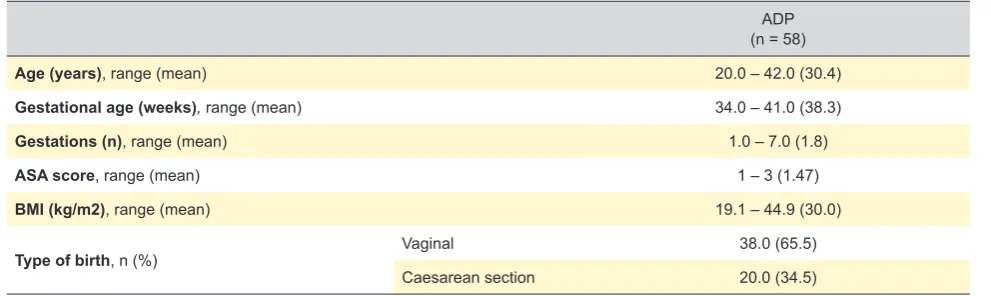
In total, 18,497 neuroaxial blockade procedures were performed between January 2007 and December 2014 (276 spinal, 15,110 epidural and 3,111 using CSE technique). An average 30.4 (20-42, 95% CI) years of age was found in patients presenting with ADP whether having or not developed any headache, at an average 38.3 weeks of pregnancy (34-41, 95% CI). A 30 kg/m2 (19.1-44.9, 95% CI) average BMI was found and most of our patients gave birth vaginally (Table 1).
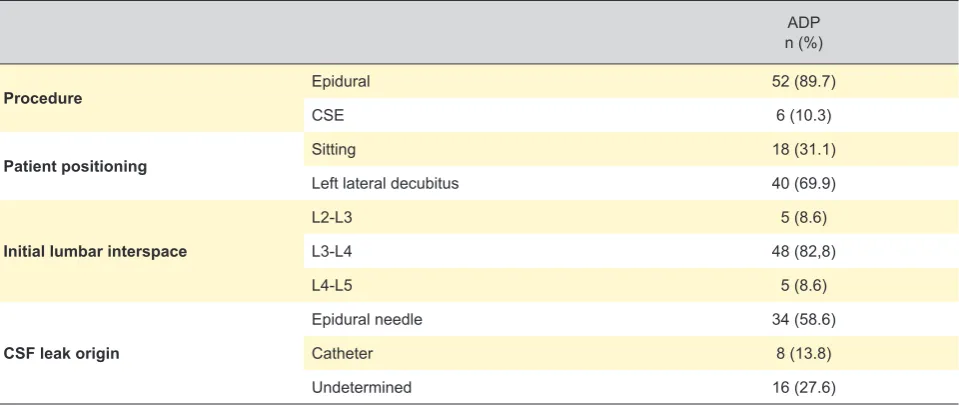
A 0.3% (58/18,221) ADP incidence rate, whether or not associated to any subsequent headache, was found in our patients; 72.4% of these presented with recognized ADP (42/58) and 27.6% (16/58) of the patients presented with headache upon an unrecognized accidental puncture. ADP (recognized or unrecognized) was associated to epidural technique in 89.7% of the patients and to CSE technique in
Table 1 - Demographic characteristics and type of birth in our group of patients
ADP (n = 58)
Age (years), range (mean) 20.0 – 42.0 (30.4)
Gestational age (weeks), range (mean) 34.0 – 41.0 (38.3)
Gestations (n), range (mean) 1.0 – 7.0 (1.8)
ASA score, range (mean) 1 – 3 (1.47)
BMI (kg/m2), range (mean) 19.1 – 44.9 (30.0)
Type of birth, n (%) Vaginal 38.0 (65.5)
Caesarean section 20.0 (34.5)
ARTIGO ORIGINAL 10.3% (6/58). This latter group of patients (6/58) underwent an additional combined technique upon an accidental puncture with the epidural needle had occurred using a needle-through-needle technique in an adjacent lumbar interspace. Left lateral decubitus position was adopted by 69.9% (40/58) of the patients. CSF leak through epidural needle occurred in more than half of the patients (58.6%), including all the patients who underwent the CSE technique (Table 2).
Upon ADP diagnosis, epidural catheter re-siting through a different lumbar interspace was used in half of the patients (21/42), at the same lumbar interspace in 21.4% (9/42), into the intra-thecal space for 24 hours in 21.4% (9/42) and regional technique was abandoned in 7.2% (3/42) of the patients. Prophylactic measures, namely bed rest (until headache improvement, up to 48 hours), forced hydration (with 5% dextrose in 0.9% normal saline – intravenously, 125 ml/h and oral hydration), caffeine drinks (equivalent to 300-500 mg of caffeine, orally, 1-2xday), analgesics and/or non-steroidal anti-inflammatory drugs (acetaminophen, 1 g, orally, q8hand/or ibuprofen 400 mg, orally, q8h) (Table 3) were used for 76.1% (35/46) of the patients with recognized or unrecognized ADP.
PDPH affected 45 (77.6%) patients (Table 4). Symptom onset mostly (86.6%) occurred up to 48 hours upon ADP,
although 6.7% of the patients developed headache upon 72 hours. All the patients, including those that did not develop headache (n=13), were recommended to attend the hospital in case of late-onset headache. Most patients (80.0%) rated their headache as moderate. A similar incidence of PDPH upon epidural and CSE (75% vs. 100%, p > 0.05) technique was found and was not related with patient positioning (left lateral decubitus – 77.5% vs. sitting – 77.8%, p > 0.05) or whether the catheter was placed in epidural or intra-thecal space (82.2% vs. 55.6%, p > 0.05). No association was found between PDPH and the type of delivery (vaginal – 73.7% vs. caesarean-section – 85.0%, p > 0.05).
Conservative treatment (bed rest, forced hydration, caffeine drinks, analgesics and/or non-steroidal anti-inflammatory drugs) was followed by all patients having developed headache (n = 45). EBP was only considered as a therapeutic option in case of persistent headache due to failure of conservative treatment and was followed by 32.8% (19/58) of the patients, with an 84.2% success rate regarding relief of symptoms. This was carried out in most patients up to 48 hours upon symptom onset (89.5%) and consisted of a slow perfusion of autologous blood in the epidural space, up to a 20 ml volume. A second EBP was needed in 15.8% (3/19) of the patients. An average 4.83 days (2-11 days, 95% CI) length of stay was found.
Table 2 -ADP-related technique characteristics (n = 58)
ADP n (%)
Procedure Epidural 52 (89.7)
CSE 6 (10.3)
Patient positioning Sitting 18 (31.1)
Left lateral decubitus 40 (69.9)
Initial lumbar interspace
L2-L3 5 (8.6)
L3-L4 48 (82,8)
L4-L5 5 (8.6)
CSF leak origin
Epidural needle 34 (58.6)
Catheter 8 (13.8)
Undetermined 16 (27.6)
n: number of patients; CSE: combined spinal-epidural technique; CSF: cerebrospinal fluid; ADP: accidental dural puncture.
Table 3 - Management of ADP
Recognized and/or unrecognized ADP (n = 42 and/or 4)
Lumbar epidural catheter Same interspace 21 (50.0)
Different interspace 9 (21.4)
Intra-thecal catheter placement 9 (21.4)
Abandoned loco-regional technique 3 (7.2)
Prophylactic measures 35/46 (76.1)
ARTIGO ORIGINAL
DISCUSSION
An ADP incidence between 0 and 2.6% was found in pregnant mothers who underwent epidural anaesthesia,4,5 while an incidence rate below 1% was described in the UK.1,6 The obstetric population is considered at increased risk for the development of PDPH. In 70 to 80% of the patients, symptoms related with CSF low-pressure were described upon ADP performed with a 16-gauge Tuohy needle.1,7 Even though the use of 18-gauge needles usually reduce headache’s severity, a similar incidence was found when using 16-gauge and 18-gauge needles (70-88% vs. 64%).2 Spinal analgesia/anaesthesia involved a lower incidence rate of headache, below 0.5%, explained by the use of small 27-gauge pencil-point needles. A 0.3% global incidence rate of ADP and 77.6% rate of PDPH associated to epidural or CSE analgesia/anaesthesia were found in our study, in line with literature.
Whenever an ADP is recognized, different attitudes may be followed, namely re-siting the epidural catheter in the same or in a different lumbar interspace, re-siting in intra-thecal space or abandoning the regional technique and opting, for instance, for systemic analgesia. In line with our study, re-siting the epidural catheter in a different lumbar interspace was the most frequently described practice in a survey involving 160 North-American anaesthetists.8 Even
though intra-thecal catheter (ITC) placement has increased over the years, re-siting the epidural catheter into an adjacent lumbar interspace remains as the preferred option upon ADP.9,10
A variable rate of ITC placement upon ADP has been found and rates of 28, 18.5 and 35% have been described in studies carried out in the UK, the USA and in Australia, respectively.9,11,12 In 2011, a survey involving North-American anaesthetists found a lower rate of just 6%.8 The use of ITCs has been associated to a lower PDPH frequency.12-14 A ten-year revision carried out in an Obstetrics Anaesthesiology Department summarised the conclusions obtained by different studies and found a 51% incidence rate of headache when ITC was placed and 66% when epidural catheter was placed, with 33 and 59% incidence rates of EBP use, respectively.15 Despite these conclusions in favour of the use of ITC placement, this revision involved prospective and retrospective data and many of the studies were non-randomized nor did have enough power. In another study, the authors used and kept an ITC for 24 hours upon ADP. In this study’s obstetric population, leaving the catheter in the sub-arachnoid space led to headache in just 6.2% of the patients, with an expected incidence rate over 50%.13 However, a reduction in the incidence of headache when an ITC was left in place for under 24 Table 4 - ADP characteristics (risk factors and treatment)
PDPH p
n 45/58 (77.6)
Intensity
Mild 5 (11.1)
Moderate 36 (80.0)
Severe 4 (8.9)
Onset
< 24h 16 (35.5)
24 - 48h 23 (51.1)
48 - 72h 3 (6.7)
> 72h 3 (6.7)
Associated symptoms 20/45 (44.4)
Conservative treatment 45 (100)
Procedure Epidural vs. CSE 39 (75.0) vs. 6 (100) > 0.05
Patient positioning Left lateral decubitus vs. Sitting 31 (77.5) vs. 14 (77.8) > 0.05
Catheter site Epidural vs. Intra-thecal 37 (82.2) vs. 5 (55.6) > 0.05
Type of birth Vaginal vs. Caesarean section 28 (73.7) vs. 17 (85.0) > 0.05
Prophylactic measures prescription vs. non-prescription 25 (71.4)vs.11 (72.7) > 0.05
Therapeutic EBP
Yes 19/58 (32.8)
Timing
24 - 48h 2 (10.5)
48 - 72h 4 (21.1)
> 72h 13 (68.4)
Repeat EBP 3/19 (15.8)
ARTIGO ORIGINAL hours was not described. A reaction to the catheter itself, with the presence of inflammation or oedema, preventing from any additional CSF leak upon removal of the catheter was suggested as the mechanism associated to the benefit of keeping the catheter in the subarachnoid space.10 More recently, in 2012, converting to subarachnoid analgesia upon ADP did not lower the incidence rate of headache nor the need for the use of EBP, even though it was associated to faster neuroaxial analgesia.16 An ITC was placed in 21.4% of our patients, although no significant difference was found regarding the incidence of headache when ITC placement was compared with re-siting in the epidural space (55.6 vs.
82.2, p > 0.05). Therefore, the decision for ITC placement must be carefully considered as, apart from the advantage of a quick and efficient subarachnoid anaesthesia, as well as preventing from another ADP, there is the disadvantage associated to its accidental use or infection.10
Different risk factors are associated to the development of PDPH. The selection of the technique as well as the type and size of the needle for lumbar puncture by the anaesthetist has an important role in the reduction of the incidence rate of PDPH.2,17 In our study, we were not able to reach any accurate conclusion regarding the incidence of headache when comparing epidural with the CSE technique (75.0% vs. 100%, p > 0.05) due to the presence of a previous ADP with the Tuohy needle in patients who underwent the CSE technique (confounding factor). Due to the fact that the same type and size of needle was used in both techniques (18G Tuohy), we were not able to reach any conclusion regarding the type of needle used in ADP. Different details related with the procedure does not seem to have any influence on the incidence rate of headache, including patient positioning.10 No significant differences were found between left lateral decubitus and sitting position (77.5% vs. 77.8%, p > 0.05) as regards the incidence of headache.
A recent review found a lower rate of headache in patients having had a caesarean section vs. those having had a vaginal birth.17 A headache incidence rate of approximately 11% was found in patients having had a caesarean section, when compared to over 75% in those having had a vaginal birth; in one study, a correlation between pushing stage (second stage) of labour and the development of headache was found.18,19 In another study, higher headache incidence rate (80%) was found with vaginal when compared to caesarean section birth (15%), suggesting that Valsalva manoeuvre during the second stage of labour may increase dural tear upon puncture with a Tuohy needle.20 However, additional studies are required in order to support this hypothesis, as any association between pushing stage of labour and an increased incidence rate of headache was found in other studies.7,21 No significant differences were found in our study regarding the incidence of PDPH and the type of birth (vaginal or caesarean section) (73.7% vs.
85.0%, p > 0.05).
Prophylactic measures upon ADP aimed to reduce the development of headache are still carried out by physicians,
despite little evidence of efficacy.8 Between 62 and 93% of the patients were prescribed prophylactic oral hydration and a 75% rate was found in 2011.7,8,9,11,22 Between 14 and 56% of the patients were recommended prophylactic bed rest and between 16 and 58% were recommended having caffeine drinks.7,8,9,11,22 Even though none of these measures has shown any efficacy, recent studies with obstetric8 and non-obstetric patients9 showed that oral or intravenous aggressive hydration is recommended by 74 to 89%, bed rest by 48 to 56% and opioid and non-opioid drugs by 47 to 58% of physicians.23,24 Prophylactic therapy with oral or intravenous caffeine proved to be effective in a small randomized study, with an absolute 27% reduction in headache incidence rate.25 However, two meta-analyses proved that this therapy is ineffective.24,26 A recent meta-analysis reached the conclusion that previous studies were not randomized and had not enough power; small series showing a benefit with abovementioned techniques had no control group and heterogeneous results mean that no technique can be recommended as effective.24 In our study, 76.1% of the patients in whom an ADP had occurred were prescribed prophylactic measures (bed rest, forced hydration, caffeine drinks, analgesics and/or non-steroidal anti-inflammatory drugs) and no significant differences were found regarding the incidence rate of headache when comparing the patients having been prescribed prophylactic measures vs. those not having been prescribed such measures (71.4% vs. 72.7%, p > 0.05).
ARTIGO ORIGINAL mostly (89.5%) used beyond 48 hours upon symptom onset,
with an 84.2% success rate. A second EBP was needed in 15.8% (3/19) of the patients, with complete symptom relief. Global average length of stay was 4.83 days, higher to the average length usually found in an uncomplicated delivery. The fact that it was a retrospective study with different uncontrolled variables, such as the fact that analgesia/ anaesthesia technique has been carried out by different anaesthetists and the small size of our group of patients should be mentioned as limitations to the study. The identification of ADP/PDPH depends on the event being recorded by anaesthetists, reason why the identification of every patient may not be ensured. We were not able to find out whether the incidence and intensity of PDPH vary with the type of selected needle, as only 18-gauge Tuohy needles were used. The fact that one patient underwent an accidental puncture using an 18-gauge Tuohy needle and another intentional puncture using a pencil-point 27-gauge needle was identified as a confounding factor in the subgroup of patients who underwent the CSE technique (6/58). This subgroup of patients underwent the CSE technique (needle-through-needle technique) upon ADP with 18-gauge Tuohy needle and therefore the real incidence rate of headache with both techniques cannot be compared.
CONCLUSIONS
The incidence rate of ADP and PDPH was in line with what has been described in literature.
The incidence rate of headache was not related with patient positioning or with the type of birth. The insertion of a subarachnoid catheter did not prevent the development of
headache, even though the catheter was not kept in place beyond 24 hours.
Upon ADP, re-siting of the epidural catheter in an adjacent lumbar interspace remains as gold standard and the implementation of prophylactic measures remains as a frequent practice, despite little evidence of efficacy. EBP is currently the gold standard treatment for PDPH, even though it was only used in our population upon conservative treatment failure and leading to a high success rate. In short, further Portuguese studies aimed to assess the incidence as well as the approach to this complication of neuroaxial anaesthesia would be extremely relevant.
HUMAN AND ANIMAL PROTECTION
The authors declare that the followed procedures were according to regulations established by the Ethics and Clinical Research Committee and according to the Helsinki Declaration of the World Medical Association.
DATA CONFIDENTIALITY
The authors declare that they have followed the protocols of their work centre on the publication of patient data.
CONFLICTS OF INTEREST
The authors declare that there were no conflicts of interest in writing this manuscript.
FINANCIAL SUPPORT
The authors declare that there was no financial support in writing this manuscript.
REFERENCES
1. Armstrong C. Post-dural puncture headache in the parturient. Anaesth Intensive Care Med. 2013;14:320-2.
2. Baysinger CL. Accidental dural puncture and postdural puncture headache management. Int Anesthesiol Clin. 2014;52:18-39.
3. International Headache Society. Classification IHD-II. [Acedido em 2015 jun 17] Disponível em: http://www.ihs-classification.org/en/02_ klassifikation/03_teil2/07.02.01_nonvascular.html.
4. Reynolds F. Dural puncture and headache. Br Med J. 1993;306:874-6. 5. Turnbull DK, Shepherd DB. Post-dural puncture headache:
pathogenesis, prevention and treatment. Br J Anaesth. 2003;91:718-29. 6. Pan PH, Bogard TD, Owen MD. Incidence and characteristics of failures
in obstetric neuraxial analgesia and anesthesia: a retrospective analysis of 19,259 deliveries. Int J Obstet Anesth. 2004;13:227-33.
7. Costigan SN, Sprigge JS. Dural puncture: the patients’ perspective. A patient survey of cases at a DGH maternity unit 1983-1993. Acta Anaesthesiol Scand. 1996;40:710-4.
8. Baysinger CL, Pope JE, Lockhart EM, Mercaldo ND. The management of accidental dural puncture and postdural puncture headache: a North American survey. J Clin Anesth. 2011;23:349-60.
9. Harrington BE, Schmitt AM. Meningeal (postdural) puncture headache, unintentional dural puncture, and the epidural blood patch. A national survey of United States practice. Reg Anesth Pain Med. 2009;34:430-7. 10. Harrington BE. Postdural Puncture Headache. Adv Anesth.
2010;28:111-46.
11. Baraz R, Collis RE. The management of accidental dural puncture during labour epidural analgesia: a survey of UK practice. Anaesthesia. 2005;60:673-9.
12. Newman M, Cyna A. Immediate management of inadvertent dural puncture during insertion of a labour epidural: a survey of Australian obstetric anaesthetists. Anaesth Intensive Care. 2008;36:96-101.
13. Ayad S, Demian Y, Narouz SN, Tetzlaff JE. Subarachnoid catheter placement after wet tap for analgesia in labor: influence on the risk of headache in obstetric patients. Reg Anesth Pain Med. 2003;28:512-5. 14. Warwick WI, Neal JM. Beyond spinal headache: prophylaxis and
treatment of low-pressure headache syndromes. Reg Anesth Pain Med. 2007;32:455-61.
15. Van de Velde M, Schepers R, Berends N, Vandermeersch E, De Buck F. Ten years of experience with accidental dural puncture and post-dural puncture headache in a tertiary obstetric anaesthesia department. Int J Obstet Anesth. 2008;17:329-35.
16. Russell IF. A prospective controlled study of continuous spinal analgesia versus repeat epidural analgesia after accidental dural puncture in labour. Int J Obstet Anesth. 2012;21:7-16.
17. Gaiser RR. Postdural puncture headache: a headache for the patient and a headache for the anesthesiologist. Curr Opin Anesthesiol. 2013;26:296-303.
18. Scavone BM, Wong CA, Sullivan JT, Yaghmour E, Sherwani SS, McCarthy RJ. Efficacy of a prophylactic epidural blood patch in preventing post dural puncture headache in parturients after inadvertent dural puncture. Anesthesiology. 2004;101:1422-7.
19. Angle P, Thompson D, Halpern S, Wilson DB. Second stage pushing correlates with headache after unintentional dural puncture in parturients. Can J Anaesth. 1999;46:861-6.
20. Konrad C, Schupter G, Wietlisbach M, Gerber H. Learning manual skills in anesthesiology: is there a recommended number of cases for anesthetic procedure? Anesth Analg. 1998;86:635-9.
21. Turnbull DK, Shepard DB. Post-dural puncture headache: pathogenesis, prevention and treatment. Br J Anaesth. 2003;91:718–29.
ARTIGO ORIGINAL
analgesia. Can J Anaesth. 1998;45:110-4.
23. Bradbury CL, Singh SI, Badder SR, Wakely LJ, Jones PM. Prevention of post-dural puncture headache in the parturients: a systematic review and meta-analysis. Acta Anaesthsiol Scand. 2013;57:417-30.
24. Apfel CC, Saxena A, Cakmakkaya OS, Gaiser R, George E, Radke O. Prevention of postdural puncture headache after accidental dural puncture: a quantitative systematic review. Br J Anaesth. 2010;105:255-63.
25. Yucel A, Ozyalcin S, Talu GK, Yucel EC, Erdine S. Intravenous administration of caffeine sodium benzoate for postdural puncture headache. Reg Anesth Pain Med. 1999;24:51-4.
26. Boonmak P, Boonmak S. Epidural blood patching for preventing and treating post-dural puncture headache. Cochrane Database Syst Rev. 2010;1:CD0011791.
27. Dieterich M, Brandt T. Incidence of post-lumbar puncture headache is independent of daily fluid intake. Eur Arch Psychiatry Neurol Sci. 1988;237:194-6.
28. Nguyen DT, Walters RR. Standardizing management of post-dural puncture headache in obstetric patients: a literature review. Open J Anesthesiol. 2014;4:244-53.
29. Halker RB, Demaerschalk BM, Wellik KE, Wingerchuk DM, Rubin DI, Crum BA et al. Caffeine for the prevention and treatment of postdural puncture headache: debunking the myth. Neurologist. 2007;13:323-7. 30. Ragab A, Facharzt KN. Caffeine, is it effective for prevention of postdural
puncture headache in young adult patients? Egyptian J Anaesth. 2014;30:181-6.
31. Tejavanija S, Sithinamsuwan P, Sithinamsuwan N, Nidhinandana S, Suwantemee J. Comparison of prevalence of post-dural puncture headache between six hour-supine recumbence and early ambulation after lumbar puncture in Thai patients: a randomized controlled study. J Med Assoc Thai. 2006;89:814-20.
32. Kim SR, Chae HS, Yoon MJ, Han JH, Cho KJ, Chung SJ. No effect of recumbency duration on the occurrence of post-lumbar puncture headache with a 22G cutting needle. BMC Neurol. 2012;12:1. 33. van Kooten F, Oedit R, Bakker SL, Dippel DW. Epidural blood patch in
post dural puncture headache: a randomized, observer-blind, controlled clinical trial. J Neurol Neurosurg Psychiatry. 2008;79:553-8.