ISSN: 2278-3369
International Journal of Advances in Management and Economics Available online at: www.managementjournal.info
RESEARCH ARTICLE
Research on the Cross-cultural Management Issues and Strategies
of Jinan University
Zhang Cong-ai
International Business School, Jinan University, Qianshan, Zhuhai, Guangdong, China.
Abstract
“Orientated to overseas, Hong Kong, Macao and Taiwan” --- this school-running concept has made cross-cultural management an important issue for Jinan University (hereinafter referred to briefly as JNU). Through theoretical analysis on the forming process of cross-cultural conflict, we find that problems such as language gaps in teaching and daily management, inadequate cross-cultural exchange on state culture level and regional culture level still remain in terms of the school’s cross-cultural communication and exchange. To resolve these existing cross-cultural management issues, a conflict resolution mechanism is designed in this article to help JNU seek out alternative solutions accordingly. We have also provide three decision criteria to evaluate all these identified alternative solutions and finally determine the optimal and most workable solution strategies.
Keywords: Cross-cultural Management, Cross-cultural conflict, Jinan University, Issues and Strategies.
Introduction
The so-called cross-cultural management means the management of people, things and events involved in different cultural background [1].In the field of cross-cultural management, scholars combine culture with management closely to study how to overcome the conflict between different cultures under cross-cultural conditions, how to design a high-performance organizational structure or management mechanism in diverse forms of cultural atmosphere [2].
In cross-cultural research field, many cross-cultural dimension analysis models have been put forward. Through observing
and studying various state cultures, scholars try to break down culture into recognizable elements and develop cultural dimension systems from all aspects.
In the process of cross-cultural management, these cross-cultural dimensions can serve as a frame of axes for people to identify the characteristics of different cultures, make cross-cultural comparison, deal with cross-cultural conflicts, and then achieve cross-cultural management efficiency. The
most famous and still
Zhang Cong-ai
Kluckhohn and Strodtheck’s value model, Trompenaar and Charles-Turner's seven cultural dimensions, Edward Twitchell Hall’s high-context culture and low-context culture analysis model [3].
The direct manifestation of cross-cultural management failure is cross-cultural conflict caused by different cultural backgrounds, so cultural difference should be matters of concern for managers in multicultural organizations, JNU is no exception. Known as “The Top-notch University for Overseas Chinese”, orientated to overseas, Hong Kong, Macao and Taiwan, JNU has become a top choice for students from overseas, Hong Kong, Macao and Taiwan. The university also enrolls students from 31 provinces and autonomous regions throughout Mainland China.
Since the founding of JNU, the university has cultivated almost 300,000 talents who come from the five different continents of the world, more than 160 countries. By March 2016, the number of students on campus in JNU had reached 48,068, 11,625 of whom were students from Hong Kong, Macao, Taiwan and other different countries [4]. Students in JNU have different cultural backgrounds, which has made cross-cultural management become an important issue for JNU.
This article aims to identify the major problems facing the manager of JNU in the field of cross-cultural management, root causes of these problems through theoretical analysis on the forming process of cross-cultural conflict, design a conflict resolution mechanism to seek alternative
solutions to address these problems, provide several decision criteria to evaluate these alternative solutions and determine the final strategies.
Description of the Problem
For better cross-cultural management, JNU has established a teaching system whose core concept is “Individualized Instruction and Classified Cultivation”. This means overseas students and students from Hong Kong, Macao and Taiwan are taught separately with mainland students for some courses, and different grading criteria are applied to evaluate the study outcomes of students from different cultures.
Besides, International School is set up, with all English teaching and multidisciplinary as its features. In International School there are about 400 qualified teachers having the ability to teach all in English, 86% of whom are full-time faculty of JNU, and the rest of whom are foreign and part-time teachers. Even so, there still remain problems in terms of cross-cultural communication and exchange in JNU. Specific performances:
Language Barriers
As we all know, English has been regarded
as the most popular
Language Barriers between Administrative Staff and Overseas Students in the Daily Management
On campus, we can often see such a scene: in front of a service window or a service desk: an overseas student is trying hard to make himself or herself understood by the administrative staff, gesturing with his or her hands, or asking fellow students who can speak both English and Chinese well for help. Obviously, the poor English skill of staff in these service positions stands as a barrier for the smooth communication between administrative staff and overseas students, which brings inconvenience and troubles to the daily life of overseas students, is most likely to make these outsiders’ stay in China an unpleasant experience, and even leaves them an bad impression of China.
Language Barriers between Teachers and Students from Hong Kong, Macao and Taiwan in Teaching
In contact with some teachers of JNU, we find that many of them think it troublesome to give classes to students from Hong Kong, Macao and Taiwan, complaining about the poor classroom discipline and poor teaching outcomes. The final grades of students from Hong Kong, Macao and Taiwan are generally lower than mainland students. Causes of these symptoms may partly lie in the fact that the educational idea and elementary educational system of mainland are really different from these of Hong Kong, Macao and Taiwan, and partly lie in students’ different personal learning abilities, but language difference between teachers and these students is another one factor that should not be neglected.
Students from Hong Kong, Macao and Taiwan are accustomed to using traditional character, while the textbooks and other teaching materials are in simplified character form. These students’ weak ability to recognize simplified character make them unable to quickly understand and assimilate what the teachers say in class, which finally leads to their passive learning attitudes, less interest in learning and the low efficiency in teaching.
Inadequate Cross-cultural Exchange on Campus
Varied and colorful cultural activities are very common on university campus, JNU is no exception. JNU has organized all kinds of cultural activities to better promote cross-cultural exchange between students from different nations or regions, such as “The Ethnic Cultural Tour---a specialty and practical summer investigation” for cultural exchange of minority culture; “The Chinese Cultural Tour Summer Camp” and “The Chinese Cultural Forum” for cultural exchange of Chinese culture especially Han culture. Furthermore, JNU has also been the organizer of “Jinan International Cultural Festival” and “Interaction Activity for Guangdong Overseas Chinese College Students” endorsed by Overseas Chinese Affairs Office of The State Council.
Zhang Cong-ai
they have little chance to contact with students from Hong Kong, Macao, Taiwan, ethnic minority areas and other countries, and know little about their unique cultures. The reason for this phenomenon is because cross-cultural exchange on JNU campus is far from enough. According to statistical analysis of the contents and intents of cultural activities in JNU in recent years, we find that experiencing programs outside school make up the majority of the existing activities, while cultural activities on campus are much less, especially on regional cultural level. JNU has failed to construct communication channels and create favorable conditions for cross-cultural interaction within student groups, cross-cultural exchange on campus is ignored both in extensity and intensity.
Causes of the Problem
Every country has its own material culture, spiritual culture and social culture corresponding to its own country regime, different nations have different cultural characteristics. Cultures vary in shared values, religions, customs and mode of thinking and behavior, no matter on state culture level or on regional culture level [5]. Dutch social psychologist Hofstede Geert has developed a cultural dimensions theory [6].
To describe the effects of a society's culture on the values of its members, and how these values relate to behavior. The original theory proposed four dimensions along which cultural values could be analyzed: Power Distance, Individualism vs. Collectivism, Uncertainty
Avoidance, and Masculinity vs. Femininity. Later on, an independent research in Hong Kong led Hofstede to add a fifth dimension, Long-term Orientation vs. Short-term Orientation, to cover aspects of values not discussed in the original paradigm. Hofstede added a sixth dimension: Indulgence vs. Self-restraint in 2010.
Power Distance
The power distance index is defined as “the extent to which the less powerful members of organizations and institutions accept and expect that power is distributed unequally”. In this dimension, inequality and power is perceived from the followers, or the lower level. A higher degree of the index indicates that hierarchy is clearly established and executed in society, without doubt or reason. A lower degree of the index signifies that people question authority and attempt to distribute power [7].
Individualism vs. Collectivism
This index explores the “degree to which people in a society are integrated into groups”. Individualistic societies have loose ties that often only relates an individual to his/her immediate family. They emphasize the “I” versus the “we”. Its counterpart, collectivism, describes a society in which tightly-integrated relationships tie extended families and others into in-groups. These in-groups are laced with undoubted loyalty and support each other when a conflict arises with another in-group [8].
Uncertainty Avoidance
status quo. Societies that score a high degree in this index opt for stiff codes of behavior, guidelines, laws, and generally rely on absolute truth, believing that one lone truth dictates everything and people know what it is. A lower degree in this index shows more acceptances of differing thoughts or ideas. Society tends to impose fewer regulations, ambiguity is more accustomed to, and the environment is more free-flowing.
Masculinity vs. Femininity
In this dimension, masculinity is defined as “a preference in society for achievement, heroism, assertiveness and material rewards for success”. Its counterpart, femininity, represents “a preference for cooperation, modesty, caring for the weak and quality of life”.
Women in respective societies tend to display different values. In feminine societies, they share modest and caring views equally with men. In masculine societies, women are more emphatic and competitive, but notably less emphatic than the men. In other words, they still recognize a gap between male and female values. This dimension is frequently viewed as taboo in highly masculine societies.
Long-term Orientation vs. Short-term Orientation
This dimension associates the connection of the past with the current and future actions or challenges. A lower degree of this index (short-term) indicates that traditions are honored and kept, while steadfastness is valued. Societies with a high degree in this index (long-term) views adaptation,
circumstantial and pragmatic
problem-solving as a necessity.
Indulgence vs. Restraint
This dimension is essentially a measure of happiness: whether or not simple joys are fulfilled. Indulgence is defined as “a society that allows relatively free gratification of basic and natural human desires related to enjoying life and having fun”. Its counterpart is defined as “a society that controls gratification of needs and regulates it by means of strict social norms”. Indulgent societies believe themselves to be in control of their own life and emotions, restrained societies believe other factors dictate their life and emotions.
Cultural difference is an objective reality facing to organizations with multi-culture like JNU in their operation, which has increased the complexity of management. Failing to control and manage cultural difference may give rise to cross-cultural conflict. Cross-cultural conflict is the most important issue for cross-cultural management, which refers to the process of mutual opposition and exclusion between different culture shapes [9] so, removing cross-cultural conflict is the core task of cross-cultural management [10].
Zhang Cong-ai
and conceptual factors like ethnocentrism.
Language Barrier
Language barrier is the most straightforward barrier for cross-cultural communication. Organizational members from different cultures usually speak different languages. Even though they can communicate with each other in a second-language, their unfamiliarity with the application and expression of the non-native language may lead to the appearance of mutual understanding deviation and the formation of communication dilemma, and finally result in the breakdown of communication.
Stereotype
The term stereotype derives from Greek words. It was not until 1922 that "stereotype" was first used in the modern psychological sense by American journalist Walter Lippmann in his work Public Opinion [12]. In social psychology, a stereotype is a thought that can be adopted about specific types of individuals or certain ways of doing things.[13]These thoughts or beliefs may or may not accurately reflect reality [14].
Stereotype makes us get a preconceived impression when there is no contact with a certain culture, and only pay attention to what coincides with our own stereotypes when we are learning a different culture, both of which are unfavorable for the interpersonal harmony among people from different cultures [15].
Ethnocentrism
Ethnocentrism is judging another culture
solely by the values and standards of one's own culture [16].Ethnocentric individuals judge other groups relative to their own ethnic group or culture, especially with concern for language, behavior, customs, and religion [17].
Ethnocentrism is reflected
at the consciousness level. As a kind of conceptual communication barrier, it can easily enlarge communication distance, hinder the continuing communication and destroy the interpersonal harmony of people with different cultural backgrounds [18].
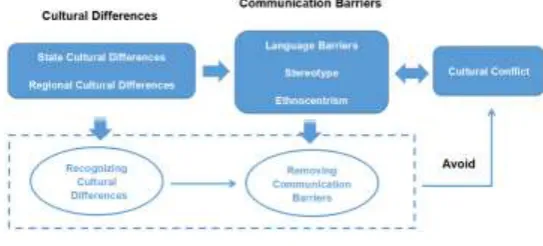
To summarize what has been mentioned above, we can get the analytical framework of the forming process of cultural conflict, as shown in Fig.1 below.
Figure 1 : The forming process and solving mechanism of cross-cultural conflict
Apart from Han culture, there are various state cultures and regional cultures in JNU: Macao culture --- a typical combination of traditional Chinese culture and Latin culture; Hong Kong culture --- deeply influenced by the Anglo-Saxon culture; colorful and various minority cultures and unique foreign cultures.
Lack of cross-cultural exchange on campus make it impossible for students to fully recognized the differences between different cultures, and even contribute to the formation of cross-cultural communication barriers like stereotype and ethnocentrism.
In addition, students from different cultures speak different languages, which has posed language barriers for their smooth communication and interaction. Both lack of knowledge of cultural differences and cross-cultural communication barriers can cause cross-cultural conflict, which will in turn further increase the resistance of cross-cultural communication if these conflicts can’t be removed successfully (Seeing Fig.1). The existing of cross-cultural conflict will ultimately lead to inefficiency and invalidation of cross-cultural management in JNU.
Decision Criteria and Alternative Solutions
Some scholars have pointed out that for a multinational company, the way to remove cross-cultural conflict lies in five aspects: First, identify cultural differences correctly and enhance cultural sympathy; Second, take cross-cultural factors into consideration when arranging their human resource; Third, pay attention to the arrangement of cross-cultural management personnel in recruitment and expatriation; Forth, strengthen cross-cultural communication and exchange; Fifth, try to construct a corporate culture advocating collaboration [19].
There are similarities in the cross-cultural management of JNU and a multinational
company. Combined with the analytical framework mentioned above, we can propose three principles JNU should follow in their cross-cultural management.
Identify Cultural Differences Correctly, Enhance Cultural Sympathy
To do this, administrative staff, teachers and students in JNU should firstly look at cultural differences in an objective and fair way, only thus can cross-cultural conflict be handled and settled rationally [20]. Secondly, JNU should attach importance to the cognitive process of cultural differences. This means what they should do is not merely to identify the differences of different cultures, rather to understand and respect other different cultures [21].
Organize Cross-cultural Training,
Cultivate and Select Cross-cultural Management Personnel
As an effective approach to avoid and solve cross-cultural conflict, cross-cultural training can strengthen organizational members’ capacity to adapt to different cultural traditions, eliminating the negative effects of cultural differences on organization. The training contents include: language, customs, living style, cultural sensitive, cultural adaptability, ability to handle cross-cultural conflict and so on.
Expand Channels for Cross-cultural Communication, Strengthen Effective Cross-cultural Communication
Zhang Cong-ai
relationship can contribute to a better understanding between organizational members from different cultures, and even prevent the formation of cross-cultural communication barriers. So, there is a need to expand both formal and informal communication channels to create an more open and inclusive communication environment. Adhering to the principles above, we can put forward several alternative solutions for the existing problems facing to JNU. Details are as follows.
Alternative Solutions for Language Barriers
Alternative Solutions for Language Barriers between Administrative Staff and Overseas Students in the Daily Management
Option 1: Language Training
According to principle (2), language training is effective for the elimination of language barriers. JNU should provide English training for the administrative staff who often deal with those overseas students, making sure their smooth mutual communication.
JNU can take full advantage of its strong faculty force to conduct the training self-sufficiently, choosing teachers who are qualified to teach all in English as the trainer. As for the training mode and contents, JNU should take full account of the fact that the overall degree of trainees’ learner ability stays at a low level.
Option 2: Employ administrative staff who
have a certain English level
JNU can also choose to reset qualifications standards of related positions and draw up a recruitment plan to recruit new administrative staff who have a certain English communicative ability.
Alternative Solutions for Language Barriers between Teachers and Students from Hong Kong, Macao and Taiwan in Teaching
Option 1: Develop a “Simplified Character-Traditional Character Recognitive Testing Platform”
JNU can commission a
software development company or just do by itself to develop a “Simplified Character-Traditional Character Recognitive Test Platform”. The design of this platform is similar to the existing “Psychological Testing System”, aiming to improve the simplified character recognition ability of students from Macao, Hong Kong and Taiwan. Meanwhile, JNU should distribute “Simplified Character-Traditional Character Contrast Handbook” to these students. Then, conduct routine tests at regular intervals in each term, and those who have failed the test should retake it until passing.
The biggest advantage of this solution is it can fully mobilize students’ initiative to learn simplified character, without burdening managers too much.
Option 2: Updating the Textbooks, take Separate Classes
teaching system by introducing textbooks in traditional character version for students from Macao, Hong Kong and Taiwan, separating these students with mainland students in all the important courses, and absorbing qualified teachers who have a good command of traditional character.
Alternative Solutions for Inadequate Cross-cultural Exchange on Campus According to principle (2) and principle (3), JNU can build all kinds of communication platforms, and create all kinds of opportunities for minority students, overseas students and students from Macao, Hong Kong and Taiwan to popularize their unique national cultures. Specifically, JNU has three options to choose from.
Option 1: Carrying out culture lecture
JNU can invite professional teachers or experts from inside or outside school to give lectures to all the teachers and students. The lectures should put particular emphasis on the popularization and promoting of foreign culture, minority culture, Macao culture and some other regional cultures.
Option 2: Offering culture courses
Setting culture courses make it easier for JNU to carry through culture education systematically. This option need the university to work out a complete set of plan in which teaching content choice, teaching materials choice, course objectives, teaching method, class hour arrangement, teacher arrangement and some other details are included.
And managers should also well scheduled the follow-up work like teaching evaluation, teaching feedback and teaching improvement.
With JNU as an educational institution, students are the main body of its all activities. And also, the cultural diversity of JNU roots in its multi-student structure. So, upholding the goal of promoting cross-cultural exchange and enriching campus culture, JNU can encourage and support students to organize cultural associations. This way, students will become the "publicity ambassadors”, their familiarity with their own cultures and their love for hometowns guarantee the quality and significance of cultural activities on campus.
To determine the optimal alternatives, three decision criteria are put forward to evaluate and filter these alternative solutions, they are “time for implementation”, “tangible costs” and “acceptability to management”. “Time for implementation” is a measure of time spent in implementing every solution, a shorter time means a higher implementation efficiency.
“Tangible costs” measures how much it will cost for JNU to implement a solution, so of course the lower the better. “Acceptability to management” is used to analyze the degree of complexity to implement a solution program, the simpler to operate for managers, the more acceptable the solution is.
Zhang Cong-ai
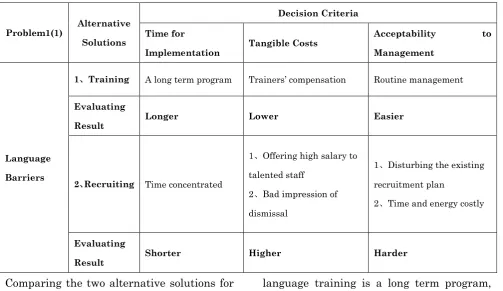
Table 1:Evaluation of alternative solutions for language barriers between administrative staff and overseas students
in the daily management
Problem1(1) Alternative Solutions
Decision Criteria
Time for
Implementation Tangible Costs
Acceptability to
Management
Language
Barriers
1、Training A long term program Trainers’ compensation Routine management
Evaluating
Result Longer Lower Easier
2、Recruiting Time concentrated
1、Offering high salary to
talented staff
2、Bad impression of
dismissal
1、Disturbing the existing
recruitment plan
2、Time and energy costly
Evaluating
Result Shorter Higher Harder
Comparing the two alternative solutions for language barriers between administrative staff and overseas students in Table. 1, we find that language training will cost much less than recruiting new administrative staff, and it can be accepted by managers more easily because of its simplicity. Even though
language training is a long term program, lower cost and easier acceptability to management drive us to choose it as the final solution to remove language barriers between administrative staff and overseas students.
Table 2:Evaluation of Alternative Solutions to Language Barriers between Teachers and Students from Hong Kong,
Macao and Taiwan in Teaching
Problem1 (2)
Alternative
Solutions
Decision Criteria
Time for
Implementation
Tangible Costs Acceptability to Management
Language
Barriers
1、Developing
A Test Platform Time concentrated
Pays for the development of
the platform Routine management
Evaluating
Result Short Lower Easier
2、Updating
The Textbook Time concentrated
1、Money on textbooks
2、Offering high salary
to talented teachers
1、Existing teaching resources
allocation is challenged
2、Time and energy costly
Evaluating
Result
From Table 2, we can easily reach the final decision that developing a testing platform is superior to updating the textbooks, because
it can neither take a long time to accomplish nor pose too much economic and social burden on the university.
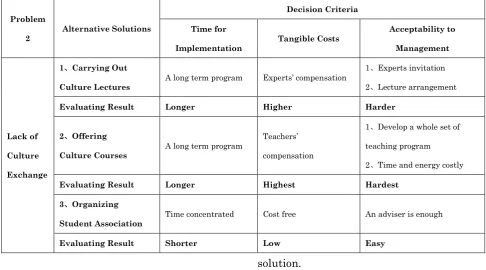
Table 3:Evaluation of alternative solutions to lack of cross-cultural exchange
Problem
2 Alternative Solutions
Decision Criteria
Time for
Implementation Tangible Costs
Acceptability to
Management
Lack of
Culture
Exchange
1、Carrying Out
Culture Lectures A long term program Experts’ compensation
1、Experts invitation
2、Lecture arrangement
Evaluating Result Longer Higher Harder
2、Offering
Culture Courses A long term program
Teachers’
compensation
1、Develop a whole set of
teaching program
2、Time and energy costly
Evaluating Result Longer Highest Hardest
3、Organizing
Student Association Time concentrated Cost free An adviser is enough
Evaluating Result Shorter Low Easy
According to the comparative analysis in Tab.3, organizing student association is the best for JNU to solve the problem of lacking cross-cultural exchange on campus. Firstly, unlike the other two solutions which both are long term programs, organizing student association is time concentrated. More importantly, zero cost and small requirement on management are the main reasons why we suggest organizing student association as the right solution.
Recommended Solution
Up to now, we have determined the three final solutions for JNU to solve its existing problems in terms of cross-cultural management. They are language training, developing a testing platform and organizing student association. Here we will explain the concrete implementation progress and implementation effect expectation of each
solution.
Language Training
Concrete Implementation Progress
Under the joint cooperation with International School, HR Department investigates what administrative positions overseas students have to make contacts with, and completes a list of trainees. Cooperating with HR Department,
Office of Academic Affairs designates appropriate teachers as the trainers and works out a specific training plan, with training time, training contents and some other details included.
Financial Department sets the salary line and develops payment standards for training teachers.
Implementation Effect Expectation
Zhang Cong-ai
gradually. The acquirement of basic listening and speaking skills will make them communicate with overseas students more smoothly, creating a comfortable and convenient living environment for these overseas students.
Developing a Test Platform
Concrete Implementation Progress
Cooperating with Office of Academic Affairs, Network and Educational Technology Center develop
and design the “Simplified
Character-Traditional Character Recognitive Testing Platform”;
Under the cooperation with Jinan University Publishing House, Office of Academic Affairs prints “Simplified Character-Traditional Character Contrast Handbook”, and then distributes to every student from Macao, Hong Kong and Taiwan.
Office of Academic Affairs determines the testing room, testing time, rating system and some other matters concerned, and then arranges students to attend the test according to the rules.
Implementation Effect Expectation
The development of “Simplified Character-Traditional Character Recognitive Testing Platform” will motivate students from Macao, Hong Kong and Taiwan to learn simplified character autonomously, because these students must study hard to make sure that they can pass through the test smoothly.
Carrying out this test will exert an imperceptible influence on the building of capability to convert simplified character into traditional character.
While this conversion ability can ensure students to understand what teachers are saying and interact with teachers in class actively. And last, a better class discipline
will contribute to a better
academic performance.
Organizing Student Association Concrete Implementation Progress
Under the construction of Office of Students’ Affairs, Student Union of JNU, in alliance with Student Unions of every schools and some other student organizations, sets up a steering group to provide guidance on the establishment of cultural student associations. Group members should have knowledge of cross-cultural management and students with different cultural backgrounds are welcomed.
Students, especially overseas students, minority students, and students from Macao, Hong Kong and Taiwan, team up voluntarily to initiate cultural associations and submit written materials like draft plannings to the steering group.
The steering group evaluates and filters the submitted written materials after these initiators of cultural student associations give a presentation of their program. Those who get approved for their proposals can go ahead and prepare for the establishments of cultural associations.
Association Union”. After the founding of this Union, all the cultural activities conducted by those cultural student associations will be under its supervision and guidance.
Implementation Effect Expectation
With the establishment of cultural student associations and “Cultural Student Association Union” , the quantity and quality of cultural activities on campus will be increased at the same time. More cultural activities means more cross-cultural exchange, more understanding, and more likely to foster an united and fraternal campus atmosphere.
Conclusion
According to the forming process and solving mechanism of cross-cultural conflict developed above, JNU can easily identify its existing problems in terms of cross-cultural management and find out rational strategies to solve these issues.
Specifically, to fill the language gaps, JNU can carry out language training for administrative staff to improve their basic communication skills and level of English, guaranteeing their smooth communication with overseas students.
The school can also develop a “simplified character-traditional character recognitive test platform” to improve the simplified character recognition ability of students from Macao, Hong Kong and Taiwan by fully mobilizing students’ initiative to learn simplified character. Organizing student cultural association can be an effective channel for JNU to rich the cultural exchange and interaction on campus --- Students’ involvement can bring new vigor and vitality into the work of cultural popularization, make the cultural activities more creative and attractive, and promote the mutual understanding and respect of students from different cultures
References
1. Li Jianxin (2004) A Research for Cross-culture Management in Multination Corporations:
Master's Thesis. Heilongjiang: Harbin
Engineering University.
2. Chen Honger, Sun Weifang (2007) A
Summarization of Cross-cultural Management Based on Multinational Company Operation. Journal of Hubei University of Economics, 5(4): 23-27.
3. Tang Yanzhao, Lu Wei (2005) Overseas Research on Cross-cultural Management. Management Frontier, (5)25-28.
4. Jinan University. About Us.
http://www.jnu.edu.cn/jnu2014/html/xxgk/xxjj/. 5. Wang Jianpeng (2014) The research on
Cross-cultural Conflict management of DHL: Master's Thesis. Hunan: Xiangtan University. 6. Hofstede Geert (1993) Culture constraints in
management theories. University of Linburgs the Netherlands Academy of Management Executive, 7(1): 81-94.
7. Hofstede Geert (2015) Dimensionalizing
Cultures: The Hofstede Model in Context. Online Readings in Psychology and Culture.
8. Hofstede Geert (1991) Cultures and
Zhang Cong-ai
strategies of cross-cultural management in enterprises' multinational operation. Seeker, 89-90.
10. He Jing (2007) Philosophical Thinking of
Enterprise Chlture Syncretism in
Trans-Culture Management. Journal of
Henan University (Social Science),
47(1):144-149.
11. Zhao Xiaobo (2016) Cross-cultural
management communication barriers of corporate and the solutions. J. Changchun Inst. Tech. (Soc. Sci. Edi), 17(1):39-41.
12. Kleg Milton. Hate Prejudice and Racism (1993) Albany:State University of New York
Press, 135-137.
13. McGarty Craig, Yzerbyt Vincent Y, Spears Russel (2002) Social, cultural and cognitive factors in stereotype formation. Stereotypes as explanations: The formation of meaningful beliefs about social groups. Cambridge:
Cambridge University Press, 115.
14. Judd Charles M, Park Bernadette (1993) Definition and assessment of accuracy in
social stereotypes. Psychological
Review.100 (1):109-128.
15. Li Yanliang (2006) Cross-cultural Conflict and Cross-cultural Conflict management. Scientific socialism, 2: 70-73.
16. John T. Omohundro (2008) Thinking like an Anthropologist: A practical introduction to Cultural Anthropology. McGraw Hill.
17. Margaret L. Andersen, Howard Francis Taylor (2006) Sociology: Understanding a Diverse Society. Wadsworth.
18. Huang Xiaoye, Zhang Yang (2006) Studys on communication disorders and strategies in
cross-cultural management. Jiangsu
Commercial Forum, 127-128.
19. Zhou Sanduo (2007) Management Science. Beijing:Higher Education Press.
20. Deng Mian (2013) Research on the
Cross-cultural Management of KRC
Company: Master's Thesis. Gansu: Lanzhou University.
21. Chen Xiaochun, Huang Yuan (2016) On Cross-cultural Management towards Foreign NGOs in Mainland of China. Journal of Xiangtan University (Philosophy and Social Sciences), 40(2): 134-137.
22. Chen Yanfeng, SI TOU Ieng Kit (2009) Research in Multiculturalism of Student Affairs Management under Diversified Culture: Samples from University of Jinan and University of Macao. Journal of Macao Studies, 55:123-126.
23. Li Yan, SiTu Shangji (2001) An Analysis on the Diversity of Macao Culture. Tropical Geography, 21(3): 237-241.
24. Zhang Xinmeng (2012) Study on
Cross-cultural Management of
FAW-Volkswagen Audi Brand : Master's