International Journal of Advances in Management and Economics
Available online at:
www.managementjournal.info
RESEARCH ARTICLE
Zivko Bergant | Sept.-Oct. 2019 | Vol.8| Issue 5 |08-15 8
The Quality of Accounting Information and User's Social
Responsibility: Social Aspect
Zivko Bergant
College of Accounting and Finance, Ljubljana, Slovenia.
Abstract: The paper deals with the information process from the analyst to the user of information. In doing so, it originally draws attention to the difference between the sense of the user's risk and his response to this feeling. It notes that both are affected by many factors. In this process, the author separates the efficiency and effectiveness of the information process, both of which are a prerequisite for the quality implementation of this process. The author offers a cybernetic model of the process from the risk to the action of an individual. The model allows for easier communication and a systematic approach to asserting social responsibility in the society. This is possible especially through the main criteria of adequate behavior. This is a contribution to the well-being of whole society.
Keywords: Quality of information, Accounting, Risk, Human behavior, Social responsibility.
Article Received: 29 July 2019 Revised: 18 August 2019 Accepted: 25 August 2019
Introduction
Accounting information is one of accounting system’s information functions. Its core tasks
are the provision, presentation and
clarification of accounting information. By informing, in principle, we understand the process of communication between the
information provider (analyst) and
information users in all possible forms and modes. The goal of this process is to instill a sense of opportunity or sense of danger in the user. In such a case, we can say that information was efficient. With this, the final purpose of business information has not yet been achieved.
It is to stimulate the appropriate response of the user to information which is a business decision. Only when a business decision is timely and appropriate, we can talk about the effectiveness of information. The fundamental criterion of information process quality is therefore a successful business decision-making process.
The efficiency and effectiveness of information is influenced by many factors on the side of information provider and on the information user's side as well. In the following, we will present some factors in more detail, with more consideration of factors on the user's side. Therefore, the research task of the
article is to examine the information process in greater detail and identify the factors through which we can influence the quality of this process. There is no doubt that people are different in their thinking and actions. With these actions, we increase or we also reduce the level of human well-being (social welfare). Therefore, we behave differently in a socially responsible way.
If we want to understand this diversity, we must first ask ourselves about the causes, because only on this basis we can systematically achieve the increase of people's awareness of their social responsibility. This is undoubtedly a complicated task. With this article, we want to contribute to its solution as well.
Information Quality Factors on the Information Provider Side
Information quality factors on the information provider side:
Knowledge about:
Analyzing (knowledge of relevant indicators, their expressive power and methods of analysis);
Information formulation;
Formulating appropriate guidelines or
Zivko Bergant | Sept.-Oct. 2019 | Vol.8| Issue 5 |08-15 9 Ability to communicate (both in defining
the analysis criteria, as well as in the information process);
Ability to empathy with the recipient of
information (understanding of his
interests).
Characteristics and character of
information provider (analyst).
The first point is discussed in more detail in the accounting professional literature. The other two points will be presented below. We will not deal with the fourth point here because it goes beyond the purpose of the paper. Business communication (unlike social communication) is a process aimed at
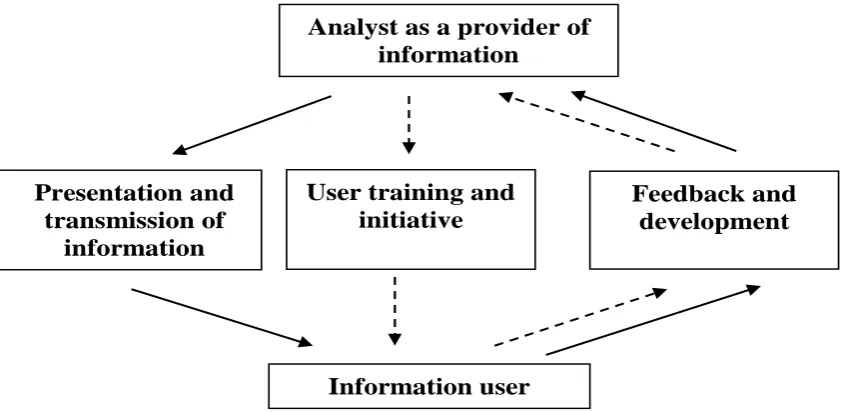
realizing the goals of a community. It is a two-way process between the analyst and the user, since it is necessary to provide feedback on the appropriate understanding on the user's side. Therefore, we can talk about the communication model shown in Figure 1. Figure 1 shows that the communication process is not complete until the analyst receives feedback (in any form) about the effect of the user (a feeling of opportunity or danger).
The user should not be left indifferent, and he should therefore have a sense of danger or opportunity. The feedback on this is shown in Figure 1 with dashed lines. The full line of feedback informs the user's initiatives, which suggests the analyst to further develop different information.
Figure 1: Business communication model
The central dashed lines in Figure 1 show another important process, namely, giving initiatives and training for the user, because in the context of the information function it is necessary to continuously:
Study the needs of users and give initiatives to create new or different, better-quality information;
Constant training for users to better
understand the information provided, and thereby raise awareness of the need for new information as well.
Both contribute to the quality of
communication and to the development of the
information system. Of course, Figure 1 does not show the whole process from information to business decision, which is important for the success of information. Therefore, we must also consider a further process where user information is included with his business decision. We shall do it in the next chapter.
Information Quality Factors on the User's Side
The efficiency of communication is usually less than ideal, due to a number of factors. These are not only on the provider's side, but also on the user's side. The ultimate effect of these factors appears to the user as his interest or motivation for business decision making. The emerging form of this interest is Analyst as a provider of
information
Presentation and transmission of
information
User training and initiative
Feedback and development
Zivko Bergant | Sept.-Oct. 2019 | Vol.8| Issue 5 |08-15 10 the user's response to the information
received. On this basis, the user begins to formulate his business decision.
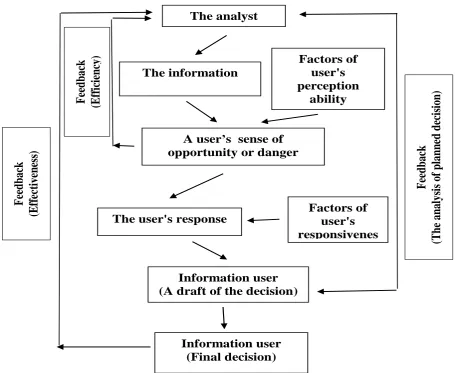
It is therefore important to determine how and why this interest emerges. A more detailed information process from an analyst to a user is shown in Figure 2.
Figure 2: Process from an information to business decision
Figure 2 shows the relationships between the analyst and the information user in the information process. With its help, we can come to some important considerations.
For analyst is important whether he has managed to create a feeling of danger or opportunity at the user. This is information about the efficiency of the information process. It is often called as a communication effect. Of course, the information is less efficient, as much as the analyst spent the time to stir up the feeling. It is therefore a question of whether the analyst has acted in
the right way.
It may happen that the user's response is not the same as the analyst anticipates. It usually means that the user does not see the significance of the danger or opportunity, or that his sense of risk or opportunity is
different, as the analyst estimates. The efficiency of information is not satisfactory.
Such a case requires from analysts considering the causes of an unexpected user response or "noise in communication". Obviously, a deeper empathy is needed to understand it.
It is important to consider factors that influence the user’s perception ability to understand information provided by the analyst. These factors form the ability of the user to accept an appropriate sense of risk and its weight. Factors affecting this ability are many.
Among the factors affecting the user information, we can especially consider the following:
The analyst
The information
A user’s sense of opportunity or danger
The user's response
Information user (A draft of the decision)
Information user (Final decision)
Feedback
(E
ff
ic
iency
)
Feedback
(E
ff
ec
ti
ven
es
s)
Feedback
(T
he a
na
lys
is o
f plann
ed
deci
si
on
)
predvi
d
ene
od
loč
itv
e)
Factors of user's perception
ability
Factors of user's responsivenes
Zivko Bergant | Sept.-Oct. 2019 | Vol.8| Issue 5 |08-15 11 Genetic characteristics and intellect, or
character,
Education and skills,
Knowledge of the environment and the
relationship with the environment, Material situation and standard of living, Experience,
status and responsibility,
forms and levels of association or
organization (e.g. family, company, different bodies and communities),
Distribution of probability and its "tails" (Taleb's Black Swan),
The degree of abstraction (sub
consciousness) and the time dimension. The ability to perceive information, of course, changes over time, even under the influence of these factors. The efficiency of the information (the ratio between the excited feeling and the received information) therefore does not depend solely on the information provided by the analyst, but also on numerous factors that influence the user's ability to objectively understand the situation.
This fact is therefore the first thing the analyst has to consider when presenting and clarifying information. It is obvious that the analyst will need different amounts of time or effort in the same objective circumstances (in a case of the same information but for the different user) in order to create an appropriate sense of opportunity or danger.
The efficiency of the information process will therefore vary. Furthermore, a consideration is needed about factors that influence the response of the user to the excited feeling of risk or opportunity. The individual responds to his own sense of risk under the influence of many additional factors. To illustrate, we can list among them in particular:
The individual responds to his own sense of risk under the influence of many additional factors. To illustrate, we can list among them in particular:
Interest and life goals,
Assessment of the costs and benefits in the widest broadest sense,
Sense of responsibility,
A sense of exploitation and inequality,
Feeling of neglecting, Desire for revenge,
Jealousy and envy,
Personality (character) characteristics,
pride and ethical norms, The degree of flexibility, Religious belief,
Characteristics of the degree of hierarchy
and extent of permitted behavior
(competences),
The struggle for power and the exploitation of the weaknesses of others,
Competitive advantages,
Age and ambition,
Current position,
Time dimension.
Selection of methods and knowledge of risk
assessment,
Different risk assessments (volume and
probability),
Knowledge and experience of risk
management,
Other characteristic and personality traits of the user.
In this paper, we will not deal more closely with individual factors. They are listed primarily for illustration and justification that, in the same circumstances, two different people, usually feel differently also at the same level of information and, therefore they respond differently. Some of these factors are also related to those that already affect the sense of risk.
We will not consider these relations in detail, but it is enough to see the practically unlimited number of different structure factors that can affect the actual response of the information user. User response is reflected in his expressed interest in making a business decision. Figure 2 shows that it is affected by the perceived sense of danger or opportunity, as well as many other factors that we have listed above as an example.
Interest can be a spontaneous, emotional or rational response. Reasonable response is the basis for the development of a risk management policy (definition, evaluation, avoidance and acceptance of risks).
Zivko Bergant | Sept.-Oct. 2019 | Vol.8| Issue 5 |08-15 12 form and content of the information in order
to maximize its efficiency.
In the continuation of the business information process, the user forms a business decision:
Based on analyst's proposals,
In accordance with his (or her) interest.
It is useful for the user to consider the intended decision in the draft together with the analyst, as shown in the feedback in Figure 2. In this way, he (or she) can get additional information about the possible consequences of the intended decision. The final decision therefore means feedback to the analyst about the performance of information, which is also shown in Figure 2. This shows whether the user was motivated to the right things. The ultimate goal of the information process is therefore the efficiency and effectiveness of a business decision. At the same time, this means an adequate quality of information process.
Social Responsibility of the User
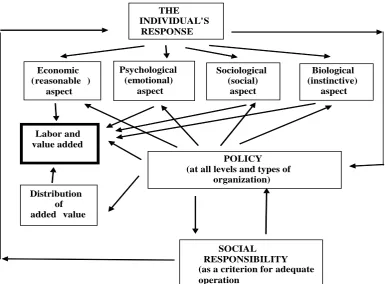
The final decision of the user in Figure 2 could be analyzed through several aspects of the response as it is shown in the Figure 3.
Biological (Instinctive) Aspect
This aspect is surely the most natural, original (spontaneous) and therefore also subconscious and accordingly strong, as it strives for the preservation of the human species.
Sociological Aspect
This aspect takes into account that the individual's response to a sense of risk influences the formation of relationships with other people, as well as the anthropological dimension of his or her functioning.
Psychological Aspect
This aspect takes into account the emotions and other characteristic features of the individual person, which give an additional dimension to his or her response to the sense of risk. A particular example of this aspect is the response in the form of fear, which can has an extremely strong influence on the performance and behavior of an individual person.
Economic Aspect
This aspect involves the operation of a person, aimed at creating added value in its broadest sense, as a material source for its existence and risk management reserves. It is based on the Value Added Law with all its consequences and a reason-based risk
management (definition, evaluation,
avoidance, reduction, redistribution and acceptance).
Figure 3: The analysis of information user's response
THE
INDIVIDUAL'S
RESPONSE
Psychological (emotional)
aspect
POLICY (at all levels and types of
organization) Economic
(reasonable )
aspect
Sociological (social)
aspect
Biological (instinctive)
aspect
Labor and value added
Distribution of
added value
SOCIAL RESPONSIBILITY (as a criterion for adequate operation
Zivko Bergant | Sept.-Oct. 2019 | Vol.8| Issue 5 |08-15 13 Within the relationships among reason,
emotion, and instinct, extreme (even negative) responses are possible, but they must be managed reasonably. In this context, e.g. the activity of preventing and detecting fraud is extremely important.
Figure 3 shows arrows showing the connection between the listed economic, psychological, sociological and biological aspects of the response (interest) with the central point (Labor and added value), which is boldly surrounded and shows the total effect of all factors on the performance of the individual and thus on the creation of added value.
The policy at all levels and types of organizations and associations of individuals is embedded in all points of the process, which is shown by appropriate arrows. The fundamental responsibility of all types of policies is reflected in particular in the impact on:
The behavior and activities of individuals, The field of labor and its consideration, Asserting the category of added value as
the basic information on sustainable development from an economic point of view,
Starting points and basic criteria for distribution of added value,
Promoting and enforcing the principle of social responsibility in all areas of people's operations,
This is shown in Figure 3 with the corresponding arrows.
Social responsibility is a fundamental criterion for assesing the proper response of the individual person, which is shown in Figure 3 with the arrow from Social Responsibility to Individual Response. This is consistent with my definition of social responsibility: social responsibility is the
responsibility of individuals and
organizational systems of all forms and levels in the creation and distribution of added value, that is, in increasing the welfare of the
whole society. At the same time, it means the
responsibility of the individual person to act socially responsibly and to shape politics at all
levels and types of organization. This is also shown in Figure 3 with the arrow from Individual Response to Policy.
The feedback loop in Figure 3 (the arrow from Social Responsibility to Policy) emphasizes the social responsibility of policy-makers and policy operators. Figure 3 shows the way a person operates in a risk-dependent manner, and provides an opportunity to optimally resolve possible ethical dilemmas in all areas of activity of both the individual and all types of organizations.
Figure 1 therefore shows the risk as the red thread of all people's activity, since the risk is their common denominator. It can therefore be a starting point in particular about:
Understanding of the diversity of people and their functioning, and on this basis for empathy to the other people and consequently for better communication;
Easier solving problems and unifying
common goals;
Easier policy-making at all levels and types of organizations;
Adequate and objective treatment of the individual (without stereotypes and prejudices);
Easier agreement on basic values, as it confirms ethical action as an integral part of the added value law;
Effective improvement of the functioning and proper modification of social systems;
More appropriate evaluation of the
performance of individuals and
communities;
Effective basis for comprehensive
measures to increase the well-being of society and social responsibility (in the economic, social and environmental spheres) and thus to ensure sustainable development.
Discussion
Zivko Bergant | Sept.-Oct. 2019 | Vol.8| Issue 5 |08-15 14 providers and information users. Without
their cooperation, we cannot guarantee the quality of the information process.
The basic condition of good information process is the cooperation and trust between the user and the analyst, for which they are both interested. However, this largely depends on the analyst's empathy in the information user. We did not find such approach in professional literature.
Of course, trust also depends on the decision-making process in a community (e.g. technocratic or democratic). In distrust and soulless discipline, information is different, as in cooperation, understanding, and creativity.
However, there are neither totally
technocratic nor fully democratic
organizations - the reality is in the middle,
the boundaries vary according to
circumstances. The analyst has to adapt to them.
Many feedback loops in the process from the risk to the performance of an individual show the cybernetic character of the model in Figure 1, which also provides answers to the starting points of the questions asked. The common denominator of all responses is the risk that the individual person feels and his (or her) response to this feeling. It is the fundamental reason for the difference in the functioning and behaving of people.
The model does not only provide answers to the question in the introduction, but offers also a basic judgment (criteria) of the adequacy of the behavior and functioning of the individual person. It is the contribution to social well-being or added value in the broadest sense, regardless of the currently environment. This means that this criterion is always the most important, despite the possible current partial or short-term interests of the individual person or organization.
The model has also a strong philosophical dimension in terms of people action and meaning of life. It does not explain only the diversity of people's behavior and actions, but it also gives an answer what kind they are supposed to be.
The model provides an understanding of today's reality, which, under the influence of
neoliberalism, puts us in the face of difficultly solvable problems, such as inequality of people, wars, migrations, dangerous threat to the environment, which pose ever-greater risks for the existence of humankind. Moreover, the model redirects postmodern ethics from the delusion of the ideological and idealistic orientation to the Christian goodness of people.
It is not about a naive-optimistic elevation of morality or moralization, but about establish the importance of proper action for the sustainable development and existence of humankind. The basic ethical principle, which is already contained in the law of added value, is confirmed, and we quoted it at the beginning of this paper.
The model therefore gives a theoretical overall basis for the design of appropriate policies at all levels, which should contribute to improving the organization and functioning of social systems, and thus to raising social welfare. Of course, the role and responsibility of individuals in shaping these policies is the most important.
The model under consideration with an innovative approach to making a difference between the individual's ability to perceive and his or her ability to respond to the risk, allows for further studies, such as:
Study of influential factors;
Study of the influences of factors and links between them;
Study of individual's responses from
different perspectives;
Possibilities of use of the model in
individual areas (e.g. studying the efficiency and effectiveness of the information process) [1-6].
Conclusion
Zivko Bergant | Sept.-Oct. 2019 | Vol.8| Issue 5 |08-15 15
References
1 Beck U (1992) Risk Society. London: SAGE
Publications Ltd.
2 Bergant Z. (2017) Appropriate
Consideration of Added Value Law as a Precondition of Social Responsibility. International conference about social responsibility. Maribor: IRDO, 2017.
3 http://www.irdo.si/irdo2017/referati/plenar
na-bergant.pdf.
4 Taleb NN (2007) The Black Swan. London:
Penguin books.
5 Taleb N, Nicholas (2009): Errors,
Robustness, and the Fourth Quadrant. International Journal of Forecasting, 25:744−759.
6 Taleb N, Nicholas in Goldstein G. Daniel in Spitznagel W, Mark (2009a): The Six Mistakes Executives Make in Risk
Management. Harvard Business Review,