International Journal of Advances in Management and Economics
Available online at:
www.managementjournal.info
RESEARCH ARTICLE
Analysis of the Influence of Cartoon Mobile Game Features on
Consumers' Usage Intention the Mediating Effect of Perceived
Entertainment
Kou Ningning
,Wang Wenfeng,
Huang Xingjun
School of International Business, Jinan University.
Abstract: In 2018, the number of anime mobile game users continued to grow. Previous scholars mainly focused on the research of the animation mobile game industry, such as the role simulation of products, interaction methods, etc., lacking research on the factors affecting consumer behavior and the mechanism of action. Based on the Technology Acceptance Model (TAM), this paper constructs a theoretical model that affects the intentions of consumers' anime mobile games through product characteristics, experience characteristics and perceived entertainment. The data was obtained through online online questionnaire survey and regression analysis. The empirical results show that the product characteristics and experience characteristics of anime mobile games significantly affect consumers' intentions, and Perceived entertainment plays a mediating role. This paper summarizes and enriches the research of the emerging field of animation mobile games, and further provides commercial advice for the animation mobile game company in terms of audience positioning and market feedback.
Keywords: Anime mobile game, Perceived entertainment, Usage intention, TAM.
Article Received: 01 August 2019 Revised: 14 August 2019 Accepted: 27 August 2019
Introduction
According to the 2017 China Game Industry Report, the actual sales revenue of the Chinese game market in 2017 reached 2036.31 billion yuan, a year-on-year increase of 23.0%. With the increasing cost of user acquisition in recent years, how to increase the number of mobile game users has become a key issue for game manufacturers. In the study of online shopping for consumers, many scholars have found that the fun of shopping can increase consumers' interest in online shopping. Studies by Thong & Hong [1], Li Li, and Liu Yumei [2], have confirmed that perceived entertainment is one of the
The Theoretical Basis and the Hypothesis
Perceived Entertainment
Playfulness was first proposed by Lieberman [4], and Barnett (1991) continued to study it. He has two definitions of entertainment: one is focused on the Trait of playfulness. It is considered that entertainment is a personally stimulating feature; the second definition is a state of playfulness, which is believed to be related to the experience and emotions of a certain period of time. Moon & kim [5], further based on the research of, proposed three aspects of perceived entertainment: concentration, curiosity and enjoyment. The suggestion of perceptual entertainment was first studied based on the Technology Acceptance Model (TAM) [6].
Davis believes that the use behavior is determined by the behavioral intention, and the willingness to use is determined by the attitude toward using and the perceived usefulness. The use attitude is determined by the perceived usefulness and ease of use. Cyr et a1 [7]. Studies confirm that product perceived ease of use and perceived usefulness can significantly affect consumers' purchasing behavior. Wang Chen [8] found in empirical research that perceived entertainment has a positive impact on users' willingness to use.
H1
Perceived entertainment positively affects consumers' usage intentions.
Anime Mobile Game Product Features
Different product features will bring different experiences to consumers. The study by Eggert & Ulaga [9] confirms that product attributes are the basis for consumers to have a variety of feelings, and product functions will make customers quickly feel good. Zhang Wei [10] empirical results also show that product preference dimension perception has a significant impact on customer attitude loyalty. The TAM model indicates that
perceived usefulness is determined by the perceived ease of use and external variables, and the ease of use is determined by external variables. External variables include system design features, user features (including perceptual forms and other personality traits), task features, nature of development or execution processes, policy implications, organizational structure, and more.
The product features of the anime mobile game include game background, game system, game play, game difficulty, and other content. Based on the migration of the TAM model, we believe that the product features of the anime mobile game will affect the consumer's perceived entertainment, which in turn affects the usage intention. So we put forward the hypothesis:
H2a
The product features of anime mobile games affect consumers' perceived entertainment.
H2b
The product features attribute of anime mobile game affects consumers' usage intentions.
Anime Mobile Game Experience Features
Theory of Reasoned Action (TRA) [11] argues that an individual's actual behavior can be reasonably determined by behavioral intention to some extent. and the individual's behavioral intention is determined by attitudes towards behavior and subjective norm. The theory of planned behavior retains this view and adds perceptual behavioral control. Attitude is people. Positive or negative emotions held by a certain target behavior. Hassenzahl [12] research shows that users.
customer's staying time and willingness to pay in the environment. Significant positive impact. People will use anime mobile games mainly for spiritual needs, and different bodies at different stages. Different character will have a different experience requirement. We propose the following hypothesis:
H3a
The experience features of anime mobile games affect consumers' perceived entertainment.
H3b
The experience features of anime mobile game affects consumers' usage intentions.
Theoretical Model
This paper combines the technical continuous theoretical model and proposes a model, as shown in Figure 1:
Figure 1: Theoretical model
Research Design
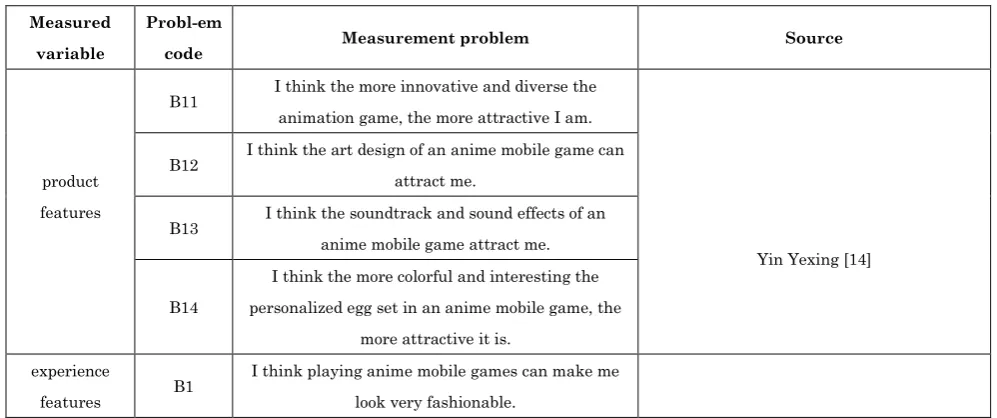
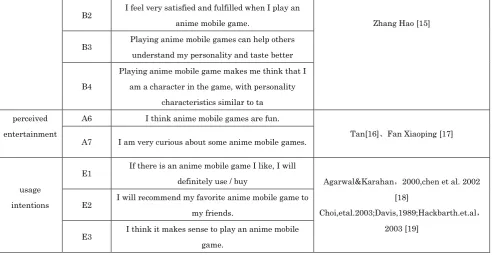
Variable MeasurementThe study involved four measured variables, namely product features, experience features, perceived entertainment and usage intentions. The variables used were from
existing literature, and these variables were adjusted according to the research scenarios of this study. Using the Likert scale, 1 to 5 represents the lowest to highest level, 1 means complete disagreement, and 5 means complete agreement. The specific measurement items are as follows:
Table 1: Measured variables
Measured variable
Probl-em
code Measurement problem Source
product
features
B11 I think the more innovative and diverse the animation game, the more attractive I am.
Yin Yexing [14] B12 I think the art design of an anime mobile game can
attract me.
B13 I think the soundtrack and sound effects of an anime mobile game attract me.
B14
I think the more colorful and interesting the
personalized egg set in an anime mobile game, the more attractive it is.
experience
features B1
I think playing anime mobile games can make me
B2 I feel very satisfied and fulfilled when I play an
anime mobile game. Zhang Hao [15]
B3 Playing anime mobile games can help others understand my personality and taste better
B4
Playing anime mobile game makes me think that I
am a character in the game, with personality characteristics similar to ta
perceived
entertainment
A6 I think anime mobile games are fun.
Tan[16]、Fan Xiaoping [17] A7 I am very curious about some anime mobile games.
usage
intentions
E1 If there is an anime mobile game I like, I will
definitely use / buy Agarwal&Karahan,2000,chen et al. 2002
[18]
Choi,etal.2003;Davis,1989;Hackbarth.et.al,
2003 [19] E2 I will recommend my favorite anime mobile game to
my friends.
E3 I think it makes sense to play an anime mobile game.
Sample Source and Analysis Method
The data comes from questionnaires filled out by game enthusiasts from different occupations in different regions of the country. This survey is conducted online. There were 322 valid questionnaires after eliminating the invalid questionnaire. In the data analysis method, this paper mainly uses PLS
statistical software for reliability and validity analysis and statistical analysis. Finally, carried out the structural equation modeling and tested the relevant hypotheses.
Data Analysis
Reliability and Validity Analysis
Table 2: Reliability and validity analysis data
Cronbach's Alpha
AVE Composite
reliability
Communality R Square
product features
.913 0.794700 0.939297 0.794700
experience features
.870 0.721157 0.911779 0.721157
perceived
entertainment .835 0.858062 0.923609 0.858062 0.509777
usage intentions
.778 0.693334 0.871389 0.693334 0.462198
It can be seen from the table that the AVE of product features, experience features, perceived entertainment, and usage intentions are all greater than 0.5, and the other three variables are greater than 0.7
analysis; product features CR=0.939, experience features CR=0.912, perceived entertainment CR=0.934, usage intentions CR=0.871 More than 0.7, so the questionnaire has a good combination of reliability; in the common factor test, product features = 0.794> 0.5, experience characteristics = 0.721 > 0.5, perceived entertainment = 0.858 > 0.5, usage
intentions = 0.693 > 0.5. It shows that the estimated effect of the reflective external relations in the model satisfies the general condition requirements, and it can be considered that the latent variables have a better reflection effect on the respective measured variables.
Table 3: Correlation coefficient between variables and square root of AVE
Variable Product features
Experience features
Perceived
entertainment Usage intentions
product features
0.8915
experience features
0.254438 0.8492
perceived entertainment
0.572430 0.558336 0.9263
usage intentions
0.498068 0.539333 0.592615 0.8327
The results in Table 3 show that there is a good correlation between the variables. It can be seen that the square root of the AVE value in the model is greater than the correlation coefficient between all latent variables,
satisfying the test conditions of the discriminant validity, so the variables have good independence and distinction.
Structural Equation Model Analysis
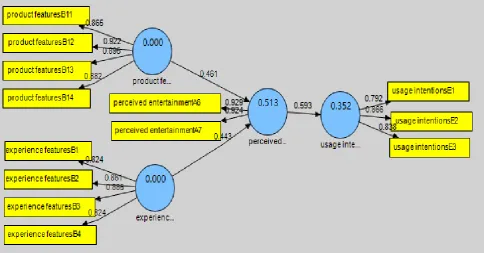
As can be seen from Figure 4, the products B11, B12, B13, B14 have a good product features, the factor load is 0.860、0.932、 0.898、0.883, respectively; the regression coefficient of product features and usage intentions is 0.268, indicating Whether the consumers of anime mobile games will continue to use the anime mobile game products is indeed related to the characteristics of the products themselves, assuming that Hypothesis 2 is established.
Experience B1, B2, B3, and B4 items are very good for the experience features. The factor loads are 0.828, 0.854, 0.889, and 0.824, respectively. The experience features are positively related to the usage intentions. The correlation coefficient is 0.328, indicating that consumers will be because of them. For the different experience of the anime mobile game, decide whether to continue to choose the product, so assume that Hypothesis 3 is established.
The use of E1, E2, E3 items is a good indication of the usage intentions; the factor load is 0.796, 0.860, and 0.841. When we added the variable of mediation variable perception entertainment, the perceived entertainment A7 and A8 items expressed the perceived entertainment well, with factor loads of 0.974 and 0.929, respectively.
It can be seen that the correlation coefficient between product features and perceived entertainment is 0.460, the correlation coefficient between experience features and perceived entertainment is 0.441, and the correlation coefficient between perceived entertainment and usage intention is 0.256. It shows that the consumer's usage intention the anime mobile game is indeed influenced by the perceived entertainment. Hypothesis 1 is established.
Conclusions and Prospects
Conclusions
Based on the technology acceptable model, this paper explains and analyzes the
consumer behavior of the animation mobile game market. The research results show that the product features and experience features of the anime mobile game significantly affect the consumers' intentions, and the consumers care more. The art design of anime mobile games and the features of their own personality when using products indicate that they care more about interaction, and the mediation variables show that the more they can bring them curious and interesting products, the more they are willing to use them.
Or recommend it to a friend. Emerging industries need theoretical guidance, and I have read a lot of literatures and found that there are not many such studies, and there are few studies on player behavior. One of the major contributions of this paper is to fill the gap in the field of animation games.
Limitations and Prospects
There are three research shortcomings in this study. Firstly, only the technology acceptance model and rational behavior theory are used to explain the behavior of anime mobile games, and this phenomenon has not been explained from more angles. Secondly, this study uses a sample of some games. The popular player sample has an advantage in internal consistency and can greatly eliminate other external interference factors.
However, there is no data analysis for professional e-sports players and niche players. In this case, high-end players may differ from the experience of mass players. Finally, this study does not consider the impact of different consumer types on the results, such as: gender, occupation, etc. Many game manufacturers have found a broad market for female players, and most scholars study the phenomenon of "her era".
players, of course, there may be new discoveries after consumer classification
analysis.
References
1. Thong JYL, Hong SJ, Tam KY(2006) The effects of post-adoption beliefs on the
expectation -confirmation model for
information technology continuance
[J].International Journal of Human-Computer Studies, 64(9):799-810.
2. Li Li, Liu Yumei (2008) Study on the Comprehensive Model of Influencing Factors of
Personal Intention of B2C
E-Commerce[J].Information system, (1):37-47
3. JN, Lieberman (1977) playfulness it is relationship to Imagination and Creativity, Academic Press, New York.
4. Davis FDA (1989) Theoretical Extension of the
Technology Acceptance Model : Four
Longitudinal Field Studies “Management Science (45:2):186-204.
5. Moon J, KIMY (2001) Extending the TAM for a worldwide-web context IJl Information and Management, 38(4):217-230.
6. Wang Chen (2010) Research on the Influencing Factors of Mobile Game Use Intention
[D].Beijing University of Posts and
Telecommunications.
7. Cyr D,Head M,Ivanov A (2006) Design aesthetics leading to m-loyalty in mobile
commerce[J].Information Management,
43(8):950-963.
8. Ulaga W , Eggert A (2006) Value-based differentiation in business relationships :
Gaining and sustaining key supplier
status[J].Journal of Marketing, 70(1):119-136
9. Zhang Wei (2008) "Influence of Product Creativity Perception on Customer Loyalty" pp66-67
10. Zhu Tex, Li Peng, Wu Qitao (2005) School of Geographical Science and Planning, Sun Yat-Sen University, “Perception of Chinese
World Heritage Tourism Products, 25.
11. Fishbein M, Ajzen I (1975) Belife Attitude Itention, Beheavior. Addition-Wesley, read -ing,MA.
12. Qu Wei, Zhang Huiying (2015)“Study on the
Impact of Non-transactional Virtual
Community User Experience on Continuous Use Intention” (Tianjin University Department of Management and Economics),34 (9):187-188.
13. Hassenzahl M , Tractinsky N (2006)User experience-reseach agenda[J】.Behaviour & Information Technology 25(2):91-97
14. Dovonan RJ, Rossite JR, Marcoolyn, G, Nesdale A (1994) Store Atmosphere and
Purchasing Behavior.Journal of
Retailing,70,198-199
15. Yin Yexing (2015) Research on the Impact of Customer Experience on Customer Loyalty in Mobile Internet Games [D]. Sichuan Normal University.
16. Zhang Wei (2007) an empirical study on the impact factor model of CRBT users [D]. Beijing University of Posts and Telecommunications.
17. Felix B, Tan, Jacky PC, Chou (2008) The Relationship Between Mobile Service Quality, Perceived Technology Compatibility, and Users' Perceived Playfulness in the Context of
Mobile Information and Entertainment
Services [J]. International Journal of Human-Computer Interaction, 24(7):649-671.
18. Fan Xiaoping (2007) Research on the influence of network interaction based on virtual community on online purchase behavior [D]. Zhejiang University.