ARTIGO ORIGINAL
ABSTRACT
Introduction: The simultaneous presence of multiple chronic diseases in the same individual is recognized as an important public
health problem. Patients with multimorbidity have greater healthcare needs, which represents a higher burden on health services. Although there is no consensual definition of this concept, multimorbidity is usually defined as the presence of two or more chronic diseases in the same patient. The existence of evidence regarding multimorbidity will lead to more efficient management and treatment of these patients.
Material and Methods: In order to estimate the prevalence of multimorbidity and to identify the associated factors, a cross-sectional
epidemiological study was developed based on data from the INSEF, a population-based survey conducted on a representative probability sample of the Portuguese population (n = 4911). The prevalence of multimorbidity was estimated for the total population and separately for men and women, stratified by age group, region, education and income. The magnitudes of the associations were measured by the adjusted prevalence ratios calculated by the Poisson regression model.
Results: Prevalence of multimorbidity was 38.3% (95% CI: 35.4% to 41.3%), with higher frequency in women, older people, Lisbon
and Tagus Valley; Northern Portugal; Algarve and Alentejo regions and in those with lower academic qualifications. No association was found between multimorbidity and income.
Discussion: Multimorbidity affects more than one third of the Portuguese population. Epidemiological data about multimorbidity in
Portugal allows the identification of population groups with higher multimorbidity prevalence.
Conclusion: Our results, which highlight the greater risk of multimorbidity among older and less instructed people, are in line with
the literature. These results show the relevance of multimorbidity patients and are especially important in the way how healthcare is organized and provided.
Keywords: Chronic Diseases; Health Surveys; Multimorbidity; Portugal
RESUMO
Introdução: A presença de múltiplas doenças crónicas, em simultâneo, no mesmo indivíduo é um problema de saúde reconhecido. Os
doentes com multimorbilidade têm necessidades de saúde acrescidas, o que representa um ónus elevado para os cuidados de saúde. Embora não exista uma definição consensual do conceito, a multimorbilidade é definida habitualmente pela presença de duas ou mais doenças crónicas. A existência de evidência, para a realidade nacional, quanto à multimorbilidade poderá contribuir para a gestão e tratamento destes doentes de forma mais eficiente.
Material e Métodos: Com o objetivo de estimar a prevalência de multimorbilidade e identificar os fatores associados foi realizado um
estudo epidemiológico transversal com base nos dados do INSEF, um inquérito de base populacional desenvolvido com uma amos-tra probabilística representativa da população portuguesa (n = 4911). A prevalência de multimorbilidade foi estimada para o total da população e para cada um dos sexos, estratificada por grupo etário, região de saúde, educação e rendimento. As magnitudes das associações foram medidas pelas razões de prevalências ajustadas calculadas pelo modelo de regressão de Poisson.
Resultados: A prevalência de multimorbilidade foi de 38,3% (IC 95%: 35,4% a 41,3%), com maior frequência nas mulheres, nos
in-divíduos mais velhos, nas regiões de Lisboa e Vale do Tejo, Norte, Algarve e Alentejo e em níveis educacionais mais baixos. Não foi observada associação estatisticamente significativa entre a multimorbilidade e o rendimento.
Discussão: A multimorbilidade é um problema que afeta mais de um terço da população portuguesa. O conhecimento epidemiológico
sobre a multimorbilidade em Portugal permite identificar os grupos populacionais onde esta realidade é mais prevalente.
Conclusão: Os valores observados apontam para maior risco de multimorbilidade entre os indivíduos mais velhos e menos
diferencia-dos e está em consonância com os resultadiferencia-dos da literatura. Estes dadiferencia-dos demonstram a relevância diferencia-dos doentes com multimorbilidade e têm especial importância na forma com os cuidados de saúde são organizados e prestados.
Palavras-chave: Doenças Crónicas; Inquéritos Epidemiológicos; Multimorbilidade; Portugal
Multimorbidity in Portugal: Results from The First
National Health Examination Survey
Multimorbilidade em Portugal: Dados do Primeiro
Inquérito Nacional de Saúde com Exame Físico
1. Unidade de Saúde Pública Lisboa Norte. Agrupamento de Centros de Saúde de Lisboa Norte. Lisboa. Portugal. 2. Departamento de Epidemiologia. Instituto Nacional de Saúde Doutor Ricardo Jorge. Lisboa. Portugal.
3. Centro de Investigação em Saúde Pública (CISP). Escola Nacional de Saúde Pública. Universidade NOVA de Lisboa. Lisboa. Portugal. 4. Unidade de Saúde Pública Dão Lafões. Agrupamento de Centros de Saúde Dão Lafões. Viseu. Portugal.
Autor correspondente: Guilherme Quinaz Romana. [email protected]
Recebido: 31 de agosto de 2018 - Aceite: 12 de novembro de 2018 | Copyright © Ordem dos Médicos 2019
Guilherme QUINAZ ROMANA1,2, Irina KISLAYA2,3, Mário Rui SALVADOR2,4, Susana CUNHA GONÇALVES2,
Baltazar NUNES2,3, Carlos DIAS2,3
Acta Med Port 2019 Jan;32(1):30-37 ▪ https://doi.org/10.20344/amp.11227
INTRODUCTION
Usually defined in medical literature as the presence of
two or more chronic conditions affecting the same patient,1
multimorbidity is certainly a relevant public health concern.2
Medical advances and increasing life expectancy have
reinforced the pressure of patients presenting with
multi-ple chronic conditions on healthcare systems.3 Rising
de-mand for healthcare services will be presented by patients
ARTIGO ORIGINAL Despite the therapeutic advances, these patients can
pre-sent a higher risk of complications and greater constraints regarding their compliance with therapy which is sometimes
complex,6 leading to an increasing mortality rate and
de-creased functional capacity.7
In Europe, an estimated 70-80% of health expenditure correspond to multimorbidity, in countries such as Denmark and is the reason of eight out of each 11 hospital
admis-sions in the United Kingdom.5 Patients with multimorbidity
attend up to 78%4 of primary care physician consultations,
with an average 9.354 to 18.66 consultations per year,
show-ing an increase of 5.64 to 12.56 consultations per year when
compared to patients with no multimorbidity. A high number of drug prescriptions and hospital referrals has been also found in these patients, with an estimated 27.5 average an-nual number of prescriptions and 0.5 hospital referrals per
patient vs. 15.3 prescriptions and 0.3 referrals in patients
with only one chronic condition.6
According to the National Health Survey (Inquérito
Nacional de Saúde), 36% of the Portuguese population presented in 2005/2006 with three or more chronic
condi-tions and female patients were mostly affected (42.5% vs.
27.4%), as well as patients aged 65 and older – (55.2%
vs. 14.8%).8 A 39.4% prevalence of multimorbidity in
pa-tients aged 50 and older has been found in Portugal by a more recent analysis of the 2011/2012 SHARE (Survey of
Health, Ageing and Retirement in Europe) data.9 Another
study, based on the population aged 18 and older attend-ing primary healthcare in mainland Portugal in 2013/2014 has reached the conclusion that 72.7% of the population presented with two or more chronic conditions and found an association between low literacy and low income with high
prevalence of multimorbidity.10 Prevalence rates between
20 and 40% have been found in international studies.11 The
presence of a relationship between low-literate and low-in-come patients with the presence of multimorbidity has also
been found in prevalence studies,9,12 in line with the
Portu-guese national results.
Varied results regarding the prevalence of multimorbid-ity in national studies is worth mentioning, due to the use of different design methodologies with different populations and age groups. Therefore, a wide age range population study is particularly relevant to understand the current Por-tuguese pattern of multimorbidity.
This study was aimed at describing the prevalence of multimorbidity in Portugal in 2015, in addition to the identifi-cation of factors associated with multimorbidity.
MATERIAL AND METHODS Data source
All respondents to the National Health Survey with
Physical Examination [Inquérito Nacional de Saúde com
Exame Físico (INSEF)], developed by the INSA (Instituto Nacional de Saúde Doutor Ricardo Jorge) in collaboration with the five healthcare regional administrations from main-land Portugal, the healthcare and social affairs regional de-partments of Azores and Madeira and the Norwegian Public
Health Institute, between 2013 and 2016, were included as observation units of the study. The INSEF was a three-part epidemiological, cross-sectional and observational preva-lence study including (i) physical examination, (ii) analysis assessment and (iii) a general health questionnaire. All procedures were carried out according to the
recommenda-tions of the European Health Examination Survey (EHES).13
Target population and study sample
Non-institutionalised patients aged 25 to 74 living in Por-tugal were included in the INSEF as target population. A two-phase selection of participants in groups stratified by healthcare region and type of urban area was carried out
by using a probabilistic sampling design.13 Sample size was
established in order to estimate an expected 50% preva-lence rate, with a 5% absolute accuracy for a 95% confi-dence interval, in each healthcare region from mainland Portugal or Autonomous Region (RA), assuming a design effect of 1.5. The calculation of the minimum sample size led to a population of 600 patients at a regional level and 4,200 nationwide while a final effective group of 4,911
pa-tients has been obtained.13
Study variables
The relevant variables for the study were obtained through a structured questionnaire based on a computer-assisted interview carried out by healthcare professionals having previously completed a specific training.
Survey questions regarding chronic conditions were aimed at collecting information on the presence of long-lasting conditions (at least six months). Multimorbidity was defined by the presence of self-reported chronic conditions from a list of twenty pathologies (hypertension, acute myo-cardial infarction, stroke; cardiac dysrhythmia, diabetes mellitus; chronic kidney disease; liver cirrhosis; chronic hepatitis, asthma, chronic obstructive pulmonary disease; chronic pain; osteoporosis; rheumatoid arthritis; osteoar-thritis; cancer, depression; chronic anxiety, peptic ulcer disease; hypercholesterolaemia and allergy), selected from
the previous national health surveys14,15 and the EHES,16
as well as from the 2013-2016 National Health Plan (Plano
Nacional de Saúde).13,17
Sociodemographic variables were also selected, includ-ing gender, age group (25 - 34; 35 - 44; 45 - 54; 55 - 64; 65 - 74); educational level (Illiterate / basic education; lower secondary education; secondary education; higher educa-tion); equivalised adult monthly income (according to the OECD scale) and healthcare region.
Statistical analysis
Absolute and relative frequencies were obtained in or-der to describe the variables in the study.
The prevalence of multimorbidity and 95% confidence intervals were estimated for the total population and each gender, stratified by age group, healthcare region, educa-tion and income.
ARTIGO ORIGINAL were obtained in order to identify the factors associated with multimorbidity.
A multivariate approach and testing the association be-tween multimorbidity and the independent variables, two by two. The Poisson’s regression models were separately constructed for each gender and adjusted for the remaining independent variables, leading to adjusted OR (aOR). A 5% level of significance has been established.
The statistical analysis was developed based on
sam-ple weights13 and IBM SPSS Statistics (version 25) software
was used18 in complex samples module and Stata (version
15.1)19 in survey data analysis (SVY) module.
Ethical issues
Data from the INSEF were analysed and no other infor-mation was collected. The INSEF was approved by the
Na-tional Data Protection Commission (Comissão Nacional de
Proteção de Dados - authorisation no. 9348/2010), as well
as by the ethics committee of the INSA (Instituto Nacional
de Saúde Doutor Ricardo Jorge), of the different healthcare regional administrations and of the hospitals of Horta and
Centro Hospitalar de Lisboa Ocidental. An informed con-sent was obtained from all respondents.
RESULTS
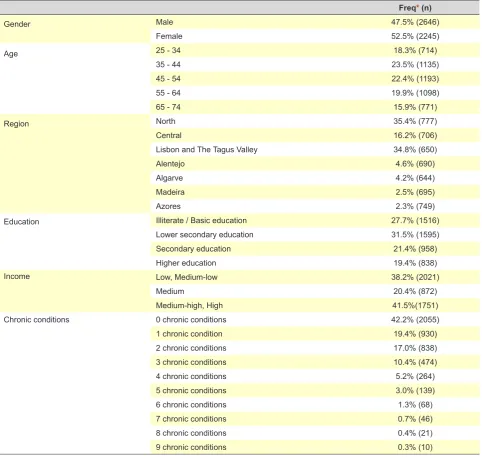
A total of 4,911 respondents have participated in the IN-SEF [52.5% female; leading age group 35-44 (23.5%), fol-lowed by 45 - 54 (22.4%) and 55 - 64 (19.9%). Approximate-ly one third of the respondents had lower secondary educa-tion (31.5%), followed by illiterate / basic educaeduca-tion patients (27.7%). Medium-high and high income patients group was the most prevalent (41.5%), followed by medium-low and low-income patients group (38.2%) and medium income pa-tients group (20.4%). Most papa-tients were living in the North-ern region (35.4%) followed by Lisbon and the Tagus Valley and Central regions. No chronic condition was described by 42.2% of the respondents, one chronic condition by 19.4%, two by 17.0% and three by 10.4% (Table 1).
Hypertension (25.1% in male and 26.1% in female pa-tients) and hypercholesterolaemia (23.7 and 25.7% respec-tively) were the two leading pathologies. Osteoarthritis was the third most prevalent disease in female patients (20.6%) and allergies in male patients (11.4%) – (Appendix 1: htt-ps://www.actamedicaportuguesa.com/revista/index.php/ amp/article/view/11227/Apendice_01.pdf).
A 38.3% CI 95% (35.4-41.3%) prevalence of
multimor-bidity has been found, higher in female patients (43.4% vs.
32.7%, RP = 1.33) (Table 2).
Similar prevalence rates were found in both genders in
25-34 (9.5% vs. 9.4%) and 35-44 (15.2% vs. 18.0%) age
groups. A higher prevalence rate has been found in female patients in the subsequent age groups, reaching a maxi-mum rate of 82.3% in the 65-74 age group (65.5% in male patients of the same age group).
A statistically significant increase in the prevalence of multimorbidity has been found with patient’s age, in both genders. An almost double prevalence rate has been found
in the 25-34 age group, when compared to the 35-44 (OR 1.90). A prevalence rate of multimorbidity 4.58, 7.54 and 8.71 times higher has been found in the subsequent age groups (45-54, 55-64, 65-74, respectively), when compared to the younger age groups. Statistically significant differenc-es in the prevalence of multimorbidity in male patients have only been found in the 25-34 and 55-74 age groups, with OR 6.39 in the 55-64 age group and 6.92 in 65-74 (Table 2). A lower prevalence of multimorbidity has been found in more educated patients, in both genders. A progressive de-crease in the prevalence of multimorbidity has been found in female patients with the increasing educational level from 70.0% in the group of illiterate / basic education patients to 25% in the group of patients with higher education. A vari-able prevalence of multimorbidity according to the level of education has been found in male patients, between 57.8% and 19.7%. A 53% decrease in the prevalence rate has been found in the group of patients with secondary educa-tion (OR = 0.47), compared to the group of illiterate / basic education patients, while a 66% (OR = 0.34) and a 63% de-crease (OR = 0.37) has been found in the group of patients with secondary and higher education, respectively.
Statistically significant differences in the distribution of the prevalence of multimorbidity has been found in the dif-ferent healthcare regions for both genders. The lowest prev-alence rate (21.3% and 32.6%, male and female patients, respectively) has been found in patients living in Madeira. Considering this region as a reference to female patients, a higher prevalence rate has been found in the Azores (OR = 1.27), Northern (OR = 1.36), Lisbon and the Tagus Valley (OR = 1.41), Algarve (OR = 1.46) and Alentejo (OR = 1.50) regions. A similar pattern has been found in male patients, except in the Azores.
No statistically significant association between multi-morbidity and income has been found.
A relationship between multimorbidity and patient’s age has been found in the multivariate regression model, with adjusted odds ratio (aOR) of 5.67 (95% CI: 2.54-12.65) and 5.68 (95% CI: 2.47-13.05) in 55-64 and 65-74 age groups of male patients and of 6.71 (95% CI: 4.01-11.21) and 7.51 (95% CI: 4.52-12.51) in female, when compared to the 25-34 age group (Table 3).
Statistically significant results regarding the distribution of the prevalence of multimorbidity in the different health-care regions have been found. The highest prevalence in both genders was found in Alentejo, Lisbon and the Tagus Valley and Algarve regions.
Statistically significant values were only found in male patients with secondary education and female patients with higher education, even though a lower risk of multimorbid-ity in more educated patients has been confirmed by the results in these two groups, when compared to illiterate / basic education patients.
DISCUSSION
ARTIGO ORIGINAL
distribution by gender, age, healthcare region, education and income. Multimorbidity is a common issue in Portugal, with a 38.3% prevalence rate, particularly in older (65.5% in male and 82.3% in female patients) and less educated patients (57.8% in male and 70.0% in female patients). The extent of this issue is shown by the values of the prevalence of multimorbidity in the Portuguese
popula-tion,8–10 reinforced by the results that were found in this
study.
A 39.6% prevalence rate has been found in the German
study by Puth et al., also based on a population survey in
patients aged 18 and older, with an increased frequency in older patients – 49.2% of adult patients aged 50-59 present
with multimorbidity – as well as in less educated patients.20
A lower prevalence of multimorbidity (20.0%) when com-pared to what has been found in this study was shown by a
study in the Spanish population, based on the COURAGE
population survey.21 A 23.3% prevalence of multimorbidity
has also been found in Scotland by Barnett et al., based on
data obtained from patient’s clinical records.7
Nevertheless, the methodological differences and the absence of a consensual definition of multimorbidity is a limitation of any comparison between our results and
those found in other studies.11 Different measurements of
the same issue using different populations and different number and type of comorbidity makes any extrapolation
more difficult, leading to a wide range of prevalence.22
Na-tional data have shown conflicting results when different lists of pathologies are used. In the same population, the adopted definition of multimorbidity and chronic conditions
have an impact on the results.23 Variable data sources have
also been found, even though different studies based on
Table 1 – Description of our group of patients
Freq* (n)
Gender Male 47.5% (2646)
Female 52.5% (2245)
Age 25 - 34 18.3% (714)
35 - 44 23.5% (1135)
45 - 54 22.4% (1193)
55 - 64 19.9% (1098)
65 - 74 15.9% (771)
Region North 35.4% (777)
Central 16.2% (706)
Lisbon and The Tagus Valley 34.8% (650)
Alentejo 4.6% (690)
Algarve 4.2% (644)
Madeira 2.5% (695)
Azores 2.3% (749)
Education Illiterate / Basic education 27.7% (1516)
Lower secondary education 31.5% (1595)
Secondary education 21.4% (958)
Higher education 19.4% (838)
Income Low, Medium-low 38.2% (2021)
Medium 20.4% (872)
Medium-high, High 41.5%(1751)
Chronic conditions 0 chronic conditions 42.2% (2055)
1 chronic condition 19.4% (930)
2 chronic conditions 17.0% (838)
3 chronic conditions 10.4% (474)
4 chronic conditions 5.2% (264)
5 chronic conditions 3.0% (139)
6 chronic conditions 1.3% (68)
7 chronic conditions 0.7% (46)
8 chronic conditions 0.4% (21)
9 chronic conditions 0.3% (10)
ARTIGO ORIGINAL
Table
2
– Estimated prevalence / OR of multimorbidity by gender
, age, healthcare region, education and income
Multimorbidity (2 or more chronic conditions)
Freq * (n) 95% CI OR 95% CI Freq * (n) 95% CI OR 95% CI Gender Male [REF] 32.7% (728)
(29.6% - 36.0%)
1
Female
43.4% (1
134)
(40.1% - 46.8)
1.33
(1.21 - 1.46)
Male
Female
Agre group
25 - 34 [REF]
9.5% (24)
(4.0% - 20.8%)
1
9.4% (30)
(6.0% - 14.5%)
1
35 - 44
15.2% (64)
(12.0% - 19.1%)
1.61
(0.65 - 4.01)
18.0% (122)
(12.3% - 25.6%)
1.90
(1.05 - 3.45)
45 - 54
24.3% (134)
(20.0% - 29.1%)
2.57
(0.91 - 7.20)
43.3% (271)
(37.0% - 49.8%)
4.58
(2.91 - 7.21)
55 - 64
60.5% (277)
(53.1% - 67.4%)
6.39
(2.62 - 15.56)
71.2% (394)
(65.3% - 76.5%)
7.54
(4.70 - 12.10)
65 - 74
65.5% (229)
(60.2% - 70.4%)
6.92
(2.82 - 16.98)
82.3% (394)
(75.9% - 87.3%)
8.71
(5.53 - 13.70)
Region
Madeira [REF]
21.3% (80)
(16.8% - 26.7%)
1
32.6% (201)
(27.6% - 37.9%)
1
Center
27.7% (101)
(22.7% - 33.4%)
1.30
(0.96 - 1.76)
35.5% (120)
(28.6% - 43.1%)
1.09
(0.84 - 1.42)
Azores
23.9% (91)
(19.8% - 28.5%)
1.12
(0.93 - 1.52)
41.2 %(170)
(26.9% - 45.7%)
1.27
(1.04 - 1.55)
North
33.6% (1
19)
(31.7% - 35.6%)
1.58
(1.24 - 2.01)
44.3% (201)
(42.6% - 46.0%)
1.36
(1.14 - 1.62)
Lisbon and the
Tagus V
alley
35.1% (109)
(27.1% - 44.0%)
1.65
(1.17 - 2.31)
46.0% (160)
(38.0% - 54.2%)
1.41
(1.1
1 - 1.80)
Algarve
33.3% (108)
(28.0% - 39.0%)
1.56
(1.17 - 2.09)
47.4% (169)
(40.0% - 55.0%)
1.46
(1.15 - 1.84)
Alentejo
35.3% (120)
(37.1% - 39.8%)
1.66
(1.27 - 2.16)
48.9% (177)
(44.0% - 53.8%)
1.50
(1.23 - 1.83)
Education
Illiterate / Basic education [REF]
57.8% (370)
(52.5% - 62.9%)
1
70.0% (537)
(64.% - 75.0%)
1
Lower secondary
26.9% (201)
(22.7% - 31.6%)
0.47
(0.39 - 0.56)
42.9% (315)
(36.4% - 49.6%)
0.61
(0.51 - 0.73)
Secondary
19.7% (102)
(14.1% - 27.0%)
0.34
(0.25 - 0.47)
28.0% (142)
(21.6% - 35.4%)
0.40
(0.32 - 0.50)
Higher
21.6% (54)
(16.6% - 27.7%)
0.37
(0.28 - 0.51)
25.0% (139)
(19.1% - 32.1%)
0.36
(0.27 - 0.47)
Income
Low
, Medium-low [REF]
34.2% (276)
(29.4% - 39.4%)
1
46.3% (527)
(40.8% - 51.8%)
1
Medium
29.5% (1
19)
(24.5% - 35.0%)
0.86
(0.67. 1.1
1)
39.9% (195)
(39.4% - 46.8%)
0.86
(0.73. 1.01)
Medium-high, High
32.5% (291)
(28.2% - 37.2%)
0.95
(0.86. 1.06)
38.6% (327)
(33.7% - 44.0%)
0.84
(0.69. 1.02)
*
W
eighted relative frequencies of the distribution of the Portuguese population by healthcare region, gender and age group in 2015.
Statistically significant values in bold
ARTIGO ORIGINAL
population surveys have been carried out,20,21,24 including
many studies based on clinical records.4,6,7,10
Different studies have also shown the association
be-tween multimorbidity and socio-economic factors25: patients
living in deprived areas present 10 to 15 years earlier with multimorbidity, when compared to those living in other
ar-eas.7 Our results were in line with the studies described
above, showing higher prevalence of multimorbidity in older and less educated patients. More educated patients are as-sociated with better health condition, as a result of healthier
behaviours and higher literacy,26 which can explain a lower
prevalence of multimorbidity.
As regards the variable age, higher prevalence of multi-morbidity has been found in older patients. The association between higher prevalence of multimorbidity and patient’s age is well known and is apparently due to a higher number of years lived with the likely accumulation of chronic
condi-tions.27,28 Data from 16 European countries have shown a
22.7% mean prevalence of multimorbidity in the 50-59 age
group, up to 52.8% in patients aged 70 and older.9 The
re-cently published Portuguese results from a cohort focused on elderly patients have shown a 78.3% prevalence of
mul-timorbidity in these patients,29 in line with the results found
in our study.
As regards the variable gender, the higher female
prevalence is in line with literature.30 Female patients have
a higher mean life expectancy which has an impact on a larger number of concomitant chronic conditions, including musculoskeletal or mental-related disorders, when
associ-ated with specific biological factors.31 The higher monitoring
towards health issues found in female patients, leading to
higher self-report, can also explain for these results.32
The differences in the prevalence of multimorbidity be-tween different healthcare regions need further research. Considering that an adjustment to patient’s age, education and income has been made, different conditions of access to healthcare can also be taken into account in subsequent
research.33
This was a study based on a population survey and therefore our group of respondents could have been differ-ent from non-responddiffer-ents. A survey with non-responddiffer-ents has been carried out within the INSEF in order to limit this hypothesis and allowing for the analysis of any differences between both groups. Weights of the patient’s age, gender and healthcare region were used in order to reduce any
dif-ferences between the sample and the target population.13
Other limitations are worth mentioning. Data collection was carried out in healthcare centres and those usually at-tending private healthcare units could have been ignored: 60% of the specialty consultations usually take place in the private or social sector in Portugal, while 26% of the Por-tuguese population takes out voluntary health insurance
Table 3 - Multivariate model: Estimated adjusted odds ratio of multimorbidity per age group, healthcare region, education and income
Multimorbidity (2 or more chronic conditions)
Male Female
aOR 95% CI aOR 95% CI
Age 25 - 34 [REF] 1 1
35 - 44 1.63 (0.72 a 3.69) 1.78 (0.96 a 3.32)
45 - 54 2.27 (0.90 a 5.72) 4.17 (2.61 a 6.67)
55 - 64 5.67 (2.54 a 12.65) 6.71 (4.01 a 11.21)
65 - 74 5.68 (2.47 a 13.05) 7.51 (4.52 a 12.51)
Region Madeira [REF] 1 1
Center 1.15 (0.89 a 1.47) 0.99 (0.79 a 1.27)
Azores 1.16 (0.91 a 1.48) 1.33 (1.06 a 1.67)
North 1.45 (1.23 a 1.71) 1.31 (1.12 a 1.54)
Lisbon and the Tagus Valley 1.59 (1.19 a 2.12) 1.39 (1.14 a 1.69)
Algarve 1.50 (1.23 a 1.84) 1.39 (1.15 a 1.69)
Alentejo 1.49 (1.17 a 1.90) 1.41 (1.17 a 1.71)
Education Illiterate / Basic education [REF] 1 1
Lower secondary 0.85 (0.64 a 1.11) 0.88 (0.77 a 1.02)
Secondary 0.63 (0.47 a 0.84) 0.85 (0.69 a 1.05)
Higher 0.80 (0.54 a 1.18) 0.75 (0.58 a 0.96)
Income Low, Medium-low [REF] 1 1
Medium 0.94 (0.81 a 1.09) 0.92 (0.81 a 1.05)
High, Medium-high 1.04 (0.90 a 1.19) 0.99 (0.87 a 1.12)
ARTIGO ORIGINAL schemes
34 and 27% of community pharmacy dispensed
drugs are originated in prescriptions from the private
sec-tor.35 The prevalence of multimorbidity could probably have
been underestimated due to the exclusion of patients older than 75 and those living in institutions.
Even though the question used by the INSEF clarifies whether or not the diagnosis has been established by a physician, self-reported data were used, in addition to the fact that respondents have also described information from the past, which may have corresponded to a memory bias. Understanding the reality of multimorbidity in a national context explained the relevance of this study. The size of our group of patients and the representativeness of the Por-tuguese population were its main strengths.
CONCLUSION
Multimorbidity is clearly a relevant issue in Portugal, with a 38.3% prevalence in the population aged 25-74. According to results, a higher prevalence of multimor-bidity has been found in female, older and less educated patients.
The presence of a population study with national repre-sentativeness allowed for a better characterisation of these patients in Portugal. This evidence will give a contribution to the current discussion on the need of healthcare systems adapted to patients with multiple chronic conditions, through policies that allow for better and more efficient treatment.
HUMAN AND ANIMAL PROTECTION
The authors declare that the followed procedures were according to regulations established by the Ethics and Clini-cal Research Committee and according to the Helsinki Dec-laration of the World Medical Association.
DATA CONFIDENTIALITY
The authors declare that they have followed the
proto-cols of their work centre on the publication of patient data.
CONFLICTS OF INTEREST
The authors declare that there were no conflicts of inter-est in writing this manuscript.
FINANCIAL SUPPORT
The 1st Inquérito Nacional de Saúde com Exame Físico
(INSEF 2015) was a major element of the pre-defined pro-ject of “Improvement of epidemiological health information to support public health decision and management in Portu-gal. Towards reduced inequalities, improved health, and bi-lateral cooperation”, an Initiatives in Public Health Program (Programa Iniciativas em Saúde Pública) and received a fi-nancial support of approximately 1,500,000€ granted by the 2009-2014 European Economic Area Financial Mechanism through the EEA Grants and the Portuguese Government.
REFERENCES
1. Mercer S, Salisbury C, Fortin M. ABC of multimorbidity. London: BMJ Books; 2014.
2. Vogeli C, Shields AE, Lee TA, Gibson TB, Marder WD, Weiss KB, et al. Multiple chronic conditions: prevalence, health consequences, and implications for quality, care management, and costs. J Gen Intern Med. 2007;22:S391–5.
3. Rijken M, Struckmann V, van der Heide I, Hujala A, Barbabella F, van Ginneken E, et al. How to improve care for people with multimorbidity in Europe? Observatory on Health Systems and Policies. ICARE4EU project; 2017.
4. Salisbury C, Johnson L, Purdy S, Valderas JM, Montgomery AA. Epidemiology and impact of multimorbidity in primary care: a retrospective cohort study. Br J Gen Pract. 2011;61:12–21.
5. Glynn LG, Valderas JM, Healy P, Burke E, Newell J, Gillespie P, et al. The prevalence of multimorbidity in primary care and its effect on health care utilization and cost. Fam Pract. 2011;28:516–23.
6. van Oostrom SH, Picavet HS, de Bruin SR, Stirbu I, Korevaar JC, Schellevis FG, et al. Multimorbidity of chronic diseases and health care utilization in general practice. BMC Fam Pract. 2014;15:61.
7. Barnett K, Mercer SW, Norbury M, Watt G, Wyke S, Guthrie B. Epidemiology of multimorbidity and implications for health care, research, and medical education: a cross-sectional study. Lancet. 2012;380:37–43.
8. Nicolau V, Nunes C, Escoval A. Estudo: prevalência da multimorbilidade em Portugal. In: Congresso Nacional de Saúde Pública. Lisboa: DGS; 2014.
9. Palladino R, Lee JT, Ashworth M, Triassi M, Millett C. Associations between multimorbidity, healthcare utilisation and health status: evidence from 16 European countries. Age Ageing. 2016;45:431–5. 10. Prazeres F, Santiago L. Prevalence of multimorbidity in the adult
population attending primary care in Portugal: a cross-sectional study. BMJ Open. 2015;5:e009287.
11. Lefèvre T, d’Ivernois JF, De Andrade V, Crozet C, Lombrail P, Gagnayre R. What do we mean by multimorbidity? An analysis of the literature
on multimorbidity measures, associated factors, and impact on health services organization. Rev Epidemiol Sante Publique. 2014;62:305–14. 12. Wang HH, Wang JJ, Lawson KD, Wong SY, Wong MC, Li FJ, et al. Relationships of multimorbidity and income with hospital admissions in 3 health care systems. Ann Fam Med. 2015;13:164–7.
13. Santos AJ, Gil AP, Kislaya I, Antunes L, Barreto M, Namorado S, et al. 1o
Inquérito Nacional de Saúde com Exame Físico (INSEF 2015): relatório metodológico. Lisboa: Instituto Nacional de Saúde Doutor Ricardo Jorge; 2016.
14. Instituto Nacional de Estatística, Instituto Nacional de Saúde Doutor Ricardo Jorge. Inquérito Nacional de Saúde 2005/2006. Lisboa: INE; 2009.
15. Instituto Nacional de Estatística. Inquérito Nacional de Saúde 2014. Lisboa: INE; 2016.
16. Tolonen H, editor. EHES Manual. Part A. Planning and preparation of the survey. 2nd ed. Helsinki: National Institute for Health and Welfare; 2016.
17. Direção Geral da Saúde. Plano Nacional de Saúde 2012-2016. Lisboa: DGS; 2012.
18. IBM Corp. IBM SPSS Statistics for Windows, Version 25.0. Armonk: IBM Corp; 2017.
19. StataCorp. Stata Statistical Software: Release 15. College Station: StataCorp LP; 2017.
20. Puth MT, Weckbecker K, Schmid M, Münster E. Prevalence of multimorbidity in Germany: Impact of age and educational level in a cross-sectional study on 19,294 adults. BMC Public Health. 2017;17:1– 7.
21. Garin N, Olaya B, Perales J, Moneta MV, Miret M, Ayuso-Mateos JL, et al. Multimorbidity patterns in a national representative sample of the Spanish adult population. PLoS One. 2014;9.
22. Violan C, Foguet-Boreu Q, Flores-Mateo G, Salisbury C, Blom J, Freitag M, et al. Prevalence, determinants and patterns of multimorbidity in primary care: a systematic review of observational studies. PLoS One. 2014;9:3–11.
ARTIGO ORIGINAL comparison of two methods. Fam Pract. 2018;1–5.
24. Hoffman C, Rice D, Sung HY. Persons with chronic conditions. Their prevalence and costs. JAMA. 1996;276:1473–9.
25. Pathirana TI, Jackson CA. Socioeconomic status and multimorbidity: a systematic review and meta-analysis. Aust N Z J Public Health. 2018;42:186–94.
26. 2Cohen AK, Syme SL. Education: a missed opportunity for public health intervention. Am J Public Health. 2013;103:997–1001.
27. Fortin M, Bravo G, Hudon C, Vanasse A, Lapointe L. Prevalence of multimorbidity among adults seen in family practice. Ann Fam Med. 2005;3:223–8.
28. Marengoni A, Angleman S, Melis R, Mangialasche F, Karp A, Garmen A, et al. Aging with multimorbidity: a systematic review of the literature. Ageing Res Rev. 2011;10:430–9.
29. Rodrigues AM, Gregório MJ, Sousa RD, Dias SS, Santos MJ, Mendes JM, et al. Challenges of ageing in portugal: data from the EpiDoC cohort.
Acta Med Port. 2018;31:80–93.
30. Uijen A, van de Lisdonk E. Multimorbidity in primary care: prevalence and trend over the last 20 years. Eur J Gen Pract. 2008;14:S28–32. 31. Vlassoff C. Gender differences in determinants and consequences of
health and illness. J Heal Popul Nutr. 2007;25:47–61.
32. Pache B, Vollenweider P, Waeber G, Marques-Vidal P. Prevalence of measured and reported multimorbidity in a representative sample of the Swiss population Disease epidemiology - Chronic. BMC Public Health. 2015;15:1–8.
33. Observatório Português dos Sistemas de Saúde – OPSS. Viver em tempos incertos: sustentabilidade e equidade na saúde. Relatório de Primavera 2017. Lisboa: OPSS; 2017. p. 1-186.
34. Simões JD, Augusto GF, Fronteira I, Hernández-Quevedo C. Health systems in transition. Portugal Health System Rev. 2017;19.