ARTIGO ORIGINAL
RESUMO
Introdução: O consentimento informado é um processo ativo na relação médico-doente, assente em valores éticos e legais. O ato anestésico tem riscos inerentes, que devem ser alvo de consentimento específico. O objetivo deste estudo foi avaliar o grau de implementação do consentimento informado escrito para o ato anestésico no contexto de cirurgia eletiva.
Material e Métodos: Estudo observacional prospetivo, num hospital terciário e universitário, em 230 doentes com idade igual ou superior a 60 anos submetidos a cirurgia eletiva entre maio e julho de 2017. Aos doentes elegíveis que consentiram participar, foi realizada entrevista clínica no dia prévio à cirurgia. No pós-operatório, foi averiguada a técnica anestésica realizada, e a existência do consentimento informado por escrito para o ato anestésico e cirúrgico. Doentes incapazes de dar consentimento informado ou admitidos na unidade de cuidados intensivos após cirurgia foram excluídos.
Resultados: Em 225 (97,8%) dos doentes, verificou-se a obtenção, por escrito, do consentimento informado para o ato cirúrgico, mas apenas em 96 (41,7%) verificou-se a obtenção por escrito do consentimento informado para o ato anestésico. De entre os doentes sem registo de consentimento informado para o ato anestésico, foram mais prevalentes antecedentes de acidente vascular cerebral, anemia e scores de Charlson e de estado físico conforme à Sociedade Americana de Anestesiologia mais elevados.
Discussão: Identificámos uma baixa implementação do consentimento informado escrito para o ato anestésico. Esta situação pode ter importantes implicações em contexto de responsabilidade disciplinar, civil ou penal.
Conclusão: Apesar da sua importância, a prática do consentimento informado escrito para o ato anestésico nesta instituição não está implementada regularmente.
Palavras-chave: Anestesia; Consentimento Informado/ética; Consentimento Informado/legislação e jurisprudência; Procedimentos Cirúrgicos Eletivos; Responsabilidade Legal; Termos de Consentimento
Obtaining Informed Consent for Anesthesia in Elective
Surgery at a Tertiary-Care Hospital: Practices and
Ethical-Legal Context
Obtenção de Consentimento Informado para Anestesia em
Cirurgia Eletiva num Hospital Terciário: Práticas e Contexto
Ético-Legal
1. Serviço de Anestesiologia. Centro Hospitalar São João. Porto. Portugal.
2. Departamento de Anestesiologia. Faculdade de Medicina. Universidade do Porto. Porto. Portugal. 3. Departamento de Investigação e Ação Penal. Ministério Público. Porto. Portugal.
Autor correspondente: Luís Guilherme Casimiro. [email protected]
Recebido: 01 de abril de 2018 - Aceite: 24 de setembro de 2018 | Copyright © Ordem dos Médicos 2019
Luís Guilherme CASIMIRO1, Sara PEREIRA2, Sofia PIRES3, Joana MOURÃO1,2
Acta Med Port 2019 Jan;32(1):53-60 ▪ https://doi.org/10.20344/amp.10592
ABSTRACT
Introduction: Informed consent is an active process of the doctor-patient relationship, based on ethical and legal principles. The anesthetic act has inherent risks, which should be subject of specific consent. The aim of this study was to evaluate the degree of implementation of written specific informed consent for anesthesia in the context of elective surgery.
Material and Methods: An observational prospective study, at a tertiary university hospital, in 230 patients aged 60 years or older, undergoing elective surgery between May and July 2017. Eligible patients who consented to participate were interviewed clinically on the day before surgery. In the postoperative period, the anesthetic technique and the existence of the written informed consent for the anesthetic and surgical procedures were assessed. Patients who were unable to give informed consent or those admitted in the Intensive Care Unit after surgery were excluded.
Results: Written informed consent for the surgical procedure was obtained for 225 (97.8%), while it was obtained in just 96 (41.7%) patients for the anesthetic act. There was a higher prevalence of stroke, anemia, and higher Charlson and physical American Society of Anesthesiologists scores in patients without written informed consent for the anesthetic act.
Discussion: We identified a low implementation of written informed consent for anesthesia. This situation may have important implications in the context of disciplinary, civil or criminal liability.
Conclusion: Despite its importance, the practice of written informed consent for anesthesia in this institution is not yet implemented on a regular basis.
Keywords: Anesthesia; Consent Forms; Elective Surgical Procedures; Informed Consent/ethics; Informed Consent/legislation & jurisprudence; Liability, Legal
INTRODUCTION
Providing information and clarification to patients on a medical or surgical therapeutic proposal is assumed in obtaining informed consent (IC) and patients should make the decision of giving consent based on their own value
system.1 In order to become valid, this should be an active
process of a fully engaged dialogue on making decisions
regarding patient’s health.2 Patients should be fully aware
ARTIGO ORIGINAL objective way, with no discrepancies in the information pro-vided by different healthcare professionals. Patient’s
deci-sion must be recognised as a legitimate demonstration of
autonomy, as long as it is a free and informed decision.3
IC is valued under (i) the ethical perspective, as a crucial part of the physician-patient relationship and the patient’s autonomy and (ii) the legal, as an instrument for patient’s self-determination regarding the assumed risks and to
specify the scope of physician’s responsibility.4 IC,
particu-larly written IC, is a legal instrument and an evidence in a legal action of medical liability and has been laid down by different legal regulations and codes of ethics, such
as the Oviedo Convention,5 the Portuguese Lei de Bases
da Saúde,6 the Regulation (Estatuto)7 and Code of Ethics (Código Deontológico) of the Portuguese Medical
Asso-ciation (Ordem dos Médicos),8 the Norm 015/2013 of the
Portuguese Direção-Geral da Saúde,3 the Portuguese Civil
Code9 and Criminal Code.10
Consent for anaesthesia was for a long time considered as implicit to elective surgeries. Surgeons have had an al-most entirely dominant role within the operating room, with no autonomy or responsibility left for the remaining players, regardless of their differentiation. Therefore, the presenta-tion of the proposed anaesthetic management oppresenta-tion was usually left to the surgeon. Gradually, Anaesthesiology has become a distinctive specialty, with its own scope for action and with an autonomous role in different areas of expertise beyond anaesthesia. The relationship between surgeons and anaesthetists has become increasingly horizontal and the direct contact between the patient and the anaesthetist has claimed for the anaesthetist’s personal and civil liabil-ity in a cumulative way, with a direct link to the obligation
concerning the means11 as well as to obtain from patients
their informed and free consent for the techniques that are proposed.
The anaesthetist’s autonomy over the remaining operat-ing room staff members has been laid down by the Code of
Ethics of the Portuguese Medical Association (Ordem dos
Médicos)8: “physicians, in exercise of their profession, are technically and ethically independent and are responsible
for their actions” (“o médico, no exercício da sua profissão,
é técnica e deontologicamente independente e responsável pelos seus atos”). Nevertheless, the studies by Tait et al.
and Zarnegar et al. have shown that more relevance is still
assigned by patients to their consent for surgery than for anaesthesia, more aware of the information discussed on
surgery itself.12,13
The anaesthesia has specific aims, benefits, alterna-tives and risks that must be specifically discussed and leading to a specific consent. Only the anaesthetist has the necessary skills and knowledge to design and discuss the anaesthesia plan and its specific characteristics. Therefore, discussing and obtaining consent for anaesthesia must be an ethical and legal obligation of the anaesthetist rather than of any other healthcare professionals. Different authors have found that understanding the anaesthesia procedures, their benefits and adverse effects, as well as the role of the
anaesthetist is improved by obtaining an adequate IC for
anaesthesia.14,15
The adequate practice for information transmission and documents leading to IC, according to current literature, has
been recommended by the Portuguese Direção-Geral de
Saúde.3,16,17 In addition, written IC are also recommended, by use of a specific form, for elective surgeries in which any kind of anaesthesia technique is used. A specific form rep-resents a straightforward record of the patient’s decision. This study was aimed at assessing written IC for anaes-thesia in elective surgeries by patients aged 60 and older attending a tertiary university hospital.
MATERIAL AND METHODS
This was a prospective observational study carried out at the department of Anaesthesiology of a Portuguese ter-tiary university hospital following the approval by the ethics committee of the institution.
The study was aimed at elderly patients submitted to elective surgery, due to its increasing prevalence, patient comorbidities, quality of life and surgical outcomes. Patients aged 60 and older having undergone an elective surgery in General Surgery, Urology, Gynaecology, Plastic Surgery, Vascular Surgery, Orthopaedics and Oral and Maxillofacial Surgery between May and July 2017 were included in the study. Patients postoperatively admitted to the Intensive Care Unit were excluded from the study, in addition to pa-tients unable to understand the Portuguese language or to give IC for the participation in the study.
Patients attended a clinical interview the day before surgery, where the following data were collected: proposed surgery procedure, demographic data, medical history, usu-al medication, American Society of Anesthesiologists (ASA) physical status, Charlson index, clinical frailty scale (CFS) and cognitive ability as assessed by the Montreal Cognitive Assessment (MoCA). Charlson index is an outcome indica-tor for the classification and assessment of comorbidities
aimed at obtaining a 10-year estimated mortality.18,19 CFS
score is a strong predictor of postoperative adverse events and patients are classified according to the level of
vulner-ability.20,21 Montreal Cognitive Assessment (MoCA) is an
early detection method of cognitive impairment, which has
already been adapted to the Portuguese population.22–24
The presence of cognitive impairment is considered below the score of 26 which has been established as clinical cut-off.
Data on anaesthesia and written consent for anaesthe-sia and surgery were postoperatively obtained from the pa-tient’s clinical record. Even though not recommended, an initial contact of the anaesthetist with patients in the imme-diate preoperative period is still currently the usual proce-dure, a moment in which a written IC should be obtained. For this reason, the presence of a written IC was only post-operatively checked.
ARTIGO ORIGINAL
the presence of any conditions of the patients or the anaes-thesia procedure associated with the absence of written IC. Mann-Whitney test was used for continuous variables and Pearson’s chi-squared, linear by linear association and Fisher’s exact tests were used for categorical variables.
Differences were considered as significant with p < 0.05.
Statistical analysis was carried out by using IBM’s Statisti-cal Package for Social Sciences (SPSS Inc. Chicago, IL), version 24.0 software.
RESULTS
A total of 230 patients were included in the study (53.9% female, mean age 70.92).
A record of written consent for surgery was found in 225 patients (97.8%), while a similar consent for anaesthesia was only found in 96 patients (41.7%) and none of the latter was due to patient’s informed refusal.
The absence of written IC for both procedures was found in five patients (2.2%).
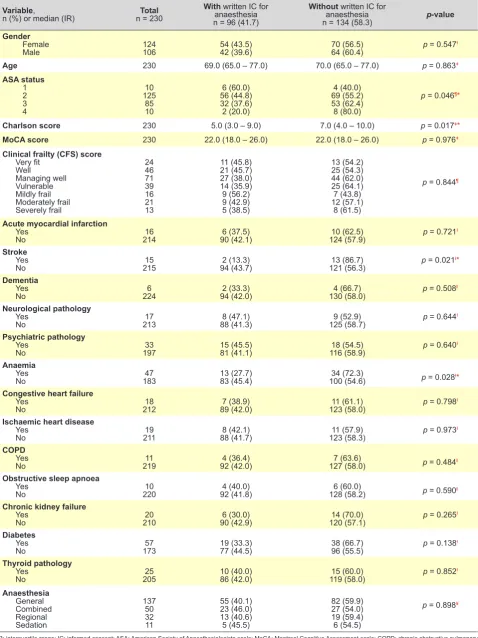
The absence of written consent for anaesthesia has
been associated with a higher prevalence of stroke (p =
0.021) and anaemia (p = 0.028), as well as higher
Charl-son scores19 (0.017) and ASA physical status scores(p =
0.046). No significant association has been found with the remaining variables or with patient’s history of neurologi-cal, psychiatric or cardiovascular pathology, as well as with higher CFS score. The results are shown in Table 1. The distribution of patients by the different departments is shown in Table 2 and no significant differences were found.
DISCUSSION
The presence of written consent for anaesthesia was only found in 96 (41.7%) patients and for surgery in 225 (97.8%). These results are in line with previous studies showing a higher implementation of consent for surgery
when compared to anaesthesia.12,26 The absence of written
consent for anaesthesia does not reflect the absence of pa-tient’s autonomy, as patients have given their consent for surgery, but possibly the lack of awareness of anaesthetists for this procedure.
A higher prevalence of patients with a history of anae-mia and stroke, in addition to higher ASA physical status score and Charlson score were found in patients in whom the absence of written consent for anaesthesia has been found. An increased risk of specific complications must be discussed with patients at the time when IC for anaesthesia is obtained.
Patients with a history of stroke present with impaired cerebral vascular territories and are particularly prone to the possible complications associated with intraoperative episodes of cerebral hypoperfusion, namely a new cerebral ischaemic episode and postoperative cognitive
dysfunc-tion.27–29
Preoperative anaemia is an independent risk factor of
adverse perioperative outcomes30–32 and the need for
perio-perative blood transfusion.33,34 These outcomes may be
potentiated by iatrogenic haemodilution itself, in addition to sympathetic and cardiac depression induced by
anaes-thesia.32,35 Specific factors that can contribute to choose a
certain anaesthesia technique must be taken into account in proposed anaesthesia, including (i) the severity and type of anaemia, (ii) the level of physiological compensation and (iii) the expected blood loss. A possible indication for perio-perative blood transfusion must be discussed with the pa-tient, complying and adequately recording the patient’s will. Poorer physical condition and more comorbidities are
globally presented by patients with higher Charlson19 and
ASA physical status scores, corresponding to a group of patients more likely to present with perioperative complica-tions, with the need for unplanned interventions and late-term complications with varying levels of severity. There-fore, these patients should be adequately informed on their condition, risks and alternatives and this should be a sys-tematic approach aimed at adjusting the information to the patient’s cognitive ability or, when adequate, providing the adequate information to the patient’s legal representative and obtaining consent.
No written IC both for surgery and anaesthesia was ob-tained in five out of the 230 patients included in the study (2.2%), in non-compliance by physician and nursing team with the indications for safe surgery by the World Health
Organization and the Norm 002/2013 of the DGS.36,37
Sig-nificant constraints may arise from this situation regarding the clarification of surgery’s lawfulness, as only free and IC allow for the transfer of risks to the patient, which would be
supported by physicians otherwise.4
IC is currently a legal prerequisite in any medical inter-vention and crucial to its legitimacy, which has been laid down by different legal and ethical norms, particularly by the
Code of Ethics (Código Deontológico) of the Portuguese
Medical Association,8 the Civil Code9 and the Penal Code,10
allowing to specify the scope of liability of physicians and
patients38,39; with consent, there is a conscious awareness
of the risks to which patients are previously informed.40 The
duty to inform is advocated both by disciplinary proceedings and by law. The areas of liability of anaesthetists are clearly defined and therefore directly and personally responds for
hypothetical medical malpractice.11
In Portugal, medical liability is ruled by the Estatuto
Disciplinar Médico41 in addition to the Code of Ethics ( Có-digo Deontológico) of the Portuguese Medical Association8; these instruments of regulation are mandatory for all the physicians registered with the Portuguese Medical Associa-tion and aim to ensure the adequacy of the clinical practice to the required quality parameters. The obligation of
obtain-ing the IC is advocated by the Estatuto7 (art. 135º) and the
Code of Ethics of the Portuguese Medical Association8 (art.
19 and 20). Disciplinary action shall be invoked in case of violation (by action or omission) of specific duties and rules of conduct of physicians and is of the exclusive
ARTIGO ORIGINAL Table 1 –Demographic and clinical characteristics (n = 230)
Variable,
n (%) or median (IR) n = 230Total
With written IC for anaesthesia n= 96 (41.7)
Without written IC for anaesthesia
n= 134 (58.3) p-value
Gender
Female
Male 124106 54 (43.5)42 (39.6) 70 (56.5)64 (60.4) p = 0.547
Ɨ
Age 230 69.0 (65.0 – 77.0) 70.0 (65.0 – 77.0) p = 0.863ǂ
ASA status
1 2 3 4
10 125
85 10
6 (60.0) 56 (44.8) 32 (37.6) 2 (20.0)
4 (40.0) 69 (55.2) 53 (62.4) 8 (80.0)
p = 0.046¶*
Charlson score 230 5.0 (3.0 – 9.0) 7.0 (4.0 – 10.0) p = 0.017ǂ*
MoCA score 230 22.0 (18.0 – 26.0) 22.0 (18.0 – 26.0) p = 0.976ǂ
Clinical frailty (CFS) score
Very fit Well
Managing well Vulnerable Mildly frail Moderately frail Severely frail
24 46 71 39 16 21 13
11 (45.8) 21 (45.7) 27 (38.0) 14 (35.9) 9 (56.2) 9 (42.9) 5 (38.5)
13 (54.2) 25 (54.3) 44 (62.0) 25 (64.1) 7 (43.8) 12 (57.1)
8 (61.5)
p = 0.844
Acute myocardial infarction
Yes
No 21416 90 (42.1)6 (37.5) 124 (57.9)10 (62.5) p = 0.721
Ɨ
Stroke
Yes
No 21515 94 (43.7)2 (13.3) 121 (56.3)13 (86.7) p = 0.021
Ɨ*
Dementia
Yes
No 2246 94 (42.0)2 (33.3) 130 (58.0)4 (66.7) p = 0.508
ǁ
Neurological pathology
Yes
No 21317 88 (41.3)8 (47.1) 125 (58.7)9 (52.9) p = 0.644
Ɨ
Psychiatric pathology
Yes
No 19733 15 (45.5)81 (41.1) 116 (58.9)18 (54.5) p = 0.640
Ɨ
Anaemia
Yes
No 18347 13 (27.7)83 (45.4) 100 (54.6)34 (72.3) p = 0.028Ɨ*
Congestive heart failure
Yes
No 21218 89 (42.0)7 (38.9) 123 (58.0)11 (61.1) p = 0.798
Ɨ
Ischaemic heart disease
Yes
No 21119 88 (41.7)8 (42.1) 123 (58.3)11 (57.9) p = 0.973
Ɨ
COPD
Yes
No 21911 92 (42.0)4 (36.4) 127 (58.0)7 (63.6) p = 0.484ǁ
Obstructive sleep apnoea
Yes
No 22010 92 (41.8)4 (40.0) 128 (58.2)6 (60.0) p = 0.590ǁ
Chronic kidney failure
Yes
No 21020 90 (42.9)6 (30.0) 120 (57.1)14 (70.0) p = 0.265Ɨ
Diabetes
Yes
No 17357 19 (33.3)77 (44.5) 38 (66.7)96 (55.5) p = 0.138
Ɨ
Thyroid pathology
Yes
No 20525 10 (40.0)86 (42.0) 119 (58.0)15 (60.0) p = 0.852Ɨ
Anaesthesia
General Combined Regional Sedation
137 50 32 11
55 (40.1) 23 (46.0) 13 (40.6) 5 (45.5)
82 (59.9) 27 (54.0) 19 (59.4) 6 (54.5)
p = 0.898¥
IR: interquartile range; IC: informed consent; ASA: American Society of Anaesthesiologists scale; MoCA: Montreal Cognitive Assessment scale; COPD: chronic obstructive pulmonary disease
ARTIGO ORIGINAL
As regards civil liability, the actions due to medical liabil-ity are mainly due to (i) malpractice or medical error or (ii) to violation of patient rights, namely the right of self-determina-tion and individual freedom, closely related to the principle
of IC.4 A voluntary conduct is required within civil liability
(contractual or non-contractual) from which any harm would illegally result to the patient, in addition to an adequate causal link between actions carried out by physicians and
the harm, leading to a proved physician fault.11
The Portuguese Civil Code (Código Civil)9 is aimed at
protecting the legal right to self-determination, physical and moral integrity of the human being. Surgeries are not ex-empt of risks that can aggravate patient’s health status and therefore the patient’s awareness on any of these possible complications is crucial. Informed consent has a crucial rel-evance to establish the legality of any medial or surgical
in-tervention (article 340 of the Código Civil).9 Its absence can
be deemed litigious for personal injury (due to violation of the right to self-determination and individual freedom) or for property damage (due to aggravated health status in con-text of arbitrary medical or surgical interventions). In such a case, physicians are obliged to compensate patients for the
damage produced with their action.43
According to the article 150 of the Portuguese Penal
Code (Código Penal),10 medical or surgical interventions
performed by physicians or other qualified professionals
with a therapeutic aim and according to the leges artis are
not considered as aggravated maltreatment. On the other hand, whenever an intervention is carried out according to the leges artis, under a technically adequate procedure, without the adequate patient’s consent (and validated ac-cording to the suppositions in the article 157), this would correspond to an arbitrary medical or surgical intervention and a crime against individual freedom, punishable by a prison sentence of up to three years or criminal fines. When physicians act allowing for a non-consented risk by patients
and this occurs, they can get involved into a legal action due to physical abuse by medical negligence (art. 148) or
negli-gent homicide (art. 137).44 Patient’s consent only enable to
rule out a violation of patient’s self-determination and not
any other legal assets.45
Despite the relevance of an IC form, decisions taken by foreign tribunals, namely in Australia and in the United King-dom46,47 have refused the value of these documents with the argument that these have been reduced to formalities and no appropriate information having been established (in some studies, less than half of the patients were informed
on the therapeutic alternatives)48 or patient awareness on
the situation to be consented for (written consent is signed by a significant percentage of patients without having
un-derstood the associated legal rights).48 There is still little
ex-perience with legal processes of medical liability related to IC (Court Judgements in 09/10/2014 and 7/03/2017 of the
Portuguese Supreme Court of Justice)49,50 and no process
has been carried out related to the absence of a written IC for anaesthesia.
Therefore, a simple signed form is not enough to ensure the validity of patient’s consent while appropriately informed and free, which had clearly been laid down by the Norm
015/2013 of the Portuguese Direção-Geral da Saúde,
up-dated in 04/11/20153: “the process of obtaining an IC does
not just involve the administrative procedure of obtaining the patient’s written or oral agreement for the proposed ac-tion, rather being part of a systematic and continuous at-titude of the healthcare professionals”.
Many patients are unaware of medical terms and have
wrong notions on the anaesthesia procedure13,51 and these
should be made clear. Understanding the anaesthesia pro-cedures, their benefits and adverse effects will be improved
by systematically obtaining IC for anaesthesia.13,14 Despite
no consensus on which information should be systemati-cally discussed with patients, it is always wise to discuss
Tablela 2 – Patient distribution per department (n = 230)
Department
n(%) n = 230Total
With written IC for anaesthesia n = 96 (41.7)
Without written IC for anaesthesia
n = 134 (58.3) p-value
General Surgery 92 37 (40.2) 55 (59.8)
p = 0.584ǁ
Vascular Surgery 21 8 (38.1) 13 (61.9)
Gynaecology 11 6 (54.5) 5 (45.5)
Orthopaedics 32 18 (56.3) 14 (43.8)
Plastic Surgery 14 5 (35.7) 9 (64.3)
Urology 53 19 (35.8) 34 (64.2)
Oral and Maxillofacial Surgery 7 3 (42.9) 4 (57.1)
Total, n (%) 230 96 (41.7) 134 (58.3)
ARTIGO ORIGINAL (i) the proposed procedure and for what reason; (ii) the ex-pected benefits and outcomes; (iii) the risks, complications
and consequences involved, in addition to (iv) information on alternatives. The pattern of each specific patient is what should determine any criteria regarding adequacy and suf-ficiency of shared information aimed at patient’s
self-deter-mination.42 The legal obligation should be transformed into
an encouragement to dialogue and shared information ade-quate to each particular situation and to patient’s concerns,
individual characteristics and probability of each outcome.38
These factors may influence the proposed anaesthesia, namely the decision of general or regional anaesthesia,
according to patient’s characteristics and risks.52 Far too
complex or overloaded forms, as well as highly technical language that would prevent patient understanding should be avoided.
Lack of adequate information and awareness of anaes-thesia can induce patient’s or patient representative dissat-isfaction regarding healthcare and therefore corresponding
to risk factors for dispute.53 In fact, dissatisfaction regarding
the information given on the different anaesthesia alterna-tives, in addition to risks and benefits of the procedure has
been confirmed in current literature.12 Poor consistency in
shared information by different anaesthetists from the same
institution has also been found.13 In certain contexts, as an
Inadequate communication between patients and
physi-cians may be the main cause for dispute,54 pre-anaesthesia
assessment in a specific consultation has even been rec-ommended by some authors, according to what has been
recommended by the norm no. 029/2013 of the Direção
Geral de Saúde, “Avaliação Pré-Anestésica Para Procedi-mentos Eletivos”.17
Apart from having to provide patients with adequate information, IC process should be adequately recorded. Maintaining clear records, namely kept within the patient’s medical record, is a crucial practice in medical approach, with a contribution to clarify the validity of a patient’s con-sent and adequate medical care. However, other authors have found that only a suboptimal percentage of physicians
actually follows these recommendations by routine.26,55 This
failure may prevent from reaching a clear conclusion on the IC validity.
Different constraints in obtaining an IC for anaesthesia have been described by anaesthetists –current work over-load in the national health system results in a frequent situ-ation in which the anaesthetist only meets the patient a few minutes before surgery, with no appropriate time or condi-tions to have an informed discussion and free from exter-nal constraints. Constraints regarding the selection of the information to be shared with patients have been described
by different anaesthetists in previous studies26 or regarding
communication barriers and the lack of time.55 Even though
these are the realities, constraints should not explain for the absence of IC as an ethical and legal imperative.
No differences were found in obtaining a written IC for anaesthesia between the different surgery procedures in this study, allowing for the conclusion that suboptimal
im-plementation of IC for anaesthesia cuts across the whole institution. An IC form previously designed by the Ethics Committee of the institution has been used, using a simple and available language, providing summarized data aimed at encouraging the oral discussion, designed for a system-atic use in clinical practice.
The fact that only the elderly population, a small number of patients and hospital departments, in addition to the fact that only one hospital has been considered were the major limitations of the study.
CONCLUSION
Even though considering the limitations of the study, a suboptimal implementation of written IC for anaesthe-sia was found, showing the need for widespread use and standardisation of the procedure to obtain an IC for anaes-thesia. Preoperative patient assessment, the systematic use of a specific IC for anaesthesia and its recording are crucial to improve patient’s awareness of the status of An-aesthesiology as a distinctive specialty in any medical or surgical intervention.
Obtaining the IC is an ethical, disciplinary and legal duty in any surgery, aimed at protecting patient’s self-determina-tion, recognised by different legal and ethical regulations. The anaesthetist’s autonomy has been laid down and has therefore the obligation to obtain patient’s IC for each pro-cedure. In order to be valid, consent should be adequately informed and recorded, contributing to prevent and clarify any possible litigious process. The absence of a valid IC is a violation of good medical practice and of patient’s individual freedom and disciplinary, civil or penal liability of the respon-sible physician could be invoked.
Despite constraints regarding its systematic implemen-tation, obtaining a written IC is very relevant and should not be neglected. The study of obtaining a written IC in a younger population would be very relevant, in order to es-tablish comparisons and to study possible underestimates of the discussion with older patients and their ability of self-determination. Knowing whether this reality cuts across oth-er Portuguese hospitals, including non-univoth-ersity hospitals, would certainly be relevant, in addition to the reasons for non-systematic implementation of consent for anaesthesia.
HUMAN AND ANIMAL PROTECTION
The authors declare that the followed procedures were according to regulations established by the Ethics and Clini-cal Research Committee and according to the Helsinki Dec-laration of the World Medical Association.
DATA CONFIDENTIALITY
The authors declare that they have followed the
ARTIGO ORIGINAL CONFLICTS OF INTEREST
The authors declare that there were no conflicts of inter-est in writing this manuscript.
FINANCIAL SUPPORT
The authors declare that there was no financial support in writing this manuscript.
REFERENCES
1. Entidade Reguladora da Saúde. Consentimento Informado - Relatório final. Maio de 2009. Lisboa: ERS; 2009.
2. Tait AR, Teig MK, Voepel-Lewis T. Informed consent for anesthesia: a review of practice and strategies for optimizing the consent process. Can J Anesth. 2014;61:832-42.
3. Direção Geral de Saúde. Consentimento informado, esclarecido e livre
dado por escrito. No 015/2013, atualizado a 04/11/2015. Lisboa: DGS;
2015.
4. Pereira AG. Responsabilidade médica e consentimento informado. Ónus da prova e nexo de causalidade. Centro de Estudos Jurídicos e Judiciários da Região Administrativa Especial de Macau, República Popular da China. Macau: CEJJ; 2008.
5. Assembleia da República. Convenção de Oviedo - Convenção sobre os Direitos do Homem e da Biomedicina (Conselho da Europa 1997). Diário da Repub. 2001;1:14-36.
6. Assembleia da República. Lei de Bases da Saúde. Lei no 48/90. Diário
da Republica. 1990;195:3452-9.
7. Assembleia da República. Estatuto da Ordem dos Médicos. Lei no
117/2015. Diário da Republica. 2015;169: 6520-79.
8. Ordem dos Médicos. Código Deontológico Da Ordem Dos Médicos.
Regulamento No 707/2016. Diário da Republica. 2016;139.
9. Lei No 43/2017. Código Civil Português. 73a Versão, de 2017-06-14.; 2017.
10. Lei No 94/2017. Código Penal Português. 45a Versão, de 2017-08-23.; 2017.
11. Nunes JM. Da responsabilidade dos médicos anestesiologistas - dos diversos tipos de responsabilidade, formas de apuramento e instâncias decisórias. Consentimento informado. Coimbra: Serviço de Anestesiologia, Hospitais da Universidade de Coimbra; 2006. 12. Tait AR, Voepel-Lewis T, Gauger V. Parental recall of anesthesia
information: Informing the practice of informed consent. Anesth Analg. 2011;112:918-23.
13. Zarnegar R, Brown MR, Henley M, Tidman V, Pathmanathan A. Patient perceptions and recall of consent for regional anaesthesia compared with consent for surgery. J R Soc Med. 2015;108:451-6.
14. Rampersad K, Chen D, Hariharan S. Efficacy of a separate informed consent for anesthesia services: A prospective study from the Caribbean. J Anaesthesiol Clin Pharmacol. 2016;32:18-24.
15. Klock PA, Roizen MF. More or better - educating the patient about the anesthesiologist’s role as perioperative physician. Anesth Analg. 1996;83:671-2.
16. Marco AP. Informed consent for surgical anesthesia care: Has the time come for separate consent? Anesth Analg. 2010;110:280-2.
17. Direção Geral de Saúde. Avaliação pré-anestésica para procedimentos eletivos. No 029/2013, atualizado a 24/04/2015. Lisboa: DGS; 2015. 18. Quan H, Li B, Couris CM, Fushimi K, Graham P, Hider P, et al. Updating
and validating the charlson comorbidity index and score for risk adjustment in hospital discharge abstracts using data from 6 countries. Am J Epidemiol. 2011;173:676-82.
19. Charlson ME, Pompei P, Ales KL, MacKenzie CR. A new method of classifying prognostic comorbidity in longitudinal studies: development and validation. J Chronic Dis. 1987;40:373-83.
20. Rockwood K, Song X, MacKnight C, Bergman H, Hogan DB, McDowell I, et al. A global clinical measure of fitness and frailty in elderly people. CMAJ. 2005;173:489-95.
21. Islam A, Muir-Hunter SW, Speechley M, Montero-Odasso M. Facilitating frailty identification: comparison of two methods among community-dwelling order adults. J Frailty Aging. 2014;3:216-21.
22. Freitas S, Simões MR, Marôco J, Alves L, Santana I. Construct validity of the Montreal Cognitive Assessment (MoCA). J Int Neuropsychol Soc. 2012;18:242-50.
23. Freitas S, Simões MR, Martins C, Vilar M, Santana I. Estudos de adaptação do Montreal Cognitive Assessment (MOCA) para a população portuguesa. Avaliação Psicol. 2010;9:345-57.
24. Nasreddine ZS, Phillips NA, Bédirian V, Charbonneau S, Whitehead V, Collin I, et al. The Montreal Cognitive Assessment, MoCA: a brief
screening tool for mild cognitive impairment. J Am Geriatr Soc. 2005;53:695-9.
25. Lichtenberg PA. Handbook of assessment in clinical gerontology. . 2nd
ed. Philadelphia: Academic Press; 2010.
26. Momin SG. Survey of anaesthesiologists’ reactions to implementation of laws related to anaesthesia practice. Indian J Anaesth. 2015;59:103-9. 27. Fleisher LA, Roizen MF. Essence of anesthesia practice. 3rd ed.
Philadelphia: Elsevier/Saunders; 2011.
28. Teles R, Mansilha A. Vantagens da anestesia locoregional relativamente à anestesia geral na endarterectomia carotídea. Angiol Cir Vasc. 2014;10:64-70.
29. Zugliani A. Anestesia em ortopedia e bloqueio de nervos periféricos. Philadelphia: Elsevier/Saunders; 2016.
30. Karkouti K, Wijeysundera DN, Beattie WS. Risk associated with preoperative anemia in cardiac surgery: a multicenter cohort study. Circulation. 2008;117:478-84.
31. Musallam KM, Tamim HM, Richards T, Spahn DR, Rosendaal FR, Habbal A, et al. Preoperative anaemia and postoperative outcomes in non-cardiac surgery: a retrospective cohort study. Lancet. 2011;378:1396-407.
32. Hans G, Jones N. Preoperative anaemia. Contin Educ Anaesth Critical Care Pain. 2013;13:71-4.
33. Priya Khanna M, Hébert PC, Fergusson DA. Review of the clinical practice literature on patient characteristics associated with perioperative allogeneic red blood cell transfusion. Transfus Med Rev. 2003;17:110-9. 34. Hare GM, Baker JE, Pavenski K. Assessment and treatment of
preoperative anemia: Continuing Professional Development. Can J Anesth. 2011;58:569-81.
35. Klick JC, Avery EG. Anesthetic considerations for the patient with anemia and coagulation disorders. In: Longnecker DE, Brown DL, Newman MF, Zapol WM, editors. Anesthesiology. 2nd ed. Philadelphia: McGraw-Hill Education; 2012.
36. Segura C, Vidas S. Orientações da OMS para a cirurgia segura 2009. Lisboa: DGS; 2009.
37. Waisel DB, Truog RD. The benefits of the explanation of the risks of anesthesia in the day surgery patient. J Clin Anesth. 1995;7:200-4 38. Minossi JG. Prevenção de conflitos médico-legais no exercício da
medicina. Rev Col Bras Cir. 2009;36:90-5.
39. Dias AS. Responsabilidade penal negligente em organizações complexas de cuidados de saúde. Responsabilidade Médica, Colóquio Da Sociedade de Advogados Morais Leitão, Galvão Teles, Soares Da Silva. 2012:52-57.
40. Estatuto Disciplinar da Ordem dos Médicos. Regulamento no 631/2016.
Diário Republica. 2016:130;20968-75.
41. Pereira AD. Responsabilidade Disciplinar Médica - Manual do Módulo. Curso de Responsabilidade Médica. Lisboa: Ordem dos Advogados; 2018.
42. Pereira AD. Pressupostos da Responsabilidade Civil Médica - Manual do Módulo. Curso de Responsabilidade Médica. Lisboa: Ordem dos Advogados; 2018.
43. Pereira AD. Responsabilidade Penal Médica - Manual do Módulo. Curso de Responsabilidade Médica. Lisboa: Ordem dos Advogados; 2018. 44. Raposo VL. Do regime das intervenções médico-cirúrgicas arbitrárias
no código penal Português. Rev Peru Ciencias Penal. 2013:1-22. 45. High Court of Australia. Rogers v. Whitaker. Aust Law J. 1993:47-55. 46. House of Lords of The United Kingdom. Chester v Afshar. London: HL;
2004.
47. Falagas ME, Akrivos PD, VAlexiou VG, Saridakis V, Moutos T, Peppas G, et al. Patients’ perception of quality of pre-operative informed consent in Athens, Greece: a pilot study. PLoS One. 2009;4:e8073.
48. Supremo Tribunal de Justiça. Processo 6669/11.3TBVNG.S1. Acórdão de 07-03-2017. Lisboa: STJ; 2017.
49. Supremo Tribunal de Justiça. Processo 3925/07.9TVPRT.P1.S1. Acórdão de 09-10-2014. Lisboa: STJ; 2014.
ARTIGO ORIGINAL
51. Green DS, MacKenzie CR. Nuances of informed consent: the paradigm of regional anesthesia. HSS J. 2007;3:115-8.
52. Stelfox HT, Gandhi TK, Orav EJ, Gustafson ML. The relation of patient satisfaction with complaints against physicians and malpractice lawsuits. Am J Med. 2005;118:1126-33.
53. Soin B, Thomson HJ, Smellie WA. Informed consent: a case for more education of the surgical team. Ann R Coll Surg Engl. 1993;75:62-5.
54. Houghton D, Williams S, Bennett J, Back G, Jones A. Informed consent: patients’ and junior doctors’ perceptions of the consent procedure. Clin Otolaryngol Allied Sci. 1997;22:515-8.