249
© 2018 by the Serbian Biological Society How to cite this article: Guan P, Sun L, Yang R, Gao H, Liu P, Zheng C, Zhang S. Global evolution and expression analysis of BTB-containing ankyrin repeat genes in plants. Arch Biol Sci. 2018;70(2):249-58.
Global evolution and expression analysis of BTB-containing ankyrin repeat genes in plants
Peiyan Guan, Lixue Sun, Rui Yang, Huiyang Gao, Pu Liu, Chengchao Zheng* and Shizhong Zhang#
State Key Laboratory of Crop Biology, Shandong Agricultural University, Tai’an, Shandong Province, 271018, P.R. China
Corresponding authors: *[email protected]; #[email protected]
Received: March 6, 2017; Revised: June 14, 2017; Accepted: September 26, 2017; Published online: October 30, 2017
Abstract: The ankyrin (ANK) repeat domain and bric-a-brac, tram-track, broad complex (BTB) domains, which are the most common protein motifs in eukaryotic proteins, regulate diverse developmental and biological processes in plants. In this study, 230 BTB-containing ANK (ANK-BTB) homologs were identified and categorized into two groups (class I and class II) in plants. Phylogenetic and comparative analysis found that ANK-BTB genes originated in bryophytes and ferns and their number expanded by segment duplications. All of the selected ANK-BTB genes were expressed in two or more
tested tissues, indicating that these genes are involved in various aspects of developmental processes in Arabidopsis.
Fur-thermore, the ANK-BTBgenes responded to abiotic stresses (NaCl, mannitol, heat and cold) and ABA treatments. To our
knowledge, this study is the first report of a genome-wide analysis of ANK-BTB genes. This study also provides valuable information to understand the classification, evolution and putative functions of the gene family.
Key words: ANK; BTB; bioinformatics; expression pattern; abiotic stress; evolution
INTRODUCTION
The ankyrin (ANK) repeat domain is a common pro-tein motif widely present in animals and plants [1]. The ANK repeats consist of 33 residues repeated in tandem that build specific secondary α-helices separat-ed by loops [2]. These repeats were initially discoverseparat-ed in two yeast cell-cycle regulators, namely, Swi6/Cdc10, and in the Drosophila signaling protein Notch [3]. Sev-eral amino acids in the ANK motifs are conserved, and correspond to hydrophobic positions required to maintain the secondary structure [2,4]. Binding within the ANK repeat is a common feature in inter- and/or intramolecular protein interactions [5, 6].
In plants, the ANK proteins are involved in vari-ous developmental and biological processes. AtAKR, the first reported ANK protein in Arabidopsis, is regulated by light and plays important roles in cell differentiation [7]. AtEMB506 is critical for embry-onic development [8]; AtNPR1 is a key regulator of systemic acquired resistance against P. syringae [9]; AtACD6 is a regulator and an effector of salicylic acid-mediated defense response [10]; AtITN1 affects the ABA-mediated production of reactive oxygen
species, which is important for salt-stress tolerance [11]; XBAT32 targets ethylene biosynthetic enzymes for proteasomal degradation to maintain appropriate levels of ethylene[12]; OsBIANK1 regulates disease resistance response in rice [13].
The bric-a-brac, tram-track, broad complex (BTB) domain, also known as the POZ domain, is widely distributed in eukaryotes [14]. This domain is an evolutionarily conserved protein interaction motif containing approximately 100 amino acid residues that form four α-helices connected by β-folds [15,16]. The BTB domain is mainly present in the N-terminal of the zinc finger protein and Kelch motif-containing proteins and is generally involved in homodimeriza-tion and heterodimerizahomodimeriza-tion [12,17-19]. BTB proteins have roles in diverse processes, including developmen-tal program, defense and abiotic stress response [20-22]. For example, AtETO1, AtEOL1 and AtEOL2 can regulate ethylene biosynthesis [23]; AtBT2 mediates multiple responses to nutrients, stresses and hormones [24]; AtBOP1, which contains the ANK and BTB do-mains, plays a key role in morphogenesis [25].
gene families in Arabidopsis and rice, respectively [16,26,27]. In the present study, the evolution and expression patterns of BTB-containing ANK genes (ANK-BTB) in 41 genome-sequenced plant species to investigate their potential functions in plant develop-ment and abiotic stress tolerance.
MATERIALS AND METHODS
Identification of ANK-BTB genes in 41 plant species
All genome information about 41 plant species was downloaded from the Phytozome database [28], which was used to construct a stand-alone database. The stand-alone version of the Basic Local Alignment Search Tool (BLAST) [29], which is available from the National Center for Biotechnology Information (NCBI), was used with an e-value cutoff of 1e-003. The known Arabidopsis ANK-BTB genes were used as query sequences to search similar sequences from the proteome and genome files.
All of the protein sequences derived from the col-lected candidate genes were examined using domain analysis programs, namely Protein family (Pfam) [30] and Simple Modular Architecture Research Tool (SMART) [31], with the default cutoff parameters. We analyzed the domains of all of the peptide sequences using a hidden Markov model (HMM) [32,33] model with Pfam searching. We then obtained sequences containing the typical BTB and ANK domains with Pfam numbers PF00651 and PF12796 (PF13857, PF13606 and PF13637), from the 41 genome se-quences using a Perl-based script. All of the protein sequences were compared with a known peptide by using ClustalX to verify the candidate genes [33]. Chromosomal location and gene structure of the ANK-BTB genes in Arabidopsis
Annotations of gene locations were retrieved from the .gff file of the Arabidopsis genome and mapped to the chromosomes using the chromosome mapping tool [34]. The gene structure was generated with the Gene Structure Display Server (GSDS) [35].
Sequence alignment and phylogenetic analysis
The peptide sequences were aligned using the ClustalX program with BLOSUM30 as protein-weight matrix [33]. The multiple sequence comparison by log-expec-tation (MUSCLE) program (version 3.52) was used to confirm the ClustalX results [36]. Phylogenetic trees of the protein sequences were constructed with the neighbor-joining (NJ) method using the Molecular Evolutionary Genetics Analysis program (MEGA5) [37]. The reliability of the obtained trees was tested by a bootstrapping method with 1000 replicates. Phyloge-netic and chromosomal location analyses were used to identify duplicated genes. The number of nonsynony-mous substitutions per nonsynonynonsynony-mous site (Ka) and synonymous substitutions per synonymous site (Ks) were calculated by DnaSP [38,39].
Plant materials
Arabidopsis thaliana (Col-0) seeds were surface-sterilized and sown on Murashige and Skoog (MS) medium. The seeds were stratified at 4°C for 2 days prior to germination. The seedlings were grown on MS medium or soil under long-day regime (16 h light/8 h dark cycle) at 23±1°C. All stress treatments were carried out using 2-week-old seedlings grown on MS medium. For different treatments, the whole seedlings were placed on filter paper soaked with 150 mM NaCl, 300 mM mannitol or 10 µM ABA for 3 or 12 h. For heat and cold treatments, the seedlings were placed at 37°C or 4°C for 3 or 12h.
RNA extraction and qRT-PCR analysis
Total RNA was isolated from different A. thaliana seedlings or tissues using the RNeasy plant mini kit (Qiagen, Germany) according to the manufacturer’s instructions. Real-time PCR analyses were performed with the SYBR® Premix Ex TaqTM (Takara) on the
RESULTS
Identification of ANK-BTB genes in 41 plant species
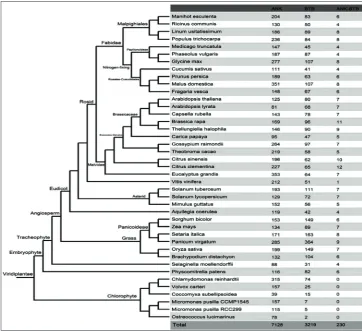
Comprehensive bioinformatics analysis indicated the presence of 7128 genes with the NK domain in 41 spe-cies from algae to angiosperms (Table S2). Meanwhile, 3220 genes with the BTB domain were identified ac-cording to conserved domain searching (Table S3). Several BTB members were observed in Micromonas pusilla and Ostreococcus lucimarinus. We also used Perl script to count the numbers and distributions of genes containing both the BTB and ANK domains. A total of 230 genes was found, distributed among 35 species from mosses and ferns to cruciferous spe-cies, in addition to single-celled algae. The highest number of genes was observed in Citrus clementina (with 12 members), whereas only one gene was found
in Vitis vinifera. Additionally, seven member-genes were obtained from Arabidopsis. To distinguish among the species, we provisionally named the Arabidopsis genes as AthANK-BTB1-7. The open reading frame (ORF) length, peptide length, genomic location and exon numbers are shown in Fig. 1 and Table S4. Phylogenetic relationships and comparative analysis of ANK-BTB genes in 41 species
In this study, the ANK-BTB genes originated from the ferns and were identified in 35 species of land plants. The results suggested that the ANK-BTB genes may be involved in the morphological characteristics of land plants and their adaptations for survival in cer-tain environments (Fig. 1). To clarify the phylogenetic relationship among the ANK-BTB genes and infer the evolutionary history of the gene family, we used the full-length protein sequences of the family members
in plants for constructing a joint unrooted phyloge-netic tree (Fig. 2). Based on the analysis of the tree, the proteins were categorized into two major groups (classes I and II), with well-supported bootstrap val-ues. Class I was divided into three subgroups (Ia, Ib and Ic), which were confirmed by maximum likeli-hood (ML) tree by full-length and conserved domain length (Fig. S1 and S2). Statistically, classes I and II contained 199 and 31 members, respectively (Fig. 2).
In class Ia, 74 (84%) genes were obtained from eudicots and only 14 genes were found in monocots (Fig. S3). In class Ia, 9 genes were obtained from Citrus clementina and 7 members were detected in Citrus sinensis, thereby implicating the distinct expansion of subclass Ia in Citrus. Classes Ib, Ic and II genes showed a wide range of species polymorphism, which included eudicots, monocots, ferns and bryophytes. In addition to several species (Medicago truncatula, Pha-seolus vulgaris, Malus domestica, and Vitis vinifera), all embryophytes contained only one class II gene, which suggested their highly conserved evolutionary feature (Table S5).
Structure classification of ANK-BTB genes in plants
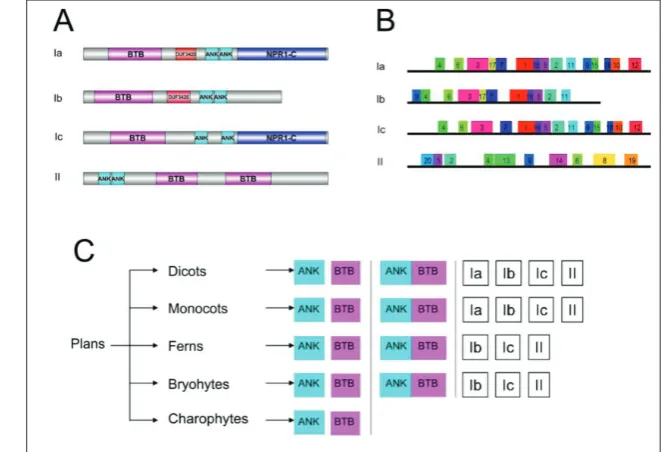
The protein structure of each ANK-BTB gene was also analyzed with SMART, Pfam and Multiple EM for Mo-tif Elicitation (MEME) (Fig. 3). Four known domains (ANK, BTB, DUF3420 and NPR1-C) were identified by SMART and Pfam (Fig. 3A). Class I contained only one BTB domain in the N-terminus, and two BTB domains were found in the C-terminus of class II. In classes Ia and Ib, the specific DUF3420 domain was located between BTB and ANK domains. In classes Ia and Ic, the proteins contained the NPR1-C domain in the C-terminus, which contained two conserved sequence motifs, LENRV and DLN. As shown in Figs. 3B and S3, we identified 20 conserved motifs using MEME. Motif 17 was found only in classes Ia and Ib; motifs 9, 10, 12, 15 and 18 were in the C-terminus of classes Ia and Ic. Moreover, motifs 8, 13, 14, 19, and 20 were specifically identified in class II.
Finally, we proposed the evolution model of conserved domain based on the evolutionary tree of ANK-BTBs (Fig. 3C). The ANK or BTB domain was
Fig. 2. Phylogenetic relationship of ANK-BTB in plants. The phylogenetic tree was constructed based on a com-plete protein sequence alignment of ANK-BTB by the neighbor-joining method with bootstrapping analysis (1000 replicates). The subgroups are marked by a colored background.
widespread in Viridiplantae. The genes with both ANK and BTB domains were first identified in bryo-phytes. Eventually, the monocot and dicots possessed the specific class Ia-type ANK-BTB structures. Chromosomal location and gene structure analysis of ANK-BTB genes in Arabidopsis
To investigate the relationships between genetic di-vergence within the AthANK-BTB family and gene duplication in Arabidopsis, we depicted the physical chromosomal locations of each AthANK-BTB member (Fig. 4A). Three segmental duplication events of seven genes were found in the Arabidopsis genome. All of these segmentally duplicated genes were observed as paralogs in the phylogenetic analysis. These results in-dicated that segmental duplications played important roles in AthANK-BTB expansion in the genome. To explore different selective constraints on the dupli-cated AthANK-BTB genes, we calculated the Ks and Ka/Ks ratios for each duplicated pair. A Ka/Ks ratio higher than 1 generally indicated accelerated evolu-tion with positive selecevolu-tion, a ratio equal to 1
corre-sponded to neutral selection, and a ratio less than 1 indicated negative or purifying selection. Ka/Ks ratios of all duplicated pairs were less than 1, thereby imply-ing strong purifyimply-ing selection (Table S6). These results suggested that the functions of the duplicated genes did not diverge over the course of genome evolution following the duplication events.
Structural analyses provided valuable informa-tion concerning duplicainforma-tion events when interpreting phylogenetic relationships within gene families. In the AthANK-BTB family, the number of exons varied from two (AthANK-BTB2 and AthANK-BTB6) to five (AthANK-BTB1) (Fig. 4B). Additionally, exon mem-bers within the duplicated pairs shared a similar exon structure and length (Table S4).
Expression pattern of the ANK-BTB genes in different tissues
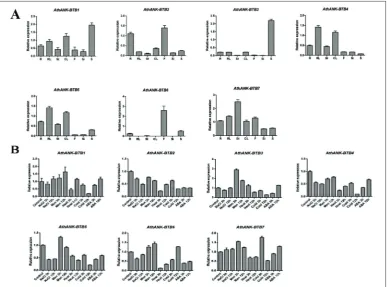
To investigate the spatial expression profiles of ANK-BTB in Arabidopsis developmental tissues, we analyzed the expression of the ANK-BTB genes in root, rosette leaf, cauline leaf, stem, flower, silique and seed using quantitative RT-PCR (qRT-PCR). As shown in Fig. 5A, most of the ANK-BTB genes can be detected with different transcript levels in all tissues. However, rela-tively high expression levels were observed in specific tissues, such as AthANK-BTB1 in seed, AthANK-BTB2 in root and flower, AthANK-BTB4 and AthANK-BTB5 in leaf and AthANK-BTB7 in the stem. Furthermore, only two members were exclusively observed in specific tissues, for instance, AthANK-BTB3 in the root and leaf and extremely high levels in dry seed, AthANK-BTB6 in the root, seed and at a relatively higher level in the flower. These results indicated the exclusive functions for AthANK-BTB3 and AthANK-BTB6 in seed storage and flower development, respectively.
Abiotic responsiveness of the ANK-BTB gene families
To explore the functional potentials of AthANK-BTB genes in various environmental abiotic stresses, we ex-amined their expression levels under different stresses, namely, NaCl, mannitol, 37°C, 4°C and ABA, in two-week-old wild-type seedlings through qRT-PCR anal-ysis. (Fig. 5B). For temperature stress, AthANK-BTB1,
AthANK-BTB2,and AthANK-BTB4 were expressed at 3 h of heat treatment and 12 h of cold treatment. Specifically, the mRNA level of AthANK-BTB3 was suppressed by heat treatment and low temperature and gradually declined over time. The expression of AthANK-BTB6 was rapidly inhibited at 3 h and signifi-cantly increased at 12 h by heat and cold treatments. Surprisingly, AthANK-BTB7 accumulated slightly at 3 h, and its expression was rapidly decreased by cold. In addition, the expression of AthANK-BTB3 was upregulated by mannitol and that of AthANK-BTB5 was downregulated by NaCl. Among all AthANK-BTB members, AthANK-BTB2, AthANK-BTB3, AthANK-BTB4 and AthANK-BTB6 were slightly suppressed by ABA. Thus, expression analysis demonstrated the diverse roles of AthANK-BTB genes in responses to different stresses, especially in temperature signaling.
DISCUSSION
The BTB and ANK proteins play important roles in the development and stress resistance of animals and
plants. In humans, the ZBTB1 protein, which contains the BTB domain, acts as a transcription repressor in the activation of CREB and cAMP-mediated signal transduction pathway to regulate cellular physiology [40]. The BTB-type protein CIBZ is involved in spi-nal cord injury in mouse [41]; ZBTB20 functions as a molecular switch for a pathway that induces invariant pyramidal neuron morphogenesis and suppression of cell fate transitions in newborn neurons [42]. In Arabidopsis, BACH1 (BTB-type gene) target genes are involved in the oxidative stress response and the control of cell cycle [43]. The BTB protein Keap1 is an adaptor participating in oxidative stress sensing [44]. Single-celled algae, particularly Micromonas pusilla and Ostreococcus lucimarinus, encode less BTB pro-teins. By contrast, the BTB domain is widely present in higher flowering plants and low single-celled plants. The large number of BTB members indicates that this domain plays important roles in vascular plants.
The ANK gene also exhibits important functions in eukaryotes; for example, TRPA1 is upregulated in colitis and its activation exerts protective roles in
humans [45]. Ankyrin-1 improves long-term beta-globin expression in hematopoietic stem cells for gene therapy of hemoglobinopathies in mouse [46]. In Ara-bidopsis, AtAKR2 regulates antioxidant metabolism during disease resistance and stress responses [47]. ACD6 can control defense responses against viru-lent bacteria [10,48]. NPR1, a positive regulator of acquired resistance responses, is a central activator of SA-regulated gene expression [9]. In rice, XB3 plays roles in Xa21-mediated immunity [49-51]. CaKR1, a pepper ANK gene, plays roles in both biotic and abi-otic stress responses [52]. Evolution analysis showed that the ANK domain was widespread in dicots and algae with large and conserved numbers. Therefore, the ANK domain, which has important functions in protein interactions, possesses highly conserved fea-tures during plant evolution.
Phylogenetic analysis of the genes containing both ANK and BTB domains showed that ANK-BTB genes originated in mosses and ferns; these homologs were divided into two groups, namely, classes I and II (Figs. 2 and 3C). Class I-type ankyrin proteins contained two ANK domains in the C-terminal and one BTB domain in the N-terminal (Fig. 3A). Further analysis of the Arabidopsis ANK-BTB members showed the collinear relationship among three pairs of class I genes, which suggested the large fragment duplication in the expansion of class I-type genes (Fig. 4A). The Ka/Ks ratio estimation implied that distinct selective pressures operated on class I ANK-BTB genes. Com-parisons between species counterparts revealed high Ka/Ks ratios, which indicated that ANK-BTB evolved under strong positive purifying selection (Table S6).
AtANK-BTB genes, except AtANK-BTB3 and AtANK-BTB6, were ubiquitously expressed in all the examined tissues, including roots, rosette leaves, stems, cauline leaves, floral organs, silique and seeds. AtANK-BTB3 was mostly expressed in seeds, and AtANK-BTB6 in floral organs (Fig. 5A). Hence, we supposed that AthANK-BTB3 may play a rolein seed storage, and AthANK-BTB6 may functionin flower development; The other five AthANK-BTBsmay play an important role in the whole life cycle of Ara-bidopsis, and they may be involved in plant growth and development processes. The first characterized ANK protein in plants was AKR, which is
associat-ed with the regulation of chloroplast differentiation [53]. The AKRP interacting partner protein EMB506 also consists of five ANK repeats, and it is essential for plant organogenesis and morphogenesis during developmental stages [54]. However, several studies have elucidated the function of ANK proteins during plant growth and development stages [55-58], but few of them play a regulatory role during stress condi-tions [59]. Comprehensive stress expression investiga-tion on Arabidopsis ANK-BTB genes implicated the putative characteristics in abiotic stresses (Fig. 5B). Remarkably, most of the AthANK-BTB members were regulated by heat or cold treatment, thereby suggesting a possible involvement in temperature signaling. AthANK-BTB2, AthANK-BTB3, AthANK-BTB4 and AthANK-BTB6 wereregulated by ABA, so theymay be involved in the ABA signaling pathway. AthANK-BTB3 and AthANK-BTB5 were upregulated by mannitol after 3 h of treatment and subsequently downregulated, but narrowed the gap to the control after 12 h of treatment. Thus, we predicted that these genes may be involved in osmotic stress adaptation. AKT1 is composed of five ANK repeats toward its C-terminus, and it plays a significant role in root K+
uptake [60-64]. The akt1 mutants display ABA hyper-sensitivity and enhanced drought tolerance [65]. ANK protein OXIDATIVE STRESS 2 plays a role in oxida-tive stress conditions [66]. In humans, ANK and BTB domains containing protein-2 inhibit the aggregation of α-synuclein and play a role in Parkinson’s disease [67]. BPOZ is involved in the development of leuke-mia through protein-protein interaction [68]. Thus, we propose that the Arabidopsis ANK-BTBgenes may have important functions in developmental and bio-logical processes.
Acknowledgments: This work was supported by the National
Natural Science Foundation in China (Grant No. 31401822).
Author contributions: Lixue Sun and Peiyan Guan contributed
equally to this work. Lixue Sun and Peiyan Guan designed the experiment and wrote the manuscript, Rui Yang, Huiyang Gao, and Pu Liu performed all of the experiments. All authors read and approved the final manuscript.
REFERENCES
1. Sedgwick SG, Smerdon SJ. The ankyrin repeat: a diversity of interactions on a common structural framework. Trends Biochem Sci.1999;24(8):311-16.
2. Mosavi LK, Minor P DL Jr, Eng ZY. Consensus-derived struc-tural determinants of the ankyrin repeat motif. Proc Natl Acad Sci U S A. 2002;99(25):16029-34.
3. Breeden L, Nasmyth K. Cell cycle control of the yeast HO gene: cis- and trans-acting regulators. Cell.1987;48(3):389-97. 4. Rohde K, Bork P. A fast, sensitive pattern-matching approach
for protein sequences. Comput Appl Biosci. 1993;9(2):183-9. 5. Desrosiers DC, Peng ZY. A binding free energy hot spot in the ankyrin repeat protein GABPbeta mediated protein-protein interaction. J Mol Biol. 2005;354(2):375-84.
6. Li J, Mahajan A, Tsai MD. Ankyrin repeat: a unique motif mediating protein-protein interactions. Biochemistry. 2006;45(51):15168-78.
7. Zhang H, Scheirer DC, Fowle WH, Goodman HM. Expres-sion of antisense or sense RNA of an ankyrin repeat-con-taining gene blocks chloroplast differentiation in Arabidopsis. Plant Cell. 1992;4(12):1575-88.
8. Albert S, Despres B, Guilleminot J, Bechtold N, Pelletier G, Delseny M, Devic M. The EMB 506 gene encodes a novel ankyrin repeat containing protein that is essential for the normal development of Arabidopsis embryos. Plant J. 1999;17(2):169-79.
9. Cao H, Glazebrook J, Clarke JD, Volko S, Dong X. The Arabi-dopsis NPR1 gene that controls systemic acquired resistance encodes a novel protein containing ankyrin repeats. Cell. 1997;88(1):57-63.
10. Lu H, Rate DN, Song JT, Greenberg JT. ACD6, a novel ankyrin protein, is a regulator and an effector of salicylic acid signaling in the Arabidopsis defense response. Plant Cell. 2003;15(10):2408-20.
11. Sakamoto H, Matsuda O, Iba K. ITN1, a novel gene encod-ing an ankyrin-repeat protein that affects the ABA-medi-ated production of reactive oxygen species and is involved in salt-stress tolerance in Arabidopsis thaliana. Plant J. 2008;56(3):411-22.
12. Lyzenga WJ, Booth JK, Stone SL. The Arabidopsis RING-type E3 ligase XBAT32 mediates the proteasomal degradation of the ethylene biosynthetic enzyme, 1-aminocyclopropane-1-carboxylate synthase 7. Plant J. 2012;71(1):23-34.
13. Zhang X, Li D, Zhang H, Wang X, Zheng Z, Song F. Molecu-lar characterization of rice OsBIANK1, encoding a plasma membrane-anchored ankyrin repeat protein, and its inducible expression in defense responses. Mol Biol Rep. 2010;37(2):653-60.
14. Li X, Peng H, Schultz DC, Lopez-Guisa JM, Rauscher FJ 3rd, Marmorstein R. Structure-function studies of the BTB/ POZ transcriptional repression domain from the promy-elocytic leukemia zinc finger oncoprotein. Cancer Res. 1999;59(20):5275-82.
15. Stogios PJ, Downs GS, Jauhal JJ, Nandra SK, Prive GG. Sequence and structural analysis of BTB domain proteins. Genome Biol.2005;6(10):R82.
16. Gingerich DJ, Hanada K, Shiu SH, Vierstra RD. Large-scale, lineage-specific expansion of a bric-a-brac/tramtrack/broad
complex ubiquitin-ligase gene family in rice. Plant Cell. 2007;19(8):2329-48.
17. Bardwell VJ, Treisman R. The POZ domain: a conserved pro-tein-protein interaction motif. Genes Dev. 1994;8(14):1664-77. 18. Alliel PM, Seddiqi N, Goudou D, Cifuentes-Diaz C, Romero N, Velasco E, Rieger F, Perin JP. Myoneurin, a novel mem-ber of the BTB/POZ-zinc finger family highly expressed
in human muscle. Biochem Biophys Res Commun.
2000;273(1):385-91.
19. Collins T, Stone JR, Williams AJ. All in the family: the
BTB/POZ, KRAB, and SCAN domains. Mol Cell Biol.
2001;21(11):3609-15.
20. Prasad ME, Schofield A, Lyzenga W, Liu H, Stone SL. Arabi-dopsis RING E3 ligase XBAT32 regulates lateral root produc-tion through its role in ethylene biosynthesis. Plant Physiol. 2010;153(4):1587-96.
21. Weber H, Hellmann H. Arabidopsis thaliana BTB/ POZ-MATH proteins interact with members of the ERF/AP2 transcription factor family. FEBS J.2009;276(22):6624-35. 22. Chevrier S, Corcoran LM. BTB-ZF transcription factors, a
growing family of regulators of early and late B-cell develop-ment. Immunol Cell Biol. 2014;92(6):481-8.
23. Christians MJ, Gingerich DJ, Hansen M, Binder BM, Kieber JJ, Vierstra RD. The BTB ubiquitin ligases ETO1, EOL1 and EOL2 act collectively to regulate ethylene biosynthesis in Ara-bidopsis by controlling type-2 ACC synthase levels. Plant J. 2009;57(2):332-45.
24. Mandadi KK, Misra A, Ren S, McKnight TD. BT2, a BTB pro-tein, mediates multiple responses to nutrients, stresses, and hormones in Arabidopsis. Plant Physiol. 2009;150(4):1930-9. 25. Ha CM, Jun JH, Nam HG, Fletcher JC. BLADE-ON-PETI-OLE1 encodes a BTB/POZ domain protein required for leaf morphogenesis in Arabidopsis thaliana. Plant Cell Physiol. 2004;45(10):1361-70.
26. Cai X, Zhang Y. Molecular evolution of the ankyrin gene fam-ily. Mol Biol Evol. 2006;23(3):550-8.
27. Huang J, Zhao X, Yu H, Ouyang Y, Wang L, Zhang Q. The ankyrin repeat gene family in rice: genome-wide identifica-tion, classification and expression profiling. Plant Mol Biol. 2009;71(3):207-26.
28. Goodstein DM, Shu S, Howson R, Neupane R, Hayes RD, Fazo J, Mitros T, Dirks W, Hellsten U, Putnam N, Rokhsar DS. Phytozome: a comparative platform for green plant genomics. Nucleic Acids Res. 2012;40:D1178-86.
29. Altschul SF, Gish W, Miller W, Myers EW, Lipman DJ. Basic local alignment search tool. J Mol Biol. 1990;215(3):403-10. 30. Punta M, Coggill PC, Eberhardt RY, Mistry J, Tate J, Boursnell
C, Pang N, Forslund K, Ceric G, Clements J, Heger A, Holm L, Sonnhammer EL, Eddy SR, Bateman A, Finn RD. The Pfam protein families database. Nucleic Acids Res. 2012;40:D290-301. 31. Letunic I, Doerks T, Bork P. SMART 7: recent updates to
the protein domain annotation resource. Nucleic Acids Res. 2012;40:D302-5.
32. Wu X, Song C, Wang B, Cheng J. Hidden Markov model used in protein sequence analysis. Sheng Wu Yi Xue Gong Cheng Xue Za Zhi. 2002;19(3):455-8.
34. Poole RL. The TAIR database. Methods Mol Biol. 2007;406:179-212.
35. Guo AY, Zhu QH, Chen X, Luo JC. [GSDS: a gene structure display server]. Yi Chuan. 2007;29(8):1023-6. Chinese. 36. Edgar RC. MUSCLE: multiple sequence alignment with
high accuracy and high throughput. Nucleic Acids Res. 2004;32(5):1792-7.
37. Tamura K, Peterson D, Peterson N, Stecher G, Nei M, Kumar S. MEGA5: molecular evolutionary genetics analysis using maximum likelihood, evolutionary distance, and maximum parsimony methods. Mol Biol Evol. 2011;28(10):2731-9. 38. Librado P, Rozas J. DnaSP v5: a software for
comprehen-sive analysis of DNA polymorphism data. Bioinformatics. 2009;25(11):1451-2.
39. Rozas J. DNA sequence polymorphism analysis using DnaSP. Methods MolBiol. 2009;537:337-50.
40. Liu Q, Yao F, Wang M, Zhou B, Cheng H, Wang W, Jin L, Lin Q, Wang JC. Novel human BTB/POZ domain-containing zinc finger protein ZBTB1 inhibits transcriptional activities of CRE. Mol Cell Biochem. 2011;357(1-2):405-14.
41. Cai Y, Li J, Yang S, Li P, Zhang X, Liu H. CIBZ, a novel BTB domain-containing protein, is involved in mouse spinal cord injury via mitochondrial pathway independent of p53 gene. PLoS One. 2012;7(3):e33156.
42. Nielsen JV, Nielsen FH, Ismail R, Noraberg J, Jensen NA. Hip-pocampus-like corticoneurogenesis induced by two isoforms of the BTB-zinc finger gene Zbtb20 in mice. Development. 2007;134(6):1133-40.
43. Warnatz HJ, Schmidt D, Manke T, Piccini I, Sultan M, Boro-dina T, Balzereit D, Wruck W, Soldatov A, Vingron M, Lehrach H, Yaspo ML. The BTB and CNC homology 1 (BACH1) target genes are involved in the oxidative stress response and in con-trol of the cell cycle. J Biol Chem. 2011;286(26):23521-32. 44. Cullinan SB, Gordan JD, Jin J, Harper JW, Diehl JA. The
Keap1-BTB protein is an adaptor that bridges Nrf2 to a Cul3-based E3 ligase: oxidative stress sensing by a Cul3-Keap1 ligase. Mol Cell Biol. 2004;24(19):8477-86.
45. Kun J, Szitter I, Kemény A, Perkecz A, Kereskai L, Pohóczky K, Vincze A, Gódi S, Szabó I, Szolcsányi J, Pintér E, Helyes Z. Upregulation of the transient receptor potential ankyrin 1 ion channel in the inflamed human and mouse colon and its protective roles. PLoS One. 2014;9(9):e108164.
46. Romero Z, Campo-Fernandez B, Wherley J, Kaufman ML, Urbinati F, Cooper AR, Hoban MD, Baldwin KM, Lumaquin D, Wang X, Senadheera S, Hollis RP, Kohn DB. The human ankyrin 1 promoter insulator sustains gene expression in a beta-globin lentiviral vector in hematopoietic stem cells. Mol Ther Methods Clin Dev. 2015;2:15012.
47. Yan J, Wang J, Zhang H: An ankyrin repeat-containing pro-tein plays a role in both disease resistance and antioxidation metabolism. Plant J. 2002;29(2):193-202.
48. Lu H, Liu Y, Greenberg JT. Structure-function analysis of the plasma membrane- localized Arabidopsis defense component ACD6. Plant J. 2005;44(5):798-809.
49. Hu H, Wang J, Shi C, Yuan C, Peng C, Yin J, Li W, He M, Ma B, Wang Y, Li S, Chen X. A receptor like kinase gene with expressional responsiveness on Xanthomonas oryzae pv.
ory-zae is essential for Xa21-mediated disease resistance. Rice (N Y). 2015;8(1):34.
50. Wang YS, Pi LY, Chen X, Chakrabarty PK, Jiang J, De Leon AL, Liu GZ, Li L, Benny U, Oard J, Ronald PC, Song WY. Rice XA21 binding protein 3 is a ubiquitin ligase required for full Xa21-mediated disease resistance. Plant Cell. 2006;18(12):3635-46.
51. Jiang Y, Chen X, Ding X, Wang Y, Chen Q, Song WY. The XA21 binding protein XB25 is required for maintaining XA21-mediated disease resistance. Plant J. 2013;73(5):814-23. 52. Seong ES, Choi D, Cho HS, Lim CK, Cho HJ, Wang MH.
Characterization of a stress-responsive ankyrin repeat-con-taining zinc finger protein of Capsicum annuum (CaKR1). J Biochem Mol Biol. 2007;40(6):952-8.
53. Zhang H, Scheirer DC, Fowle WH, Goodman, HM. Expres-sion of antisense or sense RNA of an ankyrin repeat-con-taining gene blocks chloroplast differentiation in Arabidopsis. Plant Cell. 1992;4(12):1575-88.
54. Garcion C, Guilleminot J, Kroj T, Parcy F, Giraudat J, Devic M. AKRP and EMB506 are two ankyrin repeat proteins essential for plastid differentiation and plant development in Arabidop-sis. Plant J. 2006;48(6):895-906.
55. Ha CM, Jun JH, Nam HG, Fletcher JC. BLADE-ON-PETI-OLE1 encodes a BTB/POZ domain protein required for leaf morphogenesis in Arabidopsis thaliana. Plant Cell Physiol. 2004;45(10):1361-70.
56. Ha CM, Kim GT, Kim BC, Jun JH, Soh MS, Ueno Y, Machida Y, Tsukaya H, Nam HG. The BLADE-ON-PETIOLE 1 gene controls leaf pattern formation through the modula-tion of meristematic activity in Arabidopsis. Development. 2003;130(1):161-72.
57. Nodzon LA, Xu WH, Wang Y, Pi LY, Chakrabarty PK, Song WY. The ubiquitin ligase XBAT32 regulates lateral root devel-opment in Arabidopsis. Plant J. 2004; 40(6);996-1006. 58. Bae W, Lee YJ, Kim D, Lee J, Kim S, Sohn EJ, Hwang Inhwan.
AKR2A-mediated import of chloroplast outer membrane proteins is essential for chloroplast biogenesis. Nat Cell Biol. 2008;10(2):220-7.
59.Sharma M, Pandey GK. Expansion and function of repeat domain proteins during stress and development in plants. Front Plant Sci. 2015;6(e114):487-504.
60. Hirsch RE, Lewis BD, Spalding EP, Sussman MR. A role for the AKT1 potassium channel in plant nutrition. Science. 1998;280(5365):918-21.
61. Spalding EP, Hirsch RE, Lewis DR, Qi Z, Sussman MR, Lewis BD. Potassium uptake supporting plant growth in the absence of AKT1 channel activity: inhibition by ammonium and stim-ulation by sodium. J Gen Physiol. 1999;113(6):909-18. 62. Gierth M, Maser P, Schroeder JI. The potassium transporter
AtHAK5 functions in K+ deprivation-induced high-affinity K+ uptake and AKT1 K+ channel contribution to K+ uptake kinet-ics in Arabidopsis roots. Plant Physiol. 2005;137(3):1105-14. 63. Rubio F, Nieves-Cordones M, Alemán F, Martínez V.
64. Alemán F, Nieves-Cordones M, Martínez V, Rubio F. Root K+ acquisition in plants: the Arabidopsis thaliana model. Plant Cell Physiol. 2011;52(9):1603-12.
65. Nieves-Cordones M, Caballero F, Martínez V, Rubio F. Dis-ruption of the Arabidopsis thaliana in ward-rectifier K+ chan-nel AKT1 improves plant responses to water stress. Plant Cell Physiol. 2012;53(2):423-32.
66. Blanvillain R, Wei S, Wei P, Kim JH, Ow DW. Stress tolerance to stress escape in plants: role of the OXS2 zinc-finger tran-scription factor family. EMBO J. 2011;30(18):3812-22. 67. Roy A, Pahan K. Ankyrin repeat and BTB/POZ domain
containing protein-2 inhibits the aggregation of
alpha-synuclein: implications for Parkinson’s disease. FEBS Lett. 2013;587(21):3567-74.
68. Dai KS, Wei W, Liew CC. Molecular cloning and character-ization of a novel human gene containing ankyrin repeat and double BTB/POZ domain. Biochem Biophys Res Commun. 2000;273(3):991-6.
Supplementary Information
Supplementary Tables and Figures can be accessed via the fol-lowing link: