Research Article
a
August
2017
Computer Science and Software Engineering
ISSN: 2277-128X (Volume-7, Issue-8)
Analysis of PDORP Routing Protocol for WSN
V. Balaji
Professor, Department of Electronics and Communication Engineering, SSJ Engineering College, Hyderabad,
Telangana, India
A. Ravi Kumar
Associate Professor, Department of Computer Science and Engineering, SSJ Engineering College, Hyderabad,
Telangana, India
DOI: 10.23956/ijarcsse/V7I8/0163
Abstract— In recent years, there has been a winged generation of research relating to wireless sensor networks (WSN), due to large-scale range of potential utilization there can be used for several applications such as, surveillance, hostile monitoring, target tracking, and security management. Sensor nodes can be defined as typically powered by batteries so it is having a limited amount of lifetime, and another problem can be considering is batteries cannot be recharged. The energy problem is extreme difficulty in wireless sensor networks. So we proposed advanced routing protocol PDORP, reduced the energy consumption as well as improving the quality of service (QoS), and better throughput which compared to another routing such as, LEACH, PEGASIS, DSR, and OLSR.
Keywords— Energy efficient, Sensor node, Routing, PDORP, Energy level, Network Lifetime.
I. INTRODUCTION
In the wireless sensor networks (WSN) [1] is a recent automation, which can be developed in short period of time. The wireless sensor networks consist of large number of multifunctional sensor nodes, because low cost, low power utilized in the real environment. The sensor nodes can be sensing the object or environment, collecting a information, and transmitting the data to the base station (BS). The flow chart of the operation is shown in the Figure1. All of the sensor nodes are battery powered, because direct supply cannot be connected to the sensor nodes as a same time battery power can be drained easily. It is impossible to alternation of batteries and monitoring the day by day. So to reduce the energy consumption is real important for the wireless sensor networks application as shown in the Figure 2.
Figure 1 . Flow Chart of Energy Figure 2. Energy Consumption Processing in Sensor Node
There are number [2]of protocols can be generate to improving the energy efficient in the sensor nodes. Such as, cluster established routing protocol, chain established routing protocol, shortest path routing protocol, and hybrid clustering based routing protocol, whatever renowned to become better the energy effectiveness and extending the network lifetime. But its having the significant problem can be occurred in this routing protocol. So to proposed method is PEGASIS-DSR Optimized Routing Protocol, can be consists of proactive and reactive routing method. PDORP can be reduce the energy consumption as well as increasing better throughput, minimized the delay, reduce the bit error rate, and increasing the network lifetime.
II. METHODOLOGY
ISSN(E): 2277-128X, ISSN(P): 2277-6451, DOI: 10.23956/ijarcsse/V7I8/0163, pp. 347-351
The source node S Figure 3 Route Discovery desire to transmit the information to the destination node D. so the DSR protocol can be handle a route discovery mechanism. The route discovery mechanism, first searching a optimal path and shortest path to reach the destination node. If its possible the source node sends the data to the destination. Otherwise it can be searching again to the optimal path of the network.
Figure 3. Node Creation
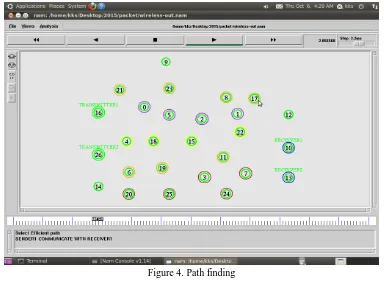
The Route maintenance is a subordinate mechanism of the dynamic source routing protocol. It can be keep up a optimal path of the source node S and destination node D. Figure 4 Route Maintenance, the source node S can be transmits the information to the destination node D. The optimum path and shortened path is consists of the DSR is [SAEFD].
Figure 4. Path finding
So the DSR protocol is very easy and understandable protocol. The advantages of the dynamic source routing protocol can be reduce a congestion& retransmission of the data, and the disadvantages of DSR considering cannot be changed another optimal path.
ISSN(E): 2277-128X, ISSN(P): 2277-6451, DOI: 10.23956/ijarcsse/V7I8/0163, pp. 347-351
information, and transmitting data. LEACH is a cluster based routing protocol, all the nodes in the network is arranged in the cluster heads. The cluster heads formation is election based and rotator formation in the network. There is one node is a cluster head. When sensor nodes are gathering the information and sends to the cluster heads (CH). The cluster heads(CH) performing the signal processing function and sends the data through the remote base station. LEACH protocol functions can be divided in to two rounds as follows, 1) Setup phase 2) Steady state phase. LEACH protocol is a randomized selection of cluster heads, it can capable of performing to prevent the draining the battery of unspecified one of the sensor nodes. The benefit of the leach protocol is better energy efficiency, better throughput, reduce the energy consumption. The losses of the leach routing protocol, sometimes difficulty can be occurred in the role of cluster head (CH) formation. It cannot use in the abundant environment regions. Power efficient gathering [6] in sensor information system (PEGASIS) is a improved routing protocol of LEACH. PEGASIS is a chain based routing protocol and it can be avoids a cluster head formation system. The basic intention of the PEGASIS routing protocol, to extends a network lifetime of the network and reduce a energy consumption. The chain based routing protocol be in possession a singular leader node, it can be aggregate a information from the all the sensor nodes and it can be transmitting to the base station. The PEGASIS is utilizing a greedy algorithm and collaborative techniques.
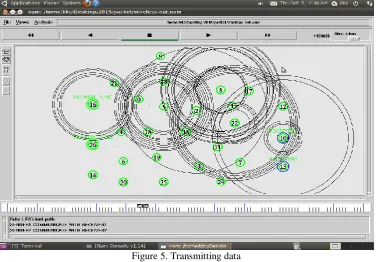
Figure 5. Transmitting data
So if any of the nodes can be lack of success in the network during the transmitting the data, the sensor node can be exchanged and cannot be losed. The sensor nodes working least possible energy to transmitting and receiving the data. The advantages of the PEGASIS routing protocol is eliminating the packet overhead and decreases the number of retransmission. The disadvantages of this protocol, it introduced significant delay.
III. PROPOSED PROTOCOL
All the networks[7] having the assured lifetime concurrently with activity which nodes have restricted energy by using of gathering the information, processing, and transmitting the information. So all the sensor ideal must be outline to be intensely energy efficient. To shorten energy dissipation, protocols should be identifying the node failures, fault- tolerant, and to maximize system lifetime. The proposed method is exploiting the characteristics of both Proactive (PEGASIS) and Reactive (DSR) routing protocol
ISSN(E): 2277-128X, ISSN(P): 2277-6451, DOI: 10.23956/ijarcsse/V7I8/0163, pp. 347-351
The essential improvement of the PDORP,
1) To decreasing the communication distances between the nodes. 2) Using the directional transmission approach.
3) It has a PEGASIS and DSR routing methodology
4) GA and BFO algorithm is applied so to identify the energy optimal paths.
The importance of essential improvement in the PDORP, a sensor nodes are insufferable work as well as run of energy. The energy consumption is one of the main reasons of the node failure. It causes the information cannot be reached into the destination. So the improvement routing protocol is very important to the WSN. PEGASIS-DSR Optimized Routing Protocol is ability to perform the efficient, and reduce the energy consumption.
There are four types of algorithm using in the PDORP routing protocol as follows, 1) Network creation
2) Path finding
3) Route cache DSR integration 4) Hybrid algorithm
1) Network Creation:
In the network creation algorithm, to create a network in the randomly deployed nodes. To well establish of the distance d, all of the nodes distance is compared to the threshold distance. This comparison result to established only on when their distance is less than or equal to the threshold value of the distance. So all the nodes are connected on the shortest distance value.
2) Path Finding:
The path finding can be used to establishing the route for the data transmission. The path finding algorithm, investing the optimal path to reach the source to destination. The optimal path can be selected in the large coverage set of nodes. As a result of the wireless sensor networks having hundreds or thousands of sensors. Transmission can be occurred in only on the source and destination nodes under the coverage set, in different circumstances to finding t a another optimal path.
3) Route Cache Dsr Integration:
When a data can be transmits from source node to destination node, the source nodes can be calculates the distance from accomplished all neighbors and communicate the information to the node which length is less than or equal to the threshold value, otherwise the node can be searching the another optimal path. This optimal path is added to the trust list of the first round, and the every round if any possible optimal path it can be added to the trust list. This can be used to not searching the every round of the optimal path.
4) Hybrid Algorithm
GA and BFO can be proposed in hybrid algorithm, it can be used to create fitness value of trust list of the optimal path.
IV. DISCUSSION & RESULTS
The simulation result provides a performance of various routing protocol is compared to the PDORP routing protocol. This can be analysis a Bit error rate, End to end delay, Energy consumption and Better throughput of the PDORP is compared to the various routing protocol. PDORP can be provides a better results than other routing protocol. The following parameters are used to extend the network lifetime of the wireless sensor networks.
From the above following parameters are used in the network simulator(NS2).
V. CONCLUSION
Our proposed energy efficient routing protocol can be performed in better than another routing protocol. The PEGASIS-DSR methodology is provides to improve the better throughput, reducing the end to end delay, reduce the bit error rate, and mainly reduce the energy consumption so it can be extend the network lifetime is compare to the other protocols such as LEACH, DSR, OLSR, PRGASIS.
PARAMETERS VALUES
ISSN(E): 2277-128X, ISSN(P): 2277-6451, DOI: 10.23956/ijarcsse/V7I8/0163, pp. 347-351 REFERENCES
[1] P.Mathumathy, Dr.D.Sivakumar, “A comparative Analysis of Clustering based Routing Techniques for WSN” vol 3, issue 10, October 2012.
[2] Subashree Rath, Chinmaya Kumar Nayak, Manoranjan Pradhan, “Energy Hole Minimization in WSN using Hierarchical Routing Protocols” vol.3,issue 2, Feb 2016.
[3]. Ravindra Prakash Gupta, Dr. Virendra Kumar Sharma and Vijay Mohan Shrimal, “investigation of Different Parameters of Dynamic Source Routing With varied Terrain Areas and Pause Time for Wireless Sensor Networks”, Vol.1,Issue.2, PP- 626-631.
[4] M.Shankar, Dr.M.Sridar, Dr.M.Rajani, “Performance Evaluation of LEACH protocol in Wireless Network” Vol. 3, Issue 1, January 2012.
[5] Vibha Nehra & Ajay K. Sharma, “ PEGASIS- E: Power Efficient Gathering in Sensor Information System Extended”, Vol 13,Issue 15, version 1.0,year 2013.
[6] Jamal N. Al-Karaki Ahemed E.Kamal, “Routing Techniques in Wireless Sensor Networks: A Survey”, Nov 2010.