Volume 42 (2011)
Proceedings of the
4th International Workshop on
Multi-Paradigm Modeling
(MPM 2010)
Towards Transformation Rule Composition
Mark Asztalos, Eugene Syriani, Manuel Wimmer and Marouane Kessentini
13 pages
Guest Editors: Vasco Amaral, Hans Vangheluwe, Cécile Hardebolle, Lazlo Lengyel Managing Editors: Tiziana Margaria, Julia Padberg, Gabriele Taentzer
Towards Transformation Rule Composition
Mark Asztalos1, Eugene Syriani2, Manuel Wimmer3and Marouane Kessentini4
1Budapest University of Technology and Economics, Budapest 1111, Hungary
2McGill University, Montréal, Québec, Canada H3A 2A7
3Vienna University of Technology, 1040 Wien, Austria
4DIRO, Université de Montréal, Montréal, Québec, Canada H3T 1J4
Abstract: Many model transformation problems require different intermediate transformation steps. For example, platform-specific models (PSM) are often gener-ated from platform-independent models (PIM) by chains of model transformations. This requires the presence of several intermediate meta-models between those of the PIM and the PSM. Thus, most of the effort is needed to define a transformation mechanism for each intermediate step. The solution proposed in this paper is to investigate whether it is possible to generate a single transformation from a chain of transformations, solely involving the initial PIM and final PSM meta-models. The presented work focuses on the composition of transformations at the rule level. We apply the automatic procedure for composing rules in the context of the evolution of the Enterprise Java Beans (EJB) language, transforming UML models into EJB 2.0 models and then to EJB 3.0 models.
Keywords:rule composition, transformation chain, transitive transformation
1
Introduction
The goal of this paper is to reduce the manual effort of shortening transformation chains by eliminating intermediate transformation steps. The presented work proposes to compose a chain of transformations into one transformation that does not involve any intermediary meta-model. In particular, this is done by computing the transitive transformation of two given transformations.
In Section2, we first define the composition of transformations in general. Section3reduces the problem to the composition of rules by (1) elaborating on the criteria for composing graph transformation rules and (2) presenting an automatic procedure to compose such rules into one. In Section 4, we illustrate this approach in the context of the evolution of the Enterprise Java Beans (EJB) language, transforming UML models into EJB 2.0 models and then to EJB 3.0 models. Section5is dedicated to the related work and we conclude in Section6.
2
Transformation Composition
In this section, we define a composition operator to precisely specify the meaning of a transfor-mation composition. This operation is applied in the context of a chain of model transfortransfor-mations as defined below.
Definition 1 (Transformation chain). Let Tn=hT1,T2, . . . ,Tnin∈N be an ordered sequence of transformations where each Ti defines a mapping from a meta-modelMi to a different
meta-modelMi+1. We denote such atransformation chainasM1
T1
→M2→T2 M3→T3 . . .→Tn Mn+1. Note that we enforce that all the meta-models involved in the chainTnbe different from one another,
i.e.,each transformation must beexogenous[MV06].
Using the previous notation, we callMithe domain ofTiandMi+1its co-domain. The trans-formation is applied on a modelmiconforming to its meta-modelMiand results in a new model
mi+1=Ti(mi)conforming to its meta-modelMi+1. Note that transformations, transformation rules, as well as the pre- and post-condition patterns of the rules are also considered as models conforming to their respective meta-models [KMS+10].
The presented approach assumes that each transformation in the chain is specified using al-gebraic graph transformation rules. The models involved are represented as graph objects in the category of typed attributed graphs as defined in [EEPT06]. In the remainder of the paper, a modelmand its element graph Gwill be used interchangeably. The typed attributed graph G
consists of a set of nodesV(G) and edgesE(G), where each node conforms to a specific node type in a type graph (representingM, the meta-model ofm) and can hold attribute values. We however require that graph edges be partitioned in two setsE(G) =Em(G)∪Λ(G),
distinguish-ingtrace edgesΛ(G)from the edgesEm(G) conforming to those defined in the type graph. A
trace edge represents a traceability link connecting any two nodes regardless of their type. While a transformation is applied, traceability links are created such that any newly created element must have at least a traceability link1.
Definition 2(Transformation composition). LetT1 andT2 be two consecutive transformations in a transformation chain such thatM1→T1
M2→T2
M3. We denoteT0 =T2•T1 thecomposed
1 Traceability links can be created implicitly such as in [JK06]. Otherwise, their creation must be explicitly specified
transformationofT1withT2, following the composition operator•which satisfies thesequence,
elimination, andtransitivitycriteria as defined below.
We describe the application criteria of the composition operator given an arbitrary input model
m1forT1,m2=T1(m1), andm3=T2(m2), wherem1,m2,andm3 conform toM1,M2,andM3 respectively. We denotem0=T2•T1(m1)be the resulting model after the composition. In the case where traceability links are created explicitly in the rules, ˆm represents the graph model isomorphic tomwithout any trace edge.
Sequence There shall exist three injective graph morphisms(seqi)i=(1,2,3)that must be defined
as: seq1:m1→m0,seq2: ˆm3−mˆ2−mˆ1→m0, andseq3: ˆm0→m3. seq1ensures that the input model is preserved. seq2 ensures that all the elements fromM3produced byT2 are present inm0.seq3ensures thatm0contains no other elements than those found inm3.
Elimination There should not be any morphism elem:m2−mˆ1 →m0. That is, m0 shall not contain any occurrence of an element fromM2. Moreover, no traceability links involving elements fromM2shall be present.
Transitivity We denote byλi j a traceability link (trace edge) between an element frommi and
an element frommj. The following predicate must hold:∃λ12∈Λ(m3)∧ ∃λ23∈Λ(m3)⇒
∃λ13∈Λ(m0). This ensures the transitive closure of traceability links,i.e.,for any instance element ofM2inm3, if it is connected through trace edges to both an instance element of M1andan instance element ofM3, thenm0must have a trace edge between the latter two instance elements.
The sequence criterion ensures soundness and completeness of the composition operator. The elimination criterion ensures that the resulting transformation is independent from any interme-diate meta-model. Finally, the transitivity criterion ensures that traceability links correctly map the source and target model elements of the composed transformationT0.
The following generalizes the transformation composition definition to an arbitrary number of transformations.
Definition 3(Transformation chain composition). Given the chainTn=hT1,T2, . . . ,Tnin∈N, the composed transformation ofTnis a transformationT0=Tn•(Tn−1•. . .(T3•(T2•T1)). . .). This can be written in shortT0=Tn•Tn−1•. . .•T3•T2•T1.
3
Rule Composition
3.1 Criteria for Rule Composability
In the following, we assume that rewriting rules or productions are defined as presented in [EEPT06]. This means that a rule p= (L←K →R) consists of three objects in the category of typed attributed graphs: the left hand side (L), the interface K, and the right hand side (R) objects respectively. In this paper, we assume that each transformation transforms an instance of one metamodel into an instance of another, therefore, the objectsL,K, andRmay contain elements from both the source and the target metamodel of the current transformation.
To apply the composition operator on two individual rules, we assume that each of the trans-formations involved consists of a single rule for sake of completeness:T1={r1}andT2={r2}. The procedure assumes that the rulesr1andr2are monotonically increasing,i.e.,they can only create new elements and/or modify attribute values. Moreover, all traceability links created dur-ing the application ofT1 andT2 shall be preserved. The output of the composition procedure is a new transformationT3=T2•T1={r2} • {r1}={r3}consisting of a single rule. The fol-lowing proposition specifies the necessary condition for the composition procedure to satisfy Definition2.
Proposition 1(Composability condition). Two rulesr1=L1←K1→R1andr2=L2←K2→R2 satisfy the composability condition if there exists a partial morphismn:L2→R1such that:
• the domain ofnis a subgraph ofL2, which consists of all the elements that is fromM2,
• the co-domain ofnis a subgraph ofR1consisting of elements only fromM2,
• the mapping from the domain to the co-domain ofnis a total injective morphism.
The formal definition of the traditional composition of two sequential rewriting rules is de-scribed in [EEPT06], this composition is called the E-concurrent production. The definition states that given two rules p1 andp2, then they can be composed into a new rulep= (L,K,R). Informally, the pis composed along a new graph objectE, which is produced by jointly surjec-tive morphisms fromR1—the right-hand side (RHS) of p1—andL2—the left-hand side (LHS) ofp2. The application of the new rule is equal with the sequential application of the two original rules. However, there are often more than one possible compositions of the rules, because of the non-determinism of the matches.
To satisfy the elimination and transitivity criteria of Definition2, the sub-procedure in Algo-rithm1is required:
Algorithm 1eliminate(m)
1: for allλ12,λ23∈Λ(m)do 2: iftrg(λ12) =src(λ23)then
3: createλ13such thatsrc(λ13) =src(λ12)andtrg(λ13) =trg(λ23)
4: Λ(m)←Λ(m)∪ {λ13} − {λ12,λ23} 5: V(m)←V(m)− {trg(λ12)} 6: end if
7: end for
Given a modelm, the elimination procedure performs two runs over the trace edges inm. In the first run (lines 1 to 7), it first looks for a trace edgeλ12 linking an element conforming to M1, saye1, to an element conforming toM2, saye2 and another trace edge λ23 linking e2 to an element conforming toM3, saye3. It then creates the transitive trace edgeλ13, removes the two other traceability edges as well ase2. In the second run, the elimination procedure looks for all remaining trace links involvingM1 andM2 elements and removes them fromm. Note that there cannot be any trace edge in the formλ23 remaining after the first run, since any element fromM2must be linked to an element fromM1by construction. Therefore after the elimination procedure terminates, the only remaining trace edges inmlink elements fromM1 to elements fromM3.
3.2 Composition Procedure
Let r1=L1←K1→R1 andr2=L2 ←K2 →R2 be two rules that satisfy the composability
conditionof Proposition1. We want to produce the composite ruler3such that{r3}={r2}•{r1} as defined in Section2.
Algorithm 2compose(r1,r2)
1: compute the E-based composition (L3,K3,R3) ofr1andr2such thatE=R1
2: K3←R1
3: L3←eliminate(L1) 4: R←φ
5: r02←r2extended withR2as a NAC, if not present
6: repeat
7: R3←applyr02exhaustively onE
8: eliminate(R3) 9: R←R∪ {(L3,K3,R3)}
10: untilall application sequences ofr02have been exhausted onE
11: return R
Algorithm 2produces the set of all possible compositions ofr1 andr2. r2 is extended with a negative application condition (NAC) corresponding to its RHS. This ensures thatr2 is only applied once on every match found inE. It is worth noting that there can be differentR3’s even ifr20 is applied exhaustively onE, if the order of application affects the result.
Before analyzing the algorithm, we demonstrate its operation on the composition of two sim-ple rulesR1andR2presented in Figure1. LetR02be ruleR2extended by the NAC which consists of the RHS ofR2. By Algorithm2, the E graph is RHS ofR1. If we modifyR1 by applying
R02once on its RHS, we get ruleR. However, we applyR02exhaustively, therefore, RHS ofRis modified again, which results in ruleR0. Note that there are no other possible matches, because of the NAC inR02. The next step is the application of the elimination algorithm, which performs the transitive closure on the trace edges. RHS ofR0is eliminated, which results in ruleR00.
The lemmas below validate the composition procedure. Lemma1ensures that the procedure will output all possible composed rulesr3and Lemma2ensures its correctness.
b1:T2
… a1:T1 a1:T1 T … b:T2 b:T2 T c:T3
R1 R2
b2:T2
b1:T2 ’
c:T3 T
’’
c:T3 b1:T2 T c:T3
… a1:T1 a1:T1
b2:T2 T R’
c:T3 T
… a1:T1 a1:T1 T R’’
c:T3
… a1:T1 a1:T1
b2:T2 T R
b2:T2 T c:T3 c:T3
b2:T2
Figure 1: Example for rule composition.
Proof. Assume that there is a possible E-based compositionr=L←K→R such that the E-graphE6=R1. This implies that∃e∈E:e∈/R1whereecan be any type of element in the graph.
E is produced by jointly surjective morphisms fromR1 andL2; thuse∈L2. Moreover,eis an element conforming toM2as it is the domain ofr2. Howevere∈/R1, which implies thate∈L, according to the definition of the E-concurrent production. ButLcannot contain elements from M2 because if it did, the input model would contain elements conforming to M2, which is a contradiction.
Lemma 2. The result of the composition procedure{r3}={r2} • {r1}satisfies Definition2.
Proof. Assume that a modelm1is processed by the transformationsT1andT2through a possible traditional E-based compositionr03of the rulesr1andr2. Letr3be a rule computed by applying the elimination procedure on the LHS, RHS, and interface graph ofr03. Let T3={r3}, m2=
T1(m1), m3=T2(m2), and m0 =T3(m1). We shall now prove that T3 satisfies the sequence, elimination, and transitivity criteria.
• Sequence Criterion: ∃seq1:m1→m0, becauseL3=K3and hence the input modelm1 is not modified.∃seq2: ˆm3−mˆ2−mˆ1→m0as no elements fromr03have been deleted during the elimination that was performed to produce r3. Moreover,∃seq3: ˆm0→m
3 sinceR3 contains elements conforming toM3because of the exhaustive application ofr02.
• Elimination Criterion: m0does not contain any element fromM2since applying the elim-ination procedure on r03 ensures that all elements from the intermediate meta-model are removed from it.
• TheTransitivity Criterionis also satisfied because the elimination procedure generates all the traceability links required by the condition.
When NACs come into play inr1orr2, we distinguish the following case:
• If there is a NAC inr1 and it corresponds to R1, then we extend each composite ruler3 with a NAC corresponding toR3.
• If there is a NAC inr2and it corresponds toR2, then it is taken into account when applying
r2toE.
4
Application
We now apply the composition approach presented in Section3 in the following scenario. A company has developed a transformationT1for transforming UML class diagrams to Enterprise Java Beans (EJB) 2.0. However, after some time, the company decided to use EJB 3.0 due to several simplifications of the new version of the standard. Thus, they developed a transformation
T2for migrating existing EJB 2.0 models to EJB 3.0 models. However, to support the generation of new EJB 3.0 models from UML class diagrams, they would have to implement a dedicated transformation T3, if applying the transformation chainhT1,T2i is undesired. Reasons for this may be related to performance issues for ensuring rapid generation of EJB 3.0 models. Also, direct traceability between UML models and EJB 3.0 models is desired since EJB 2.0 instances would become obsolete.
4.1 Involved Artefacts
EJB 3 t d l UML metamodel EJB 3 metamodel
T3
?
EJB 2 metamodel
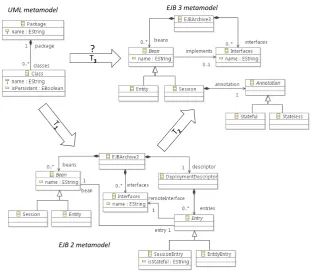
Figure 2: Meta-models of the case study.
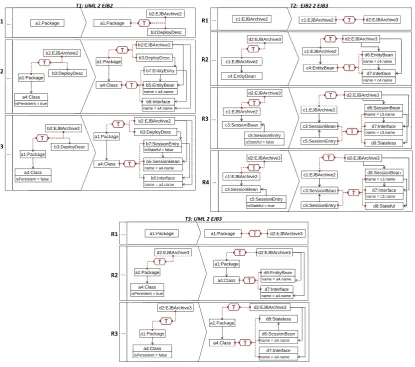
A simplified version of the meta-models and transformation rules for this scenario are il-lustrated in Figures2 and3respectively. T1 transformsPackagesinto EJBArchivesand
Classesinto eitherSessionBeansorEntityBeans, depending on theisPersistent
attribute, as well as intoInterfaces. Furthermore for eachBean, anEntryin the
Deploy-mentDescriptorhas to be generated. TheDeploymentDescriptorconcept is no longer
is supported by EJB 3.0. Note that given the semantics of this migration, all rules of the trans-formations are applied exhaustively.
The transformationsT1andT2have been implemented inATL[JK06] and subsequently trans-formed into graph transformation rules based on EMF Tiger2 [BET08]. To adhere to the be-haviour ofATL, the resulting graph transformation rules have the following properties which also comply to the criteria for rule composition:
• Matchable Elements:ATLis designed as a model-to-model transformation language mean-ing that the target model is completely rebuilt from the source model. Thus, the only ele-ments that can be matched by a rule are eleele-ments of the source model and eleele-ments of the target model already created by previous rule applications. The latter are only accessible via trace edges.
• Creation and Deletion of Elements: InATL the source model is considered as read-only, thus elements of this model may not be altered. Furthermore, elements of the target model are created by executing the transformation, but once created, they can no longer be deleted by the transformation.
• Trace Model: For each rule execution, a trace element is generated linking all matched source elements to all generated target elements. Other transformation rules can build on this trace information,e.g.,for adding links to already created target elements.
• Unique Matching: Each transformation rule can only match once for a given set of ele-ments. Thus, to ensure this behaviour in the graph transformation rules, each rule com-prises a NAC corresponding to the RHS of the rule3.
4.2 Composing the Transformations
We now apply the composition procedure to our example by composing the rules ofT1with those ofT2. Since the composition procedure is applied on individual rules, we have implemented a program in Java that first detects which combinations of rules fromT1 can be composed with rules fromT2, based on Proposition1. The iteration over the rules ofT2follows the order shown in the upper left of Figure3. However, this may lead to several possible valid combinations of rules. The user then selects the most appropriate combination according to his knowledge of UML class diagrams and EJB. Then, the composition procedure is applied on these two rules. The result,i.e.,the transformationT3, is shown at the bottom of Figure3.
Composing T2:R1. T2:R1is composable withT1:R1,T1:R2, and withT1:R3according to the composability condition. However, due to the fact thatT1 :R2 andT1:R3 both contain a subgraph of the LHS ofT2:R1in both their LHS and RHS,T1:R1seems to be more appropriate for composition. The reason is that T1 :R1 actually generates the input elements for T2 :R1 in contrast to the other two rules which only check for the existence of these elements. The composite rule T3:R1 is constructed by composingT1 :R1 and T2 :R1 as follows. The LHS of T3 :R1 remains the same as the one for T1 :R1. Then to create the RHS of T3:R1, the composition procedure connects anEJBArchive3 element to thePackageelement ofT1:
R1 via a trace edge. Then the elimination procedure removes both the EJBArchive2 and
T1 UML 2 EJB2 T2 EJB2 2 EJB3
T1: UML 2 EJB2 T2: EJB2 2 EJB3
b2:EJBArchive2 a1:Package 1 P k T
R1 R1 … c1:EJBArchive2 c1:EJBArchive2 T d2:EJBArchive3 a1:Package
… a1:Package T
R1 R1
b3:DeployDescp y
d2:EJBArchive3 T d2:EJBArchive3 b2:EJBArchive2
d2:EJBArchive3 T d2:EJBArchive3
b2:EJBArchive2
b2:EJBArchive2
T T c1:EJBArchive2
b2:EJBArchive2 b3:DeployDesc c1:EJBArchive2 d6:EntityBean R2 a1:Package b3:DeployDesc
T R2 … c1:EJBArchive2 name = c4.name
b7:EntityEntry T
R2 c4:EntityBean T
1 P k
b3:DeployDesc b7:EntityEntry R2 c4:EntityBean y d7:Interface a1:Package … c4:EntityBean
name = c4.name
a4:Class T b5:EntityBean
name = a4.name d2:EJBArchive3
d2 EJBArchi e3 T
a4:Class
b6 I t f
d2:EJBArchive3 d2:EJBArchive3 T
isPersistent = true b6:Interface
d6 S i B T
name = a4.name
c1:EJBArchive2 c1:EJBArchive2 d6:SessionBean c1:EJBArchive2 name = c3.name
R3
b2:EJBArchive2
T … c3:SessionBean
R3
b2:EJBArchive2 T c3:SessionBean c3:SessionBean d7:Interface T
a1:Package
b3:DeployDesc
T a1:Package c5:SessionEntry T name = c3.name b7 S i E t
T c5:SessionEntry
c5:SessionEntry d8:Stateless
isStateful = false
b3:DeployDesc i Sb7:SessionEntryf l f l
R3
c5:SessionEntry d8:Stateless
isStateful = false
a1:Package
b3:DeployDesc isStateful = false
…
R3
a1:Package
b5 S i B
…
d2:EJBArchive3 T d2:EJBArchive3 a4:Class T b5:SessionBean
T a4:Class
name = a4.name
d6:SessionBean T
i P i t t f l
a4:Class
b6:Interface c1:EJBArchive2 c1:EJBArchive2 d6:SessionBean
3 isPersistent = false
name = a4 name
b6:Interface
… name = c3.name
R4 name = a4.name
c3:SessionBean c3:SessionBean d7:Interface
R4
c3:SessionBean c3:SessionBean d7:Interface
name = c3 name
T
c5:SessionEntry name = c3.name c5:SessionEntry d8:Stateful
isStateful = true
T3: UML 2 EJB3 T3: UML 2 EJB3
1 P k 1 P k T d2 EJBA hi 3
R1… a1:Package a1:Package T d2:EJBArchive3
R1
d2:EJBArchive3 T d2:EJBArchive3
1 P k T a1:Package T
a1:Package d6:EntityBean
R2 g
a4:Class name = a4.name
d6:EntityBean
…
T
R2
a4:Class
a4:Class T name a4.name
i P i t t t
a4:Class d7:Interface
isPersistent = true name = a4.name
d2:EJBArchive3 T d2:EJBArchive3
a1:Package d8:Stateless T a1:Package T a1:Package d6:SessionBean … R3 a1:Package
name = a4 name
d6:SessionBean
R3
a4:Class T name = a4.name a4:Class d7:Interface
isPersistent = false name = a4.namename a4.name
Figure 3: Transformations of the case study.
DeployDescelements from the result. Finally a trace edge connecting thePackageelement to theEJBArchive3is created.T3:R1also comprises a NAC corresponding to its RHS since
T1:R1did have a NAC corresponding to its own RHS. For computing this NAC, we are currently not using a composition procedure. Instead we just copy the elements of the RHS into the NAC to ensure the aforementioned unique rule matching.
Composing T2:R2. T2:R2 is only composable withT1:R2 as it is the only rule ofT1 that has a RHS matchable by the LHS of T2 :R2. The two rules are thus composed in the same way as described in the previous case. In addition, we now have to compose not only the graph patterns but also the attribute value computations. For example, consider the assignmentname
since the assignment refers to an element of the EJB 2.0 meta-model. In this example, we only have simple value assignments without using more complex functions. For setting the attribute values in the composed transformation rule, we have to find out for each attribute value assignment inT2, how the value is actually computed inT1. In our example, we can easily find out that the name attribute of the elementc4inT2:R2is actually calculated by using thename
attribute value of the elementa4. Thus, only this assignment has to be used in the composed transformation rule. Finally, the elimination procedure applied on the LHS ofT3:R2not only deletes theDeployDescelement from the RHS ofT3:R2 (as in the previous case), but also from the LHS ofT3:R2.
Composing T2:R3. T2 :R3 is only composable with T1 :R3. In this case, in addition to composing the nodes and edges of the pattern, we also consider the attribute value condition
isStateful = falseof the LHS ofT2:R3. However, the rest of the composition is analo-gous to the previous case.
Composing T2:R4. T2:R4is not composable with any rule ofT1.
4.3 Implementation
The presented composition procedure allows to compose T1 andT2 nearly automatically. The transformationT3can be entirely produced with the help of some heuristics to further filter out meaningful composition possibilities (e.g., reasoning about if a rule generates the elements or uses them only as context, as discussed in the first composition). Furthermore, some specific extensions such as attribute value assignments as well as constraints are necessary in the future to allow for a higher automation degree.
We have implemented the composition procedure on top of EMF Tiger. The user chooses two transformations to compose. If they are composable, the procedure outputs the composite rule. In the case where there are more than one possibility, the user can interactively select the most appropriate composition. The implementation relies on a higher-order transformation implemented in Java. The first step is the generation of templates out of the LHS of the rules fromT2. These templates are then matched against the RHS of the rules fromT1. This match model is the basis for further composition computations. In a second step, the rules of T1 are rewritten according to the presented composition procedure. In addition, we have implemented the mentioned heuristic for filtering the composition possibilities and support simple attribute value assignments. After the composition computation has finished, the resulting transformation is serialized asT3expressed again as anEMF Tiger transformation.
5
Related Work
5.1 Composition of Algebraic Graph Transformations
As mentioned in Section3.2, a formal definition for the composition of two graph transformation rules was already proposed in [EEPT06], by creating the so-called E-concurrent rule. However, the authors do not explicitly precise how this rule is constructed. In the current paper, we propose a systematic algorithm to (1) detect if two rules are composable and (2) explicitly give the steps on how to construct the E-concurrent rule. Also, the scope of the definitions and algorithms of this paper are directly applicable in model-driven frameworks.
5.2 Composition of Model Transformations
In the latest years, the sequential composition of model transformations has been an active re-search field. Several approaches for modelling transformation chains [Old05,VBH+06,FABJ09, RRL+09] have been proposed. Most of them are based on UML Activity Diagrams which or-chestrate several transformations to achieve a larger goal. However, none of these approaches tries to compute new transformations out of existing transformations as done in this paper.
In [PGPB08], the authors present an approach for composing rules within one transforma-tion: the so calledinternal composition. For example, considering a transformation from UML class diagrams to Java, two rules can be composed when they both transform UML classes to Java classes with different mapping details. In [Wag08], Wagelaar presents sophisticated inter-nal composition techniques forATL andQVT [Obj08] in order to improve the design of model transformations. Since these approaches focus on internal composition only, they do not discuss the computation of the transitive transformation from two given transformations.
In [BHE09], the compositionality of model transformations is addressed. By compositionality the authors do not meansequential compositionas meant in this paper, but they are interested in thespatial composition when mapping a model to its semantic domain. Compositionality is guaranteed by a transformationT if the execution ofT produces a set of semantic expressions (instances of the semantic domain) such that their composition represents the semantics of the whole model.
In summary, to our best knowledge no comparable approach to ours exists in the field of model-driven engineering for composing two transformations into the transitive transformation.
5.3 Composition in Model Management
6
Conclusion
In this paper, we provide a mechanism for composing individual rules from a transformation chain. This composition allows for the creation of a new transformation involving only the initial and target meta-models. Although some assumptions must be made on the syntax of rules, the composition procedure is general enough in the sense that it is independent from the input model. The presented approach is based on the syntactic composition of the rules. Extending the procedure to the transformation level requires to take into account the semantics of the chain of transformations.
The main benefits of our approach are: (1) it is possible to reduce the complexity of transfor-mation chains by eliminating unnecessary transfortransfor-mation steps, (2) if there is traceability from
m1 to m2 and from m2 to m3, we are able to provide traceability from m1 to m3, and (3) our approach seems to be perfectly suited in metamodel evolution scenarios where the target meta-model evolves. If there is already an instance migration transformation from the initial target metamodel version to the new target metamodel version, this migration transformation may be composed with the transformation between the source and the initial target metamodel in order to ensure transformation co-evolution.
As this is a first attempt on composing chains of transformations, a number of open issues still remain. In the presented example, we have only considered the core part of ATL which is comparable to the core of other model-to-model transformation approaches, such as QVT-Relations [Obj08]. In particular, we did not focus on transformations requiring an explicit rule scheduler (e.g., with a control flow). Also, several other features of ATLshould be supported, such as OCL queries andcalled rules (rules that are not automatically executed by the trans-formation engine but that have to be explicitly invoked in the transtrans-formation). Furthermore, our example only considers simple attribute value assignments in the rules. However, before considering more complex attribute manipulations in the composition, one should first think of how to map them to graph transformations in order to provide a theoretical basis for extending the composition procedure. Moreover, dealing with arbitrary OCL expressions when composing transformations is challenging and should certainly form a composition topic on its own. Fi-nally, we have to provide tool support for transforming the composed transformations, expressed as graph transformations, back to ATL transformations. In this context, we have intend to migrate our current prototype to a bi-directional model transformation formalism.
Acknowledgements
We would like to thank all the participants of the 2010 Computer-Aided Multi-Paradigm Mod-elling workshop (CAMPaM) for their useful feedback.
Bibliography
[BGMN08] P. A. Bernstein, T. J. Green, S. Melnik, A. Nash. Implementing mapping composi-tion.VLDB J.17(2):333–353, 2008.
[BHE09] D. Bisztray, R. Heckel, H. Ehrig. Compositionality of Model Transformations. Elec-tronic Notes in Theoretical Computer Science236:5–19, 2009.
[BM07] P. A. Bernstein, S. Melnik. Model management 2.0: manipulating richer mappings. InInternational Conference on Management of Data. Pp. 1–12. ACM, 2007.
[EEPT06] H. Ehrig, K. Ehrig, U. Prange, G. Taentzer. Fundamentals of Algebraic Graph Transformation. EATCS. Springer-Verlag, 2006.
[FABJ09] M. D. D. Fabro, P. Albert, J. Bézivin, F. Jouault. Achieving Rule Interoperability Using Chains of Model Transformations. In International Conference on Theory and Practice of Model Transformations. LNCS 5563, pp. 249–259. Springer, 2009.
[JK06] F. Jouault, I. Kurtev. Transforming Models with ATL. InModel Transformation in Practice Workshop. LNCS 3844, pp. 128–138. Springer, 2006.
[KMS+10] T. Kühne, G. Mezei, E. Syriani, H. Vangheluwe, M. Wimmer. Explicit Transforma-tion Modeling. InMoDELS 2009 Workshops. LNCS 6002, pp. 240–255. Springer, 2010.
[MV06] T. Mens, P. Van Gorp. A Taxonomy of Model Transformation. In GraMoT’05. ENTCS 152, pp. 125–142. Tallinn (Estonia), March 2006.
[Obj08] Object Management Group. Meta Object Facility 2.0 Query/View/Transformation Specification. April 2008.
[Old05] J. Oldevik. Transformation Composition Modelling Framework. In International Conference on Distributed Applications and Interoperable Systems. LNCS 3543, pp. 108–114. Springer, 2005.
[PGPB08] C. Pons, R. Giandini, G. Perez, G. Baum. An Algebraic Approach for Composing Model Transformations in QVT. InInternational Workshop on Software Language Engineering. 2008.
[RRL+09] J. E. Rivera, D. Ruiz-Gonzalez, F. Lopez-Romero, J. Bautista, A. Vallecillo. Or-chestrating ATL Model Transformations. InMtATL Workshop. Pp. 34–46. 2009.
[VBH+06] B. Vanhooff, S. V. Baelen, A. Hovsepyan, W. Joosen, Y. Berbers. Towards a Trans-formation Chain Modeling Language. In International Workshop on Embedded Computer Systems. LNCS 4017, pp. 39–48. Springer, 2006.
[Wag08] D. Wagelaar. Composition Techniques for Rule-Based Model Transformation Lan-guages. InInternational Conference on Theory and Practice of Model Transforma-tions. LNCS 5063, pp. 152–167. Springer, 2008.