© Science and Education Publishing DOI:10.12691/dt-2-1-1
Evaluation of Two Major Online Travel Agencies of US
Using TOPSIS Method
Mortrza Soleymaninejad1,*, Milad Shadifar2, Ayoub Karimi3
1
MA student in tourism management, university of Tehran 2
MA graduated in geography and tourism planing, Islamic Azad University of Nour 3
MA student in Ecotourism, Islamic Azad University of Nour *Corresponding author: [email protected]
Abstract
Nowadays, online services for tourism are a necessity. Tourism companies need a standard website forproviding online services if they don't want to fall behind their competitors. Having a website has become so important and crucial that during recent years, many travel agencies have been stablished that only work online and do not have physical address and do not use any of traditional methods. So this website should be based on a scientific and approved framework if company wants to be successful in this very competitive market. In this study, two major online agencies of US that are considered as each other's main competitors, are examined and analyzed using TOPSIS method and based 6 main criteria. And at the end, the results are presented and some suggestions are given that can help improve these websites.
Keywords
: website evaluation, online travel agencies, AHP, TOPSIS, tourismCite This Article:
Morteza Soleymaninejad, Milad Shadifar, and Ayoub Karimi, “Evaluation of Two MajorOnline Travel Agencies of US Using TOPSIS Method.” Digital Technologies, vol. 2, no. 1 (2016): 1-8. doi: 10.12691/dt-2-1-1.
1. Introduction
The globalization of economic activities and widespread availability of the Internet across the world has led multinational firms to use their corporate Web sites to communicate and transact extensively with visitors from different parts of the world ([1,2]). In today's world that is called era of communication and information, no industry can advance and progress in very competitive industry at global or even local level without using modern technologies of ICT and following changes in digital world and tourism industry is no exception. Even now, in tourism field, ICT is one of the fundamental bases and has a deciding and crucial role in national and international competitions and role of these technologies are developing and expanding at an unbelievable pace [3]. More than 80% of tourists use internet for gathering information before going on the trip and according to statistics published by WTO, in very near future, countries without suitable infrastructure for ICT are practically removed from the international competition in tourism [4].
It is widely accepted that the Internet can serve as an effective marketing tool in tourism ([5,6]). It is a valuable tool for both suppliers and consumers for information dissemination, communication, and online purchasing. Maintaining an effective website has thus become vital for a business to strengthen its customer relationships and gain a larger market segment [7].
A website offers a business not only a platform to promote products or services but also another avenue to generate revenue by attracting more customers. Unfortunately,
not all websites successfully turn visitors into customers. The effective evaluation of websites has therefore become a point of concern for practitioners and researchers ([8,9]). As the number of online customers increases day by day, travel-related website providers should consider how to capture customer preferences explicitly [10]. Researchers indicated that service quality can help create differentiation strategies between providers [11] and may be one of the critical success factors of any Internet business [12]. Moreover, excellent online service will result in desirable behaviors such as word of mouth promotion, willingness to pay a price premium and repurchasing [12]. Thus, for travel agencies desiring to survive and thrive on the Internet, and willing to invest in online services, it is critical to understand precisely in advance how online customers will evaluate their full service offer and which service quality dimensions are valued most [13].
Website quality plays an important role in attracting and retaining customers — underpinning website effectiveness ([14,15]). Academic researchers have long advocated the importance of assessing website effectiveness. Lu and Yeung [16], who were pioneers in the field, proposed a framework for evaluating website performance, in which the usefulness of a website is estimated based on its functionality and usability. Evans and King [17], Stern [18] and Stout [19] stated that website performance can be determined by network statistics such as hit rate and log analysis.
different aspects. For example, Barnes and Vidgen [17] examine website quality in terms of usability, site design, information quality, trust and empathy; Yoo and Donthu [22] identify ease of use, aesthetic design, processing speed and security; Wolfinbarger and Gilly [24] examine Web site design, reliability, privacy / security and customer service; Parasuraman, Zeithaml and Malhotra [25] include efficiency, system availability, fulfilment and privacy; and Flavian, Guinalıu and Gurrea[26] utilize usability, trust and user satisfaction.
In the context of tourism, Jang [27] stated that online information search will become a major trend among travelers; with online reservations for travel products and services becoming an important application [28]. In brief, website evaluation is of interest to academic researchers and industrial practitioners. Law and Bai [29] found that published articles have presented various approaches and made efforts to improve the quality of commercial websites.
So considering the importance of websites, it is crucial to make sure they meet the standards and are of high quality and the best way to do this is to evaluate the website based on some criteria and rank it with other rival websites to find the strengths and weaknesses of website [30]. Then these weaknesses can be fixed which will in turn help the company to attract more customers and increase its share of the market. Especially this can be important for major online travel agencies like Expedia, Priceline and other similar ones that have a close competition with each other over market share.
In the next section, we will have a review of literature and different evaluation methods and criteria used for analyzing websites. Then research's methodology and framework and after that scoring, evaluating and ranking mechanism of these two websites is discussed. The next part is results and discussion and finally conclusion and some suggestion for improving these websites are provided.
2. Evaluation of Website Quality
With regard to the factors that mark a successful website, most managers perceived content related issues (e.g. ‘useful information’), ease of use, and security as the most important factors. They also found that website effectiveness may vary significantly between the different tourism sectors (e.g. hospitality, destination management, and airline). Therefore, the industry should not adopt common criteria without determining which are the most appropriate criteria for evaluation within the sector under consideration ([31]).
Liu and Arnett [32] surveyed Webmasters for Fortune 1000 companies to ascertain the factors critical to website success with consumers. The result was five factors: quality of information (which refers to relevant, accurate, timely, customized and complete information); service (measured by quick response, assurance, empathy, and follow-up); system use (including security, correct transactions, customer control over transactions, order tracking, and privacy); playfulness (typically enjoyment, interactivity, presence of attractive features, and flow or concentration); and design of the website (in terms of
hyperlinks, customized search functions, speed of access, and ease of correcting errors).
WebQual™. Loiacono, Watson and Goodhue [33] designed an instrument to evaluate retail website quality. The instrument assessed 12 components of retail web quality: informational fit-to-task, interactivity, trust, response time, design appeal, intuitiveness, visual appeal, innovativeness, flow-emotional appeal, integrated communications, business process, and viable substitute.
SiteQual. This instrument was developed by asking students in two marketing classes to generate appropriate questions. Using a process of exploratory and confirmatory factor analysis this was whittled down to 9 items measuring ease of use, design, processing speed, and security [33].
eQual 4.0. eQual 4.0 (previously called WebQual 4.0) has been iteratively developed over time. The authors have used the instrument on student and customer samples to assess the quality of a number of different types of Web sites. In Barnes and Vidgen [34], a total of 380 student respondents evaluated online bookstores, using an instrument with 22 questions. Based on exploratory factor analysis, five dimensions emerged: usability, design, information quality, trust and empathy.
.comQ. Wolfinbarger and Gilly [35] used focus groups, sorting and a customer panel to develop the .comQ instrument. Using concepts and attributes from both the service quality and retailing literatures, their scale contains 14 attributes in four factors: Web site design (including personalization), reliability (including accurate product description, on-time delivery, and order accuracy), privacy/security, and customer service (referring to solving problems, willingness to help and prompt answers to queries).
Kim and Stoel [36], in their more simplified instrument, include three of the factors of Loiacono [37] plus three slightly different factors — entertainment, web appearance and transaction capability.
E-S-Qual and E-RecS-Qual. These two scales were developed for assessing the full cycle of service quality for online B2C e-commerce Web sites. The E-S-Qual scale developed in a 22-item scale of four dimensions: efficiency, fulfilment, system availability, and privacy. The second E-RecS-QUAL scale contained three dimensions (responsiveness, compensation, contact) with an 11-item scale [38].
3. Research Methodology
According to previous works and opinion of some experts in field website design, 6 factors were chosen as main criteria for evaluation. Then the weight of these criteria were calculated using AHP method. After that, each of these two websites, Expedia and Priceline, were evaluated using these 6 factors and TOPSIS method was used for analyzing the results and final ranking. More details is given about each of these steps in following sections [39].
1- Criteria and Evaluation Factors
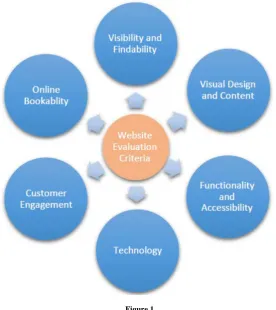
As mentioned before, 6 factors were chosen as criteria for this evaluation which are as this:
II. Visual Design and Content: Elegant design, interesting appearance, high quality media (photos, videos, audios and etc.), updated content, newsletter, customer reviews and etc. are in this category.
III. Functionality and Accessibility: Evident navigation method, ease of access to different section of the website, proper functioning of different parts (images, videos and etc.), being responsive (mobile friendly) and compatibility with different devices and browsers are considered in this part.
IV. Technology: Good CMS, fast response to emails and good support, online purchase feature, reliable web hosting and server and security and privacy are main factors that should be considered in this section.
V. Online Bookablity: Availability of purchase button on all sections, secure and instant payment methods integrated in the website itself and supporting different payment methods should be evaluated as part of this criterion.
VI. Customer Engagement: Being active on TripAdvisor website and encouraging your customers to take part in these reviews and comments, having an account and being active on YouTube, Facebook, Tweeter, Google Plus and other social networks and having direct links to your account on these websites are measured as part of this factor.
You can see all criteria in Figure 1
Figure 1.
2- Research Framework
Some questionnaires were distributed among experts of web designing to rate these criteria against each other and then AHP method was applied the results to calculate the weight of each criterion. These experts either had at least three years of experience in this field or have a license or
degree related to web designing [40]. Then Expedia and Priceline websites were evaluated by the same experts and TOPSIS method was applied to results of these questionnaires and final results and ranking was calculated. See the framework in Figure 2:
3- Introduction of Expedia and Priceline
There are many online travel agencies, but Expedia and Priceline are two of the major and famous ones and are considered as each other's main competitors, so this study is aiming to compare these two with each other based on these criteria. Both these companies are based in US, but work on a global scale.
I. Expedia was launched in 2001 by Rich Barton and Lloyd Frink as an Internet-based travel website company with headquarters in Bellevue, Washington. It also has localized sites for 30 countries. It books airline tickets, hotel reservations, car rentals, cruises, vacation packages and various attractions and services via the World Wide Web and telephone travel agents. The site uses multiple global distribution systems like Amadeus or the Sabre
reservation systems for flights and for hotels, Worldspan and Pegasus, along with its own hotel reservation system for contracted, bulk-rate reservations ("Expedia (website)", n. d.).
II. Priceline is an American company and a commercial website that claims to help users obtain discount rates for travel-related purchases such as airline tickets and hotel stays. The company is not a direct supplier of these services; instead it facilitates the provision of travel services by its suppliers to its customers. It is headquartered in Norwalk, Connecticut, United States. Priceline was founded by Jay S. Walker, who left the company in 2000. Hong Kong company Cheung Kong Holdings later purchased a significant portion of Priceline's stock ("Priceline.com", n. d.).
Figure 3.
4- Analytic Hierarchy Process
The analytic hierarchy process (AHP) is a structured technique for organizing and analyzing complex decisions, based on mathematics and psychology. It was developed by Thomas L. Saaty in the 1970s and has been extensively studied and refined since then. It has particular application in group decision making and is used around the world in a wide variety of decision situations, in fields such as government, business, industry, healthcare and education.
Users of the AHP first decompose their decision problem into a hierarchy of more easily comprehended sub-problems, each of which can be analyzed independently. Once the hierarchy is built, the decision makers systematically evaluate its various elements by comparing them to one another two at a time, with respect to their impact on an element above them in the hierarchy. In making the comparisons, the decision makers can use concrete data about the elements, but they typically use their judgments about the elements' relative meaning and importance. It is the essence of the AHP that human judgments, and not just the underlying information, can be used in performing the evaluations.
The AHP converts these evaluations to numerical values that can be processed and compared over the entire range of the problem. A numerical weight or priority is derived for each element of the hierarchy, allowing diverse and often incommensurable elements to be compared to one another in a rational and consistent way ("Analytic Hierarchy Process", n. d.).
5- TOPSIS
The Technique for Order of Preference by
monotonically increasing or decreasing. Normalization is usually required as the parameters or criteria are often of incongruous dimensions in multi-criteria problems. Compensatory methods such as TOPSIS allow trade-offs between criteria, where a poor result in one criterion can be negated by a good result in another criterion. This provides a more realistic form of modelling than non-compensatory methods, which include or exclude alternative solutions based on hard cut-offs ("
TOPSIS", n.
d.).
The TOPSIS process is carried out as follows: Step 1:
Create an evaluation matrix consisting of m alternatives and n criteria, with the intersection of each alternative and criteria given as 𝑥𝑥𝑖𝑖𝑗𝑗, we therefore have a matrix (𝑥𝑥𝑖𝑖𝑗𝑗)×𝑛𝑛. Step 2:
The matrix (𝑥𝑥𝑖𝑖𝑗𝑗)𝑚𝑚×𝑛𝑛 is then normalized to form the matrix 𝑅𝑅=(𝑟𝑟𝑖𝑖𝑗𝑗)𝑚𝑚×𝑛𝑛 using the normalization method 𝑟𝑟𝑖𝑖𝑗𝑗=𝑥𝑥𝑖𝑖𝑗𝑗√Σ𝑥𝑥𝑖𝑖𝑗𝑗2𝑚𝑚𝑖𝑖=1 ,𝑖𝑖=1,2,…,𝑚𝑚,𝑗𝑗=1,2,…,𝑛𝑛
Step 3:
Calculated the weighted normalized decision matrix 𝑇𝑇=(𝑡𝑡𝑖𝑖𝑗𝑗)𝑚𝑚×𝑛𝑛=(𝑤𝑤𝑗𝑗𝑟𝑟𝑖𝑖𝑗𝑗)𝑚𝑚×𝑛𝑛,𝑖𝑖=1,2,…,𝑚𝑚 where 𝑤𝑤𝑗𝑗= 𝑊𝑊𝑗𝑗Σ𝑊𝑊𝑗𝑗𝑛𝑛𝑗𝑗=1⁄,𝑗𝑗=1,2,…,𝑛𝑛 so that Σ𝑤𝑤𝑗𝑗=1𝑛𝑛𝑗𝑗=1 and 𝑊𝑊𝑗𝑗 is the original weight given to the indicator 𝑣𝑣𝑗𝑗,𝑗𝑗=1,2,…,𝑛𝑛. Step 4:
Determine the worst alternative (𝐴𝐴𝑤𝑤) and the best alternative (𝐴𝐴𝑏𝑏): 𝐴𝐴𝑤𝑤= {〈max (𝑡𝑡𝑖𝑖𝑗𝑗|𝑖𝑖=1,2,…,𝑚𝑚)|𝑗𝑗∈𝐽𝐽−〉,〈min (𝑡𝑡𝑖𝑖𝑗𝑗|𝑖𝑖=1,2,…,𝑚𝑚)|𝑗𝑗∈𝐽𝐽+〉}≡{𝑡𝑡𝑤𝑤𝑗𝑗|𝑗𝑗=1,2,…,𝑛𝑛},
𝐴𝐴𝑏𝑏={〈min(𝑡𝑡𝑖𝑖𝑗𝑗|𝑖𝑖=1,2,…,𝑚𝑚)|𝑗𝑗∈𝐽𝐽−〉,〈max(𝑡𝑡𝑖𝑖𝑗𝑗|𝑖𝑖=1,2,…,𝑚𝑚) |𝑗𝑗∈𝐽𝐽+〉} ≡{𝑡𝑡𝑏𝑏𝑗𝑗|𝑗𝑗=1,2,…,𝑛𝑛},
Step 5:
Calculate the L2-distance between the target alternative 𝑖𝑖 and the worst condition 𝐴𝐴𝑤𝑤
𝑑𝑑𝑖𝑖𝑤𝑤=√Σ(𝑡𝑡𝑖𝑖𝑗𝑗−𝑡𝑡𝑤𝑤𝑗𝑗)2𝑛𝑛𝑗𝑗=1,𝑖𝑖=1,2,…,𝑚𝑚,
And the distance between the alternative 𝑖𝑖 and the best condition 𝐴𝐴𝑏𝑏 𝑑𝑑𝑖𝑖𝑏𝑏=√Σ(𝑡𝑡𝑖𝑖𝑗𝑗−𝑡𝑡𝑏𝑏𝑗𝑗)2𝑛𝑛𝑗𝑗=1,𝑖𝑖=1,2,…,𝑚𝑚
where𝑑𝑑𝑖𝑖𝑤𝑤 and 𝑑𝑑𝑖𝑖𝑏𝑏 are L2-norm distances from the target alternative 𝑖𝑖 to the worst and best conditions, respectively. Step 6:
Calculate the similarity to the worst condition: 𝑠𝑠𝑖𝑖𝑤𝑤=(𝑑𝑑𝑖𝑖𝑤𝑤+𝑑𝑑𝑖𝑖𝑏𝑏)⁄,0≤𝑠𝑠𝑖𝑖𝑤𝑤≤1,𝑖𝑖=1,2,…,𝑚𝑚.
𝑠𝑠𝑖𝑖𝑤𝑤=1 if and only if the alternative solution has the worst condition; and
𝑠𝑠𝑖𝑖𝑤𝑤=0 if and only if the alternative solution has the best condition.
Step 7:
Rank the alternatives according to (𝑖𝑖=1,2,…,𝑚𝑚).
4. Results Analysis and Discussion
For this study, these two websites were evaluated during December 2014. First, some questionnaires about importance of each criterion was given to experts and their answers were gathered and analyzed and weight of each criterion was calculated using AHP method. Table 1 shows the result of one of these questionnaires:
Table 1
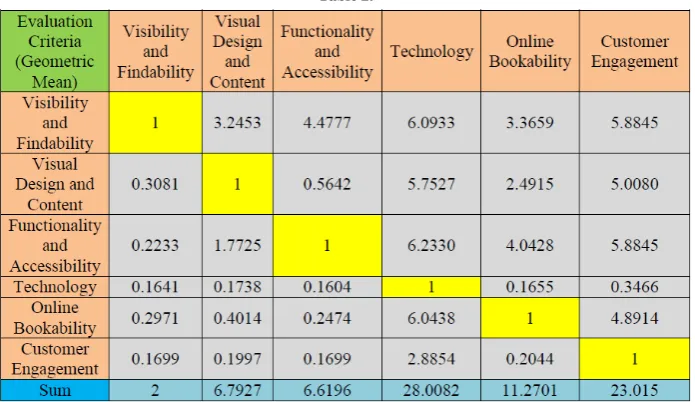
Then all these completed questionnaires were turned into one using geometric mean and you can see the result in Table 2:
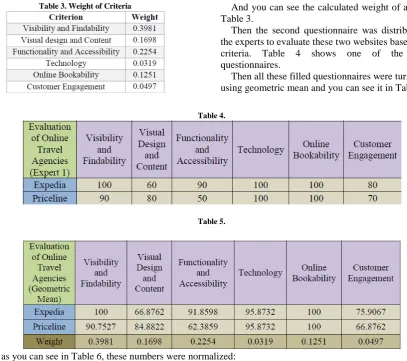
Table 3. Weight of Criteria And you can see the calculated weight of all criteria in
Table 3.
Then the second questionnaire was distributed among the experts to evaluate these two websites based on these 6 criteria. Table 4 shows one of the completed questionnaires.
Then all these filled questionnaires were turned into one using geometric mean and you can see it in Table 5.
Table 4.
Table 5.
Then as you can see in Table 6, these numbers were normalized:
Table 6
Then they were weighted (Table 7):
Table 7
Then positive and negative ideal solutions were determined. Positive ideal solutions are the maximum of
each row and the negative ideal solutions are the minimum of each row. You can see them in Table 8:
Table 9.
And finally, the distance between each alternative and positive and negative ideals and closeness coefficient (CC)
was measured. The one with the higher CC is the better website (Table 9).
As you can see, evaluations show that Expedia's website gets a better score on these criteria and so has a better quality than Priceline's website.
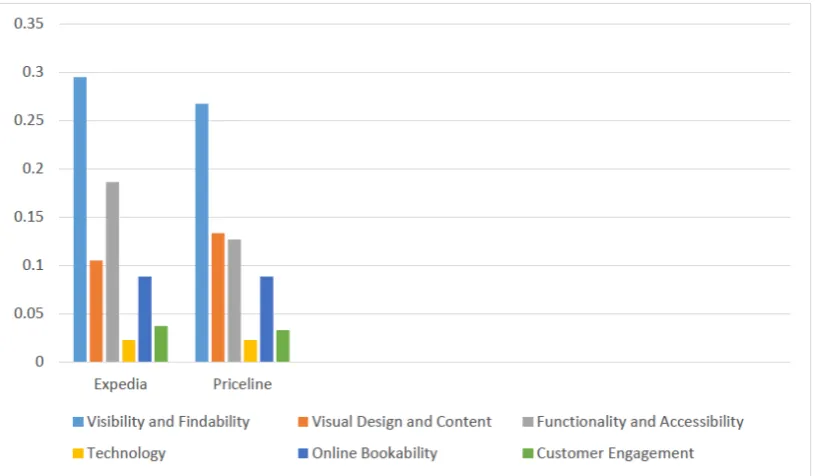
Also you can see these websites' score on each category the below chart:
Chart 1.
As you can see in this chart, the most difference is in the first three criteria that also has the most weight. In online bookability and technology, they both receive the same score and there no need for much improvement in this part. In visual design and content, Priceline has the upper hand and Expedia has to improve its website's design to make it more attractive for visitors.
In other sections, Expedia is better. In visibility and findability, Expedia usually is among the top 3 search results which very impressive. Priceline is also on the first page of search results, but it usually is 7 or higher which is good, but not as good as Expedia. So they should work more on SEO (search engine optimization) and other related methods to improve their ranking [42].
The difference in customer engagement is little and Expedia usually has more followers and fans than Priceline on every social network.
But the main difference is related functionality and accessibility. Expedia is well designed for mobile devices and different browsers and is fully responsive. But Priceline is not responsive at all which make it impossible for mobile device users to use this website on their device. And considering the fact that number of mobile users have exceeded number of desktop users, this is a major weakness for Priceline that should be solved immediately or they will keep losing their customers.
5. Conclusions
The aim of this paper was to establish a criteria for evaluating online travel agencies and evaluate two of them as the case study. Results showed that the most important
criteria are visibility and findability and functionality and accessibility. The first one is very important because the number of online travel agencies and other similar websites is rapidly growing and if users can't find your website among these huge number of competitors, then you don't have any chance for becoming successful. And the other one has become very important in recent years. Mobile devices are becoming very popular and the number of mobile devices in every house is higher than the number of desktop computers and so nowadays mobile devices have more users. But website designers should note that these devices are different than traditional ones and have special needs and websites should be responsive and optimized for them in order to function properly. Otherwise users will easily ignore their websites and will go to other similar websites that are mobile friendly. Also the nature of tourism industry involves travelling and so mobile devices are even more important in this industry. And the fact that Priceline has ignored this issue is the main reason that they are falling behind and they should solve it quickly.
The importance of these two criteria doesn't mean that we should ignore other factors. As we can see both these websites got good score on these other criteria which means they are aware of their role in success. All of these criteria are important in their own way and ignoring any of them can harm your business and give an edge to your competitors.
References
[1] Aladwania, A.M., &Palvia, P.C. (2002). Developing and validating an instrument for measuring user-perceived web quality.
[2] Kheiri, J. (2010). Review of Success Rate and Impact of Livestock Removal Plan from Forest and Organizing Forest Dwellers of Mazandaran Province. In Regional Conference on Social Impact Assessment of Plans, Programs and Policies/ShahidBeheshti University, Tehran, Iran. ShahidBeheshti University.
[3] Analytic hierarchy process. (2014, August 12). In Wikipedia, the
Free Encyclopedia. Retrieved 11:14, January 1, 2015, from
http://en.wikipedia.org/w/index.php?title=Analytic_hierarchy_pro cess&oldid=620928150.
[4] Barnes, S.J., &Vidgen, R.T. (2002). An integrative approach to the assessment of e-commerce quality. Journal of Electronic
Commerce Research, 3(3), 114-127.
[5] Kheiri, J. (2011). Necessity of Using Scientific Management for Development of Iran’s Tourism. In International Conference on Tourism Economics and Management, I.R.Iran International Conference Center, Tehran, Iran. Islamic Azad University Central Tehran Branch, Tehran, Iran.
[6] Kheiri, J., Shohrat Zeinabad, R., & Tabatabaie, F. (2016). Evaluation of Tourism Investment Priorities in Zoroastrian Villages of Yazd Province, Iran. American Journal of Rural Development, 4(1), 1-9.
[7] Buhalis, D. (2003). eTourism: Information technology for
strategic tourism management. London, England:
Pearson/Financial Times/Prentice Hall.
[8] Kheiri, J. (2013). Assessment of Economic Impacts of Religious Tourism on Local Residents (Case Study: Imamzadeh Abdollah in Amol). In Regional Conference on Tourism, Geography and Sustainable Environment, Hamedan, Iran. CIVILICA.
[9] Buhalis, D., & Law, R. (2008). Progress in information technology and tourism management: 20 years on and 10 years after the internet: The state of eTourism research. Tourism Management, 29(4), 609–623.
[10] Chakraborty, D., Jaiswal, S.K., Misray, A., &Nanavati, A.A. (2005). Middleware architecture for evaluation and selection of 3rd-party Web services for service providers. ICWS ’05: Proceedings of the IEEE International Conference on Web
Services, Washington DC: IEEE Computer Society, 647-654.
[11] Kheiri, J. (2012). Analysis of Iran's Inbound Tourists' Motivations (Case Study: Foreign Tourists in Tehran). In Regional Conference on Sports Tourism Development and Management, Islamic Azad University Shahrood Branch, Semnan, Iran. Islamic Azad University Shahrood Branch, Semnan, Iran.
[12] Clemons, E.K., Hann, I.H., &Hitt, L.M. (2002). Price dispersion and differentiation in online travel: An empirical investigation.
Management Science, 48(4), 534-549.
[13] Evans, J. R., & King, V. E. (1999). Business-to-business marketing and the world wide web: Planning, managing, and assessing websites. Industrial Marketing Management, 28(4), 343–358.
[14] Expedia (website). (2014, December 25). In Wikipedia, The Free
Encyclopedia. Retrieved 11:15, January 1, 2015, from
http://en.wikipedia.org/w/index.php?title=Expedia_(website)&oldi d=639612019.
[15] Flavian, C., Guinalıu, M., &Gurrea, R. (2006). The role played by
perceived usability, satisfaction and consumer trust on website loyalty. Information and Management, 43, 1-14.
[16] Jang, S. C. (2004). The past, present, and future research of online information search. Journal of Travel & Tourism Marketing, 17(2/3), 41-47.
[17] Kheiri, J. (2013). Assessment of Economic, Cultural and Environmental Impact of Beach Tourism in Mazandaran (Case Study: Coast City of Nur). In Regional Conference on Tourism, Geography and Sustainable Environment, Hamedan, Iran. CIVILICA.
[18] Kheiri, J., & Nasihatkon, B. (2015). Evaluating the Effects of Social Media Usage on Tourist's Behavior based on Different Phases of Travel Process. SIT Journal of Management, 5(2), 17.
[19] Jeong, M., Oh, H., &Gregoire, M. (2003). Conceptualizing web site quality and its consequences in the lodging industry.
International Journal of Hospitality Management, 22(2), 161-175.
[20] Jung, T.H., & Butler, R. (2000). Perceptions of Marketing Managers of the Effectiveness of the Internet in Tourism and Hospitality. Information Technology and Tourism, 3(3/4), 167-176.
[21] Kim, S., &Stoel, L. (2004). Dimensional hierarchy of retail website quality. Information and Management, 41(5), 619-633.
[22] Law, R., & Bai, B. (2006). Website development and evaluations in tourism: A retrospective analysis. In M. Hitz, M. Sigala, & J. Murphy (Eds.), Information and communication technologies in
tourism, 1-12. NewYork: Springer-Wien.
[23] Kheiri, J., Yazdanpanah, E., Soleymaninejad, M., &Sajjadi, Fatemeh, Taslimi, M. (2015). Ranking Five Star Hotels in Tehran Using CSR. International Journal of Information Science, 5(2), 30-41.
[24] Law, R., & Hsu, C. H. C. (2006). Importance of hotel website dimensions and attributes: perceptions of online browsers and online purchasers. Journal of Hospitality & Tourism Research, 30(3), 295-312.
[25] Law, R., Qi, S., &Buhalis, D. (2010). Progress in tourism management: A review of website evaluation in tourism research.
Tourism Management, 31, 297-313.
[26] Liu, C., & Arnett. K. (2000). Exploring the factors associated with Web site success in the context of electronic commerce.
Information and Management, 38(1), 23-33.
[27] Loiacono, E.T., Watson, R.T., & Goodhue, D.L. (2000). WebQual:
A web site quality instrument. Presented at American Marketing
Association: Winter Marketing Educators’ Conference.
[28] Lu, M., &Yeung, W. L. (1998). A framework for effective commercial web application development. Internet Research:
Electronic Networking Applications and Policy, 8(2), 166-173.
[29] Parasuraman, A., Zeithaml, V.A., & Malhotra, A. (2005). E-SQual: A multiple-item scales for assessing electronic service quality.
Journal of Service Research, 7(3), 213-233.
[30] Priceline.com. (2014, December 28). In Wikipedia, The Free
Encyclopedia. Retrieved 11:15, January 1, 2015, from
http://en.wikipedia.org/w/index.php?title=Priceline.com&oldid=6 39927559.
[31] Reichheld, F.F., Markey Jr, R.G., &Hopton, C. (2000). E-customer loyalty-applying the traditional rules of business for online success. European Business Journal, 12(4), 173-179.
[32] Shchiglik, C., & Barnes, S.J. (2004). Evaluating airlines web sites: Method and application. Journal of Computer Information Systems, 44(3), 17-25.
[33] Shen, H., Wei, J., & Zheng, L. (2009). An empirical study on the influential factors of travel agency websites quality based on the users’ perception. International Journal of Services Technology
and Management, 12(2), 216-230.
[34] Stern, J. (2002). Web metrics: Proven methods for measuring web
site success. New York, NY: Wiley Publishing.
[35] Stout, R. (1997). Web site stats: Tracking hits and analyzing
traffic. Berkeley, CA: Osborne/McGraw-Hill.
[36] TOPSIS. (2014, December 21). In Wikipedia, The Free
Encyclopedia. Retrieved 11:10, January 1, 2015, from
http://en.wikipedia.org/w/index.php?title=TOPSIS&oldid=639064 332.
[37] Williams, S. (1998). Tourism Geography. London, England: Routledge.
[38] Wolfinbarger, M., & Gilly, M.C. (2003). Etailq: Dimensionalizing, measuring and predicting etail quality. Journal of Retailing, 79, 183-198.
[39] Wolfinbarger, M., & Gilly, M.C. (2003). Comq: Dimensionalizing, Measuring and Predicting Quality of the E-tailing Experience. Journal of Retailing, 79, 183-198.
[40] Yen, C.H., & Lu, H.P. (2008). Effects of e-service quality on loyalty intention: An empirical study in online auction. Managing Service Quality, 18(2), 127-146.
[41] Yoo, B., &Donthu, N. (2001). Developing a scale to measure the perceived service quality of Internet shopping sites (SiteQual).
Quarterly Journal of Electronic Commerce, 2(1), 31-47.