Title:
Authoring Group:
Date:
IMDRF
IMDRF/MDSAP WG/N6FINAL:2013
International Medical
Device Regulators Forum
Final Document
Regulatory Authority Assessor Competence and Training
Requirements
IMDRF MDSAP Working Group
9 December 2013
I i
/---/ '
/)~
/'
Despi~a
S,pano
RF Chair
I I \ 1
This document was produced by the Intemational Medical Device R:/gulators Forum. There are no restrictions on the reproduction or use of this document: however, incorporation of this document, in part or in whole, into another document, or its translation into languages other than English, does not convey or represent an endorsement of any kind by the International Medical Device Regulators Forum.
IMDRF/MDSAP WG/N6FINAL:2013
Table of Contents
1.0 Scope ... 5
2.0 Reference(s) ... 6
3.0 Definitions ... 6
4.0 Responsibilities ... 7
5.0 Cominitinents ... 8
6.0 Entry Level Require1nents ... 8
7.0 Training require1nents ... 12
8.0 Lead Assessor, and Assessor Experience Requirements ... l4 9.0 Co1npetence Evaluation ... 15
I 0.0 Records of Pre-requisites, Competence Evaluation and Monitoring ... 16
11.0 Remediation ... 16
Appendix A- Competence Matrices ... 17
IMDRF/MDSAP WG/N6FINAL:20 13
Preface
The document herein was produced by the Intemational Medical Device Regulators Fomm (IMDRF), a voluntmy group ofmedical device regulators from around the world.
There are no restrictions on the reproduction, distribution or use of this document; however, incorporation of this document, in part or in whole, into any other document, or its translation into languages other than English, does not convey or represent an endorsement of any kind by the International Medical Device Regulators Forum.
IMDRF/MDSAP WG/N6FINAL:20 13
In trod uctio n
This is one document in a collection of documents produced by the International Medical Device Regulators Forum (IMDRF) intended to implement the concept of a Medical Device Single Audit Program (MDSAP). Two documents, IMDRF MDSAP WG N3 -"Requirements for Medical Device Auditing Organizations for Regulatory Authority Recognition" and IMDRF MDSAP WG N4- "Competence and Training Requirements for Auditing Organizations," are complementary documents. These two documents N3 and N4 are focused on requirements for an Auditing Organization and individuals performing regulatory audits and other related
functions under the respective medical device legislation, regulations, and procedures required in its regulatory jurisdiction.
Two additional documents, IMDRF MDSAP WG N5- "Regulatory Authority Assessment Method for the Recognition and Monitoring ofMedical Device Auditing Organizations" and this document, IMDRF MDSAP WG N6 -"Regulatory Authority Assessor Competence and Training Requirements," are complementary documents. These two documents N5 and N6 are focused on how Regulatory Authorities and their assessors will evaluate or "assess" medical device Auditing Organizations' compliance to the requirements in the IMDRF MDSAP N3 and N4 documents. In addition, IMDRF MDSAP WG N 11 will define a method to "grade" nonconfonnities
resulting from a Regulatory Authority assessment of an Auditing Organization and to document the decision process for recognizing an Auditing Organization or revoking recognition.
This collection ofiMDRF MDSAP documents will provide the fundamental building blocks by providing a common set of requirements to be utilized by the Regulatory Authorities for the recognition and monitoring of entities that perfotm regulatory audits and other related functions.
It should be noted that in some jurisdictions the recognition process is called designation,
notification, registration, or accreditation.
IMDRF developed MDSAP to encourage and support global convergence of regulatory systems,
where possible. It seeks to strike a balance between the responsibilities of Regulatory
Authorities to safeguard the health of their citizens as well as their obligations to avoid placing unnecessary burdens upon Auditing Organizations or the regulated industry. IMDRF Regulatory Authorities may add additional requirements beyond this document when their legislation
requires such additions.
The purpose ofthis document is to specifY competence and training requirements that shall be demonstrated and maintained by Regulatory Authorities for personnel involved in the assessment of Auditing Organizations performing regulatory audits of medical device manufacturers.
IMDRF/MDSAP WG/N6FINAL:2013
The requirements contained within this document are for personnel involved in assessments and recognition decisions assessing conformity with the IMDRF MDSAP N3 document, and
includes:
Defining knowledge, skills, and abilities.
Criteria for various degrees of competence based on roles in assessments and recognition decisions.
Assisting in the evaluation and development of Regulatory Authority Assessors. Providing a basis for identifYing training needs.
1.0 Scope
This document applies to Regulatory Authorities conducting assessments of Auditing
Organizations. Adherence to this document and its requirements will help mitigate the risk of inconsistent or ineffective assessments of Auditing Organizations by ensuring that Regulatory Authority personnel have the necessary competence and training before conducting an
assessment or participating in a decision to recognize an Auditing Organization. The
Competence Matrix described in Appendix A identifies requirements for training and assists in the development of programs for personnel involved in assessments and recognition decisions. The functions covered by a Regulatory Authority, within the scope ofthis document, and the independence ofthe roles assigned are described in Table 1.
Functions Assessment Decision Making
Conduct a review ofthe assessment nla Program Administrator
application to determine assessment team competence requirements, select assessment team members, and determine assessment duration
Assessment of a the Auditing Organization's Lead Assessor I nla
management system Assessor
Assessment ofthe Auditing Organization's Lead Assessor I nla
competence (IMDRF MDSAP WG N4) Assessor
Assessment ofthe conformity ofthe Lead Assessor I nla
Auditing Organization with regulatory Assessor
requirements (IMDRF MDSAP WG N3)
Approval of Assessment Results nla Recognition Manager
IMDRF/MDSAP WG/N6FINAL:20 13
Table 1: Regulatory Authority Functions and Roles
2.0 Reference(s)
• IMDRF MDSAP N3-Requirements for Medical Device Auditing Organizations for
Regulatory Authority Recognition
• IMDRF MDSAP N4- Competence and Training Requirements for Auditing
Organizations
• IMDRF MDSAP N5 -Regulat01y Authority Assessment Methodj01· the Recognition and
Monitoring of Medical Device Auditing Organizations
• GHTF/SG1/N78:2012-Principles of Conformity Assessment/or Medical Device
• ISO 9000:2005 -Quality management systems Fundamentals and vocabulmy
• ISO/IEC 17000:2004-Conformity assessment Vocabulmy and general principles
• ISOIIEC 17021:2011 -Conformity Assessment Requirements for bodies providing audit
and certification of management system.
3.0 Definitions
3.1 Audit: A systematic, independent, and documented process for obtaining records,
statements of fact or other relevant information and assessing them objectively to determine the extent to which specified requirements are fulfilled. (ISO 17000:2004) 3.2 Assessment: A systematic, independent, and documented process for obtaining
assessment evidence and evaluating it objectively to detetmine the extent to which assessment criteria are fulfilled.
3.3 Auditing Organization: An organization that audits a medical device manufacturer for
conformity with quality management system requirements and other medical device regulatory requirements. Auditing Organizations may be an independent organization or a Regulatory Authority which perform regulatory audits.
3.4 Auditor: A person with the demonstrated personal attributes and competence to conduct
an audit. (ISO 9000:2005 clause 3.9.9)
IMDRF/MDSAP WG/N6FINAL:20 13
3.5 Assessor: An employee of a Regulatory Authority with the demonstrated personal
attributes and competence to conduct an assessment of an Auditing Organization. 3.6 Competence: Demonstrated personal attributes and demonstrated ability to apply
knowledge and skills. (ISO 9000:2006 clause 3.9.14)
3.7 Lead Assessor: The individual responsible for leading the assessment team. The Lead
Assessor manages an assessment team, prepares the assessment plan, conducts any assessment related meetings, and submits the formal assessment repott.
3.8 Program Administrator: A person(s) that conducts a review ofthe assessment
application to determine assessment team competence requirements, select assessment team members, and determine assessment duration.
3.9 Regulat01y Authority: A government body or other entity that exercises a legal right to
control the use or sale of medical devices within its jurisdiction, and that may take enforcement action to ensure that medical products marketed within its jurisdiction comply with legal requirements. (GHTF/SG1/N78:2012)
3.10 Recognition Manager: A person responsible for the reviews ofthe assessment activities
and for the approval of the assessment results. 4.0 Responsibilities
It is the responsibility of a Regulatory Authority to collect and maintain evidence that
demonstrates that personnel involved in assessments and recognition decisions meet the specified competence requirements contained within this document.
The Regulatory Authority is expected to have a documented processes to: (1) initially qualifY
their staff, who are involved in assessments and recognition decisions to the requirements specified within this document, based on demonstrated competence; (2) ensure that the
competence ofpersonnel involved in assessments and recognition decisions is maintained on a continuing basis; (3) provide personnel with appropriate support and resources where needed and, (4) maintain records ofthese activities for each person involved in the recognition process. Assessors-in-training may be included in the assessment team, but shall not perfonn assessments without direction or guidance from the Lead Assessor.
On request, Regulatory Authorities may provide feedback of their experiences with regards to the competence requirements for personnel involved in assessments and recognition decisions to the IMDRF for the purpose of refining the competence criteria and training requirements defined in this document.
IMDRF/MDSAP WG/N6FINAL:20 I 3
5.0 Commitments
The Recognizing Authority shall ensure and document that each person involved in assessments and recognition decisions commits to comply with all applicable rules, regulations, and policies. Any potential conflicts of interest, including prior association with an Auditing Organization, a manufacturer, or its personnel shall be notified to the recognizing authority.
6.0 Entry Level Requirements
A Regulatory Authority shall apply its own procedures for formally selecting, training, and approving personnel involved in assessments and recognition decisions using the requirements and criteria contained within this document.
The following are the pre-requisite education, experience, and competencies to be deinonstrated and maintained by staff involved in assessments and recognition decisions.
6.1 Pre-requisite Education
Lead Assessors, Assessors, and Recognition Managers, should hold a diploma from a university or technical college in medicine, science, or engineering. Disciplines of interest include, for example;
• Biology
• Microbiology
• Chemistry
• Biochemistry
• Computer hardware and software technology
• Material sciences
• Engineering- electrical, mechanical, biomedical, clinical, bioengineering,
• Human physiology
• Medicine
• Pharmacy
• Physics and biophysics
• Veterinary medicine
The educational requirement shall remain a strong basis for classification ofTechnical Knowledge. Typically personnel develop expetiise directly related to their educational background.
Program Administrators should hold cetiificates or diplomas for successful completion of secondary school education qualifications.
IMDRF/MDSAP WG/N6FINAL:2013
In exceptional cases, a demonstration of equivalent knowledge and skills may be acceptable. The Regulatory Authority shall justifY and document the reasons for accepting alternatives to the education requirements.
6.2 Pre-requisite Experience
Potential Lead Assessors and Assessors, Recognition Managers, and Program Administrators shall be able to demonstrate sufficient experience to have acquired the requisite knowledge and skills to successfully perform the functions required to perform their designated tasks.
Potential Lead Assessors and Recognition Managers shall demonstrate at least four years of full-time experience in the field of medical devices or related sectors (e.g. industry, audit, healthcare, or research). Successful completion of other formal qualifications (advanced degrees) can substitute for a maximum ofthree years of working experience.
In exceptional cases, a shorter duration of experience, or experience in areas not mentioned above, may be acceptable. Such cases may include, for example, individuals employed in an audit, inspectional or enforcement position for a regulatory authority whereby they have acquired and demonstrated in-depth knowledge of the application of quality management principles to medical device manufacturing, the application ofregulations, as well as the evaluation of compliance of medical device manufacturers to standards and regulations. A Regulatory Authority shall justifY and document such cases.
6.3 Pre-requisite Competence Requirements
Three broad categories of competencies are required for potential Lead Assessors, Assessors, and Recognition Managers:
Foundational Competencies: those generic skills, personal attributes, and behaviors
applicable to all personnel and developed through experience (e.g. adaptability, diligence, critical and analytical thinking, communication, etc.)
Functional Competencies: those generic skills applicable to all personnel developed
through experience and required to perform assessments (e.g. project management; time management; teamwork; effective use of information technology; etc.)
Technical Competencies: those unique skills developed through experience and specific
knowledge applicable to personnel depending on the scope of activities needed to address
IMDRF/MDSAP WG/N6FINAL:2013
subject areas (e.g. regulatory requirements, risk assessment, health and safety impacts, etc.)
The attributes and skills described in the three categories of competence are to be evaluated as pmi of entry level requirements, as well as through training and other recognition activities.
6.3.1 Foundational Competencies
I. Integrity: Abides by a strict code of ethics and behavior; chooses an ethical course of action
and does the right thing, even in the face of opposition; encourages others to behave accordingly. Treats others with honesty, faimess, and respect; makes decisions that are objective and reflect the just treatment of others. Takes responsibility for accomplishing work goals within accepted timefl-ames; accepts responsibility for one's decisions and actions and for those of one's group, team, or depmiment; attempts to leam from mistakes.
2. Objectivity: Makes a balanced assessment ofthe relevant circumstances and not unduly
influenced by their own interests or by others in forming judgments.
3. Critical and Analytical Thinking: Seeks relevant, reliable, and competent information for use
in problem solving and decision making. Uses sound logic and reasoning to identifY strengths and weaknesses of altemative solutions, conclusions, or approaches. Uses reasoning to analyze, compare, and interpret information to draw conclusions.
4. Interpersonal Skills: Establishes and maintains positive working relationships with a diverse
group of contacts. Works effectively as a team member during the assessment process. Recognizes and considers input from all assessment program stakeholders.
5. Communication: Expresses or presents ideas, both orally and in writing, in a clear, concise,
accurate and logic fashion, taking into consideration the target audience. Has a good command oflanguage(s) and uses an appropriate business writing style, using objective, specific language; uses punctuation correctly, verifies spelling, and writes grammatically correct. Listens actively; asks clarifying questions and summarizes or paraphrases what others have said to verifY understanding.
6. Adaptability: Demonstrates the ability to use or consider nontraditional methods; makes
changes in response to demands and circumstances.
7. Tenacious: Persistent and focused on achieving objectives.
8. Perceptive: Instinctively aware of and able to understand situations.
IMDRF/MDSAP WG/N6FINAL:20 13
9. Observant: Actively observing physical surroundings and activities.
6.3.2 Functional Competencies
1. Information Technology: Has the willingness and ability to apply electronic technology to
complete work objectives, to use new techniques, and/or technologies as a routine pmt of assessments and has a working knowledge of how to use regulatory and functional databases and systems.
2. Interviewing: Plans, conducts, and documents results of discussions with individuals in such
a manner as to achieve assessment objectives; ability to determine accuracy of information from interviewees and potential indicators offmther follow-up action. Skilled in obtaining relevant, reliable, and useful information from individuals at all levels in the audited
organization.
3. Teamwork: Provides constructive feedback to assessment team members. Ability to identify
skill needs and methods for performance improvement; assists with handling performance issues. Provides environment to maximize Auditor proficiency.
4. Conflict Resolution: Recognizes the potential and actual sources ofpersonnel conflict from
assessment program stakeholders. Achieves results through diplomatic handling of
disagreements and potential conflict; works effectively and cooperates with other individuals and departments to resolve conflicts.
5. Supervision: Plans, organizes, directs, monitors, and evaluates the work of others assigned to
assessment projects.
6. Writing Literacy: Creates clear and concise reports and presentations that are based on
objective evidence. Uses correct spelling, grammar, and punctuation to produce logical and accurate written documentation and coiTespondence. Communicates ideas, infonnation, and messages, which may contain technical material, in a logical, organized, and coherent manner.
7. Time Management: Monitors progress against objectives and completes duties in timely and
effective manner.
8. Records Management: maintains accurate and objective records of facts and observations
made.
IMDRF/MDSAP WG/N6FINAL:2013
9. Cultural Sensitivity: Observant and respectful to different cultures.
I 0. Autonomy: Ability to work independently and adjust to unforeseen circumstances with
minimal assistance.
6.3.3 Technical Competencies
I. Regulatory requirements: Knowledge ofthe medical device regulatory requirements ofthe
recognizing Regulat01y Authority(s) to enable an assessment of the applicability and compliance with such laws, regulations, and standards. Including knowledge ofthe
principles and applications of medical device quality management system requirements, risk management system requirements, etc.
2. Medical devices: Knowledge of medical devices and the related manufacturing activities,
including:
• their intended use
• types of medical devices including their complexities, technologies, and risk
classifications
• safety and risks of medical devices
• processes and technologies used by medical device manufacturers
3. Assessment Procedures and Methods: An understanding ofthe Regulatory Authority's
procedures and criteria; an understanding ofthe relevant standard, and related parts, used for the recognition of an Auditing Organization; and an understanding of standards and
techniques for auditing quality management systems.
4. Statistical Analysis: Knowledge ofthe basic concepts of probability and statistics including
mean, median, confidence level and standard deviation as it relates to representative sampling and trend analysis.
7.0 Training requirements
The Competence Levels described in Appendix A are used to identify requirements for training and the development of programs for personnel involved in audits and decision making
functions.
The following are activities undertaken to establish initial competence and to maintain proficiency.
IMDRF/MDSAP WG/N6FINAL:20 13
7.1 Mandatory Initial Training
Lead Assessors and Assessors, are to undettake any new training mandated by the Regulatory Authority within the designated timeframes. Such training could encompass new or revised requirements that were not patt ofthe individual's previous training. Such training will count toward annual Continual Professional Development (CPD) hours.
Lead Assessors and Assessors shall have successfully completed the following training prior to performing independent work for the Regulatory Authority:
• 40 hours of class room training in quality management systems (e.g. ISO 9001) including
a minimum of8 hours dedicated to additional medical device quality management system requirements (e.g. ISO 13485). In cases of already qualified quality management system auditors, a minimum of 8 hours of class room training in the additional medical device quality management system requirements.
• 32 hours of training in regulatory requirements to include ISO/IEC 17021:2011, IMDRF
MDSAP WG N3, and N4, and assessing for conformity to those requirements by utilizing IMDRF MDSAP WG N5, or equivalent, plus sufficient additional time for each set of jurisdictional regulatory requirements within the scope of recognition for the Regulatory
Authority and commensurate with the existing experience ofthe trainee.
• 8 hours of training in risk management principles, preferably related to the design of a
medical device (e.g. ISO 14971) and their application within a quality management system. (e.g. ISO 13485 and GHTF/SG3/N15R8)
Any alternative evidence of experience or equivalent training by other means shall be justified and documented.
• Specified training documented in a training plan and including; the relevant procedures of
the Regulatory Authority, a sufficient number of assessments witnessed by the trainee, and a sufficient number of assessments performed by the trainee under supervision, and observed by a Lead Assessor. (See section 8.0 below)
A Regulatory Authority may use evidence of relevant assessments perfotmed for another Regulatory Authority to show fulfillment of this training requirement.
Program Administrators shall have successfully completed specified training documented in a training plan in the relevant procedures of the Regulatory Authority's quality management system.
IMDRF/MDSAP WG/N6FINAL:20 I 3
Recognition Manager shall have experience or initial training in regulatory requirements. Existing Assessors, Lead Assessors, and Recognition Managers may use experience and other alternative evidence to satisfY these mandatory initial training requirements in this clause when this document is introduced into each jurisdiction. Such cases may include, for example, when these Assessors, Lead Assessors, and Recognition Managers have acquired and demonstrated in-depth training, knowledge and experiences of the assessment of quality management systems of Auditing Organizations. A Regulatory Authority shall justifY and document such cases.
7.2 Continual Professional Development
Personnel involved in assessments and recognition decisions shall commit themselves to continually improve their proficiency, effectiveness, and quality of work.
Lead Assessors and Assessors, Recognition Managers and Program Administrators shall fillfill a requirement for CPD:
• 6 hours of professional development per year; and,
• 8 hours of annual training on changes to regulatory requirements and updates on relevant
guidance documents pertaining to the regulations, or equivalent.
Mandatory annual training or re-training on intemal Regulatory Authority procedures and processes shall not count toward CPD hours. In order to count toward CPD hours, training shall maintain or augment existing competencies, or be provided for the acquisition of new
competencies relevant to the roles and responsibilities in assessment and recognition decisions. Personnel with a broad scope of competence may require more CPD hours per year to maintain their competence. Regulatory Authorities shall not permit additional hours carried forward to count as CPD hours in future years.
8.0 Lead Assessor, and Assessor Experience Requirements
Before undertaking independent assessment, Assessors-in-training shall demonstrate on-site assessment experience of an Auditing Organization's management system, which has been observed by a Lead Assessor, with at least 4 complete assessments as a member of an assessment team. If the Assessor-in training has experience and qualifications as an auditor or lead auditor then 2 completed assessments as a member of an assessment team is required before undetiaking an independent assessment.
IMDRF/MDSAP WG/N6FINAL:20 13
Assessors shall demonstrate participation in at least 2 assessments in each subsequent 12 month period.
Before recognition as a Lead Assessor, Lead Assessors-in-training shall have successfully concluded all requirements for an Assessor. Lead Assessors-in-training shall demonstrate at least 2 complete assessments as Team Leader within the previous 12 months. Lead Assessors-in-Training are only qualified as a Lead Assessors after a successful observed assessment by a qualified Lead Assessor.
Lead Assessors shall demonstrate participation in at least 2 complete assessments in each subsequent 12 month period.
9.0 Competence Evaluation
9.1 Competence Evaluation Criteria
Program Administrator, Lead Assessor, Assessor, and Recognition Manager competence levels will differ and depend on their roles in the assessment program.
The initial and ongoing competence level required for each role is described in Appendix A. Regulatory Authorities shall use this information to formulate and maintain training plans for Program Administrators, Lead Assessors, Assessors, and Recognition Managers to ensure that they achieve the necessary competence levels. The learning process could include; fonnal assessment skills training and education, on the job assessment experience, professional development activities, supervisor/manager coaching and mentoring, etc.
9.2 Methods of Evaluation: Initial and Ongoing Monitoring.
Regulatory Authorities shall evaluate the competence ofLead Assessors, Assessors, and Recognition Manager using a combination of monitoring methods that may include;
• Review of records of assessments, education, training, etc.
• Feedback from peers and supervisors
• Interviews
• Observation ofperformance
• Testing
9.3 Re-Evaluation
A Regulatory Authority shall evaluate Lead Assessors, Assessors, and Recognition Managers for continued recognition of competence at least every 3 years.
IMDRF/MDSAP WG/N6FINAL:20 13
A Regulatory Authority shall confinn skills and personal attributes ofLead Assessors and Assessors through an observed assessment every 3 years.
10.0 Records of Pre-requisites, Competence Evaluation and Monitoring
Regulatory Authorities shall maintain current and accurate records associated with the evaluation and maintenance of competencies. Assessor competence files and assessment logs shall
demonstrate how Assessors meet the requirements contained in this document and are to include:
• Assessor name, position, and contact information.
• Pre-requisite and subsequent education
• Results of evaluation of the Assessor's competence in the role of Lead Assessor,
Recognition Manager, or Assessor according to the requirements in this document.
• Assessment/ Audit/Inspection experience
• Training participation and outcomes
• Scope of demonstrated competence to perfonn assessments including any restrictions
(e.g. due to prior experience with a manufacturer which could be considered a conflict of interest)
• An Assessment /Audit/Inspection Log
The Program Administrator shall maintain a list of Lead Assessors and Assessors.
11.0 Remediation
A Regulatory Authority shall suspend the recognition of personnel that fail to meet the requirements for the maintenance of competence or renewal of recognition. A Regulatory Authority shall prepare a remediation plan in order to bring the person back into compliance. When an Assessor is under remediation, he or she may not participate in assessments except where it is necessary as part of the remediation plan and under supervision; or to fulfil! the minimum assessment experience requirement defined in this document. In such cases, the person under remediation shall not act as a Lead Assessor or Recognition Manager. The Regulatory Authority shall observe an Assessor successfully performing a complete assessment in order to have recognition re-instated.
IMDRF/MDSAP WG/N6FINAL:20 13
Appendix A Competence Matrices
Competence Levels
Program Administrator, Lead Assessor, Assessor, and Recognition Manager are assigned one of three levels for each competence depending on their role in accordance with the following tables.
Importance Requirement Competence Level
Critical Skill or Knowledge Must have 3
Important Skill or Knowledge Should have 2
Helpfbl Skill or Knowledge Preferable to have I
Foundational Program Recognition
COMPETENCIES Administrator * Lead Assessor Assessor Manager
Integrity ..) ,., 3 3 3
Objectivity ..) ,., 3 3 ,., ..)
Critical and
3 ,., 3 3
Analytical Thinking ..)
Interpersonal Skills 2 3 3 ,., ..)
Communication 3 3 2 3
Adaptability 2 ,., ..) 3 3
Tenacious 2 ,., ..) 3 3
Perceptive 2 3 3 3
Observant I 3 ,., ..) ,., ..)
Table 1 - Foundational Competence Levels
Functional Program Recognition
COMPETENCIES Administrator Lead Assessor Assessor Manager
Information ,., ,., ,.,
2
Technology ..) ..) ..)
Interviewing 1 3 ..) ,., I
Teamwork 2 3 ..) ,., 2
Conflict Resolution ,., ..) ,., .) ..) ,., ,., .)
Supervision I ..) ,., I 3
1 Writing Literacy I 3 2 2
Time Management 2 3 3 2
Records
3 3 2 I
Management
Cultural Sensitivity I 3 3 ,., ..)
Autonomy 1 ,., .) 3 3
IMDRF/MDSAP WGIN6FINAL:20 13
Table 2- Functional Competence Levels
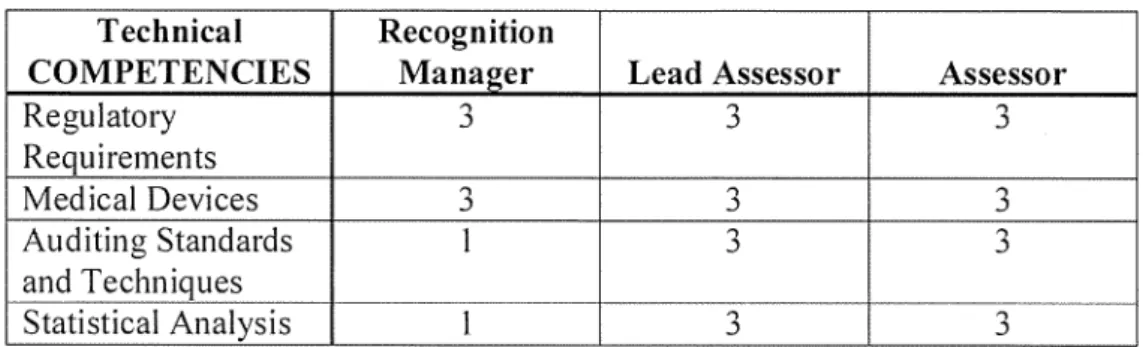
Technical Recognition
COMPETENCIES Manager Lead Assessor Assessor
Regulatory 3 3 ,.., .)
Requirements
Medical Devices 3 3 3
Auditing Standards 1 ,.., .) 3
and Techniques
Statistical Analysis 1 ,.., .) ,.., .)
Table 3 -Technical Competence Levels
Program Administrators shall have a technical competence oflevel3 in the Regulatory Authority's policies and procedures for assessing the application, to determine assessment team competence required, selecting the assessment team members, and determining assessment time.