Installing Communicator on Citrix and Windows Servers
C
C.
Installing Communicator on
Citrix and Windows Servers
This appendix describes how to install ShoreTel Communicator for Windows on Citrix and Windows servers. It contains the following information:Overview ... 378
XenApp Support Considerations... 378
Citrix XenApp Environment Best Practices... 378
Citrix XenApp Restrictions ... 379
Windows Server Support Considerations ... 379
Windows Server Restrictions... 379
Installing ShoreTel Communicator on WTS or Citrix XenApp ... 379
Preliminary Steps for Upgrading ShoreTel Communicator on 64-bit Platforms 380 Installing Communicator on a Terminal Server ... 380
Using Third-Party Applications with ShoreTel Communicator on a Citrix or Terminal Server... 381
Installing the Microsoft Office 2007/2010/2013 Outlook Add-in ... 381
Installing ShoreTel Telephony Interface (STI) on a Citrix or Terminal Server ... 382
Note
In Windows Server 2008 and Windows Server 2008 R2, Windows Terminal Services is known as Remote Terminal Services.
Installing Communicator on Citrix and Windows Servers Overview
C
Overview
You can install ShoreTel Communicator for Windows on Citrix XenApp and Windows Terminal Servers to provide ShoreTel Communicator functionality to Terminal Services clients.
ShoreTel Communicator for Windows on Citrix XenApp supports desktop and published modes in standard environments, but does not support isolation environments.
For information on Citrix XenApp and Windows Terminal Services, refer to the documentation from the manufacturer.
The topics discussed in this appendix include: XenApp Support Considerations on page 378
Windows Server Support Considerations on page 379
Installing ShoreTel Communicator on WTS or Citrix XenApp on page 379
Using Third-Party Applications with ShoreTel Communicator on a Citrix or Terminal Server on page 381
XenApp Support Considerations
This section provides information about best practices and restrictions when installing ShoreTel Communicator for Windows in a Citrix XenApp environment.
Citrix XenApp Environment Best Practices
ShoreTel recommends the following best practice guidelines for computers running ShoreTel on XenApp servers:
Use only Citrix-ready anti-virus software on XenApp servers.
Run XenApp and ShoreTel servers on a Citrix-qualified server platform. Perform frequent defragmentation of the XenApp server disk.
Co-locate the Citrix/WTS server with the Headquarters server or the DVS servicing the ShoreTel Communicator clients.
Note
To prevent the user from receiving a warning message about enhanced security, ShoreTel recommends that you disable Enhanced Security on the Microsoft server running Citrix XenApp or Windows Terminal Services.
Citrix XenApp Restrictions Installing Communicator on Citrix and Windows Servers
C
Citrix XenApp Restrictions
ShoreTel Communicator for Windows does not support the following XenApp operations: Streaming mode
Application Isolation Environment (AIE) Virtual deployment
XenDesktop
The following ShoreTel Communicator for Windows features are not supported in the Citrix XenApp environment:
SoftPhone Video
Docking in Seamless Mode (Docked Top, Docked Bottom, Docked Left, Docked Right) Presenter for Java must be used because ShoreTel does not support Presenter for Windows
(ShoreTel Conferencing)
Windows Server Support Considerations
This section provides information about restrictions when installing ShoreTel Communicator for Windows in a Windows Server environment.
Windows Server Restrictions
The following ShoreTel Communicator for Windows features are not supported in the Windows Server environment:
SoftPhone Video
Installing ShoreTel Communicator on WTS or Citrix
XenApp
ShoreTel supports ShoreTel Communicator on the following platforms: Windows Server 2008 32-bit and 64 bit
Installing Communicator on Citrix and Windows ServersPreliminary Steps for Upgrading ShoreTel Communicator on 64-bit
Plat-C
Windows Server 2012 Standard and Data Center XenApp 6.0 on Windows Server 2008 R2
XenApp 6.5 on Windows Server 2008 R2
Preliminary Steps for Upgrading ShoreTel Communicator on
64-bit Platforms
ShoreTel Communicator for Windows requires .NET Framework version 3.5 or higher on 64-bit Windows Terminal Services platforms.
ShoreTel does not ship the .NET Framework as part of the software package.
The first time the .NET Framework is required, Communicator prompts you to download and save it to a file on the ShoreTel server.
Installing Communicator on a Terminal Server
1. Open a browser on the terminal server. 2. Enter the following URL:
http://<ShoreTel_server_name>/ShoreWareresources/clientinstall
ShoreTel_server_name is the name or IP address of the ShoreTel Headquarters server or DVS that manages the client software on the ShoreTel server.
The ShoreTel Communicator Install page for Windows computers appears. Refer to Figure 73 for an example.
3. Review the information on this page, then click Click Here to Install ShoreTel Communicator. The download process starts, and the InstallShield Wizard is launched.
4. Follow the prompts to install Communicator. Note
If the .NET Framework is not installed on the target terminal server and the .NET Framework file in the ShoreTel folder is empty, the target terminal server must be able to access the Internet so that the .NET Framework can be downloaded during the Communicator installation process.
Note
Administrative rights on the terminal server are required in order to install ShoreTel Communicator for Windows.
Using Third-Party Applications with ShoreTel Communicator on a Citrix or Terminal ServerInstalling Communicator on Citrix and
C
Figure 73: ShoreTel Communicator Install Page for Windows
Using Third-Party Applications with ShoreTel
Communicator on a Citrix or Terminal Server
Third-party applications can interact with ShoreTel Communicator for Windows on a Citrix/Terminal Server only if the terminal server is running the ShoreTel Telephony Interface (STI).
This section describes how to set up the Citrix/Terminal Server to use third-party applications with ShoreTel Communicator for Windows.
Installing the Microsoft Office 2007/2010/2013 Outlook Add-in
Note
On 64-bit systems, the installation process places files in this folder by default:
C:\Program Files (x86)\Shoreline Communications\ShoreWare Client
On 32-bit systems, the installation process places files in this folder by default:
Installing Communicator on Citrix and Windows Servers Installing ShoreTel Telephony Interface (STI) on a Citrix or Terminal
C
This feature supports contact import, voice mail, conference scheduling, call handling mode, and Outlook presence.
1. Log on to the Citrix XenApp server for the desired individual user.
2. Start Communicator.
3. To install the Microsoft Office 2007/2010/2013 Outlook add-in for ShoreTel Communicator, open Tools > Options > Outlook, and click Install for the options you want to install. For more information about installing the add-in, refer to the ShoreTel Communicator for Windows User Guide.
Installing ShoreTel Telephony Interface (STI) on a Citrix or
Terminal Server
1. Install or upgrade ShoreTel Communicator. 2. Install ShoreTel Telephony Interface:
a. Launch Windows Explorer. b. Enter the following URL:
http://serverIP/shorewareresources/shoreteltelephonyinterface The ShoreTel Telephony Interface Install site appears.
c. Click the link to install the ShoreTel Telephony Interface. Download and install the interface on the Citrix/Terminal Server.
3. Reboot the terminal server. 4. Launch the Control Panel.
5. Select Phone and Modem Options.
The Phone and Modem Options dialog appears. Note
You must install Microsoft Outlook prior to installing ShoreTel Communicator.
Note
ShoreTel supports Citrix XenApp 6.0 and 6.5. For more information, refer to Installing ShoreTel Communicator on WTS or Citrix XenApp on page 379.
Installing ShoreTel Telephony Interface (STI) on a Citrix or Terminal ServerInstalling Communicator on Citrix and Windows Serv-
C
6. Click Advanced.
7. Remove all ShoreTel providers. 8. Click OK.
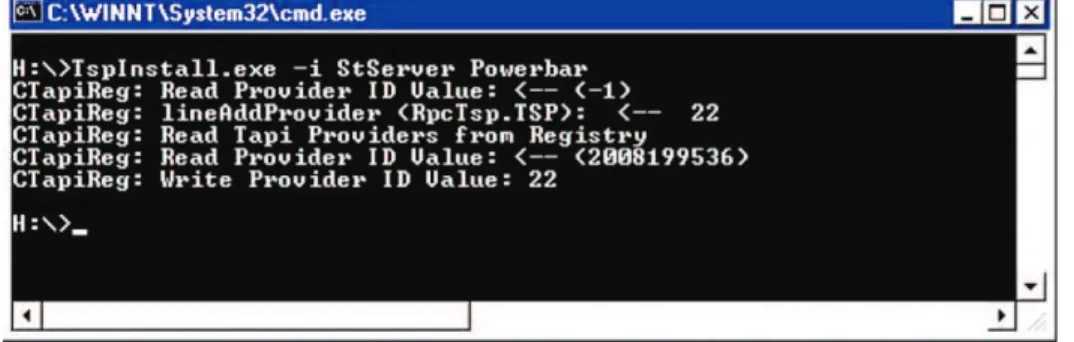
The changes are saved and the dialog closes. 9. On the terminal server, click Start > Run. 10. Type cmd, then click OK.
The Command Prompt appears, as shown in Figure 74.
11. Navigate to the directory where the ShoreTel Telephony Interface is installed: \Program
Files\ShoreTel\ShoreTel 3rd Party.
12. At the prompt, type the following:
TSPinstall -i StServer HQ servername
HQ servername is the hostname or IP address of your ShoreTel Headquarters server. The TSPinstall utility is launched.
13. Close the cmd prompt and reboot the server.
14. Verify that multiple lines are provided for the ShoreTel Telephony Interface:
a. On the terminal server, navigate to the Phone and Modem Options Advanced tab. b. In the Provider list, select the ShoreTel provider, then click Configure.
The ShoreTel Remote TSP dialog appears, as shown in Figure 75.
If the ShoreTel Remote TAPI Service Provider is connected to the ShoreTel Server, the fields are populated automatically.
If an error message is posted in Provider Status and Server Name and Login are blank, the ShoreTel Remote TAPI Service Provider must be removed.
Complete the following steps to remove the provider:
1. Go to the Control Panel and open Phone and Modem Options Advanced. 2. Click ShoreTel Remote TAPI Service Provider.
3. Click Remove. Note
If this is the first time this option is activated, another dialog box is opened first, requiring outbound dialing information.
Installing Communicator on Citrix and Windows Servers Installing ShoreTel Telephony Interface (STI) on a Citrix or Terminal
C
Figure 74: TSPInstall Command Line