Decoupled Variational Gaussian Inference
Mohammad Emtiyaz Khan
Ecole Polytechnique F´ed´erale de Lausanne (EPFL), Switzerland [email protected]
Abstract
Variational Gaussian (VG) inference methods that optimize a lower bound to the marginal likelihood are a popular approach for Bayesian inference. A difficulty remains in computation of the lower bound when the latent dimensionalityLis large. Even though the lower bound is concave for many models, its computation requires optimization overO(L2)variational parameters. Efficient reparameter-ization schemes can reduce the number of parameters, but give inaccurate solu-tions or destroy concavity leading to slow convergence. We propose decoupled variational inference that brings the best of both worlds together. First, it max-imizes a Lagrangian of the lower bound reducing the number of parameters to O(N), whereNis the number of data examples. The reparameterization obtained is unique and recovers maxima of the lower-bound even when it is not concave. Second, our method maximizes the lower bound using a sequence of convex prob-lems, each of which is parallellizable over data examples. Each gradient compu-tation reduces to prediction in apseudolinear regression model, thereby avoiding all direct computations of the covariance and only requiring its linear projections. Theoretically, our method converges at the same rate as existing methods in the case of concave lower bounds, while remaining convergent at a reasonable rate for the non-concave case.
1
Introduction
Large-scale Bayesian inference remains intractable for many models, such as logistic regression, sparse linear models, or dynamical systems with non-Gaussian observations. Approximate Bayesian inference requires fast, robust, and reliable algorithms. In this context, algorithms based on varia-tional Gaussian (VG) approximations are growing in popularity [17, 3, 13, 6] since they strike a favorable balance between accuracy, generality, speed, and ease of use.
VG inference remains problematic for models with large latent-dimensionality. While some vari-ants are convex [3], they requireO(L2)variational parameters to be optimized, where L is the latent-dimensionality. This slows down the optimization. One solution is to restrict the covariance representations by naive mean-field [2] or restricted Cholesky [3], but this can result in considerable loss of accuracy when significant posterior correlations exist. An alternative is to reparameterize the covariance to obtain O(N)number of parameters, where N is the number of data examples [17]. However, this destroys the convexity and converges slowly [12]. A recent approach called dual variational inference [10] obtains fast convergence while retaining this parameterization, but is applicable to only some models such as Poisson regression.
In this paper, we propose an approach called decoupled variational Gaussian inference which ex-tends the dual variational inference to a large class of models. Our method relies on the theory of Lagrangian multiplier methods. While remaining widely applicable, our approach reduces the number of variational parameters similar to [17, 10] and converges at similar convergence rates as convex methods such as [3]. Our method is similar in spirit to parallel expectation-propagation (EP) but has provable convergence guarantees even when likelihoods are not log-concave.
2
The Model
In this paper, we apply our method for Bayesian inference on Latent Gaussian Models (LGMs). This choice is motivated by a large amount of existing work on VG approximations for LGMs [16, 17, 3, 10, 12, 11, 7, 2], and because LGMs include many popular models, such as Gaussian processes, Bayesian regression and classification, Gaussian Markov random field, and probabilistic PCA. An extensive list of these models is given in Chapter 1 of [9]. We have also included few examples in the supplementary material.
Given a vector of observationsyof lengthN, LGMs model the dependencies among its components using a latent Gaussian vectorzof lengthL. The joint distribution is shown below.
p(y,z) =
N
Y
n=1
pn(yn|ηn)p(z), η=Wz, p(z) :=N(z|µ,Σ) (1) whereWis a known real-valued matrix of sizeN ×L, and is used to define linear predictorsη. Eachηn is used to model the observationyn using a link functionpn(yn|ηn). The exact form of this function depends on the type of observations, e.g. a Bernoulli-logit distribution can be used for binary data [14, 7]. See the supplementary material for an example. Usually, an exponential family distribution is used, although there are other choices (such as T-distribution [8, 17]). The parameter setθ includes{W,µ,Σ}and other parameters of the link function and is assumed to be known. We suppressθin our notation, for simplicity.
In Bayesian inference, we wish to compute expectations with respect to the posterior distribution p(z|y)which is shown below. Another important task is the computation of the marginal likelihood p(y)which can be maximized to estimate parametersθ, for example, using empirical Bayes [18].
p(z|y)∝
N
Y
n=1
p(yn|ηn)N(z|µ,Σ) , p(y) =
Z N
Y
n=1
p(yn|ηn)N(z|µ,Σ)dz (2) For non-Gaussian likelihoods, both of these tasks are intractable. Applications in practice demand good approximations that scale favorably inNandL.
3
VG Inference by Lower Bound Maximization
In variational Gaussian (VG) inference [17], we assume the posterior to be a Gaussian q(z) = N(z|m,V). The posterior meanmand covarianceVform the set of variational parameters, and are chosen to maximize the variational lower bound to the log marginal likelihood shown in Eq. (3). To get this lower bound, we first multiply and divide byq(z)and then apply Jensen’s inequality using the concavity oflog.
logp(y) = log Z
q(z) Q
np(yn|ηn)p(z)
q(z) dz≥Eq(z)
log Q
np(yn|ηn)p(z) q(z)
(3) The simplified lower bound is shown in Eq. (4). The detailed derivation can be found in Eqs. (4)–(7) in [11] (and in the supplementary material). Below, we provide a summary of its components.
max
m,V0−D[q(z)kp(z)]−
N
X
n=1
fn( ¯mn,σn¯ ), fn( ¯mn,σn¯ ) :=EN(ηn|m¯n,¯σn2)[−logp(yn|ηn)] (4) The first term is the KL-divergenceD[qkp] =Eq[logq(z)−logp(z)], which is jointly concave in
(m,V). The second term sums over data examples, where each term denoted byfnis the expec-tation of−logp(yn|ηn)with respect toηn. Sinceηn = wT
nz, it follows a Gaussian distribution q(ηn) =N( ¯mn,¯σn2)with meanmn¯ =wTnmand variances¯σn2 =wTnVwn. The termsfn are not always available in closed form, but can be computed using quadrature or look-up tables [14]. Note that unlike many other methods such [2, 11, 10, 7, 21], we do not bound or approximate these terms. Such approximations lead to loss of accuracy.
We denote the lower bound of Eq. (3) byf and expand it below in Eq. (5): f(m,V) := 12[log|V| −Tr(VΣ−1)−(m−µ)TΣ−1(m−µ) +L]−
N
X
n=1
fn( ¯mn,σn¯ ) (5) Here|V|denotes the determinant ofV. We now discuss existing methods and their pros and cons.
3.1 Related Work
A straight-forward approach is to optimize Eq. (5) directly in(m,V)[2, 3, 14, 11]. In practice, direct methods are slow and memory-intensive because of the very large numberL+L(L+ 1)/2
of variables. Challis and Barber [3] show that for log-concave likelihoodsp(yn|ηn), the original problem Eq. (4) is jointly concave inmand the Cholesky factor ofV. This fact, however, does not result in any reduction in the number of parameters, and they propose to use factorizations of a restricted form, which negatively affects the approximation accuracy.
[17] and [16] note that the optimalV∗must be of the formV∗= [Σ−1+WTdiag(λ)W]−1, which suggests reparameterizing Eq. (5) in terms ofL+Nparameters(m,λ), whereλis the new variable. However, the problem is not concave in this alternative parameterization [12]. Moreover, as shown in [12] and [10], convergence can be exceedingly slow. The coordinate-ascent approach of [12] and dual variational inference [10] both speed-up convergence, but only for a limited class of models. A range of different deterministic inference approximations exist as well. The local variational method is convex for log-concave potentials and can be solved at very large scales [23], but applies only to models with super-Gaussian likelihoods. The bound it maximizes is provably less tight than Eq. (4) [22, 3] making it less accurate. Expectation propagation (EP) [15, 21] is more general and can be more accurate than most other approximations mentioned here. However, it is based on a saddle-point rather than an optimization problem, and the standard EP algorithm does not al-ways converge and can be numerically unstable. Among these alternatives, the variational Gaussian approximation stands out as a compromise between accuracy and good algorithmic properties.
4
Decoupled Variational Gaussian Inference using a Lagrangian
We simplify the form of the objective function by decoupling the KL divergence term from the terms includingfn. In other words, we separate the prior distribution from the likelihoods. We do so by introducing real-valued auxiliary-variableshnandσn>0, such that the following constraints hold:hn = ¯mnandσn = ¯σn. This gives us the following (equivalent) optimization problem over x:={m,V,h,σ},
max
x g(x) :=
1 2
log|V| −Tr(VΣ−1)−(m−µ)TΣ−1(m−µ) +L −
N
X
n=1
fn(hn, σn) (6) subject to constraintsc1n(x) :=hn−wTnm= 0andc2n(x) :=12(σ
2
n−wTnVwn) = 0for alln. For log-concave likelihoods, the functiong(x)is concave inV, unlike the original functionf (see Eq. (5)) which is concave with respect to Cholesky ofV. The difficulty now lies with the non-linear constraints c2
n(x). We will now establish that the new problem gives rise to a convenient parameterization, but does not affect the maximum.
The significance of this reformulation lies in its Lagrangian, shown below.
L(x,α,λ) :=g(x) +
N
X
n=1
αn(hn−wTnm) +12λn(σ 2 n−w
T
nVwn) (7) Here,αn, λn are Lagrangian multipliers for the constraintsc1
n(x)andc2(x). We will now show that the maximum off of Eq. (5) can be parameterized in terms of these multipliers, and that this reparameterization is unique. The following theorem states this result along with three other useful relationships between the maximum of Eq. (5), (6), and (7). Proof is in the supplementary material. Theorem 4.1. The following holds for maxima of Eq. (5), (6), and (7):
1. A stationary pointx∗of Eq. (6) will also be a stationary point of Eq. (5). For every such stationary pointx∗, there exist uniqueα∗andλ∗such that,
V∗= [Σ−1+WTdiag(λ∗)W]−1, m∗=µ−ΣWTα∗ (8)
2. Theα∗nandλ∗ndepend on the gradient of functionfnand satisfy the following conditions,
5hnfn(h ∗
n, σn∗) =α∗n, 5σnfn(h ∗
whereh∗n =wT
nm∗and(σn∗)2 =wTnV ∗w
nfor allnand5xf(x∗)denotes the gradient
off(x)with respect toxatx=x∗.
3. When{m∗,V∗}is a local maximizer of Eq. (5), then the set{m∗,V∗,h∗,σ∗,α∗,λ∗}is a strict maximizer of Eq. (7).
4. When likelihoodsp(yn|ηn)are log-concave, there is only one global maximum off, and any{m∗,V∗}obtained by maximizing Eq. (7) will be the global maximizer of Eq. (5).
Part 1 establishes the parameterization of (m∗,V∗) by (α∗,λ∗) and its uniqueness, while part 2 shows the conditions that (α∗,λ∗)satisfy. This form has also been used in [12] for Gaussian Processes where a fixed-point iteration was employed to search forλ∗. Part 3 shows that such parameterization can be obtained at maxima of the Lagrangian rather than minima or saddle-points. The final part considers the case whenf is concave and shows that the global maximum can be obtained by maximizing the Lagrangian. Note that concavity of the lower bound is required for the last part only and the other three parts are true irrespective of concavity.
Detailed proof of the theorem is given in the supplementary material.
Note that the conditions of Eq. (9) restrict the values thatα∗nandλ∗ncan take. Their values will be valid only in the range of the gradients offn. This is unlike the formulation of [17] which does not constrain these variables, but is similar to the method of [10]. We will see later that our algorithm makes the problem infeasible for values outside this range. Ranges of these variables vary depending on the likelihoodp(yn|ηn). However, we show below in Eq. (10) thatλ∗nis always strictly positive for log-concave likelihoods. The first equality is obtained using Eq. (9), while the second equality is simply change of variables fromσn toσ2
n. The third equality is obtained using Eq. (19) from [17]. The final inequality is obtained sincefn is convex for all log-concave likelihoods (5xxf(x) denotes the Hessian off(x)).
λ∗n=σn∗ −1
5σnfn(h ∗
n, σ∗n) = 25σ2
nfn(h ∗
n, σn∗) =52hnhnfn(h ∗
n, σ∗n)>0 (10)
5
Optimization Algorithms for Decoupled Variational Gaussian Inference
Theorem 4.1 suggests that the optimal solution can be obtained by maximizingg(x)or the La-grangianL. The maximization is difficult for two reasons. First, the constraintsc2n(x)are non-linear and second the functiong(x)may not always be concave. Note that it is not easy to apply the aug-mented Lagrangian method or first-order methods (see Chapter 4 of [1]) because their application would require storage ofV. Instead, we use a method based on linearization of the constraints which will avoid explicit computation and storage ofV. First, we will show that wheng(x)is concave, we can maximize it by minimizing a sequence of convex problems. We will then solve each convex problem using the dual-variational method of [10].
5.1 Linearly Constrained Lagrangian (LCL) Method
We now derive an algorithm based on the linearly constrained Lagrangian (LCL) method [19]. The LCL approach involves linearization of the non-linear constraints and is an effective method for large-scale optimization, e.g. in packages such as MINOS [24]. There are variants of this method that are globally convergent and robust [4], but we use the variant described in Chapter 17 of [24]. The final algorithm: See Algorithm 1. We start with a α,λandσ. At every iterationk, we
minimizethe following dual:
min α,λ∈S
−1 2log|Σ
−1+WT
diag(λ)W|+12αTΣeα−µe
T
α+
N
X
n=1
fnk∗(αn, λn) (11)
Here,Σe =WΣWT andµe=Wµ. The functionsfnk∗are obtained as follows:
fnk∗(αn, λn) := max hn,σn>0
−fn(hn, σn) +αnhn+12λnσkn(2σn−σkn)−12λ k
n(σn−σkn) 2
(12) whereλk
Algorithm 1Linearly constrained Lagrangian (LCL) method for VG approximation Initializeα,λ∈ Sandσ0.
fork= 1,2,3, . . .do
λk←λandσk ←σ. repeat
For alln, compute predictive meanmˆ∗nand variancesˆv∗nusing linear regression (Eq. (13)) For alln, in parallel, compute(h∗n, σ∗n)that maximizes Eq. (12).
Find next(α,λ)∈ Susing gradientsgαn =h∗n−mˆ∗nandgnλ=12[−(σ k
n)2+ 2σnkσn−vˆn∗]. untilconvergence
end for
The constraint setS is a box constraints on αn andλn such that a global minimum of Eq. (12) exists. We will show some examples later in this section.
Efficient gradient computation:An advantage of this approach is that the gradient at each iteration can be computed efficiently, especially for largeN andL. The gradient computation is decoupled into two terms. The first term can be computed by computingfnk∗ in parallel, while the second term involves prediction in a linear model. The gradients with respect toαnandλn(derived in the supplementary material) are given asgnα:=h∗n−mˆ∗nandgλn := 12[−(σ
k
n)2+ 2σknσ∗n−vˆ∗n], where
(h∗n, σ∗n)are maximizers of Eq. (12) andvˆn∗andmˆ∗nare computed as follows:
ˆ
v∗n:=wTnVn∗wn=wTn(Σ
−1+WT
diag(λ)W)−1wn=Σenn−Σen,:(Σe +diag(λ)−1)−1Σen,:
ˆ
m∗n:=wTnm∗n =wnT(µ−ΣWTα) =µne −Σn,:e α (13)
The quantities(h∗n, σn∗)can be computed in parallel over alln. Sometimes, this can be done in closed form (as we shown in the next section), otherwise we can compute them by numerically optimizing over two-dimensional functions. Since these problems are only two-dimensional, a Newton method can be easily implemented to obtain fast convergence.
The other two termsˆvn∗ andmˆ∗n can be interpreted as predictive means and variances of apseudo
linear model, e.g. compare Eq. (13) with Eq. 2.25 and 2.26 of Rasmussen’s book [18]. Hence every gradient computation can be expressed as Bayesian prediction in a linear model for which we can use existing implementation. For example, for binary or multi-class GP classification, we can reuse efficient implementation of GP regression. In general,we can use a Bayesian inference in a conjuate model to compute the gradient of a non-conjugate model. This way the method also avoids forming V∗ and work only with its linear projections which can be efficiently computed using vector-matrix-vector products.
The “decoupling” nature of our algorithm should now be clear. The non-linear computations de-pending on the data, are done in parallel to computeh∗n andσn∗. These are completely decoupled from linear computations formnˆ andvnˆ . This is summarized in Algorithm (1).
Derivation: To derive the algorithm, we first linearize the constraints. Given multiplierλk and a pointxkat thek’th iteration, we linearize the constraintsc2n(x):
¯
c2nk(x) :=c2n(xk) +5c2n(xk)T(x−xk) (14)
= 1 2[(σ
k n)
2
−wTnVkwn+ 2σnk(σn−σnk)−(w T
nVwn−wTnV kw
n)] (15)
=−1 2[(σ
k n)
2−2σk nσn+w
T
nVwn] (16)
Since we want the linearized constraint¯c2
nk(x)to be close to the original constraintc 2
n(x), we will penalize the difference between the two.
c2n(x)−¯c2nk(x) =12{σn2−wTnVwn−[−(σkn) 2+ 2σk
nσn−wTnVwn]}=12(σn−σnk) 2 (17)
The key point is that this term is independent ofV, allowing us to obtain a closed-form solution for V∗. This will also be crucial for the extension to non-concave case in the next section.
The newk’th subproblem is defined with the linearized constraints and the penalization term:
max
x g
k(x) :=g(x)
− N X n=1 1 2λ k
n(σn−σkn) 2
(18) s.t. hn−wTnmn = 0 , −1
2[(σ k n)
2−2σk nσn+w
T
nVwn] = 0, ∀n This is a concave problem with linear constraints and can be optimized using dual variational infer-ence [10]. Detailed derivation is given in the supplementary material.
Convergence: When LCL algorithm converges, it has quadratic convergence rates [19]. However, it may not always converge. Globally convergent methods do exist (e.g. [4]) although we do not explore them in this paper. Below, we present a simple approach that improves the convergence for non log-concave likelihoods.
Augmented Lagrangian Methods for non log-concave likelihoods:When the likelihoodp(yn|ηn)
are not log-concave, the lower bound can contain local minimum, making the optimization difficult for functionf(m,V). In such scenarios, the algorithm may not converge for all starting values. The convergence of our approach can be improved for such cases. We simply add an augmented Lagrangian term[¯c2nk(x)]2 to the linearly constrained Lagrangian defined in Eq. (18), as shown below [24]. Here,δk
i >0andiis thei’th iteration ofk’th subproblem: gkaug(x) :=g(x)−
N X n=1 1 2λ k
n(σn−σ k n)
2+1 2δ
k
i(σn−σ k n)
4 (19)
subject to the same constraints as Eq. (18). The sequenceδk
i can either be set to a constant or be increased slowly to ensure convergence to a local maximum. More details on setting this sequence and its affect on the convergence can be found in Chapter 4.2 of [1]. It is in fact possible to know the value ofδik such that the algorithm always converge. This value can be set by examining theprimal function- a function with respect to the
deviationsin constraints. It turns out that it should be set larger than the largest eigenvalues of the Hessian of the primal function at 0. A good discussion of this can be found in Chapter 4.2 of [1]. The fact that that the linearized constraint¯c2
nk(x)does not depend onVis very useful here since addition of this term then only affects computation offnk∗. We modify the algorithm by simply changing the computation to optimization of the following function:
max
hn,σn>0
−fn(hn, σn) +αnhn+12λnσkn(2σn−σkn)−1 2λ
k
n(σn−σ k n)
2−δ k i
2 (σn−σ
k n)
4 (20) It is clear from this that the augmented Lagrangian term is trying to “convexify” the non-convex functionfn, leading to improved convergence.
Computation of fnk∗(α,λn) These functions are obtained by solving the optimization problem shown in Eq. (12). In some cases, we can compute these functions in closed form. For exam-ple, as shown in the supplementary material, we can computeh∗andσ∗in closed form for Poisson likelihood as shown below. We also show the range ofαnandλnfor whichfnk∗is finite.
σn∗ = λn+λ
k n yn+αn+λkn
σnk, h∗n =−1 2σ
∗2
n + log(yn+αn), S={αn>−yn, λn >0,∀n} (21) An expression for Laplace likelihood is also derived in the supplementary material.
When we do not have a closed-form expression forfnk∗, we can use a 2-D Newton method for opti-mization. To facilitate convergence, we must warm-start the optiopti-mization. Whenfnis concave, this usually converges in few iterations, and since we can parallelize overn, a significant speed-up can be obtained. A significant engineering effort is required for parallelization and for our experiments in this paper, we have not done so.
An issue that remains open is the evaluation of the rangeS for which eachfnk∗is finite. For now, we have simply set it to the range of gradients of functionfn as shown by Eq. 9 (also see the last paragraph in that section). It is not clear whether this will always assure convergence for the 2-D optimization.
Prediction: Givenα∗ andλ∗, we can compute the predictions by using equations similar to GP regression. See details in Rasmussen’s book [18].
6
Results
We demonstrate the advantages of our approach on a binary GP classification problem. We model the binary data using Bernoulli-logit likelihoods. Functionfnare computed to a reasonable accuracy using the piecewise bound [14] with 20 pieces.
We apply this model to a subproblem of the USPS digit data [18]. Here, the task is to classify between 3’s vs. 5’s. There are a total of 1540 data examples with feature dimensionality of 256. Since we want to compare the convergence, we will show results for different data sizes by sub-sampling randomly from these examples.
We setµ= 0and use a squared-exponential kernel, for which the(i, j)th entry ofΣis defined as: Σij =−σ2exp[−1
2||xi−xj||
2/s]wherexiisi’th feature. We show results forlog(σ) = 4and
log(s) =−1which corresponds to a difficult case where VG approximations converge slowly (due to the ill-conditioning of the Kernel) [18]. Our conclusions hold for other parameter settings as well. We compare our algorithm with the approach of Opper and Archambeau [17] and Challis and Barber [3]. We refer to them as ‘Opper’ and ‘Cholesky’, respectively. We call our approach ‘Decoupled’. For all methods, we use L-BFGS method for optimization (implemented in minFuncby Mark Schmidt), since a Newton method would be too expensive for largeN. All algorithms were stopped when the subsequent changes in the lower bound value of Eq. 5 were less than10−4. All methods were randomly initialized. Our results are not sensitive to initialization. We compare convergence in terms of the value of lower bound. The prediction errors show very similar trend, therefore we do not present them.
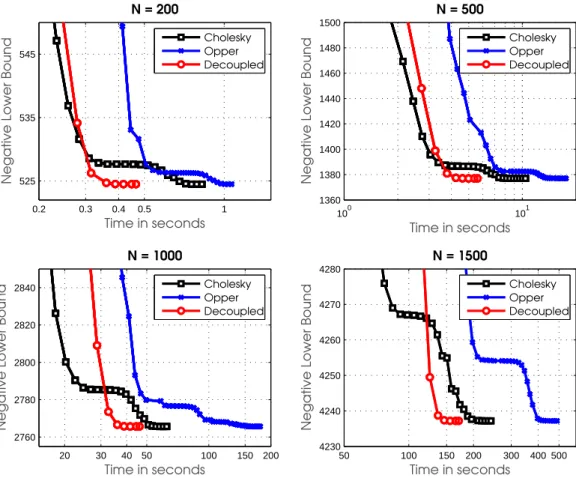
The results are summarized in Figure 1. Each plot shows the negative of the lower bound vs time in seconds for increasing data sizesN = 200,500,1000and 1500. For Opper and Cholesky, we show markers for every iteration. For decoupled, we show markers after completion of each subproblem. We can not see the result of first subproblem here, and the first visible marker is obtained from the second subproblem onwards.
We see that as the data size increases, Decoupled converges faster than the other methods, showing a clear advantage over other methods for large dimensionality.
7
Discussion and Future Work
In this paper, we proposed the decoupled VG inference method for approximate Bayesian inference. We obtain efficient reparameterization using a Lagrangian to the lower bound. We showed that such a parameterization is unique, even for non log-concave likelihood functions, and the maximum of the lower bound can be obtained by maximizing the Lagrangian. For concave likelihood function, our method recovers the global maximum. We proposed a linearly constrained Lagrangian method to maximize the Lagrangian. The algorithm has the desired property that it reduces each gradi-ent computation to a linear model computation, while parallelizing non-linear computations over data examples. Our proposed algorithm is capable of attaining convergence rates similar to convex methods.
Unlike methods such as mean-field approximation, our method preserves all posterior correlations and can be useful towards generalizing stochastic variational inference (SVI) methods [5] to non-conjugate models. Existing SVI methods rely on mean-field approximations and are widely applied for conjugate models. Under our method, we can stochastically include only few constraints to maximize the Lagrangian. This amounts to a low-rank approximation of the covariance matrix and can be used to construct an unbiased estimate of the gradient.
We have focused only on latent Gaussian models for simplicity. It is easy to extend our approach to other Gaussian latent models, e.g. sparse Bayesian linear model [21] and Bayesian non-negative matrix factorization [20]. Similar decoupling method can also be applied to general latent variable models. Note that a choice of proper posterior distribution is required to get an efficient parameterization of the posterior.
It is also possible to get sparse posterior covariance approximation using our decoupled formulation. One possible idea is to use Hinge type of loss to approximate the likelihood terms. Using the dualization similar to what we have shown here would give us a sparse posterior covariance.
0.2 0.3 0.4 0.5 1 525
535 545
N = 200
Time in seconds
Negative Lower Bound
100 101
1360 1380 1400 1420 1440 1460 1480 1500
N = 500
Time in seconds
Negative Lower Bound
20 30 40 50 100 150 200 2760
2780 2800 2820 2840
N = 1000
Time in seconds
Negative Lower Bound
50 100 150 200 300 400 500 4230
4240 4250 4260 4270 4280
N = 1500
Time in seconds
Negative Lower Bound
Cholesky Opper Decoupled
Cholesky Opper Decoupled
Cholesky Opper Decoupled
Cholesky Opper Decoupled
Figure 1: Convergence results for a GP classification on the USPS-3vs5 data set. Each plot shows the negative of the lower bound vs time in seconds for data sizesN = 200,500,1000and 1500. For Opper and Cholesky, we show markers for every iteration. For decoupled, we show markers after completion of each subproblem. We can not see the result of first subproblem here, and the first visible marker is obtained from the second subproblem. As the data size increases, Decoupled converges faster, showing a clear advantage over other methods for large dimensionality.
A weakness of our paper is a lack of strong experiments showing that the decoupled method indeed converge at a fast rate. The implementation of decoupled method requires a good engineering effort for it to scale to big data. In future, we plan to have an efficient implementation of this method and demonstrate that this enables variational inference to scale to large data.
Acknowledgments
This work was supported by School of Computer Science and Communication at EPFL. I would specifically like to thank Matthias Grossglauser, Rudiger Urbanke, and Jame Larus for providing me support and funding during this work. I would like to personally thank Volkan Cevher, Quoc Tran-Dinh, and Matthias Seeger from EPFL for early discussions of this work and Marc Desgroseilliers from EPFL for checkin some proofs.
I would also like to thank the reviewers for their valuable feedback. The experiments in this paper are less extensive than what I promised them. Due to time and space constraints, I have not been able to add all of them. More experiments will appear in an arXiv version of this paper.
References
[1] Dimitri P Bertsekas.Nonlinear programming. Athena Scientific, 1999.
[2] M. Braun and J. McAuliffe. Variational inference for large-scale models of discrete choice. Journal of the American Statistical Association, 105(489):324–335, 2010.
[3] E. Challis and D. Barber. Concave Gaussian variational approximations for inference in large-scale Bayesian linear models. InInternational conference on Artificial Intelligence and Statistics, 2011. [4] Michael P Friedlander and Michael A Saunders. A globally convergent linearly constrained lagrangian
method for nonlinear optimization.SIAM Journal on Optimization, 15(3):863–897, 2005.
[5] M. Hoffman, D. Blei, C. Wang, and J. Paisley. Stochastic variational inference. Journal of Machine Learning Research, 14:1303–1347, 2013.
[6] A. Honkela, T. Raiko, M. Kuusela, M. Tornio, and J. Karhunen. Approximate Riemannian conjugate gradient learning for fixed-form variational Bayes. Journal of Machine Learning Research, 11:3235– 3268, 2011.
[7] T. Jaakkola and M. Jordan. A variational approach to Bayesian logistic regression problems and their extensions. InInternational conference on Artificial Intelligence and Statistics, 1996.
[8] P. Jyl¨anki, J. Vanhatalo, and A. Vehtari. Robust Gaussian process regression with a Student-t likelihood. The Journal of Machine Learning Research, 999888:3227–3257, 2011.
[9] Mohammad Emtiyaz Khan. Variational Learning for Latent Gaussian Models of Discrete Data. PhD thesis, University of British Columbia, 2012.
[10] Mohammad Emtiyaz Khan, Aleksandr Y. Aravkin, Michael P. Friedlander, and Matthias Seeger. Fast dual variational inference for non-conjugate latent gaussian models. InICML (3), volume 28 ofJMLR Proceedings, pages 951–959. JMLR.org, 2013.
[11] Mohammad Emtiyaz Khan, Shakir Mohamed, Benjamin Marlin, and Kevin Murphy. A stick breaking likelihood for categorical data analysis with latent Gaussian models. InInternational conference on Artificial Intelligence and Statistics, 2012.
[12] Mohammad Emtiyaz Khan, Shakir Mohamed, and Kevin Murphy. Fast Bayesian inference for non-conjugate Gaussian process regression. InAdvances in Neural Information Processing Systems, 2012. [13] M. L´azaro-Gredilla and M. Titsias. Variational heteroscedastic Gaussian process regression. In
Interna-tional Conference on Machine Learning, 2011.
[14] B. Marlin, M. Khan, and K. Murphy. Piecewise bounds for estimating Bernoulli-logistic latent Gaussian models. InInternational Conference on Machine Learning, 2011.
[15] T. Minka. Expectation propagation for approximate Bayesian inference. InProceedings of the Conference on Uncertainty in Artificial Intelligence, 2001.
[16] H. Nickisch and C.E. Rasmussen. Approximations for binary Gaussian process classification.Journal of Machine Learning Research, 9(10), 2008.
[17] M. Opper and C. Archambeau. The variational gaussian approximation revisited. Neural Computation, 21(3):786–792, 2009.
[18] Carl Edward Rasmussen and Christopher K. I. Williams.Gaussian Processes for Machine Learning. MIT Press, 2006.
[19] Stephen M Robinson. A quadratically-convergent algorithm for general nonlinear programming prob-lems.Mathematical programming, 3(1):145–156, 1972.
[20] Mikkel N Schmidt, Ole Winther, and Lars Kai Hansen. Bayesian non-negative matrix factorization. In Independent Component Analysis and Signal Separation, pages 540–547. Springer, 2009.
[21] M. Seeger. Bayesian Inference and Optimal Design in the Sparse Linear Model. Journal of Machine Learning Research, 9:759–813, 2008.
[22] M. Seeger. Sparse linear models: Variational approximate inference and Bayesian experimental design. Journal of Physics: Conference Series, 197(012001), 2009.
[23] M. Seeger and H. Nickisch. Large scale Bayesian inference and experimental design for sparse linear models.SIAM Journal of Imaging Sciences, 4(1):166–199, 2011.