The 2015 Suspension of the Dublin Regulation: An Investigation into Possible Causes
Brittany Lynn Griese
A thesis submitted to the faculty at the University of North Carolina at Chapel Hill in partial fulfillment of the requirements for the degree of Masters of Arts in Political Science,
concentration Trans-Atlantic Studies
Chapel Hill 2017
ABSTRACT
Brittany Lynn Griese: The 2015 Suspension of the Dublin Regulation: an investigation into possible causes
(Under the direction of Dr. Liesbet Hooghe)
TABLE OF CONTENTS
LIST OF TABLES………..vi
LIST OF ABBREVIATIONS...………...……….vii
Introduction.………..……….…..1
Definitions………....2
The Dublin Regulation………...…...3
Phases………...3
Dublin III………...5
Determining Responsibility……….6
Responsibility of Communication………...8
Interview………..9
Take Charge and Take Back………...….9
Detention………11
Crisis Management………11
The Refugee Crisis……….……12
Routes of Arrival………13
Overview of Numbers………14
Two Possible Reasons for the Suspension.………...……….17
Bureaucratic (In)Capacity………..18
Case Studies………...21
Hungary………..22
Overview of Crisis……….22
Number of Refugees………..23
Government Response………...23
Public Response……….25
Germany……….26
Overview of Crisis……….26
Number of Refugees………..27
Government Response………...…28
Public Response……….30
Comparison and Conclusion………..………31
LIST OF TABLES
Table 1 - “First time asylum applicants in the EU member states”……….…..15
Table 2 - Views Towards Impact of Refugees………...19
Table 3 - Views on “Muslims in Our Country”……….20
LIST OF ABBREVIATIONS
EU European Union
CEAS Common European Asylum System ECRE European Council on Refugees and Exiles
UNHCR United Nations High Commissioner for Refugees EASO European Asylum Support Office
NGO Non-Governmental Organization FIDEZ Hungarian Civil Alliance
MIGSZOL Migrant Solidarity Group of Hungary
BAMF German Federal Agency for Migration and Refugees AfD Alternative for Germany
INTRODUCTION
In mid to late 2015 it was hard to open a news source without seeing new reports on the ever-growing refugee crisis in Europe. The refugees were coming from Syria, Iraq, Afghanistan, and other areas such as Northern Africa in search of an escape from the constant conflict in their home country. One of the main issues facing the European Union (EU) was how to handle the constant flow of refugees, which were mixing with the ever-constant flow of migrants. The Dublin Regulation is the EU directive, which dictates which EU member state is responsible for processing the asylum request of an asylum seeker: that being the “country of first entry”. In fact the crisis was reaching unprecedented levels, and countries that adhered to the Dublin Regulation began to struggle to cope with the shear numbers. Dobra (2015: 92) articulates this by noting that, “the Dublin Regulation, even by changes brought until 2015, was not taking into account a crisis of a magnitude as perceived later as being ‘the greatest crisis of refugees from the second World War’.”
Definitions
During the process of my research for this paper, I have come across different definitions and terminology. In some cases the crisis in 2015 is regarded as the “migrant crisis”, while other sources use the term “refugee crisis”. This difference in terminology, and how it impacted the view of the crisis in 2015, is well characterized by Holmes and Castaneda (2016). They describe how “at times the phrase ‘migrant crisis’ subtly delegitimizes calls for protection, whereas the phrase ‘refugee crisis’ reinforces them” (Holmes and Castaneda 2016: 16). The distinction is that “refugee” implies involuntary migration, whereas “migrant” implies voluntary migration (Holmes and Castaneda 2016: 16-17). For the purpose of this paper, I have chosen to use the term “refugee crisis”, as I believe it best describes the situation.
In that respect I use the EU definition of a refugee, which is adopted from the 1951 Geneva Convention definition:
“a person who owning to well founded fear of being persecuted for reasons of race, religion, nationality, membership of a particular social group or political opinion, is outside the country of his nationality and is unable or owing to such fear is unwilling to avail himself of the protection of that country.” (Untied Nations Refugee Agency 1951)
In regards to the term “third-country national”, I use the definition given in the Dublin regulation:
I also use the EU classification of asylum granting, as outlined on the Common European Asylum System (CEAS) website:
“Asylum is granted to people fleeing persecution or serious harm in their own country and therefore in need of international protection.” (European Commission CEAS 2017)
The Dublin Regulation
Phases
regulation is not a CEAS, but instead a “clear and workable method for determining the member state responsible for the examination of an asylum application” (Reg. No 604/2013). One of the main aspects of the passing of the 1990 Dublin Convention relied on “States mutual confidence in their asylum procedures” (Hurwitz 1999: 648). Since Schengen opened the borders between the countries and allowed for visa free travel, if the States did not have mutual trust the others asylum procedures then the system would not function.
The Dublin process has gone through three iterations: Dublin I in 1995, Dublin II in 2003, and Dublin III in 2013. The first Dublin Convention was updated on 18 February 2003 with the passing of regulation No. 343/2003 (Dublin II). Lenart (2012: 5) outlines the original aim of Dublin II as:
“Designed to prevent two of the most undesirable phenomena in the area of refugee law- ‘refugees in Orbit’ (refugees circling between member states or within one Member State neither being allowed to stay within it’s territory, nor being able to leave it) – and ‘Asylum Shopping’ (lodging an application in several member states or choosing the one having the most lenient policy or practice in this respect) – and to bring order to the process of
examining asylum application in the EU.”
seekers will be treated with similar levels of respect and dignity, while also being given adequate housing and support.
One of the main complaints from member states was in regards to the increased burden “on Southern and Eastern European Countries” (Lenart 2012: 6). This burden was a consequence of being the usual “country of first entry”, which resulted in these border countries being
responsible for handling a disproportionate number of asylum claims. Yet, while these border countries were seeing the bulk of the asylum seekers, there was still a problem with “asylum shopping”.
The new Dublin II regulation received sharp criticism from the European Council on Refugees and Exiles (ECRE) and the United Nations High Commissioner for Refugees
(UNHCR) for being insensitive to asylum seekers’ preferences and circumstances and being too cumbersome. The ten criticisms include:
“1) No equivalence of protections throughout the Union leading to the ‘Asylum Lottery’ phenomena; 2) No possibility to choose the country of Asylum; 3) Dublin II Regulation as a responsibility- shifting instrument; 4) Responsibility for asylum application as a penalty for allowing their country nationals to enter the territory of ‘fortress Europe”; 5) length and cost of procedures and transfers; 6) No suspensive effect of appeal or judicial review against the decision to take charge or take back; 7) Possibility of detention; 8) Very limited notion of a ‘Family Member’; 9) Discretions of Member States with regard to application of sovereignty and humanitarian clauses; 10) Risk of violation of non-refoulement principle in case of automatic reliance on the provisions of the regulation” (quoted from Lenart 2012: 12).
Dublin III
Europe into the Schengen area. The official objective of Dublin III was to create “a common policy on asylum, including a Common Europeans Asylum System (CEAS), is a constituent part of the European Union’s objective of progressively establishing an area of freedom, security, and justice open to those who, forced by circumstances, legitimately seek protection in the Union” (Reg. No 604/2013: 31). The chief features of the current Dublin regulation are described below.
Determining Responsibility
Chapter Two, article three indicates the type of national who can apply for asylum; “member states shall examine any application for international protection by a third country national or a stateless person who applies on the territory of any one of them, including at the border or in the transit zones”(Res. No 604/2013: 37). The article goes on to explain that only one State may process the asylum application at any one time, and that State must be the “State of first entry” (Res. No 604/2013: 37). The “State of first entry” clause commands that the State responsible for processing the asylum application is the first State in which the applicant has set foot within. The next chapter discusses the criteria for determining which member state is ultimately responsible.
Chapter three outlines the “Criteria for Determining the Member State Responsible”. The provisions include:
• the procedure for minors [article 8 and article 6],
• which State is responsible when the applicant has a legal residence permit [article 12], • the procedure for determining which member State is responsible depending on the
“entry and stay” habits of the applicant [article 13],
• and the “discretionary clause” [article 17] (Res. No. 604/2013: 40).
In terms of article 8, the member state responsible for handling the application of an unaccompanied minor is the State where there “is a family member or a sibling of the
unaccompanied minor legally present, provided that it is in the best interest of the minor” (Res. No. 604/2013: 39). Then in article 6, “guarantee for minors”, it is outlined that the application process should be carried out in a manner, which has “the best interests of the child as the
primary consideration” (Res. No. 604/2013: 38). In that regard, it is required that a representative of the unaccompanied minor is present at all times, and for that this representative is to “have the qualifications and expertise to ensure that the best interests of the minor are taken into
consideration during the procedures carried out under this regulation” (Res. No. 604/2013: 38). Article 6 stresses the importance of finding family members of the unaccompanied minor, and to meet this end all member states should cooperate to identify possible family members. On a similar note, article 9 provides that the applicant may have his/her claim processed by the State in which they have family members present who “are beneficiaries of international protection”, but only “provided that the persons concerned [applicant] expressed their desire in writing” (Res. No. 604/2013: 39).
In terms of article 12, if the asylum applicant has a legal residency permit or visa from a member state, the issuing member state is responsible for processing the claim (Res. No.
However, while these articles work together as a way to determine the responsible
member state, article 17 brings the decision back to the discretion of the member state. Article 17 states that a member state can decide to “examine an application for international protection” even if they are not determined to be the member state responsible, but in doing so they must notify all other member states using the “DubliNet electronic communication network set up under article 18 of the Regulation (EC) No. 1560/2003” (Res. No. 604/2013: 41). Member states, according to article 17, also are given the discretion “before a first decision is made they can request that another Member State takes over the request per family reunification humanitarian grounds” (Res. No. 604/2013: 41).
Responsibility of Communication
Article 4 outlines the “Right to Information” for the asylum seeker. All of this information is to be provided to the asylum seeker in a leaflet, which includes a specific leaflet for unaccompanied minors. This article states the information should be presented to the applicant “as soon as an application is lodged” (Res. No 604/2013: 37). The information should include:
• a description of the “consequences of making another application in a different member state”;
• description of the “criteria for determining the member state responsible”;
• information regarding a personal interview which is “pursuant to Article 5”;
• the possibility of submitting information regarding the presence of family members, relatives or any other family relations in the Member State, including the means by which the applicant can submit such information” (Res. No. 604/2013: 37).
• information about “the possibility to challenge a transfer decision and where applicable, to apply for a suspension of the transfer”;
• they are also to be provided information that member states “can exchange data on him or her for the sole purpose of implementing their obligations arising under this regulation”;
• and finally the applicant is to be provided “the right of access to data relating to him and her and the right to request that such data be corrected if inaccurate or be deleted if unlawfully processed” (Res. No. 604/2013: 37).
Interview
Also stated in Chapter Two, article 5 is the responsibility of the State to conduct a personal interview which “shall be conducted in a language that the applicant understands or is reasonably supposed to understand, and in which he or she is able to communicate” (Res. No 604/2013: 38). This interview is used to gather information from the asylum seeker in regards to processing their application, and determine which State is responsible for processing their asylum application.
Take Charge and Take Back
having been processed in different member state, the member state in which the applicant currently resides can request the original State to “take back” or “take charge” of the applicants’ request for asylum. This is meant as a way to prohibit “asylum shopping”, where an asylum seeker moves around to other member states in hopes of applying for asylum in a State with more lenient policies.
This information may be received through a personal interview with the applicant or through the Eurodac system. Eurodac is an electronic information system first implemented in 2000 as a shared information system that all member states use to log in the fingerprint and other biometric data of the applicant once they have applied in that State (Brekke and Brochmann 2014). The applicant is to be fingerprinted (if over 14) and processed in the system as a way of keeping track of who has already applied for asylum in any member state (European Council regulation (EC) 2725/2000). If the asylum seeker’s information is flagged in the system, for example, because he has already applied for asylum, the member state has “two months after the Eurodac hit to send a take back request” (Res. No. 604/2013: 43). In regards to “take charge”, article 21 notes that a member state has “three months to request a ‘take charge’ from another member state” (Res. No. 604/2013: 43). Once a “take charge” request has been made the respondent State has two months to respond (Res. No. 604/2013: 43).
information must be shared with the applicant “in a language hat the person concerned understands or is reasonably supposed to understand” (Res. No. 604/2013: 45).
Detention
The reasons and time limits for detention are outlined in Section V, article 28. While an applicant may be placed in detention, Dublin III stipulates:
• “Member states shall not hold a person in detention for the sole reason that he or she is subject to the procedure established by this regulation”,
• that the person is only to be detained “when there is serious risk of absconding”, • that “detention shall be for as short of a period as possible” (Res. No. 604/2013: 46). When a person is detained, and a “take charge” request has been made, the article dictates that the “take back” or “take charge” request must be responded to in one month. Once the response has been given and a transfer is decided the transfer “must take place no later than six weeks after responsibility claimed” (Res. No. 604/2013: 46). If the applicant is not in detention the transfer must take place within six months. The cost of that transfer is paid by the receiving member state-- not the asylum applicant (Res. No. 604/2013: 47).
Crisis Management
The article most relevant to the 2015 refugee crisis is article 33, “a mechanism for early warning, preparedness, and crisis management”. This article dictates that in times when it
No. 604/2013: 48). However, a member state does not have to wait for the Commission to request they draw up a preventative action plan, but can draw one up themselves and then present it to the Commission for review (Res. No. 604/2013: 49).
The action plan must maintain the “asylum acquis of the Union,” that is to say that the action plan must not disrupt the asylum procedure of other member states and must maintain “fundamental rights of applicants for international protection” (Res. No. 604/2013: 49). This action plan can be implemented at the first sign of a crisis, and after the first implementation the member state must report to the European Commission every three months.
The Refugee Crisis
The refugee crisis of 2015 was the climax of a series of events and trends that began well before 2015. As Ostrand (2014: 259) notes, the EU has seen a mass influx of persons since 2001, but the levels rose dramatically after the Arab Spring of 2010-11 and reaches the highest levels so far in 2015. According to a BBC source (2016), “the conflict in Syria continues to be by far the biggest driver of migration. But the ongoing violence in Afghanistan and Iraq, abuses in Eritrea, as well as poverty in Kosovo, are also leading people to look for new lives elsewhere.”
Routes of Arrival
Refugees were arriving to the EU by diverse means. The routes to Europe are not new, but they were being used by an increasing number of people. Refugees and migrants were mingling together on the route to Europe and caught up in an increasingly perilous journey as borders begin to close to them. The European Commission published a communication on March 2, 2016, in which it described the crisis as follows: “Today more than 60 million people have been displaced as a result of war, protracted conflict, or severe national disasters. Between Jan 2015 and February 2016, over 1.1 million people – refugees, asylum seekers, and migrants, have made their way to the European Union, either escaping conflict in their countries of origin or in search of a better and safer life” (quoted in Dobra 2016: 96).
There were three main routes for asylum seekers to get to Europe: a. Across the Mediterranean from North Africa to Italy or Spain b. Across the eastern land route from Turkey via Bulgaria
c. Across the western Balkans from Greece via Macedonia, Serbia, and Hungary
rescue the third country nationals from the sea. Since 2014, the action has been taken over by the European Union’s Frontex naval border patrol.
Along with those coming by sea from Northern Africa, are those taking the western Balkans route. As time went on, the borders between the non-EU Balkan countries and Hungary became increasingly militarized. Kallius, Monterescu, and Rajaron (2016: 26) note, “Hungary occupies a strategic corridor between Serbia and Austria; in recent years, it has developed into a crucial entry point to the EU Schengen area.” With an increase in traffic, and people passing through irregular border crossing points as a way to evade having to make their Asylum claim in Hungary instead of a more desirable country (i.e. Germany or Sweden), the Hungarian
government took a drastic choice and began to erect a razor wire border wall. The crisis in 2015 played out on television screens, in published photos from news sources throughout the world, and in the daily lives of many Europeans.
Overview of Numbers
comparing 2014 to 2015. Some of the most drastic increases are shown in Hungary, Belgium, Germany, Austria, Finland, and Sweden.
TABLE 1: “First time asylum applicants in the EU member states” (EuroStat 2016) Number of first time applicants Share in EU
total (%)
Number of applicants per million inhabitants* 2014 2015 Change
(in %) 2015/ 2014
2015 2015
EU 562 680 1 255 640 123% 100.00% 2 470
Belgium 14 045 38 990 178% 3.10% 3 463
Bulgaria 10 805 20 165 87% 1.60% 2 800
Czech Republic 905 1 235 36% 0.10% 117
Denmark 14 535 20 825 43% 1.70% 3 679
Germany 172 945 441 800 155% 35.20% 5 441
Estonia 145 225 54% 0.00% 172
Ireland 1 440 3 270 127% 0.30% 707
Greece 7 585 11 370 50% 0.90% 1 047
France 58 845 70 570 20% 5.60% 1 063
Croatia 380 140 -63% 0.00% 34
Italy 63 655 83 245 31% 6.60% 1 369
Cyprus 1 480 2 105 42% 0.20% 2 486
Latvia 365 330 -10% 0.00% 165
Lithuania 385 275 -29% 0.00% 93
Luxembourg 1 030 2 360 129% 0.20% 4 194
Hungary 41 215 174 435 323% 13.90% 17 699
Malta 1 275 1 695 33% 0.10% 3 948
Netherlands 21 780 43 035 98% 3.40% 2 546
Austria 25 675 85 505 233% 6.80% 9 970
Poland 5 610 10 255 83% 0.80% 270
Portugal 440 830 89% 0.10% 80
Romania 1 500 1 225 -18% 0.10% 62
Slovakia 230 270 18% 0.00% 50
Finland 3 490 32 150 822% 2.60% 5 876
Sweden 74 980 156 110 108% 12.40% 16 016
United Kingdom 32 120 38 370 19% 3.10% 591
Norway 10 910 30 470 179% - 5 898
Switzerland 21 940 38 060 73% - 4 620
While some of the countries have seen minimal increases in first time asylum applicants, the drastic rise in numbers over a one-year period has regardless placed a strain on the system as a whole. Dublin lays down the rules for who is responsible for processing an asylum claim, and with numbers that, in some places, have seen an increase of over 100% determining exactly who is responsible according to Dublin becomes a much longer process.
Two Possible Reasons for the Suspension
examine these two arguments by first briefly investigating the situation in the EU as a whole and then through a comparative case study of Hungary and Germany.
Bureaucratic (in)capacity
Many scholars have noted bureaucratic impediments both at the EU and national level. First, several highlight the inability of Dublin to cope with a crisis of this magnitude. A report ordered by the European Commission (2015: 4) stated, “Dublin III was not designed to deal with situations of mass influx, which has severely reduced its relevance in the current context and has undermined achieving its objectives.” Hence, even before the refugee crisis in 2015, it seems that there have been cracks in the system, but those cracks were made into crevices as a result of 2015.
challenges of implementing and enforcing Dublin III include there being a “disproportional burden on the countries on Europe’s Southern border” and the “differences in reception conditions, processing ability, and access to social rights prompt regime competition.” In the European Commission’s report, the “Evaluation of Dublin III Regulation”, it is also clarified how “Dublin III was not designed to ensure fair sharing of responsibility and does not effectively address the disproportionate distribution of applications for international protection” (EU
Commission 2015: 4).
Public pressure
An alternative explanation resides in public opinion, which rapidly became more critical of immigrants across Europe. This is apparent from the Pew Research Center Spring 2016 Global Attitudes Survey of the Pew Center, conducted in ten European countries: Hungary, Poland, Netherlands, Germany, Italy, Sweden, Greece, UK, France, and Spain. Wike, Strokes, and Simmons (2016: 3) discussed how the main concerns for many Europeans were the “security and economic repercussion of the refugee crisis”. Wike, Strokes, and Simmons (2016: 3) asked the respondents to rate the three responses in order of that which they believe is the most worrisome issue facing their country. The three responses were: 1) “refugees will increase the likelihood of terrorism in our country”, 2) “Refugees are a burden on our country because they take our jobs and social benefits”, and 3) “refugees in our country are more to blame for crime than other groups”.
TABLE 2: Views Towards Impact of Refugees
Country R1 R2 R3
Hungary 76% 82% 43%
Netherlands 61% 44% N/A
Germany 61% 31% 35%
Italy 60% 65% 47%
Sweden 57% 32% 46%
Greece 55% 72% 30%
UK 52% 46% 28%
France 46% 53% 24%
Spain 40% 40% 13%
Median 59% 50% 30%
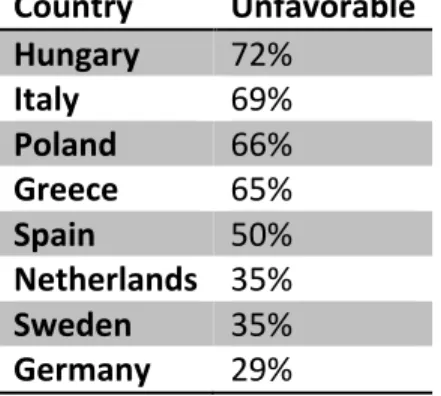
The numbers in red refer to the most worrisome to the highest number of people in that country. Wike, Strokes, and Simmons (2016: 4) also surveyed the same group in regards to their views towards “Muslims in our country”, and found there was a majority with a unfavorable view:
TABLE 3: Views on “Muslims in Our Country” Country Unfavorable
Hungary 72%
Italy 69%
Poland 66% Greece 65%
Spain 50%
Netherlands 35% Sweden 35% Germany 29%
However, the authors note that “for some Europeans negative attitudes towards Muslims are tied to a belief that Muslims do not wish to participate in the broader society” (Wike, Strokes, and Simmons 2016: 5). They conclude that, “the refugee crisis has brought into sharp relief deep ideological divides over views of minorities and diversity” (Wike, Strokes, and Simmons 2016: 5).
highest number of asylum seekers in 2015.” It is interesting that the EU appears to bear most of the blame. When asking citizens from the ten EU countries the question “Do you (Disapprove/ Approve) of the way the European Union is dealing with the refugee crisis?” a majority in each country disapproved, with the some of the highest levels of disapproval in frontier countries (Connor 2016: 7).
TABLE 4: Attitudes Towards EU Handling of Crisis Country Disapprove Approve
Greece 94% 5%
Sweden 88% 10%
Italy 77% 17%
Spain 75% 21%
Hungary 72% 24%
Poland 71% 19%
UK 70% 22%
France 70% 26%
Germany 67% 26%
Netherland 63% 31%
That is not to say that all public opinion of refugees and migrants was negative. It is important to also note the work of humanitarian organizations and Non-Governmental Organizations, which were established as a way to meet the needs of the refugees and migrants that could not be met by the different governments. In actuality, European societies became more divided, both externally and internally, on how best to deal with the refugees.
Case Studies
the EU, and has become a “country of first entry” and transit for those traveling along the Balkans land route. Germany on the other hand in landlocked in terms of Dublin. Germany, on the other hand, is landlocked in terms of Dublin, and has become a major “destination country”. The second reason is the difference in the initial government response and subsequent responses.
I will apply the same criteria for determining possible reasons for the suspension of Dublin III in both countries.
Hungary
Overview of crisis
In May 2015 there were around 2,500 asylum seekers and migrants entering Hungary per week (Piazza 2016, Part I: 40). Police reportedly gave them temporary stay permits and
approximate directions to refugee camps further inland (Piazza 2016, Part I: 40). The situation on the ground was a lot more disorganized. Piazza (2016, Part I: 40) describes how “in reality, there is a chaotic flow of people through the country, mostly bypassing the refugee camps and
slipping, or being smuggled, into Austria.” By June, the estimates of asylum seekers and migrants entering Hungary weekly increased to around 4,000, and this upsurge had police and border personnel struggling to process all the asylum claims (Piazza 2016, Part I: 40). It is at this time that more NGO’s and humanitarian groups began to increase their assistance to the growing number of asylum seekers and migrants arriving in Hungary each day.
entering Hungary steadily grew to reach in July to around 7,000 a week, and in August the numbers reached around 12,000 per week. By September 1, 2015, the Hungarian government stopped all trains from leaving for Austria, and the asylum seekers who did not want to register in Hungary were left stranded in the train station (Piazza 2016, Part I: 42). In response to this move by the Hungarian government, the asylum seekers decided to march along the M1 highway between Budapest and the Austrian border, a move that became known as “The March of Hope”. The March of Hope took place on September 4, 2015, with over 4,000 asylum seekers taking part (Piazza 2016, Part I: 42). After Austria agreed to let the refugees’ pass through its border, the Hungarian government sent buses to pick up the people from the M1 highway and drive them across the border into Austria (Piazza 2016, Part I: 42). The border wall with Serbia was
completed on September 15, 2015 and a subsequent border with Croatia was completed on October 16, 2015 (Piazza 2016, Part I: 44).
Number of Refugees
At the height of the crisis in August, almost 12,000 people per week were passing through Hungary (Piazza 2016). It has been estimated by both Connor (2016: 5) and the EU EuroStat Report (2016), in 2015 there were 174,000 asylum applications made in Hungary.
Government Response
The response by the Hungarian government to the increasing flow of refugees and migrants was by and large skeptic. On April 24, 2015, the FIDESZ government of Prime
Piazza (2016, Part II: 33) in “Living our Values- Part II”, included twelve questions which wording that invited negative responses. One online Hungarian publication, the Orange Files, published the questionnaire along with the original letter of introduction, translated to English, on their website. To quote one part of the letter, as translated by the Orange Files (2016), “Since Brussels has failed in the handling of immigration, Hungary must take its own path. We will not permit subsistence immigrants to threaten the workplaces and subsistence of Hungarian people.” In the letter Orbán goes on to say, “We must decide how to defend Hungary against illegal border-crossings. We must decide how to limit explosively increasing subsistence immigration” (Orange Files 2016). The responses to the National Consultation were then used as justification for any response Hungary would take to limit the flow of refugees through the border.
In conjunction with the National Consultation, the Hungarian government also began a poster campaign. The three posters included the phrases: “If you come to Hungary, you must respect our Culture”, “If you come to Hungary, you must respect our laws”, and “If you come to Hungary, you must not take away Hungarian jobs” (Piazza 2016, Part II: 34). Given that all three posters were solely in Hungarian, it seems that the intent was not to share these “Hungarian values” with the refugees.
the numbers had reached critical levels, and even with the reception centers dangerously over crowded.
Public Response
Apart from the responses to the National Consultation questionnaire, there were mixed responses from the public in Hungary. There were those who agreed with the government about the dangers of allowing refugees to enter the State, but there were also grassroots aid
organizations and other non-governmental and humanitarian organizations which began to assist the asylum seekers who had already entered. One of the newly formed grassroots organizations was the Migrant Solidarity Group of Hungary (MIGSZOL), which saw itself as “an informed, unregistered political grassroots organization” (Migszol 2016). This group published their own report titled “Hungary’s Long Summer of Migration”, which was a combination of statistical information, and a recording of fifty personal interviews with current asylum seekers in Hungary.
but rather a liability to national security, societal stability and cultural identity- soldiers in Orbán’s ‘invading army’, if you will.” In the end while the humanitarian groups, NGO’s, UN Human Rights organizations, and even the EU itself criticized the growing anti-refugee
sentiment in Hungary, the Hungarian government was framing its response as just acting in the best interest of securing the external European border.
The upshot was a growing divide between governmental (vertical) and civil society (horizontal) political actions. Kallus, Monterescu, and Rajoron (2016: 27) define vertical political actions as those which “located agency and action necessarily and exhaustively on the side of the State and leave no room for agentive responses by Migrants,” and horizontal political action as “involving private citizens working with migrants, standing with them in their protests, sheltering people, and transporting them to the western border.” Hence, Kallus, Monterescu, and Rajoron (2016: 27) attribute the breakdown of the Dublin regulation in part to “these
solidarities,” which “in turn, highlighted slippages between humanitarian and political action and led to the de facto collapse of the Dublin regulation.”
Germany
Overview of Crisis
while there were arrivals in Germany in 2015, there was a high likelihood of the asylum seekers being returned to the “country of first entry”. The flow of refugees entering Germany tended to come from Hungary and Austria. During the height of the crisis, it was harder to distinguish from which country was the “first entry” country, as many seekers worked to circumvent the
registration process. Also, the number of asylum seekers with open applications began to bog down the German asylum system. The result was a suspension of Dublin returns from Germany and a defacto suspension of the Dublin Regulation in all of the EU.
Number of Refugees
The number of asylum applications lodged in Germany during the crisis varies depending on which source is used. That being said, one thing that most sources have in common is that they all make it known that Germany has had the highest number of applicants. Connor (2016: 10) states that, “asylum applicants to Germany alone accounted for almost one-third of Europe’s 2015 Asylum Seekers.” The more agreed upon number of first time applicants is listed at
Government Response
The Government in Germany had a very different response to the Asylum seekers, than that of Hungary. Holmes and Castaneda (2016: 14) describe that, “while countries such as Israel and most of the Gulf States have uniformly turned away refugees, and others such as Hungary have answered with direct violence, Germany has responded with ambivalent hospitality that is uniquely nuanced and conditioned by memories (and some present day realities) of xenophobia and fascism.” However, even though Holmes and Castaneda (2016: 14) praise the responses of Germany, they are also quick to clarify “there is no unified Germany in response to the crisis.”
Germany has had a process in place for admitting Syrian refugees since 2013. Ostrand (2015: 267) explained that in March 2013 “Germany announced the initiation of a program for admitting Syrian refugees, primarily from Lebanon.” In this program Germany “vowed to accept 20,000 refugees” who were currently settled in Lebanon, for resettlement in parts of Germany where there would be housing provided along with other governmental services of support (Ostrand 2015: 267). Syrians admitted through this program received a two-year temporary residence permit. Syrians obtained their visa in Lebanon before coming to Germany (Ostrand 2015: 267). The situation in the spring and summer of 2015, which caused increasing strain on the Dublin system in Germany, was in regards to refugees entering Germany before obtaining a residency permit or visa.
tweet, translated from German by The Guardian, read “the #Dublin procedure for Syrian citizens is at this point in time effectively no longer being adhered to” (Oltermann and Kingsley 2016).
This is in line with article 17 of Dublin III, the discretion clause. Article 17 states that a country can decide to process the application of an asylum seeker even if that State is not the “country of first entry”, but in doing so they must notify all other countries through DubliNet. Thus article 17 gives any member state the right to take over an asylum application at their own discretion. Oltermann and Kingsley (2016) describe how the tweet was in connection to a memo sent to all BAMF offices in regards to asylum applications. The memo, “Rules for the suspension of the Dublin Convention for Syrian Citizens”, was sent by Angelika Wenzel a senior executive government official at BAMF. Oltermann and Kingsley (2016) summarize the memo as simply stating “the Syrians who applied for asylum in Germany would no longer be sent back to the country where they had first stepped on European soil.” They also point out how this tweet was not meant “to torpedo the unloved law [Dublin III], but as an emergency de-cluttering measure, freeing the agency from additional bureaucracy before it was unable to cope” (Oltermann and Kingsley 2016).
charge” could take as long at two months to reach a decision, which was impractical in the case of the mass influx of refugees crossing the border each day. In this context, the German
authorities choice to apply article 17 to Syrian refugees was within their authority. However, this decision had lasting impacts in not only Germany, but the surrounding countries as well.
The initial response from German Chancellor Angela Merkel was to welcome to the refugees. Smale (2016) explains how the Chancellor’s own past of growing up in East Germany had impacted her view on accepting refugees. Smale (2016) also described how the Chancellor coined the phrase “‘Wir schaffen das’ (roughly ‘We can make it’)” in response to growing discontent over the number of refugees arriving in Germany.
Public Response
The public response has been disparate. According to Holmes and Castaneda (2016: 15) it was tied to the idea of who is “deserving of Asylum”. It seems that, as Holmes and Castaneda (2016: 15) describe, “in general, Syrian families are seen as deserving because they are
understood to have been forced to flee by the ongoing civil war.”
public. It outlined how “in a survey by German public television 51% of Germans say that they fear the refugee influx, 13 points more than in September” (The Economist 2015).
The German cities struggled with how to house and take care of the ever-growing number of refugees. There were humanitarian organizations along with the German government and various NGOs, which have taken up the cause to find housing and provide support, but many cities struggled to find empty housing. The Economist (2015) described how “The government of Hamburg has begun seizing empty office buildings to house refugees, raising constitutional questions. Berlin and Bremen are considering similar measures.” Many cities within Germany became over burdened by the sudden increase. In fact, the situation eventually led to a turn in public opinion on both the refugees and the response by Chancellor Merkel.
At the same time, support for the German far right Populist Party, Alternative for
Germany (AfD), increased. Fischer (2016) described how AfD was able to “campaign on fears of refugees”. Schwartz (2016), also discussed how “over the past two years, as Merkel has
welcomed Muslim refugees and led the bailout of struggling European economies such as Greece, populist sentiments have surged- and the AfD is now reaping the rewards.” In fact in the recent State elections held in Mecklenburg- Western Pomerania, AfD was able to obtain more votes than the Christian Democratic Union, of which Merkel is a member (Schwartz 2016).
Comparison and Conclusion
The refugee crisis of 2015 exposed the flaws and faults of the Dublin Regulation, and the variances in the asylum policies of each member state. While all iterations of the Dublin
Dublin regulation had no real mechanisms in place to deal with mass influx of asylum seekers. The system was designed for a much smaller number of asylum seekers.
The Dublin process only applies to help determine who is responsible for processing a claim, and figuring out responsibility can take time. The resources needed in each country to process asylum claims and determine responsibility accumulated as the number of asylum seekers increased. Even with crisis mechanisms in place, such as Article 33 of Dublin III, the member states struggled to cope with the ever-growing number of asylum seekers. Through my own research, I had not found any instance of Article 33 being used by a member state during this crisis, and I did not expect to find one as Article 33 implies foresight into the possibility of a crisis. The only European Commission communiqué was related to Greece, which instructed the country to reinstate the Dublin procedure after the 2011 European Court of Human Rights (ECtHR) suspension of Dublin returns to Greece.
While the key question was if the suspension of Dublin III was a result of public pressure or a breakdown of the bureaucratic registration process, it seems that the situation was provoked by a combination. In terms of Germany, the suspension was actually a result of a bureaucratic decision to implement Article 17, and an illustration of a breakdown in the bureaucratic process. BAMF noted the inability to keep up with the paper work as one reason why they issued the memo and the subsequent tweet. However, it seems that the tweet by BAMF became the lynchpin for a breakdown of Dublin processing in other countries. Once the decision by BAMF became public knowledge, it became impossible for Hungary and other member states to continue to stop refugees from traveling on to Germany.
believed that public pressure would come from possible public attitudes towards the flow of refugees and migrants. The other angle, which emerged in my research, was the impact of pressure from the refugees themselves. While a large number of refugees had been registered in Hungary, they did not want to stay in Hungary. One example of this was the situation in
Budapest’s’ Keleti train station, where trains had been stopped and there were refugees were camping in the halls. This was, in part, a result of refugees who were trying to evade registration in Hungary, so that when they finally reached their destination country they would not be
returned to Hungary. Even those who had been registered still tried to continue their journeys on to Germany, Belgium, or even Sweden. Also, in the case of Hungary, there was public pressure from local humanitarian groups who believed that there was not enough being done for the refugees, which had an impact on the Hungarian response to the situation. However, in terms of housing in both Hungary and Germany, the issue was that there simply was not enough
designated space to house the sheer number of refugees. In Hungary the designated camps did not have enough room to house the vast number of people, and in Germany some States decided to designate unused buildings as housing.
REFERENCES
BBC. 2016. Migrant crisis: Migration to Europe explained in seven charts. BBC [online] 04 March. Available at: <http://www.bbc.com/news/world-europe-34131911> [Accessed on 15 December 2016]
Bayer, L. 2016. Hungary’s ‘Zero Refugee’ Strategy. Politico. [online] 20 September. Available at: < http://www.politico.eu/article/hungary-zero-refugee-strategy-viktor-orban-europe-migration-crisis/> [Accessed on 08 February 2017]
Brekke, JP. and Brochmann, G. 2014. Stuck in Transit: Secondary Migration of Asylum Seekers in Europe, National Differences, and the Dublin Regulation. Journal of Refugee Studies. 28(2) pp. 145-162. DOI:10.1093/jrs/feu028
Bertrand, B. and Troianovski, A. 2015. World News: Merkel Faces Near-Revolt Over Migrants. Wall Street Journal. [online]. 17 October. Available at: <
http://search.proquest.com.libproxy.lib.unc.edu/docview/1722617506?pq origsite=summon> [Accessed on 12 January 2017]
Connor, P. 2016. Number of Refugees to Europe Surges to Record 1.3 Million in 2015. Pew Research Center. [online]. Available at:
<http://www.pewglobal.org/2016/08/02/number-of-refugees-to-europe-surges-to-record-1-3-million-in-2015/>
De Luna Gallardo, G., Korneeva, E., and Strielkowski, W. 2016. Integration of Migrants in Europe. 9(2) pp. 244-253. DOI: 10.14254/2071-8330.2016/9-2/19
Desmond, A. 2016. The Development of a Common EU Migration Policy and the Rights of Irregular Migrants: A Progress Narative? Human Rights Law review. 16. pp. 247-253. DOI: 10.1093/hrlr/ngw012
Dobra, D. 2016. The Migrant Crisis- the Great Challenge of the European Union. Studia UBB Europaea. 61(3) pp. 91-101.
Dover, R. 2008. Towards a Common EU Immigration Policy. Journal of European Integration. 30(1). pp. 113-130. http://dx.doi.org/10.1080/07036330801959523 The Economist. 2015. Merkel at her limit: Germany’s refugee crisis. The Economist
[online]. 14 October. Available at:
<http://search.proquest.com.libproxy.lib.unc.edu/docview/1721400404?pq-origsite=summon>
European Commission. 2017. Common European Asylum System. [online]. Available at: <https://ec.europa.eu/home-affairs/what-we-do/policies/asylum_en> [Accessed on 07 February 2017].
European Commission Communication 240/2015/EC A European Agenda On Migration
European Commission Statement 15/5667 European Commission Statement following the temporary reintroduction of controls by Slovenia at the border with Hungary. Available at: < http://europa.eu/rapid/press-release_STATEMENT-15-5667_en.htm>
European Commission. 2016. Evaluation of the Dublin III Regulation: Final Report. Prepared by IFC International. [online]. Available at: < https://goo.gl/k3fquT>
European Commission. 2016. Evaluation of the Implementation of Dublin III
Regulation: Final Report. Prepared by IFC International. [online]. Available at: <https://goo.gl/0F6YIT>
European Commission. 2016. Proposal for a regulation of the European Parliament and of the Council on the establishment of 'Eurodac'. Regulation EU 604/2013. [online]. Avaliable at: < http://eur-lex.europa.eu/legal-
content/EN/TXT/?uri=celex%3A32013R0603>
European Commission Press release. 2016. Commission Adopts Second
Recommendation Identifying Steps to Restore Dublin Transfers to Greece. [online] Available at: < http://europa.eu/rapid/press-release_IP-16-2182_en.htm> [Accessed on 08 February 2017]
European Council Regulation (EC) 2725/200- of 11 December 2000 concerning the establishment of ‘Eurodac’ for the comparison of fingerprints for the effective application of the Dublin Convention. Available at: <
http://eur-lex.europa.eu/LexUriServ/LexUriServ.do?uri=CELEX:32000R2725:EN:HTML> European Parliament Report 2016, Policy Department C: Citizens' Rights And
Constitutional Affairs; The Reform of the Dublin III Regulation. Available at: <http://www.europarl.europa.eu/supporting-analyses>
European Parliament/ European Council Regulation 604/2013/EP/EC establishing the
criteria and mechanisms for determining the Member State responsible for examining an application for international protection lodged in one of the Member States by a third-country national or a stateless person (recast)
Available at:
<http://eur-lex.europa.eu/legal-content/EN/TXT/PDF/?uri=CELEX:32013R0604&from=EN>
Eurostat, 2016. Record number of over 1.2 million first time asylum seekers registered in 2015. [pdf] Brussels: Eurostat Press Office. Available at:
Eurostat, 2017. 1.2 million first time asylum seekers registered in 2016. [pdf]. Brussels: Eurostat Press Office. Available at:
<http://ec.europa.eu/eurostat/documents/2995521/7921609/3-16032017-BP-EN.pdf/e5fa98bb-5d9d-4297-9168-d07c67d1c9e1>
Federal Office for Migrants and Refugees. 2017. Arrival and Registration. [online] Available at:
<http://www.bamf.de/EN/Fluechtlingsschutz/AblaufAsylv/AnkunftUndRegistrierung/ank unft-und-registrierung-node.html> [Accessed on 03 February 2017]
Fischer, S. 2016. “A Problem for Merkel and Germany”. Speigel Online. [online]. 05 September. Available at: < http://www.spiegel.de/international/germany/rise-of- populist-afd-a-problem-for-merkel-and-germany-a-1110954.html>
Greenhill, K. 2016. Open Arms Behind Barred Doors. European Law Journal 22(3) pp. 317-332.
Guiraudon, V. 2000. European Integration and Migration Policy: Vertical Policy-making as Venue Shopping. Journal of Common Market. 30 (2). pp. 251-271
Higgins, A. 2015. Hungary’s Migrant Stance, Once Demonized, Gains Some Acceptance. The New York Times. [online]. 20 December. Available at: <
https://www.nytimes.com/2015/12/21/world/europe/hungary-viktor-orban- migrant-crisis.html?_r=0> [Accessed on 12 January 2017].
Holmes, S. and Castaneda, H. 2016. Representing the ‘European Refugee Crisis’ in Germany and beyond. Journal of the American Ethnological Society. 43(1) pp 12- 24 DOI 10.1111/amet.12259
Hruschka, C. 2015. The (reformed) Dublin III Regulation- a tool for enhanced
effectiveness and higher standard of protection? ERA Fourm. 15 pp. 469-483. DOI 10.1007/s12027-014-0364-x
Hurwitz, A. 1999. The 1990 Dublin convention: A comprehensive Assessment. International Journal of Refugee Law. 11(4) pp. 646-677.
Kallius, A., Monterescu, D. and Rajaram, P.K. 2016. Immobilizing Mobility: Border Ethnography, Illiberal Democracy, and the Politics of the Refugee Crisis in Hungary. Journal of the American Ethnological Society. 43(1) pp. 25-37. DOI: 10.1111/ament.12260
Immigration and Asylum Office. 2017. Dublin Procedure. [online] 28 December 2016. Available at:
Katz, B., Noring, L, and Garrelts, N. 2016. Cities and Refugees- The German Experience. The Brookings Institute [online]. Available at:
https://www.brookings.edu/research/cities-and-refugees-the-german-experience/ Lawler, D. 2015. “German border controls mark sudden shift in refugee policy”. The
Telegraph Online. 13 September. Available at: goo.gl/3qFyo5
Lavenex, S. 2006. Shifting Up and Out: The Foreign Policy of European Integration. West European Politics. 29(3). pp. 329-350.
http://dx.doi.org/10.1080/01402380500512684
Lenart, J. 2012. “Fortress Europe”: Compliance of the Dublin II Regulation with the European Convention for the Protection of Human Rights and Fundamental Freedoms. Utrecht Journal of International and European Law. 28(75) pp. 04-19 Mallia, P. 2011. Rethinking of the Dublin II Regulation. Refugee Survey Quarterly 30(3)
pp. 107-128. DOI:10.1093/rsq/hdr008
Migrant Solidarity Group of Hungary (Migszol). 2016. Hungary’s Long Summer of Migration. (Migszol; Budapest, Hungary) Available at:
<http://www.migszol.com/files/theme/Report/migszol_report_eng.pdf>
Oltermann, P. and Kingsley, P. 2016. 'It took on a life of its own': how one rogue tweet led Syrians to Germany. The Guardian [online]. 25 August. Available at:
<https://www.theguardian.com/world/2016/aug/25/it-took-on-a-life-of-its-own-how-rogue-tweet-led-syrians-to-germany>
The Orange Files. 2015. Search Results for: National Consultation on Immigration and Terrorism. [online] Available at:
<https://theorangefiles.hu/?s=National+consultation+on+immigration+and+terrori sm&submit=Search> [Accessed on 08 February 2017]
Ostrand, N. 2015. The Syrian Refugee Crisis: A comparison of Responses by Germany, Sweden, the United States, and the United Kingdom. Journal on Migration and Human Society. 3(3) pp 255-279.
Piazza-Georgi, B. 2016. Living Our Values, Preserving Our Values: Hungary’s Response to the 2015 European Migrant Crisis- Part I. Hungarian Review 2 pp. 37-50
---. 2016. Living Our Values, Preserving Our Values: Hungary’s Response to the 2015 European Migrant Crisis- Part II. Hungarian Review 3 pp. 33-40.
Refugee Council. 2002. The Dublin Convention on Asylum Applications. [pdf]. London: Refugee Council. Available at:
[Accessed on 10 December 2016]
Roos, C., Zaun, N. 2014. Norms Matter! The Role of International Norms in EU policies on Asylum and Immigration. European Journal of Migration and Law 16. pp. 45-68. Schwartz, Y. 2016. “Germany’s Far Right Rises Again”. Politico Magazine [online] 21
December. Available at:
<http://www.politico.com/magazine/story/2016/12/germanys-far-right-rises- again-214543>
Smale, A. 2016. “Limits of tolerance tested in Germany; For Merkel, tragic lessons of
Berlin Wall help forge response to refugee crisis”. International New York Times [online] 14 September. Available at: <goo.gl/L3so8Y>
Thomas A., Bradley M., and Geiger F. 2015. “Obscure German Tweet Helped Spur Migrant March From Hungary”. Wall Street Journal. [online]. 10 September. Available at: < https://www.wsj.com/articles/obscure-german-tweet-help-spur- migrant-march-from-hungary-1441901563>
United Nations Refugee Agency. 2010. Convention and Protocol relating to the Status of Refugees. [pdf]. Geneva, Switzerland: UNCHR. Available at:
<http://www.unhcr.org/protect/PROTECTION/3b66c2aa10.pdf> [Accessed on 10 December 2016]
----. 2001. Revisiting the Dublin Convention. [pdf] Geneva, Switzerland: UNHCR. Available at: < http://www.unhcr.org/en-
us/protection/operations/43662b3e2/revisiting-dublin-convention-reflections- unhcr-response-commission-staff.html> [Accessed on 10 December 2016] Walker, M. and Troianovski, A. 2015. Behind Angela Merkel’s Open Door for Migrant.
Wall Street Journal. [online] 9 December. Available at:
<http://www.wsj.com/articles/behind-angela-merkels-open-door-for-migrants-1449712113> [Accessed on: 12 January 2017]
Waterfield, B. and Charter, D. 2016. Europe gangs up on Merkel in migrant backlash. The Times. [online]. 17 September. Available at: <
https://www.thetimes.co.uk/article/europe-gangs-up-on-merkel-in-migrant- backlash-3lf69kphp>. [Accessed on: 12 January 2017].