THE INTEREST IN AND DESIGN OF AN ATHLETICS PERFORMANCE CURRICULUM
Molly Harry
A thesis submitted to the faculty at the University of North Carolina at Chapel Hill in partial fulfillment of the requirements for the degree of Master of Arts in the Department of Exercise
and Sport Science (Sport Administration).
Chapel Hill 2018
Approved by: Erianne A. Weight Nels Popp
Zachary Kerr
ii
© 2018 Molly Harry
iii ABSTRACT
Molly Harry: The Interest In and Design of an Athletics Performance Curriculum (Under the direction of Erianne Weight)
iv
v
TABLE OF CONTENTS
CHAPTER 1 ... 1
Statement of Purpose ... 1
Research Questions ... 3
Assumptions ... 3
Delimitations ... 4
Limitations ... 4
Definition of Terms ... 4
CHAPTER 2 ... 6
Role of Intercollegiate Athletics within the Academy ... 6
Criticisms of Intercollegiate Athletics ... 7
Educational Value of Intercollegiate Athletics ... 9
Time Demands ... 10
Experiential Learning Theory ... 11
CHAPTER 3 ... 13
Participants & Procedures ... 13
Data Analysis ... 14
CHAPTER 4 ... 16
Demographics ... 16
Support for an Athletics Performance Curriculum ... 17
vi
Athletics Performance Curriculum Initial Thoughts ... 20
Courses to Include in Athletics Performance Curriculum ... 21
CHAPTER 5 ... 23
Perspective Toward an Athletics Performance Minor ... 24
Faculty Perspectives ... 24
Academic Credit for Athletics Participation ... 26
Athletics Performance Curriculum Design ... 27
CHAPTER 6 ... 31
Limitations & Future Research ... 31
Conclusion ... 32
vii
LIST OF TABLES
Table 1 ... 15
Table 2 ... 16
Table 3 ... 17
Table 4 ... 18
Table 5 ... 19
Table 6 ... 20
1 CHAPTER 1 Statement of Purpose
The foundation for this study comes from the Integrated View of athletics within the academy proposed by Myles Brand (2006). The defining aspect of this viewpoint is that athletic programs are essential to the educational mission of the university and serve a role that other programs and departments cannot fill (Brand, 2006). Within the seminal article on the integrated view, Brand posits that if “athletic participation is relevantly similar to music performance with respect to content… as well as instructor qualifications, then if academic credit is provided for music students, should it not also be provided for student athletes?” (Brand, 2006, p. 17).
Research conducted by Weight, Cooper, and Popp (2015) found that almost half of NCAA Division I coaches believe that athletics should be structured similarly to academics, with a quarter of the coaches emphasizing this change in structure as a medium to achieve the
university’s mission of education through athletics (p. 514). Some coaches also believed the integrated view could serve as an avenue to build stronger relationships with academic departments and athletics (Weight, Cooper, & Popp, 2015).
2
only a small percentage of students participate in athletics at the varsity level. Similarly, varsity athletes that are eligible to “go pro” have between a 0.9 percent and 8.6 percent chance,
depending on the sport (estimated probability of competing in professional athletics, 2015), while dance students have less than a 1 percent chance of a professional career (Kinetz, 2005).
Both music and athletics are appreciated by many university stakeholders, however they are not equally viewed as a valuable part of the educational environment based on the
opportunity to earn academic credit (Brand, 2006; Weight & Huml, 2017). Addressing this issue, columnist Sally Jenkins posited, “we congratulate music majors for their passion, and tell them that even if they don’t make it in the symphony, they are acquiring an art and a method of thought that will be theirs forever. But for some reason we tell athletes who aspire to the highest levels that they are academically illegitimate, and look down on them as vocational students” (Jenkins, 2011, ¶ 13).
Despite documented empirical research supporting intellectual and life-skill benefits of collegiate athletics participation, (e.g. Bonfiglio, 2016; Chalfin, Weight, Osborne & Johnson, 2015; Gould & Carson, 2008; 2015; Hardcastle, Tye, Glassey & Hagger, 2015) there remains no formalized curriculum to study athletics performance. If there is clear educational value in athletics, it seems as though this education might be worthy of academic credit and
formalization.
3
medium to bring those in the academy and those in athletic administration together. This
research pilots the study of interest in and design of an athletics performance minor which would pair “on-the-field” knowledge gained (e.g. strength training), with traditional education (e.g. applied exercise physiology), and facilitate credit for education that occurs outside of the traditional structures of the academy (viewing athletics similar in form to music, or dance, for example).
Research Questions
[RQ1] What is the level of interest in an athletics performance curriculum amongst varsity athletes, coaches, athletics administrators, and faculty?
[RQ2] Are there significant differences in interest and design between varsity athletes, coaches, athletics administrators, and faculty?
[RQ3] What courses should an athletics performance curriculum include? Assumptions
1. The research methods employed are valid and reliable.
2. Survey participants have answered the survey questions completely and truthfully. Delimitations
1. This study focused on a curriculum designed for National Collegiate Athletics Association (NCAA) Division I Football Bowl Subdivision institutions, and results should not be generalized to Football Championship Series, NCAA Divisions II and III, or National Association of Intercollegiate Athletics institutions.
2. This study is only reflective of the university at which it was performed.
4 Limitations
1. This study is limited by survey response rates, response error, and response bias. 2. This area of research involves a novel and contemporary concept that might be
influenced by previous biases on the role of athletes within the academy.
3. This research did not explore the implementation of an athletics-‐centric curriculum. 4. Placing a concrete educational value on intercollegiate athletic participation is not
easily done.
5. Future research could look into the interest of an athletics-‐centric curriculum amongst coaches, athletics administrators and faculty.
Definition of Terms
1. Varsity athlete-‐ anyone who participates in an intercollegiate sport at the varsity level.
2. Club athlete-‐ anyone who competes in a sport against participants from other universities or colleges, but not at the varsity level. The sports are not regulated by the NCAA or the NAIA.
3. Traditional Student-‐ anyone who does not participate in an intercollegiate sport at the varsity or club levels.
4. Curriculum-‐ a set of subject comprising a course of study.
5. Athletics-‐centric curriculum-‐ a set of subjects relating to the elite performance of sport or exercise that comprises a course of study.
5
7. Time demands-‐ the balance between academics, athletics, and other student-‐ athlete activities that foster educational opportunities outside of intercollegiate athletics.
6 CHAPTER 2 Role of Intercollegiate Athletics within the Academy
Intercollegiate athletics was initially formed by Ivy League students in the late 1800s and was born out of a particular moment in American history in which physical activity and sport was embraced as a medium to enhance character development (Ingrassia, 2012; Smith, 2011). Over time, leaders in education administration began to see college sports as an opportunity to facilitate publicity and revenue for their institutions (Bok, 2009). Educational administrators began to hire and pay coaches, schedule competitions, construct athletic venues, and promote collegiate athletics (Chu, 1989; Smith, 2011).
As winning became ever more entangled with the financial stakes of the universities (Bok, 2009), schools began to ponder the concept of providing athletic-based scholarships (Smith, 2011). The idea of providing a scholarship based on athletic ability faced immediate scrutiny, as it seemed to undermine the educational purpose of attending college (Gurney, Lopiano, & Zimbalist, 2016; Smith, 2011). In the decades since athletic scholarship
implementation, intercollegiate sport has continued to evolve, and calls for academic reform have been a constant backdrop of the burgeoning industry (Smith, 2011).
7 Criticisms of Intercollegiate Athletics
Many scholars have voiced concern that intercollegiate athletics harms the university, claiming that with the current governance system, the mission of athletics does not correspond with the mission of higher education (Branch, 2011; Fried, 2007; Gerdy, 2006; Sack, 2001). The benefits of sport participation have come into question as headlines and lawsuits draw attention to unethical behavior (Lewinter, Weight, Osborne, & Brunner, 2013; Miller, 2016; Nocera & Strauss, 2016; Weight & Huml, 2017), excessive commercialization (Gerdy, 2006; Ingrassia, 2012; Vanover & DeBowes, 2013), and an increased focus on revenue generation at the expense of athlete education (Branch, 2011; McCormick & McCormick, 2006; Simons, Van Rheenen, & Covington, 1999).
Exploitation is a growing topic of concern. Critics of the current regulatory system believe the principle of amateurism as upheld by the NCAA (NCAA, 2016), facilitates the exploitation of varsity athletes (Benedict & Keteyian, 2013; Branch, 2011; Miller, 2016; Rosenthal, 2003; Sack & Staurowsky, 1998; Staurowsky & Ridpath, 2005). This system allows for commercialization, publicity, and revenue generation on the backs of athletes who do not have the opportunity to receive monetary compensation (outside of tuition, fees, and sometimes cost of attendance) from the revenue they generate for schools and athletic departments (Byers, 1995; Nocera & Strauss, 2016; Smith, 2011). Additionally, many varsity athletes fail to receive a true college education because of the excessive time commitment athletics demands (Branch, 2001; Nocera & Strauss, 2016; Ross, 2012; Smith & Willingham, 2015; Staurowsky & Ridpath, 2005).
8
rates (Gurney & Southall, 2013; Smith & Willingham, 2015). Some have called the cases of academic fraud an epidemic (New, 2016; Ridpath, 2016; Wolverton, 2015). The drive to commit academic fraud could stem from the reality that some varsity athletes are not ready for the rigors of college coursework (Eckward, 2010; Fountain & Finley, 2011; Hardin & Pate, 2013).
Institutions may be admitting athletes based on their athletic abilities (Schneider, Ross, & Fisher, 2010), and this special acceptance of underprepared students leads admitted athletes to struggle in the classroom and fail to balance academics and athletics (Gayles, 2004; Wolverton, 2014).
Admitting unprepared athletes can also lead to poor practices of “majoring in eligibility” wherein athletes are steered to athlete-friendly faculty, or majors that are seen as the path of least educational resistance, and not necessarily the path of educational fulfillment (Fountain & Finley, 2009; Schneider, Ross, & Fisher, 2010) An over emphasis on eligibility produces an “athletic subculture of low academic expectations, thus reducing the possibilities for developing high-achieving student athletes” (Comeaux & Harrison, 2011, pg. 236, ¶ 1), even when they are capable of academic success.
Major clustering can lead to academic failure because the students might not believe the major is the right fit for them (Schneider, Ross, & Fisher, 2010) or they are not actually
interested in the material (Paule & Gilson, 2011). However, they must stay the course or forego eligibility. This plays a role in “mental dropout” for varsity athletes (Lang, Dunham, & Alpert, 1988). While they physically remain in school, behavioral problems and low grades indicate students have mentally dropped out (Lang, Dunham, & Alpert, 1988).
9
curriculum could provide a useful and desirable field of study, a fulfilling academic path, and a proactive approach to address the issues of exploitation and educational fulfillment.
Educational Value of Intercollegiate Athletics
Paramount to the integration of athletics within the academy is the underlying theoretical premise of education through athletics (Brand, 2001; Brand, 2006; Chalfin et al., 2015; Weight, Cooper, & Popp, 2015; Weight & Huml, 2017). Despite evidence supporting educational and life-skill benefits of intercollegiate athletics participation, athletics performance curricula continue to be viewed as unworthy of academic credit within higher education (Jenkins, 2011; Weight, 2015; Weight & Huml, 2017).
Advocates for an athletics performance curriculum contend that letting varsity athletes take courses related to athletics, or even major in athletics, is a more “honest” approach, and similar to what is already done for other disciplines such as music, theater, or dance (Brand, 2006; Burke, 2016; Jenkins, 2011). For many athletes, this curriculum could also facilitate an opportunity to obtain education in an area that will provide a better chance for employment because their educational pursuits are in line with their true career objectives and desires (Pargman, 2012; Paule & Gilson, 2011).
It has traditionally been accepted that athletics participation develops character
(Duderstadt, 2009; Gayles & Hu, 2009; Gould & Carson, 2008; Hellison, 2003; Oriard, 2012) and enhances self-concept (Chickering & Reisser, 1993). Research also supports that athletics participation can enhance aspects of cognitive development including multitasking and
10
2008; 2015; Hardcastle, Tye, Glassey & Hagger, 2015). Finally, research has demonstrated that athlete graduates who work full time have higher levels of job satisfaction, work engagement, income, health, and quality of life than their non-athlete peers (Bonfiglio, 2016; DeFreese et al., 2018; Weight, Navarro, Huffman, Smith-Ryan, 2014). This research provides some evidence of the correlation between participation in intercollegiate athletics and positive life outcomes. As such, it could be argued that providing an educational forum to enrich the lessons learned through athletics could provide opportunities for more students (non-varsity athletes) to gain these advantages through the study and practice of athletics performance, and could positively impact the strength of these associations.
Time Demands
One of the most controversial and disputed topics surrounding intercollegiate athletics involves the time demands of varsity athletes. Studies show athletes spend approximately 34 hours per week on their sport during their season, and even more when out of season (NCAA GOALS Study, 2016) which undoubtedly impacts an athlete’s academic experience. One point to consider involves countable athletic related activities (CARA), which includes any required activity with an athletics purpose, involving athletes and/or coaching staff (NCAA, 2016).
11 Experiential Learning Theory
The theoretical foundation for this study is based upon Experiential Learning Theory (ELT) which emphasizes the crucial role that experience plays in the learning process (Kolb, 2014). The experiential learning pattern is cyclical, beginning with a concrete experience. This flows into stages two and three of reflective observation (reflecting on the action and in
action/reviewing) and abstract conceptualization (learning from the experience). The final stage is active experimentation in which the person tries out what was learned through the process (Kolb, 2014).
ELT demonstrates that skills, knowledge, and experience can all be acquired outside of a traditional academic setting (Kolb, 2001). By taking the lessons learned in the training room, in the locker room, on the court, or on the field, educational curricula can become more personal and strengthen cognitive development and understanding for those interested in an athletics performance curriculum (Chaddock, Neider, Voss, Gaspar & Kramer, 2011). Not only could students engage in concrete experience, they could also participate in courses that directly tie into their experiences, thus offering a unique opportunity for reflective observation. This can lead to the formation of abstract conceptualization of these experiences, and the testing of this conceptualization through active experimentation. Thus, new knowledge is created and
reinforced through transformative and hands-on experiences (Cantor, 1997; Rolls, 1992; Weight et al., 2014).
12
that take place during strength training, and steps to enhance muscle growth and reduce
13 CHAPTER 3 Participants & Procedures
The sample of survey participants was drawn from three southeastern institutions competing in the Atlantic Coast Conference. Populations of interest included current varsity athletes, coaches, athletics administrators, and faculty (N = 539). Institutional directories and athletic department websites were used to select participants and gather contact information. Purposive sampling methodology was employed. The sample of varsity athletes was drawn from only one institution due to access and privacy concerns, while all head and assistant coaches at the three institutions received the survey. Senior athletics administrators, along with
administrators in athletic compliance and academic support for athletes also received the survey. Finally, faculty invited to participate included music, dance, theater, sport management, and exercise science professors, faculty serving upon the institutional faculty athletics committees or as Faculty Athletics Representatives, and those who have been outspoken in favor or against issues surrounding the role of intercollegiate athletics in the academy.
Each invited participant received a link to a short electronic survey via Qualtrics. Two weeks after the initial survey was released, non-respondents were sent a reminder. Two weeks after the reminder e-mail, the survey was closed. The following general description of an athletics performance minor was provided at the beginning of the survey with the goal of
14
“Research over the past decade has provided insight into positive educational outcomes associated with participation in intercollegiate athletics. There appears to be education that happens through athletics that translates into increased marketability, satisfaction with life, occupational success, and health. This education is something many in athletics have felt, seen, or experienced, but little has been measured. As we seek to enhance the educational experiences of intercollegiate athletes, we are hoping to explore the possibility of designing an athletics performance minor which will pair a lot of the on-the-field knowledge gained (strength training, for example), with applied education (applied exercise physiology, for example), and facilitate credit for education that occurs outside of the traditional structures of the academy (viewing athletics similar in form to music, or dance, for example). Toward this end, we would like to gather your initial thoughts and ideas about an athletics performance curriculum.”
Closed-ended demographic questions relating to gender and ethnicity (Table 1) were posed after the provided general description of an athletics performance curriculum. The next questions were Likert Scale, inquiring about the participant’s opinions for implementation of an athletics performance minor on campus (Tables 2 and 3) and opinions on varsity athletes earning academic credit for participation in athletics (Table 4). The next questions asked for participants’ initial thoughts on the curriculum (Table 6), what courses to include (Table 7), and other topics to consider pertaining to an athletics performance curriculum.
Data Analysis
15
code to concepts to themes process was performed on research questions one and three. The researchers began with NVivo coding methods followed by axial coding to link the participants’ narratives into condensed themes while also retaining their voices (Saldana, 2009).
Upon entering the quantitative data collected from the completed surveys into Statistical Package for the Social Sciences (SPSS), numerous statistical tests were run to analyze the results and answer research question two. Descriptive statistics provided the means and standard
deviations, indicating differences in interest level and support of an athletics performance
16 CHAPTER 4 Demographics
17 Support for an Athletics Performance Curriculum
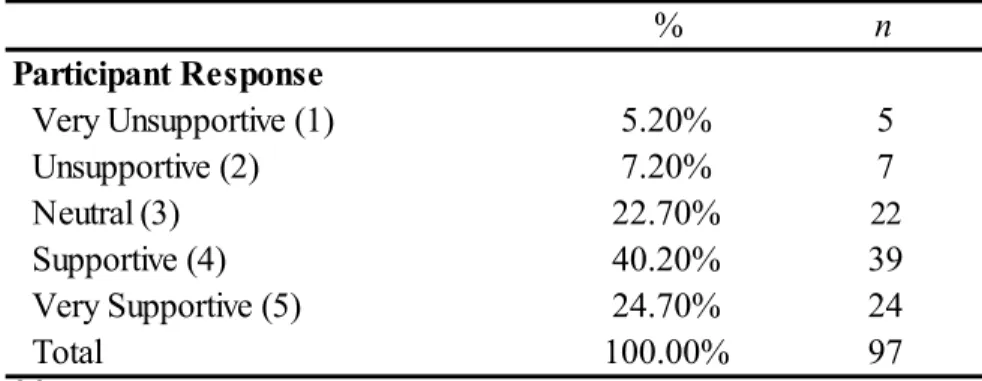
Following the introduction to the concept of an athletics performance curriculum, participants were asked, “based on your initial understanding, how supportive would you be of implementing an athletics performance minor on your campus?” The five-point Likert scale ranged from (1) very unsupportive to (5) very supportive. Sixty-five percent (n = 63) of the respondents were supportive or very supportive of implementing the curriculum. A complete breakdown of initial support for an athletics performance minor can be found in Table 2. Using another five-point Likert-scale, participants were asked, “Should varsity athletes be able to earn academic credit for participation in athletics as currently organized?” Forty-eight respondents (49.4%) reported probably or definitely yes. The results are below in Table 3.
Table 2
% n
Participant Response
Very Unsupportive (1) 5.20% 5
Unsupportive (2) 7.20% 7
Neutral (3) 22.70% 22
Supportive (4) 40.20% 39
Very Supportive (5) 24.70% 24
Total 100.00% 97
M = 3.72, SD = 1.08
18
A slight modification of the previous question asked respondents, “Should varsity athletes be able to earn academic credit for participation in athletics if clear educational outcomes are established and measured?” When educational outcomes are established and measured, a greater number of respondents were in favor of the idea with approximately 70% (n
= 68) probably or definitely supportive of credit for athletic participation when there are clear educational outcomes established and measured (see Table 4). A dependent t-test demonstrated a significant increase in support from participants’ responses from question two to question three with a mean difference of 0.474, p < 0.001.
Table 3
% n
Participant Response
Definitely not (1) 9.30% 9
Probably not (2) 21.60% 21
Neutral (3) 19.60% 19
Probably yes (4) 25.80% 25
Definitely yes (5) 23.70% 23
Total 100.00% 97
M = 3.33, SD = 1.31
Should varsity athletes be able to earn academic credit for participation in athletics as currently organized?
Table 4
% n
Participant Response
Definitely not (1) 3.10% 3
Probably not (2) 17.50% 17
Neutral (3) 9.30% 9
Probably yes (4) 36.10% 35
Definitely yes (5) 34.00% 33
Total 100.00% 97
M = 3.80, SD = 1.18
19 Variation between Stakeholder Groups
A one-way ANOVA was performed to test for significant differences among the participant groups regarding support for an athletics performance curriculum (See Table 5). Support was the highest among varsity athletes (M = 4.00, SD=0.79) and coaches (M= 4.00, SD = 0.78), followed by athletics administrators (M= 3.72, SD = 1.36) and faculty (M = 2.84, SD = 1.17). The omnibus F-test was significant, suggesting at least one group mean was different, F(3, 93) = 6.51, p < 0.001. Post-hoc analyses found that faculty showed significantly less support of the idea than varsity athletes (mean difference = -1.16, p = 0.01), coaches (mean difference = -1.16, p = 0.02), and athletics administrators (mean difference = -0.88, p = 0.04).
Next, a one-way ANOVA was performed to test for significant differences among the participant groups regarding support for academic credit for athletics participation as athletics is currently organized (See Table 5). Support was the highest among varsity athletes (M = 3.86, SD
= 1.22), followed by coaches (M= 3.46, SD = 1.06), athletics administrators (M= 3.28, SD = 1.41), and faculty (M = 2.21, SD = 0.98). The omnibus F-test was significant suggesting at least one group mean was different, F(3, 93) = 8.27, p < 0.001. Post-hoc analyses found that faculty showed significantly less support of the idea than varsity athletes (mean difference=-1.65, p <0.001), coaches (mean difference = -1.25, p = 0.005), and athletics administrators (mean difference = -1.07, p = 0.04).
20
suggesting at least one group mean was different, F(3, 93) = 4.28, p = 0.007. Post-hoc analyses found that faculty showed significantly less support of the idea than varsity athletes only (mean difference = -1.11, p =0.004.
Athletics Performance Curriculum Initial Thoughts
Participants were asked to share their initial thoughts on the concept of an athletics performance curriculum in an open-ended question, which 77 participants completed. The responses were coded, evaluated for patterns and themes, and classified into sixteen categories, which can be found in Table 6. One of the main themes garnered from the responses is that athletics participation is deserving of academic credit (29%), and that the curriculum could be a way to couple what athletes learn from athletics with what is gained in the classroom.
Many survey participants (14%) believe that athletics participation provides valuable transferable skills and experiential learning opportunities that can tie into a curriculum. Four respondents indicated that this curriculum would prove beneficial for students interested in becoming coaches in the future. However, eight of the respondents in favor of the academic credit for athletic participation raised concerns about the structure of the curriculum, grading processes, and impacts on eligibility requirements.
Some qualms pertaining to this style of curriculum expressed by those unsupportive of the curriculum (12%) include the potential for this to be an easy credit option (6.5%), the belief that basing a curriculum in athletics will further marginalize academics (5%), and that athletics is purely extracurricular (4%). Four participants, all faculty members, also declared that
Table 5
6.51 < 0.001 8.27 < 0.001 4.28 0.007 Support for implementing an athletics performance curriculum
Overall Mean (SD) Athlete Mean (SD) Coach Mean (SD) Admin Mean (SD) Faculty
Mean (SD) F p
*Tukey post-hoc analysis suggested a significant mean difference with this group compared to faculty. 3.80 (1.31)
2.21 (0.98) 3.00 (1.20) Credit for participation as currently organized
Credit for participation with clear educational
3.33 (1.31) 3.86 (1.22)* 3.46 (1.06)* 3.28 (1.41)*
Support for implementing an athletics-centric minor 3.72 (1.08) 4.00 (0.79)* 4.00 (0.78)* 3.72 (1.36)* 2.84 (1.17)
21
intercollegiate athletics is a “racket,” clearly conveying their disdain for an athletics performance curriculum. One faculty participant voiced athletics is a “total drag on the mission of schools.”
Courses to include in an athletics performance curriculum
Participants responded with a mixture of potential courses for an athletics performance curriculum. Table 7 lists the twenty-two course categories mentioned by the 77 respondents. Sport psychology was the main course proposed by the survey participants (23%), and all parties surveyed suggested the course, with varsity athletes (38%) and coaches (33%) suggesting it the most.
Leadership (21%) and teamwork (9%) were also courses regularly suggested in the survey. Coaches (38%) and varsity athletes (20%) saw the highest need for these courses. Other popular courses proposed include anatomy/physiology (21%), strength and conditioning (21%), coaching (12%), communication/public speaking (10%), and sport business/finance (8%). Table 7 has the full course suggestion list for an athletics performance minor.
Table 6
n %
Supportive 32 41.6%
Athletics is worthy of class credit 22 28.6%
Transferable skills/experiential learning 14 18.2%
This could help prepare student-athletes for life after sports 12 15.6%
Curriculum needs to be very structured 11 14.3%
Unsupportive 6 7.8%
Curriculum offers potential for easy credit 5 6.5%
Want more information on the concept 5 6.5%
College athletics is a racket 5 6.5%
Athletics is similar to dance and theater so this curriculum should be an option 4 5.2%
Poses great opportunity for future coaches 4 5.2%
Campus is already too focused on athletics and this will further marginalize academics 4 5.2%
Athletics is purely extracurricular and should remain as such 3 3.9%
Bad optics for campuses 3 3.9%
This curriculum could help solve the disconnect between the Academy and athletics 3 3.9%
n = 77
22 Table 7
n %
Sport psychology 18 23.4%
Leadership 16 20.8%
Anatomy/physiology 16 20.8%
Strength and conditioning 15 19.5%
Sport nutrition 15 19.5%
Athletic Training 10 13.0%
Coaching 9 11.7%
Communication/public speaking 8 10.4%
Teamwork/team building 7 9.1%
Sport business/finance 6 7.8%
Sport management 6 7.8%
I don't know 5 6.5%
Tactics, theory, and strategy 4 5.2%
None 4 5.2%
Sport history 4 5.2%
Research in sports 3 3.9%
NCAA rules 3 3.9%
Ethics 3 3.9%
n = 77
23 CHAPTER 5
This research explores an avenue to bridge the divide between the academy and athletics, and the results suggest there is moderate interest in an athletics-performance minor. Stemming from the conceptual rationale of an Integrated View of intercollegiate athletics (Brand, 2006) and the educational value of intercollegiate athletics (Chalfin et al., 2015; Weight & Huml, 2017; Weight et al., 2015) this discussion will focus on stakeholder perspectives surrounding 1) an athletics performance minor, 2) academic credit for athletics participation, and 3) the potential design and implementation of an athletics performance curriculum.
Perspective toward an athletics performance minor
24
The sentiments of this faculty member and varsity student-athlete provide supplementary voices to a foundation of literature exploring the educational value of participation in intercollegiate athletics (e.g. Bonfiglio, 2016; Chaflin, et al., 2015; Cooper, Weight, & Pierce, 2014; Paule & Gilson, 2011; Potuto, 2017; Potuto & O’Hanlon, 2007; Videon, 2002; Weight & Huml, 2017). The perspectives above also stress the importance of experiential learning, and the opportunities that athletics participation offers to tap into new ways of thinking and learning, while connecting different components of life to one another (e.g. sport and science).
Faculty Perspectives. Faculty support of athletics on campuses has always been tenuous
(Savage et al., 1929; Sack, 2001). Uncertainties and concerns about housing athletics within universities were expressed in the Carnegie Report (Savage et al., 1929), and many of those same concerns are still being voiced today. Faculty remain the most vocal crusaders to enhance and protect the academic experiences of intercollegiate athletes (Comeaux, 2011; Feezell, T., 2015; Lewinter, et al., 2013). Data gathered within this study support this notion. Of the participants who were either very unsupportive or unsupportive of implementing an athletics performance minor on their campus, 77% were faculty.
Faculty provided reasons why they do not support academic credit for athletics. The two primary themes were 1) athletics marginalizes the academic integrity of institutions, and 2) student-athletes are already more athletes than students (Atwater, 2010; Smith, 2011). Many faculty feel that athletics and the academy are incompatible (Comeaux, 2011; Feezell, T., 2015; Sperber, 2000), and it is possible that much of the prejudice against athletics is rooted in
25
The concerns faculty cite relative to the role of intercollegiate athletics in the academy have merit. However, faculty have largely been apathetic toward or unable to address the issues that plague the athlete-student experience (Lederman, 2007). The University of Nebraska’s Faculty Athletics Representative expressed the importance of synergy between university parties: “All the external noise and all the external factors facing college athletics demand a unified approach from the greater campus and the athletic department. A positive, mutually supportive working relationship… can go a long way to maintain, enhance, and showcase the positive values of collegiate athletics” (Potuto, 2017 ¶ 22).
Channeling this spirit, perhaps, many faculty members expressed the positive
contribution that athletics brings to a university campus and community, and approximately 42% of faculty members surveyed were supportive or very supportive of implementing the
curriculum. One faculty saw this curriculum as an opportunity to “inspire athletes to examine their value as an athlete on campus, motivate them to consider graduate school, and help inform the campus community about the value of sport (more than entertainment).”
This minor has the opportunity to address the varied faculty perceptions by creating something that can touch and benefit multiple university populations (Brand, 2006). One faculty member’s response on an athletics performance curriculum was reminiscent of Potuto’s
comments: “this would help both athletes and others (faculty, staff, students, community) better understand the skills and competencies gained through participation in athletics, especially if this experiential education was paired up with a more traditional academic course in a classroom/lab setting.” Working to understand, accept, and empathize with other differing parties is not
26 Academic credit for athletics participation
The idea of academic credit for participation in athletics has been brought up in both the media (Burke, 2016; Jenkins, 2011; Lombardi, 2014; Pargman, 2012; Weight, 2015) and recent research (Brand, 2001; Brand, 2006; Brown, 2013; Weight, et al., 2015; Weight & Huml, 2017). This study extends the literature, exploring the idea that intercollegiate athletics participation may have educational merit worthy of course credit. The results of this study demonstrate that respondents were largely unconvinced of athletics being worthy of credit within the current structure of intercollegiate athletics. However, if athletics could be combined with an academic setting, the respondents saw great opportunity for academic credit and learning experiences.
Relying on the experiential learning theory as a guide, the pairing of structured learning objectives with concrete athletics experiences could bring a host of benefits to the participating students interested in the formalized study of elite athletics performance. The minor could allow students to think creatively and critically about experiences they have had training, competing, and performing, while challenging them to understand the underlying physiology, psychology, nutrition, leadership, and communication elements necessary to thrive. The ability to study sport performance in an applied setting is a tremendous complement to other existing areas of study such as sport management, exercise and sport science, coaching, and physical education that facilitate additional knowledge about different elements of the sport industry. For those enrolled, this educational experience can facilitate rich educational opportunities allowing for complete immersion in experiential learning principles within the classroom and on the field.
27
time demands using an athletics performance curriculum is to use the required activities (CARA or RARA) as opportunities for academic credit. These activities could easily be incorporated into a course included in an athletics performance curriculum (Weight & Huml, 2017) including meetings centered upon topics of leadership, sport psychology, community outreach, nutrition, life skills, communication, Title IX, NCAA compliance, and sexual assault, for example. Athletics Performance Curriculum Design
An athletics performance curriculum could provide an educational experience while facilitating a more honest and practical curriculum for varsity athletes and those wanting to continue to work in the sport industry post-college. Since this system reflects what is currently done in music, theater, and dance departments, it stands to reason that an athletics performance curriculum could be modeled on the curriculums music, theater, and dance departments employ (Brand, 2006; Burke, 2016; Lombardi, 2014). If these fields are considered “art” and worthy of curricula, and athletics models its curriculum after them, there is certainly a case to consider athletics as an art (and science) form and a credible area of study.
A theater professor respondent made the comparison between his field and athletics: “I feel this is very comparable to the theatre world where I teach. Our students learn in the classroom and practice their craft on stage.” This acknowledgment of discipline similarities could foster an avenue for the academy to stop treating the educational foundation for careers in sports differently than careers in other professions (Jenkins, 2011; Pargman, 2012).
28
music foundations, two three-credit courses ranging from music fundamentals to rock lab to women and music to music and politics, and six hours from other music courses, which can include lessons or ensembles.
It would be most logical to create a minor in athletics similar to the music minor specified above. The curriculum could have an introductory course to collegiate athletics to provide a basis and breadth of knowledge wherein required NCAA and university trainings could be included, which frees up athlete time and facilitates a forum for rich discussion (Kember, 2016). To complete the minor, students could select from a variety of elective courses, including perhaps sport psychology, nutrition, leadership, coaching, or communication. Offering electives will boost student motivation and satisfaction while also allowing them to exercise autonomy (Kember, 2016). Due to the emphasis on experiential learning, this curriculum can differentiate from other areas of study such as sport management and exercise science by also allowing for lessons, ensembles, or labs similar to music wherein athletes are able to earn a limited amount of credit for their athletic endeavors, though there would be academic requirements and specific learning outcomes. The academic application of athletics experiences facilitates a tremendous opportunity to incorporate ELT principles and learning experiences.
The most commonly suggested courses to include were sport psychology (23%) and leadership (21%). The frequent desire to have sport psychology included in the curriculum could demonstrate a gap in knowledge of sport psychology of current varsity athletes. This could also show desire to know more about psychological strategies and coping mechanisms that come with proficiency in sport psychology. The high demand for leadership and teamwork courses
29
athletically. Offering leadership programs as academic credit will allow student-athletes to dedicate the appropriate amount of time to honing their leadership techniques and continue to prepare them for the court, classroom, and career (Bonfiglio, 2016; Chalfin et al., 2015;
Lefebvre, 2014; Weight & Huml, 2017). Sport psychology and leadership courses offer a variety of experiential opportunities to merge the classroom and athletics. Thus, students will complete the ELT cycle while performing their sport and participating in structured experience, reflection, conceptualization, and experimentation (Kolb, 2014).
This curriculum would be open, potentially through an application process, to varsity athletes and other elite performers in the general student body (possibly in club sport or competitive non-sanctioned sports, for example). Perspective is an important construct in this curriculum, and opening it up to those outside of intercollegiate athletics would provide for cross-campus connections, intriguing class discussions, and learning opportunities for all parties involved.
30
31 CHAPTER 6 Limitations
This study was the first to explore the interest in and design of an athletics performance curriculum from a limited broad base of stakeholders. There are numerous follow-up studies that could be conducted to extend this research. The most logical follow-up would be to replicate the study comparing even more institutions to gain a more expansive picture of interest and support for and/or design of an athletics performance curriculum. Another study could delve more specifically into the implementation process of an experiential style of curriculum.
The population of varsity athletes, varsity coaches, athletics administrators, and faculty from three Division I Power-5 institutions in the Southeast was appropriate for this study, but the targeted population does present a limitation to the study and restricts the ability to generalize these findings to a broader sample. Future studies could expand the study to more populations of interest. While this research was narrowed to Division I Power 5 institutions, investigating the support of an athletics performance curriculum at Division II and/or Division III institutions offers another fascinating avenue of study.
32
The response rate of 18% presents additional limitations relative to the sample. Although the response rate is sufficient for the purposes of this pilot study, a higher response rate would have provided a richer data set to analyze. Other research methodologies would also be helpful to further explore the research questions addressed with this study. Interviews and focus groups of stakeholder populations will facilitate a way to gather more information and a rich source of ideas and opinions about an athletics performance curriculum. Another future study could address the concerns and ideas to consider proposed by the survey respondents.
Conclusion
In accordance with the conceptual rationale that there is an educational value to
intercollegiate athletics, there seems to be a moderate degree of support and a rationale for the implementation of an athletics performance curriculum. There were significant differences in levels of support for an athletics performance curriculum between varsity athletes and faculty and coaches and faculty. However, many survey respondents, including faculty, believed that adding measurable educational outcomes to athletics participation would make the curriculum a viable option for implementation, while also helping to restore education as a central mission of intercollegiate athletics. An athletics performance curriculum founded on experiential
33
REFERENCES
Atwater, C. R. (2010). Faculty attitudes towards college athletics and the academic competency of student-athletes at a NCAA Division-I Institution. Virginia Commonwealth University. Benedict, J., & Keteyian, A. (2013). The system: The glory and scandal of big-time college
football. Anchor.
Bok, D. (2009). Athletics. In Universities in the marketplace: The commercialization of higher education (p.35-56). Princeton University Press.
Bonfiglio, A. (2016). Occupational measures of former NCAA athletes and traditional students.
Retrieved from
http://libproxy.lib.unc.edu/login?url=http://search.proquest.com/docview/1805576330?ac countid=14244
Branch, T. (2011). The Shame of College Sports. The Atlantic. Retrieved from: https://www.theatlantic.com/magazine/archive/2011/10/the-shame-of-college-sports/308643/
Brand, M. (2006). The role and value of intercollegiate athletics in universities. Journal of the Philosophy of Sport, 33, 9-20.
Brand, M. (2001, April 1). Academics First: Reforming intercollegiate athletics. Vital Speeches of the Day. ProQuest Central, 367-371.
Brown, M. T. (2013). College Athletics Internships: The Case for Academic Credit in College Athletics. Am. UL Rev., 63, 1855.
Burke, K. (2016, August 23). Should college athletes be able to major in their sport? Sporting News. Retrieved from: http://www.sportingnews.com/ncaa-football/news/ncaa-college-
football-academic-majors-sports-athletes-classes-degree-basketball/1lkj9zns1n8xo1payaw9ef9a99
Cantor, J. A. (1997). Experiential Learning in Higher Education: Linking Classroom and Community. ERIC Digest.
Chaddock, L., Neider, M.B., Voss, M.W., Gaspar, J.G., & Kramer, A.F. (2011). Do athletes excel at everyday tasks? Medicine and Science in Sports and Exercise, 43(10), 1920– 1926.
34
Charmaz, K., & Belgrave, L. (2002). Qualitative interviewing and grounded theory analysis. The SAGE handbook of interview research: The complexity of the craft, 2(2002).
Chickering, A. W., & Reisser, L. (1993). Education and Identity. The Jossey-Bass Higher and Adult Education Series. Jossey-Bass Inc., Publishers, 350 Sansome St., San Francisco, CA 94104.
Chu, D. (1989). The Character of American Higher Education and Intercollegiate Sport. State University of New York Press, State University Plaza, Albany, NY 12246.
Comeaux, E., & Harrison, C. (2011). A conceptual model of academic success for student– athletes. Educational Researcher, 40(5), 235-245.
Comeaux, E. (2011). Examination of faculty attitudes toward division I college student-athletes.
College Student Affairs Journal, 30(1), 75-87.
Cooper, C.G., Weight, E.A., & Pierce, D. (2014). The leader-value continuum: NCAA Division I core values and transformational leadership. International Journal of Sport Management, 15(2), 151-171.
Division I Progress-Toward-Degree Requirements. (2016). Retrieved from:
http://www.ncaa.org/about/division-i-progress-toward-degree-requirements
Duderstadt, J. J. (2009). Intercollegiate athletics and the American university: A university president's perspective. University of Michigan Press.
Feezell, R. (2015). Branding the role and value of intercollegiate athletics. Journal of the Philosophy of Sport, 42(2), 185-207.
Feezell, T. (2015). Educated ignorance: what faculty don’t know and why faculty can’t lead intercollegiate athletics reform. Journal of Amateur Sport, 1(1), 81-100.
Fountain, J. & Finley, P. (2011). Academic clustering: A longitudinal analysis of a Division I football program. Journal of Issues in Intercollegiate Athletics, 4, 24-41.
Fountain, J, & Finley, P. (2009). Academic majors of upperclassmen football players in the Atlantic Coast Conference: an analysis of academic clustering comparing white and minority players. Journal of Issues in Intercollegiate Athletics, 2, 1-13.
Fried, B. H. (2007). Punting Our Future: College Athletics and Admissions.
Change: The Magazine of Higher Learning, 39(3), 8-15.
35
Gayles, J., & Hu, S. (2009). The influence of student engagement and sport participation on college outcomes among division I student athletes. The Journal of Higher
Education, 80(3), 315-333.
Gerdy, J.R. (2006). Air ball: American education’s failed experiment with elite athletics. Jackson, MS: University Press of Mississippi.
Gould, D., & Carson, S. (2008). Life skills development through sport: Current status and future directions. International review of sport and exercise psychology, 1(1), 58-78.
Gurney, G., Lopiano, D., & Zimbalist, A. (2016). Unwinding Madness: What Went Wrong with College SportsÑand How to Fix It. Brookings Institution Press.
Gurney, G. & R.M. Southall (2013, February 14). NCAA reform gone wrong. Retrieved from: https://www.insidehighered.com/views/2013/02/14/ncaa-academic-reform-has-hurt-higher-eds-integrity-essay
Hardcastle, S., Tye, M., Glassey, R., & Hagger, M. (2015). Exploring the perceived effectiveness of a life skills development program for high-performance athletes. Psychology of Sport and Exercise, 16, 139-149.
Hardin, R., & Pate, J. R. (2013). Playbook vs. textbook: Examining academic transitioning of NCAA Division I-FBS football student-athletes. Journal for the Study of Sports and Athletes in Education, 7(3), 229-244.
Hellison, D.R. (2003). Teaching responsibility through physical activity (2nd ed.). Champaign, IL: Human Kinetics.
Huizinga, T., Handelzalts, A., Nieveen, N., & Voogt, J. M. (2014). Teacher involvement in curriculum design: Need for support to enhance teachers’ design expertise. Journal of curriculum studies, 46(1), 33-57.
Ingrassia, B.M. (2012). The rise of gridiron university: Higher education’s uneasy alliance with big-time football. Lawrence, KS: University Press of Kansas.
Jenkins, S. (2011, October 5). NCAA colleges should consider offering sports as an academic major. The Washington Post. Retrieved from:
https://www.washingtonpost.com/sports/ncaa-colleges-should-consider-offering-sports-as-an-academic-major/2011/10/05/gIQAF6ijOL_story.html?utm_term=.ece524e428f3
36
Kolb, D.A. (2001). Experiential Learning Theory: Previous Research and New Directions.
Perspectives on Thinking, Learning, and Cognitive Styles. Retrieved from: http://books.google.com.
Kolb, D.A. (2014). Experiential learning: Experience as the source of learning and development. FT press.
Lang, G., Dunham, R. G., & Alpert, G. P. (1988). Factors related to the academic success and failure of college football players: The case of the mental dropout. Youth &
Society, 20(2), 209-222.
Lederman, D. (2007). Ignorance or Bliss – or Both? Inside Higher Ed. Retrieved from: https://www.insidehighered.com/news/2007/10/10/knight
Lefebvre, K. (2014). Business leadership traits developed by participation in college athletics. Honors Thesis.
Lewinter, G., Weight, E. A., Osborne, B., & Brunner, J. (2013). A Polarizing Issue: Faculty and Staff Perceptions of Intercollegiate Athletic Academics, Governance, and Finance Post-NCAA Investigation. Journal of Applied Sport Management, 5(4).
Lombardi, J. V. (2014, April 3). Time for a sports degree. The Chronicle of Higher Education. Retrieved from: https://www.insidehighered.com/views/2014/04/03/universities-should-create-sports-performance-degree-athletes-essay
McCormick, R.A., & McCormick, A.C. (2006). Myth of the student-athlete: The college athlete as employee. Wash. L. Rev., 81, 71.
Miller, P. (2016, March 16). Are amateurism rules corrupting college athletes? The Washington Post. Retrieved from:
https://www.washingtonpost.com/news/in- theory/wp/2016/03/16/are-amateurism-rules-corrupting-college-athletes/?utm_term=.d8bd4690630d
NCAA GOALS Study of the Student-Athlete Experience: Initial Summary of Findings (2016). Retrieved from:
http://www.ncaa.org/sites/default/files/GOALS_2015_summary_jan2016_final_2016062 7.pdf
New, J. (2016, July 8). An ‘epidemic’ of academic fraud. Inside Higher Ed. Retrieved from: https://www.insidehighered.com/news/2016/07/08/more-dozen-athletic-programs-have-committed-academic-fraud-last-decade-more-likely
37
Oriard, M. (2012). NCAA academic reform: History, context and challenges. Journal of Intercollegiate Sport, 5(1), 4-18.
Pacific 12 Conference (2016). Student athlete time demands. Penn Shoen Berland. Retrieved from: http://www.cbssports.com/images/Pac-12-Student-Athlete-Time-Demands-Obtained-by-CBS-Sports.pdf
Pargman, D. (2012, November 26). End the charade: let athletes major in sports. The Chronicle of Higher Education. Retrieved from:
http://www.chronicle.com/article/End-the-Charade-Let-Athletes/135894/?cid=crutm_source=crutm_medium=en
Paule, A. L. & Gilson, T. A. (2011). Does athletic participation benefit or hinder academic performance? Non-revenue sport athlete experiences. Journal of Contemporary Athletics, 5(3), 203-217.
Potuto, J. (2017). Why ADs and FARS are both outsiders and must work in unison. Athletic Director University. Retrieved from: http://athleticdirectoru.com/articles/why-ads-faculty-athletic-reps-are-both-outsiders-must-work-in-unison/
Ridpath, D. (2016). The Drake Group Has the Right Approach and Solutions to College Athlete Time Demands. Retrieved from:
http://www.forbes.com/sites/bdavidridpath/2016/08/07/the-drake-group-has-the-right-approach-and-solutions-to-college-athlete-time-demands/#4a709b5c74a9
Rolls, J. A. (1992). Experiential Learning as an Adjunct to the Basic Course: Assessment of a Pedagogical Model.
Rosenthal, L. J. (2003). From regulating organization to multi-billion dollar business: The NCAA is commercializing the amateur competition it has taken almost a century to create. Seton Hall J. Sport L., 13, 321.
Ross, S. F. (2012). Radical reform of intercollegiate athletics: Antitrust and public policy implications. Tulane Law Review, 86, 933-1397.
Sack, A. L. (2001). Big-Time Athletics vs. Academic Values: It's a Rout. Chronicle of Higher Education, 47(20), B7-B7.
Sack, A. L., & Staurowsky, E. J. (1998). College athletes for hire: The evolution and legacy of the NCAA's amateur myth. Columbia University Press.
Saldana, J. (2009). The coding manual for qualitative researchers. Los Angeles, CA: Sage. Savage, H. J., Bentley, H. W., McGovern, J. T., & Smiley, D. F. (1929). American college
38
Schneider, R. G., Ross, S. R. & Fisher, M. (2010). Academic clustering and major selection of intercollegiate student-athletes. College Student Journal, 44(1), 64.
Simons, H. D., Van Rheenen, D., & Covington, M. V. (1999). Academic motivation and the student athlete. Journal of College Student Development, 40(2), 151.
Smith, R. (2011). Pay for play: A history of big-time college athletic reform. Urbana, Illinois: University of Illinois Press.
Sperber, M. (2000). Beer and Circus: How Big-Time College Sports is Crippling Undergraduate Education. New York, NY: henry Holt and Company, LLC.
Staurowsky, E. J., & Ridpath, B. D. (2005). The Case for a Minimum 2.0 Standard for NCAA Division I Athletes 1. Journal of Legal Aspects of Sport, 15(1), 113-138.
Toma, J. D. (2009). The uses of intercollegiate athletics: Opportunities and challenges for the university. Jossey-Bass.
Vanover E.T., & DeBowes, M.M. (2013). The Impact of Intercollegiate Athletics in Higher Education. Academic Perspectives in Higher Education, 1(1), 1.
Van Rheenen, D. (2011). Exploitation in the American academy: College athletes and self-perceptions of value. The International Journal of Sport & Society, 2(4), 11-26. Videon, T. M. (2002). Who plays and who benefits: Gender, interscholastic athletics, and
academic outcomes. Sociological perspectives, 45(4), 415-444.
Weight, E.A. (2015, March 23). Time to embrace the art and science of college sports. The Chronicle of Higher Education. Retrieved from: http://www.chronicle.com/article/Time-to-Embrace-the-Art-and/228665/
Weight, E., Navarro, K., Huffman, L. & Smith-Ryan, A. (2014). Holistic Education through Athletics: Health and Health-Literacy of Intercollegiate Athletes and Active
Undergraduate Students. Journal of Higher Education Athletics & Innovation, 1(1), 38-60.
Weight, E.A., Cooper, C.G., & Popp, N. (2015). The coach-educator: NCAA Division I coach perspectives about an integrated organizational structure. Journal of Sport Management, 29(5).
Weight, E. & Huml, M. (2017). Education Through Athletics: An Examination of Academic Courses Designed for NCAA Athletes.
39
Wolverton, B. (2016, January 8). NCAA considers easing demands on athletes' time. The Chronicle of Higher Education.
Wolverton, B. (2014, December 11). Payments for athletes? Check. Players with balanced lives? Not so much. The Chronicle of Higher Education. Retrieved from: