FORTUNES FOR THE BOLD:
AN ECOLOGICAL PERSPECTIVE ON THE EMERGENCE OF PRIVATE MILITARY AND SECURITY COMPANIES
Joseph R Bongiovi
A thesis submitted to the faculty of the University of North Carolina at Chapel Hill in partial fulfillment of the requirements for the degree of Master of Arts in the Department of Sociology.
Chapel Hill 2012
Approved by:
Arne Kalleberg
Howard Aldrich Hugh O’Neill
ii Abstract:
JOSEPH R. BONGIOVI: Fortunes for the Bold:
An Ecological Perspective on the Emergence of Private Military and Security Companies (Under the direction of Arne Kalleberg)
The past two decades witnessed the emergence of a new population of organizations, private military
and security companies. While there is a large volume of literature on the subject, most has focused
on its relationship with state agents, governance structures, role definition, public accountability, the
relative effectiveness of state and private actors and how they can best work together. While there are
studies of individual organizations there has been little analysis of the entire population organizations.
This study helps fill that gap in existing literature. It provides insight into organizational population
emergence and industry dynamics using a data set of 1,477 private military and security companies.
It contributes to organizational science by extending ecological analysis to an important new industry.
iii
ACKNOWLEDGEMENTS
This work would not have been possible without the support and guidance of Arne Kalleberg,
my advisor at the University of North Carolina at Chapel Hill. I am grateful to Howard Aldrich, Hugh O’Neill, Richard Kohn, Shane Elliott, Charles Seguin and Dave Uthlaut for their help and
insight on this project. I would also like to thank Gary Fields, Brian DeToy, Doug Anderson and Jim
Rush whose encouragement led me back to graduate school. Finally, I would like to thank my wife
Carmen, and our children Brian and Catherine, for backing my efforts during the many hours spent on
iv
TABLE OF CONTENTS
LIST OF TABLES………...………..vi
LIST OF CHARTS………..……….vii
Chapter I. INTRODUCTION……….…...…………..……..……….……….1
II. PRIVATE MILITARY AND SECURITY COMPANIES………5
III. ORGANIZATIONAL POPULATIONS AND THE PROBLEM OF EMERGENCE…...….13
New Populations of Organizations……….………..13
Entrepreneurial Opportunity Identification and Exploitation………..15
Institutional Shaping and the Importance of Legitimacy……….…16
IV. EXPECTED FINDINGS………..………....……18
Opportunity Identification and Organizing for Exploitation………….…..…...………….….18
Independent Entrepreneurial Action and Organizational Founding……… 19
Legitimacy Enhanced Survival Prospects……….………...19
V. METHODS, DATA COLLECTION AND VARIABLES….……….………21
Methods……… ………...21
Data Collection and Sources.……….……...………...22
Data Collected and Descriptive Statistics……….………...……22
VI. ANALYSIS AND RESULTS…….………..………...38
Opportunity Identification and Organizing for Exploitation……….……….…. 38
v
Legitimacy Enhanced Survival Prospects……….……….…..42
Additional Observations……….……….……… 44
VII. CONTRIBUTION, LIMITATIONS, FUTURE RESEARCH AND CONCLUSIONS..……46
Contribution..………..………..46
Limitations……….……….………..48
Future Research……….………...48
Conclusion……….………...50
vi
LIST OF TABLES Table
1. Data Collected………...………....…...23
2. Data Availability………...………..……….…24
3. Firm Type………...………..………25
4. Mode of Operation………...………..………..27
5. Services………...………..…………...………28
6. Customer Type………..…………...………30
7. Founding Action………..……….33
8. Terminating Action………..………34
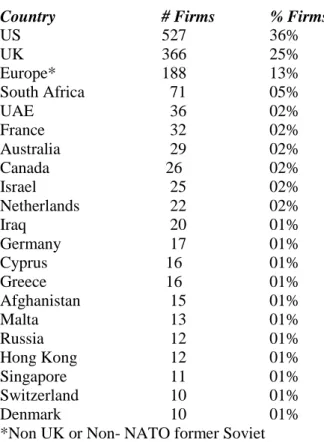
9. Private Military and Security by Country………..…………..35
10. Region of Operation………..…………..35
11. Summary of Descriptive Statistics………..…………37
12. Private Military and Security Population Growth and Key Events………...…..…41
vii
LIST OF CHARTS Chart
1. Founding Year (All Firm Founding where Data Available)………...………….………....32 2. Terminating Year (All Firm Terminations where Data Available)……….………...33
CHAPTER 1 INTRODUCTION
In the summer of 2012 the eyes of the world were focused on events in the United Kingdom,
first the Queen’s Diamond Jubilee, then the 2012 London Olympics and finally the Paralympics
games. The day after the Olympics were awarded in 2005, bombs had ripped through three subway
cars and one bus during rush hour, the largest terrorist attack in British history. Only one year before
the Olympics took place, London was convulsed with the largest civil disturbance in its history as
riots spread uncontrolled for days. As shocking as those events were, another story was unfolding
behind the scenes. A 657,000 person £7.8 Billion behemoth, Group 4 Securicor (G4S), was engaged to lead the most complex security operation in the nation’s history. In an unprecedented £284 million
contract, including a £57 million management fee, G4S was given primary responsibility for securing
the games, including providing over 10,000 private security personnel as well as leading police and
military at the Olympics venue.1
The role of private security was not exclusive to the London Olympics. G4S did £759
million in United Kingdom public business in 2010 and 2011,2 running prisons, immigration and detention centers, police stations and other security operations, though this large government business
did not even represent the majority of its United Kingdom revenue. Additionally, private military and security companies received £62.8 million in British government contracts in Iraq and Afghanistan
between 2007 and 2009, including Armor Group, itself subsequently acquired by G4S.3 As
1 House of Commons Home Office Committee. 2012. Olympics Security. Page 2
2 Ibid
3
2
impressive as its size and scope of operations are, G4S is not alone. Over the past two decades a
population of these organizations has emerged, leading to the establishment of a new global industry.
With activities in war zones, support of relief and development initiatives and securing organizations and individuals these companies play a role of critical importance.
There are aspects of the present global institutional and economic environment that are
similar to those of the seventeenth century and there is evidence of organizations evolving in that
direction (Tilly 2001). From that perspective, globalization and the prevalence of market transactions
provides an advantage to innovative and networked global firms across permeable national
boundaries, weakening the authority and sovereignty of the state in the process (Kobrin 1997).4 Newly emerged private military and security companies demonstrate such characteristics.
Furthermore, they not only cross national boundaries, but even move into activities previously
considered the exclusive domain of the state. Some of those activities were so closely linked as to
even be considered a definition of the state (Tilly 1985; Weber 1958). The establishment and
direction of a new industry operating in this domain carries a great deal of relevance for organizations
and institutions, perhaps providing insight into important changes in the global environment.
Much has been written about individual private military and security companies. A great deal
of the literature discusses their relation to state agents in defense, security and intelligence.
Nevertheless, in this paper I argue that our understanding of this industry remains incomplete. While
the presence of these firms is becoming taken for granted, there is not yet an understanding of the
nature of their emergence. Nor is there a clear explanation for the mechanisms involved in this
process. The weight of the literature on private military and security companies covers their early
role in Africa and the Balkans through their involvement in Iraq. Nonetheless, there is not a
comprehensive analysis of dynamics of this industry over a long time period.
4
3
This study is an effort to fill the gap in understanding of private military and security
companies. It seeks to identify founding mechanisms for these companies, as well as define the
dynamics of the evolution of this industry. In other words, it focuses on answering the question of how to account for the emergence and development of this industry and what it can contribute to a
broader understanding of emergence of new organizational populations.
Previous work on private military and security companies has either used individual case
study, political theory, law or public policy to shed light on what is occurring. Without a broader
view of the industry, and the population of organizations within it, this has been the best use of
evidence available to researchers. One of the drawbacks of this approach is that it results in a
perspective limited by individual case studies, studies of dyadic relations with focal organizations
such as the United States Military, or the presence or absence of legal or regulatory regimes in a
specific location. In this paper I argue that this has left of void in our understanding of these firms, in
aggregate, that can only be filled with a study grounded in organizational theory. More specifically, I
argue that an organizational ecology perspective is required to analyze the dynamics of this entire
population of organizations over a long period of time (Hannan and Freeman 1977; 1986; 1989a;
1989b). It is only in this way that a broader and more complete understanding of its nature and
trajectory can be understood.
While a population level analysis seeks to present a broader perspective than previous
studies, it does not address the nature of the emergence of this population. In order to do this, I
consider the role that independent entrepreneurial action plays in introducing variation into a dynamic
environment, and in the process enhancing the likelihood of opportunity identification and
organization for exploitation (Alvarez and Barney 2001; 2004; 2005; 2007; Shane 2000; Shane and
Venkataraman, 2000). In this study I also consider other ways that these firms could have come into
existence, such as through government or parent company action.
“Population ecologists want to understand the dynamics of organizational diversity, how
4
in the case of private military and security companies, I compare social, economic and political
factors that have occurred concurrently with the emergence of this industry. While preliminary in
nature, I seek to show the relationship of these factors over time.
Furthermore, perceptions of legitimacy are theorized to affect the prospects or organizational
populations (Aldrich and Fiol 1994; Hannan and Freeman 1977; 1989b; Meyer and Rowan 1977). To
evaluate these claims in relation to private military and security companies, I consider the role of
institutions in shaping this population and providing opportunities for organizational collective action.
This process, in turn can contribute to both “cognitive” legitimacy, or population learning, and “socio political” legitimacy, thus enhancing survival prospects for members of the population and likelihood
of retention of this new organizational form in the future (Aldrich and Fiol 1994; Hannan and
Freeman 1977; 1986; 1989b).
In the balance of this paper I develop, analyze and address these research questions. I first
provide more information and a broader context of the private military and security industry as it has
been described to date. After that I expound on theory relevant to the study of organizational
founding, emerging populations and how they are shaped. Next I review data, methods and variables
used in this study. This includes an explanation of the census of 1,477 such firms which I have
collected, what it includes and what it suggests about the industry. In the subsequent section I present
the results of this study. Finally, I conclude with a discussion of the implications of this research, as
CHAPTER 2
PRIVATE MILITARY AND SECURITY COMPANIES
Private military and security companies are legally incorporated for profit5 organizations, selling their services to a large number of diverse customers (Carmola 2010; Mandel 2002; Ortiz
2010; Singer 2003). Their products and services overlap with governmental security roles, replacing
or complementing work done by public servants. They operate in high risk conflict environments,
usually in more than one country or region. Their products and services tend to fall into three
categories: specialized military or conflict zone logistics and/ or construction; intelligence, consulting
and/ or training; and physical operations that often take on a “coercive” nature, such as convoy
security, static security or combat activities (Avant 2005; Carmola 2010; Engbrecht 2011; Mandel
2002; Ortiz 2010; Singer 2003).
The private military and security industry comprises a population of thousands of
organizations, millions of workers and hundreds of billions of dollars in annual revenue, conducting
operations on every continent and nearly all countries (Abrahamsen and Williams 2009; McCoy
2009). A recent French Parliament study defines the total market for military and security services to
be at least $200 Billion annually as of 2011, consistent with previous estimates of market opportunity,
5
6
and up from $55.6 Billion in 1990.6 Another study suggested that the total market would be $2.7 Trillion between 2010 and 2020.7
Firms such as Swedish based Securitas (Securitas) and United Kingdom based Group 4 Securicor (G4S) employ hundreds of thousands of employees on all continents. During the high
point of the United States Military surge in Afghanistan, United States Department of Defense
contractors exceeded United States service members 113,491 to 90,000 (Norland 2012; U.S.
Department of Defense), with 430 contractors (U.S. Department of Labor) and 413 soldiers (U.S.
Department of Defense) killed. This pattern had also emerged in the war in Iraq (Fischer Jacquette
2010; ProPublica; Schooner and Swan 2010; Schooner and Swan 2012; U.S. Department of Defense;
U.S. Department of Labor).
There is a substantial body of literature on private military and security companies.
Organizational founders provided their accounts of starting firms such as Executive Outcomes (EO)
(Barlow 2007), Sandline and industry giant Aegis Defense (Spicer 1999) when early operations were
occurring primarily in Africa. Other participants told of their service with Ronin Concepts (Geddes
2007) and other firms in Iraq (Ashcroft 2006). Journalistic accounts discussed these same firms
(Venter 2007; 2011), as well as others such as Crucible Security (Fainaru 2008; Schumacher 2006)
Military Professional Resources, Inc. (MPRI) (Schumacher 2006), Blackwater (Scahill 2007; Simons
2009) and Halliburton (Chatterjee 2009) in the same conflict.
A large number of these books and articles were written as an overview of the industry.
Journalistic accounts (Fainaru 2008; Geraghty 2009; Pelton 2006; Schumacher 2006) provided an
informative and readable orientation. Academic studies have been primarily written from the
6
Tran, Tran, Pierre. 2012. “Regulation, Expansion of French Private Security Firms Urged.” Defense News. February 2. And Avant, Deborah D. 2005 The Market for Force: The Consequences of Privatizing Security. New York: Cambridge University Press, page 8.
7
Graham, Stephen. 2012. “Olympics 2012 security: welcome to lockdown London.” The Guardian (London) (March 12).
7
perspective of public policy (Engbrecht 2011; Ortiz 2010; Stanger 2009), economics (Brauer and Van
Tuyll 2009 [2008]), political science (Carmola 2010; Dunigan 2011; Avant 2005), international
relations and security studies (Bruneau 2011; Carafano 2008; Isenberg 2008; Kinsey 2006; Mandel 2002; Shearer 1998; Singer 2003; Stanger 2009), law (Dickinson, 2012; Gul, 2006; Verkuil 2007)
and contractor- military relations (Camm and Greenfield 2005; Dunigan 2009; 2011; Kelty, 2007;
2008; McCoy 2009; 2010). These academic and journalistic accounts have made important
contributions to a broad understanding of operations and consequences of this industry.
Most of this literature on the industry takes a similar approach, providing an overview of the
industry and making a compelling argument for why it should be of concern. This is usually followed
by a historical narrative, often juxtaposing the “free company” private military companies of the “middle ages” with the emerging monopoly of legitimate use of force by state security beginning with
the treaty of Westphalia and accelerating after the French Revolution. They discuss changing forces
of deregulation, globalization and neo-liberalism after collapse of the Soviet Union. Case studies
discuss some of the most prominent firms, such as Executive Outcomes, Sandline, Halliburton,
Blackwater, Dyncorp and MPRI. Nearly all of these studies focus heavily on the relationship of these firms and the state, as well as the risks of “outsourcing sovereignty,” accountability and control.
In this literature, the role of private military and security companies is considered in relation
to the state’s monopoly of the legitimate use of force and the degree to which this relationship is
instrumental or competitive (Avant 2005; Mandel 2002; Singer 2003; Carmola 2010). An alternative
perspective considers participation of private companies in this realm as complementary to public authority (Abrahamsen and Williams 2007; 2009; Leander 2005). The “complementary” paradigm
nonetheless notes shifting patterns of global governance. In this view the state no longer acts alone or
even necessarily with the greatest knowledge or authority. Nor are these activities bounded by national borders. The emerging security networks are “public-private” and “global-local.” They arise
8
be accepted as legitimate authorities in the realm of security, and the resulting incorporation of these
entities into hybrid networks (Abrahamsen and Williams 2007).
In this account the power of private military and security companies to shape the security agenda has also enhanced their own role in the process. On the one hand, their competence is
growing through experience. On the other, they leverage knowledge and access to shape the perspective of key actors. This “epistemic power,” or influence derived from knowledge, is used to
shape the security discourse, and when combined with their position in newly hybridized
“public-private” and “global-local” security networks, also confers structural power and authority (Leander
2005). This leads to “global security assemblages,” a new form of governance in which nation state
neither fully relinquishes authority in the realm of security, nor maintains its monopoly (Abrahamson
and Williams 2009). Private actors take on significant power and authority through their knowledge (“epistemic power”) and network position (“structural power”). Through this process, security also
transcends spatial bounds and the sole authority of the nation state. The implication is that private
companies increasingly influence priorities in this realm. They shape the understanding, nature and
prioritization of threats (Leander 2005). They also shape decisions regarding who is secured and how
it is done (Abrahamsen and Williams 2007). In the process they also reinforce themselves as
indispensible knowledge experts (Abrahamson and Williams 2007; 2009; Leander 2005).
This dynamic is seen in the evolving manner in which international patterns and norms
manifest themselves. Multinational firms increasingly rely on private companies to protect property and activities across borders (Avant 2005), as do individuals (O’Reilly 2011). Nations rely on them
when involved in international military activities (Isenberg 2009a; 2009b; Singer 2003). This
capability builds from expertise developed in private national policing (Abrahamson and Williams
2007; Mandel 2002) and international development operations (Joachim and Schneiker 2012).
The Olympics event noted at the beginning of this paper is an example of a “public-private” and “global-local” venture. This is an example of an opportunity for exploitation as well a location
9
of mass security generates Olympic ‘spaces of exception’ that have become standardized, mobile and
globalized, and have the potential to become dissociated from the specific geographical context of the
host cities (Coaffee 2011:118).”
It has similarly been noted that:
Security has now become to a significant extent a technique and a form of expert knowledge that, while specialized, is no means the sole purview of public authorities and that may in fact be more effectively exercised by private providers. These trends have facilitated a specific form of depoliticization: a de-linking of security from public authority that is related to the growth of private security, as well as to its legitimation and the authority it wields. (Abrahamsen and Williams 2007:242).”
This perspective argues that there is a “public-private” “global-local” “hybrid” “global
security assemblage” in construction (Abrahamson and Williams 2007; 2009). While the state is not
exiting the security business it is complemented by an increasing presence of globalized private
security. As in the case of London 2012 the state is still the only force capable of deploying warships,
jet fighters, surface to air missiles and thousands of trained and reliable personnel at the last moment
under dynamic and ambiguous circumstances. On the other hand, while states remain spatially fixed, global events such as the Olympics move every two years and are seen as a way to transmit “best
practices.” Global security firms are increasingly likely to participate in this business, leveraging their
experience in previous international sporting events.
As noted above, most of the work on private military and security companies has focused in
relations with the state. Many of these studies cite Max Weber, but focus on his emphasis on state
monopoly of the legitimate use of force, rather than borrowing from his organizational theory. Only a
small number of studies touch on some aspects of organizations or organizational theory. These
studies have struggled with understanding how to categorize and analyze these organizations, define
their emergence or explain the dynamics of the industry over time. Without an organizational
10
view, disproportionately influenced by the nature of the organizations or institutions that are
considered, as well as the focal relationship of some of them with state agents.
Early studies focused on instrumental use of these firms for intervening in small conflicts (Shearer 1998). Others concentrated on “undertaking a largely conceptual and integrative study of
security privatization (Mandel 2002:3).” An example of the typical approach of these studies is…
That the objective of this work is not simply to create a compilation of facts about individual firms operating in the military field. As significant as it would be to finally collect the often incongruent information about the industry in one place, the creation and implementation of an overall analytic architecture is more important. This book organizes and integrates what we know about the firms in a systematic manner, allowing for the development of underlying theories that can guide us in the future. (Singer 2003:ix)
In the few cases that organizational approaches are considered, they are usually in the
context of “markets versus hierarchies,” and again almost exclusively in the limited focal
relationship with state agents (Avant 2005; Brauer and Van Tuyll 2008; Fredland 2004;
Williamson 1975; 1985; 1999). Some of the literature considers the effects of social norms
and professional standards on the industry (Avant 2000; 2005; Avant and de Nevers 2011;
Berndtsson 2012; Franke and von Boemcken 2011; Higate 2011; Joachim and Schneiker
2012; McCoy 2012; O’Reilly 2011; and Thumala, Gould and Loader 2011). One of the
stronger attempts at organizational assessment argues8:
PMSCs are what organizational theorists refer to as ‘informal organizations,’ entities whose basic structure resists easy categorization. Such organizations can act effectively in unclear situations, are quick to adapt, and cohere through informal trust networks. Many times, such informal organizations play a ‘boundary- spanning’ role between two other formal organizations- in this case the military and the bureaucracy. (Carmola 2010:10)
In this analysis private military and security companies are “protean shape shifters.” “They combine the worlds of the military, the business world, and the humanitarian NGO in
unfamiliar ways. The reason they are so hard to understand is that they combine
8
11
organizational cultures that in many cases have defined themselves in opposition to one
another (Carmola 2010:26).” Unfortunately, this promising insight does not go further.
The rare organizational consideration has focused on individual firms or the entire field.9 Lacking are studies that can generalize across organizations using population level data and analysis. While there is an organizational literature that uses case studies (Collins
2001; Collins and Porras 2004 [1994]), others have cautioned against drawing conclusions
based on a limited sample of selected cases (Aldrich and Ruef 2006; Dew and Hudgens 2008;
Hannan and Freeman 1989; Scott and Davis 2007). The kind of organizations that are
selected, usually large high profile cases which are mostly successful, are a biased sample not
representative of the overall population. This has tended to be the pattern, as noted above, in
the private military and security literature.
To date, there has only been one attempted population census of these companies
(Dew and Hudgens 2008). Students at the Naval Postgraduate School collected a database of
550 private military and security companies that emerged between 1970 and 2006. They
obtained founding dates on 40%, capabilities on 70% and national origin on 90% of the firms
identified. This effort suggested that firms tended to be heterogeneous, operating across the “spear,”10
from logistics to combat support to combat operations, sometimes in the same firm
(Avant 2005; Bruneau 2011; Dew and Bryan, 2008; Singer 2003). This study suggested that
more than half of all firms were from the United States, with another 20% from the United
Kingdom. In addition to operating across the “spear,” firms operated globally. Additional
information was derived from the 550, with 230 cases identifying founding years. The nature
of founding and year and nature of termination does not appear to have been collected.
The challenge this population poses to organizational studies is that:
9
For discussion of fields see Aldrich and Ruef (2006), DiMaggio and Powell (1983) or Scott and Davis (2007)
10
12
It is extremely difficult to generalize about private military and security firms. As an industry, or at least, business sector, PMCs have been around for less than 20 years. And although they have attracted growing attention from analysts, scholars, government, and the general public the past decade, there are still not agreements in how to define them, let alone categorize them. (Isenberg 2008:157)
Also:
Because they remain uncategorized by any formal measure, the exact number of PMFs that have entered the market is difficult to establish and most definitely remains in flux. The global number is estimated to be in the mid- hundreds. In London alone there are headquartered at least 10 firms that have overseas contracts thought to be work more than £100 million (roughly $160 million). These firms have more than 8,000 ex- British soldiers on their books as employees. Similarly, at least several dozen firms based in the United States specialize in providing tactical and consultative military services. Another 60 such firms work in the demining sector. If one broadens the counting of PMFs to include back-end military support firms, or diversified firms, the number multiplies. (Singer 2003:79)
The balance of this paper is intended to build on, and complement, the previous work on
private military and security companies. The intent is to provide a more comprehensive and
representative understanding of this population or organizations, the nature of its emergence and how
it has been shaped over a long period of time. In doing this I analyze the data from a census of 1,477
of these firms that I collected through the perspective of organizational theory. This adds a new
dimension to analysis of this population distinct from previous attempts to explain it. In doing so, it
seeks to answer questions not yet addressed regarding the nature of organizational founding and
population level emergence, as well as adding to the organizational theory literature on these topics.
Additionally, it seeks to add to understanding of the role of legitimacy and institutional factors
shaping and enhancing the survival prospects of this population specifically, and new populations
CHAPTER 3
ORGANIZATIONAL POPULATIONS AND THE PROBLEM OF EMERGENCE
As can be seen in the previous section, the literature on private military and security
companies has been struggling with defining and explaining what population ecologists refer to as
new organizational forms. While individual organizations are frequently founded and disbanded, and
a great diversity of forms and functions proliferate, organizational ecology theorizes that new
populations emerge when new organizational forms demonstrate a fit with new niches created
through changes in the environment (Hannan and Freeman 1977; 1986; 1989b). The resulting
successful variation is selected for retention while organizations that are not well adapted fail
(Aldrich and Reuf 2006). Resource availability defines a theoretical carrying capacity for
organizations in these environmental niches (Hannan and Freeman 1977; 1986; 1989b). Institutional
processes further shape these populations and their perceived legitimacy (DiMaggio and Powell 1983;
Meyer and Rowan 1977; Powell and DiMaggio 1991). Legitimacy in turn enhances survival
prospects (Hannan and Freeman 1986; 1989b).
New Populations of Organizations
New populations emerge when new forms proliferate that are best fit with niches created by changes in the environment. “An organizational form is a blueprint for organizational action, for
transforming inputs into outputs.” (Hannan and Freeman 1977; 935). Forms can be defined by formal
organizational structure, patterns of organizational activity or normative orders (Aldrich 2008;
Hannan and Freeman 1977). They can also be tied to goals, activity systems and boundary
maintenance (Aldrich 2008).
14
The selection process inherent in an ecological model partially explains the rates of organizational founding and failure. This is the structural part of the model. There is an agency part as well, in which the relevant social actors make choices. In the case of the founding of new organizations, the relevant actors are the entrepreneurs who create them. Whether these entrepreneurs fully embrace the density model or not, we can well expect that they will prefer to enter into niches that are not too crowded when they are defining the forms and needs of their organizations. (Lune 2010:122)
Population ecology (Hannan and Freeman 1977; 1989b), the application of ecological theory
to organizational studies, provides insight into the dynamics of organizational populations over time.
This provides a method of analysis of populations of organizations from their founding, through
growth and maturity. Inertia in existing organizations makes it difficult for them to quickly adapt.
Changes in populations take place as a result of variation provided by new organizations, rather than
the less likely adaptation by existing organizations, as internal and external pressures towards inertia
make it difficult for these organizations to change (Hannan and Freeman 1977). Social, economic and political conditions produce “niches” conducive to emergence and growth of organizational
populations and sub populations that continue to grow as long as resources are available and the “carrying capacity” of the environment has not been saturated (Hannan and Freeman 1989b). As the
population matures and consolidates, generalists replace specialists, leaving new forms to emerge in
specialized niches and setting the conditions for the process to potentially continue (Scott and Davis
2007).
Ecological analysis has been applied to a wide range of organizational populations. These
have included Labor Unions (Hannan and Freeman 1987) European automobile companies (Hannan,
Carroll, Dundon and Torres 1995), the semi conductor industry (Freeman 1990; Podolny, Stuart and
Hannan 1996) newspapers (Carroll 1987; Carroll and Delacroix 1982; Carroll and Hannan 1989b),
micro-breweries (Carroll and Swaminathan 2000), child care centers (Baum and Oliver 1992; Baum
and Singh 1994) and hotels (Baum and Mezias 1992). In nearly all of these studies the population
examined has been local, national or regional. Still left to be analyzed with these methods are newly
15
Entrepreneurial Opportunity Identification and Exploitation
While ecological analysis of organizations provides a method for studying the dynamics of
organizational populations over time, it does not provide an understanding of mechanisms that initiate new organizational variation leading to founding of new organizational populations. Literature on
entrepreneurial action helps to fill in the remaining gaps. Entrepreneurial discovery and learning
enable the emergence of new organizations for the purpose of exploiting these opportunities (Alvarez
and Barney 2007; Shane 2000; Shane and Venkataraman 2000). Entrepreneurs organize to exploit
opportunities opened up as a result of social, economic and institutional changes (Harper 2003).
Once founded, populations establishing “cognitive” and “socio- political” legitimacy improve long
term prospects for the greatest number of organizations possible in a population (Aldrich and Fiol
1994; Hannan and Freeman 1989b).
Opportunity discovery processes are used by entrepreneurs to seek out opportunities waiting
to be found and exploited (Kirzner 1997; Shane 2000; Shane and Venkataraman 2000).
Entrepreneurs form organizations which can exploit opportunities created by competitive
imperfections in the marketplace (Alvarez and Barney 2007; Harper 2003; Shane and Venkaraman
2000). Opportunity discovery theory assumes that opportunities arise exogenously. They come from
technology, consumption, political and regulatory action, or social and demographic changes.
Entrepreneurs able to take advantage of these opportunities demonstrate alertness. Decisions are
risky, with entrepreneurs seeking to identify possible outcomes and realistic probabilities of achieving
them (Alvarez and Barney 2005; Harper 2003). Knowledge or experience with an industry or market
can enable entrepreneurs to identify opportunities they would not otherwise be able to, and founding
conditions may be a blueprint that determines both initial form and subsequent evolution (Hannan and
16 Institutional Shaping and the Importance of Legitimacy
New institutional theory suggests that isomorphic forces shape organizational populations
and form them into organizational fields. These forces are both competitive and institutional. Institutional mechanisms, or processes, include: coercive forces such as legal and regulatory regimes;
mimetic processes involving copying others in the absence of clear alternative, particularly in times of
uncertainty; and normative processes established through professional standards and affiliation.
Centralization and availability of resources also suggest which of these processes might predominate
(DiMaggio and Powell 1983; Meyer and Rowan 1977; Powell and DiMaggio 1991).
While institutional processes play a role in shaping organizations, populations and fields,
organizations and institutions affect each other, rather than being a one way relationship. For
instance, California thrifts helped to craft the institutional environment, even as they themselves were
affected by it, enabling a co-evolution of organizations and institutions (Haveman and Rao 1997).
Hospital types both affected, and were affected by, the American Medical Association (Dunn and
Jones 2010). Commercial radio both influenced the regulatory environment, and in turn was shaped
by it (Lippman 2005; 2007). It also played a role in changing consumer practices and creating
entrepreneurial opportunities for an emerging population of soft drink organizations in the 19th century (Hiatt, Shine and Tolbert 2009). New institutional theories of organizations have a lot to say
about the forces shaping organizations, organizational populations and organizational fields. Alone,
however, they have limited explanatory power in regards to the emergence of new populations of
organizations as new institutional theory uses the existence of these populations as a starting point.
New organizational populations face constrained growth opportunities while their legitimacy
is in question. Empirical studies suggest lower founding rates when industries are small and new, the
highest mortality also found in these early years. Survival prospects are enhanced when organizations
band together in industry groups (Hannan and Freeman 1989b). As organizational populations gain “cognitive” and “socio- political” legitimacy, learning increases, founding activity accelerates,
17
New industries emerge when entrepreneurs succeed in mobilizing resources in response to perceived opportunities. Identifying opportunities, assembling resources, and recruiting and training employees are challenges facing all entrepreneurs, and all of these activities require cooperation and strategic interaction of individuals and groups. However, founders of entirely new activities, by definition, lack the familiarity and credibility that constitutes the fundamental basis of interaction. Many of the other constraints on a new industry’s growth are thus magnified. Access to capital, markets, and governmental protection are all partially dependent on the level of legitimacy achieved by an emerging industry. (Aldrich and Fiol 1994:647)
Emergence of new organizational forms may result from variation of existing forms (Aldrich
and Ruef 2006), as well as new structures (Hannan and Freeman 1986). Organized entrepreneurial
action enables discovery and exploitation of these opportunities (Alvarez and Barney 2007; Harper
2003; Shane 2000). Institutional forces (Meyer and Rowan 1977; Powell and DiMaggio 1991) and
coercive, mimetic and normative isomorphism (DiMaggio and Powell 1983) help to shape
populations once they have emerged (Lippman 2005; 2007; Rao 1998; Walker 2009). Continued
learning and adaptation are required for a population to achieve institutional legitimacy and retention,
in the process enhancing survival prospects (Aldrich and Fiol 1994; Hannan and Freeman 1977;
1989b). This suggests the importance of successful interaction of these elements in order to explain
the emergence, survival and growth of a new population of organizations. In the next section I apply
CHAPTER 4 EXPECTED FINDINGS
This paper is a preliminary study of the emergence of private military and security
companies. It is informed by organizational theory, and in particular population ecology,
entrepreneurial exploitation and discovery, the shaping affects new institutional theory, and the role
of legitimacy in enhancing survival outcomes. It relies on a unique census of 1,477 private military
and security companies that was specifically collected for this analysis. Given the organizational
theory cited above, and applied to the private military and security industry, I have developed a set of
expectations regarding this population.
Opportunity Identification and Organizing for Exploitation
As noted in the previous discussion on organizational theory, social, political and economic
changes can provide opportunities for the emergence of new organizational forms and therefore
populations of organizations (Hannan and Freeman 1977; 1989b). Entrepreneurs identify
opportunities and organize to exploit them (Aldrich and Ruef 2006; Alvarez and Barney 2003; 2005;
2007; Harper 2003; Kirzner 1997; Shane 2000; Shane and Venkataraman 2000). Availability of
opportunity, knowledge and resources determines a theoretical carrying capacity for a population of
organizations, which provides for continued growth until a saturation point is reached (Hannan and
Freeman 1977; 1989b).
Given the theorized relationship between opportunity identification and exploitation and
organizational population growth, I expect that private military and security company growth will be
related to opportunities that present themselves. While it might not be possible to follow all possible
19
Globalization and deregulation from the 1970s; public- private partnership, outsourcing and third party contracting in the 1980’s and 1990’s; the end of the Cold War and downsizing of state security
agents; conflicts in the Balkans and Africa in the 1990’s; the wars in Iraq and Afghanistan in the 2000’s; and the challenge of mass piracy most recently. I expect that each of these events represents
an opportunity for new entrants into this population. I expect founding of new firms to accelerate as
long as significant new opportunities present themselves.
Independent Entrepreneurial Action and Organizational Founding
As noted in the discussion on organizational theory in the previous section, existing
organizations have strong inertial characteristics, making it difficult for them to change (Hannan and
Freeman 1977; Meyer and Rowan 1977). As a result, variation in populations results from the
founding of new organizations (Hannan and Freeman 1989b). It is further theorized that these new
organizations are founded by emergent entrepreneurs who have identified these new opportunities
and organized to exploit them (Aldrich and Ruef 2006; Alvarez and Barney 2003; 2005; 2007; Shane
2000; Shane and Venkataraman 2000). As a result, I expect that most of the founding activity of
these new organizations is through independent entrepreneurial action, rather than other mechanisms.
Alternative mechanisms considered are direct government action, parent company action or mergers.
Legitimacy Enhanced Survival Prospects
Organizational theory reviewed in the previous section notes that founding is slow and disbanding high until “cognitive” and “socio political” legitimacy is achieved, at which point
population growth increases (Aldrich and Fiol, 1994; Aldrich and Ruef, 2006; Hannan and Freeman,
1986; Hannan and Freeman, 1989b). Furthermore, empirical research suggests that legitimacy is
related to the formation of survival enhancing industry organizations (Hannan and Freeman 1989b).
Given the theorized role of “cognitive’ and “socio- political” legitimacy in enhancing organizational
survival, my expectation is that population growth will accelerate with enhanced legitimacy, as
20
Given the preliminary nature of research and data collection that I conducted for this project
it would be premature to conduct a formal hypothesis test at this point. However, the relevant
organizational theory reviewed for this paper informs expected behavior and outcomes within this population. Furthermore, the data collected for this project provides information suggesting the
consistency of these outcomes with expected results. The next section provides detail on the data that
CHAPTER 5
METHODS, DATA COLLECTION AND VARIABLES
Methods
I compiled a census of private military and security companies and then used variables in the
data set in order to see if patterns were present consisted with my expected findings. I took an
ecological approach to this analysis (Hannan and Freeman 1977; 1989b). Ecological analysis looks
beyond individual organizations in order to consider the dynamics of an entire population of
organizations. It does this by aggregating key events across organizations in the population. These
events include founding and disbanding, if applicable, of the organization. Ecological analysis also
calls for the study of organizational populations over time. In large and complex populations, it
requires study and understanding of the evolutionary nature of the population, rather than relying on a
single cross sectional observation.
More specifically:
Ecologists analyze organizational birth, change, and death as the most informative dependent variables. Although differences exist in how much attention is paid to “external” conditions, such as political or institutional factors, there appears to be widespread agreement among ecologists in two methodological precepts: (1) study all members of the population. To focus on a subset- the survivors, the most effective, the Fortune 500- leads to bias in understanding the full range of organizations; (2) study processes that take place over time rather than relations among variables at a single point in time. Dynamic approaches focusing on
processes uncover different connections than static or cross- sectional studies. (Scott and Davis 2007:246-247)
As part of this ecological analysis, I collected relevant aspects of organizational
characteristics. I then aggregated this information to analyze the overall population dynamics. Combining the rates of founding and termination of organizations provides for an overall view of the
22
Because similar institutional events impact the overall population I note broader relevant
social, political and economic factors and match them to the growth rate of the population, as stated in
the expected findings section. To conduct this analysis, I overlay these key events on the growth of the organizational population over time and look for patterns that emerge.
Data Collection and Sources
In order to do this analysis, I collected a unique data set of 1,477 private military and security
companies. It was collected over 18 months, from April 2011 to September 2012. Data sources
included published popular press and academic books and journals, news accounts, government
reports and industry association membership lists. I also incorporated information from recruiters and
candidates looking for industry jobs, allowing me to identify less public organizations through their
labor market activity.
Information about the specific companies came from published sources. I was also able to
obtain extensive information on these organizations through company websites. These websites often
provided extensive detail on both the companies and the industry. Given the commercial nature of
these businesses the websites are used for communication with customers, prospects, employees, job
candidates and contractors. These websites are also used to convey competence and legitimacy to a
broader audience including the general public, journalists, politicians, government agencies and other
regulators. Many companies use Facebook, Linkedin and/ or other social media for the same
purpose, providing another source for data collection. Industry organizations often list members,
information about these organizations, and details regarding the industry. Finally, legislators and
government agencies often investigate and publish information on these organizations, providing yet
another source of information.
Data Collected and Descriptive Statistics
Data collected were intended to provide a detailed understanding of each firm. While a
23
extent that they were available for that firm. Completing this census and related information was
required for this study as no database of this kind was publically available. Compiling this database
was an important contribution and attracted attention and support from those studying this industry. The variables that I collected are detailed in Table 1: Data Collected.
Table 1: Data Collected
Variable Variable Name Description
V01 Name Name of PMSC
V02 Website Web address
V03 Type Military, security or both
V04 Mode Land, air or sea
V05 Service Logistics/ construction; consulting/ intelligence/ training; operations
V06 Description A description of the firm
V07 Customer Military, other government, corporation, NGO, individual V08 Founding Information about the founding and/ or founder
V09 FY Founding year
V10 F Action Independent, parent company, government action, merger
V11 TY Terminating year
V12 T Action Terminated operations, acquisition, merger
V13 Country Country of headquarters
V14 Region Ops Regions of operations
V15 Industry Orgs Membership in industry organizations V16 Sources Sources of information
V17 Address Physical address, e- mail, phone number, etc. V18 Comment Other comments relevant to the organization
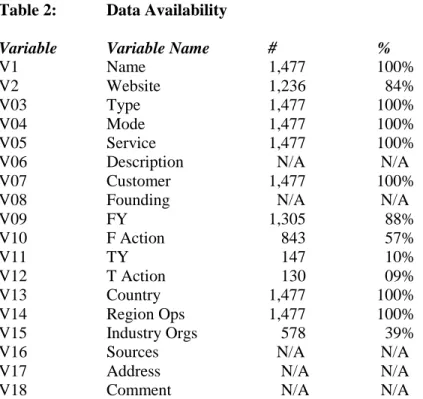
Research for compiling this census identified 1,477 firms meeting the description that I noted
at the beginning of this project. I was able to identify websites for a total of 1,236 firms. I identified
type, mode, service, customer, country of headquarters and region operations for all 1,477 firms. I
was able to identify the founding year for 1,305 firms, or 88%, and the founding action for 843, or
57% of the firms. Terminating year was available for 147, or 10% of the firms, and terminating
action was available for 130, or 88% of those firms identified as having disbanded. It is difficult to
know what percentage of disbanded firms are identified in the data set, as it required evidence of
disbanding to consider a firm no longer operating. Examples of this kind of evidence would be a notification by the firm itself that it was going out of business, announcements of mergers or
24
with terminating years having terminating action. Finally, industry organizations were only identified
for 39% of the firms. This suggests that just over half of the firms do not belong to the major industry
organizations. This information should be highly accurate as membership came from the industry organizations themselves. Percentage of information available for each variable is listed in Table 2:
Data Availability.
Table 2: Data Availability
Variable Variable Name # %
V1 Name 1,477 100%
V2 Website 1,236 84%
V03 Type 1,477 100%
V04 Mode 1,477 100%
V05 Service 1,477 100%
V06 Description N/A N/A
V07 Customer 1,477 100%
V08 Founding N/A N/A
V09 FY 1,305 88%
V10 F Action 843 57%
V11 TY 147 10%
V12 T Action 130 09%
V13 Country 1,477 100%
V14 Region Ops 1,477 100%
V15 Industry Orgs 578 39% V16 Sources N/A N/A
V17 Address N/A N/A
V18 Comment N/A N/A
Firms were identified as private military and security companies if they met the criteria
definition that was identified at the beginning of this paper. They had to be legal and for profit
commercial organizations11, selling military and/ or security services in risky environments. While I did not require them to be multinational in nature, I did limit my sample to firms that had at least a
large national footprint and work with governmental and/ or multinational corporations and/ or
agencies. There are many local or regional (sub region of a nation) security firms that do only
residential and commercial security, in most cases unarmed. While this is likely a very interesting
and important industry to study, it is not the population that I was researching.
11
25
The first variable that I collected and recorded was the name of each organization. I
included each of these as a separate entry if they were or had been a clearly identifiable and separate
corporate entity, even if they had a relationship with another firm. Where they had a relationship with another firm I noted that as well. Where applicable, I also recorded the website address for each firm.
I then identified the type of firm, specifically whether the firm was in the military industry,
the private security or both. I determined if the firm was in the military industry if it provided
services to a military organization, or if it provided services of a distinctly military nature. These
firms were classified this way, regardless of which military they provided these services for. For the
most part, if the firm serviced a military customer I included it as a military firm. In some cases,
there were firms that I included as “military,” even though they did not have a military customer per
se, if their operations were distinctly military in nature. There were not many cases in this category,
but one example was a firm that had been formed for the purposes of bidding on United Nations
peacekeeping operations. Its client was the United Nations, a non- governmental organization, but
the service was clearly military in nature. Therefore I included this as a “military” firm.
Most firms were either a hybrid of military and security (49%) or security only (49%). Only
1% of the firms in the data set were military only. This most likely indicates that firms with security
related competencies will try to diversify their operations when possible in order to grow business.
Looking at the data differently, a total of 746 firms, or 51%, provided military services either alone or
in combination. A total of 1,461, or 99%, provided civilian security and related services, either alone
or in combination with other services. Table 3 outlines this breakdown of “Firm Type.”
Table 3: Firm Type
Type # %
26
The next factor that I identified was the mode of the organization. The common perception regarding private military and security companies is that of a ground based firm in Africa or the
Middle East. While that is often the case, there are firms that specialize in aviation activities, either exclusively or in combination with other “modes.”
While most of the aviation activity is logistical or support in nature, there are a number of firms that move up the “spear” in aviation services. These include air drop and logistical insertion
into combat areas, as well as maintenance and repair services in both secure and combat locations.
Firms also provide air combat training with computer simulations and live aircraft.12 At the pointier end of the “spear” firms provide combat mapping, surveillance, and battle damage assessment.
Others provide combat experienced pilots to clients for overseas operations, as well as teams that
provide services as specialized as aerial refueling.13
Maritime security has become a prevalent “mode” of operations for firms. As piracy has
become an increasing concern, hundreds of firms have taken advantage of this opportunity to provide
maritime consulting, ship hardening and on- board security teams. Newer firms are even providing
escort ships, either retrofitted or newly equipped with combat equipment.14 Pre- positioned floating armories these teams to pick up arms after leaving territorial waters and return them before re-
12
For instance, ATAC trains US and allied air forces using former Israeli Air Force K-fir fighters, Royal Air Force Hawker Hunters, US Navy A-4 Skyhawks and Warsaw Pact L-39 Albatross fighter- bombers. Top Aces, provides a similar service in Canada, flying Dornier Alpha Jets and other aircraft Amber Tiger Aviation Management provides training to individual pilots in both Western and former Warsaw Pact rotary wing aviation platforms, including CH-47, Mi-8, Mi-17 and even Mi24/35 attack helicopters.
13
For instance, Russian firm Sukhoi provided a team of 250 employees who served as combat pilots, ground crew and maintenance workers for Su-27 fighters used in their war with Eritrea. Executive Outcomes pilots flew company owned aircraft, including former Warsaw Pact Mi-8/17 and Mi-24/35 attack helicopters and MiG fighters in combat in Angola and Sierra Leone. Omega group provides aerial refueling to the US Air Force, using B707 and DC-10 aircraft reconfigured in the same manner as Air Force KC-135 and KC-10 aerial refueling aircraft. Other contractors identify targets and “fly” UAVs on attack missions for the CIA in Pakistan, Yemen and other locations.
14
27
entering others. It is estimated that 40% of commercial shipping in these high piracy waters carry
security contractors on board.15 Additionally, efforts have been made to train local forces to combat piracy both on and off their shores.16 This combination of efforts has credited private military and security companies with a major contribution towards successful counter piracy operations.17
The mode of firms varied considerably. The vast majority of 1,245 firms, or 84%, engaged in
terrestrial operations. A total of 902, or 61%, engaged in only terrestrial operations. A small number,
143 or only 10%, engaged in aviation operations, with most of those in logistics or maintenance.
Only 33 firms or 2% engaged in aviation only operations. A growing number, at 497 or 34%, of the
firms were engaged in maritime operations. A surprisingly large number, of 198 or 13%, of the firms
were engaged in only maritime operations. Table 4 shows the breakdown of “Mode of Operations.”
Table 4: Mode of Operations
Mode # %
Terrestrial Total 1,245 84% Terrestrial Only 902 61% Maritime Total 497 34% Maritime Only 198 13% Aviation Total 143 10% Aviation Only 33 02%
15
“Piracy and private security: Laws and guns: Armed Guards on ships deter pirates. But who says they are legal?” The Economist. April 14, 2012. (Accessed April 14, 2012). An experienced four person team will often cost as much as $45,000 for one passage. Insurance companies will often pay the cost of these contractors as the cost of paying pirates to release ships runs into the tens of millions of dollars and no ship with maritime security contractors has been successfully hijacked.
16
Contractors such as Bancroft Global have been hired by the U.S. Government to train the Somali and Kenyan Coast Guards, while the United Arab Emirates has funded a contractor Sterling Corporate Services led effort to train and equip the Puntland Maritime Protection Force of that semi- autonomous region of Somalia. These operations in African, India and the Middle East learned from private security anti piracy operations previously conducted in the Malacca Straights and Southeast Asia (as the pirates themselves may have as well) (Hernandez, 2010).
17
28
I then noted the types of service(s) the company provided, moving progressively up the “spear” from least combat to most combat oriented. The first service category was logistics and
construction. The second was intelligence, advice and training. The third was direct security operations, often of a “coercive nature.” Many firms provided combinations of these services, the
provision of one leading to the need, or opportunity, to provide others.
Leveraging resources for exploitation of multiple opportunities relates to the range of services
provided as well. A total of 378 firms or 26% engaged in specialized military or security related
construction and/ or logistics. Only 66 firms or 4% engaged in these services alone. Another 1,410
or 95% engaged in specialized military or security related intelligence, advice or training, either by
themselves and/ or in combination with other services. A total of 202 firms or 12% engaged in these
services only. And 1,092 or 74% of the firms engaged in direct operations either on their own and/
or in combination with other services. All firms that were engaged in direct operations also engaged
in some aspect of advice, intelligence and/ or training. This supports the notion that firms leveraged
operational capability in order to provide advice, training and/ or intelligence as additional services
and vice-versa. As noted earlier, these private military and security firms leverage their knowledge
(“epistemic power”) and network position (“structural power”) to further build business (Leander
2005). This is also evidence of “cognitive legitimacy.” Table 5 notes the breakdown of “Services.”
Table 5: Services
Services # Firms % Firms
Intelligence/Advice/Training Total 1,410 95%
Operations Total 1,092 74%
Logistics/Construction Total 378 25% Intelligence/Advice/Training Only 202 14% Logistics/Construction Only 66 04%
Operations Only 0 00%
The next variable was the type of customer(s). I identified organizations providing services to
military organizations. I noted when firms provided services to other government organizations.
29
The next category of customers was other “companies.” These included both privately held
and publically traded corporations. As the size and scope of global companies and their operations
has increased, their engagement with private security firms has increased as well.18
The fourth category was “non- governmental organizations” or NGOs. These included the
United Nations and its agencies, as well as human rights, developmental and other organizations.
These are increasingly prevalent users of private military and security services, often refusing to do
work without them (Rubin 2010).19 When the Afghan government first threatened to terminate operations of private security companies, aid organizations said that they would shut down operations
without the availability of these firms,20 and aid programs themselves have been increasingly outsourced to private aid organizations.21
I noted firms providing services to individuals, such as high income customers, executives,
and “VIPS” and their families. They can be preventative, such as site hardening and guarding, or
reactive, such as kidnap rescue and recovery (O’Reilly 2011) and even K-9 services.22 Maritime
18
Hirsh, Afua and John Vidal. 2012. “Shell spending millions of dollars on security in Nigeria, leaked data shows Internal documents reveal oil company spent $383m over three years protecting staff and installations in Niger delta region” The Guardian. August 19 (Accessed September 29, 2012). Shell, as one example, spent nearly $1 Billion on security between 2007 and 2009.
19 The United Nations alone spent $44 million on private security contracts in 2010 and $76 million, with most
in support of the United Nations Development Program, followed by United Nations Peacekeeping Operations (Pingot 2012).
20 Rubin, Alissa J. 2010. “Afghan Projects May Stop When Security Ban Begins.” The New York Times. October
22 (Accessed November 9, 2010).
21 An example of an aid and development firm isDevelopment Alternatives, Inc.
22
30
security firms often provide specialized yacht security services. This has become a particularly
lucrative as the number of high income and high net worth customers has increased.23
The diversity of opportunity identification and exploitation is evidenced by the range of customers served. A total of 739 firms, or 50%, served military of various countries around the
world, either alone or in combination with other customers. Another 1,020, or 69%, served other
government customers. More telling, 1,362, or 92%, served corporate customers. Another 615, or
42%, served non- governmental organizations. And 710 or 48% served private clients. Only 160
firms or 11% served only one customer type, with 130 or 9%, serving corporate clients only.
Table 6: Customer Type
Customer # Firms % Firms
Corporations Total 1,362 92% Government Total* 1,020 69% Military Total 739 50% Individuals Total 719 48%
NGOs Total 615 42%
Corporations Only 130 09% *Not including military
I identified the founding year of the organization when available. I also identified the
founding action when available. Founding actions included “Independent entrepreneurial action,”
“parent organization action,” “government action,” or “merger.” In order to determine the nature of
the founding, I reviewed the statements about the founding for each firm. This was often available on
the website of the firm, or in other documentation about the organizations. These firms were often
quite proud of their heritage and anxious to detail their founding. This was particularly true when the
founder was still involved in the running of the firm.
An example of a founding by independent entrepreneurial action is Abila:
President Vern Abila is a 19-year veteran in the security, investigative and training industries. He founded Abila Security & Investigations Inc. (ASI) in 2001 and designed and implemented a world class Security, Training, Military and Law Enforcement equipment sales division globally, and a diverse client base: the U.S.
23 “Forbes World’s Billionaires 2012.” Forbes. March 7, 2012 (Accessed March 7, 2012). In just one example