THE COEFFECTS OF VITAMIN B12 AND IRON ON MARINE DIATOMS
Kelsey Ellis
A thesis submitted to the faculty at the University of North Carolina at Chapel Hill in partial fulfillment of the requirements for the degree of Master of Science in the Marine Sciences
Department in the College of Arts and Sciences.
Chapel Hill 2015
© 2015 Kelsey Ellis
ABSTRACT
Kelsey Ellis: The effects of vitamin B12 and iron on marine diatoms (Under the direction of Adrian Marchetti)
Pseudo-nitzschia and Fragilariopsis are two closely related marine diatoms, yet Pseudo-nitzschia possess only the vitamin B12-dependent form of the methionine synthase enzyme [MetH] whereas Fragilariopsis possess both MetH and a B12-independent form [MetE]. Consistent with this difference in gene repertoires, our results indicate that Pseudo-nitzschia granii has an obligate requirement for vitamin B12 while growth of Fragilariopsis cylindrus was unaffected by varying B12 availability due to increased MetE expression.
ACKNOWLEDGMENTS
TABLE OF CONTENTS
LIST OF TABLES………vii
LIST OF FIGURES………...viii
LIST OF ABBREVIATIONS………...ix
INTRODUCTION………..1
CHAPTER 1: THE EFFECTS OF VITAMIN B12 ON BLOOM-FORMING MARINE DIATOMS……….3
Introduction………3
Methods………..6
Algal Species………..6
Medium and Culture Conditions……….7
B12 Addback Experiments……….10
Gene Expression Analysis……….11
Phylogenetic Analysis………...13
Statistical Analysis………15
Results……….……..15
Steady-State Growth Rates and Photosynthetic Efficiencies………15
B12 Addback Experiments……….18
Gene Expression Analysis……….22
Phylogenetic Tree Analysis………...26
CHAPTER 2: THE COEFFECTS OF IRON AND VITAMIN B12 ON THE
DYNAMICS OF MARINE IRON FERTILIZATION EVENTS………38
Introduction………..38
Iron………...38
Vitamin B12………..39
Iron and Vitamin B12 Interactions………42
Methods……….………45
Algal Species……….………45
Medium and Culture Conditions……….……..46
Iron Addback Experiments……….…...47
Gene Expression Analysis……….……49
Chlorophyll a and Cell Count Analysis……….……49
Statistical Analyses………...….……49
Results……….……..50
Steady-State Growth Rates and Photosynthetic Efficiencies………....50
Fe-Resupply Experiments……….……54
Gene Expression Analysis………....59
Chlorophyll a Quota Analysis………..62
Discussion………64
APPENDIX 1: PRIMER INFORMATION……….70
APPENDIX 2: MetE SEQUENCE ALIGNMENT………….………71
APPENDIX 3: SYBR STAINING RESULTS………....75
APPENDIX 4: MMETSP ISOLATE LOCATION INFORMATION………..…………..76
LIST OF TABLES
Table 1.1: Diatom isolate accession information………...6 Table 1.2: Steady-state growth rates and photosynthetic efficiencies
LIST OF FIGURES
Figure 1.1: B12-addback experiment growth rates……….……...19
Figure 1.2: B12-addback experiment photosynthetic efficiencies (Fv/Fm)………21
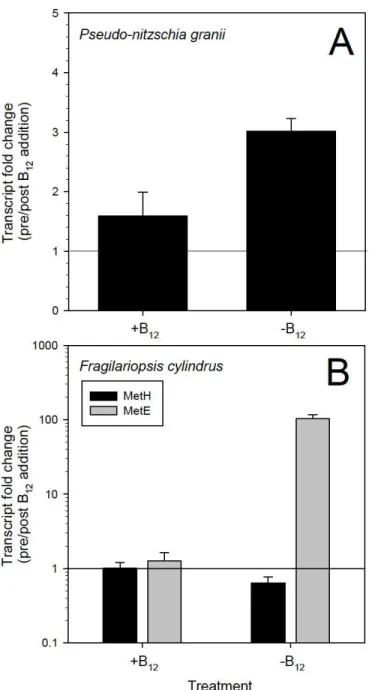
Figure 1.3: B12-addback experiment gene expression ratios………23
Figure 1.4: B12-addback experiment gene expression fold-change………..25
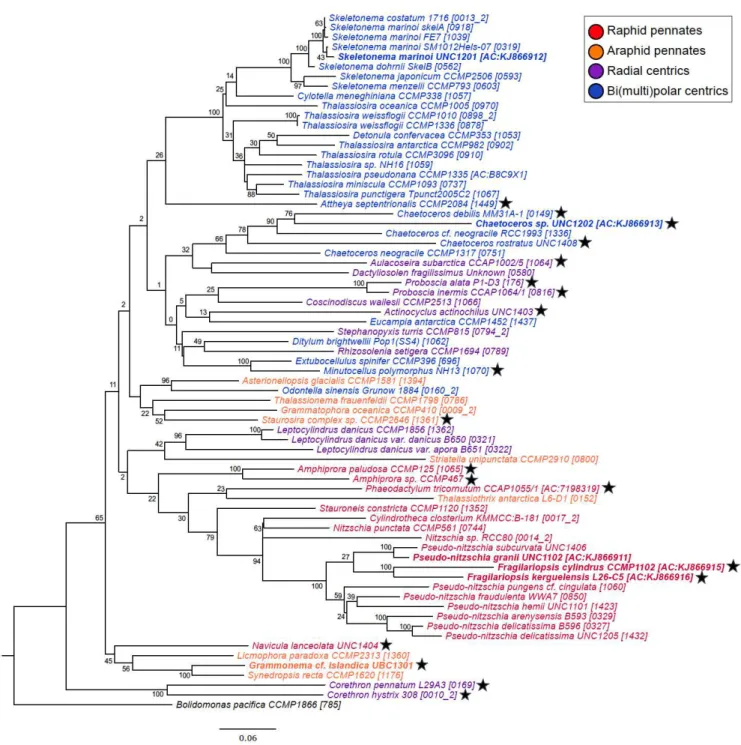
Figure 1.5: Diatom MetH phylogenetic tree………27
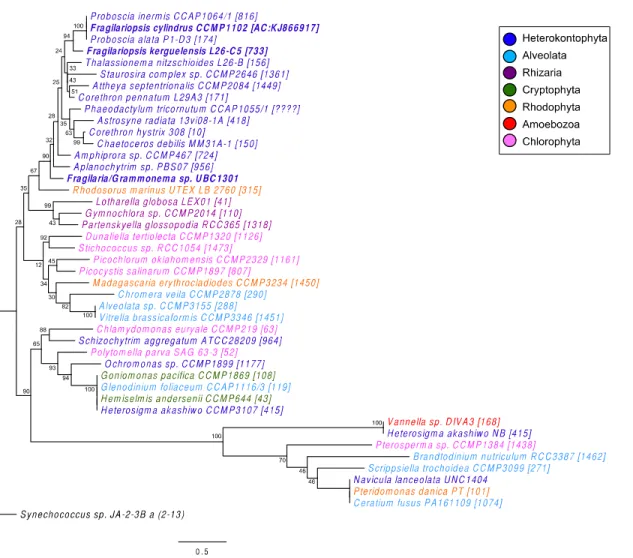
Figure 1.6: Protist MetE phylogenetic tree………..29
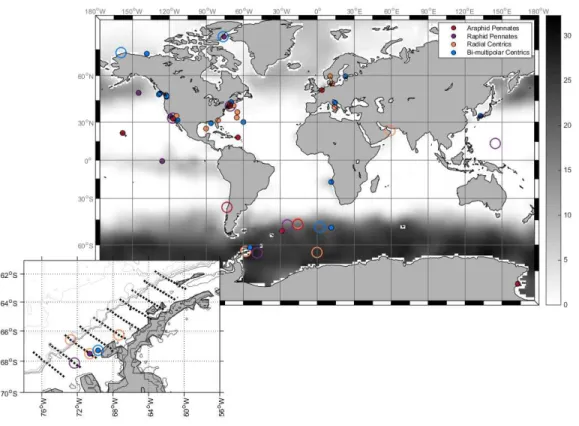
Figure 1.6B: MetE biogeography map……….30
Figure 2.1: Steady-state growth rates in a vitamin B12, Fe, and bacterial presence/absence matrix………...51
Figure 2.2: Steady-state photosynthetic effiencies (Fv/Fm) in a vitamin B12, Fe, and bacterial presence/absence matrix………52
Figure 2.3: Steady-state photosynthetic efficiencies (σPSII) in a vitamin B12, Fe, and bacterial presence/absence matrix………53
Figure 2.4: Fe-resupply experiment growth rates………56
Figure 2.5: Fe- resupply experiment photosynthetic efficiencies (Fv/Fm)………58
Figure 2.6: Fe- resupply experiment photosynthetic efficiencies (σPSII)………..59
Figure 2.7: Fe- resupply experiment gene expression ratios………....61
LIST OF ABBRREVIATIONS
ACT Actin gene
AT antibiotic-treated
Chl a chlorophyll a
dNTP deoxynucleoside triphosphate
Fe iron
HNLC high-nutrient, low chlorophyll LB media Luria Broth media
MetH B12-dependent methionine synthase MetE B12-independent methionine synthase
INTRODUCTION
Although diatoms are microscopic, their primary production is estimated to be
responsible for 20% of global carbon fixation each year. In addition, they create as much as 40% of annual marine organic carbon (Armbrust et al. 2004, Nelson et al. 1995). Over geologic timescales, it is hypothesized that changing rates of carbon sequestration into the deep ocean due to changes in diatom growth have influenced climate on a global scale (Brzezinski et al. 2002).
The growth rate and ecological success of diatoms is dependent on whether they receive enough nutrients to fuel photosynthesis and carbon fixation. For many years, researchers focused on the role of macronutrients such as nitrate, phosphate, and silicate on limiting diatom growth in the world’s oceans (Gobler et al. 2007). However, recent studies have shown that micronutrients such as iron [Fe] are scarce enough to limit primary production in vast areas of the ocean, called high-nutrient, low-chlorophyll (HNLC) areas (de Baar et al. 2005). These areas comprise
approximately 30% of the ocean’s surface and include the Southern Ocean, Equatorial Pacific, and Northeast Pacific Ocean (Boyd et al. 2007).
Incorporating the Fe and B12 effects into the traditional “Redfield ratio” has proved complicated due to a number of factors. These factors include complex Fe and B12 speciation, diverse requirements among phytoplankton species, and the role these micronutrients play in altering the uptake of classical ‘Redfield’ nutrients (Eppley and Peterson 1979). In addition, the potential for biochemical interactions between Fe and B12, both at a cellular and an ecosystem level, are not well understood.
CHAPTER 1: THE EFFECTS OF VITAMIN B12 ON BLOOM-FORMING DIATOMS
Introduction
Vitamin B12, or cobalamin, is a cobalt-containing organometallic molecule that is synthesized by certain archaea and bacteria, including cyanobacteria (Bertrand et al. 2007, Bonnet et al. 2010). Its biological importance lies in the role as a cofactor in one form of the methionine synthase enzyme [MetH] which catalyzes the synthesis of the amino acid methionine and is present in all examined marine eukaryotic microalgae (Banerjee and Matthews 1990, Helliwell et al. 2011). Many of these algal species are B12 auxotrophs, meaning they have an obligate requirement for B12 and likely only possess the MetH gene (Croft et al. 2005). However, a cobalamin-independent methionine synthase [MetE] that does not require vitamin B12 to create methionine also exists in some algae, including certain diatom species.
Another B12-dependent enzyme, methylmalonyl-CoA mutase, has been found in all examined Chromalveolate genomes, which include all diatom species (Helliwell et al. 2011). This enzyme requires the B12-containing molecule adenosylcobalamin and may be used in fatty-acid utilization, among other metabolic activities. However, as this enzyme is found in diatoms that do not require B12, it is not the primary determinant of B12 auxotrophy (Croft et al. 2006). Instead, there is a strong correlation between an absence of a functional MetE gene and B12 auxotrophy among examined microalgae (Helliwell et al. 2011).
and MetH are unrelated both in sequence homology and protein folding structure (Pejchal and Ludwig 2005). In addition, MetE is approximately 100-fold less catalytically efficient than MetH, with significantly slower observed turnover times for the enzyme (González et al. 1992). This inefficiency results in 30-40 fold increases in the nitrogen and zinc requirements allocated to MetE activity over what is used for MetH (Bertrand et al. 2013).
Although the only currently known determinant of whether MetH or MetE is utilized is vitamin B12 availability, these genomic alterations can have ecosystem-scale implications. Until recently, research in high-nutrient, low-chlorophyll [HNLC] regions of the world’s oceans focused primarily on the role of Fe limitation in sustaining low primary production despite high concentrations of macronutrients. Iron fertilization experiments have subsequently shown that these regions are limited by bioavailable Fe and fertilization of HNLC waters with Fe creates diatom-dominated phytoplankton blooms (de Baar et al. 2005, Boyd et al. 2007) that have the potential to sequester large amounts of carbon in seafloor sediments (Smetacek et al. 2012). More recent investigations in Fe-limited regions of the ocean have shown that in some cases, by adding both vitamins and Fe, diatom growth can be enhanced beyond that of Fe enrichment alone. In particular, vitamin B12 is capable of increasing growth with or without Fe under certain environmental conditions in HNLC regions (Panzeca et al. 2006, Bertrand et al. 2007, Koch et al. 2011). Vitamin B12 is also capable of affecting phytoplankton growth and community structure in coastal and estuarine waters (Sañudo-Wilhelmy et al. 2006, Gobler et al. 2007, Koch et al. 2011).
excretion, cell lysis, and direct symbiotic interactions with bacteria and archaea (Droop 2007, Bonnet et al. 2010, Kazamia et al. 2012). Therefore, an important determinant of vitamin B12 distribution is the abundance and composition of marine bacterial and archaeal communities. In addition, diatoms without MetE may compete with other B12-auxotrophic algae and bacteria when vitamin concentrations are low.
Specific bacterial genera, namely Sulfitobacter, Roseobacter, Alteromonas, and
Flavobacterium, have reoccurred as predominant groups in diatom-bacteria association studies (Grossart et al 2005, Kaczmarska et al. 2005, Amin et al. 2012). In addition, whole-genome sequencing has thus far shown that Cyanobacteria, Thaumarchaea, and members of
Alphaproteobacteria, such as Magnetococcales, Rhizobiales, and Rhodobacterales, are the main marine B12-synthesizers (Doxey et al. 2014, Sañudo-Wilhelmy et al. 2014). The cellular
requirements leading to B12 limitation have ecological effects, since diatoms possessing MetE can forgo the requirement for B12 and thus reduce their dependency on B12-producing bacteria. This allows diatoms with MetE to potentially decrease their dependence on B12-producing bacteria in a way that auxotrophic species cannot.
affect large scale processes such as community succession and carbon sequestration in areas with variable vitamin supply.
Methods
Algal species
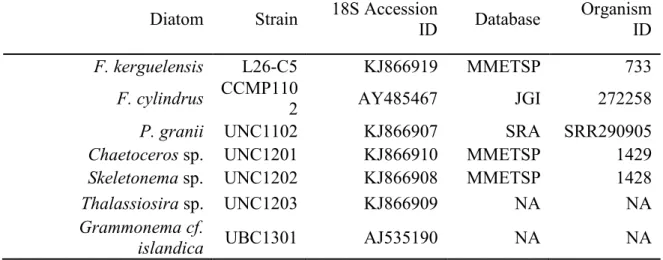
Isolates of six diatom species were examined during this study (Table 1.1). Transcriptome Diatom Strain 18S Accession
ID Database
Organism ID
F. kerguelensis L26-C5 KJ866919 MMETSP 733
F. cylindrus CCMP110
2 AY485467 JGI 272258
P. granii UNC1102 KJ866907 SRA SRR290905
Chaetoceros sp. UNC1201 KJ866910 MMETSP 1429
Skeletonema sp. UNC1202 KJ866908 MMETSP 1428
Thalassiosira sp. UNC1203 KJ866909 NA NA
Grammonema cf.
islandica UBC1301 AJ535190 NA NA
Table 1.1. Identification information for diatom species examined in this study (Chapter 1 and Chapter 2).
Pseudo-nitzschia granii (UNC1102) (G.R. Hasle) was obtained from Ocean Station Papa (50°00 N, 145°00 W) in the Northeast Pacific Ocean in 2010 (18S Genbank accession number KJ866907), Fragilariopsis cylindrus (CCMP1102) (Grunow) was obtained from the Provasoli-Guillard National Center for Marine Algae and Microbiota (NCMA) and originally isolated from the Indian Ocean sector of the Southern Ocean in 1979 (64°04 S, 48°42), Fragilariopsis
(UNC1203) (Cleve), Skeletonema sp. (UNC1201) (Greville) and Chaetoceros sp. (UNC1202) (Ehrenburg) were obtained from the Northeast Pacific Ocean (48°49 N, 128°40 W) in 2012 (18S Genbank accession numbers KJ866909, KJ866908, and KJ866910, respectively). Based on rDNA (ribosomal deoxyribonucleic acid) 18S sequencing, the Thalassiosira sp. UNC1203 isolate shares 99% homology to sequences to both Thalassiosira aestivalis and Thalassiosira nordenskioeldii deposited in Genbank. The Skeletonema sp. UNC1201 rDNA 18S sequence matches both Skeletonema marinoi and Skeletonemadohrnii, as these two species have been found to be indistinguishable based on 18S rDNA analysis (Kooistra et al. 2008). The
Chaetoceros sp. UNC1202 isolate is 93% homologous to Chaetoceros gracilis. Due to present ambiguities in identifications of the centric diatom isolates to the species level, only genus names are used throughout this study. Genbank accession numbers for MetH are indicated in Figure 1.5, while those for MetE are listed in Appendix 2.
Medium and culture conditions
added so that its concentration in the medium was 5.5∙10-7 kg m-3 (405 pmol L-1) for a B12 -replete treatment [+B12], or was excluded altogether to create B12-absent medium [-B12] while all other additions were made in excess concentrations. Trace-metal concentrations were buffered using 100 μmol L-1 of EDTA. Premixed Fe-EDTA (1:1) was added at total concentrations of 1.37 μmol L-1 to achieve free ferric-ion concentrations 10-19 mol L-1 [pFe 19], which was considered to be Fe-replete medium. The Aquil medium was allowed to chemically equilibrate overnight before use and was stored in a TMC room.
Phytoplankton cultures were grown and maintained in acid-washed, 28-mL
polycarbonate centrifuge tubes at 12°C (P. granii, Thalassiosira sp. UNC1203, Skeletonema sp. UNC1201 and Chaetoceros sp. UNC1202) or 4°C (F. cylindrus and F. kerguelensis). Cultures were grown on rotator tables under a continuous, saturating photon flux density of 120-150 μmol photons m-2 s-1, using the semicontinuous batch culture technique described by Brand et al. (1981). Cultures were grown until late exponential phase, upon which a 50 μL subaliquot of culture was transferred into fresh medium. Each of the studied diatom species were grown under +B12 and -B12 conditions, both in the presence of their full bacterial assemblage and after
antibiotic treatment (AT), except F. kerguelensis which was grown under non-AT conditions only. Growth rates and photosynthetic efficiencies (Fv/Fm) were measured for each diatom
slope of a linear regression of the natural log of in vivo fluorescence versus time during the exponential growth phase of acclimated cells after 3 successive transfers in +/- B12 medium. Cells were considered acclimated when growth rates did not vary by >10%, which typically required 3-4 transfers in +B12 or –B12 medium. If culture growth ceased during that time and responded positively to an addition of vitamin B12, cells were characterized as being unable to grow in the absence of vitamin B12.
The response of photosynthetic efficiency [Fv/Fm] to variations in vitamin B12
concentrations was measured from fluorescence-induction measurements performed on cells in mid-exponential phase using a Satlantic FIRe Fluorometer. Before each measurement, a
subsample (5 mL) of each culture was placed in the dark for 20 minutes. A strong short pulse of high luminosity blue light was applied to dark-acclimated phytoplankton for 80 μs duration to cumulatively saturate PSII and measure fluorescence induction from minimum [Fo] to maximum [Fm] fluorescence yields. After the subtraction of a blank of Aquil medium,maximum quantum yield [Fv/Fm] of PSII was calculated. The PSII quantum yield Y was quantified by Y = Fv/Fm (Fv = Fm - Fo) (Kitajima and Butler 1975).
Sterile techniques were used for all cultures to minimize bacterial contamination and the AT cultures were created by adding a mixture of antibiotics to 5 mL of an exponentially growing culture for 24 hours. Final concentrations of antibiotics were 50 μg mL-1 strepomycin, 66.6 μg mL-1 gentamycin, 20 μg mL-1 ciprofloxacin, 2.2 μg mL-1 chloramphincol (in ethanol), and 100 μg mL-1 ampicillin. A 5-mL algal culture with the appropriate antibiotic concentrations was
test and through SYBR staining and examination of the culture using epifluorescent microscopy (Noble and Fuhrman 1998). The reduction in bacteria was quantified by performing cell counts using Olympus Metamorph Basic (v.7.6.0.0) software’s integrated morphometry analysis on 10 randomly chosen fields of view from each SYBR-stained filter, which were then averaged. In all AT cultures, bacterial abundances were substantially reduced (93-99% reduction in all cultures) after incubation with antibiotics (Appendix 3).
B12 Addback Experiments
–B12 medium for experimental growth measurements. Fluorescence measurements of subsamples were taken from each culture 1-2 times each day. Fv/Fm measurements were performed using the same methodology described above. The length of experiments varied among diatom species and experimental treatments, but was typically between 5-10 days.
When fluorescence measurements indicated that cultures were in late exponential growth phase, 5-mL aliquots were taken for Fv/Fm and fluorescence measurements. 600 mL of each culture was filtered onto a 3.0-μm polycarbonate filter, immediately frozen in liquid nitrogen, and stored at -80°C until RNA extraction.
After this initial sampling time point, 400 μl of vitamin B12 (405 pmol L-1) was added to each experiment regardless of prior B12 concentration. Initial –B12 cultures then had a B12 concentration of 405 pmol L-1 and +B12 cultures were >405 pmol L-1. This was done to ensure that the response of initial +B12 cultures acted as a control, showing whether the addition procedure itself would influence growth and gene expression regardless of initial treatment. Both concentrations are well above those needed to achieve B12-replete growth of the diatom cultures. Cultures were then incubated for an additional 24 hours before the same set of
filtrations were repeated, with the exception of the volume filtered for RNA being reduced to 200 mL due to higher cell densities.
Gene expression analysis
Primers for qPCR were developed using Primer 3 and tested using PCR, gel
minutes and purified by DNase inactivation reagent. RNA concentrations were measured using a Nanodrop spectrophotometer and samples with concentrations <250 ng/μl were concentrated using the RNeasy MinElute Cleanup Kit (Qiagen, Hilden, Germany). qPCR runs using the RNA samples were used to determine DNA contamination levels, with samples containing >10 DNA copies per L of RNA given an additional incubation with DNase I and purified once more. Two µg of each RNA sample was reverse transcribed into cDNA using Superscript III First Strand Synthesis Systems for reverse transcription quantitative polymerase chain reaction (RT-qPCR; Invitrogen, NY, USA). cDNA aliquots were diluted with water to obtain 60 μL total for each sample prior to use in qPCR.
Qubit using the Qubit RNA Assay Kit (Invitrogen, NY, USA) and the copy number per microliter was calculated. Serial dilutions with UV-light treated water were used to create a series of standards for each gene of interest (106, 105, 104, 103, 102, 101 copies/μL).
Transcript copy numbers were normalized to Actin [ACT] copy numbers from the same cDNA sample. The Actin gene was used as a “housekeeping” gene for both P. granii and F. cylindrus
and is a commonly-used housekeeping gene that remains stable under a variety of nutrient regimes (Alexander et al. 2012).
Phylogenetic Analysis
Sequences for genes examined in this study (i.e. MetH, MetE and ACT) from diatoms with whole genomes publically available (e.g. F. cylindrus) were obtained from Joint Genome Institute's genome portals. P. granii sequences for MetH and ACT were obtained from an Expressed Sequence Tag (EST) library performed as part of a previous study (Marchetti et al. 2012) that is deposited in NCBI's Sequence Read Archive (SRA) (accession number
SRX066541). Seven recently sequenced transcriptomes from Southern Ocean polar diatom isolates were also used in the phylogenetic analysis of MetH and MetE (C.Moreno unpubl. data). Remaining diatom sequences were obtained from transcriptomes of isolates sequenced as part of the Marine Microbial Eukaryote Transcriptome Sequencing Project (MMETSP) and deposited in SRA (Bioproject accession number PRJNA231566) and the CAMERA database
MetE homologs from diatom species within the MMETSP database were identified through sequence homology searches against the F. cylindrus MetE protein sequence (Appendix 1). Among the diatom species in which MetE was identified, paired aligned transcript copies ranged from 4 (Chaetoceros sp. UNC1202) to 1673 (Staurosira complex sp.) suggesting
sequencing depth within each of these diatom transcriptomes was sufficient for initial screening of MetE distributions (Appendix 2). However, because gene expression can vary according to changes in growth conditions, the absence of a MetE homolog should not definitively be taken as evidence that the gene is not present within the genome of an isolate. Since the cultures used in this phylogenetic analysis were not grown under B12-limited conditions, there is the possibility that MetE could be present but not identified in the process of transcriptome sequencing.
Translated MetH and MetE sequences were separately aligned using MUSCLE (Edgar 2004) within MEGA (version 6; Tamura et al. 2013). MMETSP contigs shorter than 800 amino acids long in the case of MetH, and 600 in the case of MetE, were excluded to obtain an
alignment that spanned the majority of the genes. MetE sequences larger than 1,500 were trimmed to under 1,000 after an initial MUSCLE alignment with the F. cylindrus MetE genome sequence. A phylogenetic tree of marine microbial eukaryotic organisms possessing MetE was created using the Maximum Likelihood method with the LG+G substitution model, partial
deletion of residues and resampling with one hundred bootstrap replicates. Included isolates were then grouped according to Parfrey et al. 2010 and Dorrell and Smith 2011 into eukaryotic
“supergroups.” A MetH tree of diatom species was created using the same methodology, with the exception of the usage of the LG+G+I substitution model and grouping according to class as raphid pennates, araphid pennates, radial centrics, or bi(multi)polar centrics according to
according to MMETSP BLAST results against the known F. cylindrus genome MetE gene are indicated on the MetH phylogenetic tree.
A map showing the distribution of sequenced diatom isolates with MetE compared to those without a BLAST hit for the gene was created by C. Moreno.
Statistical Analyses
To test for significant differences between treatments, two-tailed homoscedastic t-tests within each species were performed on steady-state culture growth rate data. Two-tailed homoscedastic t-tests were also performed to test for significant differences between Fv/Fm values between treatments. A two-tailed pairwise t-test was performed between the pre +B12 and pre –B12 Fv/Fm values for the B12 addback experiments.
To test for significant differences between ratios of gene expression pre and post B12 addback, two-tailed pairwise homoscedastic t-tests were performed on gene expression ratios from B12 addback experiments. To reduce technical error in pipetting or mixing, the standard deviation of the mean for each triplicate ratio measurement was <10% of the mean. The level of statistical significance for all tests was p<0.05. All tests were performed in Sigmaplot 12.5 and passed the Shapiro-Wilk Normality Test and Equal Variance Test unless otherwise stated, in which case the Mann-Whitney U-Statistic is used in place of a p-value.
Results
Steady-State Growth Rates and Photosynthetic Efficiencies
possible as –B12 cultures could not be maintained in steady state (Table 1.2). While Chaetoceros sp. UNC1202 –B12 and AT –B12 treatments did not cease growth completely, growth rates were significantly slower in –B12 treatments (Mann-Whitney U Statistic = 3.5). Growth rates were also significantly different between Chaetoceros sp. UNC1202 –B12 and AT –B12 treatments (p = 2.5×10⁻⁵). Skeletonema sp. UNC1201 exhibited significantly slower growth between +B
12 and – B12 treatments, and growth ceased in AT –B12 treatments (p = 3.10×10⁻⁶). There were no
Class Diatom MetEa Antibiotic -Treated B12 Status Growth Rate
(d-1) n Fv/Fm n
raphid pennates F.cylindrus + - + 0.34 ± 0.02 9 0.68 ± 0.01 2 [Bacillariophyce
ae] + - - 0.32 ± 0.08 10
0.67 ± 0.01 3 + + + 0.37 ± 0.05 3 0.65 ±
0.01 3 + + - 0.33 ± 0.04 3 0.64 ± 0.02 3 F.
kerguelensis + - + 0.19 ± 0.02 4 na
+ - - 0.19 ± 0.02 3 na
+ + + na na
+ + - na na
P. granii - - + 1.02 ± 0.06 15 0.71 ± 0.006 3
- - - ng ng
- + + 1.19 ± 0.2 3 0.71 ± 0.01 3
- + - ng ng
bi(multi)polar centrics
Chaetoceros
sp. + - + 1.11 ± 0.03 23
0.71 ± 0.004 9 [Mediophyceae] + - - 0.52 ± 0.02 21 0.67 ±
0.02 1 0 + + + 1.04 ± 0.06 7 0.71 ±
0.005 6 + + - 0.71 ± 0.1 6 0.68 ± 0.004 4 Skeletonema
sp. - - + 0.85 ± 0.06 10
0.65 ± 0.01 6 - - - 0.27 ± 0.04 7 0.64 ±
0.02 5 - + + 0.90 ± 0.08 4 0.66 ± 0.02 4
- + - ng ng
Thalassiosir
a sp. na - + 0.50 ± 0.02 14
0.64 ± 0.01 7
- - ng ng
+ + 0.40 ± 0.08 3 0.62 ± 0.05 3
+ - ng ng
Table 1.2: Growth Rates and Photosynthetic Efficiencies. Steady-state growth rates (d-1) and photosynthetic efficiencies (Fv/Fm) for six cultured diatom species under vitamin B12 replete (+) or absent (-) conditions either treated with antibiotics (AT) (+) or not (-). The presence of a MetE gene as derived from genomic (F. cylindrus) or transcriptomic (all other species) sequence data is
Significant differences in Fv/Fm were observed between +B12 and –B12Chaetoceros sp. UNC1202 cultures (Mann-Whitney U Statistic = 3.5). Analysis of steady state photosynthetic efficiencies for –B12P. granii and –B12Thalassiosira sp. UNC1203 were not possible due to cessation of growth. However, Fv/Fm measurements taken before growth cessation showed a decrease in photosynthetic efficiency for both treatments prior to vitamin B12 addback and a corresponding increase in Fv/Fm post B12 addback (K.A. Ellis unpubl.). There were no significant differences in photosynthetic efficiency among treatments for the other examined diatom species.
B12 Addback Experiments
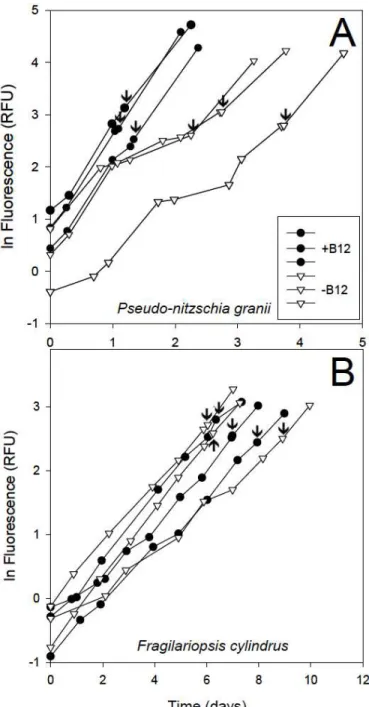
Figure 1.1. Natural log of relative fluorescence units over time for A) P. granii and B) F.
cylindrus B12 addback experiments. Cultures were initially grown with (+B12) and without (-B12) vitamin B12. Arrows indicate time of B12 addback and shape indicates B12 status.
vitamin B12 had inconsistent and reduced growth rates compared to +B12 treatments. The growth of these cultures responded positively to the vitamin B12 addback. Both + and – B12 treatments for F. cylindrus had similar and consistent growth rates. No detectable growth responses to the B12 addback were observed in either F. cylindrus treatment.
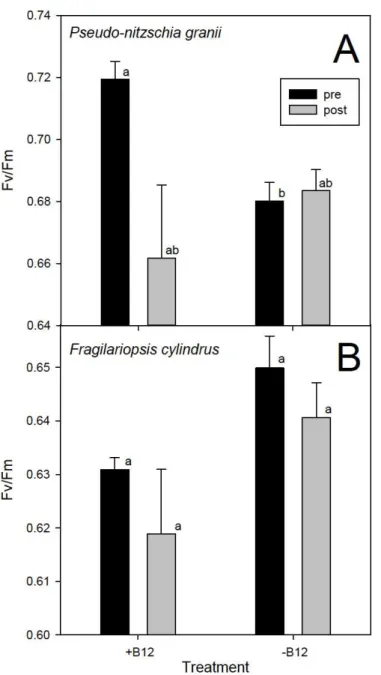
While photosynthetic efficiencies differed significantly between +B12 and –B12
Gene Expression Analysis
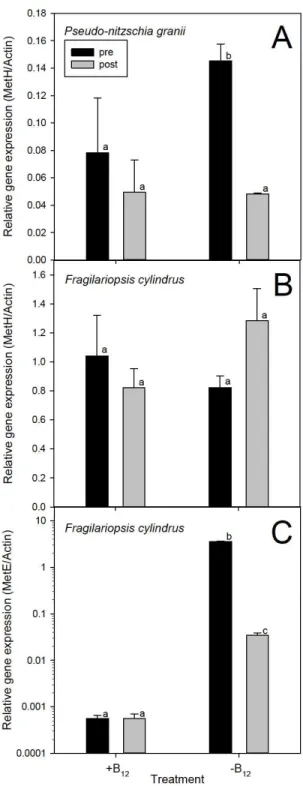
Figure 1.3. Relative gene expression of A) P.granii MetH, B) F. cylindrus MetH and C) F. cylindrus MetE pre and post addback of B12 initially grown with (+B12) and without (-B12) vitamin B12. All genes are normalized to Actin (ACT) transcripts. MetE gene expression is on a log scale. Error bars represent ±1 standard error associated with the mean (n ≥3). Letters
Average expression of MetH/ACT for F. cylindrus was constitutive across all treatments, varying from 0.61±0.02 in –B12 pre addback to 1.5±0.05 in +B12 pre addback (Figure 1.3). There were no significant differences in MetH/ACT expression from pre to post addback in either treatment. While there was no change in relative expression of MetH from pre to post B12 addback in +B12 experiments, a fold change of 0.64 in –B12 experiments infers that MetH was slightly up-regulated (1.5-fold) following B12 addition to B12deficient cells (Figure 1.4).
There was no significant difference between MetE/ACT expression from pre to post addback in +B12 experiments, while there was a significant difference from pre to post addback in –B12 treatments (p = 0.001) (Figure 1.3). The relative expression of MetE in F.cylindrus was 103-fold greater under B12-deficient conditions (Figure 1.4). MetE/ACT average transcript ratios ranged from 0.0004±0.0002 in +B12 post addback to 3.7±0.02 in –B12 pre addback.
Phylogenetic Tree Analysis
represents the amount of divergence between nodes (substitutions/site). Bolidimonas pacifica
was used as the outgroup.
Although there were no consistent groupings with the other diatom classes, including araphid pennates, bi(multi)polar centrics, (Mediophyceae), and radial centrics
(Coscinodiscophyceae), centrics and pennates generally formed distinct clades. Patterns in MetH sequence phylogeny were somewhat consistent with those achieved by 18S rRNA phylogeny (Medlin and Kaczmarska 2004). A full or partial sequence for MetE was identified in 22 of the 91 diatoms with whole genome or transcriptome sequences queried in this study. The presence of MetE within diatoms did not display any phylogenetic relatedness based on current available sequence data.
The MetE phylogenetic tree showed a strong grouping among the diatoms (within
Figure 1.6. Eukaryotic protist MetE sequence phylogenetic tree showing evolutionary grouping of the MetE gene. Diatom species cultured in this study (Chapter 1 and Chapter 2) are in bold. Font colors correspond to groupings according to Parfrey et al. 2010 and Dorrell and Smith 2011. Node labels show percent consensus support for tree arrangement. Branch length
Figure 1.6B. The distribution of diatom species possessing MetE according to current genomic and transcriptomic data. Open circles represent species with MetE, while filled circles represent species with no confirmed MetE gene. Sea-surface nitrate concentrations are denoted in
grayscale, with darker areas corresponding to high nutrient, low chlorophyll (HNLC) areas that are generally Fe-limited. [Credit C. Moreno, unpubl.]
Discussion
Though Pseudo-nitzschia and Fragilariopsis are closely related diatom genera
and succession when the nutrient, such as vitamin B12, is required for one species but not for another.
In 3 of 4 diatom species cultured in this study, the absence of a MetE gene (based on our initial screens of available sequence information) correlated with no growth in the absence of vitamin B12. In the case of the B12-auxotrophic P. granii, growth without B12 resulted in significant up-regulation of the MetH gene. This MetH up-regulation was not observed in F. cylindrus, however, indicating that P. granii may compensate for a methionine deficit through increased MetH expression as seen in previous studies (Bertrand et al. 2012).
Thalassiosira sp. UNC1203 and Skeletonema sp. UNC1201 both ceased growth in AT –B12 cultures, similar to P.granii. However, the severity of the B12 deprivation response differed between species in non-AT medium. While Skeletonema sp. continued growth in non-AT –B12 medium, albeit at reduced rates, P. granii and Thalassiosira sp. could not grow without B12 additions even in the presence of bacteria. Similarly, the Chaetoceros sp. UNC1202 examined in this study grew at reduced rates without vitamin B12 despite evidence of MetE in its gene
repertoire. These trends occurred regardless of whether bacteria were present or substantially reduced after antibiotic treatment, suggesting the bacterial communities present in the medium were not providing a significant supply of B12 to these diatoms. Thus, varying responses to B12 -limitation are more likely a consequence of differences in internal B12 quotas and B12 uptake rates as well as the presence or absence of MetE.
up-regulated far beyond levels of MetH when used. This implies many more MetE enzymes are needed to produce the methionine of one MetH enzyme (Banerjee and Matthews 1990).
This inefficiency may not adversely affect organisms in polar regions where slow-growing diatoms such as F. cylindrus and F. kerguelensis, the other two MetE-possessing diatoms in this study, are primarily found. However the Chaetoceros sp. UNC1202 had a much higher
maximum growth rate than that of the Fragilariopsis species. The lower maximum rate of MetE catalyzation, therefore, could limit Chaetoceros sp. UNC1202 growth rates but be sufficient for
Fragilariopsis species to maintain similar growth rates regardless of B12 supply (O’Brien et al. 2013). Lastly, Chaetoceros sp. UNC1202 could have a higher B12 quota than the other species examined in this study because of variations in less-studied pathways, such as the B12-requiring methylmalonyl-CoA mutase enzymatic pathway (Helliwell et al. 2011).
Although it was not possible to determine steady-state photosynthetic efficiencies for cultures that ceased growth in the absence of B12, variations in photosynthetic efficiencies were observed among other diatom species. For Chaetoceros sp. UNC1202 in particular, Fv/Fm decreased in cultures when B12 was absent from the medium. Vitamin B12 may affect
photosynthetic processes downstream—phylloquinone (vitamin K) is a hypothesized electron carrier in photosystem I and requires S-adenosyl methionine, which is B12-dependent, for its creation (Lohmann et al. 2006). In this case, as was seen within our P. granii addback cultures, growth cessation was most likely responsible for the lowered Fv/Fm values. Alternatively, diatom species could be shifting the dominant electron transfer mechanism in photosystem I from
As demonstrated by this study, vitamin B12 auxotrophy is not confined to pennate or centric diatoms but is instead distributed irrespective of phylogeny across genera. Although P. granii, F. cylindrus, and F. kerguelensis are raphid pennate and Thalassiosira sp., Chaetoceros
sp., and Skeletonema sp. are bi(multi)polar centric diatoms, B12 auxotrophy was found in the pennate P. granii, the centric Thalassiosira sp., and the centric Skeletonema sp. This study’s phylogenetic analysis of diatom MetH sequences supports other broader analyses of B12
limitation in algal groups (Helliwell et al. 2011) by demonstrating a seemingly scattered presence of MetE within a MetH-based tree that is, for the most part, phylogenetically conserved.
Some diatom genera within the tree show either complete MetE absence (e.g. Skeletonema) or presence (e.g. Fragilariopsis). However, within other genera, such as Chaetoceros and
Corethron, some species possess MetE while others seem to not, based on currently available sequence information. As a larger number of diatom genomes and transcriptomes are sequenced, the prevalence of this species-specific MetE possession will be made clearer, but these initial findings suggest that MetE presence/absence is possibly species-specific.
Our results support the hypothesis that diatom species without MetE became auxotrophic for B12 through multiple independent losses of MetE, possibly because they resided in
environments with high B12 concentrations (Helliwell et al. 2011). Perhaps this concept can help provide insights as to whether B12 is present at limiting concentrations in large areas of the ocean—if over half of surveyed algal species are auxotrophic for the nutrient, this may imply adequate concentrations of B12 in large areas of the ocean, either now or in the past (Croft et al. 2005).
zinc requirements by the MetE enzyme and its catalytic inefficiency, MetE expression is likely repressed except when B12 is absent to make the most energetically efficient use of nutrients (Bertrand et al. 2013). When a down-regulated gene is used only episodically, such as in the case of MetE, mutations to the gene under B12-replete conditions would not be strongly selected against, possibly leading to the development of auxotrophic algal species. The MetE tree created in this study is consistent with the theory of MetE acquisition early in diatom evolution, with subsequent losses of the gene as environmental conditions selected against it.
Because of this, our study demonstrates that in the case of vitamin B12 requirements, phylogeny does not predict ecology. Though diatoms such as F. cylindrus and P. granii are closely related, the difference in the presence of an isoform of a single gene can result in the survival of one species and the death of the other. As a consequence, phylogenetic relationships between diatoms are not a good predictor of which species will succeed in areas of the ocean where vitamin B12 availability has been shown to be potentially limiting.
Though transcriptomic information for a larger sample of diatoms is needed to fully analyze whether this MetE phylogeny is biogeographically based, the MetE distribution map indicates that many HNLC species, particularly those in polar regions, possess the MetE gene while coastal species do not. Sanudo-Wilhelmy et al. (2012) found that differences in B12
densities of bacteria and cyanobacteria have also been observed in polar regions (Boyd et al. 2000).
As bacteria and archaea are the ultimate sources of vitamin B12, their presence or absence undoubtedly affects the distribution and concentration of B12 in marine environments. Recent studies have argued that bacterial abundances could influence the response of phytoplankton communities to Fe and B12 additions where B12 becomes limiting after the alleviation of Fe limitation (Bertrand et al. 2007). However, in light of our results, bacterial abundances alone are likely not sufficient to explain the dynamics of B12 limitation. We propose instead that variations in B12 requirements among diatom (and other phytoplankton) species could explain the observed differences in diatom assemblages following B12 and Fe enrichment in HNLC regions.
In the aforementioned study (Bertrand and Saito 2007) a series of three B12/Fe fertilization experiments performed with natural algal assemblages found that the two
are likely affected by the diatom composition as much as they are by variations in bacterial abundances among the experiments.
Vitamin B12 is one nutrient among many, but its potential to be limiting or co-limiting during nutrient enrichments highlights its important role in diatom bloom dynamics. King et al. (2011) stated that under environmental conditions with low B12 concentrations, primary
productivity can be limited by this nutrient. Our study shows that while B12 may limit primary production of a particular diatom species, primary production across the diatom community as a whole may be unaffected as B12 auxotrophs are supplanted by diatoms possessing MetE.
Although bacterial abundances and composition undoubtedly help to determine B12
concentrations, the B12 requirements of the phytoplankton themselves direct how assemblages respond to those concentrations.
CHAPTER 2: THE COEFFECTS OF IRON AND VITAMIN B12 ON THE DYNAMICS OF MARINE IRON FERTILIZATION EVENTS
Introduction
Iron
Iron exists as a variety of chemical species in the marine environment, including inorganic soluble and inorganic insoluble species, dissolved organic complexes, mineral
particles, colloids, and within living cells. The distribution of dissolved Fe is continually changed by the formation of colloidal particles, followed by aggregation into larger particles that sink out of the euphotic zone and thus become lost to phytoplankton use (Moore and Braucher 2008).
At the cellular level, the ability of Fe to exist in different oxidation states means that it is often used as a component of redox reactions within the cell. Iron is particularly important for phytoplankton because of its catalytic role in photosynthesis and respiratory electron transport. It is a crucial part of the cell’s photosynthetic apparatus, particularly photosystems I and II as well as the cytochrome b6f complex, and is found in higher proportions there under Fe limitation (Raven 1988, Greene et al. 1991).
has been transformed by thermal, photochemical, or biological reduction (Hutchins 1995). In addition, the majority of dissolved Fe is bound to organic ligands and bacteria-synthesized compounds called siderophores. Iron bound in this way is kept from oxidizing to Fe(III), but is also difficult for phytoplankton to access (Rue and Bruland 1995).
The flux of Fe into the euphotic zone is highly spatially variable and dependent on a variety of sources. These sources include terrestrial run-off, wind-blown dust, precipitation, deep water upwelling, and anthropogenic inputs (Wetz et al 2006, Klunder et al 2012, Lohan and Bruland 2008, Mahowald et al 2005). In polar regions, glaciers may also be a significant source of Fe to the ocean. As icebergs are discharged from glaciers into open water and begin to melt, the continental debris (including Fe) suspended within them will be discharged into the
surrounding water. Sea ice also serves as a source of Fe to high-latitude areas. The ice surface accumulates Fe-laden dust, and delivers that dust to biological communities in the water beneath as it melts (Raiswell et al. 2008). Because Fe is generally reactive and insoluble, knowing the magnitude and type of Fe flux is important in determining Fe availability to primary producers (Johnson et al 1997).
Vitamin B12
Researchers have long known that most eukaryotic phytoplankton require an outside source of vitamins for use as cofactors in enzyme creation, the most ubiquitous of which are the B vitamins (Sañudo-Wilhelmy et al. 2012). One of these, vitamin B12, has two important
bioavailable forms: adenosylcobalamin and methylcobalamin (Raux et al. 2000). While
cofactor in methyltransferases (Gruber et al. 2011). One isoform of methionine synthase in particular (MetH) has been shown to depend on methylcobalamin as a cofactor in order to catalyze the synthesis of the essential amino acid methionine (Banerjee 1990, Rodionov et al 2003). While some marine algae also possess an alternate form of the enzyme that does not require B12 (MetE), over half of algal species are estimated to only possess MetH (González et al. 1992, Croft et al. 2005). The majority of isolates examined for MetE thus far have been coastal diatoms, begging the question of whether this trend in auxotrophy holds true among oceanic and polar species. A strong correlation between the absence of a functional MetE gene and B12 auxotrophy has been found in a wide range of algal species (Helliwell et al. 2011).
Although vitamin B12 functions mostly as a cofactor for MetH in diatoms, upstream and downstream processes may also be affected when B12 is unavailable to auxotrophic organisms. Folate, vitamin B12, and PLP (vitamin B6) metabolisms are linked in diatoms through a complex series of reactions (Bertrand et al. 2012). Upstream of the point where methionine is synthesized, PLP synthase creates vitamin B6, which is then used along with cytosolic serine
hydroxymethyltransferase (cSHMT) in the reversible conversion of serine and tetrahydrofolate (THF) to glycine and 5,10 methylene THF (Appaji et al. 2003). Tetrahydrofolate is then used in nucleic acid synthesis, while 5,10 methylene THF is irreversibly converted to 5-methyl-THF using methylene-tetrahydrofolate reductase (MTHFR) (Bertrand et al. 2012).
Methionine synthase, either in the form of the B12-dependent MetH or the B12 -independent MetE, is then used to regenerate methionine from homocysteine while
simultaneously turning 5-methyl THF into tetrahydrofolate (Matthews et al. 2003). Without the conversion of 5-methyl THF into tetrahydrofolate, methyl-THF accumulates and “folate
synthesis (Hoffbrand and Weir 2001). Methionine regeneration is an important part of the S-adenosyl methionine (SAM) cycle, as SAM is synthesized from ATP and methionine in two consecutive reactions. The availability of S-adenosyl methionine is important in downstream processes as well, as it functions as a cosubstrate in methyl group transfers (Bertrand and Allen 2012). ThiC, a thiamine biosynthesis protein, is also SAM dependent and has been shown to respond to B12 limitation in algal cultures (Bertrand and Allen 2012).
Methionine and SAM are both required for DMSP production, which is used by some diatoms as a cryoprotectant, osmolyte, or antioxidant. DMSP is also the precursor to
dimethylsulfide, a climatically important gas that may provide the nuclei for cloud condensation (Malin et al 1992). Antarctic diatoms in particular are known to produce relatively large amounts of DMSP, and so their metabolisms may demand more methionine synthase activity (Bertrand et al 2013). The other major enzyme that utilizes vitamin B12 as a cofactor is methylmalonyl-CoA mutase, which catalyzes the isomerization of methylmalonyl-CoA to succinyl-CoA and is used in fatty acid metabolism (Bertrand et al 2012).
The sole source of vitamin B12 to marine organisms is heterotrophic bacteria, archaea, and cyanobacteria, which synthesize this vitamin through a complicated series of over 20 enzymatic reactions. Eukaryotic phytoplankton must therefore obtain all their vitamin B12 from bacterial sources, whether through symbiotic interactions or scavenging after cell lysis (Croft et al 2005, Droop 2007).
concentrations of B12. Cobalt distribution is very likely related to aeolian and riverine sources, meaning that coastal areas are likely to have higher and more sustained cobalt concentrations. This could be a partial explanation for why higher concentrations of vitamin B12 are generally seen in coastal areas (Panzeca et al 2009).
Vitamin B12 concentrations in the ocean are in the picomolar range, and vary widely depending on the environment (Koch et al 2011, Bonnet et al 2013, Panzeca et al 2009). B12 concentrations generally increase poleward and at intermediate depths (Sañudo-Wilhelmy et al 2012). It seems probable that sustained upwelling conditions may contribute to higher B12 concentrations at the ocean’s surface (Panzeca et al 2009, Bonnet et al 2013). Koch et al (2011) found that vitamin B12 concentrations were four times higher in HNLC regions as compared to off-shelf and coastal regions, although opposite trends have been observed in other studies (Sañudo-Wilhelmy et al 2014). Incubation experiments showed that vitamin B12, alone or in conjunction with other primary limiting nutrients such as Fe or nitrate, was able to significantly increase phytoplankton growth rates and influence phytoplankton composition (Koch et al 2011).
Iron and Vitamin B12 Interactions
Fe-B12 interactions in diatoms could be the result of a change in species composition, an increase in vitamin transporters, or an increase in the energy allocated to vitamin transport systems to keep vitamin uptake rates in line with growth rates (Bertrand et al 2011).
Colimitation of vitamin B12 and Fe has been observed on a large scale in areas such as the Southern Ocean (Bertrand and Saito 2007). While B12 alone was not limiting to phytoplankton growth, Fe and B12 additions together increased growth over that of Fe alone. Even when B12 additions do not change rates of primary production, increases in its concentration can alter phytoplankton community composition, enhancing the abundances of primarily B12-auxotrophic groups. Although many diatoms are auxotrophic for B12, fertilization experiments in the Gulf of Alaska found that flagellates outcompete diatoms after B12 addition, creating a phytoplankton community less likely to export carbon than the diatom-dominated communities found after Fe fertilization (Koch et al 2011). However, the addition of both Fe and B12 has the potential to alter these community dynamics even further.
On a cellular level, the C:P and N:P ratios of B12-limited diatoms are significantly lower in comparison with B12-replete cells, particularly at high CO2 concentrations (King et al 2011). Fe-limited diatoms also show lower cellular levels of carbon, nitrogen, and phosphorus (Takeda et al 1998). In addition, cells grown under B12-replete, high CO2 conditions had lower Fe quotas than those grown under low CO2 (King et al 2011). However, another study found no large growth rate differences between Phaeodactylum tricornutum, which possesses MetE, and
Vitamin B12 can affect photosynthetic processes downstream from methionine synthase. Phylloquinone (vitamin K) is an electron carrier in photosystem I and requires S-adenosyl methionine, which is B12-dependent, for its creation (Lohmann et al. 2006). It has previously been suggested that B12 limitation could limit phylloquinone production and impair
photosynthesis, but this effect was only observed physiologically when Fe, another electron carrier, was unavailable (King et al. 2011).
Although vitamin B12 and Fe are not among the classical nutrients required for
phytoplankton growth (namely nitrogen and phosphorus), availability of these micronutrients may interactively affect macronutrient requirements and availability. Creation of MetE requires in a 30-fold increase in nitrogen and 40-fold increase in zinc allocated to methionine synthase activity relative to MetH usage (Bertrand et al 2013). More broadly, Fe is required for the reduction of nitrate to ammonium, both in Fe-containing reductases and the photosynthetic processes that provide energy for the reaction (Takeda et al 1998). In turn, nitrate is utilized in B12 molecules themselves, as well as in enzymes such as methionine synthase that are involved in B12-dependent processes (Banerjee and Ragsdale 2003). Under Fe limitation, diatoms reduce uptake of nitrate and it has been suggested that nitrogen starvation could upregulate pathways that require B12, such as methionine and SAM synthesis (Bertrand and Allen 2012).
molecular level will allow us to better understand the potential for large scale variations in carbon or silica sequestration, nutrient cycling, and phytoplankton community succession and composition in HNLC areas.
In this study, we will compare the responses of diatom species to varying Fe and vitamin B12 availabilities using physiological and molecular techniques. We will grow antibiotic-treated P. granii and G. cf. islandica in a Fe/B12 culture matrix and examine growth rates,
photosynthetic efficiencies, gene expression, and chl a contents per cell. We hypothesize that B12-auxotrophic diatoms, such as P. granii, will have a greater response to Fe/B12 colimitation than limitation of either nutrient alone because of the potential for upstream and downstream processes to be affected. Diatoms with MetE may be stressed further by Fe/B12 colimitation because of a combination of MetE’s higher nitrate requirement and decreased nitrate reductase rates as a result of Fe limitation.
Methods
Algal species
Isolates of two diatom species were examined during this study (Table 1.1). Pseudo-nitzschia granii (UNC1102) (G.R. Hasle) was obtained from Ocean Station Papa (50°00 N, 145°00 W) in the Northeast Pacific Ocean in 2010 (18S Genbank accession number KJ866907) and Grammonema cf. islandica (UBC1301) was also obtained from Ocean Station Papa in 2013.
Medium and culture conditions
All phytoplankton cultures were grown in artificial seawater medium [Aquil] using trace metal clean [TMC] techniques as according to Marchetti et al. (2006). Macronutrients were added to Aquil medium in final concentrations of 300 μmol L-1 NO
For steady-state culturing conditions, refer to the “Medium and culture conditions” section of Chapter 1 of this thesis.
Iron Addback Experiments
Changes in growth and gene expression in response to vitamin B12 and Fe co-limitation, as well as short-term response to Fe addition, were measured for P. granii and Grammonema cf. islandica by growing cultures under AT +/- B12/Fe conditions (+B12/+Fe, -B12/+Fe, +B12/Fe, -B12/-Fe) and performing an addback of Fe to the growth medium. These species were chosen because, in addition to being isolated from the HNLC North Pacific, one (P. granii) is auxotrophic for B12 while the other (G. cf. islandica) possesses MetE. Cultures were grown under similar conditions as described above in modified TMC, 2-L polycarbonate bottles with Teflon tubing to permit subsampling while minimizing contamination. All subsampling was performed under a positive-pressure, laminar-flow hood. A Teflon stir bar was added to each experiment and was incubated on top of a stir plate to ensure the culture remained well mixed. Aquil medium was prepared using the same methodology as described previously and inoculated using steady-state growth cultures. All experiments were inoculated when cultures were in mid-exponential growth phase and, except in the case of B12-limited P. granii and Fe-limited Grammonema cf. islandica treatments, cultures were transferred into the same treatment they were previously acclimated to.
Because P. granii growth ceased after approximately 2 transfers in –B12 medium in both non-AT and AT cultures, +B12 –grown P.granii cultures (18 mL) were used as the inoculum for the –B12/+Fe or –B12/-Fe treatments. A similar procedure was used to grow Fe-limited
lower medium containing a lower Fe concentration (total Fe concentrations of 6.24 nmol L—1 and free ferric Fe concentrations of 10-21.35 mol L-1) to achieve Fe-limited growth. Fluorescence measurements of subsamples were taken from each culture once each day for +Fe treatments, and once every other day for –Fe treatments. Fv/Fm measurements were performed using the same methodology as described in Chapter 1. The length of experiments varied among diatom species and experimental treatments, but was typically between 5-15 days.
When fluorescence measurements indicated that cultures were in late exponential growth phase, 5-mL aliquots were subsampled for Fv/Fm and fluorescence measurements. 450 mL of each culture was then filtered onto a 3.0-μm polycarbonate filter; the filter was immediately frozen in liquid nitrogen, and stored at -80°C until RNA extraction. 50 mL was filtered onto a GF/F filter and stored at -80°C until chlorophyll a analysis, while 200 μL of Lugol’s solution was added to 5 mL of culture to preserve cells for counts.
Gene expression analysis
Primers for qPCR were developed using Primer 3 and tested using PCR, gel
electrophoresis, and PCR product sequencing (Appendix 1). See Chapter 1 for RNA extraction, RT-pcr, and qPCR methods.
Transcript copy numbers were normalized to Actin [ACT] copy numbers from the same cDNA sample. The Actin gene was used as a housekeeping gene for both P. granii and
Grammonema cf. islandica and is a commonly-used housekeeping gene that remains stable under a variety of nutrient regimes (Alexander et al. 2012).
Chlorophyll a and Cell Count Analysis
Cell enumeration was performed for all Fe-resupply cultures, pre and post Fe addition, as well as +Fe culture using an Olympus CKX41 Inverted microscope. Cell counts were determined using a 1-mL Sedgewick-Rafter counting chamber after allowing cells to settle for 5 minutes and counting >300 cells or 30 fields of view.
Chl a was measured using the in vitro fluorometric technique (Parsons et al. 1984). Chl a
concentrations on filters were determined through extraction in 5 ml of 90% acetone at -20°C for 24 hours. Each sample was then diluted 10-fold in 90% acetone and fluorescence was measured before and after acidification on a Turner Designs 10-AU fluorometer. Chl a concentrations were normalized by cell counts to obtain cellular chl a quotas in pg cell-1.
Statistical Analyses
homoscedastic t-tests were also performed to test for significant differences between Fv/Fm and sigma (σPSII) values between treatments. A two-tailed pairwise t-test was performed between the gene expression ratios, Fv/Fm values, and sigma values for Fe-limited and Fe-resupply values for the B12 addback experiments. Two-tailed homoscedastic t-tests were performed between Fe-replete treatments and Fe-limited/resupply treatments.
To reduce technical error, the standard deviation of the mean for each triplicate ratio measurement was <10% of the mean. The level of statistical significance for all tests was p<0.05. All tests were performed in Sigmaplot 12.5 (Systat Software Inc.) and passed the Shapiro-Wilk Normality Test and Equal Variance Test.
Results
Steady-State Growth Rates and Photosynthetic Efficiencies
Figure 2.1. Steady-state growth rates (d-1) for P. granii and G. islandica under varying Fe (+/-Fe) and vitamin B12 (+/-B12) conditions. All treatments were grown with their natural bacterial assemblages (non-AT) and after antibiotic treatment that removed accompanying bacteria (AT).
Similarly, P. granii showed no significant difference in Fv/Fm between AT and non-AT cultures of the same treatment, but Fv/Fm significantly decreased between Fe-replete (+B12/+Fe)
2.2). Photosynthetic cross section (σPSII) values significantly increased between Fe-replete and Fe-limited treatments, but did not significantly change between non-AT and AT cultures within the same treatment (p = 4 × 10⁻³ and p = 6 × 10⁻³) (Figure 2.3).
Figure 2.3. Steady-state sigma values (σPSII) for P. granii and G. islandica under varying Fe (Fe) and vitamin B12 (B12) conditions. All treatments were grown with their natural bacterial
G. islandica, in contrast to P. granii, showed differences in growth rate related to AT treatment between –B12/+Fe treatments (Figure 2.1). Non-AT –B12/+Fe growth rates were significantly higher than when the same treatment was antibiotic-treated (p = 4 × 10⁻⁴). When bacteria were present in Fe-replete treatments, cultures did not grow at significantly different rates. However, AT +B12/+Fe cultures grew significantly faster than their AT –B12/+Fe counterparts (p = 5 × 10⁻⁴).
Both G. islandica non-AT and AT +B12/+Fe cultures and non-AT –B12/+Fe cultures grew significantly faster than all –Fe cultures. However, AT –B12/+Fe cultures did not grow at a significantly different rate (p = 3 × 10⁻³, p = 1 × 10⁻³, and p = 1 × 10⁻⁴, respectively). Changes in Fv/Fm between G. islandica treatments were less substantial than for P. granii, perhaps due to differences in how the taxa respond to Fe limitation (Suggett et al. 2009) (Figure 2.2). There were no significant differences in response between non-AT and AT G. islandica
cultures in the same treatment except in the case of +B12/-Fe cultures, for which Fv/Fm decreased significantly upon removal of bacteria (p = 0.02). Both non-AT and AT –B12/-Fe cultures had significantly lower Fv/Fm values than their respective –B12/+Fe counterparts (p = 7 × 10⁻⁴ and p = 4 × 10⁻⁴). σPSII values significantly decreased upon removal of bacteria from non-AT –B12/+Fe cultures (p = 5 × 10⁻³), and increased under –B12 conditions regardless of Fe status in non-AT cultures (p = 6 × 10⁻³, 9 × 10⁻⁴). In contrast, AT +B12/-Fe and AT –B12/-Fe cultures had significantly higher σPSII values than their non-AT counterparts (p = 0.04 and p = 0.049).
Fe-Resupply Experiments
P. granii cultures that were both B12 and Fe-replete grew exponentially and at a higher growth rate throughout all treatments than nutrient-limited cultures. Fe-limited P. granii cultures, both B12-replete and B12-limited, responded to Fe-resupply through a decrease in growth rate. In contrast, G. islandica +B12 and –B12 cultures grew at similar rates to their +Fe or –Fe
counterparts, and –Fe cultures had no noticeable growth response to Fe-resupply.
Photosynthetic efficiencies did not differ significantly between Fe-replete, +B12 and –B12 treatments for either P. granii or G. islandica (Figure 2.5). Both species showed significantly decreased Fv/Fm values for Fe-limited treatments relative to Fe-replete treatments, regardless of B12-limitation status (p = 5 × 10⁻³ and p = 3 × 10⁻³ for P. granii +B12 and –B12, p = 3 × 10⁻³ for G. islandica –B12). While P. granii Fv/Fm for –Fe treatments increased significantly upon Fe
addition (p = 4 × 10⁻⁵ for +B12, p = 0.01 for –B12), G. islandica –B12/-Fe cultures did not respond significantly to Fe addition. Significance for +B12/-Fe G. islandica cultures could not be
Figure 2.6. Photosynthetic cross sectional area (σPSII) comparisons pre and post addback of Feto Fe-limited P. granii and G. islandica cultures grown with (+B12) and without (-B12) vitamin B12. Error bars represent ±1 standard error associated with the mean (n=3). Letters indicate
statistically different groupings (p<0.05).
Gene Expression Analysis
limitation (-B12/+Fe) relative to nutrient-replete cultures (+B12/+Fe) (p = 7 × 10⁻³). Significance of vitamin B12 and Fe colimited cultures could not be determined because of a lack of
Expression patterns for G. islandica MetH/ACT differed from that of P. granii in that nutrient limitation decreased relative expression rather than increasing it (Figure 2.7B). Expression ratios ranged from 0.56 ± 0.17 for +B12/+Fe cultures to 0.041 ± 0.02 for –B12/-Fe cultures. MetH/ACT expression decreased under vitamin B12 limitation (-B12/+Fe) and Fe limitation (+B12/-Fe) compared to replete cultures (+B12/+Fe). However, MetH/ACT decreased further upon Fe resupply to +B12/-Fe cultures. The lowest expression levels were seen in vitamin B12 and Fe colimited cultures, both before and after Fe resupply. These MetH/ACT ratios were lower than those of replete cultures, as well as cultures limited by vitamin B12 alone.
MetE/ACT in G. islandica ranged from 0.95 ± 0.52 in –B12/+Fe treatments to 0.0005 in +B12/-Fe post Fe resupply (Figure 2.7C). Expression was higher in Fe-replete, B12-limited cultures than in cultures replete with both nutrients. Expression was highly downregulated in cultures experiencing solely Fe limitation (+B12/-Fe) compared to nutrient replete cultures
(+B12/+Fe), both pre and post Fe resupply. Expression of MetE/ACT was increased in B12 and Fe colimited cultures, both pre and post Fe resupply, but was not higher than when B12 alone was limiting.
Chlorophyll a quota analysis
Discussion
In Chapter 1, we demonstrated that the presence or absence of a single gene, MetE, determines whether diatom species are auxotrophic for vitamin B12. However, algae rely on more than just B12; they are entwined in a web of biotic and abiotic interactions that can alter their nutrient requirements and relative fitness. Another one of these factors is Fe, which limits
primary production in large areas of the world’s oceans (Watson et al. 1995). Vitamin B12 can be intermittently colimiting in these HNLC regions, and by examining the intersection of these nutrient requirements we can develop a more complete understanding of how their availability can affect community succession during diatom blooms.
This study shows that although both Fe and vitamin B12 can affect diatom growth, photosynthetic health, and chlorophyll a content, there is little to suggest that colimitation acts synergistically. It is only in gene expression patterns of MetH and MetE that any Fe-B12
colimitation effect may be indicated. Whether these gene expression patterns result in differences in competitive ability between different diatoms under Fe-B12 colimitation requires further research.
chlorophyll a content, which is also consistent with the results of this study (Davey and Geider 2001).
Generally, the presence or absence (non-AT and AT treatments) of bacteria in steady-state cultures did not significantly affect photosynthetic efficiencies. However, B12-replete and Fe-limited G. islandica did not demonstrate a significant reduction in Fv/Fm until after antibiotic treatment (AT). Likewise, under Fe-limitation, G. islandica sigma (σPSII) did not increase until cultures were treated with antibiotics to remove bacteria. In this case, bacteria may be facilitating photosynthetic health in an Fe-specific way, possibly related to siderophore excretion and usage (Amin et al. 2012).
While Fe had similar effects on P. granii and G. islandica, the effects of B12-limitation were more varied. Presence or absence of the culture’s natural bacterial assemblages did not significantly impact steady-state growth rates except in the case of B12-limited, Fe-replete G. islandica, in which growth rates decreased by half once bacteria were removed. This is
consistent with previous studies, which have shown that phytoplankton must obtain their vitamin B12 from exogenous bacterial and archaeal sources (Croft et al. 2005), and in their absence must utilize MetE to continue growth.
therefore likely that B12-synthesizers in the culture would eventually be outcompeted by auxotrophs (Helliwell et al. 2015).
Although B12 status did not significantly affect photosynthetic efficiencies, B12-limitation decreased chl a content of affected cells. This phenomenon, called chlorosis, is a common symptom of nutrient deficiency and this study’s findings show that B12-deficiency causes similar effects as other nutrients (Doucette and Harrison 1990, Greene et al. 1991, 1992). It has
previously been hypothesized that B12 and Fe could interact within the photosynthetic apparatus through phylloquinone (vitamin K), an electron carrier in photosystem I that requires
S-adenosylmethionine (which is B12-dependent) for its creation. Vitamin B12 limitation was observed to impair photosynthesis when Fe was not available (Lohmann et al 2006, King et al 2011). However, none of the variables examined in this study demonstrated a combined Fe and B12 effect on photosynthetic processes.
Iron and B12 limitation separately decreased the chl a content of cells, and 24 hours after Fe resupply these cultures had not reached chl a concentrations of nutrient replete cultures. In addition, Fe-limited P. granii cultures showed decreased growth rates 24 hours after Fe resupply, indicating that cell division rates had not yet started to increase in response to Fe addition.