The Journal of Infectious Diseases
M A J O R A R T I C L E
Phase 2 Study of the Safety and Tolerability of
Maraviroc-Containing Regimens to Prevent HIV Infection in Men
Who Have Sex With Men (HPTN 069/ACTG A5305)
Roy M. Gulick,1Timothy J. Wilkin,1Ying Q. Chen,2Raphael J. Landovitz,4K. Rivet Amico,7Alicia M. Young,2Paul Richardson,8Mark A. Marzinke,9 Craig W. Hendrix,9Susan H. Eshleman,8Ian McGowan,13Leslie M. Cottle,2Adriana Andrade,9Cheryl Marcus,15Karin L. Klingman,11Wairimu Chege,12 Alex R. Rinehart,16James F. Rooney,5Philip Andrew,17Robert A. Salata,18Manya Magnus,19Jason E. Farley,10Albert Liu,6Ian Frank,14Ken Ho,13 Jorge Santana,21Joanne D. Stekler,3Marybeth McCauley,20and Kenneth H. Mayer221
Department of Medicine, Weill Cornell Medicine, New York;2
Statistical Center for HIV/AIDS Research and Prevention, Fred Hutchinson Cancer Research Center, and3
Department of Medicine, University of Washington, Seattle;4Department of Medicine, University of California, Los Angeles,5Gilead Sciences, Foster City, and6Bridge HIV, San Francisco Department of Public Health, California; 7
Department of Health Behavior and Health Education, School of Public Health, University of Michigan, Ann Arbor;8
Department of Pathology,9
Department of Medicine, Johns Hopkins University School of Medicine,10
Johns Hopkins University School of Nursing, Baltimore,11
HIV Research Branch, and12
Clinical Prevention Research Branch, Prevention Sciences Program, Division of AIDS, National Institute of Allergy and Infectious Diseases, National Institutes of Health, Bethesda, Maryland;13
Department of Medicine, University of Pittsburgh School of Medicine, and14
Department of Medicine, Perelman School of Medicine of the University of Pennsylvania, Philadelphia;15Department of Medicine, University of North Carolina, Chapel Hill,16ViiV Healthcare and17FHI 360, Durham, North Carolina;18
Department of Medicine, Case Western Reserve University, Cleveland, Ohio;19
Department of Epidemiology and Biostatistics, Milken Institute School of Public Health, George Washington University, and20
FHI 360, Washington, DC;21
Department of Medicine, University of Puerto Rico School of Medicine, San Juan; and22
Fenway Health, Department of Medicine, Beth Israel Deaconess Medical Center/Harvard Medical School, Boston, Massachusetts
Background. Maraviroc (MVC) is a candidate for human immunodeficiency virus (HIV) pre-exposure prophylaxis.
Methods. Phase 2 48-week safety/tolerability study was conducted, comparing 4 regimens: MVC alone, MVC plus emtricitabine (FTC), MVC plus tenofovir disoproxil fumarate (TDF), and TDF plus FTC. Eligible participants were HIV-uninfected men and transgender women reporting condomless anal intercourse with≥1 HIV-infected or unknown-serostatus man within 90 days. At each visit, assessments, laboratory testing, and counseling were done. Analyses were intention to treat.
Results. Among 406 participants, 84% completed follow-up, 7% stopped early, and 9% were lost to follow-up; 9% discontinued their regimen early. The number discontinuing and the time to discontinuation did not differ among study regimens (P= .60). Rates of grade 3–4 adverse events did not differ among regimens (P= .37). In a randomly selected subset, 77% demonstrated detectable drug concentrations at week 48. Five participants acquired HIV infection (4 MVC alone, 1 MVC + TDF; overall annualized inci-dence, 1.4% [95% confidence interval, .5%–3.3%], without differences by regimen;P= .32); 2 had undetectable drug concentrations at every visit, 2 had low concentrations at the seroconversion visit, and 1 had variable concentrations.
Conclusions. MVC-containing regimens were safe and well tolerated compared with TDF + FTC; this study was not powered for efficacy. Among those acquiring HIV infection, drug concentrations were absent, low, or variable. MVC-containing regimens may warrant further study for pre-exposure prophylaxis.
Clinical Trials Registration. NCT01505114.
Keywords. HIV; PrEP; men who have sex with men (MSM); maraviroc; phase 2 clinical trial.
New human immunodeficiency virus (HIV) infections contin-ue to occur and disproportionately affect men who have sex with men (MSM) [1]. HIV pre-exposure prophylaxis (PrEP) with coformulated tenofovir disoproxil fumarate (TDF) plus emtricitabine (FTC) was associated with a 44% reduction in the rate of HIV acquisition in MSM in the iPrEx study [2]. Ran-domized efficacy studies reported in 2015 demonstrated that
TDF + FTC was associated with an 86% reduction in HIV ac-quisition in MSM when prescribed daily in the PROUD study [3] or when taken on-demand in the intervention preventive de l’exposition aux risque avec et pour les gays (IPERGAY) study [4]. Current guidelines recommend daily oral HIV PrEP for high-risk individuals [5,6].
Although effective, in prior studies PrEP with TDF + FTC was associated with gastrointestinal adverse effects in up to 18% of study participants [2,7–9] and decreased renal function in up to 18% [4,10–12] and with a small, but statistically signifi -cant, loss of bone mineral density [8,13,14]. In addition, drug resistance developed in some participants with unsuspected acute HIV infection randomized to TDF-based PrEP in the iPrEx [2] and Partners PrEP studies [7,15] and rarely, in on-study participants in Partners PrEP [15]. Given that TDF + FTC is recommended among initial HIV treatment options [16,17], Received 11 September 2016; accepted 24 October 2016; published online 2 November 2016.
Presented in part: Conference on Retroviruses and Opportunistic Infections; Boston, Massa-chusetts; 22–25 February 2016. Abstract 103.
Correspondence: R. M. Gulick, Division of Infectious Diseases, Box 125, Weill Cornell Med-icine, 1300 York Ave, New York, NY 10065 ([email protected]).
The Journal of Infectious Diseases®
2017;215:238–46
increased drug resistance linked to the use of TDF + FTC PrEP could compromise HIV treatment. Increased drug resistance also could compromise the efficacy of TDF + FTC as PrEP [18]. For these reasons, alternative PrEP regimens are needed.
Maraviroc (MVC) is a CCR5 antagonist HIV entry inhibitor that was approved for treatment of HIV infection based on the results of randomized clinical trials in HIV-infected, treatment-experienced participants that demonstrated safety, tolerability, and virologic efficacy [19]. MVC is active against R5 (CCR5-tropic) HIV, which is associated with the majority of acute HIV transmissions [20] and has several favorable properties for an HIV PrEP agent; MVC is concentrated 8–26-fold higher in the rectum compared with plasma [21]. It is prescribed infre-quently for HIV treatment [16]. Preclinical efficacy of oral MVC for HIV prevention was demonstrated in a humanized mouse model [22], although other preclinical studies did not demon-strate protection [23,24]. MVC was generally safe in HIV-in-fected individuals for ≥5 years without associated renal toxicity [25] and was associated with less bone loss than TDF in a comparative study of HIV-infected individuals [26]. Finally, MVC was generally well tolerated in a 12-week pilot study of HIV-uninfected participants with rheumatoid arthritis [27]. Based on these characteristics, we sought to study the safety and tolerability of MVC-containing HIV PrEP regimens.
METHODS
Study Design and Participants
This was a prospective, randomized, double-blinded, multicen-ter study of 4 antiretroviral regimens in at-risk, HIV-uninfected men and transgender women who have sex with men. It was conducted in the United States, sponsored by the Division of AIDS (DAIDS) of the US National Institutes of Health through the HIV Prevention Trials Network (HPTN), and cosponsored by the AIDS Clinical Trials Group.
Eligible participants were born male,≥18 years old, and self-reported condomless anal intercourse with≥1 man known to be HIV-infected or of unknown HIV serostatus within 90 days before study entry. Eligible participants had adequate base-line safety laboratory results, including a calculated creatinine clearance ≥70 mL/min (Cockcroft-Gault), a nonreactive HIV antibody test (tested at the site with the local standard-of-care assay and subsequently confirmed at the HPTN Laboratory Center with the ARCHITECT HIV Ag/Ab Combo [ fourth-generation assay], Abbott Laboratories), and a plasma HIV RNA level below detection within 14 days of study entry. Par-ticipants were excluded if they used any antiretroviral drug within 90 days (eg, for PrEP or postexposure prophylaxis [PEP]), reported active injection drug use, or had a reactive HIV test or positive hepatitis B surface antigen. The study was reviewed and approved by the institutional review boards at each of the participating sites; all participants provided writ-ten informed consent.
Randomization and Masking
Eligible participants were enrolled and randomly assigned with equal probability to receive 1 of 4 antiretroviral regimens: (1) MVC (Selzentry; ViiV Healthcare); (2) MVC plus FTC, (Emtriva; Gilead Sciences); (3) MVC plus TDF (Viread; Gilead Sciences); or (4) TDF plus FTC (control arm). Doses of the study drugs were as follows: MVC, 300 mg; FTC, 200 mg; and TDF, 300 mg; and the study regimen consisted of 3 pills, includ-ing matchinclud-ing placebos, taken together orally once daily.
The computerized randomization method was developed, implemented, and monitored by the Statistical Center for HIV/AIDS Research and Prevention (Fred Hutchinson Cancer Research Center, Seattle), and it was stratified by site using block randomization with a block size of 12, such that approximately equal numbers of participants were assigned to each arm within each site. The site pharmacist received the randomized treat-ment assigntreat-ment. All other site staff and investigators were blinded to the randomization assignments until completion of follow-up.
Procedures
After enrollment and randomization, participants were seen at weeks 2, 4, and 8 and then every 8 weeks through week 48. Study drugs were discontinued at week 48, and afinal visit was con-ducted at week 49. At each visit, interval history, targeted phys-ical examination, safety laboratory tests, blood plasma stored for drug concentration measurements, adherence assessments, risk-reduction counseling, condom distribution, and HIV test-ing were conducted and study drugs were dispensed. Fasttest-ing lipid levels were measured at baseline and at weeks 24 and 48. Adherence support was provided at each visit through counsel-or-guided discussions.
Testing for sexually transmitted infections (chlamydia and gonorrhea nucleic acid testing of urine and rectal swab samples and syphilis serology) was done at entry and weeks 16 or 24 and 40 or 48 and when an individual reported consistent symptoms; participants were referred for treatment. Participants were eval-uated at each visit for HIV exposure; those who requested PEP for HIV exposure were referred locally. Participants who started PEP were instructed to hold study medications and undergo re-peated HIV testing≥14 days after completing PEP; if HIV neg-ative, they could resume their study regimen.
liquid chromatographic–tandem mass spectrometric methods, with assay limits of quantitation of 0.5 ng/mL for MVC and 0.3 ng/mL for FTC and TFV [28,29]. Additional testing was performed for participants with confirmed HIV seroconver-sion; this included HIV RNA level, CD4 cell count, anti-retroviral drug concentration testing, drug resistance (PhenoSense GT; Monogram Biosciences), and viral tropism testing (Trofile; Monogram Biosciences).
Drug Interaction Substudy
Thefirst 72 participants (18 per study arm) who consented par-ticipated in a substudy to evaluate drug interactions between MVC, TFV, and FTC. These participants were reminded not to take study medications the morning of their week 2 visit. Par-ticipants had a blood sample collected before drug dosing (steady-state trough concentration), underwent directly ob-served study drug dosing, and then had another blood sample drawn approximately 6 hours after the observed dose. MVC concentrations in the MVC + FTC and MVC + TDF arms were compared with those in the MVC-alone arm.
Outcomes
The primary outcome was safety and tolerability of the study regimens. Safety was assessed by the investigators as the occur-rence of grade 2 (moderate), 3 (severe), or 4 (life-threatening) adverse events [30]. Tolerability was assessed as the proportion of participants who permanently discontinued study drugs and the time to permanent study drug discontinuation through 48 weeks of follow-up. Secondary outcomes included drug-drug interactions and adherence assessed by detectable plasma drug concentrations. Plasma drug concentrations were reported as detectable above the limit of quantitation (all study drugs in the regimen detected) or not. HIV testing was conducted at each visit and whenever HIV infection was suspected; additional testing was performed at the HPTN Laboratory Center to
con-firm cases of HIV infection.
Statistical Analysis
The planned enrollment was 400 participants (100 per arm) with an assumed 5% loss-to-follow-up rate. The length of the study was estimated at approximately 2 years, with 9 months for accrual and 12-month follow-up of each participant. This sample size was selected to provide sufficient power to detect differences between arms for the tolerability end point (the time to permanent discontinuation of study drugs), and to pro-vide estimates for the true safety end point (occurrence of grade 3 or 4 or higher adverse events through 48 weeks). With the sample of 100 participants per arm, if the true safety adverse event rate was 20%, the estimate would have 95% confidence in-tervals (CIs) of 12%–28%. The power to detect differences for the tolerability end point was 72% for TDF + FTC versus each of the 3 individual MVC-containing arms when the true hazard ratio is 2.0 and the incidence rate is 30%.
Primary data analysis was performed for all enrolled partici-pants on an intention-to-treat basis. Person-year analysis was performed to summarize and compare the rates of grade 3 or 4 or higher adverse events between any 2 arms. Kaplan–Meier estimates were calculated to summarize the distribution of per-manent treatment discontinuation. Analyses of detectable study drug concentrations were performed on a randomly selected subset of week 24 and 48 plasma samples.
Summary statistics were calculated in proportions, means, or event rates in person-years, depending on the variable being bi-nary, continuous, or count, respectively. Theχ2test was used to compare permanent study drug discontinuation rates, and the log–rank test was used to compare times to permanent study drug discontinuation between any 2 study arms and among the 4 arms. HIV incidence was calculated using the exact meth-od for Poisson counts. Differences were considered statistically significant atP≤.05. The study was reviewed biannually by an independent study monitoring committee of the HPTN, and it was registered at clinicaltrials.gov (NCT01505114).
RESULTS
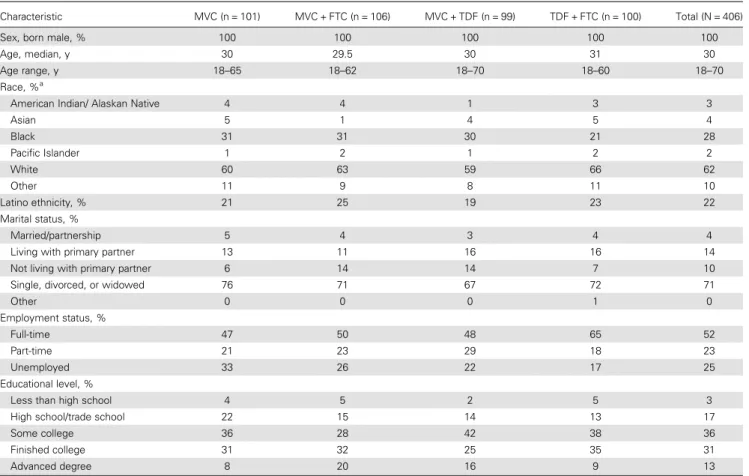
A total of 406 participants were enrolled in the study between July 2012 and April 2014 and randomized to 1 of 4 study reg-imens (Figure1); all but 2 started study drugs, 1 each random-ized to MVC + FTC and MVC + TDF. The study population was 100% male at birth, including 7 (2%) who self-identified as female, transsexual, or transgender, with a median age of 30 years (Table1). Study participants were 28% black, 22% La-tino (of any race), and 62% white; 30% were younger than 26 years. Demographic characteristics were balanced between the study arms. During screening, before enrollment, 31 (8%) of the study participants had a total of 34 sexually transmitted in-fections diagnosed: chlamydia in 15 (4%), gonorrhea in 5 (1%), and syphilis in14 (3%).
Among the 72 participants in the drug interaction substudy at week 2, the predose (trough) MVC plasma concentrations did not differ significantly among the MVC-alone, MVC + FTC, and MVC + TDF arms in pairwise comparisons after Bonferro-ni correction (allP> .05). There were no significant differences in 6-hour postdose or 6-hour predose MVC concentrations (P= .64 and .74, respectively). In a randomly selected subset of 160 participants across the 4 study arms, detectable study drug(s) were documented in 83% of plasma samples at week 24 and 77% at week 48, without significant differences among the arms (week 24,P= .72; week 48,P= .39). Participants re-ported at both 24 and 48 weeks that they took a median of 95% of their study medications as recommended, without dif-ferences among the study arms.
Fifty-five participants experienced a total of 67 grade 3 or 4 adverse events; there was no difference among the 4 study reg-imens in the occurrences or rates of these events (P= .37; Table2). Rates of selected gastrointestinal and renal grade 2–4 adverse events were also similar among the study regi-mens (Table2). Overall creatinine clearance decreased a me-dian 4% from baseline to week 48, without differences among the study arms (P= .60). During study follow-up, 89 partici-pants (22%) had a total of 114 sexually transmitted infections diagnosed: chlamydia in 48 (12%), gonorrhea in 42 (11%), and syphilis in 24 (6%), without differences among the study arms.
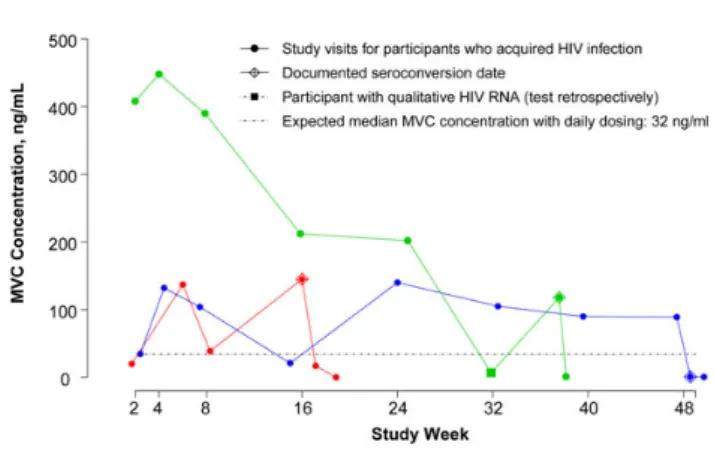
The overall annualized incidence of HIV was 1.4% (95% CI,.5%–3.3%); HIV incidence in the individual study arms was as follows: MVC alone, 4.5% (95% CI, 1.2%–11.6%); MVC + FTC, 0% (0%–4.0%); MVC + TDF, 1.1% (0.003%– 6.0%); and TDF + FTC, 0% (0%–4.0%) (P= .32; Figure 3). Four of these 5 participants had the wild-type CCR5 gene, and 1 was heterozygous for the CCR5-Δ32 deletion. At the visit when HIV seroconversion was documented, HIV RNA levels ranged from 981 to 122 150 copies/mL, and CD4 cell counts from 294 to 828 cells/mm3. All 5 participants had R5 (CCR5-tropic) HIV without genotypic substitutions asso-ciated with antiretroviral drug resistance; 1 of 5 of the viral strains demonstrated modestly decreased phenotypic suscept-ibility to nelfinavir (5-fold) and ritonavir (3-fold) owing to polymorphisms. Of the 5 participants who acquired HIV in-fection, 2 had undetectable plasma drug levels at every study visit (1 randomized to MVC alone and 1 to MVC + TDF). The 3 others, who were randomized to MVC alone, had MVC levels of 0.7, 6.7, and 145 ng/mL at the seroconversion visit (Figure4). The expected predose, steady-state geometric mean plasma concentration of MVC dosed at 300 mg/d is 32 ng/mL [31].
DISCUSSION
In this phase 2, prospective, randomized, double-blinded mul-ticenter study, we showed that MVC-containing regimens were generally safe and well tolerated compared with the control reg-imen of TDF + FTC when assessed for use as HIV PrEP in a population of at-risk men and transgender women who have sex with men. The rates of grade 3/4 and specific adverse events of interest, including gastrointestinal adverse effects, hypophos-phatemia, and increased creatinine, were similar among the study arms. It is critical that preventive medications be safe and well tolerated with few attributable adverse effects. TDF is afirst-line drug for the treatment of HIV infection, whereas MVC is infrequently used for treatment [16]. With demonstrat-ed comparable safety and tolerability to the standard-of-care regimen in the current study, MVC-containing regimens may warrant further study as an alternative strategy for HIV PrEP.
Adherence is critical for HIV PrEP efficacy [32,33]. The iPrEx study reported 51% adherence in the subgroup of MSM who did not acquire HIV infection during the study [2]. Nota-bly, IPrEx was blinded, placebo controlled, and conducted at a time when HIV PrEP was an unproven strategy, which could Table 1. Baseline Characteristics of the Study Participants
Characteristic MVC (n = 101) MVC + FTC (n = 106) MVC + TDF (n = 99) TDF + FTC (n = 100) Total (N = 406)
Sex, born male, % 100 100 100 100 100
Age, median, y 30 29.5 30 31 30
Age range, y 18–65 18–62 18–70 18–60 18–70
Race, %a
American Indian/ Alaskan Native 4 4 1 3 3
Asian 5 1 4 5 4
Black 31 31 30 21 28
Pacific Islander 1 2 1 2 2
White 60 63 59 66 62
Other 11 9 8 11 10
Latino ethnicity, % 21 25 19 23 22
Marital status, %
Married/partnership 5 4 3 4 4
Living with primary partner 13 11 16 16 14
Not living with primary partner 6 14 14 7 10
Single, divorced, or widowed 76 71 67 72 71
Other 0 0 0 1 0
Employment status, %
Full-time 47 50 48 65 52
Part-time 21 23 29 18 23
Unemployed 33 26 22 17 25
Educational level, %
Less than high school 4 5 2 5 3
High school/trade school 22 15 14 13 17
Some college 36 28 42 38 36
Finished college 31 32 25 35 31
Advanced degree 8 20 16 9 13
Abbreviations: FTC, emtricitabine; MVC, maraviroc; TDF, tenofovir disoproxil fumarate.
a
have adversely affected adherence. The more recent IPERGAY study reported detectable plasma drug concentrations in 82%– 86% of thefirst 113 men enrolled and went on to demonstrate
86% efficacy in decreasing HIV infection [4]. In addition, of note in the iPrEx [2] and IPERGAY [4] studies, men who had more frequent condomless anal sex tended to be more adherent. Table 2. Adverse Events
Event MVC (n = 101)
MVC + FTC (n = 106)
MVC + TDF (n = 99)
TDF + FTC (n = 100)
Total
(N = 406) PValue
Permanent study drug discontinuations, No. (%) of participants
7 (7) 9 (9) 12 (12) 8 (8) 36 (9) .60 (χ2
Test)
Time to permanent study drug discontinuation, median (IQR), d
120 (74–263) 66 (42–222) 113 (42–260) 67 (34–141) 87 (45–210) .60 (Log–rank test)
Grade 3–4 adverse events, No. of participants; No. of events
13; 15 11; 15 11; 14 20; 23 55; 67 .37 (Likelihood
ratio test)
Grade 3 events, No. Related to study druga,b
2 2 4 9 17 . . .
Unrelated to study druga
11 10 7 13 41 . . .
Grade 4 events, No.
Related to study druga
0 0 0 0 0 . . .
Unrelated to study druga
2 3 3 1 9 . . .
Grade 3–4 adverse event rate, per person-year (95% CI)
0.17 (0.09–0.28) 0.16 (0.09–0.27) 0.17 (0.09–0.28) 0.25 (0.16–0.38) 0.19 . . .
Selected adverse events (grade 2–4), %c
Diarrhea 3 8 7 4 5 . . .
Nausea 0 1 4 4 2 . . .
Vomiting 0 0 1 1 0.5 . . .
Unintentional weight loss 0 2 2 1 1 . . .
Hypophosphatemia 18 10 16 22 17 . . .
Increased creatinine 0 1 0 0 0.25 . . .
Abbreviations: CI, confidence interval; MVC, maraviroc; FTC, emtricitabine; IQR, interquartile range; TDF, tenofovir disoproxil fumarate.
a
The study investigator assessed the relationship of adverse event to study drug.
b
Grade 3 adverse events related to the study drug included the following: MVC, aspartate aminotransferase [AST] increase and hypophosphatemia; MVC + FTC, hyperlipidemia and hypophosphatemia; MVC + TDF, AST increase, hypophosphatemia [2]; TDF + FTC, alanine aminotransferase increase [2], AST increase, hypersensitivity reaction, hypophosphatemia [4], and neutrophil count decreased.
c
All events listed are grade 2 with the exception of hypophosphatemia, which included 2 grade 3 events.
In our study conducted at a time when HIV PrEP was known to significantly reduce the risk of HIV infection, our at-risk partic-ipants had study drugs detected in >75% of plasma samples tested, suggesting high adherence, although simply detecting antiretroviral drugs is not the same as documenting target drug concentrations.
Prior drug interaction studies conducted in HIV-uninfected volunteers demonstrated the lack of effects of MVC on the pharmacokinetics of nucleoside reverse-transcriptase inhibi-tors, including zidovudine, lamivudine, and TFV [34]. There were no available data on the interaction of MVC and FTC. We confirmed that there were no significant interactions be-tween MVC and TDF or bebe-tween MVC and FTC.
Prior preclinical studies explored MVC for prevention of HIV acquisition, and found variable outcomes. Neff et al [22] used a humanized mouse model given MVC orally daily for 7 days with a vaginal HIV challenge on day 4 and reported pro-tection against HIV infection. In contrast, Massud et al [23]
used a macaque model given an oral MVC dose 24 hours before rectal exposure and found that 5 of 6 animals acquired simian/ human immunodeficiency virus infection by thefifth rectal challenge despite achieving target drug levels. Of note, MVC disassociates 10 times more rapidly from the macaque CCR5 re-ceptor compared with the human CCR5 rere-ceptor [35]. Coll et al [24] tested single-dose MVC in human subjects and assessed HIV infectability ex vivo using a rectal tissue explant model, and found a minimal reduction in HIV infection. The investi-gators attributed this to the loss of approximately 60% of MVC from the biopsy tissue into the culture medium in thefirst hour and of >90% loss of MVC following overnight incubation. These data suggest that animal and ex vivo models may Table 3. HIV Infections
Participant Age,
y
HIV Risk Group
Race/
Ethnicity Study Arm
1st Reactive HIV Test, Study wk
HIV RNA, Copies/ mL
HIV Tropism
Genotypic Drug Resistance
CD4 Cell Count, Cells/
mm3
/%
Study Drug Concentration at
Seroconversion Study Visit, ng/mLa
1 20 MSM Black MVC + TDF 9 122 150 R5 None 357/25 MVC: 0; TFV: 0
2 61 MSM Asian MVC 16 981 R5 Noneb
294/20 MVC: 145
3 21 MSM Mixed
race
MVC 28 106 240 R5 None 325/23 MVC: 0
4 35 MSM White MVC 38 13 626 R5 None 828/38 MVC: 6.7
5 36 MSM Black MVC 48 52 191 R5 None 804/40 MVC: 0.7
Abbreviations: HIV, human immunodeficiency virus; MSM, men who have sex with men; MVC, maraviroc; TDF, tenofovir disoproxil fumarate; TFV, tenofovir.
a
Concentrations were reported as detectable or not detectable with the following limits of detection: MVC, 0.5 ng/mL; FTC and TFV, 0.3 ng/mL. The expected predose, steady-state geometric mean concentration with MVC dosed at 300 mg/d is 32 ng/mL [31].
b
Participant 2 was infected with a viral strain that demonstrated 5- and 3-fold reduced phenotypic susceptibility to the HIV protease inhibitors nelfinavir and ritonavir, respectively; all other participants had no reduced phenotypic susceptibility.
Figure 3. Estimated incidence of human immunodeficiency virus (HIV) infection by study arm, calculated using the exact method for Poisson counts. The overall HIV incidence was 1.4% (95% confidence interval [CI], .5%–3.3%), without differences among the study arms (P= .32). Abbreviations: FTC, emtricitabine; MVC, maraviroc; TDF, tenofovir disoproxil fumarate.
have limitations in predicting the clinical efficacy of MVC-containing regimens for HIV PrEP.
Five study participants acquired HIV infection during our study: 4 randomized to MVC alone and 1 to MVC + TDF. All had R5 (CCR5-tropic) HIV, without evidence of X4 (CXCR4-tropic) virus, and no participant demonstrated drug resistance as assessed with conventional genotypic testing. Notably, 2 of the 5 participants who acquired HIV infection had no detect-able study drugs at any visit, and 2 others had MVC plasma concentrations below the expected steady-state concentration at HIV seroconversion. The single participant with an expected MVC concentration documented at the seroconversion visit had concentrations consistent with less than daily dosing for half of his visits, suggesting inconsistent adherence. The similar distribution of new sexually transmitted infections among the study arms suggests that sexual behavior did not differ among the groups. Our phase 2 study was not designed to detect a dif-ference in HIV incidence among the study arms, and no defi n-itive conclusions about comparative efficacy can be made.
There are strengths and limitations of this study. As a pro-spective, randomized, double-blinded study conducted pre-dominately in at-risk MSM in the United States who were young and racially and ethnically diverse, the results are prob-ably generalizable to one of the populations most in need of HIV PrEP. The active-controlled design ensured that every par-ticipant received an antiretroviral drug regimen (ie, there was no all-placebo arm). Frequent follow-up allowed ongoing risk-reduction counseling, adherence support, and testing for HIV and other sexually transmitted infections, which may have pro-moted adherence. Detection rates of the study medications in plasma were high. Study limitations include the study popula-tion who were“at-risk”rather than“high risk”based on self-re-ported behavior, potentially limiting generalizability. Nearly 80% were highly educated and may have been better informed than prior clinical trial participants about HIV PrEP and per-haps more adherent than prior clinical trials participants. We enrolled few transgender women, limiting our ability to make conclusions for this important at-risk population. The study regimen consisted of 3 pills (2 more than the standard 1-pill TDF + FTC PrEP regimen) and used daily dosing of MVC, al-though the drug is approved for HIV treatment with twice-daily dosing. Finally, our study was not powered to detect differences in specific adverse events and had limited follow-up.
In summary, we found that MVC-containing HIV PrEP reg-imens were generally safe and well tolerated compared with the standard-of-care TDF + FTC HIV PrEP regimen. All regimens were associated with high rates of study drug detection in plas-ma, suggesting our participants were adherent. Although no
de-finitive conclusions about efficacy can be drawn from the current study, the overall annualized HIV incidence rate was low at 1.4%, and did not differ significantly among the 4 study arms (P= .32). Although HIV PrEP regimens containing long-acting injectable
antiretrovirals or intravenous monoclonal antibodies are under investigation, these regimens may not be ideal for everyone given individual preferences, agent-specific toxic effects, the re-quirements for repeated and consistent parenteral administra-tion, and the challenges in managing prolonged drug concentrations. Combination MVC-containing oral PrEP regi-mens may warrant further investigation in fully powered efficacy studies as an alternative to TDF + FTC HIV PrEP.
Notes
Acknowledgments.We would like to recognize the participants, their partners and families, other members of the study team (Todd T. Brown, Sally Hodder, Jonathan Lucas, Kate MacQueen, Joseph Margolick, Ana Martinez, Bijal Patel, Bruce R. Schackman, Usha Sharma, and Fulvia Vero-nese), FHI 360, the pharmaceutical sponsors who provided study drugs, and the study staff at the following participating sites: Case Western Reserve, Cleveland, Ohio (grant UM1-AI-069501); Fenway/Harvard Medical School, Boston, Massachusetts (UM1-AI-069412); George Washington University, Washington, DC (UM1-AI-069503; AI-117970 [DC CFAR]); Johns Hop-kins University, Baltimore, Maryland (UM1-AI-069465); San Francisco Health Department/University of California, San Francisco (UM1-AI-069496); University of California, Los Angeles (UM1-AI-069424); Univer-sity of North Carolina, Chapel Hill (UM1-AI-069423, UL1-TR-001111, P30-AI-50410); University of Pennsylvania, Philadelphia (UM1-AI-069534 and P30-AI-045008); University of Pittsburgh, Pennsylvania (UM1-AI-069494, UL1-RR-024153, UL1-TR-000005); University of Puerto Rico, San Juan AI-069415); University of Washington, Seattle 69481); and Weill Cornell Medicine, New York, New York (UM1-AI-069419 and UL1-RR-024996).
Author contributions.All authors were involved in the design and con-duct of the study. R. M. G. was the principal investigator. R. M. G., T. J. W., M. B. M., and K. H. M. drafted the protocol, consent forms, and manuscript with input from other authors. L. M. C. was responsible for data manage-ment, and Y. Q. C. and A. M. Y. were responsible for statistical analysis and interpretation. P. R., M. A. M., C. W. H., and S. H. E. were responsible for laboratory testing, analysis, and interpretation. All authors contributed to writing the manuscript and approved thefinal version.
Role of the funding sources.Representatives from DAIDS, Gilead Scienc-es, and ViiV served on the protocol team. The investigators designed the study; collected, analyzed, and interpreted the data; wrote the manuscript; and made the decision to submit for publication with input from the pro-tocol team. The corresponding author had full access to the data and made thefinal decision to submit the manuscript.
Financial support. This work was supported by DAIDS, National Insti-tute of Allergy and Infectious Diseases, National InstiInsti-tutes of Health through the HPTN (grants AI068619, AI068613, and UM1-AI068617) and the AIDS Clinical Trials Group (grant UM1-AI-068636). Gilead Sciences and ViiV Healthcare provided study drugs.
authorship. J. E. F. received an educational and PrEP implementation grant from Gilead Sciences. A. L. has led studies in which the study drug was do-nated by Gilead Sciences. I. F. has received honoraria for serving on an ad-visory board to Gilead Sciences and received a research grant (to the University of Pennsylvania) from GlaxoSmithKline/ViiV. J. S. has received research grants and speaker honoraria from and served on advisory boards for Gilead, Janssen, Merck, ViiV, and Bristol-Myers Squibb. K. H. M. has received unrestricted research grants (to Fenway Health) from Gilead Sci-ences and Glaxo/SmithKline/ViiV Healthcare. All other authors report no potential conflicts. All authors have submitted the ICMJE Form for Disclo-sure of Potential Conflicts of Interest. Conflicts that the editors consider rel-evant to the content of the manuscript have been disclosed.
References
1. Beyrer C, Baral SD, Collins C, et al. The global response to HIV in men who have sex with men. Lancet2016; 388:198–206.
2. Grant RM, Lama JR, Anderson PL, et al. Preexposure chemoprophylaxis for HIV prevention in men who have sex with men. N Engl J Med2010; 363:2587–99. 3. McCormack S, Dunn DT, Desai M, et al. Pre-exposure prophylaxis to prevent the
acquisition of HIV-1 infection (PROUD): effectiveness results from the pilot phase of a pragmatic open-label randomised trial. Lancet2016; 387:53–60.
4. Molina JM, Capitant C, Spire B, et al. On-demand preexposure prophylaxis in men at high risk for HIV-1 infection. N Engl J Med2015; 373:2237–46. 5. US Centers for Disease Control and Prevention. Recommendations for HIV
pre-vention for adults and adolescents with HIV in the United States,2014.http:// www.cdc.gov/hiv/guidelines/index.html. Accessed 24 November 2015. 6. World Health Organization. Guideline on when to start antiretroviral therapy and
on pre-exposure prophylaxis for HIV,2015.http://apps.who.int/iris/bitstream/ 10665/186275/1/9789241509565_eng.pdf. Accessed 16 August 2016.
7. Baeten JM, Donnell D, Ndase P, et al. Antiretroviral prophylaxis for HIV preven-tion in heterosexual men and women. N Engl J Med2012; 367:399–410. 8. Thigpen MC, Kebaabetswe PM, Paxton LA, et al. Antiretroviral preexposure
pro-phylaxis for heterosexual HIV transmission in Botswana. N Engl J Med2012; 367:423–34.
9. Van Damme L, Corneli A, Ahmed K, et al. Preexposure prophylaxis for HIV in-fection among African women. N Engl J Med2012; 367:411–22.
10. Marrazzo JM, Ramjee G, Richardson BA, et al. Tenofovir-based preexposure pro-phylaxis for HIV infection among African women. N Engl J Med 2015; 372:509–18.
11. Solomon MM, Lama JR, Glidden DV, et al. Changes in renal function associated with oral emtricitabine/tenofovir disoproxil fumarate use for HIV pre-exposure prophylaxis. AIDS2014; 28:851–9.
12. Mugwanya KK, Wyatt C, Celum C, et al. Changes in glomerular kidney function among HIV-1-uninfected men and women receiving emtricitabine-tenofovir dis-oproxil fumarate preexposure prophylaxis: a randomized clinical trial. JAMA In-tern Med2015; 175:246–54.
13. Kasonde M, Niska RW, Rose C, et al. Bone mineral density changes among HIV-uninfected young adults in a randomised trial of pre-exposure prophylaxis with tenofovir-emtricitabine or placebo in Botswana. PLoS One2014; 9:e90111. 14. Mulligan K, Glidden DV, Anderson PL, et al. Effects of emtricitabine/tenofovir on
bone mineral density in HIV-negative persons in a randomized, double-blind, pla-cebo-controlled trial. Clin Infect Dis2015; 61:572–80.
15. Lehman DA, Baeten JM, McCoy CO, et al. Risk of drug resistance among persons acquiring HIV within a randomized clinical trial of single- or dual-agent preexpo-sure prophylaxis. J Infect Dis2015; 211:1211–8.
16. Panel on Antiretroviral Guidelines for Adults and Adolescents. Guidelines for the use of antiretroviral agents in HIV-1-infected adults and adolescents. Department of Health and Human Services.http://aidsinfo.nih.gov/contentfiles/lvguidelines/ AdultandAdolescentGL.pdf. Accessed 16 August 2016.
17. World Health Organization. Consolidated guidelines on the use of antiretroviral drugs for treating and preventing HIV infection, June2016.http://www.who. int/hiv/pub/arv/arv-2016/en/. Accessed 2 December 2016.
18. Knox DC, Tan DH, Harrigan PR, Anderson PL. HIV-1 infection with multiclass resistance despite preexposure prophylaxis (PrEP). In: Abstracts of the Conference on Retroviruses and Opportunistic Infections. 22-25 February 2016; Boston, Mas-sachusetts. Abstract 169aLB.
19. Gulick RM, Lalezari J, Goodrich J, et al. Maraviroc for previously treated patients with R5 HIV-1 infection. N Engl J Med2008; 359:1429–41.
20. Salazar-Gonzalez JF, Salazar MG, Keele BF, et al. Genetic identity, biological phe-notype, and evolutionary pathways of transmitted/founder viruses in acute and early HIV-1 infection. J Exp Med2009; 206:1273–89.
21. Brown KC, Patterson KB, Malone SA, et al. Single and multiple dose pharmaco-kinetics of maraviroc in saliva, semen, and rectal tissue of healthy HIV-negative men. J Infect Dis2011; 203:1484–90.
22. Neff CP, Ndolo T, Tandon A, Habu Y, Akkina R. Oral pre-exposure prophylaxis by anti-retrovirals raltegravir and maraviroc protects against HIV-1 vaginal transmis-sion in a humanized mouse model. PLoS One2010; 5:e15257.
23. Massud I, Aung W, Martin A, et al. Lack of prophylactic efficacy of oral maraviroc in macaques despite high drug concentrations in rectal tissues. J Virol2013; 87:8952–61.
24. Coll J, Molto J, Boix J, et al. Single oral dose of maraviroc does not prevent ex-vivo HIV infection of rectal mucosa in HIV-1 negative human volunteers. AIDS2015; 29:2149–54.
25. Gulick RM, Fatkenheuer G, Burnside R, et al. Five-year safety evaluation of mar-aviroc in HIV-1-infected treatment-experienced patients. J Acquir Immune Defic Syndr2014; 65:78–81.
26. Taiwo BO, Chan ES, Fichtenbaum CJ, et al. Less bone loss with maraviroc- vs te-nofovir-containing antiretroviral therapy in the AIDS Clinical Trials Group A5303 Study. Clin Infect Dis2015; 61:1179–88.
27. Fleishaker DL, Garcia Meijide JA, et al. Maraviroc, a chemokine receptor-5 antag-onist, fails to demonstrate efficacy in the treatment of patients with rheumatoid arthritis in a randomized, double-blind placebo-controlled trial. Arthritis Res Ther2012; 14:R11.
28. Hendrix CW, Chen BA, Guddera V, et al. MTN-001: Randomized pharmacokinet-ic cross-over study comparing tenofovir vaginal gel and oral tablets in vaginal tis-sue and other compartments. PLoS One2013; 8:e55013.
29. Emory JF, Seserko LA, Marzinke MA. Development and bioanalytical validation of a liquid chromatographic-tandem mass spectrometric (LC-MS/MS) method for the quantification of the CCR5 antagonist maraviroc in human plasma. Clin Chim Acta2014; 431:198–205.
30. Division of AIDS (DAIDS). Table for grading the severity of adult and pediatric adverse events. Version 1.0, December 2004 (clarification dated August 2009). http://rsc.tech-res.com/docs/default-source/safety/table_for_grading_ severity_ of_adult_pediatric_adverse_events.pdf?sfvrsn=6. Accessed 2 December 2016.
31. Vourvahis M, Plotka A, Mendes da Costa L, Fang A, Heera J. Pharmacokinetic interaction between maraviroc and fosamprenavir-ritonavir: an open-label, fixed-sequence study in healthy subjects. Antimicrob Agents Chemother2013; 57:6158–64.
32. Amico KR. Adherence to preexposure chemoprophylaxis: the behavioral bridge from efficacy to effectiveness. Curr Opin HIV AIDS2012; 7:542–8.
33. Amico KR, Stirratt MJ.Adherence to preexposure prophylaxis: current, emerging,
and anticipated bases of evidence. Clin Infect Dis2014; 59:S55–60.
34. Abel S, Russell D, Whitlock LA, Ridgway CE, Muirhead GJ. Effect of maraviroc on the pharmacokinetics of midazolam, lamivudine/zidovudine, and ethinyloestra-diol/levonorgestrel in healthy volunteers. Br J Clin Pharmacol 2008; 65 (suppl):19–26.