Michelle S. Runyon. Bills, Bills, Bills: An Investigation of How Libraries and Archives Seek Disaster Recovery Funding. A Master’s Paper for the M.S. in L.S degree. April 2020. 36 pages. Advisor: Mary Grace Flaherty.
This project sought to understand how staff at libraries and archives find and select funding opportunities to apply for following a natural disaster. This topic was
investigated by deploying a survey to staff members at libraries and archives affected by natural disasters in the past five years. The survey consisted of questions about what sources of funding those libraries and archives pursued and why they pursued them. The survey was administered through Qualtrics and potential participants were asked to participate via notices posted to professional listservs. The results were analyzed with Microsoft Excel. The findings of this study will likely have implications for how library and archival institutions apply for disaster recovery funding as well as how grant giving institutions advertise their funding opportunities.
Headings: Disasters
Emergency management
Academic libraries—United States Archives—United States
BILLS, BILLS, BILLS: AN INVESTIGATION OF HOW LIBRARIES AND ARCHIVES SEEK DISASTER RECOVERY FUNDING
by
Michelle S. Runyon
A Master’s paper proposal submitted to the faculty of the School of Information and Library Science of the University of North Carolina at Chapel Hill
in partial fulfillment of the requirements for the degree of Master of Science in
Library Science.
Chapel Hill, North Carolina
April 2020
Approved by
_______________________________________
Table of Contents
INTRODUCTION ... 1
LITERATURE REVIEW ... 1
METHODOLOGY ... 12
RESULTS ... 14
DISCUSSION ... 16
LIMITATIONS ... 18
FUTURE RESEARCH ... 19
CONCLUSION ... 20
REFERENCES ... 23
APPENDIX A. RECRUITMENT MESSAGE ... 29
Introduction
In recent years, the field of cultural heritage preservation has begun to
systematically examine disaster mitigation and recovery. Literature in the field examines specific preservation concerns, such as how to treat moldy paper, and the importance of creating disaster plans for individual institutions. The library and archival professions have also refined statistics that track how often natural disasters affect libraries and archives and to what extent. However, one aspect of disaster recovery that has not been discussed in research contexts is how cultural heritage institutions obtain disaster relief funding. In this study, I examined how library and archival institutions choose which grants and other funding opportunities to pursue following the aftermath of a natural disaster. I investigated this topic by administering a survey to library and archive staff members whose institutions experienced a natural disaster. The survey consisted of questions regarding internal versus external funding opportunities as well as how funding received addressed the recovery needs of the institution.
Literature Review
cultural heritage institutions had disaster plans. One of the most notable findings of the report was that eighty percent of collecting institutions did not have codified, written disaster policies; most of these institutions were museums (Heritage Preservation, 2005a).
The updated Heritage Health Information Survey conducted in 2014 by the Institute of Museum and Library Services (IMLS) found that more collecting institutions had disaster plans (forty-two percent as opposed to twenty percent in the 2004 Heritage Health
Index)(Institute of Museum and Library Services, 2019).
Following a natural disaster, when it is safe to do so, libraries and archives staff will commonly assess damage sustained by collections or facilities to see the extent to which they were damaged. At this time, staff members may choose to consult with onsite conservation staff or reach out to a conservator offsite to solicit advice on how to proceed with recovery and salvage efforts. One resource that library and archival institutions can look to for guidance on how to proceed in their recovery efforts is the Heritage
contractor to provide recovery services. National Heritage Responders can also deploy to sites of major disasters and assist affected cultural heritage institutions
(National Heritage Responders, n.d.). The Northeast Document Conservation Center also has a free 24/7 hotline that provides free disaster recovery guidance. Tara Kennedy, National Heritage Responder and Preservation Services Librarian at Yale University, recommends vetting companies by asking them to supply references from institutions they have worked with in the past. She further recommends seeing if services can be provided onsite, without needing ship damaged materials to another location, and if not to tour the facility where the work will be completed. Kennedy further recommends
investigating what services various companies can provide and if one company can handle the institution’s recovery needs or if multiple contractors will need to be hired to
complete the work (Kennedy, 2017).
One glaring gap in current professional literature is how to work with insurance companies in the aftermath of a natural disaster. Libraries and archives may have varying levels of insurance coverage that could cover damage done to holdings, but not facilities damage or not cover damages done by specific natural events such as floods or
library and archival professionals may wish to learn more about how to work with their insurance provider (Carnes, 2018a, 2018b).
Grants/External Funding for Disaster Preparedness and Recovery
It is common in the library and archival professions to seek both internal and external funding to undertake new projects, improve ongoing services, or preserve
existing holdings. Grant funding supplements the budgets of libraries and archives and do not need to be paid back, unlike a loan (Staines, 2010). Librarians and archivists alike will encounter the need to apply for grants throughout their careers. Although this is a central part of these professions, few librarians and archivists receive training within their master’s degree programs in how to write grant applications/obtain funding. Librarians
and archivists more commonly learn how to write grant applications through professional development opportunities offered by professional organizations or through professional literature on the topic.
For academic libraries, grants must be reviewed by college-wide departments in charge of research compliance. These departments must determine if the college or university can meet the conditions of the grant. A grant constitutes a contract between the grant giving and receiving institutions to uphold certain expectations. These expectations can include cost share, how much the receiving institution is supposed to contribute to the grant project financially or by other metrics such as volunteer hours (Arlitsch, 2013).
about eligibility criteria and range of funds offered alongside tips on how to
conduct salvage and early recovery efforts. In a funding guide distributed in September 2005, in the aftermath of Hurricane Katrina, Heritage Preservation lists various funding opportunities both from the federal government and relevant non-profit organizations along with background about each grant, how to apply for them, and how much can be awarded from each type of grant. An annotated set of resources lists some resources to navigate funding alongside other disaster recovery resources (Annotated Resources, 2011; Heritage Preservation, 2005b). There are government and non-profit organizations that provide funding to libraries and archives in the wake of a natural disaster. They include, but are not limited to, the Federal Emergency Management Agency (FEMA), the Institute of Museum and Library Services (IMLS), the Andrew W. Mellon Foundation, the Society of American Archivists (SAA), and the American Libraries Association (ALA). The funding offered by these organizations can be directly for disaster relief purposes or, more commonly, are designated for preservation purposes and can be applied to disaster preparedness or relief efforts. The funds available at different
nonprofits can vary greatly. Government and non-profit partnerships are common as well where staff from many institutions coordinate assistance for cultural heritage
organizations.
Impacts of Recent Natural Disasters on Libraries and Archives
management policy, they began by hiring consultants to provide
recommendations and guide their decision-making process. The staff began by doing a preservation assessment of their holdings and identifying hazards for different areas of their facilities. Staff members also identified key services to maintain library patrons in the event of a disaster and establish communication procedures in an emergency
situation. They found it could be difficult to get staff to buy into new disaster plans, but it is essential to assign roles to staff members ahead of time to facilitate response and ensure compliance with the policy (Yeh et al., 2010). Frances Wilkinson also emphasized the need to cultivate members of a library Disaster Response Assistance Team (DRAT) who have high emotional intelligence in order to build team cohesion that are adaptable and capable to take on unforeseen circumstances that could arise in a disaster situation (Wilkinson, 2015).
part because of ongoing disputes with insurance providers and FEMA. Staff
from Tulane University’s libraries have been particularly vocal about how liability was unclear and led to prolonged debates with their insurance provider about what recovery efforts would be covered by their policy (Nevins & Nyberg, 2006; Topper, 2011). With funds from the Bill & Melinda Gates Foundation, the Gulf Coast Libraries Project began to work with public libraries in Louisiana and Mississippi to bring back library services and rebuild library facilities. The Andrew W. Mellon Foundation funded the Academic Libraries Hurricane Recovery Project, which worked with individual academic libraries to acquire new holdings and restore services to their campus communities. Additionally, both projects funded professional development efforts for library staff to learn more about relevant preservation techniques and develop more comprehensive disaster plans (Corrigan, 2008; Nevins & Nyberg, 2006; Topper, 2011). The Institute of Museum and Library Services (IMLS) also provided $1.5 million in grants for libraries and museums impacted by major natural disasters in 2006 (American Libraries, 2006).
Hurricane Maria in 2017 similarly forced cultural heritage professionals to rethink their approaches to disaster planning and how develop professional communal
on how to salvage and stabilize their materials. Her work was supported by a grant from the National Endowment for the Humanities that was granted to the
University of Puerto Rico Mayaguez University Library to aid in their recovery efforts (Heckel, 2017). National Heritage Responders deployed to Puerto Rico in December 2017 and January 2018 to aid in recovery and salvage efforts (Lee, 2017; Unger, 2018). The National Association to Promote Library and Information Services to the Latino and Spanish speaking populations (REFORMA) and the ALA also collaborated to form an Adopt a Library Program to match libraries in Puerto Rico that were significantly
affected in the aftermath of Hurricane Maria (Tobin, 2018). Climate conditions in Puerto Rico accelerated the process of mold and mildew growth on collections that sustained water damage from Hurricane Maria. The ongoing lack of reliable power on the island also hindered recovery efforts and made stabilizing library materials more difficult (Heckel, 2017; Tobin, 2018). The library at the Humacao campus of the University of Puerto Rico remained one of the most damaged buildings on campus even as classes resumed on October 31st, 2017 (Milagros Rodriguez, 2017).
Government Funding for Disaster Preparedness and Recovery
or through the grant.gov site, which shows all grants offered by the United States government (Staines, 2010).
The Federal Emergency Management Agency provides disaster relief funding for individuals and organizations, but it is less commonly pursued as an option by cultural heritage institutions. Significant barriers throughout the FEMA funding application process disincentivize institutions from applying. Before institutions and individuals are eligible to apply for Public Assistance funding from FEMA directly, applicants must first apply and be turned down for both state Public Assistance and a loan from the Small Business Loan Administration. If turned down for FEMA Public Assistance, applicants must first go through regional FEMA offices and then through FEMA headquarters to appeal. (Bawden et al., 2017; Heritage Preservation, 2008). Many cultural heritage
institutions find the FEMA Public Assistance application process difficult to navigate and do not complete the process, deciding instead to pursue other funding options (L. Foley, personal communication, September 17, 2019). This is in spite of the fact that libraries were designated as fulfilling an “essential community function” by the Stafford Act amended in 2010 (Robert T. Stafford Disaster Relief and Emergency Assistance Act, 1988). This change in the designation of libraries reflects the role that libraries can play in recovery in the larger community as well.
they work with their insurance providers to assess damage and relevant
coverage from their policy (Dickerson, 2018). The National Network of Libraries of Medicine (NN/LM) has supported public libraries in a variety of ways in their disaster planning and recovery efforts so that the libraries can then go on to assist other members of their community in the aftermath of a disaster. The South Central Region office of NN/LM (NN/LM SCR) found in conversation with their member libraries that
communication between public libraries and emergency responders should be improved in order to improve overall community response. NN/LM SCR decided to advocate for public libraries to have a greater role in disaster response on the basis of their ability to: provide information services to disaster victims, provide physical space for disaster victims and emergency responders, and distribute useful information for evacuation or other disaster response purposes (Malizia et al., 2012). In 2018, the New England Region of NN/LM studied the efficacy of resources provided by the Disaster Information
Management Research Center of the National Library of Medicine (DIMRC) and how future trainings could be adapted to the needs of staff at member libraries. The study found that institutions with small number of staff serving large user populations had lower staff interest in disaster management training. Most respondents also stated that their institutions did not have disaster plans and that they rarely or never accessed
emergency planning resources created by NN/LM or DIMRC. Many respondents also did not have existing relationships with emergency responders in their area and faced
for library directors, short video tutorials and self-paced training modules for
library staff members and other professional development opportunities geared towards needs identified in the study (Carnes, 2018a).
The Information Use Management & Policy Institute at Florida State University similarly found that public libraries aided in communal disaster recovery and suggested a variety of ways in which public libraries could further aid their communities following a natural disaster. Some of these potential measures were: extending library service hours, becoming a point of distribution for supplies, organize community services and serve as an information mediator between the surrounding community and emergency responders (McClure et al., 2009). It is important to involve a variety of staff members with different professional backgrounds in disaster planning as they will bring their varying
professional experience and expertise into problem-solving and prioritization of hazard mitigation strategies. In his 2013 survey, Craig Evans Passley found that archivists and restoration workers prioritized different types of disaster mitigation and recovery training. Archivists and restoration workers also listed different equipment they would prioritize acquiring with archivists favoring equipment that would be used directly on archival materials like microspatulas and restoration workers prioritized equipment use to measure environmental conditions like moisture meters (Passley, 2013).
Given their unique position in the disaster recovery landscape, it is important to study how libraries and archives are able to recover from a natural disaster. The resources that these institutions have can impact not only their own recovery, but how other
Methodology
I have studied archival and library institutions through surveying their staff members. I administered a questionnaire mostly comprised of closed-ended questions with some open-ended questions to library and archival professionals involved in their institutions’ disaster recovery process. These individuals could have been members of their institution’s disaster planning committee or administrators that determine what grants and other funding options the institution should apply to in order to cover their costs of recovery. They may or not have had degrees in library science, archival studies, or a similar academic program. They also likely have had variable levels of training in grant writing or fundraising; it may or may not have been a regular aspect of their work.
I had initially considered only asking for participants whose institutions
were affected a United States federally mandated disaster through my listserv notices or reaching out specifically to institutions that were affected by federally mandated disaster zones. However, I decided not to pursue either sampling option for a variety of reasons. One was I didn’t want to burden potential participants by making them determine if the natural disaster their organization experienced was part of a federal disaster declaration; that could make them less likely to participate. I also determined that many institutions could experience disaster that did not fall into federal disaster declaration zones but could have still sustained significant damage.
Data Collection Methods
I investigated my research question by administering a survey through Qualtrics. I recruited participants in my study by posting recruitment messages on library and
archives listservs with the link to the Qualtrics form. Potential participants were then able to self-select whether they wished to participate in the study. If they proceeded with the study, participants would then click on the link to the survey and fill out the
corresponding Qualtrics form.
The recruitment message with link to Qualtrics form was posted on various listservs through the months of December 2019, January 2019, and February 2020. The listservs were: [email protected], [email protected],
message was resent to the Society of American Archivist Announcements and [email protected] listservs in early February.
Data Analysis Methods
When the window to complete my survey closed, I downloaded an Excel spreadsheet of its results from Qualtrics and used Microsoft Excel primarily to analyze my data. For closed-ended questions, I assigned numerical values to the different choices available for each question and counted the frequencies of each answer choice for the question. I then used this information to generate relevant statistical data about my results.
Results
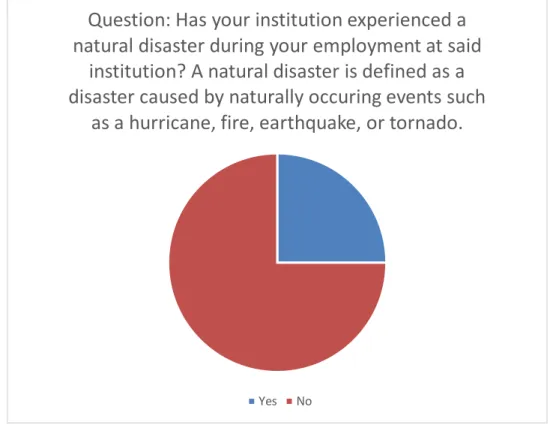
A total of 8 responses were received for the survey. 6 of the 8 respondents
answered “No” to the screening question and were directed to the end of the survey using
Figure 1: Responses to screening question.
The two respondents who answered “Yes” to the screening question each described water-related incidents at the institutions where they worked. One stated that their institution experienced a “flood due to drain failure during heavy hailstorm.” The other described a “hurricane resulting in basement water leaks.” Neither of the two respondents stated that their institutions sustained more damage than would be covered by insurance and the institution’s budget. Answering “No,” because of skip logic in the survey, brought the remaining respondents to the conclusion of the survey. No
respondents answered questions surrounding applying for outside funding.
Question: Has your institution experienced a
natural disaster during your employment at said
institution? A natural disaster is defined as a
disaster caused by naturally occuring events such
as a hurricane, fire, earthquake, or tornado.
Discussion
An impetus for creating this pilot study was to generate generalizable results that would paint a broad picture of what applying for disaster recovery funding was like. Disaster management for libraries in professional literature is often examined as a case study of a specific institution or group of nearby institutions during a single event. While case studies can provide useful information about response and mitigation at other institutions, this study attempted to understand how many different types of libraries experienced one specific aspect of disaster recovery (i.e. funding) while case studies give a sense of the total experience of an institution affected by a disaster. In one Model Memorandum of Understanding endorsed by the National Network of Libraries of Medicine Southeastern/Atlantic Region, a disaster is defined as:
an occurrence such as a hurricane, tornado, storm, flood, high water, wind-driven water, tidal wave, earthquake, drought, blizzard, pestilence, famine, fire,
explosion, building collapse, transportation wreck, terrorist event, bioterrorist event, pandemic, power failure or other similar natural or man-made incident(s) that causes human suffering or creates human needs that require assistance of hospitals, healthcare personnel as well as the support of libraries in aid of hospitals, healthcare personnel, first responders or public health personnel. (Brewer & Reich, 2005)
Given the large scope of disasters covered in definitions such as this one, future
One aspect of the survey design that should be improved in future
research surrounded terminology around disasters and the use of “natural disaster.” The survey asked only for participants who had experienced a natural disaster at their institution to respond to the study. Determining the parameters of what type of disasters would be covered in the survey was challenging, especially as disaster response can vary greatly depending on what type of disaster the institution experienced. I wanted to
exclude participants whose institutions had undergone a medical or technological disaster as response to these types of disasters often looks very different from responding to a fire, flood, earthquake, or hurricane. Maintenance related disasters were also in scope for this project, but this was not adequately communicated to participants.
Disasters can encompass fairly straightforward events such as maintenance failures, even if most think only of catastrophic events such as major hurricanes and tornadoes in connection with the term. This is a challenge that should be addressed in future research: that disasters big and small deserve consideration in professional literature. It is worth considering that experiencing small-scale disasters, such as a burst pipe over a few hundred volumes, may be the impetus for an institution to more seriously pursue disaster mitigation and planning. Several grant programs are available to fund disaster mitigation and preparedness projects for libraries, such as the Pre-Disaster Mitigation (PDM) Program from the Federal Emergency Management Agency (FEMA) and the National Leadership Grants from the Institute of Museum and Library Services (Heritage Preservation, 2005b).
possible reasons for this outcome. The librarians who are currently recovering
from a disaster at their institution are likely taking on additional duties on top of their normal workloads, reducing their ability to respond to surveys from graduate students. It could also be that, from the way the recruitment email was phrased, that many potential participants chose not to take the survey if their institution did not need to apply for external funding following experiencing a disaster. In future research efforts, it will be important to do stronger outreach with study participants.
Limitations
The limitations of this pilot study reveal both the limits of survey design and of studying this topic in a generalizable fashion. Because of the use of skip logic, there were two different points in the survey in which participants would be “skipped” to the end of the survey if they gave a particular response. The first use of skip logic in the survey was with the question “Has your institution experienced a natural disaster during your
employment at said institution? A natural disaster is defined as a disaster caused by naturally occurring events such as a hurricane, fire, earthquake or tornado.” Participants could either respond “yes” or “no” to this question. If they answered no, they were brought to the end of the survey and thanked for their participation in the study. Since the majority of survey participants answered “no” to this question, they did not get to
With my study design, I did not study how institutions change their
approaches to obtaining grant funding over time. As discussed previously I anticipate that I did not receive as many responses from staff members at mid-sized or small institutions. Difficulties with recall are another limitation of this study. Since the survey asked
participants to answer questions about past events, it is possible that they did not perfectly relate the relevant events that occurred at their institution. This is especially a concern as the staff members that answer the survey may or may not have been directly involved in the grant writing process for disaster recovery funds.
Future Research
In my survey, I did not ask about preventative care given to holdings or library infrastructure. One avenue of research that could follow this study would examine how libraries and archives do preventative care and how what impact that had if those are later hit by a natural disaster. One other future research topic could investigate if libraries and archives that experience small-scale disasters are more likely to take part in disaster preparedness initiatives than libraries and archives that do not.
In the wake of the COVID-19 pandemic, during which this study was completed, librarians expressed concern about sterilizing circulating library materials upon their return. Researchers could study how and if libraries applied for preservation, disaster mitigation, or disaster response funding for sterilizing library materials.
mutual support, also known as mutual aid, to the other entities in the agreement if they suffer a disaster. This support could be monetary or material. Libraries are
increasingly entering into these types of agreements, which would be fruitful to include in future studies of disaster recovery funding for libraries. With this type of financial or material backing, libraries with Memoranda of Understanding may be less likely to need to apply for external funding if they experience a disaster.
Conclusion
While the wide-ranging nature of natural and man-made disasters make studying disaster recovery a complex proposition, libraries and archives would be better served in disaster management if professional networks had more consensus on what constituted a disaster. Different definitions of disaster are operable for different situations, making studying this topic on a large scale extremely challenging. It remains difficult to grasp how many libraries and archives experience disasters each year, especially as small-scale disasters may be undercounted. The causality of a disaster also plays too large a role in classifying disasters, as was the case in this study.
One must also consider how a variety of disasters can impact libraries and
collections materials normally ubiquitous in their work. In the long term, many libraries and archives will make difficult decisions regarding funding, especially as enrollment drops at institutions of higher education and government funding for public libraries becomes uncertain (Hartocollis, 2020; Public Library Association, 2020). Budgets will be cut, and many organizations have already instituted indefinite hiring freezes (Flaherty, 2020). With reduced resources and limited access to facilities, library and archive workers will be forced to make difficult decisions about how they can continue to do their jobs while also balancing responsibilities and disruptions in their personal lives. However, the library and the archive continue to be centers of informal and formal learning, recreation, and assistance. They have been able to function because of strong, flexible, and resilient networks of information professionals, willing to
undertake unusual challenges like hosting story times over Facebook Live and scanning physical library materials for patrons that are unavailable digitally.
With increased numbers of businesses and other organizations applying for government aid, it has become clear that usually stringent and inflexible requirements for various funding agencies must be relaxed to adequately confront the many crises
Flexibilities for Libraries, Museums,” 2020). Hopefully, the present crisis will
force key funding bodies to consider extending many flexibilities instituted for COVID-19 relief in future disasters.
References
American Libraries. (2006). Laura Bush Announces $ 1.5 Million in Gulf Coast Grants.
Library Times International: World News Digest of Library & Information Science, 23(1), 9–9.
Annotated Resources. (2011, March 16). Society of American Archivists.
Arlitsch, K. (2013). Committing to Research: Librarians and Grantsmanship. Journal of Library Administration, 53(5–6), 369–379.
https://doi.org/10.1080/01930826.2013.876828
Bawden, A., Rabinowitz, B., Bova, A., Fread, J., Kerns, S., Chase, J., Currie, C., Gebhart, R., Keisling, C., Miller, D., Padulchick, K., Parker, A., Shive, E., & Vance, W. (2017). Disaster Recovery Additional Actions Would Improve Data Quality and Timeliness of FEMA’s Public Assistance Appeals Processing [Report to
Congressional Requesters]. United States Government Accountability Office. Brewer, M. V., & Reich, B. S. (2005). Model Memorandum of Understanding for a
Health Sciences, Hospital/System or Medical Library for Emergency
Preparedness Support (p. 4) [Memorandum of Understanding]. National Network of Libraries of Medicine Southeastern/Atlantic Region.
Librarians (Part One of a Two-Part Series). Journal of Hospital
Librarianship, 18(2), 115–126. https://doi.org/10.1080/15323269.2018.1437502 Carnes, S. (2018b). Investigating Options for Increased Awareness and Use of Disaster
Preparedness, Response, and Recovery Resources Among Libraries and
Librarians (Part Two of a Two-Part Series). Journal of Hospital Librarianship,
18(3), 210–222. https://doi.org/10.1080/15323269.2018.1471900
Corrigan, A. (2008). Disaster: Response and recovery at a major research library in New Orleans. Library Management, 29(4/5), 293–306.
https://doi.org/10.1108/01435120810869084
Diamond, T. (2006). The Impact of Hurricanes Katrina and Rita on Three Louisiana Academic Libraries. Library Leadership & Management, 4, 9.
Dickerson, B. J. 1. (2018). Recovering from Hurricane Sandy: A Municipal Government Archives’ Role in Disaster Recovery. Provenance: The Journal of the Society of Georgia Archivists, 35, 91–117.
Federal Government Invests $50M in Museums, Libraries to Address Digital Divide During COVID-19. (2020, March 27). News Releases - Institutre of Museum and Library Services. https://www.imls.gov/news/federal-government-invests-50m-museums-libraries-address-digital-divide-during-covid-19
Flaherty, C. (2020, April 1). Scores of institutions announce faculty hiring freezes in response to the coronavirus. Inside Higher Ed.
Foley, L. (2019, September 17). RE: FEMA funding for Cultural Heritage Institutions
Hartocollis, A. (2020, April 15). After Coronavirus, Colleges Worry: Will Students Come Back? The New York Times.
https://www.nytimes.com/2020/04/15/us/coronavirus-colleges-universities-admissions.html
Heckel, J. (2017, December 21). University of Illinois librarian to help Puerto Rican libraries with disaster recovery. Illinois News Bureau.
https://news.illinois.edu/view/6367/592003
Heritage Preservation. (2005a). A Public Trust At Risk: The Heritage Health Index Report on the State of America’s Collections. Heritage Preservation.
Heritage Preservation. (2005b). Before and After Disasters: Federal Funding for Cultural Institutions FEMA 533/September 2005. Heritage Preservation.
Heritage Preservation. (2008). Guide to Navigating Federal Emergency Management Agency and Small Business Administration Disaster Aid for Cultural Institutions
(p. 66). Heritage Emergency National Task Force.
IMLS Authorizes New Grant Flexibilities for Libraries, Museums. (2020, April 6). News Releases - Institute of Museum and Library Services.
https://www.imls.gov/news/imls-authorizes-new-grant-flexibilities-libraries-museums
Kennedy, T. (2017, April). Working With Disaster Recovery Vendors.
Malizia, M., Hamilton, R., Vargas, K., & Olney, C. (2012). Connecting Public Libraries with Community Emergency Responders. 51(3), 7.
Mary Grace Flaherty. (2019, September 30). Personal Communication About Insurance Policies for Libraries [Personal communication].
McClure, C. R., Ryan, J., Mandel, L. H., Brobst, J., Hinnant, C. C., Andrade, J., & Snead, J. T. (2009). Hurricane Preparedness and Response for Florida Public Libraries: Best Practices and Strategies. Florida Libraries, 52(1), 4–7.
Milagros Rodriguez, E. (2017, October 26). I’m a librarian in Puerto Rico, and this is my Hurricane Maria survival story. The Conversation.
National Heritage Responders. (n.d.). Retrieved October 20, 2019, from
https://www.culturalheritage.org/resources/emergencies/national-heritage-responders
Nevins, K., & Nyberg, S. (2006). SOLINET’s Gulf Coast Libraries Recovery Projects for Public and Academic Libraries. Public Library Quarterly, 25(3–4), 215–223. https://doi.org/10.1300/J118v25n03_18
Passley, C. E. (2013). Determining Differences Between Archival Staff and Restorers Ranking of Training Topics for Disaster Restoration Projects. Collection Management, 38(4), 267–300. https://doi.org/10.1080/01462679.2013.836139 Plagman, E. (2020, March 23). Public Libraries Respond to COVID-19: Survey of
Response & Activities. Public Library Association (PLA). http://www.ala.org/pla/issues/covid-19/surveyoverview
http://www.ala.org/pla/sites/ala.org.pla/files/content/advocacy/covid-19/PLA-Libraries-Respond-Survey_Aggregate-Results_FINAL2.pdf
Robert T. Stafford Disaster Relief and Emergency Assistance Act, Pub. L. No. 93–288, United States Code (1988).
Staines, G. M. (2010). Go Get That Grant!: A Practical Guide for Libraries and Nonprofit Organizations. Scarecrow Press.
http://ebookcentral.proquest.com/lib/unc/detail.action?docID=616302
The Institute of Museum and Library Services. (2019). Protecting America’s Collections:
Results from the Heritage Health Information Survey, February 2019 (p. 62). The Institute.
Tobin, T. (2018, March). Puerto Rico recovery efforts: Our help is still needed.
International Leads: A Publication of the International Relations Round Table of the American Library Association, 18.
Topper, E. F. (2011). After Hurricane Katrina: The Tulane Recovery Project. New Library World, 112(1/2), 45–51. https://doi.org/10.1108/03074801111100445 Unger, J. (2018, January 12). Second Deployment of National Heritage Responders to
Puerto Rico. https://www.conservators-converse.org/2018/01/second-deployment-of-national-heritage-responders-to-puerto-rico/
Yeh, F., McMullen, K. D., & Kane, L. T. (2010). Disaster planning in a health sciences library: A grant-funded approach. Journal of the Medical Library
Appendix A. Recruitment Message
Hello colleagues,
I am writing to you to invite you to participate in my survey about how library and archival professionals apply for disaster recovery funding. I am seeking participants who were staff members at a library or archive that was affected by a natural disaster in the last five years, especially those directly involved in the disaster recovery process for their institution.
The results of this survey will further my research at the School of Library and Information Science at the University of North Carolina at Chapel Hill. It should also inform how various library and archival institutions strategize obtaining disaster relief funding, including but not limited to for facility repair and treatments for library or archival holdings. The results of this survey will be anonymized, and participants will not be referred to by personal identifying information in the discussion of the results.
This survey should take approximately 15-20 minutes to complete.
This study received IRB approval on _________. The IRB application number is _________.
If you wish to report any ethical concerns you may have about how this study is conducted, you may contact the University of North Carolina at Chapel Hill IRB here:
Appendix B. Survey
1. (Screening Question: If participants answer no to this question, they will be directed to the end of the survey with a thank you message for their participation in the study.) Has your institution experienced a natural disaster during your employment at said institution? A natural disaster is defined as a disaster caused by naturally occurring events such as a hurricane, fire, earthquake or tornado. (Choices Yes, No)
2. Describe the disaster that your institution experienced. (Open-ended question). 3. How would you best describe the institution you work for? (Choices Academic
(post K-12), Public, Government, School (K-12), Other)
4. How would you best describe the library or archive that you work for (not parent institution)? (Choices Small, Medium/Mid-sized, Large, Other: Please describe (free response))
5. In the aftermath of a disaster, did your institution sustain more damage than would be covered by its insurance policy and its then current budget? (Choices Yes, No) (If the participant answers no, they will be directed to the end of the survey).
7. Did you or other staff members at your institution apply for internal
funding (grants/other funds provided your parent institution) or external funding (grants/other funds provided by other institutions)? (Choices: Grants/other funds provided by your parent institution; Grants/other funds provided by other
institutions).
8. Did your institution have a professional grant writer or another staff member whose explicit duty is to seek out external funding on staff? (Choices: Yes; No) 9. Did your institution hire a contract or temporary grant writer to apply for external
funding? (Choices: Yes; No)
10. If you or other staff members at your institution applied for external funding, what funding bodies did you apply to? (Choices are Institute of Museum and Library Services (IMLS); Andrew W. Mellon Foundation; National Historical
Publications & Records Commission (NHPRC); National Endowment for the Arts; National Endowment for the Humanities; National Center for Preservation Technology and Training; Public Assistance from your institution’s State Government, Small Business Administration; Federal Emergency Management Agency (FEMA); Society of American Archivists (SAA); American Libraries Association (ALA); Other (Allow for participants to select multiple options)) 11. Did your institution receive funding after you or other staff members at your
institution applied for it at one or more of the above organizations? (Choices are Yes; No)
Services (IMLS); Andrew W. Mellon Foundation; National Historical
Publications & Records Commission (NHPRC); National Endowment for the Arts; National Endowment for the Humanities; National Center for Preservation Technology and Training; Small Business Administration; Federal Emergency Management Agency (FEMA); Society of American Archivists (SAA); American Libraries Association (ALA); Other (Allow for participants to select multiple options))
13. How did you learn about the grant or funding source that you or other staff members at your institution applied for? (Choices are: Word of mouth from colleagues; Funding guide put out by a professional organization (such as the American Libraries Association or Society of American Archivists); Notice posted to a professional listserv about the grant or funding source; Other)
14. For which reasons did you or other staff members at your institution NOT choose to apply for other grants or external funding opportunities? (Choices are: Lengthy or difficult process by which to receive funding; Institution not eligible for
funding under conditions of the grant; Opportunity cost was too high (i.e. would take more staff/other resources to complete the application than the chance of success would warrant); Unable to comply with conditions of the grant, such as unable to meet cost-share requirements; Other)
15. Did you and/or other staff members at your institution discard materials damaged in the natural disaster? (Choices: Yes; No).
repair, Cheaper to acquire newer version of the item than to repair the damaged copy, Not Applicable/Answered No to previous question)
17. Do you feel that your institution received adequate financial resources in order to recover from the disaster that it experienced? (Choices: Yes or No)