A P P L I C A T I O N N O T E
Abstract
Response times are critical for healthcare practitioners. Delayed reactions caused by slow, inefficient processes and disparate communications systems compromise patient care. A dynamic, unified com-munications environment that connects voice, video and data systems throughout large, multisite hospital systems, reduces the number of mobile devices physicians must carry to stay connected, improves collaboration among colleagues and speeds document sharing. The result is faster, more efficient patient care.
The Alcatel-Lucent OmniTouch Unified Communications solution is a suite of next-generation, IP-based unified communications applications. It consists of four modules that deliver unified mes-saging, advanced telephony, one-number service and conferencing and collaboration. Built on the award-winning Alcatel-Lucent OmniPCX Enterprise platform, the Alcatel-Lucent Unified Com-munications solution provides an integrated user experience across all communication devices for better physician mobility, nurse call integration, patient voice portals and tele-consultations.
Table of contents
1 Introduction
1 The solution: Alcatel-Lucent OmniTouch Unified Communications
2 Alcatel-Lucent OmniPCX Enterprise Communication Server
3 Alcatel-Lucent OmniTouch 8600 My Instant Communicator
4 Common unified communications applications for healthcare
4 Dial by function
4 On-site and off-site physician mobility
5 Nurse call integration
6 Patient voice portals
6 Multimedia tele-consultations
6 Case study: Advocate Health Care – changing the culture of care
Introduction
One of the key challenges — and key opportunities — facing healthcare institutions today is communications. Existing communications infrastructures may feature static, disparate systems that do not interoperate. Doctors may have to carry two or three different pagers in addition to a mobile phone so they can be reached by different hospitals, departments and paging systems. They have different voicemail boxes, passwords and interfaces at each hospital. When specialists need to be consulted, valuable time is lost as physicians and nurses try to figure out who is on duty, send multiple messages in multiple ways and wait for a response, all the while hoping they’ve contacted the right person. In these cases, instead of facilitating patient care, communications is a stumbling block. However, herein lies tremendous opportunity for improving how healthcare systems work. By deploying a new, dynamic framework, hospitals can streamline workflows and connect caregivers faster, more easily and with more information such as patient records, images and video. This framework speeds accurate decision-making, which reduces errors and clinician stress and improves patient outcomes.
This dynamic communications framework features a unified communications solution that brings together voice, video and data to provide:
• Mobile, presence-aware communication • Multimedia collaboration
• One number, one voicemail • Text-to-speech
• Find me and follow me services
• Integration with desktop applications such as e-mail and instant messaging (IM)
Unified communications provides an integrated user experience across all communications options and devices. The approach is entirely user-centric. This means delivering communications that allow end users to connect seamlessly how they want, where they want, across whichever devices make sense for them and their job.
The solution: Alcatel-Lucent OmniTouch Unified Communications
Alcatel-Lucent OmniTouch™ Unified Communications is a suite of next-generation IP-based unified communications applications for enterprises. The suite allows users to tailor, control and manage calls, messages, directories, collaborative work tools and information from any location using any device and any software interface. Included are modules for:
• Unified messaging
• Consistent, advanced telephony services on desktop phones and softphones for PCs
and mobile PDAs
• One-number services providing intelligent call routing • Conferencing and collaboration services
Alcatel-Lucent provides these applications in an integrated, real-time, multimedia, multisession, multi-device, media-blending unified communications application called the Alcatel-Lucent OmniTouch
8600 My Instant Communicator. The Alcatel-Lucent OmniTouch 8600 My Instant Communicator
delivers a consistent user experience and can be upgraded to respond to changing user needs.
Combined with our award-winning IP PBX platform — the Alcatel-Lucent OmniPCX™ Enterprise Communication Server — our unified communications applications provide the best in converged telephony and next-generation communications options for today’s healthcare providers.
Alcatel-Lucent Unified Communications | Application Note
2
Alcatel-Lucent OmniPCX Enterprise Communication Server
The Alcatel-Lucent OmniPCX Enterprise Communication Server is a highly-scalable solution based on a pure software communication server platform that provides multimedia call processing for both Alcatel-Lucent and third-party clients and phones, including time division multiplexing
(TDM), Internet protocol (IP) and session initiation protocol (SIP). This rich call-handling appli -cation provides world-class business telephony to serve large, multisite hospital systems or smaller community hospitals with a choice of either centralized or decentralized IP telephony solutions. The Alcatel-Lucent OmniPCX Enterprise Communication Server provides the building blocks for any IP or legacy communications solution, incorporating the latest Linux®, extensible markup
language (XML), SIP, voice extensible markup language (VXML) technologies, and open standards such as Q signaling (QSIG), H.323, computer-supported telecommunications applications (CSTA),
and SIP. Standards-based platforms enable enhanced integration with existing hospital systems and applications such as those for paging, nurse call, device monitors and event notification. The Alcatel-Lucent IP telephony solution offers broad scalability ranging from 10 to 100,000 users who can be spread across multiple geographical sites. Plus, it delivers highly reliable, real-time, carrier-grade performance solutions with an unmatched 99.999 percent uptime.
Alcatel-Lucent OmniTouch 8600 My Instant Communicator
As part of the Alcatel-Lucent Unified Communications suite of next-generation, IP-based
applications for enterprises, the Alcatel-Lucent OmniTouch 8600 My Instant Communicator
can transform hospital operations. Physicians, nurses, and staff benefit from real-time, unified communications, a consistent user experience and complete control over their communications.
FEaturES FunCtiOnS BEnEFitS
OmniPCX EntErPriSE COmmuniCatiOnS SErvEr
IP telephony platform • High availability mode • Multisite topology • Cellular extension
• Support for multivendor environment and legacy phones (analog, digital or IP)
• Mobile support (cellular, Wi-Fi®, dual mode)
• Cost effectively implement IP telephony while leveraging existing communications investment • Provide one number for fixed and mobile communications
• 99.999 percent reliability with built-in redundancy across an entire healthcare system network
OmnitOuCh 8600 my inStant COmmuniCatOr
Integrated user experience • Integration of all unified communications appli cations with a single sign-on, a single interface
• Consolidated user administration in a single repository • User profiling based on job function and role • Integration with desktop applications (Microsoft, IBM,
corporate portals)
• High availability design with the N+1 concept • Seamless integration with hospital security policies
• Learn one interface, use on every device
• Security and access control made simple for users and administrators
• Applications deployed across multiple servers for reliability and backup
• Full visual session control, integrated with the client of choice
Messaging services • Multimedia mail box (voice mail, e-mail, text, IM, fax) for a single point of storage
• Third-party integration (Microsoft Exchange/ Outlook®, IBM Lotus Domino/Notes®)
• Integration with hospital directories and databases
• Simplified access to messages for physicians and other staff — regardless of where they are and
what device they have • Staff can carry fewer devices
• Add images and video to messaging for improved information exchange and decision making Telephony services • Common interface across multiple devices
• Wired (PC, desktop phone) • Wireless (PDA, smartphone) • User profiling based on job function
• Easy to learn, user-friendly interface reduces training requirements
• True user mobility allows seamless, yet secure access from office, home and anywhere in between • Flexible deployment that differentiates the
administrator phone from the doctor phone from the in-room patient phone with different features Collaboration services • Web-based audio, data, and video conferencing
• Telephony via integration with OmniPCX Enterprise Communication Server or other vendor PBX, SIP or T2 • Presence-aware communication (on/off hook,
conferencing availability — audio and video) • Ability to self-manage phone number, availability
and buddy list
• Recordable, archivable sessions • Version for Windows Mobile®
• Real-time, media-rich collaboration • Reach the right people faster and with more
information to speed and improve patient care • Allow doctors and specialists to manage their
availability in real time
• Invite specialists from other hospitals or institutions to collaboration sessions without requiring them to have an account on the system
• Web-based so you can join from any PC or Windows Mobile device — you don’t need to have an application installed on the PC
• Archive sessions for hospital and patient records One number services • Intelligent communication routing
• Integration with hospital systems (directories, scheduling, etc.)
• Automated work groups for routing to back up contacts
• Allow users (doctors, nurses and patients) to reach contacts by role (i.e., “Attending Physician”) without worrying about on-call schedules • Ease physician stress: They are contacted only
when they are supposed to be. • Improve patient experience:
¬ Nurse call and messaging integration to reach the right support staff
Alcatel-Lucent Unified Communications | Application Note
4
They can tailor and manage calls, messages, directories, collaborative work tools and information from any location, using any device. In addition to helping users manage incoming and outgoing
calls, the Alcatel-Lucent OmniTouch 8600 My Instant Communicator provides a snapshot of all activity — call backs, new voice mail, missed calls and faxes — in a single window. Medical staff can switch seamlessly from one mode of conversation to another. For example, a nurse can launch
a call to an attending physician and, while still talking, decide to turn the phone call into a multimedia conference. With one click, the nurse shares patient data or images with the doctor for a more accurate consultation.
With the Alcatel-Lucent solution, healthcare systems get the ultimate match of flexibility, scalability and reliability with simplified, user-centric management of all communications.
Common unified communications applications for healthcare
With the Alcatel-Lucent Unified Communications solution in place, hospitals, doctors, staff and patients can take advantage of numerous new applications that leverage the power of a dynamic communications framework.
Some common healthcare applications include:
• Dial by function
• On-site and off-site physician mobility • Nurse call integration
• Patient voice portals
• Multimedia tele-consultations
Dial by function
By integrating the power of unified communications with hospital management systems, healthcare
providers can simplify workflows and improve response times. For example, when an emergency room
team needs to reach the attending physician on call, they can simply press a button for “Attending Physician” and the system will automatically connect the staff member.
In a static communications environment, a nurse has to look up who is on call, work through several different means of communication, such as sending a page or text message, leaving a voice-mail mes-sage and paging the doctor on an overhead speaker system. Then, he or she must wait, not knowing if the doctor is responding or busy. In some cases, if that doctor is busy with another emergency call, the nurse would then have to identify the backup physician and repeat the process.
Alcatel-Lucent can automate work groups and call routing and link them with schedules and depart-ment directories to identify the right doctor and send a single message that is delivered across the communications system in a single step. Doctors can then click one button to acknowledge the message and indicate that they are responding. This capability can save lives by reducing the time between a patient event and a patient outcome in a critical care situation.
On-site and off-site physician mobility
With the Alcatel-Lucent solution, hospitals can register standard mobile phones and devices as extensions on the Alcatel-Lucent OmniPCX Enterprise Communication Server and pair those devices with a desktop phone using our cellular extension feature. This is the first step to delivering mobility to physicians and specialists who move frequently between different hospitals and clinics. When they are in their office, they can answer calls on their desk phone. When they are in different areas of the hospital or in a clinic or other location, they can answer on their mobile phone. If a nurse needs to reach the doctor, he or she can dial one number on either the office or mobile device; there is no need to know where the doctor is or to try multiple phone numbers before finally making contact.
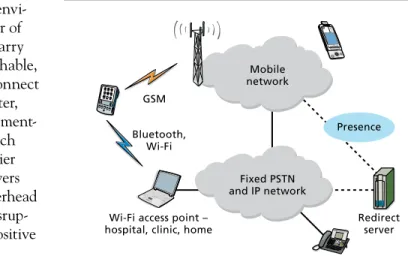
Another option is to provide doctors and specialists with special dual-mode smartphones or PDAs that
work over either the hospital’s Wi-Fi network or over a mobile carrier’s network like a standard mobile phone. When the doctor is working within a hospital or clinic, the phone will work over the Wi-Fi
network, avoiding the issues of low cellular signal and bad reception in certain areas. When the doctor leaves the hospital, calls will be forwarded to the same device over the mobile carrier’s network.
In either case (cellular extension or dual-mode phone), doctors can carry a single device, such as a
smartphone or wireless PDA with softphone, and have access to a single voice-mail system and to most of the same features available on their desktop phone. In addition, with the Alcatel-Lucent
OmniTouch 8600 My Instant Communicator feature, the user interface is consistent between their
desk and mobile phones, which eases the stress and increases efficiency. Plus, doctors get access to mobile data applications — including conferencing and collaboration tools — on the hospital
net-work. Medical teams can reach the right expertise without the delays of outdated communications
and can share more information on the fly.
Such solutions also mean that doctors can be reachable while on call via the same single phone number as they have while they are on duty, and with the same enhanced communication and collaboration features. Coupling this with intelligent call routing means that the doctors can also “switch off” work when they need to be unavailable.
The choice between the cellular extension and the dual-mode solution is based on the profile of the
user. For doctors or specialists who move around frequently and are often outside the reach of the hospital network, the cellular extension feature is ideal. For those doctors or specialists who are often within the reach of the hospital’s Wi-Fi network, the dual-mode option may be preferable. And it is
not a one-size-fits-all proposition. The two solutions can be mixed in any deployment. With unified communications,
health-care providers create a dynamic envi-ronment that reduces the number of mobile devices physicians must carry to stay connected and easily reachable, expands their opportunities to connect with colleagues, and provides faster, more efficient patient care. Implement-ing solutions that help nurses reach the right physician faster and easier through mobile devices also delivers the added benefit of reducing overhead paging, which in turn reduces disrup-tive noise and provides a more posidisrup-tive patient experience.
Nurse call integration
Alcatel-Lucent can integrate its unified communications applications with a hospital’s nurse call system for real-time connectivity between patients and staff. The system can reach the right nurse on duty at the nurse’s station or on a mobile device. This integration helps eliminate unnecessary callbacks to other staff members and improve patient response times. Software applications also provide detailed patient activity along with automatic reporting on calls and response times to provide staff accountability.
The result is a better patient experience at the hospital and improved satisfaction with doctors and staff, which translates into patient referrals and increased business.
Figure 2. alcatel-Lucent dual-mode solution
Bluetooth, Wi-Fi
Wi-Fi access point – hospital, clinic, home
GSM Redirect server Presence Mobile network Fixed PSTN and IP network
Alcatel-Lucent Unified Communications | Application Note
6
Patient voice portals
Integrating telephony and data services, along with an Alcatel-Lucent contact center solution,
allows 24/7 availability of voice portals. The Alcatel-Lucent solution supports the use of VXML, also known as voice-enabled Web, which simplifies integration with hospital databases. VXML
enables automated voice access to the hospital database for appointment tele-scheduling. The same system automatically reminds patients before their appointments, significantly decreasing the number of no-shows for consultations.
The infrastructure in place is also adapted to many other applications, such as self-service access to interactive medical information, prescription refills, flu vaccine reminders, research surveys for disease management, risk assessment, and other research surveys.
Multimedia tele-consultations
Inherent in the collaborative nature of healthcare delivery is the need to reach out to specialists and colleagues who are not at the same location. The more information that can be brought into consultations via sound, graphics and application sharing, the more efficient the interactions will be and the quicker the patient issues can be resolved.
Case study: Advocate Health Care – changing the culture of care
At Advocate Health Care (Advocate), a leading healthcare system in the greater Chicago area, Alcatel-Lucent implemented this solution as part of a larger network transformation and helped Advocate improve productivity and remove barriers to communication and patient care.
Advocate Health Care has eight hospitals and over 200 sites offering acute care, outpatient services, home health-care, counseling, day health-care, physician services, skilled nursing care and healthcare education. With more than 24,500 employed at Advocate including 4600 physicians, it is one of the Chicago area’s 10 largest employers.
CuStOmEr ChaLLEngE
Initially, Advocate was seeking a more efficient way for administrative staff to collaborate on documents and case consultations. Prior to implementing the Alcatel-Lucent My Teamwork*, face-to-face meetings were held
all over the Chicago metro area — a 70-mile radius — requiring heavy travel for staff. In many cases, time en route far outweighed actual meeting time. This was both costly and unproductive for staff.
Recognizing the need to change its “meeting culture” environment to minimize travel and increase time spent on core business, Advocate sought a web-conferencing solution to enable cross-functional, dispersed teams to hold effective, virtual meetings on an as needed basis.
thE aLCatEL-LuCEnt SOLutiOn
Advocate evaluated a number of offerings from leading vendors and service providers. However, these all incurred monthly costs and did not offer the features required: ease of use and presence-based instant messaging for on-the-fly meetings.
The Alcatel-Lucent premises-based My Teamwork solution provided the feature requirements with the added benefit of fixed costs. Instead of accounting for the system as an operational expense, Advocate could purchase the solution as a capital expense item amortized over 3 years.
EvaLuatiOn and dEPLOymEnt
After its initial pilot test in August 2005 with 10 users, My Teamwork expanded rapidly. Just 1 year later, the project had expanded to support 2250 users in the information systems, human resources, and home health divisions, with the potential of 14,000 additional users.
“Because of its ease of use, we get a lot of demand for the solution,” explains
Gary Horn, Director of Enterprise Architecture and Network Security at Advocate.
“It is purely word of mouth and requested users are actively utilizing the tool.”
Additional features include integration with Advocate’s enterprise LDAP directory and internal web portal with full Advocate Health Care branding.
COLLaBOratiOn tOday at advOCatE
The bulk of Advocate’s virtual meetings are internal with heavy use of presence-based IM and application sharing. Activity averages 25 to 30 collaboration sessions per day with an estimated 7 percent reduction in face-to-face meetings. Horn notes that this occurred without any promotion of the tool to users.
The home health care team, dispersed across 12 sites, conducts frequent ad hoc case consultation sessions. A typical scenario begins with an IM chat using presence availability. From here, users may escalate to an appli-cation-sharing session. By eliminating travel barriers and using presence status, meetings are spontaneous and drive faster case resolution.
OmnitOuCh uniFiEd COmmuniCatiOnS
In addition to My Teamwork, Advocate has begun implementation of the My Phone* and My Assistant*
solutions for mobile clinical staff. The collaboration solution is enhanced and the ability now exists to always be in touch with remote access to key features such as the dialing directory via the Advocate web portal. For Advocate’s busy clinical staff, the main challenge is efficient and immediate communication in a mobile work environment. Unlike most businesses, healthcare professionals are on the move, and with numerous telephone numbers and devices providing only asynchronous contact, communication is difficult. With full access to their phone, mail and organizational directory from remote devices — anywhere the Internet is available using portal-based access — the medical staff enjoys faster response times and reduced commu-nication delays.
thE FuturE
Advocate is rolling out collaboration and conferencing to clinical staff so they have full audio and web confer-encing capabilities. The existing third-party conferconfer-encing service is being replaced.
With teamwork services accessible to all staff, Advocate envisions a borderless hospital. Physicians can review and discuss test results from remote locations, enabling collaboration on patient cases. Telemedicine supports a “networked practice” approach where staff can efficiently diagnose, treat patients, and avoid medical errors with the help of virtual meeting rooms and presence-based IM. Available medical experts are identified and engaged within or outside the boundaries of the hospital.
Implementation will be an open enrollment system, making it easy for users to request accounts and the IT department to manage activation. Horn notes, “This is only possible because of My Teamwork’s ease of use and minimal training requirements. Users can be conferencing in 30 minutes.”
Alcatel-Lucent Unified Communications | Application Note
8
Alcatel-Lucent value proposition
Alcatel-Lucent is a world leader in communications with over 100 years of technology and commu-nications innovation with solutions that span voice, video, data, and collaborative technologies. Our goal is to leverage our expertise to eliminate communications bottlenecks and create more time for patient care. Our OmniTouch Unified Communications suite is a proven solution doing just that for major hospital systems around the world.
We offer an innovative user experience that integrates, yet simplifies communications and complex workflows and provides easy-to-use tools for all the stakeholders in a healthcare enterprise. The solu-tion is based on open standards to allow hospitals the greatest flexibility in a dynamic, multivendor
environment, while still providing high-value, timesaving applications. From the network to the
desktop to mobile devices, hospitals can deploy new services with user profiling to tailor the solution to the preferences and requirements of its user communities. User authentication and end-to-end security protect patient data and limit liability.
In the end, hospitals can not only achieve operational and cost efficiencies, but also reduce the stress on doctors, nurses and staff caused by poor communications — realizing meaningful improvements in patient care and patient satisfaction.
For more information, visit the Alcatel-Lucent healthcare web site:
http://www1.alcatel-lucent.com/enterprise/en/solutions/industry_solutions/healthcare/
Abbreviations
CSTA computer-supported telecommunications applications DECT Digital Enhanced Cordless Telecommunications GSM Global System for Mobile Communications IM instant messaging
IP Internet Protocol
LDAP Lightweight Directory Access Protocol PBX Private Branch Exchange
PDA personal digital assistan
PSTN Public Switched Telephone Network QSIG Q signaling
SIP Session Initiation Protocol TDM Time Division Multiplexing VXML Voice Extensible Markup Language Wi-Fi Wireless Fidelity
XML Extensible Markup Language
* The Alcatel-Lucent OmniTouch My Instant Communicator integrates functionality previously available as My Teamwork (now Teamwork Services), My Assistant (now One Number Services), and My Phone (now Telephony Services). For more information, contact your Alcatel-Lucent representative.
www.alcatel-lucent.com Alcatel, Lucent, Alcatel-Lucent and the Alcatel-Lucent logo are trademarks of Alcatel-Lucent. All other trademarks are the property of their respective owners. The information presented is subject to change without notice. Alcatel-Lucent assumes no responsibility for inaccuracies contained herein. © 2008 Alcatel-Lucent. All rights reserved. ENT2913080410 (06)