The Effect of Iodine in Various Forms on the Content of
Selected Essential Amino Acids and Their Accumulation
into the Broilers Chest Muscles
Mária Angelovičová, L’ubica Mrázová, Martin Kliment,
Jana Tkačová, Martin Král, Ebrahim Alfaig
Slovak University of Agriculture in Nitra, Faculty of Biotechnology and Food Sciences 949 76-Nitra, Tr. A. Hlinku, 2, Slovakia
Abstract
The aim of this study was comparison of a biological effectiveness of iodized oil premix and potassium iodide premix applied in feed mixtures on the protein value and selected essential amino acids content of broiler chickens meat. According to the obtained results of experiment of broiler chickens and chemical analyses of feed and breast muscles it was found that by using iodized oil the content of the selected essential amino acids was decreased with statistically significant (P<0.01, P<0.001) compared with using of potassium iodide premix, while as the protein content was not affected by the different forms of iodine. The biological value of protein was calculated and expressed as protein efficiency ratio (PER) and it was 3.048 to 3.626 during different fattening period.
Keywords: amino acid, breast muscle, broiler chicken, feed, iodine
1. Introduction
Iodine affects the metabolism of all nutrients. It has the synergistic and antagonistic relationships with other macro and microelements. Its occurrence is related to geographical conditions. For the research of compensation other antibiotics feed supplements, it is important to address this now trace the central focus, not only in relation to the performance of animals, but also following the food quality and safety and health. Broiler strains with higher weight gain potential, such as Ross and Cobb, suffer a stronger influence of dietary Crude protein content than other genetic strains [1]. Protein and amino acid requirements vary considerably according to the physiological state of the bird, that is, the rate of growth. Other factors contributing to variations in amino acid
*Corresponding author: Mária Angelovičová, Tel.
requirement change with body size and the ideal amino acid profiles for maintenance and growth different, the composition of the ideal amino acid
pattern will change continuously during the growth period [7]. The most representative body compartment of the body amino acid pool is the skeletal muscle [8]. As the breast muscle accounts for 60% of the edible protein of the broiler carcass [9], it is an important component when studying animal response to dietary essential amino acid and total protein levels.
The aim of this paper was the investigation of the effectiveness of iodine oil premix and potassium iodide premix for performance of broiler chickens and biological value of protein in the breast muscle of fattening type chickens.
2. Materials and methods
Broiler chickens Coob 500 were kept in deep litter hall for poultry farming. The capacity of the hall was 24 000 birds and equipped with boxes containing the feeding and drinking equipments. The experimental groups was divided according to the feed mixture active compounds, so the first group was the group of potassium iodide premix (PI) and the second was iodized oil premix (IO). During the experiment the following variable had been studied: body weight of broiler chickens– scale Soenhle 7740, feed intake–for the whole group, as the difference of feed weighed at the beginning and end of the experiment, crude protein content–instrument Kjeltec Auto, Methionine, Lysine and Threonine in breast muscles of broiler chickens–amino acid analyzer AAA 400 M, protein quality was calculated on the basis of protein efficiency ratio (PER).
Weight gain (g/bird)
PER = --- Feed intake (g/bird)*Protein content feed
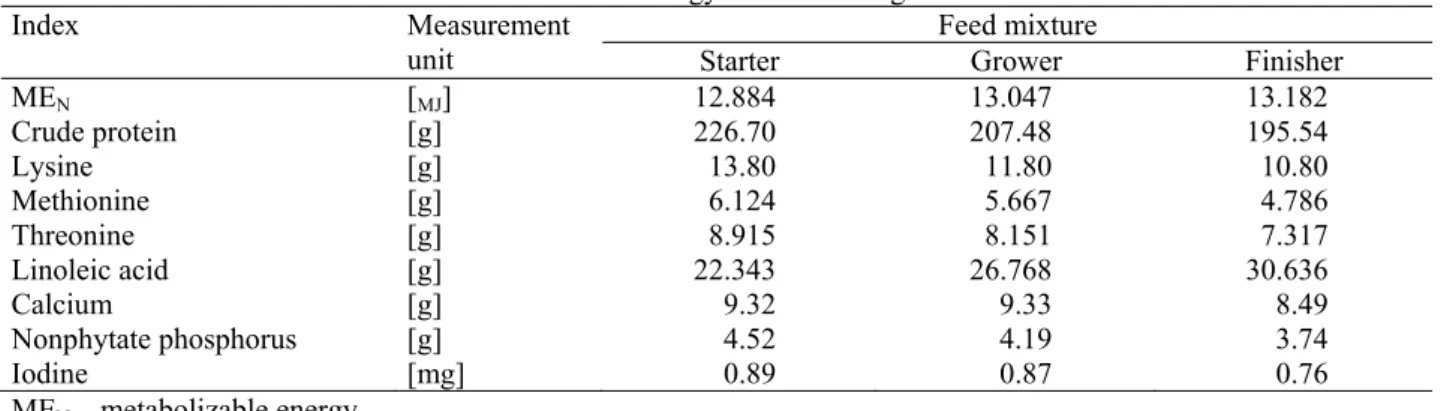
The chickens were fed with powder feed mixtures from 1 to 14 days by means of disc rack for feed and hat drinker for beards drinking. From 15 days to the end of feeding was used bucket feeders and watering place. Chickens were fed with feed mixtures nearly the same composition in the experimental PI and IO groups (Table 2 and 3). The difference was that the experimental IO group starter feed mixture did not contain antibiotic avilamycin compared to PI experimental group starter feed mixture. In all experimental IO feed mixtures (starter, growth and final) has been used mineral supplement without potassium iodide compared to the PI feed mixtures. Iodine in the experimental IO feed mixtures was used in the form of iodized oil, vehicle-vegetable oil (PX IO) (Table 1). Effects of iodine linked to thyroid function.
Iodine incorporated into thyroid hormone, Thyroxine (T4) (URL 1: International Council for the Control of Iodine Deficiency Disorders).
Table 1. Experiment scheme
Experiment period (day) 1.-18. 19.-31. 32.-36. Number of days 18 13 5
PX IP (n = 100 pcs) starter (antibiotics, PI) growth (PI) final (PI) PX IO (n = 100 pcs) starter (0.5% IO) growth (0.5% IO) final (0.5% IO)
Table 2. Composition of the feed mixtures (%)
Variable Feed mixture
Starter Growth Final
Corn 25.00 30.00 30.00
Wheat 38.00 35.50 37.00
Plant oil 1.50 2.00 2.50
Soybean meal 27.00 26.00 26.50
Wheat feed meal 0.155 0.306 0.306
Mycosorb 0.025 - -
Betaine 96% 0.015 0.01 0.01
Fish meal 5.00 2.50 -
Prebiotics 0.10 - -
Sodium chloride 0.25 0.35 0.35
Monocalcium phosphate 1.10 1.40 1.40
Calcium carbonate 1.10 1.40 1.40
Coccidiostat 0.05 - -
L-lysine premix 0.26 0.179 0.179
L-threonine premix 0.10 0.07 0.07
DL-methionine premix 0.25 0.20 0.20
Vitamin premix 0.045 0.04 0.04
Mineral premix 0.045 0.04 0.04
Feed enzymes 0.005 0.005 0.005
Table 3. Nutrient and energy content in 1 kg feed mixture Index Measurement
unit Starter Grower Finisher Feed mixture
MEN [MJ] 12.884 13.047 13.182
Crude protein [g] 226.70 207.48 195.54
Lysine [g] 13.80 11.80 10.80
Methionine [g] 6.124 5.667 4.786
Threonine [g] 8.915 8.151 7.317
Linoleic acid [g] 22.343 26.768 30.636
Calcium [g] 9.32 9.33 8.49
Nonphytate phosphorus [g] 4.52 4.19 3.74
Iodine [mg] 0.89 0.87 0.76
MEN – metabolizable energy
3. Results and discussion
Crude protein content in the broiler breast muscle
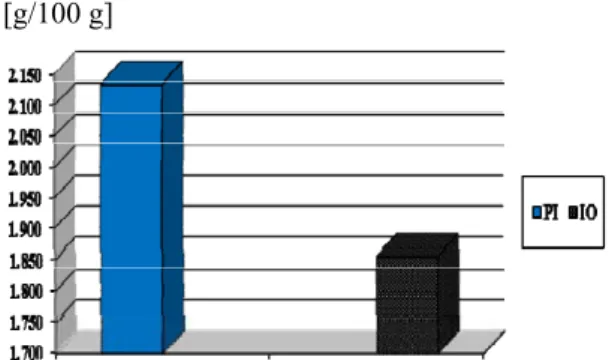
The results of the analysis and mathematical and statistical assessment of the crude protein in broiler chickens breast muscle (Figure 1, Table 4) showed almost the same values (no statistically significant difference between groups P>0.05). Iodized premixes of different sort did not affect crude protein content in breast muscle of broiler chicken.
[g/100 g]
Table 4. Mathematical-statistical assessment of crude protein content in thebroiler breast muscle Group
PI n = 10 IO, n = 10
SD vc SD vc t-test
Crude protein[g/100 g] 0.36 1.52 0.48 2.04 0.46
-SD–standard deviation; vc–coefficient of variation; -P >0.05–no statistically significant difference between groups; n=number of birds; PI=potassium iodide premix; IO=iodized oil premix
Lysinecontentin the broiler breast muscle
Lysine content was decreased in breast muscles of broiler chickens fed with feed mixtures, which contained an iodized oil premix. This difference of lysine content was confirmed by statistical analysis and it was statistically significant (P≤0.001) (Figure 2, Table 5) in compare with its content in breast muscles of chickens after feeding of feed mixtures with potassium iodide premix and promoting of antibiotics avilamycin. Amino acid requirements are influenced by several environmental [10], genetic [11], and nutritional [12] factors. In this context, it was shown that modern broiler strains, with high potential for the
accretion of valuable parts, such as the breast muscle, have high dietary lysine requirements [11].
[g/100 g]
Figure 2.Lysinecontent in thebroiler breast muscle
Table 5. Mathematical-statistical assessment of lysinecontenting the broiler breast muscle
Group
PI n = 10 IO n = 10
SD vc SD vc t-test
Lysine [g/100 g] 0.075 3.50 0.073 3.95 5.58+++
SD–standard deviation, v –coefficient of variation, +++P≤0.001 –statistically significant difference between groups, n=number of birds, PI=potassium iodide premix, IO=iodized oil premix
Methioninecontentin the broiler breast muscle
[g/100 g]
Mathematical and statistical assessment of results of methionine in broiler chickens breast muscle showed that the essential amino acid methionine was lower after feeding the feed mixtures with iodized chickens fed with potassium iodine premix. The different was statistically significant (P≤0.01) (Figure 3, Table 6) between groups. It found a decreased biological efficiency iodized oil at incorporation of methionine compared with the effects of potassium iodide and promoting of antibiotics avilamycin.
Table 6. Mathematical-statistical assessment of methioninecontent in the broiler breast muscle
Group
PI n = 10 IO n = 10
SD vc SD vc t-test
Threonine [g/100 g] 0.046 4.19 0.038 4.03 5.10+++
SD–standard deviation; vc–coefficient of variation;++P≤ 0.01–statistically significant difference between groups; n=number of birds; PI=potassium iodide premix; IO= iodized oil premix
Threonine contentin the broiler breast muscle
The accumulation of threonine in broiler chickens breast muscle was statistically significantly lower (P≤0.001) (Figure 4, Table 7) after feeding of feed mixtures with iodine oil premix than after feeding of feed mixtures with potassium iodide premix with promoting antibiotics avilamycin.
[g/100 g]
Figure 4. Threoninecontentin the broiler breast muscle
Table 7. Mathematical-statistical assessment of threoninecontent in thebroiler breast muscle
Group
PI n = 10 IO n = 10
SD vc SD vc t-test
Threonine [g/100 g] 0.046 4.19 0.038 4.03 5.10+++
SD–standard deviation; vc–coefficient of variation; +++P ≤ 0.001–statistically significant difference between groups; n=number of birds, PI=potassium iodide premix, IO=iodized oil premix
Table 8. Total body weight gain of broiler chickens, total intake of feed, total intake of crude protein, lysine, methionine and threonine per bird andprotein efficiency ratio (PER)
Group
PI OI
Phase
Starter Growth Final Starter Growth Final The total weight gain of broiler chickens
[g per bird] 573.00 1078.02 452.38 597.60 1115.94 414,42
The total intake of feed during starter, growth and final periods per bird [g per bird]
787.05 1793.37 835.79 762.02 1738.77 861.60
The total intake of crude protein during starter,
growth and final periods [g per bird] 178.42 372.09 163.43 172.75 360.76 168.48 PER (protein efficiency ratio) 3.21 2.90 2.77 3.45 3.09 2.46 The total intake of lysine during starter, growth and
final periods [g per bird] 10.86 21.16 9.03 10.52 20.52 9.31
The total intake of methionine during starter,
growth and final periods [g per bird] 4.82 10.16 4.00 4.67 9.85 4.12 The total intake of threonine during starter, growth
and final periods [g per bird] 7.02 14.62 6.11 6.79 14.17 6.30
PI=potassium iodide premix; IO=iodized oil premix
Assessment of food consumption and intake of total crude proteins, lysine, methionine and
results were almost the same at broiler chickens body weight gain and almost the same at values of PER during the fattening period (Table 8). Quality and quantity of dietary CP influence muscle protein mass [13], and by inference, protein metabolism and muscle growth. Abdel-Maksoud
et al. [14] studied the protein efficiency ratio of broiler chickens during starter period (1-18 days of age), and they found that the values of protein efficiency ratio were 3.048 to 3.626, and this result was comparable to our result for the same period which were 3.21 and 3.09 after feeding of premixes potassium iodine and iodized oil respectively.
4. Conclusions
On the basis of experimental results obtained from fattening type of chickens Cobb 500 and of the chemical analysis of feed and breast muscle and the statistical analysis of the obtained results, we can conclude that the use of iodized oil premix oil in feed mixtures reduced the incorporation of the essential amino acids, lysine, methionine and threonine in the breast muscles in comparison with the effects of the mixture of potassium iodide premix and promoting of antibiotics avilamycin. While the biological value of protein which calculated as PER for the different phases, it was found that the broiler chicken breast muscles after feeding of iodized oil premix reduced the biological value of protein in the starter and the final phase, and during growth was increased compared to the action of potassium iodide. The protein content was almost the same for the effects of the iodized oil and potassium iodine.
Acknowledgements
This work was supported by Scientific Grant Agency under the contract No. VEGA 1/0007/11.
References
1. Sterling, K. G., Petsi, G. M., and Bakalli R. I., Performance of different broiler genotypes fed diets with varying levels of dietary crude protein and lysine, Poultry Science, 2006, 85, 1045-1054
2. Zubair, A. K., Leeson, S., Compensatory growth in the broiler chicken: A review, World's Poultry Science Journal, 1996, 52, 192-201
3. Pond, W. G., Church, D. C., Pond, K. R., Basic Animal Nutrition and Feeding, 4th Edn., John Wiley
4. Gous, R.M., Morris, T.R., Evaluation of a diet dilution technique for measuring the response of broiler chickens to increasing concentrations of lysine, British Poultry Science, 1985, 26, 147-161
5. Nemavhola, Z., The effect of different diets on production performance and meat quality of the indigenous chickens. Masters of Agricultural Management (Animal Production) Dissertation, University of Limpopo, South Africa, 2001
6. Leeson, S., Caston, L., Summers, J.D., Broiler response to diet energy, Poultry Science, 1996, 75, 529-535
7. Mack, S., Bercovici, D., de Groote, G., Leclercq, B., Lippens, M., et al., Ideal amino acid profile and dietary lysine specification for broiler chickens of 20-40 days of age, British Poultry Science, 1999, 40, 257-265 8. Fernández-Fígares, I., Prieto, C., Nieto, R. et al., Free amino acid concentrations in plasma, muscle and liver as indirect measures of protein adequacy in growing chickens, Animal Science, 1997, 64, 529-539 9. Labadan, M., Hsu, K.N., Austuc, R.E., Lysine and arginine requirements of broilers chickens at two-to three-week intervals to eight weeks of age, Poultry Science, 2001, 80, 599-606
10. Borges, A.F., Oliveira, R.F., Donzele, J.L., Exigência de lisina para frangos de corte machos no período de 22 a 42 dias de idade, mantidos em ambiente quente, Revista Brasileira de Zootecnia, 2002, 31, 1993-2001
11. Fatufe, A., Timmler, R., Rodehutscord, M., Response to lysine intake in composition of body weight gain and efficiency of lysine utilization of growing male chickens from two genotypes, Poultry Science, 2004, 83, 1314-1324
12. Urdaneta-rincon, M., Lange, K., Peña-Ortega, L. et al., Lysine requirements of young broiler chickens are affected by level of dietary crude protein, Canadian Journal of Animal Science, 2005, 85, 195-204
13. Grizard, J., Dardevet, D., Papet, I., Mosoni, L., Patureau-Mirand, P., Attaix, D., Tauveron, I., Bonin, D., Arnal, M., Nutrient regulation of skeletal muscle protein metabolism in animals. The involvement of hormones and substrates, Nutrition Research Reviews,
1995, 8, 67-91