Refin-Align: New Refinement Algorithm for Multiple Sequence Alignment
Ahmed Mokaddem, Amine Bel Hadj and Mourad Elloumi
Laboratory of Technologies of Information and Communication, and Electrical Engineering, University of Tunis, Tunisia E-mail:[email protected], [email protected], [email protected]
Keywords:multiple sequence alignment, algorithms, refinement, block
Received:December 17, 2018
In this paper, we present Refin-Align a new refinement algorithm for a multiple sequence alignment. Re-fining alignment consists on constructing a new more accurate multiple sequence alignment from an initial one by applying some modifications. Our refinement algorithm Refin-Align uses a new definition of block and also our multiple sequence alignment algorithm Pro-malign. We assess our algorithm Refin-Align on multiple sequence alignment constructed by different algorithms using different benchmarks of protein se-quences. In the most cases treated, our algorithm improves the scores of the multiple sequence alignment. Povzetek: Razliˇcni znani algoritmi napovedujejo zaporedje beljakovin, novo razviti algoritem pa doloˇca najboljšo skupno vrednost na osnovi napovedi posameznih algoritmov.
1
Introduction
Multiple sequence alignment is an important task in bioin-formatics. Aligning a set of sequences consists in optimiz-ing the number of matches between the characters occur-ring in the same order in each sequence (figure1).
Figure 1: Multiple sequence alignment.
Multiple sequence alignment can help biologist to pre-dict structure and function information for a set of se-quences. Indeed, we can reveal information about biolog-ical functions common to biologbiolog-ical macromolecules from several different organisms by identifying similar regions, these regions are often an important structural or functional roles. Multiple sequence alignment can also help in the classification of macromolecules into different families ac-cording to similar sub-strings detected. In addition, mul-tiple sequence alignment can help to construct a phyloge-netic tree and analyse relationships between species in or-der to establish a common biological ancestor.
Although pairwise sequence alignment for two se-quences can be constructed with optimal solution using the dynamic programming algorithm [1], multiple sequence alignment for more than two sequences is a NP-complete problem [2]. There are two main approaches to resolve this
problem:
1. Progressive approach: it consist to align sequences gradually. Indeed, we start by aligning the most simi-lar two sequences. Then, we align the sequences to other sequences aligned, according to a defined or-der. Finally, we obtain the multiple sequence align-ment. All progressive multiple sequence alignment al-gorithms adopt the same process. The most used pro-gressive multiple sequence algorithms are ClustalW [3], T-COFFEE [4], MUSCLE [5], MAFFT [6], GL-Probs [7] and Clustal Omega [8].
Progressive approach operates in three steps:
(a) In the first step, we compute distances between all pairs of sequences of the set and we store these distances in a matrix calleddistance ma-trix. This step aims to estimate the similarity be-tween pairs of sequences in order to distinguish the two sequences that are the first to be aligned. Many distances are used [9]. Among these dis-tances we mention:
– k-mer distances used by the algorithm MUSCLE and MAFFT,
– Percent of similarityused by the algorithm ClustalW,
– Kimura distance[10] used by the algorithm Clustal Omega,
– Distance defined by the GLProbs algorithm.
(b) In the second step, we construct a guide tree us-ing the distance Matrix. This step aims to define the order of aligning sequences. Two main algo-rithms are used to construct a guide tree:
528 Informatica43(2019) 527–534 A. Mokaddem et al.
– Neighbor-joining [12] used by ClustalW and T-COFFEE
(c) In the last step, we follow the branching or-der of the guide tree, constructed in the pre-vious step, to construct the multiple sequence alignment by aligning pair of sequences using the dynamic programming algorithm[1] or bya profile-profile[3] alignment.
Aprofileis constructed by selecting for each col-umn of the sequence alignment the character that have the maximum occurrences in that column (Figure 2).
Figure 2: Profile construction.
2. Iterative approach: it consists to construct an initial multiple sequence alignment. Then, we apply a num-ber of iterations, during each iteration we perform a set of modifications to the current alignment in order to ameliorate his score. Among this modifications, we can insert or delete of one or more gaps ’-’ in one or more position in the multiple of sequence align-ment. The main multiple sequence alignment rithms adopting iterative approach are genetic algo-rithm such as GAPAM [13] and PASA [14].
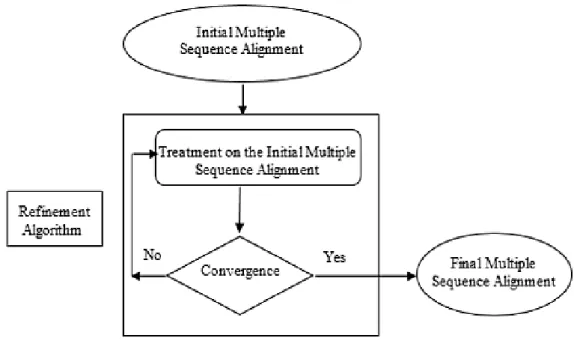
Each algorithm adopting progressive approach or iterative approach produces mistakes in multiple sequence align-ment, thus, we used refinement algorithms in order to cor-rect bad aligned residues, that can ameliorate the quality of the multiple alignment by ameliorate his scores. The pro-cess of all refinement algorithms consists to apply a set of modifications to an initial multiple sequence alignment in order to construct a new one having better scores than the previous alignment. These modifications are repeated un-til convergence(i.e. no improvement can be made on the current alignment). There are different algorithms for re-finement of multiple sequence alignments:
1. RASCAL [15]: Rascal operates as follows: First, we analyse the initial multiple sequence alignment and detect the well-aligned regions by applying the Mean Distance (MD). Then, we detect the badly aligned re-gions. Finally, we realign the badly aligned rere-gions.
2. REFINER [16]: when applying REFINER algorithm on a multiple sequence alignment, we realign each se-quence with the profile of the multiple sese-quence align-ment of the remaining sequences. Convergence is ob-tained when all the iterations is realised and each se-quence is realigned.
3. RF [17]: is similar to the REFINER algorithm but the convergence is obtained when the number of iterations is equal to 2N2 where N is the number of sequences.
4. REFORMALIGN [18]: Using REFORMALIGN, we construct the final alignment indirectly. First, we start by constructing a profile to the initial multiple se-quence alignment. Then, we align each sese-quence to the profile constructed in the first step. Finally, we merge all the sequences alignment in order to obtain the final alignment.
Thus, Refinement algorithms are used in order to enhance a multiple sequence alignment (MSA). Indeed, we start by an initial multiple sequence alignment by using one mul-tiple sequence alignment algorithm. Then, we apply the refinement algorithm to the initial multiple sequence align-ment in order to construct a new more accurate multiple sequence alignment having higher score.
2
Block definition
We propose a new algorithm calledRefin-Alignfor refin-ing multiple sequence alignment. Refin-Alignuses a new definition of block. Indeed, a block is defined as a multi-ple alignment of substrings extracted from a multimulti-ple se-quence alignment. A block is formed of at least two adja-cent columns separated from the initial alignment on both sides by a column formed only of identical characters. Our new definition of blocks is different from the standard defi-nition of blocks, which presents the blocks as substrings de-limited by columns containing at least one gap. The blocks are extracted from the initial multiple alignment and then they will be realigned to improve their scores. A block is defined as follow:
– A set of aligned substrings
– having the same size in each sequence
– A block must contain at least two columns
– No substrings formed the block must be formed en-tirely of gap
– A block must not contains a column having exactly the same character.
3
Refin-Align: New refinement
algorithm
Figure 3: Refinement process.
Figure 4: Block extraction.
more possibility for the characters of the initial alignment to be realigned. OurRefin-Alignalgorithm operates as fol-lows:
1. First, we extract the blocks from the initial multiple sequence alignment.
2. Then, we compute the scores of each block. We use the sum of pairs score SP[19]. The SP score corre-spond to the sum of the scores for all pairs of aligned characters. SP score is computed using this formula:
SP(A) = L X
i=1
X
1<k<j<l
s(wk[i], wj[i]) (1)
Where wk[i] and wj[i] are the characters in the se-quenceskandjthat are in the ith column of the align-mentA,Lis the length of the alignmentAandsis the score of aligning a pair of characters.
3. Then, we delete gap character from each block and we apply a multiple sequence alignment algorithm Pro-malign[20] to align these set of new sequences.
4. Finally, we compute the new SP scores. In the case where the scores of the new multiple alignment of blocks are higher than the previous scores, the initial alignment is replaced by the new alignment of blocks obtained.
We repeat this same process, by identifying the new blocks, until we can no longer improve the SP score of each block. The same process is applied for all the blocks of the multi-ple alignment.
4
Illustrative example
Let be A a multiple sequence alignment of a set of 4 se-quences. From this alignment, we extract the blocks B1, B2, B3.
Figure 5: Alignment A contains three blocks B1, B2, B3.
Alignment A contains three blocks B1, B2, B3, we will present the treatment of the second block B2. The same process is repeated for all the blocks.
530 Informatica43(2019) 527–534 A. Mokaddem et al.
Figure 6: Block B2.
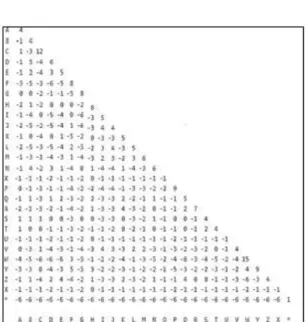
Figure 7: Matrix VTML200.
the Matrix represent the gap ’-’ character)
SPb:= s(A,A)+2*s(A, V) + 2*s(A, Q) + s(V, Q)+ 4* s(Q, -) + s(Q, Q) + s(-, -) + 3*s(Y,Y)+ 3* s(Y,Q).
SPb:= 0.
Then, we delete gap ’-’ characters.
Figure 8: Block B2 without gap.
Then, we realign the block B2, we obtain the following new block.
We compute the SPa score. The SP score of the block B2 after alignment.
SPa:= s(A,A)+2*s(A, V) + 2*s(A, -) + s(V, -) + 3*s(Q, -) +3*s(Q, Q) + 3*s(Y,Y) + 3* s(Y,Q)
SPa:= 1.
The score SPa after alignment is higher than the score SPb before alignment. Thus, we replace the old block B2
Figure 9: Realign the block B2.
by the new block B2 in the initial multiple sequence align-ment.
We obtain the following new multiple sequence align-ment.
Figure 10: Multiple sequence alignment after refinement.
5
Experimental study
In this section, we present the experimental study realized in order to evaluate the performances of our algorithm. In this experimental study, we use the datasets extracted from several benchmarks. These benchmarks maintain reference multiple sequence alignments constructed in manually or automatically. Moreover these benchmarks continent the scores that allow to compare between the reference multi-ple sequence alignment in the benchmarks and the test mul-tiple sequence alignment. We used the following scores to compare between the refined multiple sequence alignment obtained using ourRefin-Alignalgorithm and the reference multiple sequence alignment in the benchmark.
– (Column Score (CS) [22] is the ratio between the number of correctly aligned columns and the number of all columns whose alignments are known.
CS= 1/L∗
L X
i=1
Ci (2)
Ci= 1if all the character of the ith column of the test alignment well aligned in the reference alignment in the benchmark elseCi = 0. Lthe number of column where their alignment are known.
SP S= Pct
i=1Pi
Pcr
r=1Pr
(3)
Piis the number of pairs of character well aligned in the columni,Ctis the number of column in the align-ment test,Prthe total number of all pairs of character whose alignments are known. Crthe number of col-umn in the reference alignment.
We used the Qscore program [5] to compute different scores of the different multiple sequences alignments. Each benchmark uses one notation of the same scores for exam-ple BALIBASE uses SPS and CS scores however PREFAB uses respectively Q and TC scores. In our experimental study we used Q and TC scores notations. The datasets used in our experimental study are extracted from the fol-lowing benchmarks for protein sequences:
1. BALIBASE [23]: This benchmark is the first bench-mark dedicated to protein multiple alignment algo-rithms and contains a number of accurate reference alignments grouped in different references according to the nature of the set of the sequences used. The alignments are constructed based on the superposition of proteins tertiary structures and manual improve-ment of the results. BALIBASE in the first version contain 5 references, in the last version BALIBASE other references are included. The references are:
– Reference 1 contains short sequences with dif-ferent sizes,
– Reference 2 is composed of sequence families aligned with one, two or three orphan sequences,
– Reference 3 is composed by groups of sequences having 25% of identity by groups,
– Reference 4 and 5 are composed by extensions and insertions in the sequences,
– Reference 6, 7 and 8 are composed by repeat and circular permutation in the sequences.
– Reference 9 contains motifs in all the sequences.
BALIBASE uses the CS and SPS.
2. PREFAB [5]: This benchmark is made up of 1932 multiple alignments constructed automatically in the following way: The tertiary structures of two se-quences are aligned by using two different superpo-sition methods. A set of 50 homologous sequences is then extracted from databases and a multiple align-ment is constructed for the whole set of sequences. PREFAB uses only the Q score that is similar to the SPS score of BALIBASE because the comparison is realized between two aligned sequences, extracted from the reference multiple sequence alignment, and the pairwise alignment of the same sequences ex-tracted from the test multiple sequence alignment
3. OXBENCH [24]: This benchmark is constructed in an automatic way, by aligning known tertiary structures extracted from the Protein Data Bank (PDB) using the AMPS method [25]. OXBENCH uses the Q score and the TC score.
4. HOMSTRAD [26]: It contains 1032 multiple se-quences alignments of protein sese-quences representing different structures and grouped in homologous fami-lies.
We assess our program Refin-Align using the following methods:
– First, we construct for every dataset an initial set of multiple sequences alignments using the following programs: Clustal Omega, MUSCLE, and MAFFT.
– Then, we compute the column score (CS) [22] and the sum of pairs scores (SPS) [22] before refinement for every multiple sequence alignment in the set.
– Then, we apply our algorithm Refin-Align to each multiple sequence alignment in order to obtain the re-finement multiple sequence alignment. After that, we compute the column scores (CS) and the sum of pairs scores (SPS) for each multiple sequences alignment after refinement.
– Finally, we compare between the scores obtained be-fore applying our refinement algorithm and those ob-tained after applying our refinement algorithm.
Scores Q-scores T-scores
Before After Before After
MAFFT 73,30 73,42 52,48 52,85
MUSCLE 73,04 73,82 54,01 54,63
Clustal Omega 70,06 71,36 46,70 47,14
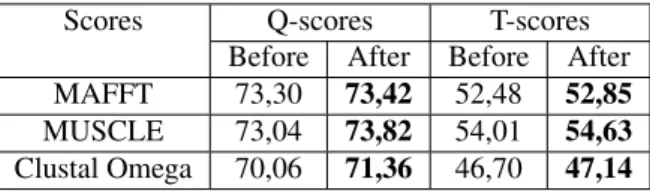
Table 1: Scores obtained using HOMSTRAD Benchmark
The results of the Program MUSCLE, MAFFT and Clustal Omega are respectively obtained using the program MUSCLE, the online web server of MAFFT and the online web server of Clustal Omega.
These tables below represent the SPS and CS scores ob-tained.
Table 1 represents the Q-scores and the TC scores ob-tained before refinement and the scores after refinement on a set of multiple alignment sequence extracted from HOM-STRAD Benchmark.
We benchmarked also our programRefin-Alignon a set of datasets extracted from OXBENCH Benchmark. Table 2 shows the average of the TC scores and the Q-scores ob-tained.
532 Informatica43(2019) 527–534 A. Mokaddem et al.
Scores Q-scores T-scores
Before After Before After
MAFFT 79,63 81,63 70,20 71,60
MUSCLE 80,45 81,74 70,21 70,89
Clustal Omega 84,37 84,42 67,25 67,04
Table 2: Scores obtained using OXBENCH Benchmark
The comparison of alignments for the PREFAB and the scores computing is different from other benchmarks; this is due to the method of creating this benchmark. Indeed, the reference alignments is a set of pairwise alignment extracted from the multiple sequence alignment. Thus, the Q-scores are computed between the reference pairwise alignment and the test pairwise alignment of the same se-quences. In this case, the Q and TC scores are identical.
Table 3 shows the average of Q-scores obtained by ap-plying our refinement Refin-Align algorithm on a set of multiple sequence alignment of datasets extracted from PREFAB.
Q-scores Before After
MAFFT 62,07 62,07
MUSCLE 65,06 66,04
Clustal Omega 64,60 64,19
Table 3: Scores obtained using PREFAB Benchmark
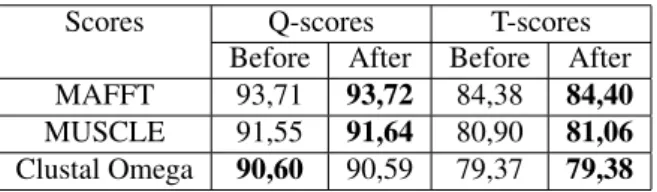
We also benchmarked our algorithmRefin-Alignon all the 44 datasets of RV12 reference of BALIBASE and we compute the Q-scores and the TC scores. RV12 represents the reference 1 of the BALIBASE benchmark that contain sequences having between 20% and 40% of identity. Table 4 represents the average scores obtained.
Scores Q-scores T-scores
Before After Before After
MAFFT 93,71 93,72 84,38 84,40
MUSCLE 91,55 91,64 80,90 81,06
Clustal Omega 90,60 90,59 79,37 79,38
Table 4: Scores obtained using RV12 BALIBASE Bench-mark
We note that for several datasets, our refinement algo-rithm Refin-Align can ameliorate the scores of many dif-ferent multiple sequences alignments obtained by differ-ent multiple sequences alignmdiffer-ent algorithms. In fact, the refinement multiple sequence alignment after refinement have the best SPS and CS scores for the most datasets used.
6
Conclusion and perspectives
In this paper, we presented a new refinement algorithm for multiple sequence alignment called Refin-Align. Our al-gorithm adopts a new definition of block and use theses blocks to construct a new multiple sequence alignment by realigning these blocks.
We assess our algorithm using different datasets ex-tracted from different benchmarks and using the more ef-ficient multiple sequence alignment algorithms MUSCLE, MAFFT and Clustal Omega. For several datasets, our algo-rithm can ameliorate the SPS and CS scores for the initial multiple alignment.
In future work, we would like also to compare the results obtained by our program to other refinement programs. We would like also to asses our algorithm on DNA and RNA datasets. We can also improve the scores by using different alignment algorithms to align the blocks in order to obtain the more accurate multiple sequence alignment.
References
[1] Needleman B.S., Wunsch, D. C., (1970) A general method applicable to the search for similarities in the amino-acid sequence of two proteins,Journal of Molecular Biology, 48, pp. 443–453.
https://doi.org/10.1016/ 0022-2836(70)90057-4.
[2] Wang, L., Jiang, T., (1994). On the complexity of multiple sequence alignment,J. Comput. Biol.1(4), pp. 337-348.
https://doi.org/10.1089/cmb.1994.1. 337.
[3] Thompson, J. D., Higgins, D. G., Gibson, T. J., (1994). CLUSTALW: improving the sensitivity of progressive multiple sequence alignment through sequence weighting, position specific gap penalties and weight matrix choice. Nucleid Acids Research, 22(22), pp. 4673-4680.
https://doi.org/10.1093/nar/22.22. 4673.
[4] Notredame, C., Heringa, J., Higgins, D., (2000). T-COFFEE: A novel method for fast and accurate multiple sequence alignments.J. Molecular Biology, 302(1), pp. 205-217.
https://doi.org/10.1006/jmbi.2000. 4042.
[5] Edgar, R.C. (2004). MUSCLE: multiple sequence alignment with high accuracy and high throughput. Nucleic Acids Research, 32(5), pp. 1792-1797. https://doi.org/10.1093/nar/gkh340.
multiple sequence alignment.Molecular Biology and Evolution, 30(4), pp. 772-780.
https://doi.org/10.1093/molbev/ mst010.
[7] Yongtao, Y., Cheung, David, W., Wang, Yadong W., Yin, S. M., Zhang, Q., Lam, T. W., Ting, H. F.,.(2013). GLProbs: Aligning Multiple Sequences Adaptively. IEEE/ACM Transactions on Computa-tional Biology and Bioinformatics, 12(1), pp. 67-78. https://doi.org/10.1109/TCBB.2014. 2316820.
[8] Sievers, Fabian, Higgins, Desmond, G. (2014). Clustal Omega, accurate alignment of very large numbers of sequences,Multiple Sequence Alignment Methods, (1079), pp, 105-116.
https://doi.org/10.1007/ 978-1-62703-646-7_6.
[9] Mokaddem A. Elloumi, M. (2013). New distances for improving progressive alignment algorithm. Advances in Computing and Information Technology, (177), pp. 243-251.
https://doi.org/10.1007/ 978-3-642-31552-7_26.
[10] Kimura, M. (1983). The Neutral Theory of Molecular Evolution.Cambridge University Press, Cambridge. https://doi.org/10.1017/
CBO9780511623486.
[11] Sneath, P., Sokal, R., (1973). Numerical Taxonomy. San Francisco Freeman, pp. 230-234.
https://doi.org/10.2307/2529664.
[12] Saitou, N., Nei, M..(1987). The Neighbor-Joining Method: A New Method for Reconstructing Phylo-genetic Trees.Mol. Biol. Evol, 4(4), pp. 406-425. https://doi.org/10.1093/
oxfordjournals.molbev.a040454.
[13] Naznin, F, Sarker. R, Essam D, (2012). Progressive Alignment Method Using Genetic Algorithm for Multiple Sequence Alignment.IEEE Transactions on Evolutionary Computation, 16(5), pp. 615-631. https://doi.org/10.1109/TEVC.2011. 2162849.
[14] Behera, N., Jeevitesh, M. S., Josea, J., Kant, K., Dey, A., Mazher, J., (2017). Higher accuracy protein multiple sequence alignments by genetic algorithm. Procedia Computer Science, 108, pp. 1135-1144. https://doi.org/10.1016/j.procs. 2017.05.100.
[15] J. D. Thompson, J. C. Thierry, O. Poch (2003) RASCAL: rapid scanning and correction of multiple sequence alignments. Bioinformatics, 19(9), pp 1155-1161.
https://doi.org/10.1093/ bioinformatics/btg133.
[16] Chakrabarti, S., Lanczycki, C. J., Panchenko, A. R., Przytycka, T. M., Thiessen, P. A., Bryant, S. H., (2006). Refining multiple sequence alignments with conserved core regions,Nucleic Acids Res,34(9), pp. 2598-2606.
https://doi.org/10.1093/nar/gkl274.
[17] Wallace, I.M., Blackshields, G., Higgins, D.G., (2005). Multiple sequence alignments. Current Opinion in Structural Biology, 15, pp. 261-266. https://doi.org/10.1016/j.sbi.2005. 04.002.
[18] Lyras, Dimitrios P., Metzler, Dirk. (2014) Refor-mAlign: improved multiple sequence alignments using a profile-based meta-alignment approach.BMC bioinformatics, 15(1), pp. 265.
https://doi.org/10.1186/ 1471-2105-15-265.
[19] Altschul, S.F.(1989). Gap costs for multiple sequence alignment.J Theor Biol., 138(3), pp. 297–309. https://doi.org/10.1016/
S0022-5193(89)80196-1.
[20] Mokaddem, A.,Hadj, A. B., Elloumi, M., (2018). Pro-malign: Multiple Sequence Alignment Algo-rithm using Approached Profile.Journal of software, 13 (1), pp. 57-65.
https://doi.org/10.17706/jsw.13.1. 57-65.
[21] Muller, T., Spang. R, Vingron. M, (2002). Estimating amino acid substitution models: a comparison of dayhoff’s estimator, the resolvent approach and a maximum likelihood method.Mol Biol Evol, 19(1), pp. 8-13.
https://doi.org/10.1093/
oxfordjournals.molbev.a003985.
[22] Thompson, J.D., Plewniak, F., Poch, O. (1999). BAliBASE: a benchmark alignment database for the evaluation of multiple alignment programs. Bioinformatics, 15(1): pp. 87-88.
https://doi.org/10.1093/ bioinformatics/15.1.87.
[23] Thompson, J.D.„ Koehl P., Ripp R., Poch O.(2005) BAliBASE 3.0: latest developments of the multiple sequence alignment benchmark. PROTEINS: Struc-ture, Function, and Bioinformatics, 61(1), pp. 127-136.
https://doi.org/10.1002/prot.20527.
534 Informatica43(2019) 527–534 A. Mokaddem et al.
accuracy.BMC Bioinformatics, 4(1), pp. 47. https://doi.org/10.1186/ 1471-2105-4-47.
[25] Barton, G.J., Sternberg, M.J.: (1987). A strategy for the rapid multiple alignment of protein sequences, confidence levels from tertiary structure comparisons, J Mol Biol, 198(2), pp. 327-337.
https://doi.org/10.1016/ 0022-2836(87)90316-0.
[26] Stebbings, L. A. and Mizuguchi, K., (2004). HOM-STRAD: recent developments of the Homologous Protein Structure Alignment Database.Nucleic Acids Research, 32, pp. 203–207.