ORIGINAL RESEARCH ARTICLE
Married Adolescents and Family Planning in Rural Ethiopia:
Understanding Barriers and Opportunities
DOI: 10.29063/ajrh2018/v22i4.3
Helen Ketema
1and Annabel Erulkar
2*University of Toronto, Canada1; Population Council, Addis Ababa, Ethiopia2
*For Correspondence: Email: [email protected]
Abstract
Large numbers of girls in the developing world are married before age 18, an estimated 100 million girls in the next decade. It is assumed that newly married girls are under pressure to have children early in marriage. However, there is increasing evidence that married adolescent girls have significant levels of unmet need for family planning (FP). This qualitative study explores married girls‘ knowledge and demand for FP, as well as barriers and support. Qualitative data was obtained from girls who married as children in rural Ethiopia. Respondents demonstrated a high interest in FP, while the power dynamics within arranged marriages were the biggest factor influencing FP use. Disapproval of FP use was considerable among in-laws and community members; however, partner approval was the main determining factor in girls‘ FP use. Some service providers reportedly reinforced this dynamic; some girls reported that they requested confirmation of the husbands‘ approval of FP use. The findings suggest further investment in addressing social norms related to girls‘ status and voice. (Afr J Reprod Health 2018; 22[4]: 26-34).
Keywords: Child marriage, family planning, male involvement, Ethiopia
Résumé
Un grand nombre de filles dans les pays en développement sont mariées avant l'âge de 18 ans, soit environ 100 millions de filles au cours de la prochaine décennie. On suppose que les filles nouvellement mariées subissent des pressions pour avoir des enfants tôt dans le mariage. Cependant, il est de plus en plus évident que les adolescentes mariées ont d'importants besoins en matière de la planification familiale. Cette étude qualitative explore les connaissances et la demande de la PF, ainsi que les obstacles et le soutien des filles mariées. Les données qualitatives ont été obtenues auprès de filles mariées en bas âge dans une région rurale de l‘Éthiopie. Les répondants ont montré un grand intérêt à l‘égard de la PF, tandis que la dynamique du pouvoir au sein des mariages arrangés était le facteur le plus déterminant pour l'utilisation de la PF. La désapprobation de l‘utilisation de la PF était considérable parmi les beaux-parents et les membres de la communauté; toutefois, l‘approbation des partenaires était le principal facteur déterminant de l‘utilisation de la PF par les filles. Certains fournisseurs de services auraient renforcé cette dynamique; certaines filles ont indiqué avoir demandé confirmation de l‘approbation par le mari de l‘utilisation de la PF. Les résultats suggèrent d‘investir davantage dans le traitement des normes sociales liées au statut et à la voix des filles. (Afr J Reprod Health 2018; 22[4]: 26-34).
Mots-clés: Mariage des enfants, Planning familial, Participation masculine, Ethiopie
Introduction
Child marriage, defined as marriage before the age of 18, is still prevalent across Ethiopia despite the legal age of marriage being 18. Based on analysis of the 2016 Ethiopia Demographic and Health Survey (EDHS), among young women aged 20 to 24, 40% were married by age 18, and 14% by age 151. Very early child marriage – those occurring to
children faced multiple disadvantages, including compromises to their power and status in the family and community, their educational attainment, their potential to engage in productive livelihoods and their health2.
It is commonly believed that married girls are expected to bear children soon after their marriages, in order to prove their fertility. Research from Rwanda supports this assertion, showing that half of newly married adolescents were pressured to have children within the first year by families. However, the desires of partners and extended families may not align with those of girls themselves3. While two thirds of married adolescent girls in sub-Saharan Africa want a pregnancy in the next two years, one third do not. Among those who prefer not to be pregnant, only 21% of married girls in Africa use a modern contraceptive method4. This is not only reflective of high unmet need for family planning among married adolescents, but also suggests that social factors may influence the use of family planning among married adolescent girls.
Women‘s empowerment and support of partners and families have been shown to have a positive influence on family planning use. Analysis of Demographic Health Survey (DHS) data in Egypt found a positive relationship between women‘s decision making, autonomy, and their use of family planning methods5. Research in Rwanda has shown that women whose partners support family planning are eight times more likely to use family planning methods6. Other research based on the DHS from Namibia, Zambia, and Uganda demonstrate that women‘s empowerment and couple agreement on fertility are related to contraception use7. Conversely, little research has focused on child brides, family planning use, and how the diminished power married girls experience in their marital relationships and within their extended families may impact upon use of family planning and other decisions related to reproductive health.
Evidence is emerging from a number of settings of the significant unmet need for family planning among married adolescent girls.
Research conducted by the Population Council in slum communities of Dhaka, Bangladesh found
that the percent of married adolescent girls with an unmet need for family planning was higher amongst the youngest, least educated, unemployed, and those in arranged marriages8. Recent evidence from Nigeria has found that young women age 15-19 were more likely to have an unmet need for birth spacing and limiting, than those age 20-249. Unmet need for family planning in Ethiopia‘s Southern Nations, Nationalities, and People‘s (SNNP) Region was found to decrease as age increases, and to be related to low education levels10. In Ethiopia, currently married girls aged 15 to 19 have the highest unmet need for family planning (33%), compared to married women in other age groups1.
The research on the reasons for unmet need among married adolescent girls is limited. Various studies have highlighted community perceptions and social stigma11 poor quality of care and commodity stock-outs12 and partner influence13 as influential factors on the use of family planning among girls married as children. This qualitative study explores married girls‘ views and experiences of family planning, including barriers to family planning use, in a rural community in Beneshangul-Gumuz region, Ethiopia, a region with significant levels of child marriage. Although there are other studies on family planning and married couples in Ethiopia14 and on adolescents and family planning in general15, there is a gap in the literature on married adolescents and family planning use dynamics.
Methods
This study explored various dimensions of unmet family planning need among rural married girls in Ethiopia. The study took place in rural Beneshangul-Gumuz region, which is the region in Ethiopia with the second highest level of very early child marriage (before age 15) and fourth highest level of unmet need for family planning (21%)1. The objectives of the study were to explore married girls‘ knowledge of and access to family planning information and services; understand married girls‘
for family planning services, including those of husbands, in-laws, parents, service providers and the community-at-large.
This is a qualitative study composed of 16 respondents who were purposefully sampled in two woreda/districts of Beneshangul-Gumuz region: Sherkole woreda and Dibate woreda. The sample was restricted to young women aged 18-24 who had been married before age 18. Prior to sampling, the EDHS 2011 data for Beneshangul-Gumuz region was analyzed to understand the distribution of girls with different background characteristics, such as education level, age at marriage (both before age 15 and 15-18) and ethnicity. Using these distributions as a guide, respondent characteristics, such as the number of girls in the sample with different levels of education, marriage age, and ethnic group were predetermined, to mirror girls‘ demographic patterns in the region.
Two study woredas/districts were selected to represent the range of cultural patterns, ethnicities, and service availability. The two woredas/districts were in different administrative zones and non-contiguous. Four data collectors were recruited locally and trained in qualitative interview methods and the discussion guide. Interviewers possessed local language skills and, as local residents, were familiar with cultural practices in the region. The rural kebeles (lowest administrative unit) or villages within each woreda/district were chosen in collaboration with the Regional Health Bureau to represent the range of cultures, ethnicities and religions in the region. Kebele administrations provided the guides who were familiar with the study communities and helped recruit participants. As well, staff from local health centers and health extension workers assisted in identification of respondents.
Prior to the interview, consent was obtained from both the respondent and the respondent‘s husband or household head. While consent was not strictly required from the respondent‘s partner, such permission is socially expected and helps to prevent negative reactions from families and communities. Consent forms were available for participants to keep but most often, because of low literacy levels, oral consent was obtained by the interviewer explaining
confidentiality and other aspects of the study following a written script.
A discussion guide of questions guided the interview but interviewers were not confined to the guide; rather they were encouraged to probe and create a broad ranging conversation with research participants. The discussion guide covered topics such as education, family, marriage, couple communication, decision-making, family planning and health care utilization. The instrument was translated from English into Amharic and other local languages such as Afan Oromo. The guide was pilot tested by interviewers during the training, providing an opportunity to improve interviewing techniques.
All interviews were conducted in a private place and were tape recorded. Taped interviews were translated and transcribed in English. Once transcribed, the data was coded using the NVivo software and analyzed for emerging patterns across themes. Ethical approval was obtained from both the Population Council Institutional Review Board (IRB) and the local IRB in Beneshangul Gumuz region.
Results
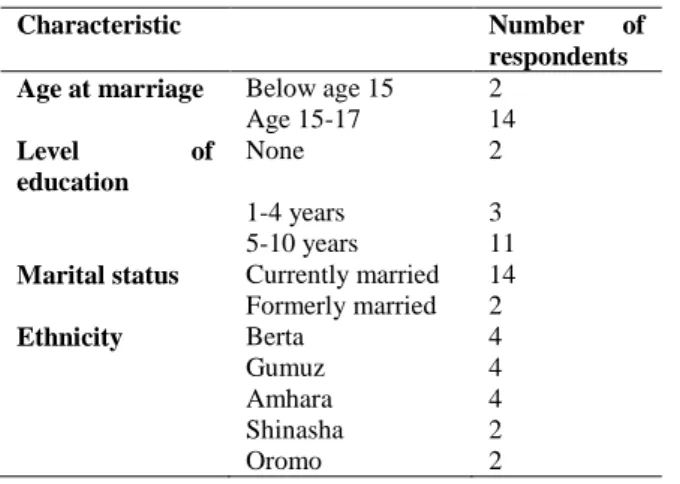
Table 1 shows the distribution of respondents for the study. Most of the respondents (14) were married during mid to later adolescence, between ages 15 and 17. Five respondents had fewer than five years of education while 11 had from five to ten years of schooling, reflecting a study population that might have been biased toward better educated respondents, compared to the general population. Respondents covered a range of ethnicities present in the region including Berta, Gumuz, Amhara, Shinasha and Oromo.
Patterns of marriage and marital relations
Almost all respondents had their marriages arranged for them by relatives, typically a father or brother. Some girls were married as a result of abduction, or telefa, where a man and a group of his male peers or family members abduct a young woman, rape her, and then negotiate a bride price
with her family in order to sanction the
Table 1: Distribution of married adolescent girls interviewed in rural Ethiopia, by background characteristics
Characteristic Number of
respondents Age at marriage Below age 15 2
Age 15-17 14
Level of education
None 2
1-4 years 3
5-10 years 11
Marital status Currently married 14 Formerly married 2
Ethnicity Berta 4
Gumuz 4
Amhara 4
Shinasha 2
Oromo 2
respondents had been married through exchange marriage, a common practice among the Gumuz ethnic group. Through exchange marriage, a man who wants to marry a girl in another family is obligated to commit his own sister to marry the brother of his intended bride.
Married girls had little or no choice in when they married and to whom. Most girls felt they could not defy decisions made by family members regarding their marriage. Even when girls had a boyfriend they were interested in marrying, they acquiesced to the choice of their families when an arranged marriage was presented:
They brought that person [husband] to me and they told me that the person who I love is not a good guy. So, I stopped my relationship with my boyfriend and I got married to the person of their choice. They said it is good and I made the right decision. – Age 18, married at age 16, 5 years education
The marriage was decided by my father and my brothers. It was decided by them. We were worried thinking that we cannot stop what is decided by them, so we took the oath [of marriage] and after that we were married to each other. – Age 23, married at age 15, 9 years education
Most often, girls were not informed of the marriage beforehand. They usually learned through friends or through rumors in the community. In effect,
girls were passive participants in their marriages. This lack of voice extended into their marital relationships. While many girls described discussing issues with their husbands, husbands were described as the ultimate decision maker in the relationship. Respondents often felt that husbands need to approve of any decisions or choices they made:
Everything now is not like the time before marriage. You live according to your husband‘s standards and orders, once you are married. You discuss together and you do what he requests. – Age 18, married at age 16, 5 years education
Awareness and demand for family planning
There was a general awareness of family planning, with many respondents having used a method at some time. However, respondents demonstrated limited knowledge of the variety of family planning methods and many were aware only of the injectable/depo or implants, the most commonly used methods in Ethiopia. Discussions about family planning were common among female friends, with respondents sharing their knowledge of family planning with other young women and also taking them to where the services were offered.
We discussed that… for example…we are going to build one home if Allah gives us money. We discussed to raise our one child in good manner. We are not going to have another child very soon; we thought to have another child after three years from now. This is because this child could be disadvantaged if we give birth to another child very soon. We need to avoid pregnancy for at least 3 or 4 years. Until that time, we have agreed to construct a home. – Age 18, 9 years
education, married at 15
If we give birth again and again – maybe yearly – then we cannot raise them properly and there will be too many children. So, it should be after two or three years that we need to give birth again – meaning when the first child is grown enough… It is a problem for me if I have many children. If I am taking care of one of them, the other one is waiting for my help. It is also impossible to care for their health in such a manner. We thought it would be problematic. – Age 19, married at age 16, 8 years education
Family, community and partner influence on
family planning use
Respondents reported significant social stigma related to family planning, including the disapproval of families and communities. Relatives were described as encouraging couples to have more children and dissuading the use of family planning. In particular, in-laws expected girls to bear children. There was an explicit expectation by families that girls give birth soon after marriage and prove their fertility before using family planning.
They [in-laws] say, we are not here to sit idle. We are here to give birth to children. – Age 23, married at age 15, 9 years education
They [community] asked me why I took family planning as I am young. They asked me why I take it in the beginning [of the marriage]. They told me it is not good. –Age 19, married at age 16, 8 years education
A community misconception that family planning causes infertility contributes to the negative view of family planning, especially early in the marriage. It was commonly believed that married girls should have at least one child before beginning family planning:
This is their view: if a woman uses family planning before giving birth, she will never have children at all. Maybe, there are women who cannot give birth anyway. If she takes this medicine [FP] and never gives birth, we say it is the medicine. They say after having one child, use family planning... – Age 20, married
at 16, 10 years education,
The influence of religion on the use of family planning differed by community. Religious influence was particularly strong in communities that were homogeneous in terms of religious and ethnic make-up. For example, one of the study woredas/districts – Sherkole woreda – was predominantly of the Berta ethnic group and Muslim religion. In such places dominated by a single ethnic group and religion, religious proscriptions against family planning were frequently invoked.
At the same time, negative attitudes towards family planning among the community and family were rarely described as the main barrier to family planning use. The biggest influence on married adolescents‘ use of family planning was their husbands. The societal views of family planning only impacted the family planning use of respondents in cases where their husbands accepted them. Many reported family members who were unsupportive of family planning use but when their husbands defied family wishes, they were able to use family planning.
What he [husband] said was, ‗I want two girls and two boys.‘ So, I had two boys. What the family said was ‗Don‘t use family planning because that is haram.‘ He [husband] said ‗No, use family planning. I only want four children.‘ - Age 20, married at 16, 10 years education
into decisions related to their reproductive health and family planning. When asked about barriers to family planning use, disapproving husbands were described as the biggest potential barrier. Husbands controlled choices related to fertility and family planning, including whether to use family planning, when to use family planning, the conditions under which it is used, and, at times, which method to use.
He [husband] thought, ‗Before even having one child, how can you use family planning?‘ Then he refused, ‗After you have one child then you will use [FP]. No one will refuse you then.‘ – Age 20, married at age 16, 8 years education
I didn‘t want to have a child as I was interested to complete my education. In the beginning, when we were married, he made me start a family planning method and he told me that I need to prevent the pregnancy for at least one year. – Age 18, married at age 15, 9
years education
The influence of husbands was a theme running throughout discussions of social barriers and community attitudes about family planning. The majority of respondents who had used family planning did so because their husbands had agreed to it or insisted on it. Consistent with data from surveys in Ethiopia, there was no indication of clandestine use of family planning
.
Health services
All respondents who had received family planning services had done so through their local health center, a pattern consistent with data suggesting that the public sector is the main source for family planning for Ethiopian women16. Choice of the health center as a source for family planning was attributed to the low cost or free service as well as the referral by the health extension workers. In addition, the methods used by respondents – injectables and implants - required visits to the health center rather than other outlets such as pharmacies. Despite residing in extremely remote communities, distance to the health center was not seen as an obstacle. Rather, ready supply at the
facility of the method of choice was viewed as an issue:
Ahaa…no this distance cannot be a barrier to them. If she cannot get her choice or if there are no pregnancy control methods in the health institution then such things could be barriers to them. Otherwise this distance is not a barrier to them. – Age 18 years old, married age 15, 1 year education
Respondents who were family planning users were generally satisfied with the services they received. Some respondents described that service providers requested the husband to be present and aware of the service. Thus, according to the reports of some respondents, some service providers reinforce husbands‘ control, and young women‘s lack of decision-making and autonomy related to family planning services.
The ones that give the medicine [family planning], they say, ‗Where is your husband? Why didn‘t he come, or have you not agreed?‘ They asked me this. [I said] ‗We agreed but he had to go to work. That is why he sent me here.‘ The professionals, they say we won‘t give you [family planning] unless your spouse comes… if you come with him, then we will give it. – Age 20, married at age 16, 10 years
education
Health Extension Workers did not seem to feature prominently in the provision of family planning in our study areas. Many respondents said that they had not received information on family planning from Health Extension Workers and none had received family planning from them. Some in remote communities had never seen a Health Extension Worker in their village and suggested a need for better awareness creation around family planning.
Discussion
although knowledge about method choices were limited, mainly to those commonly used in Ethiopia. The majority of respondents described that their husbands viewed family planning positively, which is consistent with studies from other parts of Ethiopia14. Concerns related to financial costs of children was one of the most prominent factors in support of family planning and appeared as an important motivation for husbands to accept family planning. Concerns surrounding reproductive and maternal health were also considered important amongst respondents, as well as devoting sufficient time to a newborn baby before having another one.
The lack of participation and control in decision-making was apparent in most girls‘ family and marital relationships. This lack of power and control cut across a range of decisions, including decisions of when and whom to marry, household decisions, and those related to family planning and healthcare. While many girls described discussions between partners, husbands were the ultimate decision-makers. Moreover, respondents never described taking actions without their husbands‘ approval, such as obtaining family planning services without his knowledge.
Families, especially in-laws, were strong opponents of family planning. The lack of awareness in some communities could be a contributing factor to the misconceptions about family planning and its effects on fertility, as many respondents reported a need for more education on the topic in their area. A major part of the community and family disapproval was rooted in the notion that newly married adolescents should not use family planning methods before having their first child, and respondents explained that this is because of a fear that methods might cause infertility. Many simply believed that it was the responsibility and role of newly married girls to bear children. While families were strongly pronatalist, decisions related to family planning rest firmly with husbands. Husbands were, at times, influenced by the views of their families or defied their wishes and supported girls‘ use of family planning. Some service providers were found to reinforce husband‘s control over family planning.
While distance to health facilities was not seen by respondents as a barrier to accessing services, stock-outs were described. Awareness creation about family planning was seen as a need in the communities. Respondents expressed the hope that the more the community is educated on family planning, the more acceptance family planning use will receive from communities and families. This study found possible gaps in the health extension worker program, as none of the respondents had obtained family planning services from HEWs and some had never met with a HEW in their area. Despite being part of the national strategy for improving sexual and reproductive health care, HEWs were not found to be key actors in providing family planning services to married adolescent girls in our study area. Given the significant investment and strong infrastructure of the Health Extension Program, this is a possible missed opportunity suggesting the need to direct more attention to the large and underserved married girl demographic.
This was a qualitative study which explored patterns and themes in the demand and use of family planning among married adolescent girls. As a small-scale study, our respondents are not likely to be representative of the entire population of the location, given that local guides assisted in the identification of study respondents. For example, respondents in this study tended to have higher levels of education than the average reported for the region in the Ethiopia DHS (2011). In order to identify strengths and weaknesses in the health system, a larger study including service providers and observations of client-provider interactions would provide more reliable data on health systems. A follow-on, quantitative study based on a representative sample would be needed to further investigate the extent of the themes presented, including familial views of family planning and patterns of decision-making among married girls, their spouses and their extended families.
The study underscored the need to improve girls‘ ability to make decisions and access services. Their limited decision-making and power within
Programs to engage males may well take advantage of the fact that decision-making rests with husbands. However, investment in programs for male partners in the absence of improving the status and voice of girls only reinforces girls‘ disadvantage. Additional investment is needed to evolve social norms related to girls‘ status and voice, directing programmatic content at girls themselves.
Acknowledgements
This study was made possible through the Evidence Project of the Population Council. The Evidence Project is made possible by the generous support of the American people through the United States Agency for International Development (USAID) under the terms of cooperative agreement no. AIDOAA-A-13-00087. The contents of this manuscript are the sole responsibility of the Evidence Project and Population Council and do not necessarily reflect the views of USAID or the United States Government. We are grateful to USAID/Ethiopia and the Federal Ministry of Health for support and facilitation of this study. The Regional Bureau of Health in Beneshangul-Gumuz provided valuable direction and guidance for the study along with District representatives and Kebele administrators. We are grateful to Mr. Getachew Kassa, Dr. Samuel Tefera, Ms Alemnesh Abreha, Mr. Mellese Gamachu and our interviewers for their commitment and extensive contributions to the study. Finally, we thank the respondents in rural Beneshangul-Gumuz for being so giving of their time, ideas and experiences.
Contribution of Authors
Annabel Erulkar conceived and designed the research and the research tools. Helen Ketema supervised data collection and undertook analysis. Both Erulkar and Ketema co-wrote the manuscript.
References
1. Central Statistical Agency [Ethiopia] and ICF
International. Ethiopia Demographic and Health Survey 2016. Addis Ababa, Ethiopia and Rockville, Maryland, USA. 2016.
2. Erulkar A. Early Marriage, Marital Relations and
Intimate Partner Violence in Ethiopia. International Perspectives on Sexual and Reproductive Health. 2013; 39:6-13.
3. Farmer D, Berman L, Ryan G, Habumugisha L, Basinga P, Nutt C, Kamali F, Ngizwenayo E, St. Fleur J, Niyigena P, Ngabo F, Farmer PE and Rich M. Motivations and Constraints to Family Planning: A Qualitative Study in Rwanda'a Southern Kayonza District.Global Health Sciences Practice 2015; 3(2): 242-254.
4. Guttmacher Institute. Facts on the Sexual and
Reproductive Health of Adolescent Women in the Developing World. 2010.
5. ALSumri H. A National Study: the Effect of Egyptian Married Women‘s Decision-Making Autonomy on the use of Modern Family Planing Methods.. African Journal of Reproductive Health 2015; 19(4): 68-77. 6. Brunie A, Tolley E, Ngabo F, Wesson J and Chen M.
Getting to 70%: Barriers to modern contraceptive use for women in Rwanda. International Journal of Gynecology and Obstetrics. Dakar. 2013. Second International Conference on Family Planning. 11-15. 7. Do M and Kurimoto N. Women's Empowerment and
Choice of Contraceptive Methods in Selected African Countries. International Perspectives on Sexual and Reproductive Health . 2012; 38: pp. 23-33.
8. Huda FA, Chowdhuri S, Sarker BK, Islam N and Ahmed A. Prevalence of unintended pregnancy and needs for family planning among married adolescent girls living in urban slums of Dhaka, Bangalesh. STEP UP Research Report . 2014.
9. Oginni AB, Ahonsi BA and Adebajo S . Trend and Determinants of Unmet Need for Family Planning Services among Currently Married Women and Sexually Active Unmarried Women Age 15-49 in Nigeria (2003-2013). African Population Studies. 2015; 291(1): 1438-1500
10. Hailemariam A and Haddis F. Factors affecting Unmet need for Family planning in Southern Nations, Nationalities and Peoples Region, Ethiopia. Ethiopian Journal of Health Science. 2011; 21(2); 77-89.
11. Adams MK, Salazar E and Lundgren R. Tell them you are planning for the future: Gender norms and family planning among adolescents in nothern Uganda . International Journal of Gynecology and Obstetrics 2013: 7-10.
12. Warren C. and Kibidi S. Safe Motherhood Community- Based Survey: Findings from SNNPR Region, Ethiopia. Population Council. 2009.
13. Erulkar A and Tamrat T. Evaluation of a Reproductive Health Program to Support Married Adolescent Girls in Rural Ethiopia. African Journal of Reproductive Health2014; 18 (2);68-76.
15. Feleke SA, Koye DN, Demissie AF and Menegesha ZB. Reproductive health service utilization and associated factors among adolescents (15-19 years old) in Gondar town, Northwest Ethiopia. BMC Health Services Research 2013: 1-10.