ORIGINAL RESEARCH ARTICLE
Introducing the Progesterone Vaginal Ring (PVR) as a New Option
for Postpartum Family Planning in Sub-Saharan Africa: Insights
from Engagements with Stakeholders
DOI: 10.29063/ajrh2018/v22i2.7
Salisu M Ishaku
1*, Nafissatou Diop
2, Babacar Mané
2, Wilson Liambila
4, Saumya RamaRao
3Heather Clark
3, Harriet Birungi
4, Godwin Unumeri
1, Francis Obare
4Population Council-Nigeria1; Population Council-Senegal2; Population Council-New York3; Population Council-Kenya4
*For Correspondence: Email: [email protected]; Phone: +234-803-295-6445
Abstract
The progesterone vaginal ring (PVR) is a ring-shaped device designed for use by women in the postpartum period to regulate fertility by complementing and extending the contraceptive effectiveness of lactational amenorrhea to suppress ovulation.1 It is available in eight Latin American countries for use by breastfeeding women who want more effective modern contraceptives in addition to contraceptive benefits provided by lactational amenorrhea alone.1 The PVR is a method that can be suitable to women in sub-Saharan Africa, given the near-universal practice of breastfeeding and the current level of unmet need for contraception in the postpartum period. Efforts are currently underway to introduce the PVR in Africa and south Asia. To ensure a seamless introduction, scale up and sustainability of the PVR in the region, the Population Council conducted pre-introductory activities with stakeholders in Kenya, Nigeria and Senegal to determine the level of interest in the ring, potential facilitating and mitigating factors and identify solutions to address challenges. The research team combined three approaches: in-depth interviews with family planning stakeholders; desk review of reports and policy guidelines; and in-group meetings. The stakeholders reached included public sector officials including policy makers and program managers, implementing partners, regulators, women and religious networks. All three countries had a promising policy and programmatic context that was supportive to PVR introduction. The exercise provided insights on socio-cultural and religious factors that could potentially impact how the PVR is perceived within communities and identified possible remedies to address misperceptions. It also paved the way for the conduct of an acceptability study of the PVR among breastfeeding women in these countries. The high acceptability rate in each country and the support expressed by government and other stakeholders have provided impetus for registration of the product in each country. Learning from this process could also direct how other family planning and reproductive health commodities would be introduced in the future. (Afr J Reprod Health 2018; 22[2]:68-75).
Keywords: Progesterone Vaginal Ring, postpartum family planning, sub-Saharan Africa
Résumé
élevé d'acceptabilité dans chaque pays et le soutien exprimé par le gouvernement et d'autres parties prenantes ont stimulé l'enregistrement du produit dans chaque pays. L'apprentissage de ce processus pourrait également indiquer comment d'autres produits de planification familiale et de santé reproductive seront introduits à l'avenir. (Afr J Reprod Health 2018; 22[2]: 68-75).
Mots-clés: Anneau vaginal de progestérone, planification familiale post-partum, Afrique subsaharienne
Introduction
Despite the progress made over the last few decades, up to 210 million women globally1-2, 3 and as high as 30% in many African countries, experience unmet need for contraception4. The need is even greater in the immediate postpartum period with about two-thirds of women, and as high as 74% in sub-Saharan African countries not using a modern contraceptive5. Sub-optimal birth spacing has deleterious effects on maternal and child health as complications are more common in pregnancies that occurred within two years of the previous birth1. Evidence suggests that uptake and continued use of modern contraceptive methods increases when additional methods are added to the mix6-7. This is also true for postpartum contraception from experiences in West and East Africa8. Therefore, the World Health Organization has recommended expanding contraceptive options during the postpartum period9. In the last few years, there has been increased attention for meeting contraceptive needs of women in the postpartum period by expanding the available choices. For a new product to be introduced successfully in each country, local stakeholders must be engaged from the beginning and briefed continuously along the entire process as they provide valuable information and guidance. Previous studies from Africa and Asia have espoused the benefits of early engagement with in-country stakeholders as a strategy for understanding local contexts to properly position new contraceptive products within the appropriate framework10-11.
In this respect, Population Council conducted a stakeholder mapping exercise in three countries in sub-Saharan Africa namely Kenya, Nigeria, and Senegal to determine the program and policy contexts as well as in-country level of interest for the progesterone vaginal ring (PVR) as a new method for postpartum contraception.
The PVR is a ring-shaped device used by women in the postpartum period to regulate fertility by complementing and extending the
contraceptive effectiveness of lactational amenorrhea to suppress ovulation. It diffuses a continuous flow of low doses of natural progesterone through the vaginal walls into the bloodstream. The ring is inserted in the vagina after 4 weeks postpartum and is used continuously for 3 months. The used ring can then be replaced with a new 3-month ring, up to three times, if breastfeeding is sustained adequately and continued contraception is desired.1 Although the PVR has been available and used in a few countries in central and south America, it is not widely available in Africa or Asia. In these regions, breastfeeding is near universal and for long durations and the product may serve the needs of the women in these settings as it was designed for nursing women. As the PVR is a self-initiated and user-controlled method, it would be suitable for many settings in Africa and south Asia where health infrastructures are weak. Due to the simplicity of its use, it can be provided through multiple outlets such as pharmacy and local drug shops. The Reproductive Health Supply Coalition (RHSC) identifies the PVR as an under-utilized reproductive health commodity12. As part of the stakeholder mapping, assessments of financing environment and procurement mechanisms for family planning and reproductive health commodities, analysis of existing socio-cultural and religious beliefs that could impact the PVR and assessment of policy and program environments in the respective countries were conducted. This paper highlights the processes, successes and potential challenges, as revealed through engagements with the stakeholders, and lessons learned that could shape the way the PVR and other new reproductive health and family planning commodities can be introduced in sub-Saharan Africa.
Methods
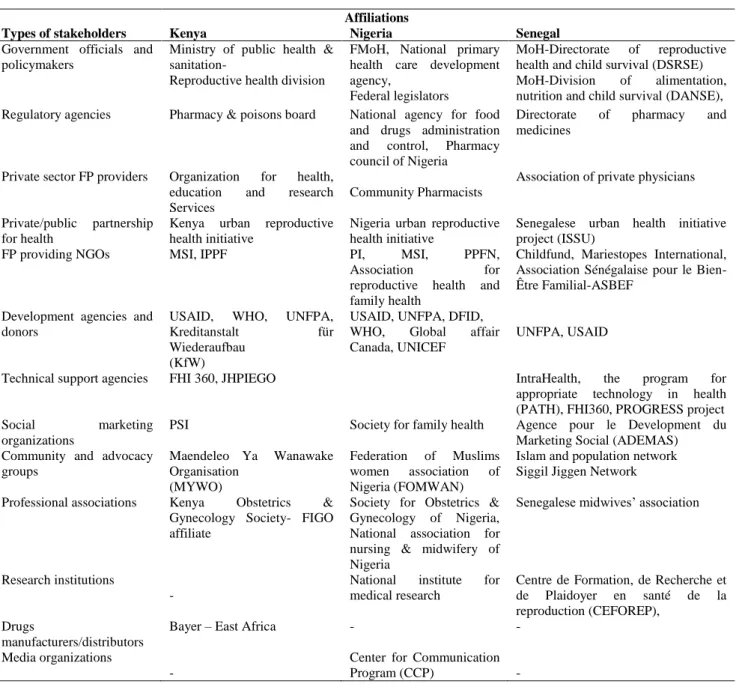
map out the family planning program and support for contraceptive technologies available in each country with the view to determining potentially supportive and limiting program, policy, and culturally relevant factors in each country. The research team carried out in-depth interviews and in-group meetings with stakeholders and reviewed numerous other policy documents and guidelines on contraceptive procurement and financing, local policy context and prevailing local sociocultural and religious beliefs and practices. A range of public and private sector stakeholders were consulted including government officials, regulators, policymakers, manufacturers and distributors, social marketing organizations, development partners and donors, research institutions, and civil society representatives such as advocacy groups, and members of the community. In all countries, a structured interviewer guide and check-list were developed and used for the interviews and reviews. Table 1 summarizes the affiliations of stakeholders interviewed in each country.
Results
The following describes the results of the landscaping assessment organized under the following thematic areas: 1. Supply side (Local policy context, procurement mechanisms, financing) and 2. Demand side (Socio-cultural and religious factors).
Local policy context
In each country, interviews with stakeholders confirmed a commitment of national authorities to position family planning as a priority strategy for reducing maternal and neonatal morbidity and mortality. For example, in Senegal in 2012, the Ministry of Health elevated the division of reproductive health to the rank of Directorate of Reproductive Health and Child Survival (DSRSE). The new Directorate developed an FP action plan for the period 2012–2015 with the ambitious objective of increasing contraceptive prevalence rate (CPR) from 12% in 2012 to 27% by 2015 and 45% by 2020. Increasing CPR for postpartum contraception is an integral part of this initiative, and the PVR was considered a valued addition. At
the same time, Nigeria was renewing its commitment to reposition family planning by pledging to provide $3 million annually from 2012 onward for procurement of contraceptive products with the aim of raising the country‘s CPR from 10% in 2012 to 36% by 2018 through making FP commodities available and accessible routinely, especially during postpartum period. In line with the FP2020 objectives, the government of Nigeria also pledged to provide additional $8.3 million for procurement of contraceptives. In Kenya, meeting contraceptive needs in postpartum period was already on the country‘s list of priority policy and programmatic actions. Stakeholders believed that there was a need for additional contraceptives to enhance contraceptive options since the last method to be introduced in the country was the sino-implant which was registered in 2008 and introduced in 2009. Kenya is committed to realizing the FP2020 goal by reaching an m-CPR of 58% by 2020 and an m-CPR of 66% by 2030. If the PVR were introduced, women would have one additional option. It is assumed that FP usage will increase given the high prevalence of breastfeeding in the country, and as noted earlier, the PVR requires the user to breastfeed at least four times a day.
In Nigeria, stakeholders observed that the sudden shift in attention and funding to emerging issues such as HIV/AIDS in the late 1990s, have derailed the implementation of the National Health Policy whose mandate was accelerating health and growth through improving access and use of family planning services. With the renewed commitment to re-position family planning services, especially during the postpartum period, the PVR is been regarded as a welcome addition. The family planning program in Nigeria has many challenges including limited skills of providers, weak supply chains, and stock-outs of contraceptives that can reduce the choice for a prospective user. The simplicity of the PVR administration in terms of not requiring sophisticated health system structure for its provision resonated well with stakeholders, given the fragile service environment especially in the northern part of the country.
Table 1: Stakeholders Interviewed and their Organizational Affiliation, by Country
Types of stakeholders
Affiliations
Kenya Nigeria Senegal
Government officials and policymakers
Ministry of public health & sanitation-
Reproductive health division
FMoH, National primary health care development agency,
Federal legislators
MoH-Directorate of reproductive health and child survival (DSRSE) MoH-Division of alimentation, nutrition and child survival (DANSE), Regulatory agencies Pharmacy & poisons board National agency for food
and drugs administration and control, Pharmacy council of Nigeria
Directorate of pharmacy and medicines
Private sector FP providers Organization for health, education and research Services
Community Pharmacists
Association of private physicians
Private/public partnership for health
Kenya urban reproductive health initiative
Nigeria urban reproductive health initiative
Senegalese urban health initiative project (ISSU)
FP providing NGOs MSI, IPPF PI, MSI, PPFN, Association for reproductive health and family health
Childfund, Mariestopes International, Association Sénégalaise pour le Bien-Être Familial-ASBEF
Development agencies and donors
USAID, WHO, UNFPA, Kreditanstalt für Wiederaufbau
(KfW)
USAID, UNFPA, DFID, WHO, Global affair Canada, UNICEF
UNFPA, USAID
Technical support agencies FHI 360, JHPIEGO IntraHealth, the program for appropriate technology in health (PATH), FHI360, PROGRESS project Social marketing
organizations
PSI Society for family health Agence pour le Development du Marketing Social (ADEMAS) Community and advocacy
groups
Maendeleo Ya Wanawake Organisation
(MYWO)
Federation of Muslims women association of Nigeria (FOMWAN)
Islam and population network Siggil Jiggen Network
Professional associations Kenya Obstetrics & Gynecology Society- FIGO affiliate
Society for Obstetrics & Gynecology of Nigeria, National association for nursing & midwifery of Nigeria
Senegalese midwives‘ association
Research institutions -
National institute for medical research
Centre de Formation, de Recherche et de Plaidoyer en santé de la reproduction (CEFOREP),
Drugs
manufacturers/distributors
Bayer – East Africa - -
Media organizations
-
Center for Communication Program (CCP) -
introducing the PVR in these countries. For example, the ongoing efforts in the three countries to increase availability and access to postpartum contraception provide impetus for programs that seek to introduce postpartum family planning methods such as the PVR.
Socio-cultural and religious factors
In Kenya, some of the stakeholders, especially community-based organizations, reported that rural women are usually reluctant to touching their
planning is harmful to women‘s health13
. However, there are some positive cultural beliefs and practices such as the near-universal breastfeeding practice, and the desire for long birth intervals in the community.
In Nigeria, the cultural and religious factors identified were both facilitators and barriers to uptake of family planning services. The existing practice of inserting vaginal substances as aphrodisiacs in northern Nigeria can facilitate women‘s desire to try the PVR as an intra-vaginal method. But even the barriers were not thought to be insurmountable to the PVR‘s use. For example, stakeholders indicated that in northern Nigeria, communities prefer female providers to minimize interactions between female clients and male providers for religious reasons. Interactions between a client and a provider that warrant vaginal procedures or other forms of intimate contacts are particularly problematic. The PVR does not require such procedures and intimacy as the woman can be instructed on how to insert and remove the ring by herself. As experience from the local communities indicates use of vaginal aphrodisiacs to be a relatively common practice, the concern around women touching their genital areas was not considered a barrier to women using the PVR. This entrenched practice could facilitate PVR adoption.
In all countries, interactions with stakeholders provided deeper understanding of how practices and beliefs rooted in religion and culture of the people could be harnessed to ensure that the PVR is introduced with minimal friction and tension. Commencing community awareness campaign in Kenya ahead of the PVR introduction, for example, could ameliorate women‘s anxiety around touching the genitals. Also, families in northern Nigeria would be more receptive to the PVR if they know that the ring is woman-initiated - and controlled.
Procurement mechanism
Based on conversations with stakeholders, the requirement for the PVR to be procured by the private sector is similar across the three countries, which is prior registration of the product in the respective countries. The mechanism for public sector procurement are similar across the three
countries with minimal variations. In Kenya, the endorsement of the PVR by the World Health Organization through inclusion in its Essential Medicines Lists (EML) would facilitate public sector procurement both directly by the government and by donors who support the national FP program in the country. In Senegal, public sector procurement will require a prior incorporation of the PVR into the national commodity security plan which is managed by a designated commodity security committee, a multi-disciplinary committee that operates through the National Procurement Pharmacy. In Nigeria, a pre-condition for public sector contraceptive procurement, including the PVR, is inclusion into the country‘s EML. Once this is achieved, public sector procurement can take place either via a direct government procurement or a public-sector procurer such as the UNFPA. However, in all three countries, initial in-country registration is required for subsequent inclusion into the EML. Due to the insights gained from stakeholder discussions, the research team has begun collaborations with national partners in the three countries to ensure the inclusion of the PVR on each country‘s EML. The PVR‘s inclusion into WHO guidelines and documents such as the latest edition of the EML, the fifth edition of the Medical Eligibility Criteria, and the 2017 Edition of the FP Handbook are facilitating factors.
Financing of contraceptive commodities
In Kenya, the government has a regular budgetary allocation for contraceptive products which was about $26 million and $37 million for the 2011-2012 and 2011-2012-2013 financial years respectively. Budget for contraceptive procurement are generally implemented in Kenya, and stakeholders believe that the total budgetary allocation for FP commodities would increase to accommodate the PVR that is being registered and introduced in the
country. UNFPA and USAID procure
financing continues to be the main source of funding for public sector financing. In Senegal, USAID and UNFPA are the main procurers of FP commodities. They procure approximately 99% of the contraceptive products (above $3 million) through their own specific channels, while the government procures for less than $100,000 of products through the national procurement pharmacy. In addition, Senegal is engaged in various innovative financing systems, such as the Global Financing Facility (GFF) initiative with the World Bank. These initiatives will contribute to supporting FP program implementation. Concomitantly, the private sector has its own channels for FP products procurement and pricing.
Synopsis
Dialogue with key stakeholders provided a roadmap for progesterone vaginal ring (PVR) introduction that reflects national priorities and needs. It helped identify country-level opportunities and potential challenges, as well as the roles that different stakeholders could play. The dialogue also contributed to prioritizing activities that need to occur including understanding how family planning commodities are financed and procured, and the required resources for successful introduction.
Discussion
Understanding the various elements and processes around contraceptive procurement, financing, delivery, and uptake in a given system is an important initial step for a successful contraceptive introduction as observed in all the three countries. This initial engagement with stakeholders enabled us to determine and select countries in the region where there would be need and interest for the introduction of a new FP product. It also sheds light on intermediary activities and pathways existing in each country that determine how commodities reach their target beneficiaries wherever they live. Ensuring cultural and religious harmony with a given contraceptive product has been highlighted in a previous study12. The realization that some women in Kenya may be reluctant to touching their genitals calls for the
need to commence behavior change
communication programs ahead of time. The lessons and experience from Kenya will also be relevant to Nigeria, Senegal and other countries. Such programs will also be needed in Senegal where up to 90% of couples still believe that it is only God that determines the number of children a woman can have, and where nearly half of men believe that family planning products are harmful to women‘s health13
. The adoption of a national family planning communication plan in the Senegal in the year 2012 is already yielding results with the recent surge in family planning use. This creates a highly receptive environment for the PVR and other FP and RH commodities that may newly arrive in the country. The preference for a female provider in northern Nigeria would not adversely affect the PVR as the product does not require vaginal procedures or other intimate contacts between the provider and the clients; the PVR can be initiated and discontinued by the woman herself. Also, the practice of vaginal insertion of substances such as aphrodisiacs shows that women are already used to touching their genitals, a practice that could accelerate the uptake of the PVR.
across countries, the main cross-cutting requirement is getting the product on the countries‘ EML. Now that the PVR is on both the WHO EML17 and WHO Medical Eligibility Criteria (MEC) for contraceptive products18, the process for individual country getting the PVR on their respective EML is deemed simplified.
Financial support for contraceptives products procurement and distribution from public budget is not always forthcoming in Nigeria and Senegal. An important proportion of family planning use comes from the private sector accounting for 60% of contraceptive use in Nigeria19. And in both countries, donor funding covers most of the public sector need in terms of procurement, distribution and training of family planning providers. The PVR introduction process will leverage the private sector market while continuing to collaborate with civil society organizations such as the Civil Society for Family Planning in Nigeria (CiSFP) and the Siggil Jiggen Network in Senegal, for continuous advocacy to government for increased financing and spending for family planning services. This also calls for early collaboration with public sector procurers in Nigeria and Senegal to ensure the PVR is being included on the contraceptive procurement list of government in the two countries. Given the high proportion of women who expressed willingness to pay for the PVR even at about $2 per cycle in each country20, the commodity should be expected to generate high clientele in the private sector while a public-sector response is being anticipated.
Conclusion
Kenya, Nigeria, and Senegal presented promising policy and programmatic context for PVR introduction. For example, Kenya has already officially identified postpartum period as the period with the greatest unmet need requiring urgent attention augurs well for the PVR. Their near-universal breastfeeding culture and the large unmet need for contraception among breastfeeding women indicate a potential for the PVR in these settings. Their commitment to several global and local initiatives such as the FP 2020 declaration, repositioning of family planning program in Nigeria and the DSRSE in Senegal are ongoing
opportunities to leverage as the ring is being introduced into the respective country‘ FP programs. However, to ensure sustainable integration of the product into the method mix, it will be necessary to conduct the introduction process systematically. A practical approach would entail initial introduction in private sector to be followed by the public sector. We anticipate that the product will be available through multiple outlets ranging from tertiary to primary care facilities and through pharmacies, drug stores and community-based distribution networks. In a nutshell, engagement with country-level stakeholders has proven useful in providing information that set the stage for the PVR registration and introduction, elucidating financing needs and procurement strategies not only for the PVR but potentially for other FP and RH products in the pipeline.
References
1. RamaRao S, Ishaku S, Liambila W and Mane B.
Enhancing contraceptive choice for postpartum women in sub-Saharan Africa with the progesterone vaginal ring : a review of the evidence. Open Access Journal of Contraception 2015; (6) 117–123 2. Osotimehin B. Family planning saves lives, yet
investment falters. Comment. The Lancet.com 2012 ;380 ; http://dx.doi.org/10.1016/So140-6736(12)60906-4
3. Singh S and Darroch JE. Adding it up: costs and benefits of contraceptive services — estimates for 2012. New York : Guttmacher Institute and United Nations Population Fund.2012
4. John C, Igbal HS and Lenka B. The contraceptive revolution: focused efforts are still needed. The lancet.com 2012 ; (381) : S0140-6736(13)60588-7 5. Jesse R, Elizabeth N, Nora WC, Christine G, Shuyuan H
and Mariela R. Rapid contraceptive uptake and changing method mix with high use of long-acting reversible contraceptives in crisis-affected populations in Chad and the Democratic Republic of the Congo. Global Health : Science and Practice
2016; (4) Supplement 2
6. John R and John S. Use of modern contraception increases when more methods become available : analysis of evidence from 1982–2009. Global Health : Science and Practice 2013; (1): 2
7. Tsigue P, Yolande H, Suzanne H, Abdoulaye D, Blami D, Rachel W and Priya K. Increasing use of postpartum family planning and the postpartum IUD : Early experiences in West and Central Africa.
WHO and partners release programming strategies for postpartum family planning. Global Health: Science and Practice 2014; (2): 1
9. Jane KC Jennifer KD, Imelda TK, Eleanor T, Tanya D and Claudia H. Stakeholder and provider views regarding peri-coital contraceptive pills in India and Uganda. Studies in Family Planning 2013; 44 (4): 431-444.
10.Kevin M, Jennet A, Kate HR, Caroline M, Fidele N, Emmanuel M, Jennifer W and Elizabeth ET. Policy and programmatic considerations for introducing a longer-acting injectable contraceptive : perspectives of stakeholders from Kenya and Rwanda. Global Health: Science and Practice 2014; (2): 4.
11.Clark H and Sophia DR. New and under-used
reproductive health technologies Caucus meeting background, progress and updates. Reproductive Health Supply Coalition. 2015 ; Retrieved February
2017 from
http://.www.rhsupplies.org/fileadmin/uploads/rhsc. 12. Ujuju C, Anyanti J, Adebayo SB, Muhammad F, Oluigbo
O and Gofwan A. Religion, culture and male involvement in the use of the Standard Days Method: evidence from Enugu and Katsina states of Nigeria. International Nursing Review 2011; 58 : 484–490.
13. Intrahealth International. 2011 baseline Survey for the Urban Health Initiative Project. Household Survey.
Final Report. Chapel Hill, NC. 2012
14. Obare F, Liambila W, Birungi H, Eseoise I, Clark H and RamaRao S. Progesterone vaginal ring – country mapping : Kenya. Technica report. The Population Council, Inc. 2012
15. Ishaku S and RamaRao S. Progesterone vaginal ring – country mapping : Nigeria. Technical report. The Population Council, Inc. 2012
16.Mane B, Diop N, Nancy T, RamaRao S and Clark H. Progesterone vaginal ring – country mapping : Senegal. Technical report. The Population Council, Inc. 2012
17. World Health Organisation. WHO Model List of Essential Medicines 2015 ; Retrieved 05 February,
2015 from
http://www.who.int/medicines/publications/essentia lmedicines/en/
18.World Health Organization. Medical eligibility criteria for contraceptive use 2015 ; 5th ed. ISBN 978 92 4 154915 8
19. National Population Commission (NPC) [Nigeria] and ICF International. Nigeria Demographic and Health Survey 2013. Abuja, Nigeria, and Rockville, MD: NPC and ICF International. 2014