ORIGINAL RESEARCH ARTICLE
Religious Perceptions and Attitudes of Men towards Discontinuation
of Female Genital Cutting in Nigeria: Evidence from the 2013
Nigeria Demographic and Health Survey
DOI: 10.29063/ajrh2018/v22i1.2
Ayotunde Titilayo
1,2*, Martin E. Palamuleni
1, John O. Olaoye-Oyesola
2and Olumide M.
Owoeye
3Population Training and Research Unit, North West University, Mmabatho, South Africa1; Demography and Social Statistics Department, Obafemi Awolowo University, Ile-Ife, Nigeria2; Department of Sociology, Bowen University, Iwo, Nigeria3
*For Correspondence: Email: [email protected]; Phone: 234-802-329-2667
Abstract
Men‘s roles in any patriarchal society and the influence of their religious belief cannot be overemphasized especially in a culturally encrypted matter like female genital cutting (FGC).The study sample consisted of 8,111 men who had previous awareness of FGC from a cross-sectional nationally representative survey in Nigeria. The data took into cognizance the religious belief of the respondents as well as their attitude towards FGC among others. Analytical bivariate and multivariate ordered logistic estimates for FGC discontinuation were considered for the study. Of the total respondents, 29% reported that their religion required FGC for female children. A significantly higher proportion (89.4%; p<0.01) of men whose religion did not require FGC were found subscribing to its discontinuation. Significantly lower odds of FGC discontinuation exist among those whose religious belief requires FGC practice. Religious teachings and beliefs are crucial correlates of men‘s attitude towards FGC. There is therefore a need to consider the religious beliefs of men when engaging them in strategies to fight FGC. (Afr J Reprod Health 2018; 22[1]: 20-28).
Keywords: Female Genital Cutting, Perception, Attitude, Religion, Nigeria
Résumé
Les rôles des hommes dans n'importe quelle société patriarcale et l'influence de leurs croyances religieuses ne peuvent pas être surestimés en particulier dans une affaire culturellement cryptée comme l‘excision génitale féminine (EGF). L'échantillon de l'étude comprenait 8 111 hommes qui avaient déjà été sensibilisés à l'excision à partir d'une enquête transversale représentative au niveau national au Nigeria. Les données ont pris en compte la croyance religieuse des interviewés ainsi que leur attitude envers l'excision, entre autres. Les estimations logistiques analytiques bivariées et multivariées pour l'abandon de l‘EGF ont été prises en compte dans l'étude. Sur l'ensemble des interviewés, 29% ont déclaré que leur religion nécessitait l'excision pour les filles. Une proportion significativement plus élevée (89,4%; p <0,01) d'hommes dont la religion n'exigeait pas l'excision a été observée en souscrivant à son abandon. Il existe des probabilités significativement plus faibles d'abandon de l'excision chez les personnes dont les convictions religieuses nécessitent une pratique de l'excision. Les enseignements religieux et les croyances sont des corrélats cruciaux de l'attitude des hommes envers l'excision. Il est donc nécessaire de prendre en compte les croyances religieuses des hommes lorsqu'ils s'engagent dans des stratégies de lutte contre l'excision. (Afr J Reprod Health 2018; 22[1]: 20-28).
Mots-clés: Excision génitale féminine, perception, attitude, religion, Nigeria
Introduction
Female genital cutting (FGC) is an age long practice which has severally been observed as an act against the girl child and women folk in general1,2.Although the practice of FGC has been observed as undergoing rapid change, the high
health implications of FGC still give great concern to women and all in general. Abolishing FGC has generated a lot of heated argument overtime, while many strong supporters of the act want the continuation of the age long traditional practice, many more fail to see either the justification or the reasons why a total stop should not be put to the practice once and for all9,10-14.
To reach a unanimous consensus among different groups and attain absolute prevention of FGC in many cultures requires better understanding of the factors that influence this practice. Women have been the focus on the issue of FGC and as such most studies have examined this subject matter from the point of view of women15. Men were either not featured or seen as less important in any discussion or research on FGC3.Despite the efforts made so far to bring an end to FGC, the practice still continues. Therefore, the need to change approach to the strategies adopted in the fight against FGC cannot be overemphasized.
The role of men in any patriarchy society cannot be waved aside especially in a matter like FGC which is most often culturally encrypt. More so, that emphasis has been placed on equal involvement of both men and women in all aspects of life during 1995 Beijing Declaration. Although women have been observed as holding a leading role in the perpetuation of FGC; men acting as fathers, husbands, and community and religious leaders can play a significant part in its continuation16, 17. Though no known religious teaching has affirmative position on FGC practice (on whether to do or not), the practice of FGC according to many has become a functionality of their religious beliefs. Hence the influence of both religious teachings and beliefs over the practice of FGC needs to be examined among men.
Methods
Data
This paper used data extracted from the nationally representative 2013 Nigeria Demographic and Health Survey (NDHS)18(male recode dataset) in examining the religious perception and attitude of men towards female genital cutting discontinuation
in Nigeria. Although the total national respondents for 2013 NDHS (male data) were 17,334; 10,780 (62.2%) of the total reported ever having awareness of the subject matter (Female Genital Cutting).The present study limits the sample for the study to those of the weighted sample size of 8,111 respondents; these were those respondents who had previous awareness of FGC, and who answered the question on whether FGC was required by religion or not. This was with the assumption that those who reported awareness could give a correct opinion on the subject matter (Figure 1).
Definition of variables
Dependent variable
The main dependent variable for the study was men‘s attitude towards female genital cutting (continuation or discontinuation). This was obtained from the responses to the question of female circumcision: continue or be stopped (mg119). The question that was asked during the survey and the possible answers were continued, stopped, depends, don‘t know and missing. Those whose responses were ―depend‖, ―don‘t know‖ or ―missing‖ were excluded from the study, while those who responded with ―continue‖ or ―stop‖ were invariably used for the analysis. The two categories were coded (1) for ―continue‖ and (0) for ―stop‖.
Independent variables
The main independent variable for this study was the variable on religious dictate on FGC; FGC required by religion (1) and FGC not required by religion (0). Other independent variables were age, region of residence, place of residence, religion, ethnicity, respondents‘ educational attainment and wealth status. These variables were selected for inclusion in the analysis based on their significance in previous studies or on their hypothesized association with the dependent variable (see Varol et al)15.
Figure 1: Framework showing Selection and Exclusion procedures for Final Sample
(North Central, North East, North West, South East, South West, and South South); educational attainment (Low and Higher); religion (Christianity, Islam, and Traditional religion); Wealth Status (Poor, Middle and Rich), and ethnicity (Hausa/Fulani, Igbo/Ibo, Yoruba, and Others).
Methods of analysis
With the aid of Stata 12, the analysis of the study‘s objective was based on pure descriptive and inferential statistics. While bivariate analysis revealed the percentage distribution of all the variables and the relationship between the independent variables and dependent variable, the relationship between the dependent and independent variables were further examined using multivariate binary logistic regression techniques. The dichotomous nature of the dependent variable informed the use of the binary logistic regression technique. A two-model binary logistic regression was applied in the multivariate analysis to be able to see the net effect of the main independent variable and group independent variables on the dependent variable. While the first model examines the unadjusted association between the
dependent variable and the main independent variable, the second model observed the relationship while controlling for the demographic and socioeconomic variables.
Results
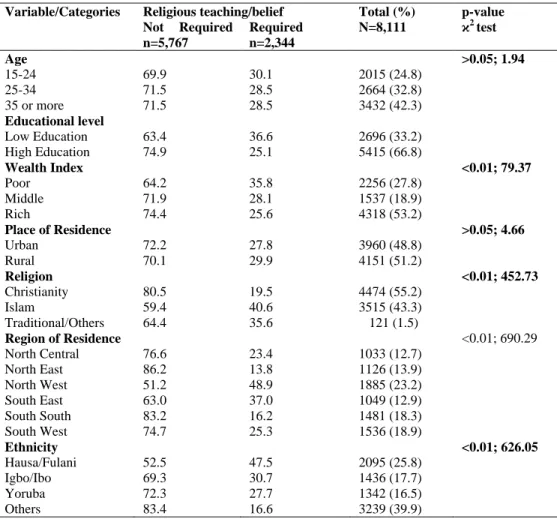
The bivariate analyses showing relationship between socio-demographic characteristic and religious belief and teaching on female genital cutting is presented in Table 1. Of the 8,111-total weighted sample (respondents) for the study, majority (42.3%) was between ages35-45, (66.8%) were highly educated, (53.2%) belonged to rich category, (51.2%) were rural dwellers, (55.2%) were of Christian faith, and twenty-three percent were from North Western region. Grouping by ethnicity showed that majority (39.9%) of the sampled respondents were of other minority groups apart from Hausa/Fulani, Igbo/Ibo, and Yoruba. A
non-statistically significant higher
proportion(30.1%) of the respondents in the youngest age group (15-24 years)and who reside in rural areas (29.9%) reported that their religion required FGC. Significantly higher proportion (36.6%) of the low level educated, who belong to poor wealth index (35.8%), who were Muslim Religion required
FGC
n=2,344
Religion not required FGC
n=5,767
Others -Missing -Don‘t have religion
-Don‘t know
n=2,669 Weighted-
(2013 NDHS)
n=8,111
Excluded from the study not aware of
FGC & Others -missing -No religion -Don‘t know
2013 NDHS Recode Data
n=17,334
Aware of FGC
n=10,780 (62.2%) N=17, 334
Not aware of FGC
n=6,554
Table 1: Men‘s Background Characteristics and Descriptive Statistics by Religious‘ Requirement of Female Genital
Cutting in Nigeria
Variable/Categories Religious teaching/belief Total (%) N=8,111
p-value ϰ2
test Not Required
n=5,767
Required n=2,344
Age >0.05; 1.94
15-24 69.9 30.1 2015 (24.8)
25-34 71.5 28.5 2664 (32.8)
35 or more 71.5 28.5 3432 (42.3)
Educational level
Low Education 63.4 36.6 2696 (33.2) High Education 74.9 25.1 5415 (66.8)
Wealth Index <0.01; 79.37
Poor 64.2 35.8 2256 (27.8)
Middle 71.9 28.1 1537 (18.9)
Rich 74.4 25.6 4318 (53.2)
Place of Residence >0.05; 4.66
Urban 72.2 27.8 3960 (48.8)
Rural 70.1 29.9 4151 (51.2)
Religion <0.01; 452.73
Christianity 80.5 19.5 4474 (55.2)
Islam 59.4 40.6 3515 (43.3)
Traditional/Others 64.4 35.6 121 (1.5)
Region of Residence <0.01; 690.29
North Central 76.6 23.4 1033 (12.7) North East 86.2 13.8 1126 (13.9) North West 51.2 48.9 1885 (23.2) South East 63.0 37.0 1049 (12.9) South South 83.2 16.2 1481 (18.3) South West 74.7 25.3 1536 (18.9)
Ethnicity <0.01; 626.05
Hausa/Fulani 52.5 47.5 2095 (25.8)
Igbo/Ibo 69.3 30.7 1436 (17.7)
Yoruba 72.3 27.7 1342 (16.5)
Others 83.4 16.6 3239 (39.9)
(40.6%) from North West region (48.9%) and of Hausa/Fulani ethnic group (47.5%) reported that their religion required FGC (p<0.01).
As contained in 2013 Nigeria
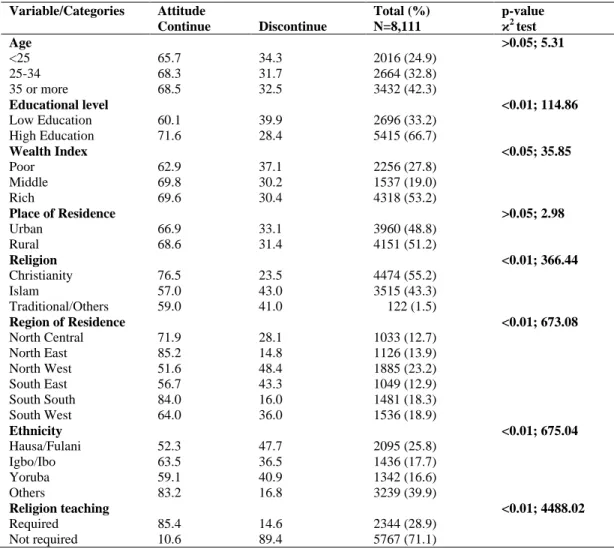
Demographic and Health Survey (NDHS) data set, men were asked of their opinion on whether FGC should continue or stop. This question was used to measure the attitude of individual respondent towards the practice of FGC. As presented in Table 2 significant statistical relationships were found between some of the respondents‘ characteristics (level of education, wealth index, religion, region of residence, ethnicity and religiosity) and attitude toward FGC. Higher proportion of less educated men (40%) supported discontinuation of FGC than those who were of higher educational background (p<0.001). Though the relationship between current age and attitude towards FGC was not statistically significant, it was found that more of
the much younger men (34.3%) (less than 25 years) were reported to have supported discontinuation of FGC than the older cohort (31.7% and 32.5% among 25-34 years and 35+ respectively). The study found difference between wealth index categories of men and their attitude towards FGC. Significant higher proportion of men (37.1%; p<0.005) who belonged to poor category than those in middle and rich wealth indexes were found not to favour continuation of FGC. Investigation between respondents‘ place of residence and their attitude towards FGC showed a non-significant (p>0.05) relationship.
Table 2: Men‘s Background Characteristics and Descriptive Statistics by Attitude towards Discontinuation of FGC
Variable/Categories Attitude Total (%)
N=8,111
p-value ϰ2
test Continue Discontinue
Age >0.05; 5.31
<25 65.7 34.3 2016 (24.9)
25-34 68.3 31.7 2664 (32.8)
35 or more 68.5 32.5 3432 (42.3)
Educational level <0.01; 114.86
Low Education 60.1 39.9 2696 (33.2) High Education 71.6 28.4 5415 (66.7)
Wealth Index <0.05; 35.85
Poor 62.9 37.1 2256 (27.8)
Middle 69.8 30.2 1537 (19.0)
Rich 69.6 30.4 4318 (53.2)
Place of Residence >0.05; 2.98
Urban 66.9 33.1 3960 (48.8)
Rural 68.6 31.4 4151 (51.2)
Religion <0.01; 366.44
Christianity 76.5 23.5 4474 (55.2)
Islam 57.0 43.0 3515 (43.3)
Traditional/Others 59.0 41.0 122 (1.5)
Region of Residence <0.01; 673.08
North Central 71.9 28.1 1033 (12.7)
North East 85.2 14.8 1126 (13.9)
North West 51.6 48.4 1885 (23.2)
South East 56.7 43.3 1049 (12.9)
South South 84.0 16.0 1481 (18.3)
South West 64.0 36.0 1536 (18.9)
Ethnicity <0.01; 675.04
Hausa/Fulani 52.3 47.7 2095 (25.8)
Igbo/Ibo 63.5 36.5 1436 (17.7)
Yoruba 59.1 40.9 1342 (16.6)
Others 83.2 16.8 3239 (39.9)
Religion teaching <0.01; 4488.02
Required 85.4 14.6 2344 (28.9)
Not required 10.6 89.4 5767 (71.1)
of FGC while 23.5% of men who were Christian
supported discontinuation of FGC
(p<0.01).Relationship between region of residence and attitude towards FGC in Table 2 shows that a higher proportion of men in North West (48.4%) and South East (43.3%) regions wanted a stop to the practice of FGC than any other remaining four regions of Nigeria. The least proportion (15%) was found among men in North East region (p<0.01).
At least four out of every ten men of Hausa/Fulani and Yoruba ethnicity and thirty-seven per cent of Igbo/Ibo background and less than twenty per cent (17%) among other ethnicity reported a negative attitude towards continuation of FGC (p<0.01). Being the main independent variable, relationship between level of religious belief on FGC and attitude towards FGC showed a statistically significant (p<0.01) higher proportion
(89.4%) of men who reported that their religion did not required female genital cutting subscribing to discontinuation of FGC (Table 2).
Table 3: Multivariate Ordered Logistic Estimates for FGC Discontinuation
Variables Model 1 Model 2
Odds ratio 95% CI p-value Odds ratio 95% CI p-value Religious belief on FGC
Not required RC RC
Required 0.03 (0.02-0.03) <0-01 0.03 (0.02-0.03) <0.01
Age
<25 RC
25-34 1.05 (0.88-1.26) 0.58
35 or more 1.34 (1.13-1.60) <0.01
Educational level
Low Education RC
High Education 1.71 (1.44-2.03) <0.01
Wealth Index
Poor RC
Middle 0.98 (0.78-1.22) 0.78
Rich 0.90 (0.71-1.14) 0.72
Place of Residence
Urban RC
Rural 1.01 (0.86-1.19) 0.91
Religion
Christianity RC
Islam 0.63 (0.51-0.77) <0.01
Traditional/Others 0.64 (0.38-1.07) 0.09
Region of Residence
North Central RC
North East 4.06 (2.99-5.50) <0.01
North West 1.40 (1.03-1.91) <0.05
South East 1.07 (0.74-1.56) 0.71
South South 2.04 (1.57-2.65) <0.01
South West 1.37 (1.04-1.79) <0.05
Ethnicity
Hausa/Fulani RC
Igbo/Ibo 0.62 (0.42-0.92) <0.05
Yoruba 0.32 (0.23-0.46) <0.01
Others 1.36 (1.03-1.79) <0.05
status was inversely related to FGC discontinuation; odds of discontinuation were lowest (10%) among the rich. In addition, the FGC discontinuation odds were more among respondents from rural areas than those in the urban settings. Considering religious affiliation, Muslims (0.63 times) and Traditionalists (0.64 times) were less likely to discontinue FGC than the Christians; this indicated that FGC practice is more acceptable among the Muslims than other religions in Nigeria. The chance of FGC discontinuation was 4.06 times high among those that reside in North East than the North Central; the chances reduced among those in the South West (1.37 times) and South East (1.07 times). Yorubas were less likely (0.32 times) to discontinue FGC than the Hausas and Igbos.
Discussion
the functionality of religion in influencing young people‘s sexual behaviour9,19-23
. Having considered the importance of religion and religious teaching as a socio-cultural variable, this study examined its effects on men‘s attitude towards female genital cutting and its discontinuation.
Out of the total 17,334 respondents in the 2013 men recode of Nigeria Demographic and Health Survey,10,780, (62.2%) reported awareness of female genital cutting (see Fig. 1). Although acceptance of religious teachings seems not limited to any particular educational and wealth status but as indicated in this study‘s findings, acceptance of religious teaching on FGC was more significantly prevalent among Nigerian men with lower educational background and those of lower wealth status. This collaborates one of the conclusions of Varol et al.15 in their systematic review of role of men in abandonment of female genital mutilation (FGM) where they reported that level of education of men was one of the most important indicators for men‘s support for abandonment of FGM. Social exposure and impact of education are the possible reasons in this case. As also indicated, we found that the likelihood of acceptance of religious teaching was significantly higher among the poor than the rich. The interrelationship between wealth status and acceptance of religious teachings on FGC as found in the study demonstrates that poverty is a major socioeconomic determinant of religious affiliation among Nigerian men. This is line with what Ouldzeldoune et al.24and Sakeah et al.25 reported in their different studies in Mauritania and Northern Ghana respectively. Region of residence and ethnicity were also found to have a significant influence on religious teaching. For instance, and as also observed by Varol et al.15our study found that educated and wealthy Nigerian men who were residents of the three southern regions of the country reported that their religion did not require FGC unlike their counterparts with lower educational background and those from the three northern regions of the country. Among the plausible explanations for the interaction between educational attainment, wealth status and acceptance of religious teachings could be possession of more knowledge, power, and confidence to challenge and reject unexplainable
and unclear cultural and religious norms by educated and wealthy Nigerian men.
Furthermore, to achieve its objective the study investigated the individual relationship between the background characteristics and men‘s attitude towards FGC discontinuation. Our study revealed that some of the background characteristics (educational attainment, wealth index, religion, region of residence, ethnicity and religiosity) were found to be significantly associated with men‘s attitude towards FGC continuation or discontinuation (p<0.001). In line with our findings, Orji and Onwudiegwu26 found that religion was associated with attitude of married Nigerian men in their study of contraceptive use among Nigerian men. Higher proportion of men (85.4%) whose religion subscribed to FGC practice was seen supporting continuation of the age-long traditional practice. Greater percentages (89.4%) of those who rejected or stood against the continuation of FGC were those who reported that their religion did not require FGC.
It was found that the odds of supporting FGC discontinuation were significantly lower among men whose religion affiliation required FGC in Nigeria. This was in line with other studies2,15 that had investigated the relationship between either religious affiliation or belief and men‘s support for abandonment of FGC practices. The results of the study further revealed that age and ethnicity significantly influenced men‘s attitude towards FGC discontinuation in Nigeria. There was consistent increase in the odds of men‘s attitude towards FGC discontinuation as age of men increases. These results also collaborate what Varol et al.15and Ouldzeldoune et al.24 found in their different studies. Our study also shows significant differences in the propensity of Nigerian men to FGC discontinuation by ethnic affiliation. Yoruba ethnicity decreases the likelihood of Nigerian men subscribing to FGC discontinuation.
Limitation
causality relationship between the dependent and independent variables could not be established and there are some other independent variables like men‘s knowledge of health complication of FGC on women and men that that could have improved the study, but which were not readily available in the dataset.
Conclusion
The continued negative effects of FGC practice in Nigeria in spite of efforts to the contrary necessitate a change in the strategies employed in the fight against this age long traditional practice. This study revealed that religious teachings and beliefs are crucial correlates of men‘s attitude and opinion on continuation or discontinuation of FGC. Most of the religious leaders are men who teach this subject matter in the Churches and Mosques. Sensitization and education of men on the deleterious effects of FGC may have far-reaching positive effects on the discontinuation of this practice. The urgent need to engage men and their religious teachings in the strategies to fight FGC is thus advocated.
Ethical Approval
The Institutional Review Board of ICF International, Inc. reviewed and approved the data used for this analysis. The Institutional Review Board of ICF International complied with the United States Department of Health and Human Services regulations for the protection of human research subjects. The ethical approval and clearance was equally obtained by MEASURE DHS from National Ethics Committee of Nigeria before the commencement of data collection.
Acknowledgements
The authors gratefully acknowledge the National Population Commission (NPC) [Nigeria], ICF Macro and MEASURE DHS Project for the provision and making available the NDHS dataset.
Contribution of Authors
Titilayo conceptualized the idea, wrote the study background/introduction and conclusion. Palamuleni wrote discussion section. Olaoye-Oyesola did the data analyses and the result section. Owoeye reviewed relevant literature and came up with the variable selection. All the authors reviewed and approved the manuscript.
References
1. Berg RC, Underland V, Odgaard-Jensen J, Frethim A. and Vist GE. Effects of female genital cutting on physical health outcomes: a systematic review and meta-analysis. BMJ Open 2014; 4:e006316. Doi:10.1136/bmjopen-2014-006316
2. UNICEF. Female genital mutilation/cutting: A statistical overview and exploration of the dynamics of change. UNICEF, New York. 2013. www.unicef.org/publication/index_69875.html 3. Sharmon LM. Patriarchy: Perpetuating the practice of
female genital mutilation. Journal of Alternative Perspectives in the Social Sciences. 2010;Vol 29(1): 160-181.
4. Population Reference Bureau (PRB), Ending Female Genital Mutilation/Cutting: Lessons from a decade of progress 2013. Population Reference Bureau. 2013.
5. Oyefara JL. Female genital mutilation (FGM) and sexual functioning of married women in Oworonshoki community, Lagos State, Nigeria. African Population Studies.2015;29(1): 1526-1540.
6. Carr D. Female genital cutting: Findings from the Demographic and Health Survey Programme, Calverton, Maryland: Macro International. 1997. 7. Oyefara JL. Female genital mutilation (FGM) and theory
of promiscuity: myths, realities and prospects for change in Oworonsoki community, Lagos State, Nigeria. Genus Journal of Population Science.2014;70(2-3):7-33.
8. Abdelshahid A. and Campbell C. Should I circumcise my daughter? Exploring diversity and ambivalence in Egyptian parents‘ social representations of female circumcision. Journal of Community Applied Social Psychology. 2015;25(1):49–65
9. Pal DK, Kasar PK, Tiwari R and Sharma A. Involving religious leaders in HIV/AIDs prevention. Indian Journal of Community Medicine. 2007;32(1), 2. 10. Mcleary PH. Female genital mutilation and childbirth: A
case report. Birth 1994;21:221-224.
Mutilation/Cutting: Data and Trends Update 2014. Population Reference Bureau. 2014.
12. Sipsma HL, Chen PG, Ofori-Atta A, Llozumba UO, Karfo K and Bradley EH.Female genital cutting: Current practices and beliefs in Western Africa. Bulletin of the World Health Organization. 2012;90: 120-127. Doi:102471/BLT.11.090886.
13. Thomas LM. Ngaitana (I will circumcise myself): Lessons from colonial campaigns to ban excision in Meru, Kenya. In Female “circumcision” in Africa, edited by Shell-Duncan B. and Hernlund Y. 2000;129-150. Boulder, CO: Lynne Rienner. 14. Sharfi AR, Elmegboul MA and Abdella AA. The
continuing challenge of female genital mutilation in Sudan African Journal of Urology 2013; 19: 136– 140.
15. Varol N, Turkmani S, Black K, Hall J. and Dawson A. The role of men in abandonment of female genital mutilation: a systematic review. BMC Public Health. 2015;15:1034. DOI 10.1186/s12889-015-2373-2
16. Missailidis K. and Gebre-Medhin M. Female genital mutilation in Eastern Ethiopia. Lancet. 2000;356: 137-138.
17. Davis G, Ellis J, Hibbert M, Perez RP and Zimbelman E. Female circumcision: the prevalence and nature of the ritual in Eritrea. Mil Med. 1999;164(1):11-6. 18. National Population Commission (NPC) [Nigeria] and
ICF International, Nigeria. Demographic and Health Survey 2013, Abuja, Nigeria, and Rockville, Maryland, USA: NPC and ICF International 2014. 19. Titilayo A, Agunbiade MO and Okanlawon K.
Perception and attitudes of Christian youths towards
condom use: Implications for HIV/AIDs in Nigeria. African Research Review: An International multi-disciplinary Journal. 2009;Vol. 3(1):47-60. 20. O‘Toole BJ, McConkey R, Casson K, Goetz-Goldberg
D and Yazdani A. Knowledge and attitudes of young people in Guyana to HIV/AIDs. International Journal of STD and AIDs. 2007;18(3):193-197. 21. Otolok-Tanga E, Atuyambe L, Murphy CK, Ringheim
KE and Woldehanna S. Examining the actions of faith-bnased organizations and their influence on HIV/AIDs-related stigma: A case study of Uganda. Mera, 2007;28(3):55-60.
22. Viana FJ, Faundes A, de Mello MB and de Sousa MH. Factors associated with safe sex among public school students in Minas Gerais, Brazil. Cadermos de Sande Publica. 2007;23(1):43-51.
23. Warenius L, Pettersson KO, Nissen E, Hojer B and Chishimba P. Vulnerability and sexual and reproductive health among Zambian secondary school students. Culture, Health and Sexuality Journal. 2007;9(5):534-544.
24. Ouldzeldoune N, Keating J, Bertrand J and Rice J. A description of female genital mutilation and force-feeding practices in Mauritania: Implications for the protection of child rights and health. PLoS One. 2013; 8(4), e60594.
25. Sakeah E, Beke A, Doctor HV and Hodgson AV. Males‘ preference for circumcised women in Northern Ghana. African Journal of Reproductive Health. 2006;10(2):37-47.