12
Influence of Probiotic "Vitacorm Bio Plus"
on Nutrient Digestibility in Growing Gilts
Larisa Caisin, Natalia Grosu
The State Agrarian University of Moldova, Department of Animal Science and Biotechnology p/c 2049, 44-Chisinau, Mircesti Street, Moldova Republic
Abstract
The purpose of the research was to determine the digestibility of nutrients in the mixed fodders supplemented with the probiotic preparation "Vitacorm Bio Plus" based on Lactobacilus bacteria 1 x 10⁷ at different levels. To achieve
the goal, a digestibility test was carried on using twelve analogues gilts of two breeds (YxP), distributed into four experimental groups of three heads each (G1, G2, G3 and G4), which were kept in similar conditions. The gilts in G1
(the control group) were fed the basic mixed fodder (BMF), and the experimental animals in G2, G3 and G4 were fed
mixed fodder supplemented with the probiotic preparation "Vitacorm Bio Plus" at different levels: 2.0 kg/t, 3.0 kg/t and 4.0 kg/t respectively. At the end of the trial it was determined, that during the control period the intake of mixed fodder was the lowest in the gilts in G2. It was by 4.8% lower compared to G1. It was also observed that the
supplementation of the BMF with probiotic "Vitacorm Bio Plus" at the level of 2.0 kg/t increased the digestibility of nutrients in the animals in G2 compared to G1: the dry matter by 2.34% (p>0.05), the organic matter by 2,09%
(p>0.10), crude ash by 5.69% (p> 0.10), crude fiber by 5.2% (p>0.001), and non-nitrogenous extractive matter by 1.96% (p>0.10). The results suggest that in order to improve the digestibility of nutrients in young pigs, the supplementation of mixed fodders with the probiotic "Vitacorm Bio Plus" should be done at the level of 2.0 kg/t.
Keywords: digestibility, gilts, nutrient, symbiotic
Introduction
Modern intensive animal husbandry is based on the use of different biologically active stimulants as an important component of animal feed ingredients. Probiotics have a positive effect on the host organism. They helps support the immune system, recover the digestive system, increase the effectiveness of vaccination, reduce the treatment costs of animal diseases, improve the productivity and the products quality [1].
The researches carried out over the last decade on the use of probiotics are not fully expounded in the evidence-based recommendations on practical use of these preparations in animals.
* Corresponding author: Larisa Caisin,
Tel: +373 22-432-380; [email protected]
There is an increasing demand for probiotics because of their mechanisms of action. In contrast to antibiotics, they do not aim on destroying the intestinal microbial population, but directly supplement the intestinal microbiota with live beneficial organisms–probiotic bacteria strains that have non-specific control over the number of pathogenic microorganisms and eliminate them from the intestinal microbiota [2, 3]. Unlike antibiotics, they can be used in the technology for obtaining complete and organic food [4].
13
2. Materials and methods
The aim of the research was to determine the influence of different levels of probiotic "Vitacom Bio Plus" on the digestibility of nutrients in young pigs. The trial was conducted in the physiological laboratory at the State Enterprise for Pig Breeding and Hybridization "Moldsuinhibrid".
Twelve gilts of two breeds (Yorcshire x Pietrain) were selected as experimental material using the method of analogous groups [6], which were randomized into four experimental groups: one control (G1) and three experimental groups (G2,
G3, G4). The feeding was done using mixed fodder
identical for all groups, except that the fodder for the pigs in the experimental groups G2, G3, G4 was
supplemented with different levels of probiotic preparation "Vitacorm Bio Plus" (Table 1).
Table 1. The structure of the mixed fodder
Ingredients, % G1 Experimental groups G2 G3 G4 Corn grains 15.0 15.0 15.0 15.0 Barley grains 24.0 24.0 24.0 24.0 Extruded corn 19.5 19.5 19.5 19.5 Extruded barley 22.0 22.0 22.0 22.0 Extruded soybeans 12.0 12.0 12.0 12.0
Fishmeal 5.0 5.0 5.0 5.0
Premix 2.0 2.0 2.0 2.0
Salt 0.5 0.5 0.5 0.5
"Vitacorm Bio Plus" - 2.0 3.0 4.0
Throughout the experiment, the mixed fodder was produced according to the feeding norms for young swine [7].
The animals were kept in similar conditions, separately in individual cages with the possibility to collect physiological waste. The fodder and the water were distributed three times a day. There was also carried out the record of the individual intake, the excretions were collected and average samples for testing, which were preserved for chemical analysis, were taken [8].
The nutrients (dry matter, organic matter, crude protein, crude fat, crude fibre and crude non-nitrogenous extractive substances) in the ingestion and the excretion were chemically analyzed [9]. The main indicators of the gilts’ growth and development were assessed through weighing
each animal at the beginning of each experimental period, and at the end of the experiment.
The biometric data were processed using the Student test [10]
3. Results and discussion
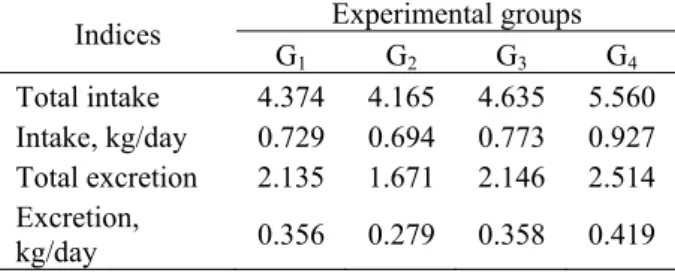
The digestibility test showed that the probiotic "Vitacorm Bio Plus" had influenced the mixed fodder intake during the main experimental period.
The gilts in the G2 which received the preparation
"Vitacorm Bio Plus" at the level of 2.0 kg/t showed an average daily intake by 4.8% lower compared with G1, while the animals in G3 and G4
showed an increase by 6.04% and 27.16% in fodder consumption compared with G1 (Table 2).
Table 2. Recording data during the test (average/head)
Indices Experimental groups G1 G2 G3 G4
Total intake 4.374 4.165 4.635 5.560 Intake, kg/day 0.729 0.694 0.773 0.927 Total excretion 2.135 1.671 2.146 2.514 Excretion,
kg/day 0.356 0.279 0.358 0.419
The data obtained as a result of weighing each experimental animal showed (Table 3), that at the end of the digestibility test the live weight of the animals in G2 and G3 was 2.42% and 1.21%
higher compared to G1, while the gilts in G4 which
received the preparation at the level of 4.0 kg t showed a smaller increase by 0.74% in live weight compared to G1.
It was determined that the gilts in the experimental groups G2, G3 and G4 had an absolute increase by
32.96% (p>0.10), 18.99% and 18.44%, respectively, higher compared to G1. The average
daily gain amounted to 0.340 g in G2 (p>0.02)
which was by 32.81% higher than in G1.
Comparative analysis of the absolute and the average daily gain obtained during the recording period showed, that the use of the probiotic "Vitacorm Bio Plus" at the level of 2.0 kg/t was the most effective.
14
Table 3. Dynamic of the live weight and the weight gain during the physiological experiment, (X±Sx)
Indices G Experimental groups
1 G2 G3 G4
Live weight, kg
at the beginning of the experiment 18.38±0.14 17.97±0.09 18.33±0.15 17.93±0.09 at the beginning of the recording period 21.33±0.41 21.30±0.29 21.27±0.15 20.83±0.38 at the end of the experiment 23.12±0.49 23.68±0.35 23.40±0.31 22.95±0.31 Absolute gain, kg 1.79±0.16 2.38±0.06** 2.13±0.19 2.12±0.07
Average daily gain, g 0.256±0.02 0.340±0.01*** 0.304±0.03 0.303±0.01*
t-student-*p>0.10; **p>0.05; ***p>0.02
Table 4. Chemical composition of the intake and excretion, %/kg
Groups animals № of Dry matter Organic matter protein Crude Crude fat Crude fiber NNES Crude
Fodder 86.86 8.08 12.85 3.23 7.80 54.90
G1
1 30.57 23.10 6.02 2.06 6.52 8.50
2 29.83 21.99 5.84 1.75 7.40 7.00
3 31.58 23.79 6.03 2.35 6.68 8.73
G2
4 31.32 22.83 6.66 2.22 6.70 7.25
5 32.08 24.01 7.14 2.46 7.32 7.09
6 33.31 25.30 7.47 2.61 7.96 7.25
G3
7 32.89 24.68 5.61 2.19 8.61 8.28
8 30.85 23.78 7.73 2.31 6.58 7.16
9 29.78 22.71 6.22 2.02 6.97 7.49
G4
10 30.79 22.68 5.86 1.89 7.92 7.01
11 30.53 22.79 7.77 2.67 8.66 3.80
12 30.76 23.16 6.25 2.12 6.81 7.98
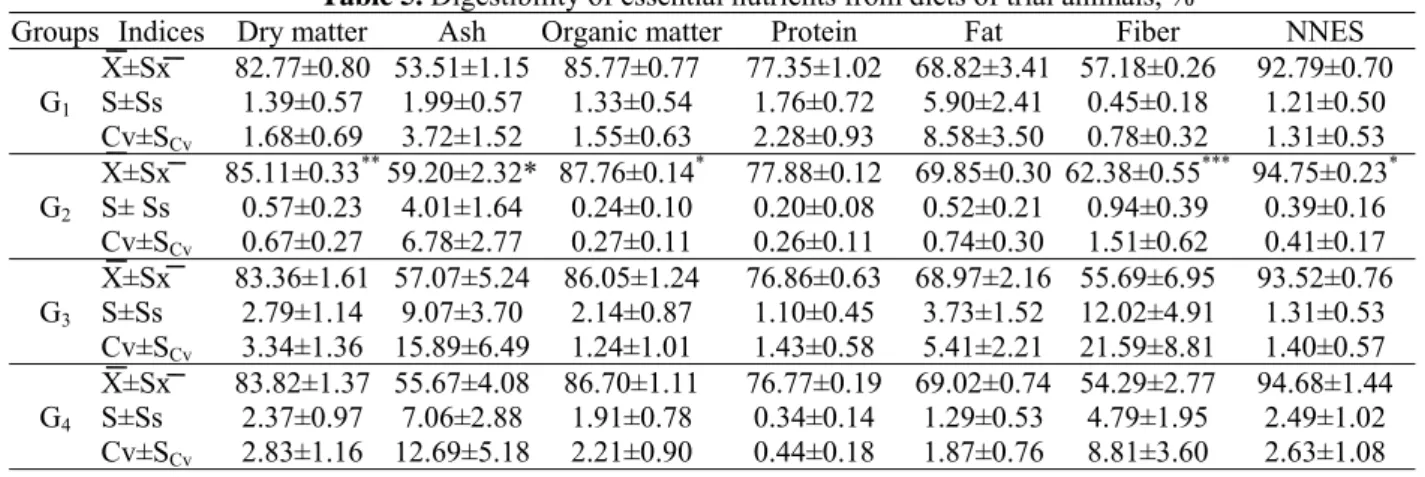
In order to determine the influence of different levels of probiotic preparation "Vitacorm Bio Plus" on the digestibility in gilts, the digestibility
coefficients were calculated based on the ingestion and the excretion data and the results of the chemical analysis (Table 5).
Table 5. Digestibility of essential nutrients from diets of trial animals, %
Groups Indices Dry matter Ash Organic matter Protein Fat Fiber NNES
G1
X±Sx 82.77±0.80 53.51±1.15 85.77±0.77 77.35±1.02 68.82±3.41 57.18±0.26 92.79±0.70 S±Ss 1.39±0.57 1.99±0.57 1.33±0.54 1.76±0.72 5.90±2.41 0.45±0.18 1.21±0.50 Cv±SCv 1.68±0.69 3.72±1.52 1.55±0.63 2.28±0.93 8.58±3.50 0.78±0.32 1.31±0.53
G2
X±Sx 85.11±0.33** 59.20±2.32* 87.76±0.14* 77.88±0.12 69.85±0.30 62.38±0.55*** 94.75±0.23*
S± Ss 0.57±0.23 4.01±1.64 0.24±0.10 0.20±0.08 0.52±0.21 0.94±0.39 0.39±0.16 Cv±SCv 0.67±0.27 6.78±2.77 0.27±0.11 0.26±0.11 0.74±0.30 1.51±0.62 0.41±0.17
G3
X±Sx 83.36±1.61 57.07±5.24 86.05±1.24 76.86±0.63 68.97±2.16 55.69±6.95 93.52±0.76 S±Ss 2.79±1.14 9.07±3.70 2.14±0.87 1.10±0.45 3.73±1.52 12.02±4.91 1.31±0.53 Cv±SCv 3.34±1.36 15.89±6.49 1.24±1.01 1.43±0.58 5.41±2.21 21.59±8.81 1.40±0.57
G4
X±Sx 83.82±1.37 55.67±4.08 86.70±1.11 76.77±0.19 69.02±0.74 54.29±2.77 94.68±1.44 S±Ss 2.37±0.97 7.06±2.88 1.91±0.78 0.34±0.14 1.29±0.53 4.79±1.95 2.49±1.02 Cv±SCv 2.83±1.16 12.69±5.18 2.21±0.90 0.44±0.18 1.87±0.76 8.81±3.60 2.63±1.08
t-student - *p>0.10 ; **p>0.05; ***p>0.001
As the result of data analysis (Table 5, Figure 1) it was established, that the animals which received the preparation at the level of 2.0 kg/t (G2) showed
15 Figure 1. Dry matter digestibility
The digestibility of the organic matter in the experimental groups G2, G3 and G4 was by 2.09%
(p>0.10), 0.28% and 0.93% higher compared to the control group G1 (Figure 2).
Figure 2. Organic matter digestibility
The crude protein was digested in the experimental group G2 at the level of 77.88%,
which was higher by 0.53% compared to G1, and
in G3 and G4 it was digested at the levels of
76.86% and 76.77%, which was lower by 0.49% and 0.58% compared to G1.
Figure 3. Crude protein and fat digestibility
The results of the digestibility test revealed, that the gilts in G2, G3 and G4 showed a digestibility of
crude fat at the level of 69.85%, 68.97% and 69.02%, respectively, which was by 1.03%, 0.15% and 0.20% higher than in G1 (Figure 3).
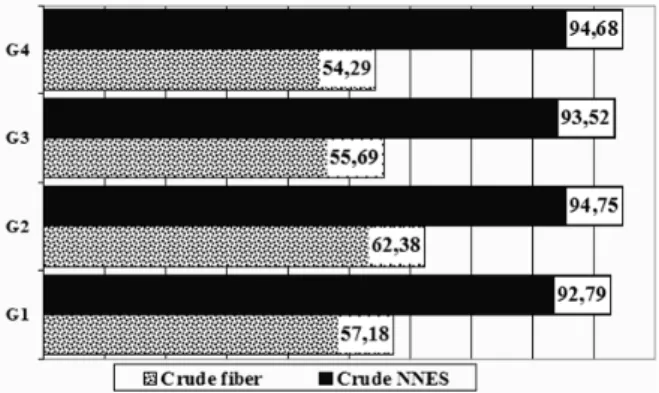
The supplementation of the mixed fodder with the probiotic preparation at the level of 2.0 kg/t showed a higher digestibility of crude fibre and non-nitrogenous extractive substances in the gilts in G2 in comparison with the gilts in G1. It was at
the level of 62.38% (p>0.001) and 94.75% (p>0.10), which was higher by 5.20% and 1.96% respectively (Figure 4).
Figure 4. Crude fibre and non-nitrogenous extractive
substances digestibility
The highest coefficient of the digestibility of crude ash was also in G2; it was at the level of 59.20%
(p>0.10), which was by 5.69% higher as compared to G1 (Figure5).
Figure 5. Crude ash digestibility
4. Conclusions
16 level of 2.0 kg/t caused a decrease in mixed fodder intake by 4.8%, an increase in the live weight at the end of the digestibility test by 2.41%, and the daily absolute and average weight gain by 32.96% and 32.81% respectively.
It was also established that the optimal level of the probiotic preparation "Vitacorm Bio Plus" was of 2.0 kg/t. This level significantly increased the digestibility of dry matter by 2.34%, of the organic matter by 2.09%, of the fibre by 5.20%, of the non-nitrogenous extractive substances by 1.96% and of the ash by 5.69% in young swine.
Acknowledgements
We would like to thank the manager of the enterprise "Moldsuinhibrid", the Republic of Moldova and the enterprise “Himtehservice”, Ukraine, for letting us perform this scientific research.
References
1. Ushacova, N., Nekrasov, R., Pravdin, V., Cravtova L., Bobrovskaya O. and Pavlov D., A new generation of symbiotics for feeding. Journal Fundamental research, 2012, 1
2. Artiuhova, S. and Lashin, A., Use of symbiotics in poultry feeding / S. I. Artyukhova, A.V. Lachine / / Symbiotics, prebiotics, synbiotics and functional food supply. Current status and prospects: Proceedings of the International Conference / Moscow, 2004, pp.130-131.
3. Auhatova, S. and Panin, A. Symbiotics – promising immune-boosting drugs for livestock / S. N. Auhatova, A.N. Panin / / Symbiotics, prebiotics, synbiotics and functional food supply. Current status and prospects: Proceedings of the International Conference / Moscow, 2004, pp.131-132.
4. Alimchin Iu., Symbiotics instead of antibiotics – this is real. Poultry. 2005, 2, 15.
5. Alimchin, Iu., Biologically active substances in the prevention and treatment of farm animals. Bio., 2002, 3, 4.
6. Victorov, P., Methodology of experimental work in animal husbandry. Krasnodar, 1983, pp.97
7. Kalaşnicov, A., Standards and rations of animal feeding. Moscva. Colos, 2003, pp.374.
8. Pocerneaiev, F., Research methods in pig breeding. Haricov, 1977, pp.151
9. Razumov, V., Handbook of a chemistry laboratory assistant on fodder analysis. Moscow, Rosselihozizdat, 1986, pp. 300