*Correspondence to Author:
Kasali, F. A.
Department of Computer Science and Information Technology, Bab-cock University, Ogun State, Nige-ria
How to cite this article:
Kasali et al., A Conceptual Design and Evaluation Framework for Mo-bile Persuasive Health Technolo-gies (Usability Approach). Research Journal of Mathematics and Com-puter Science, 2017; 1:4.
eSciPub LLC, Houston, TX USA. Website: http://escipub.com/
Kasali et al., RJMCS, 2017; 1:4
Research Journal of Mathematics and Computer Science
(
I
SS
N
:257
6-
3
989
)
Research Article RJMCS (2017) 1:4
A Conceptual Design and Evaluation Framework for Mobile
Persuasive Health Technologies (Usability Approach)
Persuasive techniques are recently being explored by computer science researchers as an effective strategy towards creating applications that are aimed at positive attitudinal changes es-pecially in the health domain but finding effective evaluation ap -proaches for these technologies remain an herculean task for all stakeholders involved and in order to overcome this limitation, the Persuasive System Design (PSD) model was designed but researchers claim that the model is too theoretical in nature and some of its design principles are too subjective as they cannot be measured quantitatively. Hence, the focus of this paper is to critically review the PSD model and popular models currently be-ing used to evaluate the usability of information systems as us-ability has been identified as an important requirement currently used to evaluate the overall success of persuasive technologies. To achieve the stated objectives, the systematic review method of research was done to objectively analyze the PSD model, its applicability as an evaluation tool was tested on a popular mobile health application installed on the Samsung Galaxy Tablet using android Operation system. Exhaustive evaluation of the appli-cation was performed by 5 software usability researchers using the method of cognitive walkthrough. From the analysis, it was realized that the PSD model is a great tool at designing persua-sive technologies but as an evaluation tool, it is too theoretical in nature, its evaluation strategies are too subjective in nature and the 28 principles described in it overlap with one another. As a result, the PSD model was extended with an integrated usability model and the fuzzy Analytic Hierarchical Technique was pro-posed theoretically to evaluate usability constructs so as to make evaluation of persuasive technologies more quantitative in nature and easier for researchers to analyze their design early enough to minimize developmental efforts and other resources.
Keywords: Persuasive systems, Usability Models, PSD model, Fuzzy Analysis Hierarchical Process
Kasali, F. A.1, Awodele, O.2, Kuyoro, S.3, Akinsanya, A.4, Eze, M.5
1,2,3,4,5Department of Computer Science and Information Technology, Babcock University, Ogun
State, Nigeria
ABSTRACT
INTRODUCTION
As a result of the recent proliferation of smart phones, mobile health applications has been attracting a lot of attentions from software designers, researchers and users at large. Mobile health applications provide convenient access to a wide range of health information; according to a recent research done by Pew Research Centre’s findings (Fox, 2013), 31% of mobile phone users check health related news with their devices, while 20% smartphone users possess at least one health application downloaded and installed on their device. Research2guidance in 2013 also estimated that about an half a billion of the present population of smart phone users downloaded at least one healthcare app in 2015 and by 2018, 50% of the more than 3.4 billion mobile technology users have been approximated to have downloaded mobile health apps with fitness apps accounting for 36% of such downloads (Appfutura, 2016).
However, a unique trial being faced by mobile health app users is that most of these applications lack proper evaluation (Intercontinental Marketing Services Health, 2013) and one of the factor for evaluating these systems is usability which have been confirmed by various information systems quality researchers. Mendiola, Kalnicki & Lindenauer (2015) also identified usability as one of the features and characteristics that are mostly appreciated by users of mobile health applications using 234 apps found in Apple iTunes and Google Play store.
Usability simply implies that users easy, simple to learn and are satisfies with their level of communication between themselves and the corresponding interface of their devices. With the proliferation of various mobile health applications, there should be a proper and standard way of assessing or evaluating the usability of these apps right from the early design phase to guarantee increased effectiveness, satisfaction and confidence from prospective users.
The concern is how to ensure a high level of usability in mobile persuasive technologies. One solution to this issue is that usability requires the correspondence between users and applications based on the specific restriction under the actual boundaries of the chores being carried out with the application and the surroundings. Under this circumstances, usability relies on the environment or area of use of the tool and not when such product is being developed. Basically, when developing any application with effective usability among users in mind, significant skill, considerable expertise and dedication to usability is required, all of which are normally or practically unobtainable in the fundamental or critical primitive stages of development. (Thimbleby, Cairns & Jones, 2001). Once a functioning prototype is in place, usability analysis can be done and any adjustment made although many usability analysis are being done after the product might have been implemented which normally makes any design issues too complicated, expensive and time wasting to address.
There currently exist a corpus literature on designing mobile Persuasive Technologies (mPT) aimed at healthier lifestyle behavioural change but evaluating these technologies has been a herculean task as most usually need an already finished product which must have been installed for a long period of time (Kientz et al., 2010). The major model used in evaluating and designing such systems based on extensive literature review is the Persuasive System Design (PSD) model but this model does not accept usability constructs that can be measured early on from the first prototype design into consideration and in overall, cannot objectively measure the usability of persuasive systems except when other usability models or methods are used.
constructs that can be integrated into Persuasive Health Systems (PHS) during the developmental phase of these applications (Stephen, Latika & Jonathan, 2015) since usability has been identified as a quality construct by several models and what they do, is to categorize usability attributes that can be quantified but most of these models rarely focus on each usability attributes from the primitive stage while the interface is still being developed (Kathia, Christophe, Sophie & Ahmed, 2014) as their models require fully functional prototypes and more so, one of the highest risk in Software production is usability commonly characterized by the software user interface.
Hence, this work extends the PSD model, a significant approach to the design and evaluation of persuasive technologies (Oinas-Kukkonen & Harjumaa, 2009) with measurable constructs to improve usability at the primitive stage of persuasive software development and generally reduce developmental costs and other resources. The work is arranged as follows: Chapter 1 gives a concise introduction of what persuasive technology is all about, the PSD model as an effective tool in designing persuasive applications but with inherent evaluation challenges was detected. Usability was also identified as an important constructs in evaluating the overall success of information systems. Chapter 2 gives a general review of various usability models laying more emphasis on some specific ones. Current approaches used in persuasive systems evaluation was also considered. In chapter 3, the PSD model was extended with an Integrated Usability Model to overcome the inherent limitations of evaluation processes identified in the PSD model. Chapter 4 gives a brief summary of the paper, conclusion and recommendations for further studies.
Literature Review
General Overview of Usability Models for Mobile Applications
Recent improvements in mobile application development has made it possible for varieties of software to be designed for faster accessibility
by users as it makes it for them to easily have access to numerous health apps on different app stores worldwide which continues to grow at a geometric rate (Chittaro, 2015). Software designers sometimes forget that most users who user these apps use them while multi-tasking. One of the greatest challenges is the environment in which they are used as a result of their easy mobilityand the influence that using this tools has on the freedom of users’ movement is very important to the success or failure of the software applications (Harrison, Flood and Duce, 2013). There also exist new usability challenges which is as a result of the advent of mobile devices that continually makes using traditional models of usability difficult to apply as highlighted by Lobo, Kaskaloglu, Kim, & Herbert, (2011); Zhang and Adipat (2005). Some of these issues include unreliable network connections, the unrealistic urge for smaller and slicker screen sizes, and inadequate battery usage time amongst others.
Over the years, there have been an upsurge in the usefulness of mobile devices that enable users to carry out additional chores in a particular mobile environment but this surge in efficacy has been seen to have a negative impact on the actual usability of such tools in particular situation. The International Standard Organization (ISO) highlighted some usability evaluation methods which require users’ participation as observation methods, questionnaires, thinking aloud, interviews amongst others and those that does not require any user to participate in the evaluation process some of which are approaches based on models, document based, expert evaluations, automated evaluations amongst others in their Usability Technical Report (ISO, 2002).
use the other approaches. From the other methods that does not require user participation, using automated evaluation approach will give
the least non-subjective results as seen in Table 1.
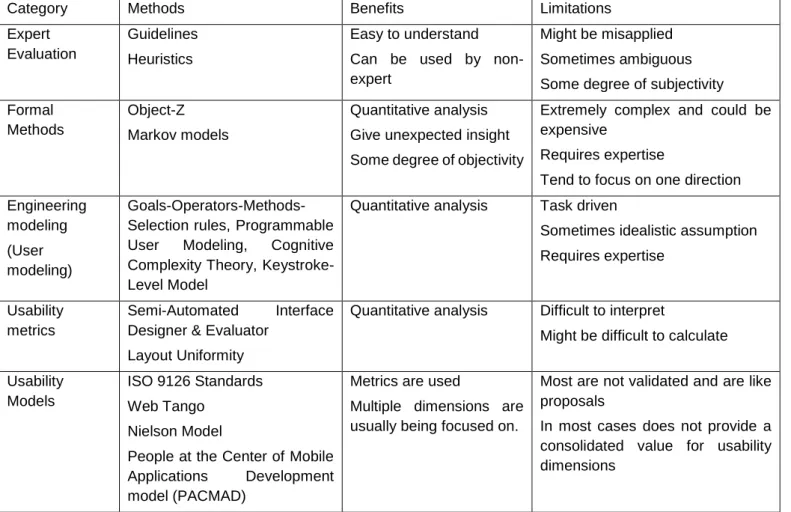
Table 1: Usability Prediction Methods (Donyaee, Seffah & Rilling, 2006)
Category Methods Benefits Limitations
Expert Evaluation
Guidelines
Heuristics
Easy to understand
Can be used by non-expert
Might be misapplied
Sometimes ambiguous
Some degree of subjectivity
Formal Methods
Object-Z
Markov models
Quantitative analysis
Give unexpected insight
Some degree of objectivity
Extremely complex and could be expensive
Requires expertise
Tend to focus on one direction
Engineering modeling
(User modeling)
Goals-Operators-Methods-Selection rules, Programmable User Modeling, Cognitive Complexity Theory, Keystroke-Level Model
Quantitative analysis Task driven
Sometimes idealistic assumption
Requires expertise
Usability metrics
Semi-Automated Interface Designer & Evaluator
Layout Uniformity
Quantitative analysis Difficult to interpret
Might be difficult to calculate
Usability Models
ISO 9126 Standards
Web Tango
Nielson Model
People at the Center of Mobile Applications Development model (PACMAD)
Metrics are used
Multiple dimensions are usually being focused on.
Most are not validated and are like proposals
In most cases does not provide a consolidated value for usability dimensions
From table 1, different usability predictive methods are shown with their strengths and limitations but this work is a novel approach towards combining usability models and the various metrics described in them to strengthen both approaches. The aim is to come up with well-defined usability metrics from models that will be easy to interpret, calculate and also make an attempt at validating a usability model that tends to encapsulate other existing models.
Overview of Some Specific Usability Models
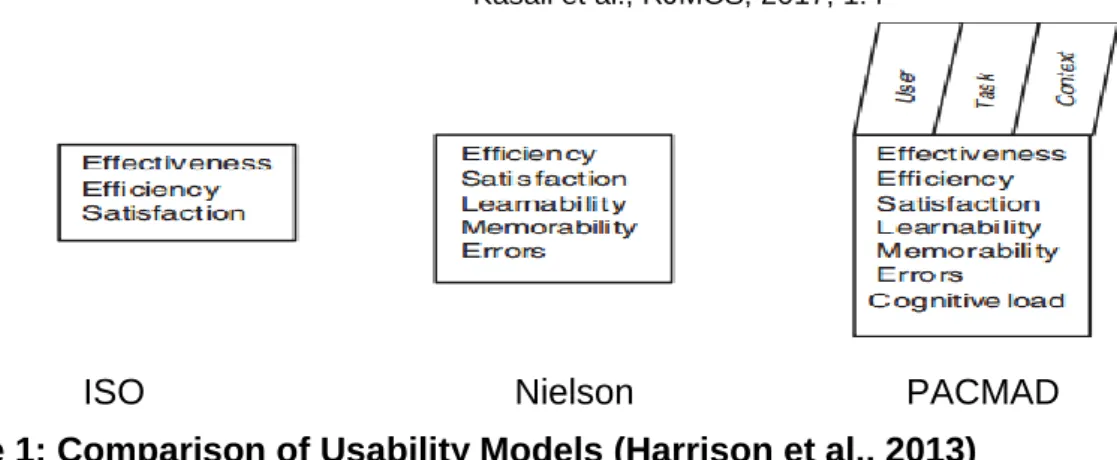
Several conceptual frameworks have been proposed to measure usability overtime but the most widely used and referred model is the one proposed by the International Standard Organization (ISO) which identified effectiveness, efficiency and satisfaction as the main usability evaluation construct. Jacob Nielson, a consultant, leading and foremost
usability researcher identified 5 usability evaluation constructs model but some researchers argue that the Nielson’s usability model constructs are included implicitly in the ISO model and was mainly based on telecoms system rather than computer software.
Harrison, Flood and Duce, (2013) proposed the PACMAD model by integrating the ISO model with Nielson model and adding the Cognitive load attribute as shown in Figure 1.
ISO Nielson PACMAD
Figure 1: Comparison of Usability Models (Harrison et al., 2013)
presently exist no standard agreement among Cognitive Load researchers on the appropriate instrument that can be used for CL measurement (Krell, 2015) as there are different kinds of measurement techniques that can be used to measure CL as suggested by Jarodzka et al., (2012). CL could be intrinsic, extraneous and germane in nature.
The Integrated Measurement Model for Evaluating Usability Attributes
Hasan & Al-Sarayreh (2015) developed the Integrated Measurement model based on the integration of previous models of usability by
combining numerous fuzzy usability constructs that can be applied during each stage of software design and also providing suitable measures for each one. The main goal of this approach is to be able to notice and identify usability issues at every stage, manage them with fewer usage of resources and also evaluate the usability of the fully developed system as usability measurement is one of the most difficult task for software developers and researchers. The model divided usability attributes into 12 parts. Table 2 indicates attributes in existing usability models.
Table 2: Usability attributes in existing models
Usability Models Usability Attributes
A B C D E F G H I J K L M
Shakel ✓ ✓ ✓
Nielson ✓ ✓ ✓ ✓ ✓
Abbran ✓ ✓ ✓ ✓
Seffah ✓ ✓ ✓ ✓ ✓ ✓ ✓ ✓
Dubey ✓ ✓ ✓ ✓
Schneiderman ✓ ✓ ✓ ✓
Preece ✓ ✓ ✓
Gupta ✓ ✓ ✓ ✓ ✓
ISO 25010 models ✓ ✓ ✓ ✓ ✓ ✓ ✓ ✓ ✓
PACMAD ✓ ✓ ✓ ✓ ✓ ✓ ✓
The Integrated usability model is a novel approach at indicating which usability attributes to be considered at every stage of system development although the efficiency of this model is yet to be proven using an original case study.
The Integrated usability model is intended to be incorporated into the PSD model as an approach towards examining the competency of the Integrated Usability framework and also extending the PSD model to have attributes that can be measured analytically so as to increase the systematic strength of the PSD model during PT evaluation purposes.
Methodology for Quantifying Usability
Attributes
Basically, software usability depends largely on specific attributes as identified in integrated model, these attributes depend on numerous sub-attributes which could also depend on several characteristics forming a hierarchical structure as depicted by Dubey, Gulati & Rana (2012) in their research work where they considered five Usability attributes.
From the analysis of their work, it was seen that only five usability attributes were considered but in other to make the classification more robust, some of the usability attributes outlined in the integrated usability model should be considered with their own sub-attributes. There have been various methods that have been proposed over the years for usability evaluation as earlier stated but there still exist one limitation or the other in each as highlighted in Table 1.
More recently, due to the ambiguous and imprecise nature of usability attributes, researchers are beginning to experiment with fuzzy logic theory proposed by Zadeh (1965). Jain, Dubey and Rana (2012) gave a theoretical view in the application of fuzzy logic to evaluate usability by making use of three usability attributes which are understandability, learnability and operability. Dubey, Gulati and Rana (2012) approached usability evaluation by using fuzzy multi-criteria method with 10 users
and five usability attributes which are effectiveness, efficiency, satisfaction, comprehensibility and safety. Al-Rawashdey (2015) used this same approach for Open Source Software usability with 9 attributes while Gupta & Ahlawat (2016) applied this technique on the Generalized Usability Model (GUM) which constitutes 7 attributes with 10 users amongst other software usability evaluation researchers.
This approach is also being suggested for the predictive evaluation of persuasive systems usability to overcome some of the limitations highlighted by (Donyaee, Seffah & Rilling, 2006). In other to achieve this, a fuzzy analytic hierarchy methodology is to be used for quantifying the usability of software as a result of their multiple attributes and to also deal with the imprecise and uncertainty of human decision making process. The Usability evaluation issue is a Multi-criteria decision making problem (MCDM) which is a subset of the general Operation Research models that is applicable to for tackling difficult problems involving high uncertainty, different ideas, data and information (Wang, Jing & Zhang, 2010).
also ascertained by Bacudio, Esmeria and Promentilla (2016).
Aruldoss, Lakshmi and Venkatesan (2013) gave a detailed review on Fuzzy Multi Criteria Decision Making (FMCDM) methods, models and applications. The Analytic Hierarchy Process (AHP) is a technique based on dividing a problem in a ranked form (Lee, Chen and Chang, 2008) which is being presently integrated with fuzzy logic to solve the MCDM problem to infuse some sort of objectivity into the decision making process other than using the traditional AHP approach is now being explored by usability researchers such as Mehrotra, Bhatia & Sharma (2015) who used technique to rank the usability of universities websites, Alptekin, Hall & Sevim (2015) evaluated websites quality using Fuzzy Technique for Order Preference by Similarity to Ideal Solution (TOPSIS) method and Zhou (2017) also made use of this approach to determine product usability.
Current Approaches in Evaluating
Persuasive Technologies
Recently, researchers interest are beginning to wax towards investigating the PSD model by going further to use it for analytic and evaluation purposes other than for design purpose only but very few have been able to realize this as evidenced from extensive literature search. Amongst the few are Anandhi, Lauries & Alex (2015) who used the PSD model and some features in HCI to assess the design of seven mobile health apps using 4 researchers. Each of the apps were rated by the researchers against features in the PSD framework and realized after analysis that the current mobile apps can help in persuading users and they also confirmed several complicated issues that encourage users’ attitude when it comes to using such tools. Their aim was just to learn how to develop health related apps from current ones.
Lehto & Oinas-Kukkonen used the PSD model to qualitatively explore different persuasive attributes on six websites designed to assist in weight reduction. Conclusively, it was shown
that the evaluated sites provided relatively good primary task and strong social support but there exist weaknesses in both dialog and credibility support and that the evaluated weight loss websites may not be very persuasive after all.
Julie, Eun, Brennen, Robert, Amanda, Chelsey & Jen (2010) presented the heuristic approach to evaluating Persuasive Technology (PT) by developing some heuristics expected to find issues in PT. The proposed heuristics results was compared to Nielson’s heuristics on two PT using 10 different evaluator and it was verified that using their own heuristics, more problems were readily identified in the apps evaluated.
Al Ayubi, Parmanto, Branch and Dinq (2014) developed a persuasive application called PersonA and evaluated it by employing Usability testing approach and actually testing it on users’ that were recruited through paper pamphlets and facebook adverts making use of five Usability factors. Three usability techniques were used in analyzing these factors which are
think-aloud assessment, post-study
questionnaire and in-depth semi-structured interview.
Another researcher who has also applied the PSD model in evaluating various designs is Adaji (2016) who used the model to evaluate the persuasive principles used by Amazon, an electronic commerce and cloud computing company, and concluded that the Credibility support part was left out. Adaji & Vassileva (2016a) used the Primary task support and dialogue support categories of the PSD model to evaluate Netflix, and concluded that the model still need to be validated by actual user studies. Adaji & Vassileva (2016b) also did another study in which the PSD model was used to identify the persuasive principles that aids in the success of a particular Q&A network using Stack overflow which is an online social community where programmers learn, share knowledge and progress in their careers as a case study.
are usually time and resource consuming as there presently exist no solution on frameworks for designing and testing persuasive strategies as existing solutions majorly focus on methods and methodologies to guide developers during the design process of persuasive systems which is also basically what the PSD model too does as realized from literature.
Mukhtar (2016) agreed with this opinion when he claimed that existing theories, models and frameworks for persuasive technology design and evaluation currently lacks a systematic design processes that is now commonly used in
computing domains and a support for suitable evaluation after design. Mukhtar tried to bridge this gap by trying to analyze persuasive designs from a data analytics point of view by trying to integrate analytical models into persuasive designs for improved results and he also tried to describe how to represent human behaviour as a mathematical model. The researcher described several factors such as User profiling for data collection purpose, user modeling amongst others as shown in Figure 2. The model is meant to be iterative in nature and still very abstract in nature.
Figure 2: A model for analytical persuasion (Mukhtar, 2016)
From literature, it is observed that the PSD model is mostly used for evaluation purposes although few researchers try to implement such systems before doing Usability evaluation on them using the traditional usability evaluation approach but all these come with one limitation or the other as highlighted in Table 2 which is why the fuzzy analytic hierarchy approach is being proposed for predictive usability evaluation in other to be able to evaluate the usability of such systems before implementation to save developmental and implementation resources. As a result, the PSD model which is actually suitable for designing persuasive systems is being proposed theoretically in this paper to be extended with an integrated usability model and then evaluate the initial prototype of a persuasive system being designed using the fuzzy analytical hierarchical approach.
Proposed Conceptual Framework for
Persuasive Technology Design and
Evaluation
The conceptual framework is an extension of the PSD model because it is believed that all the 28 design features in the model is essential to the eventual acceptability and usability of PT. The
features will aid in the easy identification and categorization of persuasive technologies because there is always an element of persuasiveness in most application domains such as in web-designing, HCI, healthcare systems, social networks, e-commerce apps amongst others. Oinas-Kukkonen and Harjumaa (2009) analyzed the PSD framework thoroughly in their famous paper on Persuasive designs. The seven theories they came up with in other to have a profound idea on the real factors affecting persuasive applications is as a result of their empirical and conceptual analysis and these postulates can as well be applied to other major Information systems.
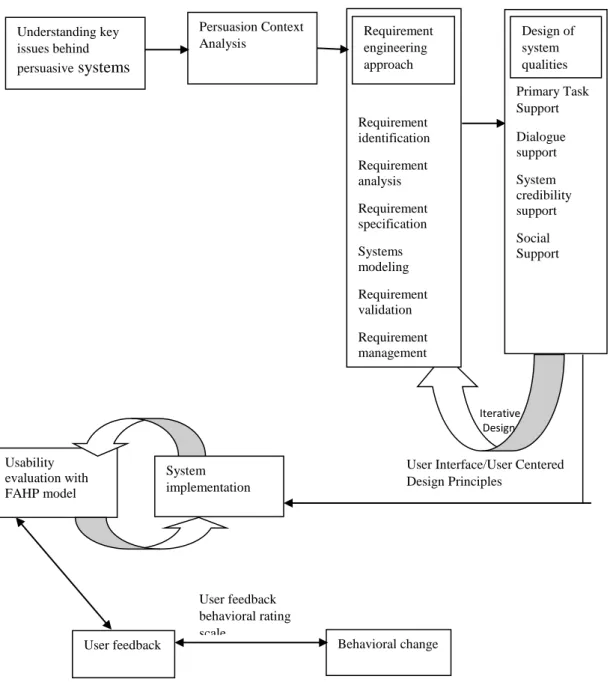
Figure 3: Conceptual framework for Persuasive design and evaluation
In analyzing the persuasion context, users need to have a thorough understanding of what the system is intended to do, what it was designed for, understand the persuasion event and be able to explain or identify the strategy. For example, a health behavioural change app that will draw people closer towards embracing a healthy approach to their lifestyle choices want to be designed and evaluated. The Intent here is for people to embrace a more active life and be healthier and if it will be a temporary or permanent change. The type of change can be used in analyzing the intent.
The event here is in three phases which are use context, user context and technology context.
The use context are features that depend on the problem domain. For example, an obese person must have lived an unhealthy life over a long period of time so the persuasive system should place more emphasis on healthy living and it should be designed in a way that such system will be easy and fun to use. User context are the user dependent features which includes motivations, goals, lifestyles, ability, resource availability (in terms of time, finance etc.), commitments, old habits, cultural and social factors amongst others while the technology context includes technology dependent features such as the, strong points, threats, limitations
User Interface/User Centered Design Principles
System implementation Usability
evaluation with FAHP model
Iterative Design
User feedback Behavioral change
User feedback behavioral rating scale
Understanding key issues behind persuasive systems
Persuasion Context Analysis
Requirement identification
Requirement analysis
Requirement specification
Systems modeling
Requirement validation
Requirement management
Requirement engineering approach
Primary Task Support
Dialogue support
System credibility support
Social Support
and prospects of various technological platforms have to be known meticulously.
The message embedded in such persuasive application need to be analyzed in trying to define persuasion strategy. This is where the third postulate is needed either to persuade the user through direct or indirect route which is similar to the phenomenon suggested in the Elaboration Likelihood Model as central or peripheral route (Petty & Cacioppo, 1986)
Pandey, Suman and Ramani (2010) explained what Requirement Engineering is all about including and gave a detailed summary of each process in their work. They termed Requirement Engineering as “a systematic approach through which the software engineer collects requirements from different sources and implements them into the software development processes”. In trying to design the system requirement, requirement engineering steps should be adhered to as strictly as possible as
requirement has been identified by various researchers as an important concept for developing high quality software products (Pandey, 2013) and also the most important phase in any software development (Juristo, Moreno & Silva, 2002; Pandey & Ramani, 2009).
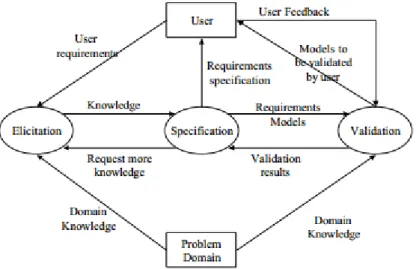
In designing Persuasive Technologies that are meant to be effective, usable and acceptable, users need to be involved at every phase of the developmental process and the suitable way in which such method can be achieved between users and developers is by using the Iterative process which allows developers to show results earlier on in the process and obtain essential feedback from system users (Munassar & Govardhan, 2010). As a result of this, the iterative requirement engineering process model proposed by Laucopoulos & Karakostas (1995) is suggested to be explored by PT designers’ right from the requirement identification stage as shown in Figure 4.
Figure 4: Iterative Requirement Engineering Model (Laucopoulos & Karakostas (1995)
In designing PT design qualities, the persuasive features suggested in the PSD model is of four categories which are primary task, dialogue, system credibility and social support with each one of them having seven design features each making the total design features specified by the PSD model to be twenty eight although it is not mandatory to use all the features but features should be chosen based on the domain of
application, criticality of the intent behind the design and the inherent extent of persuasiveness intended by designers.
usability by prospective users. There have been series of User Interface Design Principles that have been proposed both in the Industry and Academia such as Schneiderman’s ‘Eight Golden Rules of Dialog Design’, Mayhew’s ‘General Principles of User Interface Design’, ‘IBM’s Design Principles for Tomorrow’ amongst others but what most of them have in common is simplicity, consistency and Context as also supported by Valverde (2011).
Analysis of existing mobile eHealth
applications design features using the PSD model
GoogleFit was developed by GoogleInc for Android platform, works on Android 4.0 operating system and higher versions, initially released in 2014 and has been stable since then. It is one of the mobile applications rated by healthline which currently enjoy a high growth rate amongst its peers with a monthly visitors of up to 65 million, as one of the best and most used eHealth mobile apps in 2016 based on user ratings, number of downloads which currently exceeds 10million, regular updating and upgrading. It was designed to basically assist people in weight loss and to generally improve their quality of life.
Methodology for mobile app analysis
The most widely used model from researches done so far is the PSD framework which is known widely, has been tested by numerous researchers for developing and assessing the effectiveness persuasive systems. It explains the content and functionalities that are required in a persuasive system and how the system’s design principles can be converted to software
requirements and then implemented as features of the system. The main aim of the PSD model is really not to select all the 28 persuasive design principles but to choose the right features that best suits a particular app based on the intent, event and strategy to be employed by the designer.
To identify the PSD features integrated in GoogleFit app which was selected purposively and randomly based on user ratings, expert evaluation method was used. Exhaustive evaluations were performed by 5 Software Usability researchers simulating users by walking through the application step by step performing regular tasks as done by Langrial, Lehto, Oinas-Kukkonen, Harjumaa & Karppinen (2012). Each expert’s evaluation was written down, all reviews were collated and each decision to take based on each design principle specified in the PSD model was now rigorously and judiciously debated and agreed upon.
This method of evaluation is also called cognitive walkthrough. The selected apps was installed on an Android phone (Samsung Galaxy Tab) which was used to perform representative tasks. The purpose of the evaluation was to identify the design persuasive features present in the apps and determine how those features were implemented using the PSD model.
Findings from the evaluated apps
The design principles in the primary task category support performance of user’s primary task. The design principles in this category are reduction, tunneling, tailoring, personalization, self-monitoring, simulation and rehearsal as specified in the PSD model.
Table 3: Primary Task Support
Principle (as explained in the PSD model)
How feature is implemented in Google Fit app
Tunneling Users can set or pick a goal from a list of goals to achieve in other to stay motivated
Tailoring User can set personal goals, set target duration for all exercised done, calories intended to be burnt amongst others.
Personalization Users can synchronize with other Google devices, set their own goals, change personal information, alter goals, add name/picture to the screen etc.
Self-monitoring This is what the app does best as it is basically a body fitness tracking app that effortlessly record any user activity.
Simulation It has no support for this principle.
Rehearsal It has no support for this principle.
Table 4: Dialogue Support
Principle How feature is implemented in Google Fit
Praise Not supported
Rewards Not supported
Reminders It sends e-mails and progress update to its users telling them on the benefits of exercises, new updates on the app and added features.
Suggestion It has no support for this principle
Similarity It has no support for this principle
Liking This can only be done through usability studies but based on its number of downloads and user ratings, this principle is supported
Social Role Users can inform their friends about the app and show their success through social networks such as Facebook and WhatsApp
The design principles in the system credibility category describe how to design a system so that it is more credible and thus more persuasive. The category of system credibility consists of trustworthiness, expertise, surface credibility, real-world feel, authority, third-party endorsements, and verifiability.
The design principles in the social support category describe how to design the system so that it motivates users by leveraging social influence. The design principles that belong into this category are social facilitation, social comparison, normative influence, social learning, cooperation, competition, and recognition.
Discussion of findings
From the analysis, it was seen that both applications rev,iewed do not provide any means for Social and System Credibility features as explained by Oinas-Kukkonen and Harjumaa (2009).
It is also realized that the PSD model cannot be used to measure the effectiveness of Persuasive applications quantitatively as most of its design features are qualitative and highly subjective in nature.
The contribution to the PSD model is the quantitative analytics dimension that is being
CONCLUSION, SUMMARY AND
RECOMMENDATIONS FOR FURTHER
STUDY
In order to determine the features that will be chosen for designing a health behavioral change system, it is suggested that the Structural Equation Model Approach used by Aris, Gharbaghi, Ahmad, & Rosli (2014) can be suitably adopted for developers who feel that the 28 design principles in the PSD model are too many and they overlap. A measuring tool designed based on the features specified in the PSD model should be used to gather likely persuasive features from prospective users of the system and such features will be modelled using the Structural Equation modelling (SEM) approach.
The SEM according to (Schumacker & Lomax, 2010) “is an approach that uses different types of models to show relationships that exists among observed variables with the aim of providing a quantitative test for hypothesized theoretical models”. It depicts how a collection of variables are used to explain some concepts, the relationship among these different concepts (Ullman, 2006) and allows complex phenomena to be modelled systematically. This is just to understand the significant relationships that exists among various variables defined in the PSD model so as to know the right constructs to be selected based on users’ preferences in other to ensure participatory design between developers and prospective users. Some of the tools that can be used to generate SEM models include LISREL, AMOS, EQS, Mx, Mplus, Ramona, Sepath amongst others.
In conclusion, after effective evaluation might have been done using measurable constructs and the results justified, such systems can now be deployed. Getting user feedback is another important way of knowing how users feel about such systems. If there exist a high rate of positive feedback from a user about the systems effort in making their health goals come true, then such user can be referred to the behavioral change rating scale which will measure users’
behavioural change based on some threshold defined by developers in the rating scale. If the change has been seen to be consistent for some period of time and some positive health goals achieved, such user can now be said to have undergone what is termed behavioural change.
In summary, this paper has identified usability as an important software requirement that if applied with the right methodologies can be used to effectively evaluate persuasive systems as against the PSD model which is used to guide developers on the right features to input into the design of any persuasive system. Once usability of a persuasive technology is assessed, the herculean task of developing and implementing any product will become simpler and such product will be readily acceptable among prospective users as software usability has been found out to be one out of the many significant software quality factors required for the assessment of the eventual success of any Information system.
GoogleFit workout mobile apps which is a popular and highly rated health fitness tool found on google play store was used to understand the PSD model better just to see how the features specified in the model were implemented. The PSD model was seen to be limited in terms of objectively measuring the effectiveness of persuasive systems since most of its features are highly subjective in nature. In order to provide measurable attributes that can be evaluated in the PSD model, constructs in the integrated model of usability were studied and found to be suitable in measuring persuasive systems effectiveness and hence, the PSD model was extended with the integrated model which constitutes the main part of the newly proposed conceptual framework.
design PT and evaluate its usability which is an essential non-functional requirement. The framework can be re-conceptualized and modified based on the PT evolutions, availability of new data and text. A systematic approach using the fuzzy multi-criteria decision technique was also suggested to be adopted by persuasive systems developers to aid in the selection of relevant persuasive system features from the PSD model based on the domain of application and users’ features preferences.
For further studies, the extended framework is still highly theoretical in concept and as a result of this, a health behavioural change system will be designed based on the newly proposed framework to test its applicability and evaluation purposes using the FAHP approach on the integrated usability model. In evaluating such system, we also intend to formalize the mobile persuasive technology evaluation problem by using fuzzy multiple criteria weighted average approach as a result of the highly unpredictable and ambiguous nature of usability attributes.
References
Abdessettar, S., Gardoni, M., & Abdulrazak, B. (2016, April 5-7). Enhancing persuasive design’s productivity:
Towards a domain-specific language for persuasion strategies. Adjunct Proceedings of the 11th International Conference on Persuasive Technology (pp. 2-5). Salzburg, Austria.
Adaji, I. (2016). Evaluating personalization and persuasion in e-commerce. Retrieved from ceur.ws.org>Vol-1582>8Adaji
Adaji, I. & Vassileva, J. (2016). Evaluating persuasive systems using the PSD framework. Retrieved from https://www.semanticscholar.org>paper
Adaji, I., & Vassileva, J. (2016, April 5-7). Persuasive patterns in Q&A social networks. Adjunct Proceedings of the 11th International Conference on Persuasive Technology (9638:189-196). Salzburg, Austria. doi: 10.1007/978-3-319-31510-2_16
Alptekin, N., Hall, E. E., & Sevim, N. (2015). Evaluation of websites quality using fuzzy TOPSIS method.
International Journal of Academic Research in Business and Social Sciences, 5 (8), 221-242
Al-Rawashdey, T. (2015). Evaluating open source software usability using a multistage fuzzy model approach. International Review on Computers and Software, 10 (10), 1018-1026
Anandhi, V. D., Lauries, P., & Alex, K. (2015, August 17-18). Application of persuasive techniques in the design of mobile ehealth systems. Global Summit on Telemedicine & eHealth. Houston, Texas. USA.
AppFutura. (2016, February 1). Everything about mHealth: Figures, best mhealth apps ranking and main players [Blog post]. Retrieved from m.appfutura.com/blog/everything-about-mhealth…. Aris, B., Gharbaghi, A., Ahmad, M. H., & Rosli, S. M. (2014). A structural equation model of persuasive features for computer-based mathematics learning,
Applied Mathematical Sciences, 8 (112):5569 - 5576 Aruldoss, M., Lakshmi, T. M., & Venkatesan, V. P. (2013). A survey on multi criteria decision making methods and its applications. American Journal of Information Systems, 1 (1), 31-43.
Chen, F., Zhou, J., Wang, Y., Yu, K., Arshad, S. Z., Khawaji, A., & Conway, D. (2016). Robust multimodal cognitive load measurement. Human-Computer Interaction Series. Sydney, Australia: Springer International Publishing
Chittaro, L. (2015, August 24-27). Mobile persuasion for health and safety promotion. Proceedings of the 17th International Conference on Human Computer Interaction with Mobile Decisions and Services Adjunct (pp. 878-882). Copenhagen, Denmark. doi: 10.1145/2786567.2786570.
Donyaee, M. K., Seffah, A., & Rilling, J. (2006). Exploring the correlation between predictive usability measures
and user tests. Retrieved from
citeseerx.ist.psu.edu>viewdoc>download
Dubey, S. K., Gulati, A., & Rana, A. (2012). Usability evaluation of software systems using fuzzy multi-criteria approach. International Journal of Computer Science Issues, 9 (3), 404-409.
Fox, S. (2013). Mobile health in context: how information is woven into our lives. Pew Research Center’s Internet & American Life Project. http://www.pewinternet.org/2013/10/22/mobile-health-in-context
Gupta, D., & Ahlawat, A. K. (2016). Usability determination using multistage fuzzy system. Procedia Computer Science, 78: 263-270. Elsevier
Hasan, L. A., & Al-Sarayreh, K. T. (2015). An integrated measurement model for evaluating usability attributes. Proceedings of the International Conference on Intelligent Information Processing, Security and Advanced Communication (94). Batna, Algeria. doi: 10.1145/2816839.2816861
IMS Health. (2013). Patient apps for improved healthcare: from novelty to mainstream. IMS Institute for Healthcare Informatics (pp. 1-65). Retrieved from http://www.imshealth.com/deployedfiles/imshealth/Glob al/Content/Corporate/IMS%20Health%20Institute/Rep orts/Patient_Apps/IIHI_Patient_Apps_Report.pdf
International Standard Organization, (2002). Ergonomics of human-system interaction: Usability method supporting human-centered design, Retrieved from https://www.nen.nl/pdfpreview_83288.pdf
Jarodzka, H., Janssen, N., Kirschner, P. A., & Erkens, G. (2012). Avoiding split attention in computer-based testing: Is neglecting additional information facilitative?
Retrieved from dspace.ou.nl/handle/1820/4705
Jain, P., Dubey, S. K., & Rana, A. (2012). Software Usability Evaluation Method. International Journal of Advanced Research in Computing Engineering and technology, 1(2), 28-33
Juristo, N., Moreno, A. M., & Silva, A. (2002). Is the European industry moving toward solving requirement engineering problems?IEEE, 19(6), 70-77
Kathia, M., Christophe, K., Sophie, L., & Ahmed, S. (2014). Predictive usability evaluation: Aligning HCI and software engineering practices, IHM’14, Villeneuve d'Ascq, France ACM 978-1-4503-2935-4/14/10
Kientz, J. A., Choe, E. K., Birch, B., Maharaj, R., Fonville, A., Glasson, C., & Mundt, J. (2010, November 11-12).
Heuristic evaluation of persuasive health technologies. Proceedings of the 1st ACM International Health Informatics Symposium. Arlington, Virginia, USA. doi; 10.1145/1882992.1883084
Krell, M. (2015). Evaluating an instrument to measure mental load and mental effort using item response theory science education review letters. Cogent Education, 4, 1-10. doi: 10.1080/2331186X.2017.1280256
Langrial, S., Lehto, T., Oinas-Kukkonen, H., Harjumaa, M., & Karppinen, P. (2012). Native mobile applications for personal well-being: A persuasive systems design evaluation. Pacific Asia Conference on Information Systems (PACIS) Proceedings. Vietnam.
Laucopoulos, P. & Karakostas, V. (1995). System Requirements Engineering. Europe: McGraw-Hill Book.
Leandro, G. & Laercio, A. B. (2012). Towards an automatic evaluation of web applications, ACM 978-1-4503-0857-1/12/03, Riva del Garda, Italy
Lee, A. H. I., Chen, W. C., & Chang, C. J. (2008). A fuzzy AHP and BSC approach for evaluating performance of IT department in the manufacturing industry in Taiwan.
Expert Systems with Applications 34, 96–107.
Lehto, T. & Oinas-Kukkonen, H. (2010, June 7-10).
Persuasive features in six weight loss websites: A qualitative evaluation. Proceedings of the 5th International Conference on Persuasive Technology (pp.
162-173). Copenhagen, Denmark. doi: 10.1007/978-3-642-13226-1_17
Lobo, D., Kaskaloglu, K., Kim, C. Y., & Herbert, S. (2011). Web usability guidelines for smartphones: A synergic approach. International Journal of Information and Electronics Engineering, 1(1), 33-37
Mehrotra, D., Bhatia, P. K., & Sharma, A. (2015). Rank university websites using fuzzy ahp and fuzzy TOPSIS approach on usability. International Journal of Information and Electronic Business, 1, 29-36
Mendiola, M. F., Kalnicki, M., & Lindenauer, S. (2015).
Valuable features in mobile health apps for patients and consumers: Content analysis of apps and user ratings.
Journal of Medical Internet Research mHealth uHealth, 3 (2).
Mukhtar, H. (2016). Towards analytical modeling for persuasive design choices in mobile apps.International Journal of Advanced Computer Science and Applications, 7 (11).
Munassar, N. M. A., & Govardhan, A. (2010). A comparison between five models of software engineering. International Journal of Computer Science Issues, 7 (5).
Oinas-Kukkonen, H., & Harjumaa, M. (2009) Persuasive systems design: Key issues, process model, and system features. Communications of the Association for Information Systems, 24 (28), 485-500
Pandey, D. (2013). Requirement engineering research. International Journal of Computer Science & Engineering Technology, 4 (4).
Pandey, D., Suman, U., & Ramani, A. K. (2010, October 16-17). An effective requirement engineering process model for software development and requirements management. Proceedings of the International Conference on Advances in Recent Technologies in Communication and Computing (pp. 287-291). IEEE Computer Society, Washington DC, USA. doi: 10.1109/ARTCom2010.24
Pandey, U. S., & Ramani, A. (2009). Social-organizational participation difficulties in requirement engineering process-A study. National Conference on Emerging Trends in in Software Engineering and Information Technology. Gwalior Engineering College, Gwalior
Petty, R. E. & Cacioppo, J. T. (1986). The Elaboration Likelihood model of persuasion. Advances in experimental social psychology, Vol. 19. Retrieved on 12th of Nov. 2016 from www.psy.ohio-state.edu/petty/documents/1986ADVANCESsPettyCaci oppo.pdf
http://www.research2guidance.com/shop/index.php/mh ealth-report-2
Schumacker, R. E. & Lomax, R. G. (2010). A beginner’s guide to structural equation modelling. New York, London. Taylor & Francis Group.
Stephen, R. S., Jonathan, A. S., Latika, E. (2015). Make It usable: Highlighting the importance of improving the intuitiveness and usability of a computer-based training simulation, IEEE journal.
Thimbleby, H., Cairns, P., & Jones, M. (2001). Usability analysis with Markov models. ACM transactions on computer –human interaction, 8 (2), 99-132
Ullman, J. B. (2006). Structural equation modelling. Reviewing the basics and moving forward. Journal of Personality Assessment, 87(1), 53-50.
Valverde, R. (2011). Principles of human computer interaction design (pp 59-61). Germany: LAP Lambert Academic books.
Wang J. J., Jing Y. Y., & Zhang C.F. (2010). Review on multi-criteria decision analysis aid in sustainable energy decision-making. Renewable Sustainable Energy Review, 13, 2263-2278
Zhang, D., & Adipat, B. (2005). Challenges, methodologies, and issues in the usability testing of mobile applications. International Journal of Human-Computer Interaction, 18(3), 293–308.