Hungarian Association of Agricultural Informatics European Federation for Information Technology in Agriculture, Food and the Environment
Journal of Agricultural Informatics. Vol. 11, No. 1 journal.magisz.org
Consumer acceptance of Blockchain-Based Traceability Systems in Food
Supply Chains
István Füzesi1, Adrián Csordás2, Shkodra Reuf 3, János Felföldi4
I N F O
Received 07-04-2020 Accepted 20-05-2020 Available on-line 17-07-2020 Responsible Editor: L. Várallyai
Keywords:
Blockchain, Traceability, Food Supply Chain
A B S T R A C T
The demand for the history of food is increasing. The used food traceability systems also provide this kind of information, but the appearance of blockchain could open new opportunities in this field. To set up a new food tracking system cost a lot and presumably the companies devolution it's costs on the consumers. To see their openness we examined the previous studies. According to these papers, the interest of the costumers is mixed. There are studies where a huge percentage of the surveyed want more information but the extra fee what the new system would cause should be not so much higher than the original price. Based on the available information the forecast of a new food tracking system was made with Anylogic simulation software that showed a lack of interest from the consumers’ side. The reason could be the low rate of the advertisements’ effectiveness and the high premium price of extra information as well.
1. Introduction
There are religious or health reasons that make it essential to know the full history of food. Behind this new demand, there is information asymmetry. While product labels provide consumers information, thereby reducing information asymmetry, food traceability systems could be the real solution, as they can monitor the entire food production process and thus provide a reliable and continuous flow of information. This method will not only meet the specific needs of some consumers but will also reduce food safety risks. According to global economic and technological changes, increasing of information systems development, companies have to adapt to these changes (Lutfi Al-Dalahmeh & Dajnoki,2020) however, the introduction and practical application of new (technological) solutions is a significant challenge, both on the manufacturers' and consumers' side. To build a blockchain-based traceability system that meets these consumer demands costs money which is likely to be covered from the extra price of the product, however, it is not clear how many percentages of the consumer are ready to pay for the extra information. That is why it worth measuring the openness and interest of the consumers towards this system and its extra fee.
2. Literature review
Over the past decade, Supply Chain Management (SCM) has undergone significant changes due to the rapid pace of globalization and technological development (Botos et al., 2018). Competitive pressure has forced companies to step up cooperation with their partners throughout the life cycle of the supply chain. To increase their ability to integrate processes in businesses need to face shorter
1 István Füzesi University of Debrecen [email protected] 2 Adrián Csordás
University of Debrecen
[email protected] 3 Shkodra Reuf
University of Debrecen [email protected] 4 János Felföldi
product cycles, outsourcing and growing market demand for mass customization. As a result, companies need to create demand-driven and flexible supply chains that can meet customer expectations, thereby integrating key business processes across the supply chain while sharing their strategy for mutual benefit (Madenas et al., 2014).
Already in the early 2000s, it was clear that SCM depends on the flow of information as it enables collaboration and development between companies (Power & Bahri, 2005; Pereire, 2009; Vickery et al., 2003). By allowing product manufacturers (a product manufacturer makes its products from purchased parts of other companies) to focus on their core business while utilizing the additional resources, capabilities, and skills of their suppliers to produce lower-cost, higher-quality products, can improve through information flow between suppliers (Lindquist et al., 2008).
One useful tool for this the Vendor-Managed Inventory (VMI), which is a well-known and widely used supply chain practice between a supplier and a customer, where the supplier manages the inventory at the customer and decides when and how much to ship (Lee et al., 2016). Applying this practice helps, among other things, to reduce orders, inventory, and shipping costs (Mateen& Chatterjee, 2015).
Similar returns are provided by the “Collaborative Planning, Forecasting, and Replenishment” systems (CPFR), which are an important business process for managing demand uncertainty, point of sale data, and promotional and replenishment plans. By applying them, companies can not only reduce inventory, cost and the lead time, but also increase forecast accuracy, customer service efficiency, and sales volume (Singhry & Abd, 2018).
Here belongs also to the so-called Efficient Consumer Response (ECR), which is a model of cooperation between manufacturers and retailers in the daily consumer goods market. In implementing this strategy, grocery stores and retailers work closely together to deliver better value to the consumer (Martens & Dooley, 2010).
The flow of information between companies has been further enhanced by the development of technology and the Internet. These enabled that the development of Internet-based systems can improve collaboration within the supply chain, which is extremely important in the manufacturing industry, while in this field various digital systems are used daily to design, develop, produce, supply, and support products. This has resulted in the so-called "isolated of information islands", which means that information is stored in different systems, repositories that are not or only partially connected, although some of these systems support dynamic and direct data exchange (Fiala, 2005). Connecting these areas can be greatly helped by Industry 4.0's flagship Internet of Things (IoT). This is one of the areas most likely to be transformed by new blockchain technology. IoT sensors, Radio Frequency Identification Tags (RFID), barcodes, GPS tags, and chips allow us to accurately and continuously track the location of products, packages, and shipments. This provides improved real-time tracking of goods (Kshetri, 2018), which can lead to the inevitable evolution of the IoT’s closely linked supply chain (Casey & Wong, 2017; Srai & Lorentz, 2019). Experts of supply chain and logistics also expect that further digitalization will lead to lower costs and increased revenue (Kersten et al., 2017).
The processing industry can also be positively affected by further digitalization as it generates huge amounts of data by using various sensors (Oláh et al., 2019), electronic devices and digital machines on production lines (Zhong et al., 2015), so it is not surprising that this industry produces the most data (Nedelcu, 2013). IDC (International Data Corporation) reports that manufacturers increasingly look at this large amount of data as a great opportunity. With the analysis of it (Big Data analytics), they want to increase their competitiveness and thus their long-term profitability (Zhong et al., 2016).
Blockchain technology is often referred to in the media as an epoch-making innovation. According to Schmidt and Wagner (2019), it can be similar to the Internet, if it can go through the initial difficulties and become widely used in everyday life (Babich & Hilary, 2019; Treibmaier, 2018), while the blockchain technology is transformative but still fundamental. Just as the World Wide Web has revolutionized the global exchange of information and made it accessible to everyone, the blockchain can impact on databases. It can increase the transparency and the unalterability of data (beyond company boundaries). Besides, it can also revolutionize the way transactions are made for both physical and digital products and services (Elmasri & Navathe, 2015).
The blockchain facilitates real system state determination through network computations and consensual rules, thus replacing the need for human intervention and personal trust, influencing all data sharing and data storage processes (Zhao et al., 2016).
Blockchain forecasts are quite optimistic, despite the uncertainty, and in many cases, very difficult to estimate the costs of implementation and return on investment. This is illustrated in Figure 1, which shows the expected growth of the global role of the blockchain.
Figure 1: Global blockchain share forecast in the agriculture and food industry 2017-2028 (US $ million), own elaboration, based on statista.com
Companies expect the financial burden of introducing these technologies to be covered by the consumers, which could mean increased prices. This could influence price-sensitive consumers' decisions, so they may respond with the consumption of non-blockchain based (therefore less expensive) products. Although the willingness to pay for additional information to consumers is uncertain (Füzesi et al., 2018), and there is no completed research yet about the consumers' technology adoption, so it is not known which factors influence consumers' acceptance (Keszey & Zsukk, 2017).
2.1. The usage of blockchain in food supply chains
There is no one general definition of „traceability” (Bosona & Gebresenbet, 2013; Karlsen et al., 2013; Olsen & Borit, 2013), but according to Bosona and Gebresenbet (2013), the different definitions include at least two from consistency and clarity, backward up of ingredients, forward follow-up of products, product history information during the sfollow-upply chain. Internal traceability is the traceability capability of the internal processes of one supply chain actor, and the traceability between two actors in the supply chain is called by the Global Traceability Standard external traceability. These two traceability concepts together make the chain traceable, which means the traceability between all supply chain actors (Aung & Chang 2014). The usage of blockchain technology, by considering decentralized data management can track and trace food in a farm-to-table approach (Yung et al., 2019).
According to Galvez et al, (2018), there are three reasons why the food supply chain can benefit from the blockchain:
Transparency. The blockchain facilitates the exchange of information, create a digital twin of the information and its workflow, and it also validates the quality of food on its way along the chain (World Economic Forum, 2017). The food on its way in the supply chain is recorded in the so-called “food bundle” blockchain object, and this is going to contain the combination of all information (quality, sustainability, flavor) at the end of the supply chain contributed by the stakeholders (Galvez et al., 2018).
Efficiency. Every participant comes in the blockchain, where they can evaluate the assertions made, and notify their account holders when matches in timing, quality, quantity are found. Buyers and sellers also have data that is shared but trusted and it can then be combined and used by the participant. In this case, there is no need to wait for company consortiums to use standards, and/or semi-mandatory or concentrated business practices, to access the information (Galvez et al., 2018).
Security and safe. The blockchain requires that transactions between network participants be faithfully recorded in a shared ledger. Every record has a timestamp and a unique cryptographic signature, which provides that each transaction can be traced back. Any changes in the blocks are saved in all copies within a few seconds, which prevents anyone from altering them maliciously (Zhang et al., 2018).
Although the blockchain is a decentralized ledger that acts as a database since the data is stored on networked computers, where the nodes ensure the authenticity of the data and the system as a whole - with the right licence – provides continuously available unalterable data, so the consumers with a simple (smartphone) application can immediately query the history of a product. Despite its innovations blockchain also has disadvantages that can come from technical limitations (Behnke & Janssen, 2019):
Transaction rate. The transaction rate is limited. While the (original) blockchain was designed on a permissionless system, which limits the size of a block to max 1MB and the processing rate to seven transactions per second. Because of that hundreds of transactions, real-time processing in a short period is not possible. However, alternative variants of blockchain significantly improved the transaction rate (e.g. Eyal et al., 2016; Kogias et al., 2016).
Immutability. The transactions which are stored in the blockchain are not just immutable but they also cannot be tampered (Zheng et al., 2017). That means the blockchain grows with each transaction and in a case when the uncontrolled number of users access it, and it can cause problems (storage); however, this is less relevant in the context of a food traceability system with a limited number of users (Behnke & Janssen, 2019).
Protection of sensitive information. The commercial adoption of this technology depends on the level of sensitive data protection and in some cases also important the level of anonymity (Tian, 2017). The original blockchain did not include so many functions to protect sensitive information, however, the current commercial platforms not just identified this requirement but also added the possibility to control access to information in the blockchain (Hyperledger, 2018).
Standardization. Larger adoption of blockchain requires an architecture that supports more than one supply chain process and lets the actors fulfill different roles. The suppliers do not want to join to different blockchain architectures of different customers, because it would lead to fragmentation and a high level of complexity (Behnke & Janssen, 2019).
There are some companies which already use somehow the blockchain in their daily work. These companies and their branches are seen in the table below.
Table 1. Companies and their branch, which already uses blockchain technology for food traceability, own elaboration (based on Kamilaris et al, 2019.)
Turkeys Cargill Inc. (Bunge, 2017),
Mangoes Walmart, Kroger, IBM (CB Insights, 2017) Pork Walmart, Kroger, IBM (CB Insights, 2017) Beer Downstream (Ireland Craft Beers, 2017)
Beef
“Paddock to plate” project (Campbell, 2017),
BeefLedger (BeefLedger Limited, 2017), JD.com (Adele Peter, Fast Company, 2017)
Chicken
Gogochicken (Adele Peter, Fast Company, 2017),
Grass Roots Farmers Cooperative (Grass Roots Farmers’ Cooperative, 2017),
OriginTrail (OriginTrail, 2018)
Sea-food Balfegό (Balfegό Group, 2017) WWF (WWF, 2018), Organic
food
Soil Association Certification (Soil Association Certification, 2018)
As it is seen in Table 1, there are many branches, where the new technology helps to track but also helps to reduce brand and reputation risk, while the end markets look for mechanisms to ensure that the products do not come from supply chains which are engaged in illegal or unethical practices (WWF, 2018).
2.2. The consumers' food tracking approach
There are a few reasons why a reliable food monitoring system is needed. Of course, the law plays an important role (EU Regulation 178/2002), but quality management aspects, logistics optimization, risk minimization also gain a lot from it (Stranieri et al., 2017), and the importance of marketing has been also increasing. In this study, we focus on the consumers' side because, in the 21st century, it becomes even more important to understand their factors that influence the adoption of the (new blockchain) technology (Keszey & Zsukk, 2017).
an important determinant of technology acceptance within the TAM (Technology Acceptance Model) (Davis, 1989).
A German study which examined the acceptance of blockchain technology revealed the relationship between access to self-led investigation tools and consumers’ purchasing decision is quite strong, and the blockchain technology implementation as a traceability and transparency system (TTS) exhibits also high significance for both consumers’ quality perceptions and their purchasing decisions (Knauer & Mann, 2019).
Important to keep in mind, that according to Wu et al. (2015), willingness to pay of consumers for traceability information and quality certification were significantly influenced also by gender, age, monthly family income, and education level. More than the half of the Chinese respondents (62%)-according to Wu et al. (2015) especially the male consumers with high education and income levels want to try new things, - in the research of Wu et al. (2012) showed willingness to pay a price premium for traceable food, what is higher than that in Canada (less than 50%), and in Spain (27.5%). Although the average percent of the extra price that consumers were ready to pay was quite low, only 3.15% of the base price (Wu et al., 2012)
According to another study, which examined willingness to pay in the US, Canada, Japan, and UK traceability alone does not encourage the consumer to pay extra, but additional benefits may provide sufficient motivation (Dickinson & Bailey, 2005).
From the side of the interviewed German retail managers this willingness and this interest are not seen. They think the consumers have not articulated a sufficiently strong demand for a complete TTS (Sander et al., 2018). According to the German Government officials’ interview (Sander et al., 2018), their main concern about a complete TTS is the financial burden. According to Füzesi et al. (2018)’s survey maximum 10 percent increase in the price could be acceptable for the consumers, but to develop, build and operate an information system requires a significant investment that is not, or difficult to achieve from this rise.
3. Materials and methods
Modeling is a process that allows us to map and solve real-world problems. After all, in some cases, there is no way to experiment with real objects to find a solution. Then we can represent reality by using modeling languages and models. These points which we consider important we include in the model, while the others are omitted. The resulting models are always simpler than the original systems, so finding a solution is also less difficult (Grigoryev, 2014).
In analytical models, as in Excel, the underlying technology is very simple. The data inputs only need to be recorded in a cell and converted to a data output according to the earlier defined context. These pre-written formulas or formulas defined by us can combine and modify the data. However, there are problems where finding an analytical solution is difficult or simply impossible (Borschhev, 2013). In contrast, simulation models, which are best suited to map dynamic systems, create a virtual system that predicts future state changes in the model as it runs. In this case, the rules may take various forms, such as differential equations, state diagrams, or flow process models. In simulation modeling, we distinguish three types of methods. These include discrete event-driven modeling, agent-based modeling, and system dynamics simulation. These systems differ in the level of detail they allow when constructing a model, so they have a different degree of abstraction (Grigoryev, 2014).
Discrete event-driven modeling sometimes called distributed simulation. This only simulates the state changes of discrete points at a time, so the simulation model jumps from one state to another when an event occurs. (Fujimoto, 1990). In this case, it is assumed that nothing (nothing means nothing interesting) occurs between two consecutive events, that is, no state change occurs (as opposed to continuous systems where state changes are continuous).
well-suited, as dynamic process modeling requires real-time, fast adaptation to changing requirements and events (Siebers et al., 2010).
System dynamics simulation allows us to observe the behavior of the modeled system and its reactions to various interventions. These models consist of dynamic change equations, meaning that if the system state is known at a given time, then the system state for the next time can be calculated. By repeating this process, we can move step by step within the desired time interval. However, simulation only helps to predict future states as long as the model describes reality with sufficient accuracy (Winz et al., 2008).
The program we used in the research is AnyLogic, which is a dynamic simulation that allows combining these different systems, which is the most advanced modeling technique. With the help of it, we can model different segments of the commercial because it provides industry-specific libraries, which means we can use the typical tools and processes, among other things, the railway or the material handling branches. Last but not least, it also enables us to convert flowcharts into interactive movies in 2D or 3D.
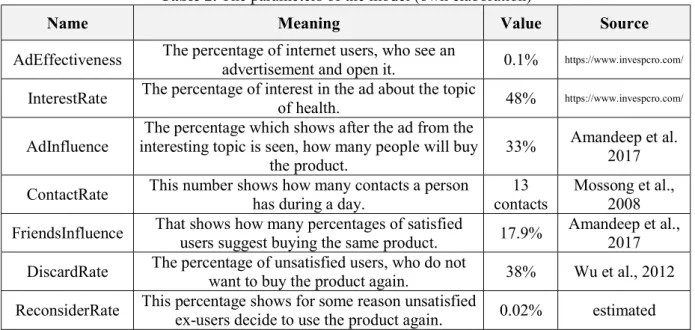
As there are currently no publications available, which could provide a wide range of different data from consumer surveys in this filed, we had to look for papers mainly from the area of marketing with a connection to food traceability. We defined as it is seen in the table below seven parameters, based on statistics and publications, which affect on the examined population.
Table 2. The parameters of the model (own elaboration)
Name Meaning Value Source
AdEffectiveness The percentage of internet users, who see an advertisement and open it. 0.1% https://www.invespcro.com/
InterestRate The percentage of interest in the ad about the topic of health. 48% https://www.invespcro.com/
AdInfluence
The percentage which shows after the ad from the interesting topic is seen, how many people will buy
the product.
33% Amandeep et al. 2017
ContactRate This number shows how many contacts a person has during a day. contacts 13 Mossong et al., 2008
FriendsInfluence That shows how many percentages of satisfied users suggest buying the same product. 17.9% Amandeep et al., 2017
DiscardRate The percentage of unsatisfied users, who do not
want to buy the product again. 38% Wu et al., 2012
ReconsiderRate This percentage shows for some reason unsatisfied ex-users decide to use the product again. 0.02% estimated
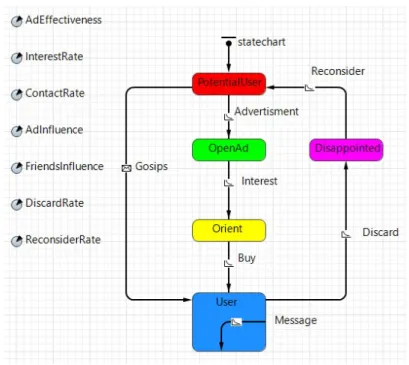
The base of our model is a ten thousand population, where everybody -because everybody consumes- is a potential user of the new blockchain-based food tracking system. While in the 21st. century the information consumption patterns have changed we used a statistic, which reflects the internet-based ads. Unfortunately, the framework of the study does not provide an opportunity to present all the variables and properties of the parameters, but the algorithm of the model is described in detail below:
attributable to advertising. When a „User” is satisfied with the bought product he can offer, advertise it to his friends and his family. Based on Amandeep et al. (2017) these „Gossips” can make one-third of „PotentialUser” immediately „Users”, but if the product not enough good for the consumer he can leave, „Discard„ and become a „Disappointed” customer. According to Wu et al., (2012), the rate of it is 38%. Despite the consumer became „Disappointed” there is a chance to become a „User” again, because either the new advertisements persuade him to try and buy it again, or his situation is simply changed. Based on our estimation the rate of it is 0.02%. The model is based on secondary data from different countries and eras and the construction of it tries to focus on an average user without any specification (gender, age, education level), so the results of it can differ from the country, gender, age-specific ones. Nevertheless, it can be concluded that the model used may be suitable for analyzing the expected fundamental trends. The described model is seen in the figure below.
Figure 2.How potential users could become blockchain-based products consumer (own elaboration)
4. Results
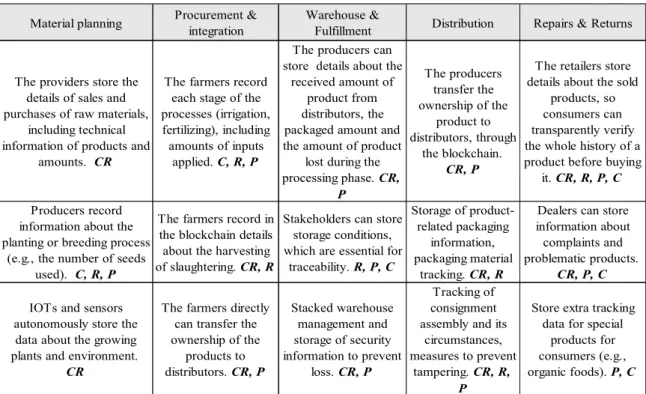
Table 3. Reasons for using blockchain technology in the food supply chain (own elaboration)
Material planning Procurement & integration
Warehouse &
Fulfillment Distribution Repairs & Returns
The providers store the details of sales and purchases of raw materials,
including technical information of products and
amounts. CR
The farmers record each stage of the processes (irrigation, fertilizing), including amounts of inputs
applied. C, R, P
The producers can store details about the
received amount of product from distributors, the packaged amount and the amount of product
lost during the processing phase. CR,
P
The producers transfer the ownership of the
product to distributors, through
the blockchain.
CR, P
The retailers store details about the sold
products, so consumers can transparently verify the whole history of a product before buying
it. CR, R, P, C
Producers record information about the planting or breeding process
(e.g., the number of seeds used). C, R, P
The farmers record in the blockchain details about the harvesting of slaughtering. CR, R
Stakeholders can store storage conditions, which are essential for
traceability. R, P, C
Storage of product-related packaging
information, packaging material
tracking. CR, R
Dealers can store information about complaints and problematic products.
CR, P, C
IOTs and sensors autonomously store the data about the growing plants and environment.
CR
The farmers directly can transfer the ownership of the
products to distributors. CR, P
Stacked warehouse management and storage of security information to prevent
loss. CR, P
Tracking of consignment assembly and its
circumstances, measures to prevent
tampering. CR, R, P
Store extra tracking data for special
products for consumers (e.g., organic foods). P, C
However, it should be noted that the application examples listed in the table, and the reasons for their application were determined from literature sources (not determined by industry experience), because of the novelty of the technology.
Based on the statistics, publications, and our model, we simulated how the population of the different groups will shape, and we estimated how widely blockchain-based tracking systems will be used. This information could be really useful because, according to this, the companies can decide it is worth setting up a new food tracking system or not.
Although the Food Marketing Institute (2018) measured a massive decrease of the public’s trust in the food supply chains and parallel an increased demand for food traceability, the number of Blockchain-Based Traceability Systems’ users does not show a monotonically increase, even a clear trend is not seen, as represents the table below. The detailed Table 4 shows how the exact numbers of the different groups are shaped after 5 years.
Table 4. The detailed number of the examined groups (own elaboration)
Run(day) OpenAd Orient Users Disappointed Potential
users
1 7 2 0 0 9991
182 11 24 23 1540 8402
365 16 22 21 2856 7085
547 10 24 16 3948 6002
730 10 16 8 4866 5100
912 8 7 14 5505 4466
1095 6 13 12 6070 3899
1287 7 6 7 6511 3469
1460 7 13 9 6857 3114
1642 8 15 12 7145 2820
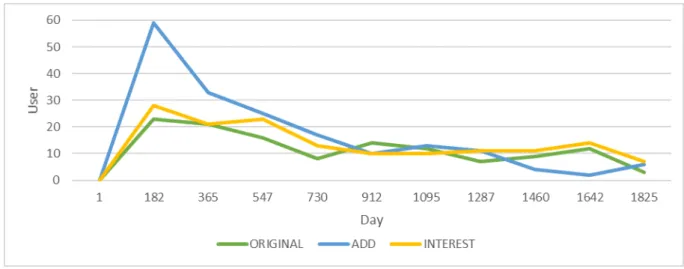
According to these data we can say, the number of potential users monotonically decreased, while the number of disappointed people monotonically increased by the years, however, we can not see any kind of regularity in the number of users, even the number of daily users (as it is seen in table 4) is vanishing. We hypothesized that the low number of users was due to a generally low rate of advertising effectiveness, because a huge number of potential users (7000) even did not open any ad, and around 3000 people already tried out the new product but they did not like it and they became „disappointed users” (after 1 year). To test this assumption, the rate of the advertisement's effectiveness was increased with 0.001. The blue line shows in Figure 3. how the new value changed the number of users compared to the original (green) values and the increased interest rate values (orange).
Figure 3. The effect of the changes in the number of users within 5 years (own elaboration)
Even it is seems an increase in the number of users, surprisingly, the change of ad effectiveness did not have any positive effect on the total proportion of it; however, it increased the average proportion of disappointed group with 22%. Based on this outcome, we hypothesized the increase of the interest’s rate value – because this variable is the second in state chart, which influences the potential users – could enhance the number of the users. Thus the rate of interest was increased with the same quantity (0.001) and its effects seen with the orange line in Figure 4 above. Even nearly every second person is interested in about health, when we examined the effect of the new value, we measured an 11% higher proportion of total users, while the average number of daily users, in this case, was also only 8. Based on Wu et al., (2012) 62% of consumers are ready to pay a premium for the extra information, so 38% of users will leave because they do not want or not able to pay extra fee for the traceability data even they tried it out, they are not going to be loyal users. While the biggest question of this new blockchain-based traceability systems is, how much extra % (of basic price) have to consumers pay for the information. We hypothesized the companies take a bigger part of expenses (they ask higher prices, but the increase is lower than 10%) or the governments take over some costs of the set up, so a higher proportion of consumers could afford the new traceability system. We analyzed how it would change the size of the groups if our assumption would affect a 0.1% decrease in the value of DiscardRate. In five years caused this lower DiscardRate a 6.46% increase in the proportion of users and a 0.5% decrease in the group of disappointed consumers. Table 5. shows the above-mentioned changes.
Table 5. The affected changes in the examined groups (own elaboration) original increased ad increased interest decreased discard Users
(average) 7.2 6.2 8 7.7
Disappointed (average) 7212 8842 7242 7178
Surprisingly separately, none of the examined parameters had a serious effect on the size of the users' group. Based on our results, the advertisement's effectiveness does not have a positive effect on the users’ number, while the decreased discards’ rate and the increased interest rate enhanced the size of this group. Whereas the increased interest rate influenced more the number of users than decreased discards’ rate, but it is increased more the size of the disappointed group too. According to these results, the companies have to decrease the extra price of the information – or make the governments interested in the set-up of the new system – which could decrease the discards’ rate, since the population is already quite healthy-minded. Naturally, the growth of interests towards food traceability would also increase the cluster of users, but as long as the consumers are not involved with this new opportunity and they have no idea what benefits this would bring, the examination of willingness to pay will not provide reliable results.
5. Conclusion
The appearance of blockchain provides so many new features in the food tracking that could satisfy the demand of the consumers. Some researches demonstrated openness from their side to pay more for the traceable food, and the proportion of this group is quite high in many cases, but the idea of the increased price which would provide the set up these new systems is not popular. That is why important to see the proportions of different minded consumers since the companies do not want to invest in a new system which payment is uncertain. According to the available statistics and publications, we measured a lack of interest from the consumers’ side, which means in the close future (next five years) this kind of new tracking system is not going to be used by the consumers (if they would be available). The details showed the reasons for it could be the low rate of the advertisements’ effectiveness and the high premium price of extra information which could affect a quite huge discard rate. According to the statistics, the population is quite healthy-minded so the advertisers should find better ways to address them and involve them with this new blockchain-based opportunity.
References
Adele Peter, Fast Company 2017 ‘In China, You Can Track Your Chicken On–You Guessed It– The Blockchain. Retrieved from https://www.fastcompany.com//
Amandeep, Seema, V, & Syed, A 2017 ‘The Impact of Advertising on Consumer Purchase Decision with Reference to Consumer Durable Goods in Oman, International Journal of Managerial Studies and Research (IJMSR) Volume 5, Issue 12, December2017, doi:10.20431/2349-0349.0512002,
Angulo, A, M & Gil, J, M 2007 ‘Food safety and consumers’ willingness to pay for labelled beef in Spain. Food Quality and Preference 18: 1106–17., doi:10.1016/j.foodqual.2007.05.008
Angulo, A, M, Gil, J, M, & Tamburo, L 2005 ‘Food safety and consumers’ willingness to pay for labelled beef in Spain. Journal of Food Products Marketing 11 (3): 89–105. doi:10.1300/J038v11n03_06
Aung, M, M, & Chang, Y, S, 2014 ‘Traceability in a food supply chain: Safety and quality perspectives. Food Control, 39(1), 172–184. https://doi.org/10.1016/j.foodcont.2013.11.007.
Babich, V, & Hilary, G 2019 ‘Distributed ledgers and operations: what operations management researchers should know about blockchain technology. Manufacturing & Service Operations Management, forthcoming, doi:10.1287/msom.2018.0752
Balfegό Group 2017’ https://balfego.com// BeefLedger Limited 2017 ‘ http://beefledger.io//
Behnke, K, & Janssen, M, F, W, H, A 2019 ‘Boundary conditions for traceability in food supply chains using blockchain technology. International Journal of Information Management. doi:10.1016/j.ijinfomgt.2019.05.025 Borschhev, A 2013 ‘The Big Book of Simulation Modeling: Multimethod Modeling with Anylogic 6, ISBN-13: 978-0989573177
Botos, Sz, Felföldi, J, Várallyai, L, Péntek, Á & Szilágyi, R 2018 ’Analysis the advanced ict usage of the Hungarian sme sector for preparing a domestic agri-food research. Apstract - Applied Studies In Agribusiness And Commerce 11 : 3-4 pp. 147-154.
Bu, F, Zhu, D, & Wu, L 2013 ‘Research on the Consumers' Willingness to Buy Traceable Pork with Different Quality Information: A Case Study of Consumers in Weifang, Shandong Province’, Asian Agricultural Research, Vol. 5(05), (2013) pp. 121–124
Bunge, J 2017 ‘Latest Use for a Bitcoin Technology: Tracing Turkeys From Farm to Table. https://www.wsj.com//
Campbell, A 2017 ‘Sustainability from paddock to plate. Retrieved from https://www.sciencealert.com/sustainability-from-paddock-to-plate//
Caro, M, P, Muhammad, S, A, Massimo, V, & Raffaele, G 2018 ‘Blockchain-based Traceability in Agri-Food Supply Chain Management: A Practical Implementation 2018 IoT Vertical and Topical Summit on Agriculture - Tuscany (IOT Tuscany)
Casey, M, & Wong, P 2017 ‘Global supply chains are about to get better, thanks to blockchain. Harvard Business Review Digital Articles.
CB Insights 2017 ‘How Blockchain Could Transform Food Safety. Retrieved from https://www.cbinsights.com// Chien, L, H & Zhang Y, C, 2006 ‘Food traceability system—An application of pricing on the integrated
information. Paper presented at the 5th International Conference of the Japan Economic Policy Association, Tokyo, Japan, December 2–3.
Cunningham, P 2008 ‘Using DNA Traceability to Track Meat and Ensure Safety. Genetic Engineering & Biotechnology News, 28 (8)
Davis, F, D, 1989 ‘Perceived Usefulness, Perceived Ease of Use, and User Acceptance of Information Technology, Psychology, Computer Science, Published in MIS Quarterly 1989, DOI:10.2307/249008 Devries, P, D, 2016 ‘An analysis of Cryptocurrency, Bitcoin, and the future. International Journal of Business Management and Commerce, 1(2), pp. 1–9. http://www.ijbmcnet.com//
Dickinson, D, L, & Bailey, D 2002 ‘Meat traceability: Are U.S. consumers willing to pay for it? Journal of Agricultural and Resource Economics 27: 348–64.doi:10.22004/ag.econ.31128
Dickinson, D, L, & Bailey, D 2005 ‘Experimental evidence on willingness to pay for red meat traceability in the United States, Canada, the United Kingdom, and Japan. Journal of Agricultural and Applied Economics 37 (December): 537–48. doi:10.1017/S1074070800027061
Elmasri, R, & Navathe, S, B, 2015 ‘Fundamentals of Database Systems. New York: Pearson. ISBN-10: 0133970779
Eyal, I, Gencer, A, E, Sirer, E, G, & van Renesse, R 2016 ‘Bitcoin-NG: A scalable blockchain protocol. Proceedings of the 13th USENIX Symposium on Networked Systems Design and Implementation pp. 45–59, https://www.usenix.org/
Fiala, P 2005 ‘Information Sharing in Supply Chains, Omega – International Journal of Management, S33: pp. 419–423.
Food Marketing Institute 2018 ‘THE TRANSPARENCY IMPERATIVE, Product Labeling from the Consumer Perspective
Fujimoto, R, M 1990 ‘Parallel discrete event simulation. Communications of the ACM, 33(10), pp. 30–53. doi:10.1145/84537.84545
Füzesi, I, Gyarmati, Á, Lengyel, P, & Felföldi, J 2018 ‘Élelmiszerjelölések hatása a fogyasztói döntésekre – különös tekintettel a nyomon követésre. GAZDÁLKODÁS 62 : 5 pp. 444-458. , 14 p.
Galvez, J, F, Mejuto, J, C, & Simal-Gandara, J 2018 ‘Future challenges on the use of blockchain for food traceability analysis, Trends in Analytical Chemistry, doi:10.1016/j.trac.2018.08.011.
Grass Roots Farmers’ Cooperative 2017 ‘How we ‘re using blockchain tech for total transparency. Retrieved from https://grassrootscoop.com//
Hansstein, F, V 2014 ‘Consumer Knowledge and Attitudes towards Food Traceability: A Comparison between the European Union, China and North America, Paper presented at the 2014 International Conference on Food Security and Nutrition
Helbing, D 2012 ‘Agent-Based Modeling. Social Self-Organization, pp. 25–70. doi:10.1007/978-3-642-24004-1_2
Hobbs, J, E, Bailey D, Dickinson D, L, & Haghiri, M 2005 ‘Traceability in the Canadian red meat sector: Do consumers care? Canadian Journal of Agricultural Economics 53 (1): 47–65.
Hou, X, G, 2011 ‘Analysis of Consumers' Willingness to Pay for Traceable Fresh Fruits in Shanghai City and Countermeasures’, Asian Agricultural Research, Vol. 3(12), (2011) pp. 35–38
Hyperledger 2018 ‘An introduction to hyperledger. https://www.hyperledger.org// invespcro https://www.invespcro.com/blog/effectiveness-online-advertising/
Ireland Craft Beers 2017 ‘Downstream beer. Retrieved from http://www.down-stream.io//
Karlsen, K, M, Dreyer, B, Olsen, P, & Elvevoll, E, O 2013 ‘Literature review: Does a common theoretical framework to implement food traceability exist? Food Control, 32(2), 409–417.
https://doi.org/10.1016/j.foodcont.2012.12.011.
Kersten, W, Seiter, M, von See, B, Hackius, N, & Maurer, T 2017 ‘Trends and Strategies in Logistics and Supply Chain Management – Digital Transformation Opportunities.DVV Media Group, Hamburg, 2017. Keszey, T, & Zsukk, J 2017 ‘Az új technológiák fogyasztói elfogadása, Vezetéstudomány/ Budapest Management Review, XLVIII. ÉVF. 2017. 10. SZÁM, DOI:10.14267/ VEZTUD.2017.10.05
Kim, K, Ryoo, Y, S, & Jung, D, M 2011 ‘Inter-organizational Information Systems Visibility in Buyer–Supplier Relationships: The Case of Telecommunication Equipment Component Manufacturing Industry, Omega – International Journal of Management, 39: pp. 667–676.
Knauer, F, & Mann, A 2019 ’What is in It for Me? Identifying Drivers of Blockchain Acceptance among German Consumers, The Journal of The British Blockchain Association, https://doi.org/10.31585/jbba-3-1-(1)2020
Kogias, E, K, Jovanovic, P, Gailly, N, Khoffi, I, Gasser, L, & Ford, B 2016 ‘Enhancing bitcoin security and performance with strong consistency via collective signing. Proceedings of the 25th USENIX Security Symposium pp. 279–296, https://www.usenix.org//
Lee, J, Y, Cho, R, K, & Paik, S, K 2016 ‘Supply chain coordination in vendor-managed inventory systems with stockout-cost sharing under limited storage capacity. European Journal of Operational Research, 248(1), pp. 95– 106. doi:10.1016/j.ejor.2015.06.080
Lindquist, A, Berglund, F, & Johannesson, H 2008 ‘Supplier Integration and Communication Strategies in Collaborative Platform Development, Concurrent Engineering: Research and Applications, 16: pp. 23–35. doi:10.1177/1063293X07084639
Lutfi, Al-Dalahmeh, M., & Dajnoki, K 2020 Do Talent Management Practices Affect Organizational Culture?. Műszaki és Menedzsment Tudományi Közlemények, 5(1), pp. 495-506.
https://doi.org/10.21791/IJEMS.2020.1.40
Madenas, N, Tiwari, A, Turner, C, J, & Woodward J 2014 ‘Information flow in supply chain management: A review across the product lifecycle. CIRP Journal of Manufacturing Science and Technology, 7(4), pp. 335–346. doi:10.1016/j.cirpj.2014.07.002
Martens, B, J, & Dooley, F, J 2010 ‘Food and grocery supply chains: a reappraisal of ECR performance. International Journal of Physical Distribution & Logistics Management, 40(7), 534–549.
doi:10.1108/09600031011071993
Mateen, A, & Chatterjee, A, K 2015 ‘Vendor managed inventory for single-vendor multi-retailer supply chains. Decision Support Systems, 70, pp. 31–41. doi:10.1016/j.dss.2014.12.002
Mossong, J, Hens, N, Jit, M, Beutels, P & Auranen, K 2008 ‘Social contacts and mixing patterns relevant to the spread of infectious diseases. PLoS Med 5(3) e74. doi:10.1371/journal.pmed.0050074
Oláh, J, Popp, J & Erdei, E 2019 ’ Az Ipar 5.0 megjelenése: ember és robot együttműködése. Logisztikai Trendek És Legjobb Gyakorlatok 5 : 1 pp. 12-19.
Olsen, P, & Borit, M 2013 ‘How to define traceability? Trends in Food Science & Technology, 29(2), 142–150.
https://doi.org/10.1016/j.tifs.2012.10.00. OriginTrail 2018 ‘https://origintrail.io//
Pereira, J, V, 2009 ‘The New Supply Chain’s Frontier: Information Management, International Journal of Information Management, 29: pp. 372–379.
Popp, J, Balogh, P, Oláh, J, Kot, S, Harangi Rákos, M, & Lengyel, P 2018 ’Social Network Analysis of Scientific Articles Published by Food Policy’ SUSTAINABILITY 2018, 10, 577: doi:10.3390.
Power, Y, & Bahri, P, A 2005 ‘Integration Techniques in Intelligent Operational Management: A Review, Knowledge-Based Systems, 18: pp. 89–97. doi:10.1016/j.knosys.2004.04.009
Reshma, K 2018 ‘Food Traceability on Blockchain: Walmart’s Pork and Mango Pilots with IBM, The JBBA, Volume 1, Issue 1, doi:10.31585/jbba-1-1-(10)2018
Sander, F, Semeijn, J, & Mahr, D 2018 ‘The acceptance of blockchain technology in meat traceability and transparency. British Food Journal. doi:10.1108/bfj-07-2017-0365
Schmidt, C, G, & Wagner, S, M 2019 ‘Blockchain and supply chain relations: A transaction cost theory perspective, Journal of Purchasing and Supply Management (2019), doi:10.1016/j.pursup.2019.100552. Siebers, P, O, Macal, C, M, Garnett, J, Buxton, D, & Pidd, M 2010 ‘Discrete-event simulation is dead, long live agent-based simulation! Journal of Simulation, 4(3), pp. 204–210. doi:10.1057/jos.2010.14
Singhry, H, B, & Abd, R, A, 2018 ‘Enhancing supply chain performance through collaborative planning, forecasting, and replenishment. Business Process Management Journal. doi:10.1108/bpmj-03-2017-0052 Soil Association Certification 2018 ‘https://www.soilassociation.org//
Srai, J, S, & Lorentz, H, 2019 ‘Developing design principles for the digitalisation of purchasing and supply management. Journal of Purchasing & Supply Management, 25(1), pp. 78-98.
Statista 2019 ‘ https://www.statista.com//, downloaded: 2020.02.17.
Stranieri, S, Cavaliere, A, & Banterle, A 2017 ‘Do motivations affect different voluntary traceability schemes? An empirical analysis among food manufacturers. Food Control, Vol 80, 1 October 2017, 187–196. pp.
Szakály, Z, Pető, K, Popp, J, & Jasák, H 2015 ‘A fenntartható fogyasztás iránt elkötelezett fogyasztói csoport, a LOHAS szegmens jellemzői. Táplálkozásmarketing, 2 (1) 3–9. pp.
Szakály, Z, Soós, M, Kovács, S & Polereczki, Zs 2016’ A felárfizetési hajlandóságot befolyásoló tényezők elemzése funkcionális élelmiszereknél. Gazdálkodás, 60 (4) 305–321. pp.
Tian, F 2017 ‘A supply chain traceability system for food safety based on HACCP, blockchain & internet of things. Proceedings of International Conference on Services Systems and Services Management (ICSSSM 2017), doi:10.1109/ICSSSM. 2017.7996119.
Treiblmaier, H 2018 ‘The impact of the blockchain on the supply chain: a theory-based research framework and a call for action. Supply Chain Management: An International Journal, 23(6), 545-559
Tsang, Y, P, Choy, K, L, Wu, C, H, Ho, G, T, S, & Lam, H, Y, 2019 ‘Blockchain-driven IoT for Food Traceability with an Integrated Consensus Mechanism. IEEE Access, 1–1. doi:10.1109/access.2019.2940227 Vickery, S, K, Jayaram, J, Droge, C, & Calantone, R 2003 ‘The Effects of an Integrative Supply Chain Strategy on Customer Service and Financial Performance: An Analysis of Direct Versus Indirect Relationships, Journal of Operations Management, 21: pp. 523–539.
Winz, I, Brierley, G, & Trowsdale, S 2008 ’The Use of System Dynamics Simulation in Water Resources Management. Water Resources Management, 23(7), pp. 1301–1323. doi:10.1007/s11269-008-9328-7 World Economic Forum 2017 ‘Why Blockchain should be Global Trade’s Next Port of Call, May
Wu, L, Wang, S, Zhu, D, Hu, W & Wang, H 2015 ‘Chinese consumers’ preferences and willingness to pay for traceable food quality and safety attributes: The case of pork, China Economic Review, doi:
Wu,L, Xu,L, Dian, Z & Xiaoli, W 2012 ‘Factors Affecting Consumer Willingness to Pay for Certified Traceable Food in Jiangsu Province of China, Canadian Journal of Agricultural Economics vol.60, no. 3, pp. 1–17, doi:10.1111/j.1744-7976.2011.01236.x
WWF 2018 ‘New Blockchain Project has Potential to Revolutionise Seafood Industry. https://www.wwf.org.nz// Zhang, T, Pota, H, Chu, C, C, & Gadh, R 2018 ‘Real-time renewable energy incentive system for electric vehicles using prioritization and cryptocurrency. Applied Energy, 2018, 226: pp. 582-594.
https://doi.org/10.1016/j.apenergy.2018.06.025
Zhao, J, L, Fan, S, & Yan, J 2016 ‘Overview of business innovations and research opportunities in blockchain and introduction to the special issue. Financial Innovation, 2(28), pp. 1-7.
Zheng, Z, Xie, S, Dai, H, Chen, X, & Wang, H 2017 ‘An overview of blockchain technology: Architecture, consensus, and future trends. Proceedings of the 2017 IEEE BigData Congress, pp. 557–564,
doi:10.1109/BigDataCongress.2017.85.
Zhong, R, Y, Huang, G, Q, Lan, S, L, Dai, Q, Y, Xu, C, & Zhang, T 2015 ‘A big data approach for logistics trajectory discovery from RFID-enabled production data. International Journal of Production Economics, 165, pp. 260–272. doi:10.1016/j.ijpe.2015.02.014
Zhong, R, Y, Newman, S, T, Huang, G, Q, & Lan, S 2016 ‘Big Data for supply chain management in the service and manufacturing, Computers & Industrial Engineering, Volume 101, November 2016, pp. 572-591,