FOOTHILL HIGH SCHOOL
2016-2017
Course Catalog & Student
Registration Guide
800 College Drive, Henderson, Nevada 89002
(702) 799-3500 Fax (702) 799-3524
Dear Foothill High School Students and Family Members,
Welcome to Foothill High School! We have developed a relevant, comprehensive
curriculum that is geared to maximize the academic potential of all Foothill students.
Our advanced placement classes and honors programs will challenge college-bound
students. Our Fine Arts Department is recognized throughout the district as one of the
very best in the state. Students will also receive offerings in our successful career and
technical education programs.
We encourage you to consider both your academic goals, as well as your involvement in
extracurricular activities as you make your selections. Please take advantage of the
experience and knowledge of our tremendous teachers and counselors in helping you
with course selection decisions. If you have questions regarding course selections,
please contact our counseling department at (702) 799-3500 extension 4300. We pride
ourselves in doing whatever it takes to prepare our students for post-secondary
opportunities. We are very proud of our academic programs, athletic endeavors, and
wide array of school-based activities.
We recognize the importance of family involvement and invite your families to be a part
of the Foothill community. With your support, we will help our students graduate and
become productive, responsible, and successful community members. Please remember,
the courses you select, will remain your courses for the 2016-2017 school year.
Welcome to the Falcon Family!
Respectfully,
Lisa Burkhead
Principal
CLARK COU N TY SCHOOL DISTRICT
5 100 \V/. Sah a ra Ave.
Foothill High School
2016-2017
Administration Staff
Principal………..Lisa Burkhead Assistant Principal; Curriculum………..Marla Kober Assistant Principal; Athletics………...William Love Assistant Principal; Activities, Discipline………...Molly Jensen-Muir Dean A – H………..Zenon Brooks Dean I – P………...Tina Lahr
Dean Q – Z………..Mark Romonowski
Counseling Staff
Counselor A – Cas ... Breeana Crine Counselor Cat - Fr ... Jeff Doyle Counselor Fs - Has ... Darcie Yakubik Counselor Hat - Mab ... Patricia Winlow Counselor Mac - Pen ... Christine Gonzalez Counselor Peo - Spa ... Nicole Vasquez Counselor Spb - Z ... Steven Campbell
GENERAL INFORMATION………4-6
Preregistration Information Schedule Change Policy Schedule Requirements Prerequisites
Challenges to Teacher Recommendation Fees
Attendance Requirement Concurrent Credit Options
Testing Program at Foothill High School
SPECIAL PROGRAMS……….………….7
NCAA Initial Eligibility/Maintenance Guidance and Counseling
CSN Concurrent Enrollment 2 + 2 Tech Prep Credit
GRADUATION INFORMATION………...8-9
Matriculation/Academic Load Requirements Four-Year Academic Plan
Suggested Program Sequence External/Additional Credit Sources
GRADUATION REQUIREMENTS……….10-15
21st Century Course of Study Standard Diploma
Advanced Diploma Advanced Honors Diploma Special Programs Diploma Honors and AP Courses
GRADUATION RECOGNITION……….15-16
Valedictorian & Salutatorian
Honors & High Honors Scholar Athlete Graduation Gowns and Awards
PLANNING FOR THE FUTURE……….17-19
Community College Information College & University Admissions College Financial Aid
Military Information Millennium Scholarship
College Entrance Tests and Course Requirements NCAA/NAIA Eligibility Center
Career and Technical Education Career Center
Athletic Eligibility
CODE OF HONOR………...20 CLUBS AND ORGANIZATIONS………...21 DEPARTMENT COURSE OFFERINGS………..22-71
Art 22
Career and Technical Education 25
English 33 Foreign Language 40 Math 46 Performing Arts 49 Physical Ed/Health 57 Science 59
Social Studies Core 64
General Information
Preregistration Information
The courses in this registration guide will be offered at Foothill High School for the 2016-2017 school year. The courses
listed in this guide will only be offered if an adequate number of students register for a course and if we are able to
sufficiently provide staffing. If too few students enroll in a course, or we do not have the staffing required, it may be
canceled, and those students will be rescheduled into their alternative elective courses. Students will not receive credit for
repeating a semester of a course that they have previously passed. There are certain exceptions. Courses such as varsity band
or varsity chorus may be repeated for credit. Students should see a school counselor for this information.
Students will be scheduled into classes selected during registration unless those classes are filled or canceled. Courses that
students select this spring are the courses they will be required to attend next year. Choose classes carefully. No
schedule change requests will be granted other than those governed by the policy statement printed on page 5.
In order to register effectively for classes next year, please read and follow these guidelines:
READ this entire registration guide and course catalog before you register.
DISCUSS your course selection with your parents and teachers before registration. Many courses require a teacher
recommendation.
CHOOSE a Four Year Academic Plan that will challenge you and give you the best preparation for your future education
and employment. Consider your career interests as you make course selections. Please keep in mind that year-long courses
mean just that – you are enrolled for an entire year. No changes will be made at semester time. Please choose your courses
carefully.
CHOOSE what electives you would like to take. If teacher approval is required, bring the form to the elective teacher for
his/her signature. Make alternative choices for your electives. In the event that some of your first-choice electives are filled,
you will be assigned to your alternative choice(s) in the order you listed them.
EVALUATE possible career goals using www.intocareers.org (NVCIS) to determine post-high school education needed to
meet your career interests. Research the requirements for the college/University or career goals you are considering ensuring
that you are selecting appropriate courses. Review graduation requirements.
MEET individually with your counselor to discuss course selection, graduation requirements, and after high school plans. At
that meeting, you and your counselor will complete the registration process. You will be given a copy of the courses selected
for the 2016-2017 school year.
You are responsible for notifying your counselor of summer school courses completed as soon as possible.
Students will be expected to remain in courses for the duration of the course. Exceptions such as graduation
requirements and misplacement will be handled through the regular schedule change procedure.
NON-DISCRIMINATION LANGUAGE
The Clark County School District does not knowingly discriminate against any person on the basis of
race, color, creed, religion, national origin, sex, age, or disability in admission or access to, or
General Information
Schedule Change Policy
Since much advance planning and guidance are provided for each student prior to registration, schedule changes will not be
made after registration. Class changes will not be granted to accommodate a change in a student's lunch period or to request
a specific instructor. Due to the State of Nevada Department of Education Guidelines, no student may change a class and
receive credit after the third week of the semester. If a student is allowed to drop a class after this time, the student will
receive an “F” grade in that class. Requests for schedule changes are considered during the first three weeks of the semester
and are granted only for the following reasons:
End of Course Exam
Fulfillment of graduation requirements
Misplacement in an academic area according to ability
Successful completion of summer school course work
The administration may, due to increased/decreased enrollment and staffing, balance course sections by transferring students
from one class and/or teacher to another section. Every effort will be made to ensure a smooth transition for students.
Schedule Requirements
Prior to the selection of any electives, students must enroll in required courses they have failed. All ninth, tenth, and
eleventh grade students must enroll in six courses a year. Twelfth grade students may apply for a reduced course load (four
or five courses). However, all schedules must be continuous. The scheduling of open periods will be based on the master
schedule and class loads. Students who qualify may request, but are not guaranteed, a late start or early dismissal. Students
on a reduced schedule must provide their own transportation and leave campus as soon as their schedule is complete.
.
Prerequisites
Prerequisites are listed in the course catalog to help students and parents make the best educational decision possible.
Students must meet these prerequisites to enroll in a course. Both semesters of the prerequisite course must be successfully
completed. Preregistration schedule adjustments will be made automatically should prerequisites not be met.
Course Challenge
Students who are not recommended or do not meet the requirements for a course may enroll in the class by completing the
challenge process in the spring and having a parent/teacher conference. By doing so, the student will remain in the class for
the entire school year.
Fees
Fees are charged for some elective classes where students complete special projects to be taken home. These class fees cover
the actual cost for projects. With the uncertainty of our economy, there are families who may be unable to purchase all of the
necessary items or pay fees for their students. This is understandable and will not prevent a child’s enrollment in any class. If
the circumstances are such that alternatives to immediate payment of fees must be considered, please contact your child’s
counselor and/or teacher(s) so the school and parent can work together for a resolution.
Enrollment Adjustments
The administration may, due to increased/decreased enrollment and staff changes, balance course sections by transferring
students from one class to another section of the same course. Every effort will be made to ensure a smooth transition for
students.
Attendance Requirement
With state mandated accountability, comes greater responsibility to young people. Students are required to attend all classes
in which they are enrolled. Students with more than ten unexcused absences in any class will lose credit for that class.
Concurrent Credit Options
Students may earn credits beyond the regular school day by enrolling in any of the approved concurrent programs. There is
no limit to the number of concurrent credits a student may earn. See your counselor for more information on concurrent
programs.
General Information
Testing Program at Foothill High School
Starting with the class of 2017, four End of Course Examinations (EOC) are taking the place of the Nevada High School
Proficiency Examinations (HSPE). Students will take the End of Course Exams at the conclusion of the course, regardless
of when that course is taken during a student's high school career. Usually, students take these courses during their
freshman and sophomore years. These exams include Algebra, Geometry, English I (reading), and English II (writing).
The College and Career Readiness Assessment (ACT) is a requirement for graduation. Juniors will take the ACT in Spring
of their junior year at no cost.
The College Board offers Advanced Placement (AP) exams in numerous disciplines in May of each year. Many students
may earn college credit at various colleges and universities based on their scores on these exams.
All Clark County School District students will take the PSAT at no cost (pending final budget allocations) during the
sophomore year to provide data that will assist in determining the student’s potential success in Advanced Placement (AP)
courses. Taking the PSAT in the sophomore year also prepares the student for the SAT. The PSAT taken as a junior (at the
cost of the student) is used to identify National Merit Scholarship Semi-finalists.
It is recommended that student’s take ACT and/or SAT in the spring of their junior year, as most four-year
colleges/universities require either test for admission. In addition, some colleges/universities require a minimum score on
the ACT and/or SAT to determine placement in freshman English and math courses. Finally, some universities determine
scholarship eligibility on ACT and/or SAT results. Students wishing to take either exam, the SAT or retake the ACT, must
apply on their own at
www.sat.collegeboard.com
for the SAT or
www.actstudent.org
for the ACT. (At the cost of the
student) Foothill school code: 290073
Note: It may be necessary to retake the ACT and/or SAT to increase the student’s score. This may enable a student to
avoid placement in a remedial math and/or English college course. Remedial courses at Nevada System of Higher
Education Institutions provide no college credit and are not paid for by the Millennium Scholarship program.
The ASVAB (Armed Services Vocational Aptitude Battery) is available to interested eleventh and twelfth-grade students.
The military uses these test results for admission and placement purposes. It is also an outstanding test for career planning in
the civilian world.
Special Academic Programs
Clark County School District Athletic Eligibility
Initial Eligibility – General Requirements1.
Must be enrolled in grades 9 – 12.2.
Must reside in the school of enrollment’s attendance zone.3.
Must be enrolled in a minimum of two units of credit per semester and regularly attend school.4.
Must have passed a minimum of two units of credit the immediately preceding semester with a minimum grade point average of 2.0. A student may earn a maximum of one unit of external credit (summer school, correspondence, etc.) to improve a previous semester deficiency.5.
Transfer students are automatically presumed ineligible. Rebuttal of presumption of ineligibility guidelines are contained in Nevada Interscholastic Activities Association regulations (NAC 386.785 – 386.799).6.
Secondary Magnet/CTA students who enroll for less than a three-year program or enroll in individual classes are ineligible for sports at the Magnet/CTA for 180 days. Students who drop from the Magnet/CTA will become automatically ineligible for sports at the Magnet/CTA for 180 days. If a student chooses to return to his/her school residence, he/she would be ineligible for the remainder of that school year and for 180 days in any sport in which he/she appeared on an NIAA roster during his/her attendance at the Magnet/CTA.7.
Secondary Open Enrollment students who are selected to attend an Open Enrollment school are eligible to participate in athletics. Students who change schools will become automatically ineligible for the remainder of the current school year and for 180 school days in any sport his/her name appeared on an NIAA roster during his/her attendance at the Open Enrollment school.8.
Career Technical Academy/ Charter School/ Home-Schooled students are eligible to participate in athletics in the school that is located in the attendance zone of the residence of the parent or legal guardian.Maintenance of Eligibility
1.
Must maintain passing grades in all subjects during the current athletic season.2.
Must regularly attend school. Must be in school in order to participate in practice or games on any given day.3.
Must maintain positive citizenship. Students on RPC or suspension are not eligible to participate. Serious and/or chronic behavior infractions may result in suspension of athletic participation for up to one year, at the discretion of the principal.CCSD Guidance & Counseling Website
The Guidance and Counseling website which can be found at http://ccsd.net/departments/guidance-counseling is designed to provide students and parents with information on counseling services provided by the school district. It also serves as a support reference for preparing students for their future educational decisions. Information on diploma requirements, scholarship opportunities and post- secondary opportunities are just a few of examples of what is available on the website.
CSN Concurrent Enrollment
Through a partnership with CSN, juniors and seniors may enroll in dual credit classes, wherein college credits may be earned for
certain classes held here on the Foothill High School campus and taught by college certified instructors. There is a reduced fee for these college credits and books and materials are furnished.
Available dual credit courses:
English 101 – 3 credits English 102 – 3 credits Music Appreciation – 3 credits
Students enrolled in the dual credit program will be able to utilize any benefits offered to college students. A placement test is required for English classes.
2 + 2 Tech Prep Credit
The Tech Prep Program allows students the opportunity to earn college credit for approved high school courses. These credits are granted to any CCSD student that took a qualifying course in his/her junior or senior year, or who took a course earlier and remained in a qualifying program of study through junior year. Credits earned from the College of Southern Nevada apply to a degree at CSN or may be transferred (for a small fee) to a university or four-year college. This is a great way to kick-start your college education with free credits! For more information, please speak with a counselor.
Graduation Information
Matriculation - Academic Load Requirements
Grade classification for high school students will be determined by years in school, not on credits earned. Students will be classified to the next grade level at the end of each school year.
Required High School Student Class Load
The State of Nevada, NAC 387.345, requires all high school students be enrolled as follows:
Ninth, tenth, and eleventh grade students must be enrolled in six classes or the equivalent of six periods per day. Twelfth grade students must be enrolled in at least four classes or the equivalent of four periods per day. Four Year Academic Plan
A four year Course Plan will be created by all 9th grade students and updated each year thereafter in Infinite Campus. This plan sets forth specific educational goals that students intend to achieve before graduation. The Course Plan, which includes a four year high school Academic Program, will be used as a guide to manage the student’s educational development and course selection in alignment with an identified Academic Program. Revising the Course Plan annually will assist students in preparation for graduation and post- secondary goals.
This plan includes students and parents:
Working in consultation with a school counselor to develop the Course plan
Parent review and approval
Reviewing the plan yearly and revising when necessary Suggested Program Sequence
The suggested program sequence to meet minimum graduation requirements is listed below. This is not a college preparatory program sequence (standard diploma).
Ninth Grade Tenth Grade
1. English 1. English
2. Math 2. Math
3. Science 3. Science
4. Health/Study Skills 4. World History
5. PE I 5. PE II
6. Elective 6. Elective
Eleventh Grade Twelfth Grade
1. English 1. English
2. Math 2. Math
3. Science 3. U.S. Gov.
4. U.S. History 4. Elective
5. Elective 5. Elective
6. Elective 6. Elective
Please note: Although Concurrent Courses, Distance Education, Dual Credit, External Courses, and Work Experience are considered equivalent coursework, students must receive prior approval of the counselor and administration.
Ways to make up Deficiencies and Additional Credit Sources
Students may make up credit deficiencies in summer school, dual enrollment at sites listed below, correspondence, independent study, and other external credit sources. A contract between the student and the counselor must be signed prior to enrollment in any credit retrieval program.
Final exams for correspondence study must be taken under school district supervision. Final grades for seniors taking correspondence courses must be on file in the registrar's office by the end of the 3rd
quarter. Students may earn a maximum of six credits from external credit sources.
Concurrent Credit Options
Students may earn credits beyond the regular school day by enrolling in any of the approved concurrent programs. There is no limit to the number of concurrent credits a student may earn. See your counselor for more information on the following concurrent programs:
PNevada Learning Academy - For specific information, including fees, call (702) 855-8435 or visit http://nvlearningacademy.net/. PAdult Education - For specific information on this program, call (702) 799-8650, extension 317 or visit http://schools.ccsd.net/aded/. PSunset High Schools/Programs - Call (702) 855-9775 for more information or visit
http://ccsd.net/divisions/education-services-division/adult-education-horizon-sunset-high-schools.
PSummer School - Students may earn credit during the summer. Registration information is available in the counseling office in the spring. Additional information is available at http://ccsd.net/schools/summer-school/.
Community Service Credit A maximum of one credit may be earned for students who complete 120 hours of volunteer service with an approved community agency. One-half credit may be earned for 60 hours of service; court
mandated hours do not count for Community Service credit.
Credit By Exam
Students may earn credit by obtaining a score of 70% or better on an examination for a course they have not taken previously or are not enrolled in currently. For a complete list of credit by exam course offerings and
fees, see the NVLA website at http://nvlearningacademy.net/. Credit by Exam cannot count toward Honors
credit
Dual Credit High school credit can be earned for approved college or university courses not offered at the student's school of enrollment. A three credit college/university course equals one-half unit of high school credit. Educational Travel Credit A maximum of one credit may be granted to students who keep a journal while traveling for 42 consecutive days or 1/2 credit for 21 consecutive days. Students must submit their completed
journals for evaluation to determine credit.
Enrichment Program Credit Students may receive credit for academically accelerated courses taken at accredited institutions. Music Equivalent Credit
A maximum of one credit may be granted to students participating in a music program not offered by the Clark County School District. Credit granting is monitored by the CCSD Department of Fine Arts. Specific application forms must be submitted along with time log. Call (702) 799-8531 for more information.
Online Courses Credits may be earned for courses completed online from approved institutions. The costs of courses vary. Students must conform to the procedures set by the credit granting institution. P.E. II Waiver A maximum of one credit may be earned for students who complete 120 hours of P.E. II for participating in sports practice and tournament. One-half credit may be earned for 60 hours of P.E. II. Community Service Credit A maximum of one credit may be earned for students who complete 120 hours of volunteer service with an approved community agency. One-half credit may be earned for 60 hours of service; court
mandated hours do not count for Community Service credit.
Credit By Exam
Students may earn credit by obtaining a score of 70% or better on an examination for a course they have not taken previously or are not enrolled in currently. For a complete list of credit by exam course offerings and
fees, see the NVLA website at http://nvlearningacademy.net/. Credit by Exam cannot count toward Honors
credit
Dual Credit High school credit can be earned for approved college or university courses not offered at the student's school of enrollment. A three credit college/university course equals one-half unit of high school credit. Educational Travel Credit A maximum of one credit may be granted to students who keep a journal while traveling for 42 consecutive days or 1/2 credit for 21 consecutive days. Students must submit their completed
journals for evaluation to determine credit.
Enrichment Program Credit Students may receive credit for academically accelerated courses taken at accredited institutions.
Music Equivalent Credit
A maximum of one credit may be granted to students participating in a music program not offered by the Clark County School District. Credit granting is monitored by the CCSD Department of Fine Arts. Specific application forms must be submitted along with time log. Call (702) 799-8531 for more information.
Online Courses Credits may be earned for courses completed online from approved institutions. The costs of courses vary. Students must conform to the procedures set by the credit granting institution.
P.E. II Waiver A maximum of one credit may be earned for students who complete 120 hours of P.E. II for participating in sports practice and tournament. One-half credit may be earned for 60 hours of P.E. II.
EXTERNAL CREDIT OPTIONS
21
st
Century Course of Study
The Clark County School District expects all students to meet the requirements of the 21st Century Course of Study Expectations. In addition to the three years of mathematics and two years of science necessary to graduate with a high school standard diploma, students will be scheduled into a fourth year of mathematics, which will include Algebra II, and a third year of science, which will include Biology. The school district expects its students to satisfy the 21st Century Course of Study expectations so that they may be competitive in higher education and the workforce and be prepared to take full advantage of what the world has to offer beyond high school.
The Clark County School District believes that all students must be prepared for the following post-secondary opportunities:
University/Four-Year College
Community/Two-Year College Trade/Technical School Workforce
21
STCENTURY COURSE OF STUDY EXPECTATIONS
AREAS OF STUDY UNITS
ENGLISH 4
MATHEMATICS (Includes Algebra II) 4
SCIENCE (Includes Biology) 3
WORLD HISTORY or GEOGRAPHY 1
U.S. HISTORY 1
U.S. GOVERNMENT 1
PHYSICAL EDUCATION 2
HEALTH ½
USE OF COMPUTERS ½
ELECTIVES (Includes one Arts/Humanities or Career & Technical Education Course)
5½
TOTAL 22½
The 21st Century Course of Study provides the following for students:
P Opens Doors to Post-Secondary Education and Workforce Opportunities P Nevada System of Higher Education (NSHE) University Admissions Preparation
o Grade Point Average (GPA) and Core Curriculum Requirements are:
§ 3.00 GPA (weighted or weighted with Bonus Points) in the core curriculum
§ Approved NSHE Core Curriculum (4 English, 3 Math – including Algebra I or higher, 3 Natural Science, 3 Social Science & History = 13 units)
P Prepares Students for the Governor Guinn Millennium Scholarship o GPA and Core Curriculum Requirements are:
§ 3.25 cumulative GPA (weighted or weighted with Bonus Points), 21 ACT Composite score, or 990 combined (reading and math) SAT score and the core curriculum
§ Approved NSHE Core Curriculum (4 English, 4 Math – including Algebra II, 3 Natural Science, 3 Social Science & History = 14 units)
HIGH SCHOOL GRADUATION
Standard Diploma
To receive a standard high school diploma, each student granted an exception to the 21st Century Course of Study must complete the following subjects to meet graduation requirement:
STANDARD DIPLOMA
REQUIRED/ELECTIVE AREAS OF STUDY UNITS
*ENGLISH 4
**MATHEMATICS 3
SCIENCE 2
WORLD HISTORY or GEOGRAPHY 1
U.S. HISTORY 1 U.S. GOVERNMENT 1 ***PHYSICAL EDUCATION 2 HEALTH ½ ****USE OF COMPUTERS ½ ELECTIVES 7½ TOTAL 22½
*English course units for the Class of 2017 and the Class of 2018 must include English 9 or English 1( 1.0 credit, semester 1 and 2) and English 10 or English 2 ( 1.0 credit, semester 1 and 2).
**Mathematics course units for the following cohort years:
P Class of 2017 and Class of 2018- must include Algebra I or Principles of Algebra (1.0 credit, semester 1 and 2), and Geometry or Principles of Geometry, (1.0 credit, semester 1 and 2).
P Class of 2019 and beyond- must include Algebra I or higher.
*** A maximum of ONE credit may be earned for a P.E. II Waiver by participating in a school approved activity/athletic.
****Satisfactory completion of a semester of a computer literacy course offered in grades 6, 7, or 8 will meet the requirement for the use of computers.
To receive a diploma from a Nevada high school, students in the Classes of 2017 and 2018 must participate in each of the End of Course Exams and pass the aligned courses, take the College and Career Readiness Assessment- ACT with Writing, in addition to meeting course requirements. Students in the Class of 2019 must receive a passing score on each of the End of Course Exams, take the College and Career Readiness Assessment- ACT with Writing and meet course requirements. Passing scores for the End of Course Exams will be determined by the Nevada State Board of Education.
AB288 in the 2013 Legislature eliminated the Certificate of Attendance. Students must meet all of the graduation requirements to receive a diploma and participate in graduation ceremonies. Students receiving an adjusted diploma as prescribed by IEP requirements can also participate in graduation ceremonies.
HIGH SCHOOL GRADUATION
Advanced Diploma
The following subjects are needed to meet Advanced Diploma requirements:
ADVANCED DIPLOMA
REQUIRED/ELECTIVE AREAS OF STUDY UNITS
*ENGLISH 4
**MATHEMATICS 4
SCIENCE 3
WORLD HISTORY or GEOGRAPHY 1
U.S. HISTORY 1 U.S. GOVERNMENT 1 ***PHYSICAL EDUCATION 2 HEALTH ½ ****USE OF COMPUTERS ½ ARTS / HUMANITIES or
CAREER AND TECH ED ELECTIVE
1
ELECTIVES 6
TOTAL (3.25 GPA without Bonus Points) 24
*English course units for the Class of 2017 and the Class of 2018 must include English 9 or English 1( 1.0 credit, semester 1 and 2) and English 10 or English 2 ( 1.0 credit, semester 1 and 2).
**Mathematics course units for the following cohort years:
P Class of 2017 and Class of 2018- must include Algebra I or Principles of Algebra (1.0 credit, semester 1 and 2), and Geometry or Principles of Geometry, (1.0 credit, semester 1 and 2).
P Class of 2019 and beyond- must include Algebra I or higher.
*** A maximum of ONE credit may be earned for a P.E. II Waiver by participating in a school approved activity/athletic.
****Satisfactory completion of a semester of a computer literacy course offered in grades 6, 7, or 8 will meet the requirement for the use of computers.
To receive a diploma from a Nevada high school, students in the Classes of 2017 and 2018 must participate in each of the End of Course Exams and pass the aligned courses, take the College and Career Readiness Assessment- ACT with Writing, in addition to meeting course requirements. Students in the Class of 2019 must receive a passing score on each of the End of Course Exams, take the College and Career Readiness Assessment- ACT with Writing and meet course requirements. Passing scores for the End of Course Exams will be determined by the Nevada State Board of Education.
AB288 in the 2013 Legislature eliminated the Certificate of Attendance. Students must meet all of the graduation requirements to receive a diploma and participate in graduation ceremonies. Students receiving an adjusted diploma as prescribed by IEP requirements can also participate in graduation ceremonies.
HIGH SCHOOL GRADUATION
Advanced Honors Diploma
The following subjects are needed to meet the Advanced Honors Diploma requirements:
Students planning to apply to universities with competitive admission requirements may pursue the CCSD Advanced Honors Diploma. The Advanced Honors Diploma requires additional rigorous coursework beyond those required for the Advanced Diploma. Students will be required to fulfill the 24.0 credit Advanced Diploma requirements (including 4-years of mathematics, 3-years of science and an additional Arts/Humanities or Career and Technical Education course) and must complete the Honors, International Baccalaureate (IB), or Advanced Placement (AP) courses required of the Honors Course Program. Students must achieve a minimum of a 3.25 without Bonus Points GPA and 3.85 GPA with Bonus Points. GPA calculations are exact and not rounded to meet diploma requirements.
ADVANCED HONORS DIPLOMA
Required/Elective Areas of Study Advanced Diploma
Units Honors Course Program Units
*ENGLISH 4 3
**MATHEMATICS 4 2
SCIENCE 3 2
SOCIAL STUDIES (must earn all 3 credits) World History or Geography U.S. History 3 2 ***PHYSICAL EDUCATION 2 HEALTH ½ ****USE OF COMPUTERS ½ ARTS/HUMANITIES or CAREER TECH ED ELECTIVE 1 +ELECTIVES 6 3*
TOTAL (3.25 GPA without Bonus Points and 3.85 GPA with Bonus Points)
24 12
+Must include one Honors Foreign Language Course. First year foreign language classes will not receive Honors credit. Student must achieve a minimum 3.25 GPA without Bonus Points and a minimum 3.85 GPA with Bonus Points.
*English course units for the Class of 2017 and the Class of 2018 must include English 9 or English 1( 1.0 credit, semester 1 and 2) and English 10 or English 2 ( 1.0 credit, semester 1 and 2).
**Mathematics course units for the following cohort years:
PClass of 2017 and Class of 2018- must include Algebra I or Principles of Algebra (1.0 credit, semester 1 and 2), and Geometry or Principles of Geometry, (1.0 credit, semester 1 and 2).
PClass of 2019 and beyond- must include Algebra I or higher.
*** A maximum of ONE credit may be earned for a P.E. II Waiver by participating in a school approved activity/athletic.
****Satisfactory completion of a semester of a computer literacy course offered in grades 6, 7, or 8 will meet the requirement for the use of computers. To receive a diploma from a Nevada high school, students in the Classes of 2017 and 2018 must participate in each of the End of Course Exams and pass the aligned courses, take the College and Career Readiness Assessment- ACT with Writing, in addition to meeting course requirements. Students in the Class of 2019 must receive a passing score on each of the End of Course Exams, take the College and Career Readiness Assessment- ACT with Writing and meet course requirements. Passing scores for the End of Course Exams will be determined by
AB288 in the 2013 Legislature eliminated the Certificate of Attendance. Students must meet all of the graduation requirements to receive a diploma and participate in graduation ceremonies. Students receiving an adjusted diploma as prescribed by IEP requirements can also participate in graduation ceremonies.
High School Graduation
SPECIAL PROGRAMS DIPLOMA
An Individual Education Plan (IEP) for each special education student must be developed and reviewed annually. The I.E.P.
committee, with parent and student involvement, selects the appropriate course of study leading to programcompletion in
one of the following diploma options:
Option 1 - A standard, advanced diploma, or advanced honors diploma
1. Standard diploma - completion of a minimum of 22 1/2 units in regular and/or special education courses including the
required areas of study.
2. Advanced diploma - completion of a minimum of 24 units in regular and/or special education courses, including
4 units of math including Algebra II, 3 units of science including Biology, and a 3.25 unweighted GPA.
3. Advanced Honors diploma-completion of a minimum of 24 units-4 units of math including Algebra II, 3 units of science
including Biology, 12 units of honors or AP classes. Students must achieve a minimum 3.25 unweighted GPA and a
minimum 3.85 weighted GPA.
Option 2 - Adjusted High School Diploma
A special education student may earn a special education high school diploma (Option 2):
Upon completion of credit requirements above in special education and/or regular courses, or successful completion of IEP
requirements.
HONORS AND AP COURSES
Honors Program/Pre-AP
The Foothill High School Honors Program is designed to challenge the student to his/her maximum potential and to prepare the student to pursue a higher education. The program requires a commitment from parents/guardians and the student regarding the proper placement of the student. To enroll in an Honors Program Course, the student must be recommended by a teacher. Students may take Honors courses even if they have not chosen to complete the requirements for the Advanced Honors Diploma. These courses may lead to special awards at graduation.
Advanced Placement Program
The Advanced Placement (AP) Program is a cooperative educational endeavor with the College Board in Princeton, New Jersey, for academically talented students. Through this program, students in high school take courses that have been developed with college-level material and expectations. Since the curriculum goes into more depth than the regular level courses, there is a greater opportunity for individual progress and achievement. The AP examinations are given each May. All examinations consist of an essay or problem-solving section and a series of multiple-choice questions. At the completion of the course, each student is highly encouraged to take this examination at an approximate cost of $91.00 per exam. (See your counselor if you have a financial hardship). Advanced Placement exams are developed by the Educational Testing Service. The College Board grades the exams and scores are given on the following basis:
P!=J9-Extremely well qualified P!CIF-Well qualified
P/<F99-Qualified P/KC-Possibly qualified P*B9-No Recommendation
The student should refer to the college catalog for the policy of the colleges he/she is planning to attend. Awarding of college credit(s) is at the discretion of each university. A score of three to five may enhance the student’s opportunity for a
scholarship and for university admission. Honors Courses with Bonus Points
Students will earn Bonus Points for successful completion of Honors, Advanced Placement (AP), and International Baccalaureate (IB) courses will be added as follows:
Honors .025
Advanced Placement (AP) .050
The GPA Cap with Bonus Points for the Honors Program for students will be added as follows:
P The GPA with Bonus Points for the Honors Program is no more than twenty-eight semesters (14 classes) of Honors/AP/IB courses. The highest possible GPA under this system is 4.80.
P Students will receive Bonus Points of .050 for four semesters (2 classes) of AP and/or IB courses and will also receive Bonus Points of .025 for twenty-four semesters (12 classes) of Honors courses.
P Students who choose to enroll in only Honors level courses will receive Bonus Points of .025 for twenty-eight semesters (14 classes) of Honors Courses.
Advantages of the Honors Course Offerings
P Most competitive colleges and universities consider not only students’ grades, but also their academic background evidenced by courses listed on the transcript, letters of recommendation from teachers and counselors, and SAT I or ACT scores. P Enrollment in the Honors Program will assist students in their preparation for college entrance exams.
P The GPA with Bonus Points is used when determining ranking in class.
Students may take Honors/Advanced Placement courses even if they have not chosen to complete the requirements for the Advanced Honors Diploma.
Graduation Recognition
Valedictorian & Salutatorian
Valedictorian status is awarded to the student(s) earning the highest grade point average (with Bonus Points) in the
graduating class. Salutatorian status is awarded to the student(s) earning the second highest grade point average
(with Bonus Points) in the class. The class ranking for these awards will begin in the 9th grade, although any high
school credits earned in the 8th grade will be included. Candidates for the Valedictorian/Salutatorian designations
will be identified at the end of the fall semester of their senior year. The final ranking will be based on any and all
completed high school credit granting courses completed by the end of eight semesters, inkling those courses
which receive Bonus Points.
Honors & High Honors
Graduating seniors will be given special recognition at graduation ceremonies if they achieve Honors or High
Honors status. This will be based on the student’s cumulative grade point average (weighted) from 8th grade
equivalent credits through the seventh semester (first semester of the senior year). Honors status is given to
students earning a 3.5 to 3.79 weighted GPA and High Honors status is given to those earning a 3.8 or higher
weighted GPA.
Scholar Athlete
At the conclusion of each sports season, Varsity athletes are recognized for their outstanding performance in the
classroom. Students participating on an Interscholastic Varsity team who earn a minimum of 3.5 Grade Point
Average for the semester are eligible for this award. The grade point average for Fall athletes will be based on the
previous spring semester. Winter and Spring athletes will earn a Scholar Athlete patch/certificate with the grade
point average based on the fall semester of the current year.
Graduation Gowns and Awards
Students earning a Standard Diploma or an Advanced Diploma will wear blue gowns during Foothill’s graduation
ceremony. Girls will wear light blue and boys will wear navy gowns. Students receiving the Clark County School
District Advanced Honors Diploma will wear gold gowns. Medallions will be awarded to those students earning
Valedictorian, Salutatorian Advanced Honors Diploma, and Advanced Diploma. Foothill High School students
with High Honors status will wear a navy sash, and Foothill High School students with Honors status will wear a
gold sash.
Planning for the Future
Community College InformationCommunity colleges, sometimes called junior colleges, offer two-year programs which lead to an Associate of Arts or Science Degree and/or a Certificate of Achievement. A high school diploma or its equivalent is recommended for admission.
College & University Admission
Students planning to go to college should take a rigorous course of study throughout high school. Minimum graduation requirements may not qualify students for admission to the college of their choice. For information concerning specific admission requirements, students and their parents should consult their guidance counselor, university websites, and/or college catalogs. Students should utilize their counselor and the career center in the cafeteria for complete and thorough college and career planning.
College Financial Aid
Listed below are four basic types of financial aid available to help defray the costs of college education. This is a very general outline on financial aid. For information on specific scholarships or programs, please contact your counselor.
Scholarships are monetary awards the student earns and does not have to repay. The student’s high school courses (including AP and Honors courses), grade point average, financial need, and college entrance examination scores (ACT, SAT), and essays weigh heavily in determining recipients.
Grants are monetary awards based on need. Need is determined from information on the Free Application for Federal Student Aid (FAFSA). Grants need not be repaid.
Work study is employment on or near campus on a part-time basis. Often the university or college makes an effort to place the student in a job related to his/her major.
Student Loans are low-interest monies students can borrow to attend college. A loan must be repaid. Military Information
Military personnel visit the Foothill campus during the school year. Generally, all of the armed service branches have representatives available to answer student questions regarding a potential career in the military. Foothill’s counselors can also provide information to interested students. The ASVAB test is an optional exam utilized by the military to assess student interests, abilities, and aptitude for future career options.
Millennium Scholarship
The State of Nevada Millennium Scholarship Program provides financial support to Nevada’s high school graduates who plan to attend an eligible Nevada college or university. Seniors who meet the requirements listed below will qualify.
Graduated with a diploma from a Nevada public or private high school.
Successfully completed 13 core courses with 4 years of English, 4 years of Math (including Alg. II), 3 years of Science, and 3 years of Social Studies.
Take four End of Course exams and pass the aligned courses.
Class of 2019 and beyond must take and pass four End of Course Exams
Completed high school with at least a 3.25 weighted or unweighted grade point average.
Be enrolled at a Nevada high school for four full semesters. Student must be enrolled by the 18th day of a semester. You may receive up to a maximum award of $10,000 for undergraduate coursework during the six years following your high school graduation. There is no application form to complete. If you meet all Millennium Scholarship requirements upon high school graduation, the district will submit your name at the end of June to the Office of the State Treasurer. You will receive an award notification in late July. Policy guidelines and requirements for eligibility can be obtained by calling 1- 888-477-2667 or by visiting the website at: www.nevadatreasurer.gov. Please note that this information is subject to any changes in state law, policies adopted by the NSHE Board of Regents, availability of funding, and any related matter.
Planning for the Future
College Entrance Tests and Course RequirementsMost colleges and universities require the following minimum preparatory program:
4 credits in English (I, II, and literature)
3 credits in Math (Algebra, Geometry, and Algebra II) 3 credits of lab science (Biology, Chemistry, and Physics) 3 credits of social studies (U.S. & World History, U.S. Govt.) 2 to 4 credits of World Language.
One semester course in computer literacy and one semester in Health. Many colleges also require 1 credit in Fine Arts.
ACT and SAT Exams taken in the spring of the students junior year. Career and Technical Education Program (CTE)
CTE College Credit provides an opportunity for secondary students who complete state-approved programs in career and technical education (CTE) to earn postsecondary credit at no cost to the student. CTE College Credit is articulated credit, the high school coursework aligns to postsecondary courses and the teacher of record is a high school CTE teacher.
To qualify for the CTE College Credit, students must:
(1) Earn a 3.0 grade point average in their CTE course sequence; (2) Pass the state end-of-program technical content assessment; (3) Pass the state Workplace Readiness assessment for employability skills.
Students who complete a CTE program of study according to the criteria are eligible to earn the CTE College Credit within three years of graduating from high school and upon admission to the postsecondary institution. The amount of credit is dependent upon the state standards for each high school CTE program and how the standards align to the college courses for a certificate or degree in a related career pathway.
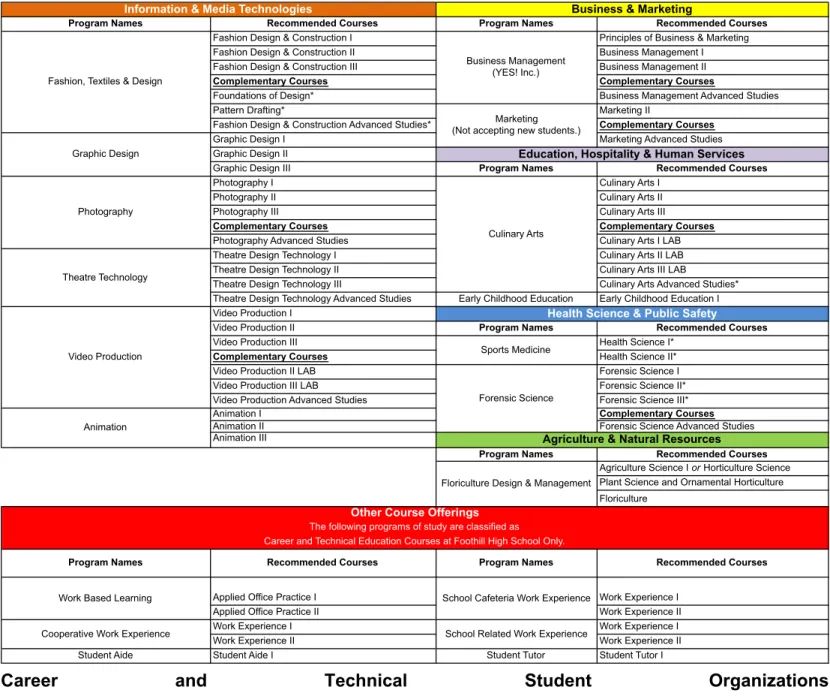
Listed below are some occupational/vocational courses that may be offered at Foothill. These courses may allow students to earncollege credit from the Community College of Southern Nevada and other approved in state schools.
Marketing* Graphic Design* Video Production * Technical Theatre* Culinary Arts* Work Experience Forensic Science* Photography* Fashion and Design*
* Career and Technical Education credit may be available (see top paragraph).
Foothill’s College & Career Center
Foothill High School offers courses in many occupational areas. In most cases, students will need additional education. Students should start early by obtaining information for post-secondary occupational programs. Students can obtain much information in the Foothill Career Center located in the cafeteria. They can use the Career Informational System (CIS) and the Internet to explore possible career choices. School counselors can assist students in long-range planning. Many school catalogs, applications, and admission requirement are available on-line in the career center.
NCAA Initial Eligibility Requirements
In order to participate in collegiate athletics, students must register with the NCAA at www.eligibilitycenter.org. This should be initiated in the student’s junior year. NCAA Division I and Division II require 16 core courses. See the charts below.
NCAA Division I will require 10 core courses to be completed prior to the seventh semester (seven of the 10 must be a combination of English, math or natural or physical science that meet the distribution requirements below). These 10 courses become "locked in" at the start of the seventh semester and cannot be retaken for grade improvement.
Division I core GPA required to be eligible for competition on or after August 1, 2016, is 2.300. The Division I ACT/SAT minimum score is determined by the core GPA on the Division I sliding scale. Division II requires a minimum SAT score of 820 or ACT sum score of 68 and a core GPA of 2.0. Beginning August 1, 2018, Division II core GPA to be eligible for competition is 2.200. Be sure to look at your high school’s List of NCAA Courses on the NCAA Eligibility Center's website (www.eligibilitycenter.org). Only courses that appear on your school's List of NCAA Courses will be used in the calculation of the core GPA.
Beginning August 1, 2016, it will be possible for a Division I college-bound student-athlete to still receive athletics aid and the ability to practice with the team if he or she fails to meet the 10 course requirement, but would not be able to compete.
NAIA Eligibility Center
Every student interested in playing sports at an NAIA college, needs to register and have their eligibility to play determined. NAIA governs athletics at a group of nearly 300 smaller colleges and universities. NAIA eligibility is separate from NCAA eligibility certification and is ONLY for this different group of lower enrollment schools. Go to the NAIA website at PlayNAIA.org to register. To be eligible, students must meet the school’s admission standards equal to or higher than those applied to the general student body plus meet a minimum combination of ACT or SAT scores, grade point average and/ or class rank. Additional specific eligibility guidelines are contained in Nevada Interscholastic Activities Association regulations (NAC 386.776 – 386.855) and Clark County School District regulation 5135 or visit the website at www.niaa.com.
Physical Education II Waiver & Athletics Eligibility Baseball – Varsity, Junior Varsity
Basketball – Varsity, Junior Varsity, B-Team Bowling
Cheerleaders – Varsity, Junior Varsity, B-Team Cross Country – Varsity
Flag Football – Varsity, Junior Varsity Football – Varsity, Junior Varsity, B-Team Golf – Varsity
Marching Band/Flags/Mascots
Soccer – Varsity, Junior Varsity, B-Team Softball – Varsity, Junior Varsity, B-Team Swimming – Varsity
Tennis – Varsity Track – Varsity
Volleyball – Varsity, Junior Varsity, B-Team Varsity, Junior Varsity
Team Managers are not eligible for the P.E. II Waiver; however, they may be eligible for Community Service credit.
ATHLETIC ELIGIBILITY
Required Courses* Division I Division II
English 4 3
Mathematics (Alg I or higher) 3 2
Science (minimum 1 lab science) 2 2
Additional In Above 1 3
Social Studies 2 2
Additional Core Courses** 4 4
*Remedial, special education, compensatory or related courses do not qualify for initial eligibility
**From any core area, foreign language, comparative religion or philosophy.
There is a clear expectation that all students will perform academic tasks with honor and integrity, with the support of parents, staff, faculty, administration, and the community. The learning process requires students to think, process, organize and create their own ideas. Throughout this process, students gain knowledge, self-respect, and ownership in the work that they do. These qualities provide a solid foundation for life skills, impacting people positively throughout their lives. Cheating and plagiarism violate the fundamental learning process and compromise personal integrity and one’s honor. Students demonstrate academic honesty and integrity by not cheating, plagiarizing or using information unethically in any way.
What is cheating?
Cheating or academic dishonesty can take many forms, but always involves the improper taking of information from and/or giving of information to another student, individual, or other source. Examples of cheating can include, but are not limited to:
♦
Taking or copying answers on an examination or any other assignment from another student or other source♦
Giving answers on an examination or any other assignment to another student♦
Copying assignments that are turned in as original work♦
Collaborating on exams, assignments, papers, and/or projects without specific teacher permission♦
Allowing others to do the research or writing for an assigned paper♦
Using unauthorized electronic devices♦
Falsifying data or lab results, including changing grades electronicallyWhat is plagiarism?
Plagiarism is a common form of cheating or academic dishonesty in the school setting. It is representing another person’s works or ideas as your own without giving credit to the proper source and submitting it for any purpose. Examples of plagiarism can include, but are not limited to:
♦
Submitting someone else’s work, such as published sources in part or whole, as your own without giving credit to the source♦
Turning in purchased papers or papers from the Internet written by someone else♦
Representing another person’s artistic or scholarly works such as musical compositions, computer programs, photographs, drawings, or paintings as your own♦
Helping others plagiarize by giving them your workAll stakeholders have a responsibility in maintaining academic honesty. Educators must provide the tools and teach the concepts that afford students the knowledge to understand the characteristics of cheating and plagiarism. Parents must support their students in making good decisions relative to completing coursework assignments and taking exams. Students must produce work that is theirs alone, recognizing the importance of thinking for themselves and learning independently, when that is the nature of the assignment. Adhering to the Code of Honor for the purposes of academic honesty promotes an essential skill that goes beyond the school environment. Honesty and integrity are useful and valuable traits impacting one’s life.
Questions or concerns regarding the consequences associated with a violation of the Code of Honor may be
directed towards your child’s school administration and/or the school district.
Students may also earn P.E. Waiver credit by completing 120 hours of external course work under the direct supervision of a qualified instructor or coach who is a credentialed and/or licensed professional outside the school district. Use of external credit for the P.E. Waiver credit requires completion of the CCF-850: External Credit Application. The activity must be geared toward competition or performance-based and it is expected that the student will compete/perform in the activity. Membership in a gym does not meet this criterion.
Prospective Clubs & Organizati
ons
Animé
Art Club
Bible Club
FBLA
Foothill Student Television
Creative Writing Club
DECA
Drama/Thespians
Eco-Vision Club
FCCLA (Fashion)
Gavel Club
Interact Club
Journalism
Cycling Club
Digital Culture Club
Dungeons and Dragons
HOSA
Red Cross
Physics Club
Rubiks Club
Science Bowl
Minecraft Club
Mu Alpha Theta
Multicultural Club
National Honor Society
Skills USA
Spanish Club
Speech & Debate
Student Council
Sun Youth Forum
Varsity Quiz
Spirit/Performing Groups
Band
JV Cheer
Choir
Varsity Dance
Color Guard
Drum Line
Orchestra
Varsity Cheer
JV Dance
Varsity Girls’ Sports
Basketball
Bowling
Cross Country
Flag Football
Golf
Soccer
Softball
Swimming
Track
Volleyball
Tennis
Varsity Boys’ Sports
Baseball
Basketball
Bowling
Cross Country
Football
Golf
Soccer
Swimming
Tennis
Track
Volleyball
Wrestling
Art
*Course offerings may be subject to enrollment numbers.
Grade 9
Art I
Ceramics I
Grade 10
Art I
Ceramics I
Drawing I
Painting I
Grade 11
AP Studio Art-Drawing
AP Studio Art-3D
Art I
Ceramics I
Ceramics II
Ceramics III
Drawing I
Drawing II
Painting I
Painting II
Grade 12
AP Studio Art-Drawing
AP Studio Art -3D
Art I
Ceramics I
Ceramics II
Ceramics III
Drawing I
Drawing II
Painting I
Painting II
Art
Course Descriptions
ART I
This one-year foundation course is designed to provide a basic understanding of the elements and principles of art as emphasized through the production of art, the study of art history, aesthetics, and art criticism. This course will fulfill either the one arts/humanities credit or one of the elective credits required for graduation.
Fee: $30
AP STUDIO ART: DRAWING
This one-year course is designed with an emphasis on meeting the requirements of the College Board Advanced Placement Studio Art: Drawing examination and portfolio submission. This college-level curriculum facilitates the creation of a college-level portfolio of artwork demonstrating a mastery of drawing. Students engage a wide range of approaches and media to address various drawing issues through abstract, observational, and/or inventive works. Instructional practices incorporate integration of diversity awareness including appreciation for all cultures and their important contribution to society. The appropriate use of technology is an integral part of this course. This course fulfills either one elective credit or one Arts/Humanities credit required for high school graduation and may be repeated.
Fee $40.00, in addition to test fee Grade Level: 11-12
Prerequisites: Completion of Art I, Paint I and Drawing I Permission of AP teacher
AP STUDIO ART-3D
This one-year course is designed with an emphasis on meeting the requirements of the College Board Advanced Placement Studio Art: 3-D Design examination and portfolio submission. This college-level curriculum facilitates the creation of a college-level portfolio demonstrating mastery of three-dimensional design. Through additive, subtractive, and/or fabricated processes, students create works that demonstrate a range of understanding and fundamental mastery of 3-D visual concerns and methods. Instructional practices incorporate integration of diversity awareness including appreciation for all cultures and their important contribution to society. The appropriate use of technology is an integral part of this course. This course fulfills either one elective credit or one Arts/Humanities credit required for high school graduation and may be repeated.
Fee: $40.00 Grade Level: 11-12
Prerequisites: Ceramics I and II
CERAMICS I
This first-year course is designed to provide experience in three-dimensional design as it applies to ceramics. This course includes an exploration of a variety of hand-building methods and an introduction to wheel techniques. Glaze techniques, tools, vocabulary development, safety factors, historical appreciation, and evaluation are a part of the course. Students are encouraged to exhibit their work.
Fee: $40.00 Grade Level: 9-12
CERAMICS II
This one-year advanced course is designed to build upon the experience in three-dimensional design as it applies to ceramics. Students will refine hand building methods and learn or expand wheel techniques. Surface decoration, vocabulary development, studio participation and safety, historical appreciation, aesthetics and critique are to be continued in this course. This course will fulfill one elective credit required for high school graduation.
Prerequisite – Ceramics I Fee: $40.00
Grade Level: 11-12
CERAMICS III
This one-year advanced course is designed to follow Ceramics I and II and will build upon knowledge of three-dimensional design specific to ceramic arts. In this advanced class a student will further develop hand-building or wheel throwing skills or a combination of both. Vocabulary development, exploration of advanced surface decoration, the use of a variety of firing methods and communication of artistic ideas will be emphasized. Students will analyze and discuss their work and the work of others and will be required to exhibit their work. Instructional practices will incorporate integration of diversity awareness including appreciation for all cultures and their important contribution to our society. The appropriate use of technology is an integral part of this course. This course will fulfill either one elective credit or one Arts/Humanities credit required for high school graduation.
Fee: $40.00 Grade Level: 11-12
DRAWING I
This one-year course provides students with a strong foundation for drawing through the study of basic techniques and the use of a variety of media and subject matter. Students participate in exercises in art appreciation and critique to learn to personally consider and judge art. Problem solving, creativity, and originality are cultivated through planning, art making, and reflection. The development and influence of drawing for communication and expression are integrated into learning. Instructional practices incorporate integration of diversity awareness including appreciation for all cultures and their important contribution to our society. The appropriate use of technology is an integral part of this course. This course fulfills one of the elective credits required for high school graduation.
Fee: $30.00 Grade Level: 10-12 Prerequisite: Art I
DRAWING II
This one-year course expands knowledge and skill through an in-depth study of tools, techniques, media, and subject matter, and is a continuation of Drawing I. Students extend the study of art appreciation and participate in self and group critiques while interpreting, defending, and judging art. Problem solving, creativity, and originality are expected in planning, art making, and reflection. Instructional practices incorporate integration of diversity awareness including appreciation for all cultures and their important contribution to our society. The appropriate use of technology is an integral part of this course. This course fulfills one of the elective credits required for high school graduation.
Fee: $30.00
Grade Level: 10-12
Prerequisites: Art I and Drawing I
PAINTING I
This one-year course is designed to provide students with a strong foundation of painting through the study of basic techniques and the use of a variety of media. Students participate in exercises in art appreciation and critique to learn to personally consider and judge art. Problem solving, creativity, and originality are cultivated through planning, art making, and reflection. The development and influence of painting and painters throughout the ages are integrated into learning. Instructional practices incorporate integration of diversity awareness including appreciation for all cultures and their important contribution to our society. The appropriate use of technology is an integral part of this course. This course fulfills one of the elective credits required for high school graduation.
Fee: $40.00 Grade Level: 10-12
PAINTING II
This one-year course is designed to expand knowledge and skill through an in-depth study of tools, techniques, and media associated with painting and is a continuation of Painting I. Students extend the study of art appreciation and participate in self and group critiques while interpreting, defending, and judging art. Problem solving, creativity, and originality are expected in study, planning, art making, and reflection. Specific painting styles and significant painters throughout history are emphasized. Instructional practices incorporate integration of diversity awareness including appreciation for all cultures and their important contribution to our society. The appropriate use of technology is an integral part of this course. This course fulfills one of the elective credits required for high school graduation.
Fee: $40.00 Grade Level: 10-12