Demand-Driven Curriculum for
Embedded System Software in Korea
Suehee Pak
Dongduk Women’s University 23-1 Hawolgok-dong, Sungbuk-gu Seoul 136-714, Korea
Eunha Rho
Sungkonghoe University 1-1 Hang-dong, Kuro-gu Seoul 152-716, KoreaMoon Hae Kim
Konkuk University 1 Hwayang-dong, Gwangjin-gu Seoul 143-701, Korea
[email protected]
Juno Chang
Sangmyung University 7 Hongji-dong, Jongno-gu Seoul 110-743, KoreaABSTRACT
This paper describes how Korean Government has designed and driven the innovation of undergraduate curriculums to meet increasing industrial demand for quality IT experts in the computer-software field. The computer-software field has been categorized into five specialized areas, tracks. The embedded system software area is one among them. Educational contents (including track curriculums, detailed syllabuses, and class materials) have been designed and constructed for the tracks. First, a curriculum development methodology is described, which is used to develop curriculums in the computer-software field. Next, artifacts for the embedded software system track produced in the process are described. By applying iterative and incremental principles of the methodology, all artifacts will be continuously updated and constantly upgraded as related technologies progress rapidly.
Keywords
track, curriculum, industry demand, demand-driven course, detailed syllabus, class material, course development
1.
INTRODUCTION
Despite the excessive supply of IT manpower in the market, many companies in Korea still find difficulty in recruiting manpower of quality satisfying their needs. This is so called ‘skill mismatch’ phenomenon, where maturity levels of skills of graduates from academic institutions are lagging far behind the required level in the spot industrial sectors. Therefore, the cooperation between universities and IT industry in producing IT manpower of quality is urgently called for to create the effective labor pool of supply and finally balance its supply and demand.
To facilitate the cooperation, Korean Government has been
workers as one of the major policy measures by applying the SCM (Supply Chain Management) model to human resource development [2].
The basic concept of SCM is to optimize whole supply networks to maximize total profit. Applying this concept to human resource development denotes that we have recognized a series of educational process and career path as a huge supply network so that optimization would be deployed into all of human resource development processes. To reflect intensive and extensive technological changes and industrial needs from academia, a study is necessary to solve and act as an antidote against the imbalance problem between the skill factors demanded by industry and the curriculums of universities. As a sub-project for the SCM project, Korean Government launched a challenging project where curriculums and courses are designed and constructed, based on their own estimated demand for IT manpower.
According to IT industry, to solve the skill mismatch, the computer-software field needs to be subdivided into more specialized areas. For each specialized area, track in the project, educational contents are to be properly constructed and customized to the corresponding IT sector. The practical purpose of this project lies in producing students as IT experts equipped with specialized skills. As the first stage to innovate academic curriculum, computer-software field is categorized into five specialized tracks.
With five tracks to pursue as majors in computer-software field, four demand-driven courses for each track are designed and their detailed syllabuses and course materials are constructed.
In the following section, a methodology is suggested to develop demand-driven curriculums. In the next sections,
development for the embedded system software track are described, which is followed by concluding remarks.
2.
METHODOLOGY FOR CURRICULUM
DEVELOPMENT
2.1
Curriculum Development as a Process of
Change and Evolvement
Academic curriculums are to change and evolve over a period of time. Curriculum development as a process of change and evolvement is somewhat similar to software development.
Spiral model, originally proposed by Boehm [1], is an evolutionary software process model that combines the iterative and incremental nature of prototyping with the structural aspects of the linear sequential model.
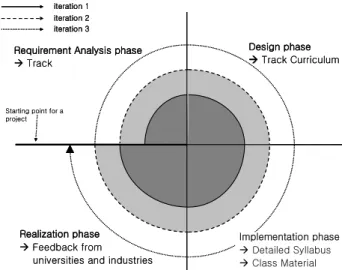
Applying concepts and basic principles of the spiral model, Curriculum Spiral model for demand-driven curriculum development is derived and proposed. In the process, a curriculum is developed in a series of incremental releases. That is, a whole development process is divided into several, time-boxed scaled projects. This small-scaled project is called iteration stage and an iteration stage is again subdivided into four activities, called phases. Figure 1 depicts the curriculum spiral model that performs 3 iteration stages, each of which contains four phases, and shows artifacts in each phase. In the rest of this section, each phase is described in terms of its activities and artifacts.
In the first phase in an iteration stage, Requirement Analysis phase, tracks are identified and selected by analyzing industrial demands and requirements, and also by collecting feedbacks from universities involved in the previous iteration stage. Partitioning tracks is to vertically decompose a certain generalized field. A track should be a highly cohesive subfield of computer-software field. In the Design phase, a curriculum is designed and developed for each track. Several industrial demand-driven courses are included in each curriculum. A track
curriculum includes track goals, a course tree, and
preliminary design for demand-driven courses. A course tree includes demand-driven courses, prerequisite courses, basic computer science courses, and their associations. In the Implementation phase, a detailed syllabus and class materials are constructed for each demand-driven course. In the Realization phase, semester classes are lectured, based on the track curriculum, detailed syllabus, and class materials. As input to the requirement analysis phase of the next iteration stage, all feedbacks from the involved universities and industries are collected.
iteration 1
Design phase
ÆTrack Curriculum
Realization phase
ÆFeedback from universities and industries Requirement Analysis phase
ÆTrack
iteration 2 iteration 3
Starting point for a project Implementation phase ÆDetailed Syllabus ÆClass Material iteration 1 Design phase ÆTrack Curriculum Realization phase ÆFeedback from universities and industries Requirement Analysis phase
ÆTrack
iteration 2 iteration 3
Starting point for a project
Implementation phase
ÆDetailed Syllabus
ÆClass Material
Figure 1. Spiral model for curriculum development
2.2
Human Infrastructure
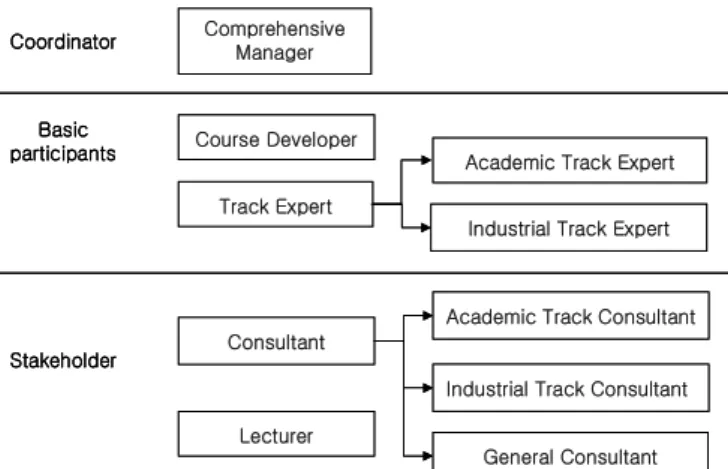
The human infrastructure for curriculum development is classified in Figure 2.
As a coordinator, Comprehensive Manager coordinates all phases of a small-scaled project, that is, an iteration stage. Comprehensive Manager plans overall process, collects ideas, suggestions, and information from the rest of the participants and finalizes track decision, curriculum design and course materials. Comprehensive Manager identifies and organizes human infrastructure, assigns their roles and coordinates their communications and finally resolves their conflicts.
As a basic participant, Course Developer develops all artifacts from phases. Two or more Course Developers are assigned to each and every track. Course Developer constructs track curriculum and makes class materials. Track Expert, another participant, consists of Academic Track Expert and Industrial Track Expert for each track. Track Expert is involved in the process of constructing artifacts. Course Developer works in close cooperation with Track Expert.
Consultant, as one of the stakeholders, consists of General Consultant and Track Consultant. Track Consultant consists of Academic Track Consultant and Industrial Track Consultant. Consultant reviews and monitors all artifacts constructed by Course Developer. Lecturer, another stakeholder, lectures using artifacts constructed by Course Developer.
Coordinator
Course Developer
Academic Track Expert
Industrial Track Expert
Academic Track Consultant
Industrial Track Consultant
Lecturer General Consultant Comprehensive Manager Consultant Track Expert Basic participants Stakeholder Coordinator Course Developer
Academic Track Expert
Industrial Track Expert
Academic Track Consultant
Industrial Track Consultant
Lecturer General Consultant Comprehensive Manager Consultant Track Expert Basic participants Stakeholder
Figure 2. Human infrastructure for curriculum development
3.
TRACK: VERTICAL DECOMPOSITION
OF COMPUTER-SOFTWARE FIELD
3.1
Necessity for Specialized Field Tracks
Applying industrial demands into academia, it should be considered what educational unit would be a suitable one for bearing the task. From the educational perspective, decision for the choice of an appropriate educational unit is one of the most important underlying factors to be considered. An undergraduate curriculum, especially for science and engineering majors, should be the proper combination of mathematics, understanding of principles, practices, application, and skills for tools [3].
Demand-driven curriculum needs to be balanced with five factors mentioned above, and categorized for more specialized area by possible career pursuits of students. The concept of track is introduced, which has a demand-driven curriculum for a specialized area while satisfying the guideline of ABET, ACM, and IEEE/CS. ABET has ‘program’ as a unit of accreditation. ABET guideline indicates that each program should have its own objective, so track would have the objective of ‘satisfying demands from specific IT area’. In this paper, a track can be considered to be a proper educational unit (for undergraduate) composed of major issues reflecting industrial needs.
3.2
Five Tracks and Ongoing Changes
Selecting tracks is based on the work in [5], which suggested several specialized tracks in the field. In order to identify tracks, needs from IT industry experts are carefully examined. Requirements of universities are also considered. As a result, the computer-software field is divided into five specialized tracks as follows:
- Software Development (SD)
- System Integration (SI)
- Embedded System Software (EM)
- Multimedia and Game Software (MM)
- Business Information Technology (BI)
In the software development (SD) track, the goal is to educate skilled manpower with expertise in software development. It is recommended not to deal with fragmentary skills and detailed application skills, considering the limited time horizon of 4-year university education. Instead, the curriculum focuses on training the ability of problem solving and that of self-adapting to rapid changes in the practical IT field.
The goal of the system integration (SI) track is to train manpower with practical knowledge required in system development companies which make general business applications. In order to produce students who understand the whole process of system development, the curriculum is designed to focus on up-to-date technologies such as software modeling, software development process, and web service computing.
In the embedded system software (EM) track, students are trained to have an understanding of various aspects of embedded systems. The curriculum contains the establishment of system development environment, hardware control programming and application programming in embedded systems. Electronic engineering is merged into software engineering from the viewpoint of software field.
The goal of the multimedia and game software (MM) track is to educate both multimedia software and game software developers. Students are trained to have basic abilities to have considerably high productivity in a short period of time after graduation. Multimedia software courses focus on understanding of the overall multimedia area, including moving picture processing and animation, and achieving the ability of integrating and applying various digital media. Game software courses deal with the concept and technology of computer game production, and train students to have the ability to collaborate in practical game production.
In the business information technology (BI) track, the goal is to train IT consultants and IT business managers who have the ability to apply and manage rapidly changing information technologies of management. The curriculum basically intends for students of computer-software departments. It integrates courses for overall knowledge of management and courses for information technologies, such as computers and communication.
goals of tracks will be continuously updated and constantly upgraded as IT technologies progress rapidly. Tracks can be added, deleted or even merged. For example, information security track can be newly added on the track list.
3.3
Demand Survey of the Five Tracks
Surveys on industrial preferences for the five tracks have been conducted [4]. About 2,000 Korean companies are surveyed (about 1,000 IT companies and about 1,000 non-IT companies).
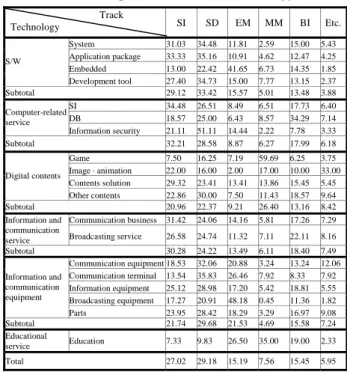
The result shows demand preferences for human resources in each track. Out of five tracks, SD and SI stand out in demand pressure from the industry. Table 1 shows preferences for the tracks in each IT profession. Table 2 shows preferences of the tracks in each technology.
Table 1. Track preference in each profession (%)
Track Profession SI SD EM MM BI Etc. IT consultant 28.67 25.98 13.47 6.94 18.94 6.01 Project manager 25.79 27.34 13.13 7.83 15.38 10.53 System engineer (analysis/design) 25.16 31.68 18.64 4.42 13.34 6.76 DB design · administrator 27.72 28.04 11.08 6.49 17.42 9.26 Computer information security engineer 20.01 41.05 14.93 6.36 13.00 4.66 Network design · administrator 22.19 17.58 23.51 7.49 20.86 8.37 Web engineer (development ·
construction) 27.34 28.09 12.64 10.03 17.11 4.80 General S/W developer and
programmer 28.33 32.22 14.94 4.75 15.78 3.96 SI/SW
development and design
System S/W developer and
programmer 19.98 26.48 33.63 6.06 11.39 2.47 Web planner and designer 25.69 28.45 9.28 11.66 17.01 7.91 Game / animation / graphic
planner 0.91 22.71 8.29 54.76 13.10 0.23 Game / animation / graphic
developer 4.83 8.86 10.41 54.83 15.82 5.25 Digital contents
Virtual reality / animation /
graphic designer 19.67 26.46 6.71 29.16 3.80 14.21 Web master 26.48 26.79 7.54 5.15 23.12 10.92 System administrator 30.54 23.54 7.35 11.50 18.58 8.48 System
operation and
administration Computer technology
support technician 24.35 24.03 19.20 6.43 21.88 4.11 Education IT education 16.76 16.94 18.31 28.65 12.46 6.87 Business IT technology business 23.52 27.63 14.83 5.16 20.12 8.74
Total 27.02 29.18 15.19 7.56 15.45 5.95
4.
CURRICULUM: HORIZONTAL
DECOMPOSITION FOR TRACKS
4.1
Track Curriculum Outline
Track curriculums are designed and constructed, with the main focus on the specialized skills demanded by IT industry. A track curriculum includes a course tree. Courses in the tree are grouped into three types.
Table 2. Track preference in each technology (%)
Track Technology SI SD EM MM BI Etc. System 31.03 34.48 11.81 2.59 15.00 5.43 Application package 33.33 35.16 10.91 4.62 12.47 4.25 Embedded 13.00 22.42 41.65 6.73 14.35 1.85 S/W Development tool 27.40 34.73 15.00 7.77 13.15 2.37 Subtotal 29.12 33.42 15.57 5.01 13.48 3.88 SI 34.48 26.51 8.49 6.51 17.73 6.40 DB 18.57 25.00 6.43 8.57 34.29 7.14 Computer-related service Information security 21.11 51.11 14.44 2.22 7.78 3.33 Subtotal 32.21 28.58 8.87 6.27 17.99 6.18 Game 7.50 16.25 7.19 59.69 6.25 3.75 Image · animation 22.00 16.00 2.00 17.00 10.00 33.00 Contents solution 29.32 23.41 13.41 13.86 15.45 5.45 Digital contents Other contents 22.86 30.00 7.50 11.43 18.57 9.64 Subtotal 20.96 22.37 9.21 26.40 13.16 8.42 Communication business 31.42 24.06 14.16 5.81 17.26 7.29 Information and communication
service Broadcasting service 26.58 24.74 11.32 7.11 22.11 8.16 Subtotal 30.28 24.22 13.49 6.11 18.40 7.49 Communication equipment 18.53 32.06 20.88 3.24 13.24 12.06 Communication terminal 13.54 35.83 26.46 7.92 8.33 7.92 Information equipment 25.12 28.98 17.20 5.42 18.81 5.55 Broadcasting equipment 17.27 20.91 48.18 0.45 11.36 1.82 Information and communication equipment Parts 23.95 28.42 18.29 3.29 16.97 9.08 Subtotal 21.74 29.68 21.53 4.69 15.58 7.24 Educational service Education 7.33 9.83 26.50 35.00 19.00 2.33 Total 27.02 29.18 15.19 7.56 15.45 5.95
The first group consists of demand-driven courses, the skills of which are analyzed as demanded by IT industry. The second group consists of direct prerequisites of demand-driven courses.
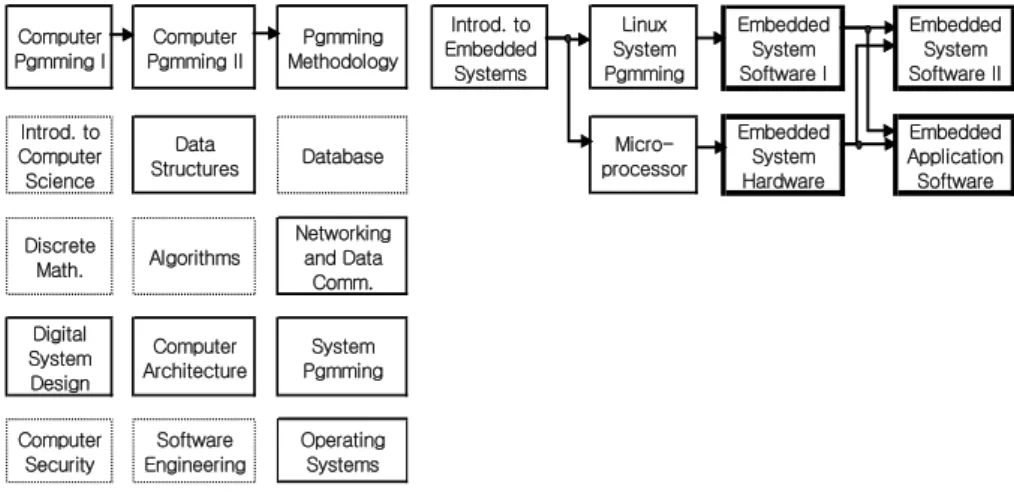
The third group consists of common fundamental courses, which are classical computer science courses. These courses are included in all track curriculums in common. The basic notation to represent designed courses and their associations are shown in Figure 3. Course tree for the embedded system software track is shown in Figure 4.
Common fundamental courses
Prerequisite of demand oriented courses Demand oriented courses
Prerequisite relationship
Figure 3. Notation of three kinds of course grouping
4.2
Demand-Driven Courses
A track curriculum includes four demand-driven courses. The courses are designed and constructed to reflect the demands of IT industry. They are targeted to senior year and designed to have the specialized skills that turned out to be demanded from the buyers, IT industry. Table 3 shows the mapping between these courses and the specialized skills for the embedded system software track.
Table 3. Specialized skills of demand-driven courses for the embedded system software track
Demand-Driven
Courses Specialized Skills
Embedded System Software I
Startup code Development, Memory/Clock/IO Control, Linux System Programming, Device Driver Development, and Assembly Language Programming
Embedded System Hardware
VHDL, Combinational/Sequential Circuit Design, Timing Analysis and Design, and System H/W Design Embedded System
Software II
RTOS concept, RTOS based Programming, and
DMA/Timer/Interrupt Programming Embedded
Application Software
Embedded Network Programming, TCP/IP, Client-server Programming, and GUI programming
5.
CONCLUSION AND FUTURE WORKS
IT education in academia has not properly accommodated the changing industrial demands. This paper presents research results to solve the imbalance between the skill factors demanded by industry and the curriculum of universities.
As a curriculum development methodology, Curriculum Spiral model has been suggested and applied.
As the first artifact of this work, five specialized areas in the computer-software field, called tracks, have been identified to reflect the demand from IT industry. The goal for each track has been established along with the demand-driven courses, which are major artifacts of the curriculum development process. Detailed syllabus and class materials
Using the artifacts from this work, the governmental SCM project started in the beginning of 2004. Korean Government selected 39 universities (19 for the embedded system software track) from all over the country. Each university in the program selected one track and adopted the suggested track curriculum. At the point of yielding students equipped with specialized skills and expertise, meaningful feedbacks will be obtained to improve the curriculums. The feedbacks are expected from the parties involved.
As the Curriculum Spiral model explicitly suggests, curriculum development procedures will be iteratively and incrementally performed in order to promote the curriculum. First of all, changes are expected and inevitable in tracks. Proper classification and restructuring of tracks in computer-software field will lay the groundwork for developing a full-fledged demand-driven curriculum. Secondly, track curriculums, detailed syllabuses, and class materials need to be maintained and elaborated according to feedbacks stemming from the universities and IT industry.
Finally, demand-driven courses need to be continuously updated and constantly upgraded as IT technologies progress rapidly.
Acknowledgements: Thanks to Korean Ministry of Information and Communication, and Institute of Information Technology Assessment for the support in development of demand-driven curriculums in the computer-software field.
6.
REFERENCES
[1] Boehm, B. A Spiral Model for Software Development and Enhancement, IEEE Computer, vol. 21, no. 5, May 1998, pp. 61-72.
[2] Lee, J., Om, K., Chang, J., and Pang, S. Innovation of IT human resource development in Korea. 14th International
Vocational Education & Training Association Conference,
August 2004.
[3] Meyer, B. Software Engineering in the Academy. IEEE
Computer, May 2001, pp. 28-35.
[4] Demand Survey of Specialized Skills. Institute of Information Technology Assessment, March 2004. (in Korean)
[5] Research on Computer/Software Training in Higher Education. Korea IT Industry Promotion Agency, November Computer Pgmming I Computer Pgmming II Pgmming Methodology Introd. to Embedded Systems Linux System Pgmming Embedded System Software I Embedded System Software II Introd. to Computer Science Data Structures Database Micro-processor Embedded System Hardware Embedded Application Software Discrete Math. Algorithms Networking and Data Comm. Digital System Design Computer Architecture System Pgmming Computer Security Software Engineering Operating Systems