Business Model Framework:
Allocation
GCF/B.05/05
30 September 2013
Meeting of the Board 8-10 October 2013 Paris, France Agenda item 4 (d)
Recommended action by the Board
It is recommended that the Board:(a) Takes note of the information presented in document GCF/B.05/05 Business Model Framework: Allocation;
(b) Provides guidance on the policy matters and options regarding allocation; and
Table of contents
I. Introduction 1
II. General considerations on the Fund’s resource allocation system 2
III. Relevance of the resource allocation systems of other multilateral funds 3
IV. Building blocks of a resource allocation system 4
Tiers 4 4.1 Set-aside 5 4.2 Allocation/reallocation 6 4.3
Rules for country-based allocation 6
4.4
Modifications of rules for allocating to country groups 7
4.5
V. Incorporating results and addressing vulnerable countries’ needs 7
Incorporation of results in the country-based 5.1
resource allocation systems 7
Addressing the needs of particularly vulnerable countries 8
5.2
VI. Resource allocation system model options 9
VII. Next steps 11
Annex I: Draft decision of the Board 14
Annex II: Key dimensions of the resource allocation systems of other
multilateral funds 15
Annex III: Building blocks of a resource allocation - Tiers and set-asides
in resource allocation systems of other multilateral funds 16 Annex IV: Building blocks of a resource allocation system– Country
allocation rules 17
Annex V: Global Environment Facility resource allocation model 18
Annex VI: African Development Fund resource allocation model 23
Annex VII: Current trends in concessionary resource allocation by the
Asian Development Fund 26
Annex VIII: International Fund for Agricultural Development
resource allocation model 28
Annex IX: Proposed options for a resource allocation system –
Tiers and set-asides 31
Annex X: Proposed options for a resource allocation system–
Business Model Framework: Allocation
I.
Introduction
1. At its March 2013 meeting, the Board requested the Interim Secretariat to undertake work on a number of documents on the Fund’s business model framework, with the assistance of consultants (decision B.01-13/06). One of the documents to be prepared for consideration at the October 2013 Board meeting was to address allocation under the Fund, including
“an assessment of the allocation procedures of other multilateral funds, their benefits and disadvantages and applicability; and results-based approaches for resource allocation”. 2. The purpose of this document is to present to the Board an assessment of allocation procedures of other multilateral funds, their benefits, disadvantages and applicability, including results-based approaches to allocation. This document should be read in conjunction with the other documents on the business model framework.1
3. The Governing Instrument provides specific guidance on several key allocation-related features of the Fund:
Paragraph 50: “The Board will balance the allocation of resources between adaptation and mitigation activities under the Fund and ensure appropriate allocation of resources for other activities.”
Paragraph 51: “A results-based approach will be an important criterion for allocating resources.”
Paragraph 52: “In allocating resources for adaptation, the Board will take into account the urgent and immediate needs of developing countries that are particularly vulnerable to the adverse effects of climate change, including LDCs, SIDS and African States, using
minimum allocation floors for these countries as appropriate. The Board will aim for appropriate geographical balance.”
Paragraph 53: “The Fund will have a streamlined programming and approval process to enable timely disbursement. The Board will develop simplified processes for the approval of proposals for certain activities, in particular small-scale activities.”
4. In addition, the Governing Instrument contains guidance relevant to the allocation of resources:
Paragraph 3: “The Fund will operate in a transparent and accountable manner guided by efficiency and effectiveness. The Fund will play a key role in channelling new, additional, adequate and predictable financial resources to developing countries and will catalyse climate finance, both public and private, and at the international and national levels. The Fund will pursue a country-driven approach and promote and strengthen engagement at the country level through effective involvement of relevant institutions and stakeholders.” Paragraph 37: “The Fund will have thematic funding windows. Initially, the Fund will have windows for adaptation and mitigation. An integrated approach to funding mitigation and adaptation will be used to allow for cross-cutting projects and programmes.”
Paragraph 41: “The Fund will have a private sector facility that enables it to directly and indirectly finance private sector mitigation and adaptation activities at the national, regional and international levels.”
Paragraph 42: “The operation of the facility will be consistent with a country-driven approach.”
II.
General considerations on the Fund’s resource allocation system
5. Definition of the resource allocation system. The resource allocation system (RAS) is the set of policies and procedures that the Fund uses to channel the resources it receives from various sources to projects or programmes to meet the strategic objectives of the Fund.Application of the RAS starts with the execution of financial instruments between the Fund and contributing sources and ends with the execution of financial instruments between the Fund and the project or programme financial intermediary or implementing entity. In terms of the project cycle, the focus of the RAS is on the design stage of the project or programme – up to the time the proposal is approved by the Board.
6. A “performance-based” resource allocation system (PBAS) is one that allocates
resources to entities on the basis of their performance prior to making individual approval decisions on proposed activities.
7. A “results-based” resource allocation system (RRAS) takes the performance-based
allocation system concept one step further. Every performance-based allocation system uses an allocation formula that includes performance variables, most of which relate to policy and institutional performance but some of which are measures of actual results. The RRAS takes this a step further by including more variables that are measures of actual outcomes (in addition to needs variables and policy/institutional performance variables).
8. Learning lessons on RAS. As requested by the Board, this document contains a brief assessment of the RASs used by other multilateral funds, to determine their benefits and
disadvantages for, and applicability to, the Fund. Annexes II - IV summarize, in tabular form, the key features of the RASs in selected multilateral funds that span the diversity of systems in use.2
Annexes V–VIII provide brief descriptions about the RAS at the Global Environment Facility (GEF), the African Development Fund (AfDF), the Asian Development Fund (AsDF), and the International Fund for Agricultural Development (IFAD), respectively.
9. The RASs of other multilateral funds have a common focus on improving delivery of results that meet the strategic objectives of the respective institutions. The Fund’s RAS should perform the same basic task, in line with the Governing Instrument.
10. The purpose of a RAS is to deliver strong results by increasing allocation effectiveness. 11. Guiding principles. This document puts forward five guiding principles for the Fund’s RAS based on the Governing Instrument and the review of the RASs of other multilateral funds. The Board may wish to consider the following principles for guiding the development and implementation of the Fund’s RAS:
(a) Strategically focused. The RAS will focus on meeting the Fund’s specific mandates, objectives and priorities;
(b) Country-driven. The RAS will provide an incentive for paradigm shift towards low-emission and climate-resilient development pathways, and will promote and strengthen engagement at the country level through effective involvement of relevant institutions and stakeholders, including in the private sector;
(c) Results-based. The RAS will be designed to increase the effectiveness of the allocated funds in achieving the objectives and result areas of the Fund at the global, national and sub-national levels. This could include mechanisms to incentivize the achievement of paradigm shift, scale and ambition, as well as the strengthening of enabling
environment;
2 The funds covered include the Global Environment Facility (GEF), Climate Investment Funds (CIFs), Adaptation Fund, Global Fund to Fight AIDS, Tuberculosis and Malaria (Global Fund), International Fund for Agriculture and Development (IFAD), International Development Association (IDA), African Development Fund (AfDF) and Asian Development Fund (AsDF).
(d) Efficiency. The RAS will allocate resources there where it is expected to deliver the most transformational impacts for the Fund’s objectives, whilst employing a simple process to minimize total operational time and resources needed by the Fund and the implementing entities to programme and approve projects; and
(e) Predictable and transparent. The RAS will be designed to increase the predictability of allocations to facilitate programming decisions at the country, financial intermediary and/or implementing entity levels. The policies and procedures of the RAS will be carried out in a clear and open manner and will be publicly disclosed.
12. The purpose and guiding principles constitute a clear foundation on which the Fund’s RAS will be developed for initial implementation and evolution.
III.
Relevance of the resource allocation systems of other
multilateral funds
13. Five dimensions of applicability. The RASs of other multilateral funds have been built to respond to the specific purpose and the guiding principles of the respective fund. There are five key dimensions that are important in assessing the relevance or applicability of these systems to the Fund: age, size, periodicity of funding, focus and role of the private sector. Annex II summarizes the relevant information for the following ten multilateral funds which span the full spectrum of characteristics: the Adaptation Fund, Least Developed Country Fund (LDCF), Special Climate Change Fund (SCCF), CIFs, GEF, Global Fund, AfDF, AsDF, IDA and IFAD. 14. Age of fund. While a number of funds have existed for over 50 years, many of the climate-related funds have a much shorter history. For instance, both the Adaptation Fund and the CIFs were established within the last 5 years. Once established, multilateral funds generally want to get operational as soon as possible, and often transition to more permanent processes and systems as their full business model matures. The Adaptation Fund, GEF and the Global Fund used a project-based allocation system during their early years. The GEF and the Global Fund, with annual allocations in excess of US$ 1 billion, have recently migrated from project-based to country-project-based allocation. Despite its short history, the CIFs were able to initiate country-level programming by adopting a pilot approach and limiting the number of countries in each of its programmes so that each funded country is provided sufficient resources for such programming.3
15. Size of fund. The size of a fund is a key determinant of the feasibility of some of the allocation models used in the multilateral funds. Larger funds, such as the IDA (79 eligible countries, annual commitments of US$ 16 billion) have sufficiently predictable resources to allocate a strategic and transformative portfolio with numerous projects in each country. Country-based allocations are feasible in this case, if desired. In contrast, smaller funds, such as the LDCF (48 eligible countries, cumulative commitments of US$ 180 million) do not have the resources to fund economically viable projects in all countries every year.4 As a result, a
country-based allocation system is not a feasible option for the LDCF and the SCCF. Medium-size funds, such as the GEF and the IFAD, with over 100 eligible countries and annual commitments of about US$ 1 billion, modify their systems to make a country-based allocation system feasible.5
3 The CIFs consist of the Clean Technology Fund (CTF) and the Strategic Climate Fund. The latter includes three targeted programmes: Pilot Program on Climate Resilience, Forest Investment Program, and Scaling up Renewable Energy for Low Income Countries.
4 While it is technically feasible to fund small projects in all countries, the transaction cost of approving and implementing projects would make them economically infeasible.
5 GEF allocations are on a 4-year basis, so the available resources are four times as large as if the GEF allocated annually. Another mechanism used by the GEF in GEF-4 was to pool the resources for counties with small allocations into an allocation for a group of countries. Similarly, IFAD allocates to the smallest countries every few years, by limiting its allocations to countries it is actively engaged in.
16. It is recommended that the Fund develops and implements a simple RAS model that is consistent with the expected initial size of the Fund and can be operationalized quickly and, in parallel, albeit more slowly, lay the foundation for a model that allows the Fund to be
transformative as it matures. The Fund can then migrate to the latter when the circumstances are appropriate.
17. Periodicity of funding. Most major multilateral funds receive periodic replenishments every three or four years. In contrast, the Adaptation Fund, LDCF, SCCF and CIFs receive resources on a rolling basis.6 Periodic country allocations are only feasible when the level of
available funding is predictable, such as in a replenishment-type system or for earmarked funding. For instance, the CIFs allocated their initial pledges among pilot countries. The
availability of additional resources has been less predictable and used for a number of purposes, including allocating resources to new pilot countries, and additional allocations to existing pilot countries, set-asides for private sector initiatives, and other specific programmes.
18. Focus of the fund. Multilateral funds can have a limited focus (e.g. the GEF on the global environment, and the Global Fund on HIV, Malaria and tuberculosis) or have a broad focus on development (e.g. IDA, AfDF, AsDF). The priorities of broad-based funds often substantially overlap with the priorities of recipient countries, making it easier for them to develop common programmes. In contrast, the priorities of narrowly focused multilateral funds can diverge significantly from those of the recipient country, increasing the importance of co-benefits. 19. Role of the private sector. Most multilateral funds are funded by Governments and primarily support public sector activities. While some funds have the mandate and have attempted to engage with the private sector, the share of resources that actually flows to the private sector is small. Country-based allocation systems that require project-by-project endorsement of government authorities can disincentivize private sector projects as was the case with the introduction of the GEF’s Resource Allocation Framework. Partly, this resulted from the unwillingness of government authorities to endorse the use of country’s allocations for private sector projects. The Global Fund and the CIF have attempted to strengthen private sector participation through the development of strategic upstream country plans with the participation of key stakeholders including the private sector. In addition, more recently, three of the target programmes of the CIFs include set-asides to promote private sector engagement.
IV.
Building blocks of a resource allocation system
20. The RASs of other multilateral funds comprise five major building blocks. Together, these building blocks provide sufficient flexibility to meet the specific requirements of the respective funds. They are: tiers, set-asides, allocation/reallocation, rules for country-based allocation, and modifications of rules for allocation to country groups. Annexes III and IV
summarize the RASs of ten multilateral funds. The RASs of the GEF and IFAD have changed over the past few years. For GEF, the two prior systems and the current system are shown separately to provide an evolutionary perspective. Similarly, for IFAD, the prior and current systems are shown separately.
Tiers
4.1
21. In a single-tier system, all proposed activities meeting specified selection criteria are approved contingent on resource availability. They are used by small funds (Adaptation Fund, LDCF, and SCCF) with a single area of focus (e.g. adaptation). It is the simplest system to set up. All of the larger funds have more than one tier. Tiers are used to direct specific proportions of
6 In recent years, all four funds have received some of the climate fast start resources. In addition to these country contributions, the proceeds from the certified emission reductions (CERs) are earmarked for the Adaptation Fund but have diminished in value due to the state of the carbon markets.
resources to designated areas (theme, countries or groups of countries). Proportions can be negotiated or based on pre-defined rules.
22. Tiers as an approach to balance. The GEF and the Global Fund used a two-tier system during the start-up phases of their operations. Allocations were made first to themes, at the start of their replenishment periods. The allocations for each theme were then used to fund proposals meeting specified criteria contingent on the resource availability for the theme. The purpose of the first tier was to achieve a pre-defined balance in resources between the themes. 23. Rules for balance. The specific allocation between themes is often based on
negotiations and/or historical shares. If the effectiveness of allocations across themes can be compared using a common metric, it is also possible to use pre-defined rules for such allocation (e.g. the disease burden of HIV relative to malaria). Similarly, the Fund could allocate resources to the adaptation and mitigation themes in the top tier. These amounts could be next allocated to countries or proposals. Lack of a common metric makes it challenging to determine a specific objective rule for balancing adaptation and mitigation.
24. Furthermore, there are activities that provide both mitigation and adaptation results. Any approach will need to take into consideration these synergies. For example, some activities that have important synergies between adaptation and mitigation are “Reducing emissions from deforestation and forest degradation and the role of conservation, sustainable management of forests and enhancement of forest carbon stocks in developing countries” (REDD+) and payment for ecosystem services (PES). In addition, these types of activities offer important opportunities for based financing structures that can clearly complement the results-based approach to allocation of resources.
25. Tiers as an approach to predictability. Two-tier structures have also been used by multilateral funds with broad development goals (AfDF, AsDF, IDA). Allocations are made first to countries at the start of their replenishment period. The allocations for each country are then used to fund proposals meeting specified criteria, with the total funding for all proposals in the country limited to the allocation for the country . Upfront country allocations provide countries with greater predictability in resources and facilitate country-level programming.
26. Flexibility in a tiered system with country allocations. The GEF, CIF and the Global Fund have recently evolved into three-tier structures. Each of these multilateral funds first allocates to specific themes. This is followed by allocations to countries and then to projects. Under these systems, countries have separate allocations by theme, which fragments the resources available to the country. Under the current models, the Global Fund allows all
countries, and the GEF allows countries with smaller allocations, to pool their allocations across themes and to use them flexibly for the themes of their interest. This flexibility strengthens the country-based approach at the expense of thematic balance at the country level. The expectation is that, despite this flexibility, allocations will be thematically balanced at the fund level.
Set-aside
4.2
27. Multilateral funds with country-based RASs allocate 50–85 per cent of available resources to countries. The remainder is set aside to meet other priorities of the fund. They have also often been used to support programmes with high cross-country spill-overs, such as global public goods and regional programmes (IDA, GEF, AsDF, AfDF). For instance, the AsDF sets aside 10 per cent of its available resources for sub-regional proposals and three per cent for national disaster response. Similarly, the GEF sets aside resources for a small grants
programme, and the GEF Earth Fund sets aside resources to support community-level and private sector engagement, respectively.
Allocation/reallocation
4.3
28. Under a country-based allocation system, multilateral funds allocate resources for fixed periods, ranging from annual to their whole replenishment period. All multilateral funds make the point that country allocations are not entitlements. They are indicative amounts that are available if activities are proposed and approved within the allocation period. Funds can also be reallocated across countries at fixed intervals.
29. Reallocation of unutilized allocations. Funds that use a country-driven resource allocation system run the risk that available resources may remain unutilized because some countries are unable to bring forward proposals of acceptable quality in a timely manner. Most multilateral funds have provisions to reallocate unutilized allocations towards the middle and the end of their allocation period. The policies and procedures for such reallocation attempt to increase the impact of the available resources while ensuring fairness to the affected countries. Annex VIII presents how IFAD actively manages its allocations.
30. Allocation of supplementary resources. Multilateral funds also obtain additional resources after the allocations have been made (e.g. supplemental contributions from
Governments, exchange rate gains or better-than-expected returns on investments). Policies for allocating such additional resources are varied. They could be allocated to all or a selected subset of countries (e.g. countries with good performance scores) or for specific purposes such as set-asides. Additional allocations to countries could be in proportion to their original
allocations, or based on a re-evaluation of the allocation formulas.
Rules for country-based allocation
4.4
31. Country-based allocations are rule-based in accordance with agreed principles, generally using a formula.7 They are one of the ways by which most major multilateral funds
provide an incentive to the member countries for improved performance. Their predictability facilitates the ability of countries to programme in a strategic manner. Formula-based
allocations to a country are based on two factors: country’s needs and country’s performance (results).
32. Country’s needs often include two components – a measure of the overall scale of the problem and the intensity of the problem. Country’s needs in multilateral funds focus on general development and are typically based on the scale (often measured by population) and the intensity of need (often measured by per capita gross national income (GNI)). Theme-based multilateral funds measure needs based on their specific areas of focus.
33. Country’s performance (results) includes both forward looking indicators of the quality of policies and institutions that constitute the enabling environment for success and backward-looking indicators of effective resource use, such as past portfolio performance. By linking future allocations to measures of current performance, the RASs of other multilateral funds incentivize countries to perform better. Chapter V provides a detailed discussion of how these systems incorporate results.
34. Country’s allocations. Country’s needs and results are measured by an aggregate index computed in an agreed manner and a set of indictors. Allocation scores are computed for each
7 The CIFs provide another approach to allocate to countries. Each CIFs programme is targeted to a limited set of countries (currently 8 to 17). While each of the CIFs programmes has its own distinct set of rules for allocating resources to countries, they provide a range of indicative allocation amounts for each country, except for the CTF which provides specific indicative allocation. Indicative allocations for each programme are determined based on the total resources available, minimum funding levels, and, when appropriate, criteria and indicators specific to the programme. As additional resources become available, through new pledges, cancellations or non-utilization of funds, the Board has allocated the resources to new pilot countries, additional allocations to existing pilot countries, set-asides for private sector initiatives, and other specific programmes on a case-by-case basis.
country based on an agreed formula that combines the indices.8 The score of a country relative
to that of all other countries determines the share of the available resources allocated to the country. The formula-based allocations to the country may be subject to a floor and a cap. Countries may have a single allocation or separate allocations, one for each of the themes. 35. Periodic revision of allocation rules. Funds review their allocation rules, formulas and allocations on a periodic basis, typically as part of each replenishment discussion. These reviews typically lead to revisions. Recent revisions to the RASs have included efforts to reduce the volatility of allocations and increase emphasis on governance. While funds vary in the relative emphasis given to country’s needs versus country’s performance, funds that have heavily emphasized performance (results), regard it as an effective instrument. For instance, the World Bank has attributed improvements in project/portfolio performance scores to the IDA’s performance-based allocation system.
36. Setting up a new system. Establishing a new country-based allocation system is an iterative process between the development team and the Board that can take several years based on the recent examples of the GEF and the Global Fund. Full disclosure of the allocation process and the scoring of performance is now accepted practice at the funds, adding to the costs of operating such a system.
Modifications of rules for allocating to country groups
4.5
37. Flexibility and competition key drivers for groups. Some multilateral funds have
modified country-based allocation systems to increase programming flexibility of the fund. For instance, both the GEF and the Global Fund allocate to groups of countries instead of just to individual countries. The GEF created a group of countries for allocation based on the size of the allocation (smallest allocation in GEF-4, highest allocation in GEF-6). In contrast, the Global Fund model creates groups based on similar needs. Once a group is formed, the allocations to the group are obtained by pooling together the allocations that these countries would have received under the country-based allocation system. Compared to the country-based allocation system, this modification increases competition and reduces the predictability for countries in the group. It may also reduce the incentives for countries to improve their policies and
institutions.
V.
Incorporating results and addressing vulnerable countries’ needs
Incorporation of results in the country-based RASs
5.1
38. Country-based allocation systems are commonly also referred to as “performance-based allocation” (PBA or PBAS), due to the special emphasis they place on the performance of
countries. These RASs provide incentives to countries to deliver results through the use of backward and forward-looking indicators in their allocation formulas.
39. Portfolio results. The allocation formulas of most country-based allocation RASs reward countries for effective management of their portfolios with higher allocations in
subsequent years. Portfolio performance/results are assessed on the basis of either “projects at
8 Most funds’ allocation formulas are multiplicative – harmonized with the approach pioneered by the World Bank/IDA. To simplify somewhat, this means that a country that improves its performance score will receive an allocation that is proportionately larger. This is a strong incentive. On the negative side, multiplicative formulas that contain variables with exponents (that is, variables raised to a certain power) are not easy to understand. While additive formulas are easy to understand, the only multilateral fund that had been using it, the
risk” in the current portfolio, or project performance scores linked with the fund’s results framework, or linked to external criteria for project effectiveness.9
40. Quality of policies and institutions. The allocation formulas of most country-based allocation systems also place a heavy emphasis on forward-looking indicators of performance. They provide higher allocations to countries that have stronger policies and institutions,
incentivizing countries to strengthen them. The enabling policy and institutional environment is often a key determinant of the success of the proposed activity. Teams of professional staff in multilateral funds assess the policies and institutions that are relevant for the success of
proposed activities. For instance, the World Bank assessment includes separate ratings for a set of 16 performance/results areas for each country. These assessments are substantiated and validated in various ways, making them time and resource-intensive. Several multilateral funds use the results from the assessments carried out by other funds in their allocation formulas. For instance, the GEF uses the World Bank’s environment and governance scores in making
allocations to member countries. Annex V provides details of the GEF formula.
41. Governance. Multilateral funds have increasingly focused on improved governance in recent years as a way to increase their impacts. The IDA and the AsDF have reflected this emphasis in their RASs by increasing the effective weight of the “public sector management” cluster (Country Policy and Institutional Assessment - CPIA) in their allocation formulas. Similarly, the GEF increased the weight of its “broad framework indicator” which is the same as IDA’s “public sector management” cluster rating.
42. The GEF also incorporates two results-focused variables in its allocation formula that measure the direction of change in a country – change in emissions over time relative to the international norm and change in the rate of loss of forest cover.
43. Many funds’ allocation formulas are similar in format. However, they tend to give different weights to the variables. The rationale is that the mandates and priorities of different funds lead to different weights of different aspects of performance/results. This seems
reasonable, but, in fact, it has led to considerable instability in the weights assigned to allocation variables by the same fund. For instance, the exponent on the performance cluster in the World Bank/IDA allocation formula was changed from 2.0 to 5.0 during one replenishment
negotiation.
44. Results in project or activity-based allocation systems. Multilateral funds that use project or activity-based allocation systems use interim evaluations of the approved proposal to decide whether to fund subsequent phases of the same proposed activity (e.g. the Global Fund). They, however, have limited influence in the allocation of resources to additional proposals in the same country. Typically, all activities proposed for funding are required to provide the context, including risks, in which the activity is carried out. Activity or project documents are required to address the risks to the success of proposed activities before funding is approved. These systems are not able to influence the overall strategic direction of actions in a country.
Addressing the needs of particularly vulnerable countries
5.2
45. Many multilateral funds have developed mechanisms to address the needs of particularly vulnerable countries. Some of these include the following:
(a) Set-asides. A pool of funds could be set aside for access only by certain countries (e.g. least developed countries (LDCs), small island developing States (SIDS) or African States);
(b) Changing formula weight. In a country-based allocation system, the effective weight of scale variables, such as population, can be reduced relative to the country’s
9 For example, criteria from the Organisation for Economic Co-operation and Development's (OECD) Development Assistance Committee (DAC).
performance variables.10 This increases the allocations for small countries that have
good performance scores on policies and institutions;
(c) Introducing a vulnerability indicator in the formula. A “vulnerability” indicator could be included in the allocation formula. This would benefit those countries that, on average, experience a high vulnerability to climate change and incidence of natural disasters. The Caribbean Development Bank is the only multilateral institution presently incorporating such a variable in its allocation formula; and
(d) Improving access terms. Support to particularly vulnerable countries could be provided in preferential terms (e.g. share of grants, terms of grant, degree of concessionality).
VI.
Resource allocation system model options
46. Three RAS model options for the Fund. Based on an assessment of approaches used
by multilateral funds, three RAS model options have been developed for Board consideration. The options presented are not mutually exclusive. Elements of some of these options could be selected to form a number of hybrids. The options presented in this Chapter are:
(a) Activity-based (A);
(b) Theme and activity-based (TA); and (c) Theme, country and activity-based (TCA).
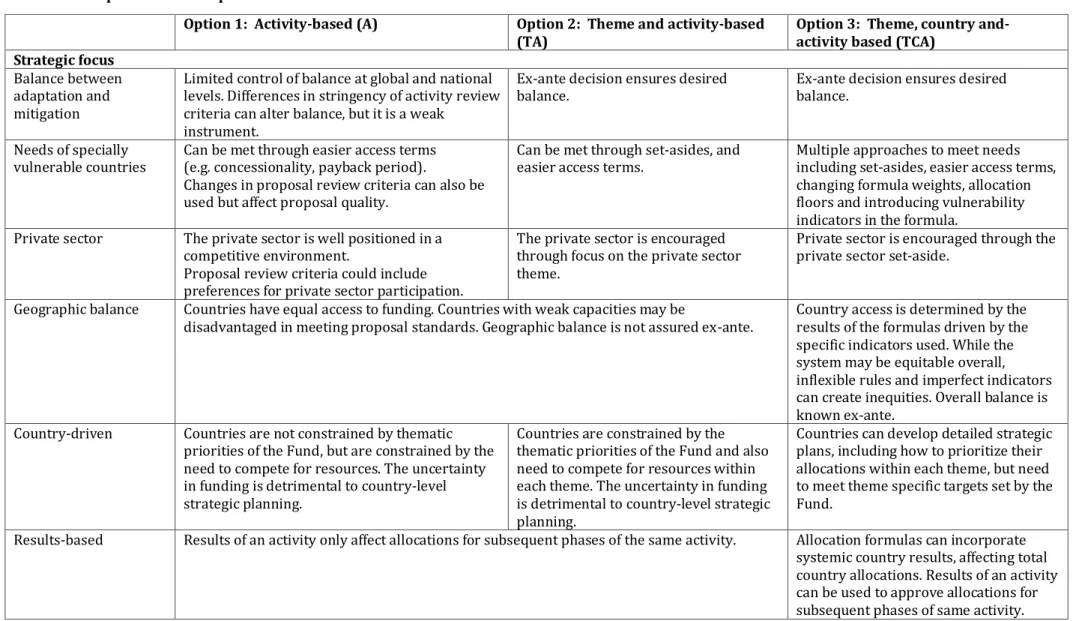
Options 1 and 2 are activity-based allocation systems, while Option 3 includes a country-based allocation. Table 1 provides a comparison of the three options, country-based on the proposed guiding principles. Annex IX contains a table presenting the building blocks of the three proposed options. Annex X contains a table illustrating the factors that would need to be considered when constructing a formula for country allocation. The advantages and
disadvantages of each of the models are discussed in this Chapter. The following options can be considered:
(a) Option 1 – Activity-based (A). This is a single-tier system, is the simplest to set up and is similar to the systems currently in use at the Adaptation Fund, SCCF and LDCF. Most of the processes and procedures used in Option 1 are applicable to the final tier of all of the other options as well. Under this option, the Fund would approve an activity or a programme that meets the standards relevant for the activity or programme. Such standards could be different for different types of activities (adaptation, mitigation, small, large).11 While countries have full control of their portfolio and can create a
suitable balance based on their respective needs, the Fund has limited control over the resulting global portfolio, which may be highly unbalanced. Countries also have limited predictability of the availability of resources from the Fund, which is detrimental to country-level strategic planning.
Approval of proposed activities or programmes would be contingent upon the
availability of funds. The system can be quite efficient with a small number of activities or projects; however, it can quickly become inefficient and slow if funding is limited and a large number of proposals need to be competitively assessed. Competitive selection can be achieved through, for instance, a review by technical expert panels, and may be necessary if the demand exceeds the available resources. However, this processes can introduce delays, can be costly and the decision may not be as transparent.
10 The Caribbean Development Bank uses the logarithmic value of “population” in its allocation formula, which has essentially the same effect on allocations as giving a small weight to population.
11 The RAS is independent from project/activity approval criteria, systems and procedures used for approving
(b) Option 2 – Theme and activity-based (TA). This is a two-tier system with available resources first allocated to themes – adaptation and mitigation. Within themes, an activity-based allocation system would prevail and would operate as in Option 1. The advantage of Option 2 is that the Fund would be assured of reaching pre-defined targets of allocations to the two themes, which may or not may be achieved in Option 1. In principle, the Fund could introduce additional themes beyond the two proposed, such as a theme focused on the needs of particularly vulnerable countries, LDCs, SIDS, and African States , or the private sector. While a small number of such expansions may be feasible, significant increases in the number of themes will fragment available resources, increase the complexity of engaging with the Fund, and reduce the transparency of allocations. Activities from vulnerable countries could still be prioritized, without the addition of a separate theme, through preferential treatment during the competitive review process.
(c) Option 3 – Theme, country and activity-based (TCA). In this option, allocations are made first to themes, through negotiations at the Board meetings. Thematic allocations are then made to countries based on agreed rules. Countries can use their allocations to support activities and respective themes. Country-driven choices could be enhanced by increasing the level of flexibility provided to countries in reallocating their adaptation and mitigation allocations. However, this flexibility will reduce the precise targeting of resources at the national level, and perhaps at the global level as well. Nevertheless, resource flows to countries are predictable, enabling countries to engage with the Fund and other development partners in a more strategic way.
This is supplemented by a set-aside for the private sector, in order to strengthen its role. The set-aside would be available for activities that would normally not be financed through Governments from their country allocations. The scope of the set-aside would allow the Fund to directly and indirectly finance private sector activities and promote the participation of actors in developing countries, including small and medium-size enterprises and local financial intermediaries.
47. Costs of a country-based RAS. Structured allocations of resources, such as in a country-based allocation system, can require a significant amount of time and money. For instance, the AsDF estimates that it spends about US$ 1.5 million in staff time to complete the first allocation in each replenishment cycle and smaller amounts in other years to update country’s performance data and to reallocate resources at the mid-point of the cycle. Obtaining objective data and performance scores for determining country allocations generally involves establishing an administrative unit in charge of resource allocation that is independent of the programme management divisions or geographic divisions. It also involves review and validation of country performance scores at several levels of the organization, including clear links with the results management framework. The information gathered from such reviews also informs the strategic programming and planning decisions of funds leading to more effective programmes, a clear co-benefit of the effort.
48. Costs of a project or activity-based RAS. The costs of RASs that allocate resources directly to proposed activities are not as visible, hence are difficult to quantify. However, they are certainly not insignificant. The lack of readily available risk and performance information in a project or activity-based allocation system makes it essential to either collect such information multiple times – leading to duplicative efforts, or not consider such information – degrading quality of the proposed activity. One of the main advantages of a rule-based system, with an allocation formula, is that it settles a lot of issues that otherwise typically absorb large amount of the management and Board’s time.
49. Country-based allocations are not feasible until the Fund has predictable resources of at least US$ 500 million to US$ 1 billion per allocation period. Since the timing of reaching this milestone is uncertain, it is recommended that the Fund adopts Option 2 as an initial RAS. Further, given the time needed to develop and finalize a country-based allocation system, it is
recommended that the Fund begins the development of such a system, which can be used in Option 3.
VII.
Next steps
50. Based on the Board’s decision on the guiding principles for the RAS and guidance on the Fund’s initial RAS model, the Secretariat will develop a detailed initial allocation framework for the Fund. To be fully operational, the RAS developed under any of the Options highlighted above will need to be complemented with the development and adoption of review criteria for
activities and approval processes. In addition, the Secretariat will need to develop options for determining the appropriate balance of resources between themes.
Table 1: Comparison of RAS options
Option 1: Activity-based (A) Option 2: Theme and activity-based
(TA) Option 3: Theme, country and-activity based (TCA)
Strategic focus
Balance between adaptation and mitigation
Limited control of balance at global and national levels. Differences in stringency of activity review criteria can alter balance, but it is a weak
instrument.
Ex-ante decision ensures desired
balance. Ex-ante decision ensures desired balance.
Needs of specially
vulnerable countries Can be met through easier access terms (e.g. concessionality, payback period). Changes in proposal review criteria can also be used but affect proposal quality.
Can be met through set-asides, and
easier access terms. Multiple approaches to meet needs including set-asides, easier access terms, changing formula weights, allocation floors and introducing vulnerability indicators in the formula.
Private sector The private sector is well positioned in a competitive environment.
Proposal review criteria could include preferences for private sector participation.
The private sector is encouraged through focus on the private sector theme.
Private sector is encouraged through the private sector set-aside.
Geographic balance Countries have equal access to funding. Countries with weak capacities may be
disadvantaged in meeting proposal standards. Geographic balance is not assured ex-ante. Country access is determined by the results of the formulas driven by the specific indicators used. While the system may be equitable overall, inflexible rules and imperfect indicators can create inequities. Overall balance is known ex-ante.
Country-driven Countries are not constrained by thematic priorities of the Fund, but are constrained by the need to compete for resources. The uncertainty in funding is detrimental to country-level strategic planning.
Countries are constrained by the thematic priorities of the Fund and also need to compete for resources within each theme. The uncertainty in funding is detrimental to country-level strategic planning.
Countries can develop detailed strategic plans, including how to prioritize their allocations within each theme, but need to meet theme specific targets set by the Fund.
Results-based Results of an activity only affect allocations for subsequent phases of the same activity. Allocation formulas can incorporate systemic country results, affecting total country allocations. Results of an activity can be used to approve allocations for subsequent phases of same activity.
Efficiency
Allocation efficiency Specific mechanisms are not available to make strategic choices. Such choices could be made with more complex proposal approval processes (e.g. if activities are approved competitively in batches).
Strategic choices can be made to create additional themes that merit attention. Creating too many themes increases fragmentation and complexity and reduces transparency.
High-value opportunities can be identified through appropriate
indicators. Higher-value opportunities in the private sector may be limited by the need to finance them though country allocations.
Operational efficiency Systems can be simplest to design. May create delays if approval decisions are taken at long and discrete intervals. Efficient at activity level but is not focussed at country or Fund levels. Can be operationally complex if competitive reviews are carried out by technical expert panels.
Systems are more complex to design and manage. However, the predictability of resources enables holistic programming at the portfolio level. May streamline programming decision at the activity level by identifying country level priorities.
Predictability and transparency
Transparency Limited, if the basis for choosing among proposed activities is not clearly identified. Expert
panels with full disclosure can increase transparency. Full disclosure is the norm in other multilateral funds. However, country scores may not be easily understood.
Predictability Countries and implementing entities have to guess if funding will be available when the
proposed activity is ready for approval. Allocations are known upfront, at the beginning of allocation period, facilitating programming.
Annex I: Draft decision of the Board
The Board, having reviewed document GCF/B.05/05 Business Model Framework: Allocation: (a) Decides that the Fund will adopt a theme/activity-based approach;
(b) Notes convergence that the Board will keep the allocation system under review with the intention of improving it over time;
(c) Decides that the Fund will initially make allocations under adaptation, mitigation and the Private Sector Facility;
(d) Decides that in relation to adaptation, resources will be allocated in accordance with the Governing Instrument:
(i) Based on the ability of a proposed activity to promote a paradigm shift towards low-emission and climate-resilient pathways in the context of sustainable development; and
(ii) Reflecting the urgent needs of vulnerable countries, in particular LDCs, SIDS and African States;
(e) Decides that, in relation to mitigation, resources will be allocated, in accordance with the Governing Instrument, based on the ability of a proposed activity to promote a paradigm shift towards low-emission and climate-resilient pathways, in the context of sustainable development;
(f) Decides that in relation to the Private Sector Facility, resources will be allocated, in accordance with the Governing Instrument and Board decisions, based on, but not limited to, the contribution a proposed activity makes towards promoting a paradigm shift to low-emission and climate-resilient pathways, and to:
(i) Directly and indirectly finance private sector mitigation and adaptation activities at the national, regional and international levels;
(ii) Promoting the participation of private sector actors in developing countries, in particular local actors, including small and medium-sized enterprises and local financial intermediaries, and activities to enable private sector involvement in SIDS and LDCs;
(g) Requests the Secretariat to develop and present to the Board at its the second meeting of 2014 a resource allocation system, as outlined in paragraphs (a) to (f), to promote a paradigm shift towards low-emission and climate-resilient development pathways that facilitates:
(i) Cross-cutting proposals; (ii) A results-based approach; (iii) A country-driven approach;
(iv) A geographically balanced approach;
(v) Private sector mitigation and adaptation activities at the national, regional and international levels; and
(h) Further requests the Secretariat to develop and present an initial process for due diligence and approval of proposals to the Board at the second meeting of 2014.
Annex II: Key dimensions of the resource allocation systems of other multilateral funds
AdaptationFund LDCF SCCF GEF CIF IDA AfDF AsDF IFAD Global Fund
Year current RAS was established 2009 2003 2001 RAF: 2006
STAR: 2010 2009 1980 1999 2001 2005 2012
Size of fund
Number of recipients* 31 49 144* 144 48 82 39 50 130 120
Annual allocations (billion US$)** n/a n/a n/a 1.1 n/a 16.4 3.1 3.1 1.1 3.6
Cumulative pledges
(billion US$)*** 0.3 0.8 0.3* 7.6
Period of funding
Rolling √ √ √ √
Replenishment period 4 years 3 years 3 years 4 years 3 years 3 years
Focus of funding
Adaptation √ √ √ Pilot basis
(2005-2010) Pilot basis
Mitigation √ Pilot basis
REDD/REDD+ √ Pilot basis
Others thematic Global
environment development Rural HIV, TB, malaria
General development**** √ √ √
Source of funding
Contributing Governments √ √ √ √ √ √ √ √ √ √
Non-government CERs,
private Private sector
Financing private sector activities
Targeted pool for private sector √ √ √
Notes:
* Number of eligible countries may be higher.
** Latest available year; amounts shown are the sum of total ex-ante annual allocations under the respective RAS; they will be higher than actual commitments based on approvals for specific projects. For multilateral funds that allocate for multiple years, an average per year is reported.
*** Only reported for multilateral funds that do not have an annual allocation.
**** Multilateral funds included only if projects whose primary aim is general development is financed (most special purpose multilateral funds include generaldevelopment as a co-benefit but this is not the primary objective of the fund).
Annex III: Building blocks of a resource allocation - Tiers and set-asides in resource allocation systems of
other multilateral funds
Adap-ation Fund/ LDCF/ SCCF (P) GEF-3 (TP) GEF-4 (RAF) (TCP) GEF-5 (STAR) (TCP) GEF-6 (TCP) CIF (TCP) IDA (CP) AfDF (CP) AsDF (CP) IFAD-08 (TCP) IFAD-12 (CP) Global Fund – old (TP) Global Fund – new (TCP) Tiered structure
Tier 1 Project Theme Theme Theme Theme Theme* Country Country Country Region Country Theme Theme
Tier 2 Project Country or
group of countries
Country Country or group of countries
Country Project Project Project Country Project Project Group of countries
Tier 3 Project Project Project Project Project Project
Allocation rules
Tier 1 Project
quality Negotiated at replenish-ment Negotiated at replenish-ment Negotiated at replenish-ment Negotiated at replenish-ment Contributor
negotiated Formula Formula Formula Historical shares Formula Negotiated at replenish- ment
Historical shares
Tier 2 Project
quality Formula Formula Formula Varies * Project quality Project quality Project quality Formula Project quality Project quality Formula
Tier 3 Project
quality Project quality Project quality Project quality Project quality Project quality
Set-aside for Specific pro-grammes √ √ √ √ √ √ √ Specific country groups √ √ √ √ √ Private sector √ √ ? √
* The CIFs comprise the Clean Technology Fund and the Strategic Climate Fund. The latter includes a number of different targeted programmes. Contributing countries choose the amount of their contribution in each fund. As such, each fund of the CIF operates independently in a two-tier system of allocation to countries and then to projects. Each fund/targeted programme of the CIFs is limited to few countries to facilitate country-level programming in the selected countries.
Annex IV: Building blocks of a resource allocation system– Country allocation rules
GEF-4* GEF-5* IDA, AfDF,
and AsDF IFAD Global Fund –new
Factors considered in formula
Need: Country scale Baseline emissions Baseline emissions and forest
cover Population Rural population Disease burden
Need: Intensity Change in emissions
intensity intensity & change in forest Change in emissions cover and GNI PC***
GNI PC*** GNI PC*** GNI PC***
Performance: Governance √ √ √ √ √
Performance: Policy and institutions √ √ √ √ √
Performance: Portfolio √ √ √ √ √
Type of formula
Multiplicative √ √ √ √
Ceilings and floors to formula allocation
Ceiling By theme By theme √**
Floor By theme By theme √ √ √
Modifications for group allocations
Country-based formula √ √ √
Pooling of allocations based on
country-based formula √ √ √
* GEF-4 and GEF-5 factors are for climate change focal area only. ** Ceilings are applied on a per capita basis.
Annex V: Global Environment Facility resource allocation model
1. The GEF was established in 1991 to help protect the global environment and to promote environmentally sustainable development. The GEF has 182 member countries in partnership with international institutions, civil society organizations (CSOs) and the private sector.The United Nations Development Programme (UNDP), the United Nations Environment Programme (UNEP) and the World Bank were the three initial partners implementing GEF projects. There are now 10 implementing agencies1 and the GEF is in the process of accrediting others.
2. The GEF makes grants in seven areas, including biodiversity, climate change (mitigation and adaptation), chemicals (persistent organic pollutants), international waters, land
degradation, sustainable forest management/REDD+ and ozone layer depletion. Although not linked formally to the Montreal Protocol on Substances that Deplete the Ozone Layer, the GEF supports implementation of the protocol in countries with economies in transition. In addition to its seven focal areas, the GEF funds several cross-cutting programmes, including results and learning; Earth Fund and public–private partnerships; capacity development; small grants programme; and the GEF country support programme.
3. The GEF serves as financial mechanism for the following conventions: (a) United Nations Convention on Biological Diversity (CBD);
(b) United Nations Framework Convention on Climate Change (UNFCCC);
(c) United Nations Convention to Combat Desertification (UNCCD, since 2003); and (d) Stockholm Convention on Persistent Organic Pollutants (POPs, since 2001).
2. Ten GEF (implementing) agencies are responsible for creating project proposals and for managing GEF projects at a high level (Governments and non-governmental organizations are the executing agencies in member countries, or regionally).
I.
Resource allocations by the Global Environment Facility
4. The GEF operates a resource allocation system entitled the System for Transparent Allocation of Resources (STAR). In each replenishment cycle, the GEF sets a programming budget in each of its three major focal areas and sets aside funds for special programmes. The GEF also sets aside 20 per cent of each focal area’s resources, which are then not available for national allocations and are used to finance enabling activities, the Sustainable Forest
Management (SFM) programme and regional and global projects.2
3. Each eligible member country receives an allocation at the start of the replenishment period (144 countries in GEF-5). The STAR is used to calculate those allocations. A country receives, in effect, three allocations, one for each of the three main focal areas of the GEF. However, in certain circumstances some countries are allowed to manage their allocations as a single pot of funding with considerable flexibility (see below). The other GEF focal areas, including international waters and chemicals, are managed outside the STAR system and their budgets are as shown above. The sustainable forest management (SFM) programme is also funded separately.3
1 UNDP, UNEP, World Bank, Food and Agriculture Organization of the United Nations (FAO), IADB, United Nations Industrial Development Organization (UNIDO), Asian Development Bank (ADB), African Development Bank (AfDB), European Bank for Reconstruction and Development (EBRD), IFAD.
2 Global Environment Facility. 2013. System for Transparent Allocation of Resources (STAR), Policy OL/RA/01 March 14, 2013. Paragraph 27: “20% of focal area resources are set aside for each focal area and are not available for national STAR allocations. These set asides will be used to finance enabling activities, the sustainable forest management program (SFM) and for regional and global projects”.
3 The GEF Council set aside resources from the three focal areas of biodiversity, climate change and land degradation, to create a Sustainable Forest Management (SFM) incentive programme of US$ 200 million. This is intended to
4. The GEF-5 allocations for various uses will not be fully determined until all of the donor contributions are received. The total is subject to various scenarios. However, the percentage allocations to uses are expected to be approximately those shown in Table V.1.
Table V.1: Approximate allocations to focal areas and themes (per cent, GEF-5)
Focal area/theme Approximate allocations
(per cent)
Biodiversity (80 per cent for national allocations, 20 per cent other4)a 25 Climate change (80 per cent for national allocations, 20 per cent other) 29 Land degradation (80per cent for national allocations, 20 per cent other) 9
SFM/REDD+ 6
International waters 10
Chemicals 10
Corporate programmes (country support programme and capacity building) 2
Small grants programme 4
Private sector 2
Corporate budget 3
Total 100
Source: GEF. 2012. Financial Projections for GEF-5 Programming Options. GEF/C.43/08. 12 October 2012.
II.
How are country allocations determined?
5. The STAR allocation to an eligible member country is based its “scores” relative to other member countries, as calculated by a formula. The formula contains three types of variables. These are:
(a) Country’s performance. This is based on two variables:
(i) Components of the World Bank’s CPIA performance index (the rating for environmental policies and institutions; and a rating for general policy and institutional performance); and
(ii) A measure of a country’s performance in its GEF portfolio of projects in the past; (b) Country’s effects on climate change, biodiversity and land degradation (potential
benefits from GEF intervention);
(c) Stage of development, based on per capita income.
6. Country’s performance and country’s needs (potential benefits) are given a large weight in the allocation formula. The “stage of development” variable (per capita income) has a very small weight.
7. There is a minimum and a maximum allocation that a country can receive. The rationale for a minimum allocation is partly that each country needs to have sufficient funding for at least one project of a viable size and partly that a minimum allocation favours SIDS and vulnerable small countries, many of which are in Africa.
8. The allocation “floor” has been set at US$ 2 million for climate change, US$ 1.5 million for biodiversity, and US$ 0.5 million for land degradation.5Therefore, each country receives a
ensure that the GEF can continue to act strategically in this arena and support the multiple international conventions related to forests.
4 GEF, System for Transparent Allocation of Resources (STAR), Policy OL/RA/01 14 March 2013. Paragraph 27: “20% of focal area resources are set aside for each focal area and are not available for national STAR allocations. These set asides will be used to finance enabling activities, the sustainable forest management programme (SFM) and for regional and global projects.”
minimum allocation of US$ 4 million if it is eligible in all three focal areas. Countries with small allocations are allowed to use the total of their allocations across any of the STAR focal areas during the GEF-5 cycle.6 In effect, they can move resources from one focal area to another.
Countries that have total allocations greater than the US$ 7 million threshold are allowed to make marginal adjustments among the three focal areas. These marginal adjustments vary by focal area and by country.
9. The GEF has also set a maximum allocation that any single country can receive in each focal area. The rationale for a maximum (ceiling) is that, otherwise, the allocation to the largest countries would crowd out the small countries. This is particularly true in the area of climate change where, for example, China and India are large and growing emitters. The maximum that a member country may receive is 11 per cent of total GEF funds for climate change, and 10 per cent of total funds for each of biodiversity and land degradation.
Table V.2: Numbers of countries receiving minimum or maximum allocations in GEF-5
Focal area Number of countries with ‘floor’ allocation with a ‘ceiling’ allocation Number of countries
Climate change 70 1
Biodiversity 45 0
Land degradation 8 0
Source: GEF Secretariat, July 2013.
10. As shown in Table V.2, about half the eligible countries receive the fixed minimum (floor allocation) for climate change; and lesser numbers for other focal areas.
11. Some other provisions of the GEF resource allocation system are as follows: (a) Additional resources will be available outside the STAR to fund reporting to
conventions, with up to US$ 500,000 per country for biodiversity and climate change. Countries can, if they wish, programme higher amounts for these purposes by adding resources from their national allocations;
(b) Also outside the STAR allocations, the GEF provides funding for CSOs and community-based organizations through its Small Grants Programme (SGP);
(c) The GEF Earth Fund, which specifically targets the private sector, is provided outside of the STAR; and
(d) Unlike some other funds, the GEF does not allow its member countries to carry over unused allocations from one cycle to the next (from GEF-4 to GEF-5, for example).
GEF resource allocation formula
2.1
12. A country’s allocation is decided by its “country score”, which is computed from three factors, the GEF Performance Index (GPI), the GEF Benefits Index (GBI), and the gross domestic product (GDP)-based Index. The formula, showing the weight of each factor, is as follows: 2.1.1 Country score = GPI1.0 * GBI0.8 * GDP-0.04Component 1: Global Performance Index (GPI)
13. The GEF formula by which its Global Performance Index is calculated is thus: GPI = 0.20 x PPI + 0.65 x CEPIA + 0.15 x BFI
5 The GEF Council agreed that resources in addition to the country allocations will be available to support countries in their reporting against the 10-year strategic plan of the UNCCD, with up to US$ 150,000 per country.
6 Under the current US$ 4.25 billion replenishment scenario, countries with a total allocation of up to US$ 7 million (when adding up biodiversity, climate change and land degradation), would have the flexibility to allocate these US$ 7 million to any or all of these three focal areas, without having to respect the proportions.
Where:
(a) Portfolio Performance Index (PPI). The PPI is calculated using implementation progress ratings of project implementation reports (PIR), as well as terminal evaluation reports (TER) ratings on outcomes. PPI = 0.4 x PIR + 0.6 x TER;
(b) Country’s Environmental Policy and Institutional Assessment (CEPIA). This is a
sub-component of the World Bank/IDA CPIA. The sub-component is just the
environmental policy and institutions part of the CPIA. That is, it is just one criterion of 16 in the World Bank’s country performance scoring system. This component is based on the World Bank staff’s judgment about the quality of the country’s environmental institutions and its capacity to implement and enforce policies in each of the following areas: air pollution, water pollution, solid and hazardous waste, ecosystem conservation and biodiversity protection, marine and coastal resources, freshwater resources, and commercial natural resources; and
(c) Broad Framework Indicator (BFI). This is another sub-component of the World
Bank/IDA CPIA – specifically it is an average rating for indicators in the “Public Sector Management and Institutions” cluster of the World Bank CPIA. This cluster consists of the following areas: property rights and rule-based governance; quality of budgetary and financial management; efficiency of revenue mobilization; quality of public administration; and transparency, accountability and corruption in the public sector. 2.1.2 Component 2: GEF Benefits Index (GBI)
14. The GEF Benefits Index is calculated separately for biodiversity, climate change and land degradation.
15. Biodiversity Benefits Index. In terrestrial biodiversity, the GBI accounts for eco-region representation, species representation, threatened species, and threatened eco-regions. In marine biodiversity, it accounts for species representation.
16. Climate Change Benefits Index. This index is comprised of two indices – index on emissions of greenhouse gases weighted 95 per cent and index on forest cover weighted 5 per cent. Each of these indices is the product of two sub-indices.
17. The two sub-indices for the index on emissions of greenhouse gases are: (a) The countries’ emissions of six greenhouse gases (CO2, CH4, N20, SF6,
hydroflourocarbons, perfluorocarbons) in tons of CO2 equivalent in the latest year
available. This excludes greenhouse gases (GHG) emissions from land-use changes; and (b) Changes in the carbon intensity index, which is the ratio of GHG emissions per GDP in
the latest available year to that 1990.
18. The two sub-indices for the index on emissions of greenhouse gases are: (a) Country’s forest cover in 2005.
(b) Average annual change in forest cover between 1990 and 2000, divided by the country’s average annual change in the forest cover between 2000 and 2005.
The index relating to forest cover is a proxy for the potential of emissions reduction and/or carbon sequestration related to forest cover. The GEF RAS further clarifies that the use of a forest-related indicator should not be seen as an attempt to pre-empt in any way deliberations and decisions related to LULUCF (land use, land-use change and forestry), AFOLU (agriculture, forestry, and other land-use) and REDD+ at the Conference of the Parties (COP) of the UNFCC. The use of this indicator recognizes the central importance of these sectors for climate mitigation but a relatively small weight (5 per cent) is given to as the indicator is imperfect. This indicator will be kept under review and could be revised based on discussions under the UNFCCC and technical and scientific advances.
19. Land Degradation Benefits Index. This index takes three factors into account: (a) The need to control and prevent land degradation in the context of production systems; (b) The challenge of combating desertification in dry-lands, including the need for
adaptation to drought risks; and
(c) The need to address the livelihood needs of vulnerable populations. Proxy indicators were derived for each of these factors based on data availability. The three indicators used are land area affected, total dry-land area, and vulnerable populations.
2.1.3 Set-asides
20. Twenty per cent of each focal area’s resources are set-aside and are therefore not available for STAR allocations to countries. These set-aside resources are used to finance enabling activities, the SFM incentive programme, and regional and global projects. Among other things, the set-aside budget is used to provide up to US$ 500,0007 to eligible countries
(in addition to any individual STAR allocations) to support enabling activities that are Convention obligations under the CBD and the UNFCCC. With regard to land degradation, US$ 150,000 per country will be available to support reporting against the 10-year strategic plan of the UNCCD.
21. Set-asides for global and regional projects across all focal areas are envisaged to fund regional projects/programmes addressing trans-boundary ecosystems, or regional/multi-country projects and programmes, and to fund global/regional assessments and methodologies advancing the delivery of global economic benefits.
22. Separate from the focal area set-asides, a number of other programmes and activities will be funded outside of the STAR allocation process. These include:
(a) Corporate budgets of the Secretariat, the Trustee, the Evaluation Office, and the Scientific and Technical Advisory Panel;
(b) Small Grants Program (SGP);
(c) Country Support Programme, including voluntary National Portfolio Formulation Exercises (NPFEs);
(d) International waters; (e) Ozone layer depletion;
(f) Sound chemicals management, including mercury; and (g) GEF Earth Fund.
7 Countries can choose to programme amounts above US$ 500,000 for these purposes by adding resources from their national allocations.