09091105A.SOV - 15 september 2009 - HP/JB
CONTRACTING PUBLIC TRANSPORT INFRASTRUCTURE:
Recent experience with the Dutch High Speed Line and the Amsterdam North-South Metro Line
Presentation at the 11th International Thredbo Conference on Competition and Ownership in Land Passenger Transport, Delft University of Technology, September 21, 2009
Hugo Priemus, emeritus professor at the Faculty of Technology, Policy and Management, OTB Research Institute for Housing, Urban and Mobility Studies, Delft University of Technology
1. Introduction
In 2003 Dutch Parliament decided to start a parliamentary investigation into the decision-making process related to two mega-projects: the dedicated Betuwe-line for freight transport, connecting Rotterdam and the Rhein-Ruhr Area, and the High Speed Rail Line, connecting Amsterdam and the Belgian border. This Committee, headed by Adri Duivesteijn, looked around to find research support for their activities. And they hired seven members of the TPM-faculty: Bert van Wee, Hans de Bruijn, Ernst ten Heuvelhof, Joop Koppenjan, Martin de Jong and Martijn Leijten. I acted as research coordinator for the parliamentary committee which published a shelve of reports in 2004. The recommendations, related to the decision-making of mega-projects and in particular the role of Parliament were all accepted by Parliament. As a result of one of the TCI-studies the preparation of the Zuiderzeelijn, the High-Speed Rail Track connecting Amsterdam and Groningen, was stopped and the project was completely abandoned. One of the spin-offs of this TPM-activities was the publication of the book ‘Decision-making on Mega-projects: Cost-Benefit Analysis, Planning and Innovation’, edited by Hugo Priemus, Bent Flyvbjerg and Bert van Wee (Priemus et al., 2008).
This presentation draws heavily on our TCI-studies (in particular: TCI, 2004) and is related to the contracting of infrastructure of the Dutch High Speed Line. And I shall include recent information about the contracting of infrastructure for the Amsterdam North-South Metro Line, as a preparation on your visit this week to that project. At the moment a public inquiry is going on by a Committee with members of the Amsterdam Council. This time TPM-staff members are not involved in the supporting research, but we are active in informing the press and as opinion leaders.
2. Contracting the High Speed Line-South
The Dutch railways were a public monopoly in the past. In the 1990s the organisation Nederlandse Spoorwegen was split into five parts: Prorail (for infrastructure: public), NS Reizigers (transport of persons: public but independent since 1995), NS Cargo (now: Railion = private), NS Real Estate and NS Stations (recently merged into NS Poort: private).
The HSL-project consists of three categories of contracts: − Transport services for 15 years;
− Infraprovider, DBFM-contract for 25 years; − Substructure, D&C-contract in 7 parts.
3. Transport services
This contracting procedure was dominated by a tension between the Ministry of Transport, Public Works and Water Management and the Dutch Railways NS. The idea was that the concession would create an income for the State of at least 1.8 billion guilders, which made private cofinancing an attractive option.
The tender procedure was prepared by Dutch government in the spring of 1999. The objections by the NS were neglected. A registration document was sent around on June 1, 1999. The NS was invited to come with a bid first for transport within the Netherlands: two train services per hour and per direction between Amsterdam and Rotterdam. Then consultations started to determine the interest of parties for international transport of passengers. NS is not allowed to have a majority share in the consortium that provides international transport of passengers. This is based on EU competition rules.
On July 16, 2000 the Transport Minister announced that she will start an open contracting procedure for the transport services. There were four candidates:
1. Arriva Netherlands and Deutsche Bahn (Germany)
2. Connexxion (NL), CGEA-Connex (France) and SJ International (Sweden) 3. NS Reizigers and KLM (later: High Speed Alliance: now HI Speed) 4. Stagecoach Holdings Plc (Great Britain)
The contract is awarded in 2001 to HSA for a concession of 15 year for both interior and international transport. Price: € 148.4 million per year for the State. A starting period of two years is agreed upon. The Infraprovider costs 118 million euro each year, so the Transport Minister remarks that the State will have an annual profit of 30 million euro, excluding the huge costs for the substructure.
In this presentation I shall not elaborate the contracting of the transport services, which seemed to have been successful with a cheaper outcome than was anticipated.
4. Infraprovider
The Infraprovider consists of the whole superstructure of the HSL-South. The applications of candidates closed on 2 April 1999. After selection there were four candidates. The contracting started 1 May 1999 and the decision on the contracting was taken on 1 July 2000. The strategy was adopting a Design, Build, Finance & Maintain contract. The contract was acquired by the Infraspeed Consortium, a special purpose company, consisting of BAM NBM (20.5%), Fluor Daniel (7.1%), Siemens (23.4%), the British investing Company Charterhouse (24.5%) and Innisfree (24.5%).
The expectations in adopting innovative contracts for the Infraprovider were very high. In the DBFM-contract the majority of risks are transferred from the State to the Infraspeed consortium. The DBFM-contract for the Infraprovider is the first major DBFM-contract in the Netherlands. The Ministries of Transport and Finance expected since the beginning of the nineties that Public Private Partnerships and innovative contracting will provide a quicker, better and cheaper realisation. Within the Ministry of Finance a special expertise centre for Public Private Partnerships is formed. The State buys the services of the Infraprovider, not the Infraprovider itself.
Infraspeed has to finance the investments in the Infraprovider itself and must regain these investments via the reimbursements for the availability of the Infraprovider. This leads to strong
economic incentives for minimalising the costs for the period of 25 years and maximalising the availability of the Infraprovider.
The consortium bears the risks which normally are public risks: - design and construction failures;
- time overruns in starting the exploitation
- availability problems as a result of technological and other causes; - earlier replacement of components;
- higher maintenance costs; - higher costs of finance. Contracting procedure
These risks were priced and included in the bid of the consortium.
The European contracting procedure started in February 1999 with a pre-qualification round. In April 1999 five consortia were present, four of which were invited in the formal consultation, the Invitation to Consult, in which the draft contract is discussed.
The following four consortia, compete for the Infraprovider contract:
- Infraspeed (Fluor Daniel BV, NBM-Amstelland, Siemens Nederland BV, Siemens AG, Deutsche Bank, ING);
- Speed Rail (Ballast Nedam Bouw BV, Balfour Beatty, ABB Daimler Benz, Transportation UK Ltd., Arcadis Bouw/Infra BV, Systra, Price Waterhouse Coopers);
- Zuid Rail Groep (Bechtel Enterprises International Ltd., Amey Plc, Hyder Investments Ltd., Ove Arup & Partners Int. Ltd.);
- Consortium 4 (later: Fastrail) (Alstom Transport SA, Strukton Groep NV, TVC Rail NV, ABN Amro Bank NV, HSBC Investment Bank).
In November 1999 the consortia were invited to submit a bid by the Invitation to Tender; three bids were submitted and evaluated. The Public Sector Comparator calculated a value of € 1.055 million, but the bids were 50 to 80% higher. The Ministry of Transport considered to stop the procedure, but the consortia appeared to be willing to lower their bids. The Invitation to Modify Bids leads to a decrease of bid prices until a level of 10 to 30% above Public Sector Comparator value. The contracting procedure was continued. A group of experts declared later that the PSC value was calculated 20% too low.
The two best bidders received an Invitation to Negotiate in June 2000. They were invited in January 2001 to submit a Best and Final Offer (BAFO). The PSC value is then adapted by a considerable increase. The project scope has been changed and some risks were reallocated. November 2001 the final Infraprovider contract is signed for an amount of € 1.108 million.
Infraspeed does not bear all risks. The state has the risks of lower transport quantities and changes in legislation, but also the timely availability of the substructure and the collaboration with Prorail to deliver the rail connections. The risks related to dependency of Infraspeed from others are defined as interface risks. The state has these interface risks and has a crucial coordinating role to manage these risks.
5. Substructure
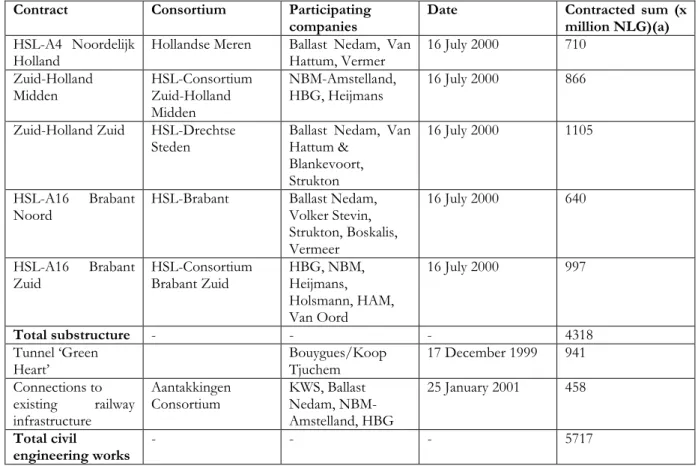
In the beginning the substructure between Amsterdam and the Belgian border was subdivided into 21 parts. Until the middle of 1998 the idea was to prepare 21 contracts. This appeared to be too complicated and introduced too many interface risks. One mega contract for the whole substructure was considered to be too risky. There are possibly not enough candidates for such a huge job. Finally, in 1998 the whole substructure is divided into seven parts, in the range between 600 million and 1,100 million guilders (see Table 1). The expectation is that there were enough
candidates in the NW part of Europe for these seven contracts. With the exception of the Green Heart tunnel (realised by a French contractor), the Dutch contractors are very successful in blocking the way to a contract for foreign contractors. The competition for six contracts appeared to be a closed shop of Dutch participants. The names of the competing consortia are different, but there were a limited number of firms participating, each active in more than one consortium.
[About here: Table 1]
In 2001/2002 the Parliamentary Committee on the Building Trade revealed massive fraud in the Dutch construction sector, the HSL substructure contracts being a part of this fraud (PEB, 2002). It is clear with hindsight that the competition was fake and that the State was negotiating with different members of the same construction cartel (Priemus, 2004; Dorée, 2004). No wonder that, after opening the first envelope, the bids for the substructure were more than 40% higher than the official estimates of the Transport Ministry.
Design & Construct
There were high expectations about the Design & Construct strategy, adopted for the substructure (including the Green Hart tunnel) of the HSL-South. Such an approach was strongly supported by large Dutch contracting companies because they suggested that this gave room for creativity, innovation and lower prices (EIB, 2003; Gann, 2000; Janssen, 2001; Mandeau & Seaden, 2001; Miozzo & Dewick, 2001).
We first reveal what were the goals and the background for adopting D&C contracts for a large infrastructure like the HSL-South (see: Priemus, 2005; Priemus, 2009).
A client who sets out a building project in detail (including the plans and the working drawings) leaves the contractor no scope for improvisation. The gap between design and execution remains too wide to be comfortably bridged. Price competition – as it were – invites (illegal) deals between building firms (cartel forming). The client’s task in the new setting is to precisely define the functional programme, i.e. the performance criteria for the project and the regulations on spatial planning, the environment, safety, health, maximum annual allowable disruption to infrastructural capacity etc.
Cross-border competition can be more effectively mobilized if the invitation to tender is performance-based. Construction firms will then compete on quality as well as price. Extra quality can be expressed in added value.
The scope of the invitation to tender can be optimized in two ways:
In a spatial sense. From line to area development: the project does not only include the line but also the junctions (stops and surrounding zones) and areas crossed by the line. The real estate value of the places where the train/vehicle does not stop will decline because of noise nuisance, emissions etc. Construction firms in competition with one another can devise creative solutions to prevent or limit this decline without breaching the regulations. Conversely, the value of real estate in and around the junctions may increase considerably. If so, competing firms can develop creative solutions to further increase this value or deploy value-capturing so that (part of) the surplus value can cover (some of) the infrastructure costs.
In a temporal sense. The invitation to tender involves one or more decades of exploitation besides the investment. That way, problems will not be pushed forward during the investment process. The infrastructure project must be adequately defined in space and time for the potential advantages of D&C to emerge.
We now explain what strategy was used for contracting the substructure of the HSL-South (TCI, 2004).
Twijnstra Gudde consultancy agency conducted a market survey on behalf of the project organizers at the end of 1998. The following conclusion appears in their management summary of 3 December 1998: “The market relationships in the period when HSL-Zuid is open to public tender, are not expected to differ significantly from the present market relationships. Accordingly, healthy competition will ensue which must not hamper favourable pricing.”
This conclusion is based on the following observations (TCI, 2004: 235):
Macro-economic developments in the world are leading to overcapacity in the engineering and construction sector; this may manifest itself in the Netherlands via, amongst others, internationally operating contractors.
After a period of recovery, growth in GNP and in the volume of building and engineering works has evened out in Europe as a whole and in the Netherlands and the surrounding countries in particular. Such a situation cannot lead to a shortage of capacity. On the contrary, a contingent of eager candidates may emerge.
Given the relatively poor economic prospects and a possible fall in investment in building and civil engineering in the UK, British contractors can certainly be expected to show an interest in bidding for HSL-Zuid.
HSL-Zuid is a relatively small project in European terms and will be realized in a period when the construction activities for the Trans European Network (TEN) are winding down.
There are enough large contractors (around 40) in the Netherlands and the surrounding countries who can realize HSL-Zuid contracts worth around 450 million euros.
Later, as events unfolded, the actual situation bore very little resemblance to the predictions of Twijnstra Gudde. The assumed global and European overcapacity in the construction and engineering sector did not materialize in the Netherlands. The engineering work for the Betuwe Freight Railway and HSL-Zuid more or less coincided and caused in the Netherlands a huge shortage of building materials (sand, cement, concrete, asphalt, bricks), tradesmen and executives. No interested parties turned up from the UK and the serious candidates numbered far below 40. With hindsight, the market survey by Twijnstra Gudde can only be described as flawed. The TCI (2004: 236) reached the same conclusion.
In a draft evaluation the Tender Board (which advised the principal on contracting matters) concluded on 13 May 2000: “Possibly as a result of limited capacity, the complex demand, and the short throughput time, the Dutch construction and engineering sector has reorganized itself. It was obvious long before 1 September that the threshold was too high for foreign companies (…). This effectively destroyed one of pillars of the contracting strategy: competition.”
Though foreign companies did submit tenders for the drilled tunnel under the Green Heart, very few showed up for the substructure. As a result, competition was severely constrained and serious capacity shortages arose on the Dutch market. In addition, the consortia were engaging in large-scale collusion on the bids. It was patently clear that the bidding procedure for the HSL-Zuid substructure contracts was fraught with cartel formation and fraud.
The aim of Design & Construct (equivalent: Design & Build) is to achieve better price-quality ratios in projects by closer integration of design and constructional expertise. The integration of design, construction and possibly maintenance would redistribute the risks between the principal and the contractor, because the contractor would have a greater responsibility. The principal would concentrate on determining the functional requirements, on the basis of which the contractor would be free to optimize the execution. Design freedom for the contractor would save building costs, shorten building time, and stimulate creative competition, innovation and dynamism (see Konings & Lourens, 2004).
A decision was taken to apply a negotiation procedure with a preliminary announcement in line with EEC Directive 93/37 of 14 June 1993. A limited number of candidates would be invited to submit a design and a price on the basis of specific criteria. These included:
− procedural requirements such as completeness of the application; − exclusion criteria, such as bankruptcy and suspension of payment;
− a strong financial and economic support base, as demonstrated by the balance sheet and profit and loss account (solvency, profitability and liquidity);
− turnover requirements;
− technical and organizational requirements such as experience in the design and realization of large projects and knowledge and experience of risk and interface management;
− quality requirements such as a certified quality-control system. Collusion between contractors
We shall now move on to the question: How was Design & Construct concretized in this contracting process, to what extent could it stimulate innovation, and which problems arose? When the contracting strategy for the HSL substructure was settled at the end of 1998, the project organizers expected great things from the deployment of Design & Construct. This strategy was discussed in advance with the building sector and was well received. Large contractors stated that they were prepared to commit themselves contractually at highly competitive prices, they would guarantee maintenance and shorten the collective preparation and realization time. Remarks were made about positive experience of D&C for the Flood Barrier in the Waterweg (near Rotterdam) and the Oresund connection in Denmark. The good intentions came to nothing at the end of the day.
After the application deadline had expired, between three and five consortia had submitted bids but they turned out to consist of different compositions of largely the same companies. The large contracting firms in the Netherlands were participating in different consortia, a practice which – of course – makes a total farce of the principle of free competition. The consortia consisted of the following companies in the construction and engineering sector:
− Ballast Nedam;
− BAM;
− Heijmans;
− Van Hattum & Blankevoort (part of Volker Stevin); − NBM-Amstelland;
− HBG;
− Dura Vermeer; − Strukton.
The dredging companies Boskalis and Van Oord also had a stake in the consortia. The contract for the drilled tunnel went to Bouygues (France) in combination with Koop Tjuchem (the Netherlands). Only a few French and Belgian firms joined the Thalys 1, 3, 4 and 5 consortia (along with Koop Tjuchem and TBI amongst others). Apart from the group that was to realize the drilled tunnel, no other consortium was fronted by a foreign company. The lack of foreign interest was blamed on the nature of the Dutch subsoil (peat) and the close interconnections with the surroundings, which is dictated by uniquely Dutch regulations. This was not mentioned at all by Twijnstra Gudde in 1998. It transpired later that the WO-6 consortium (comprising Ballast Nedam, HBG, Heijmans, KWS, BAM NBM and Dura Vermeer) had operated as a cartel and had struck deals to divide up the work for HSL-Zuid and the Betuwe Freight Rail Line. It had also pursued a deliberate policy to stave off foreign competition.
disappointed at the low levels of foreign interest but believed, strangely enough, that the conditions were adequate for effective competition.
All the consortia were invited to submit a bid. At this point Thalys withdrew from three of the five contracts. The contracting procedure of the HSL-Zuid substructure was from now on a completely Dutch game.
Engineering & Construct
In May 1999, the remaining parties were sent extensive bid documentation consisting of the guidelines, the calculation plan, the programme of requirements, the project information, the draft contract and the so-called ‘reference design’. This reference design was intended to serve as a basis for a bid that complied with the D&C philosophy; it set out the technical and functional requirements. The construction companies thought the programme was too tight and complained that the emphasis was on technical rather than functional requirements. They argued that the strategy was more like Engineering & Construct than Design & Construct. Many of the fits and construction requirements had already been decided. Commitments that the project organizers had already made to local authorities placed serious constraints on the design freedom. Finally, they felt that the preparation time was far too short: three or four months, which also coincided with the summer vacation. Be that as it may, the project organizers were nonetheless disappointed by the meagre innovative capacity exhibited by the consortia. The directorate maintained that the consortia had had nine months to acquaint themselves with the project. Concern about pricing
The Dutch Parliamentary Commission for Infrastructure Projects (TCI, 2004: 229) came to the conclusion: “In the bidding phase the principal lacked the correct professional culture for D&C.” Ninety percent of the departmental staff of the HSL-Zuid project had been hired externally. The reference design had been worked out in detail and there was no actual programme of functional requirements. As the bidding for the HSL substructure more or less coincided with the engineering work for the Betuwe Freight Rail Line, the Dutch construction and engineering market had become overheated, contradicting the expectations of Twijnstra Gudde in 1998. On 28 May 1999 HSL-Zuid cost managers ascertained that: “Mounting pressure on the size of the building cost estimates is due to recent (external) contracts for civil engineering” (TCI, 2004: 230). Signals like these prompted concern about pricing, even before the bidding procedure got started. The Tender Board continued to hope that the new strategy would prod the consortia into creativity. On 31 August 1999 the management team set the budget for the five civil engineering contracts at 1.79 billion euros. This figure was approved and stored in the solicitor’s safe. It was based on a ‘bare’ estimate with no allowances for market fluctuations or specific risks. A second figure of 1.90 billion euros, which did incorporate market fluctuations and specific risks, was also deposited at the solicitor’s office as the ‘anticipated value of the contract’. According to the project organizers, this figure was the absolute maximum for which the work could be contracted. The anticipated value of the contract would form the basis of the arguments in any arbitration case. The organizers revealed the budget unofficially before the bids, which was in strong contradiction with the earlier decision of the Tender Board to store the ‘bare’ budget estimation in the solicitor’s safe.
Bids and bewilderment
The bids for the HSL-Zuid substructure contracts were submitted on 1 September 1999. The project organizers smelt a rat. They suspected that price deals had been struck and that the bids would (strongly) exceed the budget. On the advice of the Tender Board they decided, for the time being, to open the procedure for the Noordelijk Holland contract alone. This took place on 9 September 1999 in the presence of the solicitor. The lowest bid came from the Hollandse Meren consortium, but it was as much as 57% above the budget! At that moment the envelopes
containing the bids for the other contracts were still sealed. The project organizers were confounded. The contractors took the view that it was not the price that was too high, but the budget that was too low. On 10 September 1999 the Government Prosecutor and the Tender Board were asked for legal advice on the next step. The legal advisors said that the project organizers should be prepared for arbitration. The minister was immediately notified of the size of the bids.
The project directorate had no appetite for negotiating with the construction companies. The chairmen of the corporate boards were summoned and given a chance to submit a new, more appropriate bid, but none of them did. On 15 September 1999 the project directorate approached the Dutch Competition Authority (Nederlandse Mededingingsautoriteit / NMa) and asked them to take a look at the case. The NMa found it vague and could not do much anyway as it did not yet have the relevant expertise in those days.
On 30 September 1999 one of the companies submitted a proposal for lowering the price. This company offered to provide off-the-record insight into the bids and to lower the tenders by half of the difference before engaging in further negotiations – provided Noordelijk Holland was included in the deal. A start would be made with Zuid-Holland Zuid, where the differences were thought to be reconcilable. The other companies could be persuaded to go along with this as well. The HSL directorate was wary. Under no circumstances would it negotiate on the Noordelijk Holland contract, where it wanted to stop the procedure. Moreover, the proposed price reduction was bound up with economies.
In mid-October 1999 the project organizers received a cost-saving proposal of 150 million guilders from the Brabant Noord consortium for the contract of the same name. The envelopes were then opened for Brabant Noord. The minimum difference was lower than for Noordelijk Holland, but it was still 30% (TCI, 2004: 245).
On 9 October 1999 the HSL directorate announced to the participating consortia and the media, that it was halting the procedure for Noordelijk Holland. All the envelopes had been opened on 29 October 1999. After all the lowest bids had been added up, there was a total price of 2.6 billion euros: 43% above the budget deposited in the safe (TCI, 2004: 246). This huge disparity turned out to be due to the percentages for indirect costs: general expenses, insurance, profit, and premium loading. The directorate took the view that this was “a large percentage of air” (TCI, 2004: 247); the contractors especially stressed the unequal risk distribution, which had forced them to accept certain risks only at very high premiums.
Cobouw (Dutch newspaper for the building industry) of 20 September 1999 mentioned the threat of billion-guilder excesses in the contracting for the HSL substructure. Reports in the newspaper Haagsche Courant of 18 and 19 November 1999 said more or less the same. The Minister for Transport, Public Works and Water Management denied this in a letter to the House of Representatives, thus misinforming it.
Task-setting budget
The inquiry by the TCI revealed that after Cost Report 15 (28 May 1999), which formed the basis for the budget, Cost Reports 16 and 17, though drawn up had not been authorized, so the budget was not revised. The Ministry of Transport, Public Works and Water Management, adhering to the principle of the task-setting budget, did not therefore align the budget with the estimate but the estimate with the budget. Also, tasks were entered in Cost Report 15, which ostensibly brought the estimates into line with the budget. Cost Report 17 calculated an investment that exceeded the task-setting budget by 239 million euros. Hence, Report 17 was not authorized. To negotiate or not to negotiate?
After the contracting procedure had been halted, the HSL directorate adopted two positions towards the contractors. Officially, it prepared a new procedure for the Noordelijk Holland contract. Unofficially, the contractors were afforded the opportunity to submit cost-cutting
proposals. A mediator was recruited to find out, via informal channels, whether the differences could be reconciled. These positions pulled the HSL directorate in two opposite directions. On 22 November 1999 the representative of the contractors came up with a new offer, in which the original bids would be lowered by 17% per contract. This signal led to the postponement of the arbitration case to 8 and 9 December 1999.
On 25 and 26 November 1999 informal talks took place with the contractors, which did not qualify as official negotiations. Many cost-cutting options were placed on the table at this so-called ‘black-box’ meeting. The directorate thought that, if these proposals were realized, they would be over and above the 17% reduction, but the contractors said no; on the contrary, the proposed technical savings would actually form the 17% reduction quoted on 22 November 1999. This caused a further deterioration in the relation between the HSL directorate and the contractors. At the start of December 1999, an attempt was made to patch things up with the aid of two mediators, Roelofs (for the HSL directorate) and Wentink (for the contractors). On 7 December 1999 the mediators made the project organizers a proposal for a contract price of 1.90 billion euros. They arrived at this figure via favourable payment regimes for the builders, shifting the risks to the HSL directorate and numerous straightforward economies. However, the directorate was not convinced that the savings options were watertight (TCI, 2004: 263).
Arbitration and the awarding of contracts
On 8 November 1999 the Hollandse Meren consortium asked the Arbitration Council for the Building Trade to arbitrate. It asked them ‘to censure the government for halting the renewed bid procedure and to open negotiations’.
Shortly before Christmas 1999 the arbitration case was called between the Dutch Government and Hollandse Meren. The cause was the stoppage of the bidding procedure for the Noordelijk Holland contract. In January 2000 the Arbitration Council ruled that it was unlawful for the government to halt the procedure. The project organizers should first have engaged in negotiations with the Hollandse Meren consortium. The Council instructed the organizers to do so until it became clear that negotiations were fruitless. The HSL directorate was not instructed to reach agreement with Hollandse Meren.
In the formal negotiations, which now started, everything revolved around price. It had to be lowered at all costs. Risks were transferred to the government, numerous savings were pushed through and led to a provisional agreement on 25 February 2000, based on a maximum figure of 2.04 billion euros which would be reduced to a lump sum of 1.89 billion euros by extra optimization and an adapted payment regime. Once the technical and legal aspects of the agreement had been worked out, Minister Netelenbos signed a statement of intent with the five consortia on behalf of the Dutch government on 14 March 2000. On 16 March 2000 a debate was held in the House of Representatives about the statement of intent. The starting point was that a maximum of 1.89 billion euros would be reserved for the substructure of HSL-Zuid, excluding the drilled tunnel. The negotiations then moved on to the optimizations. Not until 16 July 2000 did Minister Netelenbos sign five contracts for a total of 1.96 billion euros and a provision of 36 million euros for options and optimizations.
Results
Table 2 gives an overview of the awarded contracts. [About here: Table 2]
The project had changed drastically in the meantime: the scope and conditions in the final contracts were vastly different from the original programme of requirements.
Despite the declaration of intent of 14 March 2002 an unforeseen 250 million guilders had to be produced. Eventually, the budget for the HSL substructure had to be raised by 600 million
guilders. This figure was covered by reshuffling the priorities in the Multi-Year Programme for Infrastructure and Transport and by adjustments to the budget.
In a statement on 25 April 2001, Minister Netelenbos explained the disappointing results of the contracting procedure for the HSL substructure (TCI, 2004: 279):
− The market did not really respond to the Design & Construct philosophy of the contracting authority;
− The reference design was perceived as imposed, so the bidders did not have a clear enough idea of the design freedom;
− Competition was insufficient and shortages in the subcontracting and supply markets pushed up the prices.
By now, so much extra work had accumulated in the execution of the contracts that the final bill for the substructure could conceivably be in the region of the original bids (2.6 billion euros), which the project organizers had rejected because they were unacceptably high.
Summing up, we have to conclude that, in this case, the Design & Construct strategy was a dismal failure. No savings were realized in the costs, there were no gains in reducing the time schedule in the preparation or the implementation of the works, and the construction and engineering sector showed no sign at all of design creativity or innovation.
Lessons from the D&C strategy in HSL-Zuid
We now move to the last question: How can the problems observed be explained and how can they be avoided in the future? What lessons can be learned, and how can the deployment of a Design & Construct strategy be improved to stimulate innovation.
We start with the sub-question: why did the contracting procedure for HSL-Zuid fail so abysmally? Murphy’s Law was having a field day: everything that could go wrong, apparently went wrong.
First, the function of principal was not executed in a professional way: there was no challenging, sharply formulated programme of functional requirements. The reference design was too dominant and could easily be perceived as binding, as in a traditional contracting procedure. And the whole project was split in several parts which created many interface risks and costs.
Second, there was the cartel forming, which removed incentives for cost-cutting and quality of design.
Third, the construction of the Betuwe Freight Railway Link more or less coincided with the civil engineering for HSL-South. This led to dramatic price increases throughout the building chain. An unbridgeable gap developed between budget and estimate. The project organizers were not allowed to tamper with the (far too low) budget. As a result, the entire process was dominated by savings; scope and quality were consigned to second place.
Part of the cost-cutting was virtual. The Dutch Government re-assumed many of the risks, causing extra work and expenses at a later stage. Many additional costs were incurred by interface management between the superstructure and the substructure and between the five components of the substructure. Even though the builders engaged in preliminary consultations, the five components did not interconnect as they should have done. The collusion was about price, not about design. The builders were not provided with design rules, which would have ensured proper interconnection in advance.
The benefits of a D&C contract can only be reaped if the infrastructure project is adequately defined. HSL-South had serious shortcomings in this area:
Splitting the substructure into seven parts without guarantees for mutual synergy pushed up the costs of interface management.
Separating the substructure from the superstructure created a disproportionately large number of interface risks.
The detailed drawings, intended as illustrations, enticed the bidders into interpreting the project as a traditional tender.
At the time of the HSL-Zuid project a long-standing (illegal) practice was still in force in the Netherlands, whereby Dutch contractors came together in advance and formed cartels instead of competing against one another. Also, the bidding consortia consisted largely of the same parties – which makes a mockery of the whole principle of competition.
The client (the Ministry of Transport, Public Works & Water Management) applied a task-setting, normative budget which made insufficient allowance for what was then an overheated construction market. It also neglected to express the sizable risks and interface problems in monetary terms. As a result, both the ministry and the Dutch Parliament had unrealistic expectations of the budget required for the project. Flyvbjerg et al. (2003) have suggested an ideal solution to this well-known problem: base the budget on the actual costs of comparable, recently executed projects instead of (only) on the programme of requirements or the design. This was not done by the Ministry.
The following lessons can be learned, both in the Netherlands and within the international community, from the experience of the contracting procedure for the Dutch High Speed Railway Link.
D&C projects must be seen as a whole. Inviting contractors to make a design for each component in five separate D&C contracts and/or separate superstructure and substructure contracts is asking for trouble. It leads to interface problems and communication breakdowns. The quality of design cannot be guaranteed in such a system.
The programme of functional requirements needs to be unambiguous, well structured and should contain only essential information. The contracting authority can compile a reference design – also as a basis for estimating costs – but it is not advisable to send it to the candidates. It may undermine the whole idea of a D&C approach.
If we use the term ‘research & development’ in the usual way, the D&C approach of HSL-Zuid did not generate additional R&D-expenses by the building companies and did certainly not promote innovation.
D&C does not fit in with a culture of collusion, price-fixing and building cartels. Such cultures will have to die a death, if D&C is to get a realistic chance. D&C only works in combination with real competition.
The principal must behave in a professional way and must be able to forecast the investment budget in a reliable way. The method of reference forecasting (Flyvbjerg et al., 2003) may be helpful.
D&C works best in technically complex projects, which are not subject to too much interaction with the social and physical environment. The Green Heart Tunnel, the Westerscheldt Tunnel and the Flood Barrier in the Nieuwe Waterweg are excellent examples. In such cases the conditions for innovation are bright. For other projects the system must not be limited to the infrastructure line, but most include a larger area.
D&C needs both a contracting authority and building consortia with a cutting-edge, innovative culture. In particular, in adopting a D&C contract, a highly sophisticated and knowledgeable client is needed. The Dutch ministry of Transport, Public Works and Water Management is learning quickly now. But there was very little sign of this when the HSL-Zuid project was prepared.
D&C is a learning process for both the building industry, designers and public and private clients, which will take many years to get established. This is especially the case in a country like the Netherlands with a long tradition of cartel forming. In a process like this it is best to start with less complex projects and move on gradually from there. HSL-Zuid was simply a bridge too far. Experience in countries like Spain and the United Kingdom learn that, if the conditions for a
proper D&C approach are met, D&C can improve the price: quality ratio of the awarded infrastructure projects and can bring more dynamics and innovation in the building industry.
6. Contracting the North-South Metro Line
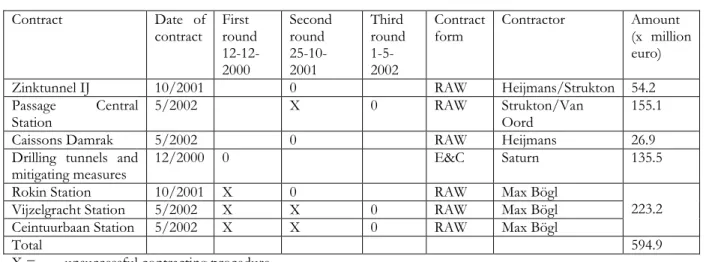
The North-South Metro Line project is subdivided into 16 contracts. The first round of contracts was based on an Engineering & Construct (E&C) formula, which left quite some risks with the contractors. In the second round of contracts the formula was the traditional RAW-specifications. In the third round of contracts a common domain was introduced for the Central Station area and approximate estimates in the contracts for the stations Rokin, Vijzelgracht and Ceintuurbaan, in which the risks were allocated to the municipality.
[About here: Table 3] First round of contracts
The first contracts were those of the three deep stations: Rokin, Vijzelgracht and Ceintuurbaan, and the drilling tunnels. It was a closed contracting procedure in which six contractors were invited to participate. Five of them submitted a bid. The economically most favourable bid would be selected. General points of departure were the reduction of risks by hiring specialist contractors where this was possible, management of risks by an optimal clustering and dividing of contracts, and finally allocating the risks to those actors who were in the best position to reduce the risks.
The E&C contract was chosen to stimulate innovation but in this respect the results were disappointing. After the prequalification there was an exchange of information between the municipality and the consortium during four months. For the contractors it was very difficult to identify and to quantify the technological and political risks.
In November 2000 the consortia were invited to submit a price not including specific risks and to add a catalogue of risks with a price per risk. The idea was to introduce a risk fund and to design a bonus scheme for contractors to stimulate not to spend money of the risk fund.
The results were again disappointing: the bids were 1½ - 2 times higher than the budget, estimated by the municipality, with the exception of the drilling tunnels.
Lloyds & Horvat produced an audit and concluded that the budget estimations was 10% - 30% too low. Negotiations with each of the consortia meetings took place, but without a satisfactory result: the gap between bid and budget was not bridged. The bidding procedure for the stations was stopped, the bidding procedure for the drilling tunnel was continued. The contract for this tunnel was awarded to Saturn. The contract included the Risk Assessment and Allocation Catalogue (RAAC).
In this first contracting round the concerns of the contractors were the technological risks, the common domain, the environment and the negative image of political decision-making in Amsterdam. In addition, there was not enough real competition and the E&C-approach was not fully understood by the contractors.
Second round of contracts
In the second round the contracts were reformulated from E&C to traditional RAW-specification. The contracts were simplified and reduced in size: six contracts were offered simultaneously. For the first time the bidding documents were published in English and not only in Dutch! By increasing the appeal to foreign contractors competition would be tougher, was the idea.
The subscription for the second round of contracts took place on October 25, 2001. For three contracts the results were satisfactory: Zinktunnel IJ, Caissons Damrak and Rokin Station. For three contracts (Vijzelgracht Station, Ceintuurbaan Station and Central Station) the prices were 20% or more above budget. There was one foreign contractor, Max Bögl, but this contractor had huge problems in finding a Dutch subcontractor. For three components (earth work, deep walls and jetgrouten) there was no price from a subcontractor available. A crucial point was the very high price, offered by Dutch specialist subcontractors.
The municipality declared that the bids would be declared inappropriate. The difference in price between budget and bid was particularly high in the case of the Vijzelgracht Sation. The main contractor here, Heijmans-Holzmann, collaborated with subcontractor Soletanche. On January 24, 2002 the director of Heijmans Beton and Waterbouw sent an Email to Soletanche, confirming that Soletanche was not allowed to submit a bid for an other contractor than Heijmans. This referred to an earlier agreement (ultimo 2009) between Heijmans and Soletanche. By accident this Email was received by municipal officials. In the meantime Holzmann had financial troubles as a result of which the bid by Heijmans-Holzmann was declared unvalid. An official complaint was submitted to the Dutch Competition Authority NMa about the cartel between Heijmans and Soletanche. After a long procedure NMa decided (December 19, 2001) that Heijmans and Soletanche were both guilty, and had to pay a penalty of €50,000.
Third round of contracts
The next round consisted of negotiations, based on article 55 UAR-EG. The lowest bidders were invited to submit a reduced price for Central Station, Ceintuurbaan Station and Vijzelgracht Station. The negotiations resulted in a satisfactory outcome. Contracts Vijzelgracht Station and Ceintuurbaan Station were awarded to Max Bögl. This contractor was also the lowest bidder for Rokin Station. A complications was that Max Bögl had submitted a price for the three contracts together, not for the contracts separately.
In later stages a number of renegotiations took place and in some cases the contracts were reformulated. A substantial part of the contracts was shifted to the so-called common domain with specific agreements on the allocation of risks.
For the drilling tunnels a crucial risk is the speed of the drilling engine, which was defined at 12 meter per day. Risk funds were introduced to cover additional costs, testing procedures, temporary measures and the coverage of approximate estimates.
A number of surprises manifested themselves, For instance, Max Bögl bought deep walls in the form of a flexible contract (‘regiecontract’), which the municipality did not know. This component was an approximate estimate in the contract with Max Bögl. So the additional costs had to be paid by the municipality.
The common domain in the Central Station area was agreed upon by Strukton/Van Oord and the projectbureau, without any legal support. The legal quality of the agreement on the common domain appeared to be weak. Agreements about the approximate estimates for the deep stations appeared to be very fuzzy, allowing many different interpretations. This can lead to disadvantages for the Municipality of Amsterdam.
Buck and Buis conclude in 2006 that the history of the bidding procedures of the North-South Line is a factor undermining the health of the whole project. In some cases the huge implementation risks were not allocated to the contractor but to the municipality.
Buck and Buis (2006) conclude that via approximate estimates 34% of the contract for three deep station with Max Bögl, financial problems were shifted to the future. In addition, no criteria for experience were adopted for subcontractors.
In December 2008 it was decided to change the contract with Saturn on the drilling tunnel to replace the old contract, that allocated all risks to the Municipality, by a contract with a ‘normal’ allocation of risks.
In the case of the Central Station two mediators were hired to solve a difference of opinion between the contractor and the Municipality about the length of the implementation period (municipality: 387 weeks; contractor: 567 weeks; agreement: 480 weeks). The costs of the extra weeks (10.3 million euro) were paid by the Municipality.
For the deep stations a price increase of 46.6 million euro was expected on January 1, 2006. In addition, there was a delay in the planning of 120 weeks (from 330 to 450 weeks). The costs of the deep walls increased from 40 to 56 million euro. Of course, the Municipality had to pay. The contract for the drilling tunnels allocates all risks to the Municipality. It appeared to be impossible to renegotiate this contract successfully.
The value of the seven contracts at the time of the go-decision (in 2002) was €595 million. Of this amount 43% was based on risks allocated to the Municipality: €136 million drilling tunnel; common domain €45 million and €76 million for the deep stations. After the three contracting rounds, the size of the risk funds was not big enough to cover these risks.
In the meantime some technological problems have manifested themselves, such as leakages in the building excavations and damage to a number of buildings close to the metro track. The construction activities were stopped for a while, Alderman Herringa stepped down and the Veringa Committee recommended that the works would be continued. On September 4, 2009 a committee of council members, chaired by Maurice Limmen, started the public interrogations of about 40 politicians, officials and advisers to reconstruct what has happened in the past and to learn lessons from this inquity.
7. Conclusions
Although the inquiry of the Limmen Committee only recently has started, it seems possible to draw a number of conclusions:
1. The strategic goal of a Metro Line, connecting the Northern and Southern part of Amsterdam, now divided by the IJ-river, is undisputed.
2. When the public go-decision was taken, the whole project was not under control, not in a financial sense, not in planning terms and not in a technological sense.
3. The contracting procedure is determined by cartel forming and construction fraud in the first stages and a lack of innovation and creativity among the contractors.
4. The Dutch contractors have – partially in a successful way – excluded foreign contractors and subcontractors.
5. The technological and interface risks of the construction are underestimated by the Municipality from the start. The estimations of prices between the contractors and the Municipality differed 50-100%. This gap was bridged by virtual measures such as introduction of approximate estimates, common domains and the payment by the Municipality of delays and other cost overruns.
6. Also at the moment the project is not under control as a result of the interaction between the 16 contracts, the interrelations between contracts and environment and the fuzzy character of many contract formulations. There is a current list of 15 top risks which need a reservation of 500 million euro. This reservation has not yet been made. Nobody knows what the final costs will be of realising the North-South Line with hindsight a piecemeal, step by step approach with separate contracts, not simultaneously but in a longer time period, had resulted in the opportunity of learning during the process, a reduction of interface risks and a better control of technology, management and costs.
7. The Municipal Board of Amsterdam was again and again entrapped in micro-management, as if the Alderman, responsible for the North-South Line, was the managing director of the project. The division of responsibilities between public and
private was mostly unclear, changed several times and has blurred the real responsibilities of municipal board and municipal council.
8. The contracts about the operation of the metro line and the management of the stations are not yet made, let alone agreed upon. Quite some surprises can take place after the completion of the North-South Line in the first years of operation.
9. It is too early how to come to a final evaluation. Two years after the start of the operation (about 2020) seems the right moment for the final evaluation. From several points of view the North-South Line contracting process provides many lessons to be learned.
10. A rethinking of the public and the private domain in the case of preparing, constructing and operating large public transport infrastructure project may be useful.
7. Preliminary conclusions
1. Experience with innovative contracts (E&C; D&C; DBFM) in the Netherlands is still determined by a long tradition of cartel forming between contractors and subcontractors. As a result of this there is a backlog in international exchange of experience, a lack of dynamics and innovation and a surplus of conservatism in the construction industry.
2. In developing new public transport infrastructure the danger of cannibalism in relation to the existing public transport networks is underestimated.
3. Innovative contracts are exciting in theory but mostly disappointing in practice. It reduces competition because only a few number of contractors can handle these contracts. The knowledge and the experience among public actors are insufficient, at least in the Netherlands.
4. The deal flow of innovative contracts in the Netherlands is too small. Training and education in this field is insufficient. Transaction costs are still too high.
5. The decision to start the execution of a project can and must be taken when the project is in control and completely defined. This decision is taken too early in the case of the North-South Metro Line: this project was still too dynamic; too many changes took place after the go-decision.
6. A clear demarcation of public and private responsibilities before and after the go-decision is essential. The responsibility of the Cabinet, Parliament, Municipal Board and Municipal Council has to be clearly defined and related (exclusively) to public values and public finance.
7. In any stage of the decision-making it is crucial to have alternatives and options, to make the project flexible and resilient. It is important to rethink the stages of mega-projects and the way interface management can be simplified.
8. Innovative contracting in public transport infrastructure in the Netherlands is still in its infancy.
Table 2. HSL-South: contracts awarded for civil engineering Contract Consortium Participating
companies
Date Contracted sum (x million NLG)(a) HSL-A4 Noordelijk
Holland
Hollandse Meren Ballast Nedam, Van Hattum, Vermer 16 July 2000 710 Zuid-Holland Midden HSL-Consortium Zuid-Holland Midden NBM-Amstelland, HBG, Heijmans 16 July 2000 866
Zuid-Holland Zuid HSL-Drechtse Steden
Ballast Nedam, Van Hattum & Blankevoort, Strukton 16 July 2000 1105 HSL-A16 Brabant Noord
HSL-Brabant Ballast Nedam,
Volker Stevin, Strukton, Boskalis, Vermeer 16 July 2000 640 HSL-A16 Brabant Zuid HSL-Consortium Brabant Zuid HBG, NBM, Heijmans, Holsmann, HAM, Van Oord 16 July 2000 997 Total substructure - - - 4318 Tunnel ‘Green Heart’ Bouygues/Koop Tjuchem 17 December 1999 941 Connections to existing railway infrastructure Aantakkingen Consortium KWS, Ballast Nedam, NBM- Amstelland, HBG 25 January 2001 458 Total civil engineering works - - - 5717
Table 3. Seven North-South Metro Line contracts Contract Date of contract First round 12-12-2000 Second round 25-10- 2001 Third round 1-5- 2002 Contract form Contractor Amount (x million euro)
Zinktunnel IJ 10/2001 0 RAW Heijmans/Strukton 54.2
Passage Central Station
5/2002 X 0 RAW Strukton/Van
Oord
155.1
Caissons Damrak 5/2002 0 RAW Heijmans 26.9
Drilling tunnels and mitigating measures
12/2000 0 E&C Saturn 135.5
Rokin Station 10/2001 X 0 RAW Max Bögl
Vijzelgracht Station 5/2002 X X 0 RAW Max Bögl
Ceintuurbaan Station 5/2002 X X 0 RAW Max Bögl
223.2
Total 594.9
X = unsuccessful contracting procedure 0 = successful contracting procedure
References
Dorée, A.G. (2004) Collusion in the Dutch construction industry; an industrial organization perspective, Building Research & Information, 32, No 2: 146-156.
Economisch Instituut voor de Bouwnijverheid (EIB), (2003) Innovatie en bouwbedrijf
[Innovation and building industry], Amsterdam (EIB).
Flyvbjerg, B., N. Bruzelius and W. Rothengatter (2003) Megaprojects and Risk: An anatomy of ambition, Cambridge (Cambridge University Press).
Gann, D.M. (2000) Building Innovation: complex constructs in a changing world, London (Thomas Telford).
Jansen, C.E.C. (2001) Totstandkoming en inhoud van design & construct contracten voor complexe infrastructurele werken [Origin and content of D&C contracts for complex infrastructure projects], Deventer (Kluwer).
Konings, J.J.G & E. Lourens (2004) Design & Construct en innovatie in de bouw in de sector GWW [Design & Construct and innovation in the building industry: land, roads and water works], Amsterdam (EIB).
Mandeau, A. & G. Seaden (2001) Innovation in construction: an international review of public policies, London (Spon).
Miozzo, M. & P. Dewick (2001) Building competitive advantage: innovation and corporate governance in European construction, Research Policy, 31: 989-1008.
Parlementaire Enquêtecommissie Bouwnijverheid (PEB) (2002) De bouw uit de schaduw: eindrapport Parlementaire Enquêtecommissie Bouwnijverheid [The building industry out of the shadow: final report Parliamentary Inquiry Committee on the Building Industry], The Hague (Sdu Uitgevers).
Priemus, H. (2004) Dutch construction fraud and governance issues, Building Research & Information, 32, No 4: 306-312.
Priemus, H. (2005), Design & Construct bij de Hogesnelheidslijn-Zuid: de Wet van Murphy,
Building Business, 7, nr. 1: 242-249.
Priemus, H. (2009), Do Design & Construct contracts for infrastructure projects stimulate innovation? The case of the Dutch high speed railway, Transport Planning and Technology, 32, nr. 4 (August): 335-353.
Priemus, H., B. Flyvbjerg and B. van Wee (eds.) (2008) Decision-making on Mega-Projects. Cost-Benefit Analysis, Planning and Innovation, Cheltenham/Northampton (Edward Elgar). Tijdelijke Commissie Infrastructuurprojecten (TCI) (2004) Reconstructie HSL-Zuid. De besluitvorming uitvergroot [Reconstruction of the decision-making process for the High Speed Railway South; an in-depth analysis], Tweede Kamer 2004-2005, 29.283 nr. 8, The Hague (Sdu Uitgevers).