Abstract:
The design studio continues to be the default core of architectural education. On the assumption that no good alternative is available at present, this paper proposes a model of the design process in the studio as a step towards a theory of design pedagogy. The 2x2 model is sensitive to two types of complementarities: on the one hand the two types of learning that take place in the studio, i.e., conceptual and professional learning, and on the other hand the important impact of inputs that are not task-dependent, i.e., personal input by the (student) designer and instructional input. The effectiveness of the process of designing that is being rehearsed in the studio is contingent on control over the perception-conception continuum which, in turn, hinges on acquired representational expertise.
Keywords: design education, design pedagogy, instruction, learning, representation, studio.
Introduction
Despite changes – some of them radical – that have transpired over the last century concerning architectural styles, building technologies, and the cultural and social contexts in which architecture is practiced, corresponding changes in architectural education have been surprisingly modest. This is particularly true regarding the buzzing core of such education, in the past as well as at present: the studio, or atelier. Many have described the Beaux Art's atelier (e.g., Cuff, 1991; Esherick, 1977) and its many similarities to today’ studio (although differences have also been noted, of course). The influence of Bauhaus innovations on today's educational conventions are also well known (e.g., Forgács, 1995; Wingler, 1969). Even the migration of schools of architecture from independent institutions and art academies where they have traditionally resided into universities – including research universities – has not had a major impact on the essentials of architectural education (Goldschmidt et al., 2001). It is hard to believe that the constancies in the schooling of young architects result from thinking stagnation and lack of will to modernize and improve education. Quite on the contrary, architectural educators, students and critics are the first to seek ever better methods, curricula and teachers for their schools. Therefore there must be other reasons for the stubborn persistence of certain traditions such as studio teaching/learning. Needless to say, today's studio differs from that of yesteryear (and likewise cotemporary studios in different institutions
ITU A
|Z
VOL: 2, NO: 1/2, 11-20 2005-1/2
Learning to design in the studio: A 2x2 model
G a b r i e l a G o l d s c h m i d t
Technion-Israel Institute of Technology Faculty of Architecture and Town Planning, ISRAEL Invited Paper
differ from each other) in the type of assignments that students undertake, the style of instructors' critiquing of students' work and so on. The studio model has been questioned in the past and gives rise to frustration at present (e.g., Weiner, 2005), but to date we are not aware of a promising alternative model for the training of aspiring architects. The principle of project-based learning by doing, skill acquisition and knowledge transfer through design exercises, continues to be common to all educational systems.
Some teachers (and students) are more eloquent than others in explicating what is being taught and learned in the studio. More often the parties concerned are able to offer after-the-fact insights into why progress has been achieved in students' design competency and achievements. Everyone appears to agree that over time, studio training results in "knowing how to design," and the most common explanation that accompanies such assertion hinges on the experience gained by students who exercise the process of designing repeatedly, at varying scope, complexity, ideological foci, physical and social settings, and so on. This explanation is inadequate in that it does not reveal what it is that the student knows after having gained experience that he or she did not know at the outset. In other words, what is the "designerly way of knowing," as Nigel Cross (1982, 2006) cogently described that which experts bring to the practice of design (see also Lawson, 2004; Uluoğlu, 2000).
Over twenty years ago we made a first attempt to model the design process (Goldschmidt, 1983), recognizing that personal input (by the designer) plays an important role in this process. In the present paper we revisit the process of designing with an emphasis on studio instruction and its contribution to the learning of "designerly ways of knowing."
The "Double Layered" Model
In our 1983 model, we described the process of designing as consisting of four elements. In the 'process of designing' we refer to the preliminary phase which is usually undertaken by the designer alone: we do not attempt to cover the entire scope of the process and the involvement of various other 'actors' in it. The first three elements of the model represented a rough temporal sequence. These elements were: A – Definition/Design Imperatives; B – Interpretation/Personalized Program; and AD – Architectural Design/Physical Form. The definition is the design problem, or task, as presented to the designer (or student-designer) and the information and knowledge that are relevant to the task that are either given with it or collected by the designer. This body of information is organized along four universal imperatives: Functional needs; Cultural heritage; Climate and site characteristics; and Available resources (including technology). Given the task description and the information available to the designer, he or she develop a personalized plan of action, which reflects the designer's interpretation of the problem, a personal stance that is reflected in a set of goals and priorities that the designer uses as a guide for action. We shall see in a minute how the fourth element of the design process, which we have not hitherto addressed, is involved in the process of advancing from A to B. Once B, interpretation, is specified, the design problem becomes quite well defined (as opposed to the ill-defined state in which it is typically presented) and the designer proceeds to translate requirements, wishes, constraints, and priorities into physical form. This may be a lengthy and sometimes complex journey during which alternatives are developed,
changes are made in goals and priorities, various assessments and evaluations are carried out and finally a solution is solidified.
The three elements above deal with the design problem and its solution, while the designer is present in the process only indirectly through his or her interpretations and choices. The designer however, as we know all too well, is not a neutral entity, and he or she brings to the process a world of personal knowledge, beliefs, values, ambitions, cultural and social alliances, passions, taste, and much more. How do these characteristics impact the process? We have described a fourth element: – Independent Input/Design Modifier. It is a modifier in the sense that it channels the sequence that leads from A to B (Definition to Interpretation) through a "filter" of the designer's persona. Therefore interpretations of the same Definition vary with those who offer them.
Salama (1995) called this model "double layered," the layers being, according to him, a creative process and a problem solving process. Designing occurs in the overlap zone between the two. In the studio, the processes run in parallel and teaching occurs through two activities undertaken by the teacher: instruction and reaction. Instruction involves transferring knowledge and modeling for the student how certain goals may be attained. Reaction is an interactive conversation about and around the student's work, in which questions can be asked and a broad and dynamic range of issues may be discussed.
With hindsight, the double-layered model still makes sense to us, but we would like to expand it a little and integrate learning into it. In a sense, one never ceases to learn: with every new assignment the designer learns something new and hopefully becomes a more competent and skillful architect. We will, however, restrict our treatment of learning to the context of the studio.
A 2x2 Model
Students are not altogether devoid of design knowledge when they begin their architectural studies, nor can the educational system take credit for everything they learn, even while at school. Students are asked to undertake design exercises at the very beginning of their schooling and they are able to come up with results based not on training, which they have not yet had at that point, but on prior knowledge and skills that they bring with them. Indeed, any domain-specific knowledge and skills build on "general" knowledge that people gain in their earlier educational experiences and otherwise in life. In addition students, like everybody else, are "bundled" with a personality, values and beliefs, social and cultural affiliations, and many personal characteristics that shape their interests and behavior. When faced with a design task, the designer has two "ingredients" to start with: the design problem and its givens, and his or her own "givens" which include previous knowledge and experience as well as personality traits. The first ingredient in our model was called "A" in the double-layered model, and for the sake of simplicity we shall now call it Problem/Assignment. The second ingredient is called , as before, and we recall that signifies Independent Inputs/Design Modifier. It is a design modifier because when the designer brings to the situation his or her own givens, which are independent of the task, the situation is perforce modified. In fact it is hardly possible to develop a valid interpretation of the task without the input that contributes. The
magnitude of 's contribution varies, of course, and depends on the designer as well as on the design task in question.
Now when the designer is a student, and the design task is a studio exercise, we must add another ingredient to the model we have presented above. That ingredient is the instructional input, which may take many forms and depends on the instructor's personality and teaching style, the school's curriculum and philosophy, studio culture and the like. We shall call the Instructional Input . impacts the design process primarily through individual and group critique and review sessions in the studio. The comments, suggestions, questions and reference to precedents that are offered by instructors in these studio sessions are of great importance to students, who are very aware of their centrality in their education. The instructor – or teacher (we use these terms interchangeably) – is a resource, a professional authority, a coach and a role model (Quayle 1985). Whatever the student's educational needs, the instructional input has a great impact on the student's design process.
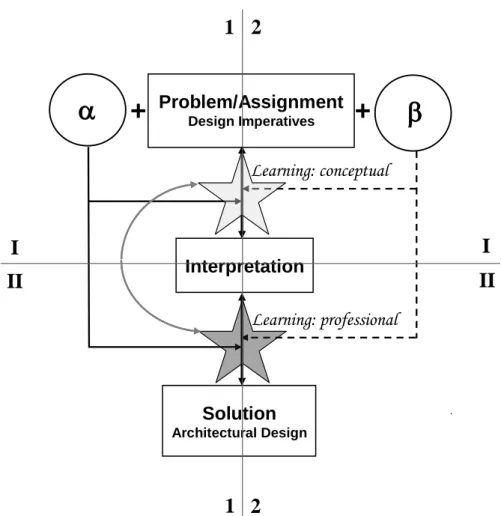
Figure 1 below diagrams our proposal for a model of the design process in the studio. At the outset we now have three instead of two ingredients: The design assignment, the designer's independent input, and the instructional input. From here the designer progresses to formulate an interpretation of the assignment, a concept, a parti. We dub the kind of learning that occurs in this phase conceptual learning: students learn how to develop major ideas and evaluate their relevance and strength, and how to "concoct" an overriding concept that makes sense, responds well to the givens of the assignments, and is an ample expression of their own priorities, as clarified during the instructional process.
Once a concept is developed that gains the approval of the parties concerned (student, instructor, jury members, peers) the student is expected to develop it into a design proposal, or solution to the design problem, at some degree of completion (subject to educational standing and the specific requirements of the assignment). Again, his or her progress is largely a function of available instructional input (and the student's capacity to utilize it) as well as his or her own input, which will determine how far he or she will go. The learning that takes place in this phase of the process is of a different kind: this is the phase in which domain-specific knowledge comes into play, and the student is asked to apply it to the case in point. Therefore we call this kind of learning professional learning. Needless to say, the process is not linear (the linear representation is a simplification), and there are overlaps between the design phases. Likewise, the two kinds of learning are not entirely distinct and each contains elements of the other.
We notice that the diagram in Figure 1 submits to two bisections along approximate symmetry axes, one vertical and one horizontal. The vertical section divides between the process of designing with the two non-problem dependent inputs, and (side 1 on the left with and side 2 on the right with ). The horizontal section distinguishes between the first phase of the process in which one departs from the problem as assigned and reaches a solid interpretation, on which one builds in the second phase of the process where the interpretation is gradually developed into a design solution. The two phases are marked by different kinds of learning: the upper part I where primarily conceptual learning takes place, and the lower part II where learning is mostly professional. Thus we think of it as a 2x2 model.
Figure 1: Model of the design process in the studio
– Independent Input/Design Modifier; – Instructional Input
Design tasks and even more so design exercises differ, of course, and in some cases conceptual learning weighs much heavier than professional learning, or vice versa. Design educators, too, come to the studio with different dispositions and sometimes they are much better at one or the other type of teaching. Last but not least, the student's inclinations may lead him or her to invest more in professional or conceptual aspects of a task: a student is sometimes said to be better at the "idea phase" than the "development phase", or the other way round.
In our view both learning cycles are related to the perception-conception relationship which, in the case of designing, is mediated through representation. In designing representation is primarily visual, and designers who are skillful representers are able to foster and utilize the perception-conception, or conception-perception relationship in designing. In order to exemplify this point we shall describe two design exercises conducted in the studio.
Problem/Assignment
Design Imperatives
Solution
Architectural Design+
+
Interpretation
I
I
II
II
1
1
2
2
Learning: conceptual
Learning: professional
The Primacy of Representation
The first example below describes an exercise we often administer to incoming architecture students of architecture, immediately as they enter their first studio. Naturally the majority of these students have no prior design training and they lack the skills required to make normative representations in either two dimensions (orthogonal projections) or three dimensions (scale models). The purpose of this exercise is to allow them to very fast acquire basic model-building skills. The second example is an exercise given to somewhat more advanced students, who have at least some fluency in the drawing of orthogonal projections. The exercise is meant to encourage them to start thinking about spaces through first drawing sections.
Exercise I: Scale model
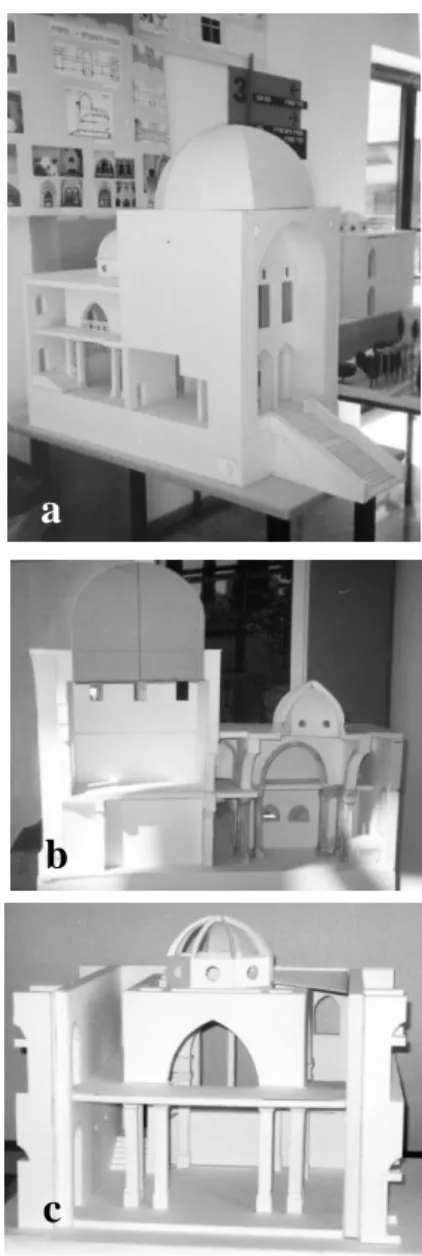
In most schools of architecture students are exposed to designing, and start to design in the studio, from the minute they enter school. The theory behind this practice is that you learn swimming only in the water, and to start with you should get wet. However, one cannot design without producing representations, and the fresh novice lacks any knowledge of design representation. It takes considerable time before the student learns how to draw normative drawings, and even longer before he or she is fluent enough with orthogonal projections to utilize them automatically and freely when sketching. Therefore it is hardly practical for novices to attempt to use drawing as a means of representation in their first design exercises. Scale models are less abstract and easier to learn how to make, and it is sensible to use models as a primary representational mode for novice students. Figure 2 shows three different students’ models of the entry hall to the historic building of the National Science Museum in Haifa, inaugurated in 1923. Freshman students, in teams of three or four, were asked to build models of the hall at the scale of 1:20, as their first studio exercise. This entailed measuring the place, deciding how to fragment it into building components, drawing those components, cutting them and gluing them into shape. Further decisions had to do with the definition of the edges of the space(s) to be represented, the method of representing the dome that the main space is adorned with, the mode of showing the interior and/or the exterior (no explicit directions were given), and the optional use of colors. The team that built model a chose to represent the exterior, including a monumental stair that leads to the entrance. To see the interior the viewer must look through cut-out windows or through the open side at the level of the first floor, to see the two-storey space. A back wing of the building, adjacent to the entry hall, is also represented (in the back of the photo). Models b and c are "sectional models." They do not represent the exterior at all. Model b "covers" a wider space than model c, and it makes (schematic) use of color (stone is represented in brown). Model c ignores the large dome but shows very explicitly a smaller dome nearby, which is also represented in models a and b. The technique used to represent the domes is different in each model.
Figure 2: Three models of the entry hall to the historic building of the Science Museum in Haifa (A. Berwald, architect, 1923), by 1st year students
b
c
Two weeks into the first semester of the first year, the exercise is concluded and some half a dozen models of this sort are presented in the studio and discussed for a few hours. The students, who have never before measured a space, never used a scale ruler, and never cut or glued cardboard, are faced with questions such as: what level of detail is appropriate for a certain scale? Which elements are most important to represent, and why? What is a "natural" edge of the space, and therefore how is the representation to be "cut off" from the rest of the building? In addition to form, how desirable is it to represent other characteristics of the building/space, such as materials? And if the answer is that it is important, should the representation model the appearance of the material (color, texture) or can it be rather abstract and symbolic? Having seen the differences among three models, we can imagine that additional models provide more representational options and comparing them in the studio presentation session allows the discussion of the issues above.
Now what is it that we postulate the students have learned in this exercise? The formal goal was to acquire basic model-making skills. This goal has been achieved (models made for subsequent exercises prove this beyond doubt). Furthermore, it has been achieved easily and quickly: team members who had some experience or those who were naturally dexterous helped those who were slower in picking up the necessary know-how (and as a bonus the students formed social ties – note that this was their very first fortnight at school – and began very quickly to be acclimatized to the "studio culture"). The acquisition of representational skills clearly falls within "professional learning." But is this all the students have learned? If we return to the issues that were discussed when the models were presented, we note that some of them have a heavy conceptual bent. For example, the need to decide where to disjoint the represented piece from the rest of the building brings up issues that can go deeply into matters of style, composition and functional allocation of spaces. Such issues cannot be properly treated without conceptual considerations. Students who encounter such issues learn to observe and analyze spatial qualities where they initially intended to measure only. They may discover how repetitive elements produce rhythm and how proportions of a space affect one's experience of that space. They may even note the different quality of light that enters through openings in walls with different orientations. These are examples only, of course, and the nature of the space and the guidance provided by the instructor can turn such a simple exercise into a comprehensive introduction to the basics of architecture, based on the representational imperative.
Exercise II: Sections first
Most architects draw many more plan than section projections when they design buildings, and with students this is even more true. Plans are easier to conceptualize and they appear more vital because they are the first and primary representation of space and movement allocation and organization. Sections are often drawn only to illustrate heights. This practice is reflected in many CAD programs where building masses are constructed on the basis of plans with "extruded" vertical walls, on top of which a roof is placed. With or without CAD, the result is often a dull design which, even if it boasts efficient floor-plans of a building, lacks in spatial excitement. Clearly, sections through most architectural masterpieces reveal that they are not simply plans with extruded walls. The following exercise was designed to
drive this point home to young students who have already acquired a certain proficiency in the fluent production of orthogonal (or parallel) projections. Students are presented with sections through a relatively small building. The building is carefully selected on the basis of an interesting spatial treatment of its spaces. In this example we use a house by Paul Rudolph which was designed for a plant-lover, thus it includes a large greenhouse. The exercise material includes three sections through the house (Figure 3) and a quantitative program which lists the spaces of the house with their floor area. The students are asked, as a sketch problem, to come up with a plan and schematic axonometric drawing of a house, that are compatible with the given sections.
Second semester students typically react with surprise and amazement to this exercise. Many have difficulties dealing with it, but those with high visual imagery and spatial manipulation capabilities are delighted with it. The perception-conception continuum is challenged by this task and this is pointed out by the instructor at the end of the exercise (which usually lasts only one studio session), when the actual plans of Rudolph's house are shown along with photographs. Most students who have been exposed to this exercise testify that it helped them understand the relationship between spatial quality and its conception through representation. Choosing the right mode of representation is something that
needs to be learned and unless instruction supports this learning it can take a very long time before students master the knowledge that makes it possible to automatically pick the best representational option.
In Goldschmidt (2003) we recount how Seymour Papert (former prominent MIT Media Laboratory professor and developmental psychologist by training) failed to find the right location for an opening in his kitchen wall that would allow him to see the view outside, across a corridor that had a window in it (whereas the kitchen wall was an interior partition). Papert tried to draw a plan in order to determine the best spot to open up the wall, but the result was disappointing. When shown that in order to solve the problem a section is required, this very original and creative thinker was surprised and filled with a sense of discovery. This vignette demonstrates that what is trivial to an expert designer is in fact professional knowledge that a layperson, or novice student, does not possess. However in the exercise described above students learn a lot more than straightforward professional knowledge. By way of conceptual knowledge they learn about exciting spaces and the features that are responsible for that excitement; they learn about far-reaching ideas and the potential they have to create interest and enhance spatial experience. They also learn about the need to experiment during designing and the courage to explore the non-conventional.
Figure 3 Sections through Green House, C.R.T., Pennsylvania (P. Rudolph, architect, 1972). © Karl Krämer Verlag, Stuttgart
Architectural Education: The Profession and the Field
According to Stevens (1998) there is much confusion between the
profession of architecture and the field of architecture. In business the two entail very different patterns of practice in terms of motivation, daily activity and type of compensation. Practitioners, according to this view, belong to dissimilar sub-disciplines. The two facets of architecture are reflected in the studio, where students at various stages of their studies may expect instructors to contribute more to specific areas of expertise or to architectural discourse (Wilkin 2000). The latter is conceived as a privileged area, and architects who are associated with it belong to a narrow elite group. One of the hallmarks of the work produced by this elite squadron is outstanding creativity and their work must be, accordingly, innovative and ground breaking. Instructors are not requested to position themselves on what Stevens (1998) calls the continuum from workaday practice to activity in a sphere of symbolism, nor do most schools set specific educational goals in this respect.
However, the two kinds of learning we have identified appear to reflect the janus-faced nature of architecture quite faithfully: that of the cultural field, and that of the professional practice. Students need to be exposed to both, and in most cases they indeed are, given the fact that throughout their long training they encounter a host of different instructors who, almost by statistical probability, represent different facets of architecture. But we take that too much for granted and rely on chance to take care of a balanced instructional input into the curriculum students follow and the kind of guidance they receive. It would be much wiser if we controlled this input and structured it well. We cannot and should not make instructors teach what they have no disposition for, but we can team-up instructors for any given design assignment, for better fit with every phase of training, and for congruence with the curriculum's general philosophy. A condition for success appears to be the pre-training of design instructors, based on a design pedagogy theory, the absence of which is sorely felt today (Goldschmidt, 2002).
The 2x2 model we propose is meant to make a small step towards the development of a theory of architectural design education as manifest in the studio. It wishes to stress that we must make clear distinctions between at least two types of learning that occur along the curriculum and within each component thereof. We want to structure the knowledge that students "pick up" as they learn skills and absorb conceptual knowledge that is applicable to design but usually not in prescribe-able ways. Today we are much more sensitized to individual differences – among students as well as among teachers, but we must manage these differences such that students will be able to maximize the advantages of the studio system.
The question of representation is, as foreign as this may sound to some, central to the issue of the studio's raison d'être. Learning, like design itself, is mediated through representation. The current (digital) state of the art turns the instructor into a commentator, who sits with students in a dark room and discusses with them presentations that are projected on a screen or on the wall. This may suffice for certain levels of conceptual learning, but not so for professional learning. We must re-invent the representational exchange in the studio if we want to make for better, not merely more fashionable design. We believe that rethinking the different contents of learning and restructuring
the mode of input – personal and instructional – may make for a fair beginning.
Acknowledgements
The research reported in this paper was supported by the fund for the promotion of research at the Technion. The author wishes to thank members of the Design Thinking and Education research group in the Faculty of Architecture and Town Planning at the Technion for stimulating ideas and many fruitful discussions over the years.
References
Cross, N. (1982). Designerly ways of knowing. Design Studies, 3 (4), 221-227.
Cross, N. (2006). Designerly ways of knowing. Springer Verlag, London Cuff, D. (1991). Architecture: The story of practice. The MIT Press,
Cambridge, MA.
Esherick, J. (1977). Architectural education in the thirties and seventies: A personal view. In S. Kostof (ed.), The architect. Chapters in the history of the profession. The University of California Press, Berkeley, 238-279.
Forgács, E. (1995). The Bauhaus and Bauhaus politics. Central European University Press, London.
Goldschmidt G. (1983). Doing design, making architecture, Journal of Architectural Education37 (1), 8-13.
Goldschmidt, G., Sebba, R., Oren, C. & Cohen, A. (2001). Who should be a designer? Controlling admission to schools of architecture. In P. Lloyd & H. Christiaans (eds.), Designing in context: Procs. Design Thinking Research Symposium 5, Delft University Press, Delft, 277-296.
Goldschmidt, G. (2002). One-on-one: A pedagogic base for design instruction in the studio. In D. Durling & J. Shackleton (eds.), Procs. Common Ground, Design Research Society International Conference, Staffordshire University Press, Brunel University, Stoke-on-Trent, 430-437.
Goldschmidt, G. (2003). The backtalk of self-generated sketches, Design Issues, 19 (1), 72-88.
Lawson, B. (2004). What designers know. Architectural Press, Oxford. Quayle, M. (1985). Ideabook for teaching design. PDA Publisher
Corporation, Mesa, Arizona.
Salama, A. (1995). New trends in architectural education: Designing the design studio. Tailored Text & Unlimited Potential Publishing, Raleigh, NC.
Stevens, G. (1998) The Favored Circle: The Social Foundations of Architectural Distinction. MIT Press, Cambridge, MA.
Uluoğlu, B. (2000). Design knowledge communicated in studio critiques. Design Studies 21 (1), 33-58.
Weiner, F. (2005). Five critical horizons for architectural educators in an age of distraction. In EAAE News Sheet 72,17-33 (1st prize, Writings in Architecture 2003/2005).
Wilkin, M. (2000). Reviewing the review. In D. Nicol & S. Pilling (eds.), Changing architectural education. Spon Press, London, 100-107. Wingler, H.M. (1969). The Bauhaus. MIT Press, Cambridge, MA.